
CoTeaching in an Inclusive Setting By Shanna Boucher
Co-Teaching in an Inclusive Setting By: Shanna Boucher & Brian Calnan
WE BELIEVE ……. • Each individual can learn • Each individual is valued • Each individual is accepted for his/her unique abilities • Inclusive schools promote respect for diversity

Co-teaching • According to Dr. Marilyn Friend, co-teaching is a service delivery option of two or more educators that contract to share instructional responsibility for a single group of students. The co-teachers share mutual ownership, pooled resources and joint accountability for the group of students.
ü Co-teaching starts with co-planning ü Co-teaching means that ALL the students are the equal responsibility of both teachers ü Co-teaching means both teachers deliver instruction, perhaps in different ways ü Co-teaching means co-assessing and shared grading What Makes It Coteaching?
THE HONESTY SLIDE Is it completely effective at first? Does it work if one or the other isn’t invested? Is it easy to work together immediately? Is it meant to punish general education teachers? Is it a burden? NO!
6 Co-teaching Models v. One teach/one observe v. One teach/one drift, assist v. Parallel teaching v. Station teaching v. Alternative teaching v. Team teaching
One teach/one observe Recommended use: occasional • One teacher delivers instruction • One teacher observes and collects data to • The purpose of this model is to collect data that will drive instruction and/or address behavioral issues
One teach/one drift Recommended use: Seldom • One teacher delivers content • One teacher provides classroom support • The purpose of this model is while one teacher is delivering content, the other teacher can provide support to students who are having a difficult time taking notes, grasping concepts, controlling their behavior or remaining focused.
Parallel Teaching Recommended use: frequent • Teachers divide students into two heterogeneous groups, and each teaches the same material to their group. The purpose of this model is: • to provide students with a smaller studentteacher ratio • increased opportunity for practice, participation and monitoring of student progress
Station Teaching Recommended use: Frequent • Grouping is done by several different criteria: ability level, content, interest…. The purpose of this model is: • to provide students with various methods and perspectives around a common theme • To incorporate multiple intelligence teaching • Provide small group instruction opportunities • Provide kinesthetic breaks for students
Alternative Teaching Recommended use: occasional • One teacher manages the large group while the other breaks off a small group to teach a particular skill or enrichment activity • The purpose is to provide a small group of students with specialized attention (ex: remediation, pre-teaching, enrichment, oral testing). • This type of teaching works well for both remediation of struggling learners/special education students/ELLs and for enrichment of advanced learners.
Team Teaching Recommended use: Occasional • requires both teachers to actively teach students at the same time. • often one lecturing or leading a discussion, while the other models the skills that the students should be using during this time to stay organized. • key element of teaming is that both teachers are fully participating in delivering the main content of the lesson. • The purpose of this model is: • To model teaming to students • Make immediate curriculum adjustments • Use a variety of presentation styles
Why co-teaching works Develop relationships Structure Shared planning and evaluation Learn from each other Less boring Shared accountability 2 heads are better than one It’s fun Climate is improved Students become accepting Fresh ideas Less chance a kid falls through the cracks More modeling Peer tutoring Distribution of work load Presentation variety More creativity
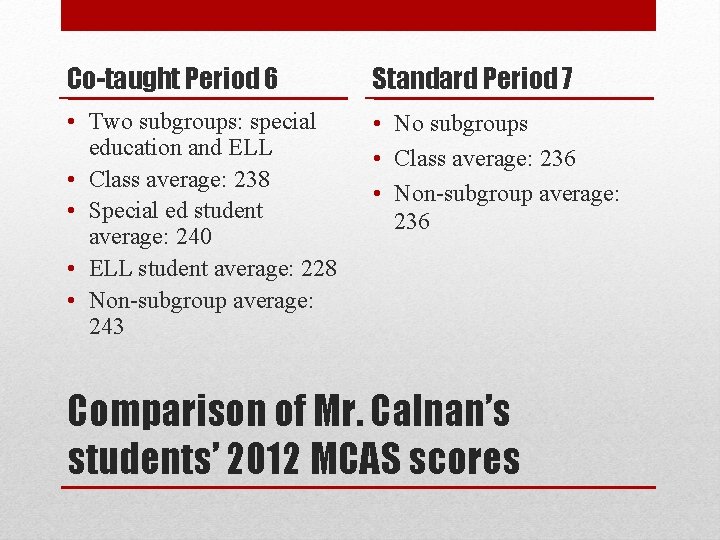
Co-taught Period 6 Standard Period 7 • Two subgroups: special education and ELL • Class average: 238 • Special ed student average: 240 • ELL student average: 228 • Non-subgroup average: 243 • No subgroups • Class average: 236 • Non-subgroup average: 236 Comparison of Mr. Calnan’s students’ 2012 MCAS scores
References Friend, M. (2008) Co-Teach! A handbook for creating and sustaining effective classroom partnerships in inclusive schools. Greensboro, NC: Marylin Friend, Inc. Heineman Kunkel, S. (2004) Practical Inclusion Strategies Grades 6 -12, Bureau of Education and Research

- Slides: 17