
CostVolumeProfit Relationships Chapter 05 Power Point Authors Susan

- Slides: 15
Cost-Volume-Profit Relationships Chapter 05 Power. Point Authors: Susan Coomer Galbreath, Ph. D. , CPA Charles W. Caldwell, D. B. A. , CMA Jon A. Booker, Ph. D. , CPA, CIA Cynthia J. Rooney, Ph. D. , CPA Mc. Graw-Hill/Irwin Copyright © 2012 by The Mc. Graw-Hill Companies, Inc. All rights reserved.
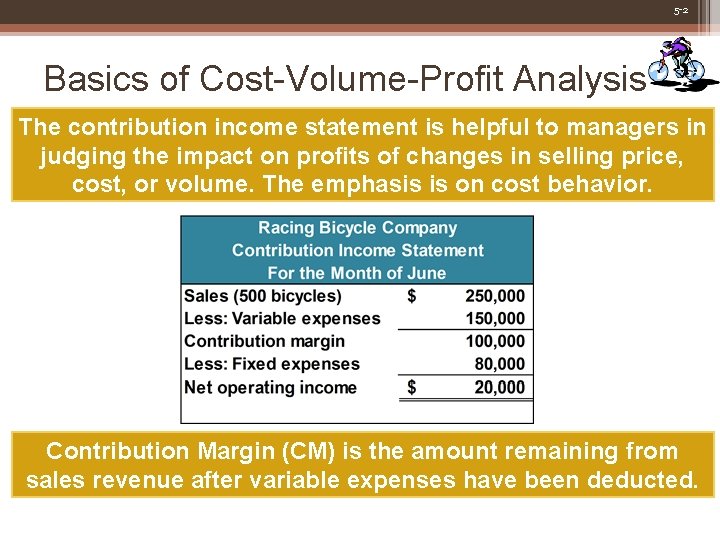
5 -2 Basics of Cost-Volume-Profit Analysis The contribution income statement is helpful to managers in judging the impact on profits of changes in selling price, cost, or volume. The emphasis is on cost behavior. Contribution Margin (CM) is the amount remaining from sales revenue after variable expenses have been deducted.
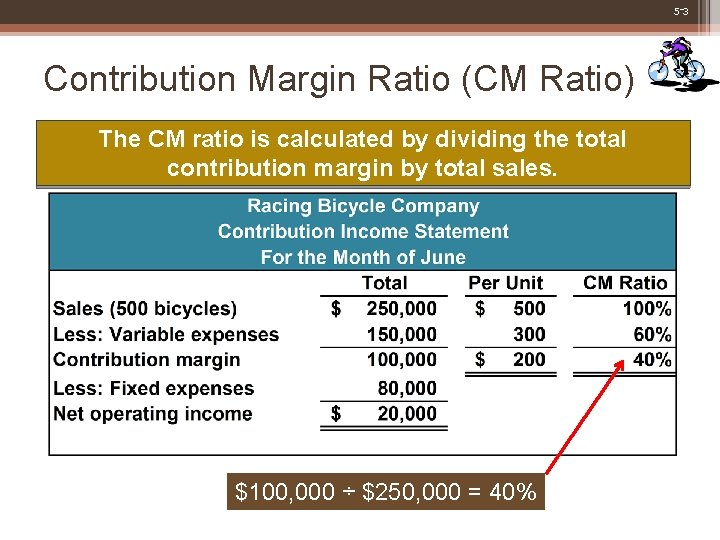
5 -3 Contribution Margin Ratio (CM Ratio) The CM ratio is calculated by dividing the total contribution margin by total sales. $100, 000 ÷ $250, 000 = 40%
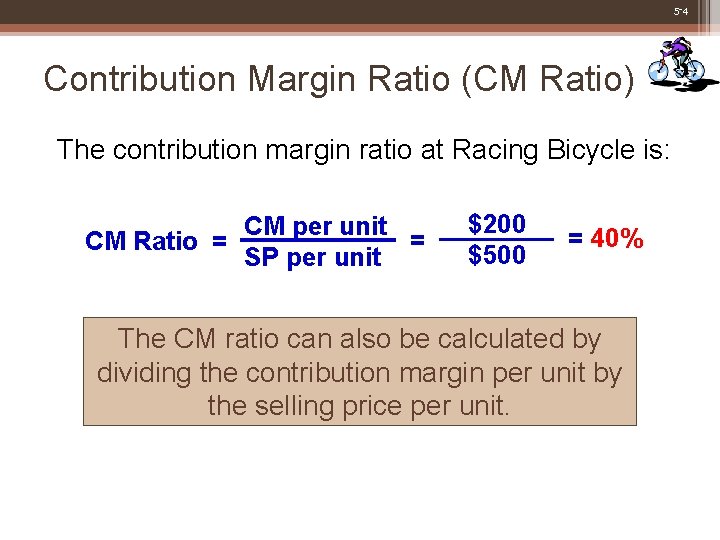
5 -4 Contribution Margin Ratio (CM Ratio) The contribution margin ratio at Racing Bicycle is: CM per unit = CM Ratio = SP per unit $200 $500 = 40% The CM ratio can also be calculated by dividing the contribution margin per unit by the selling price per unit.
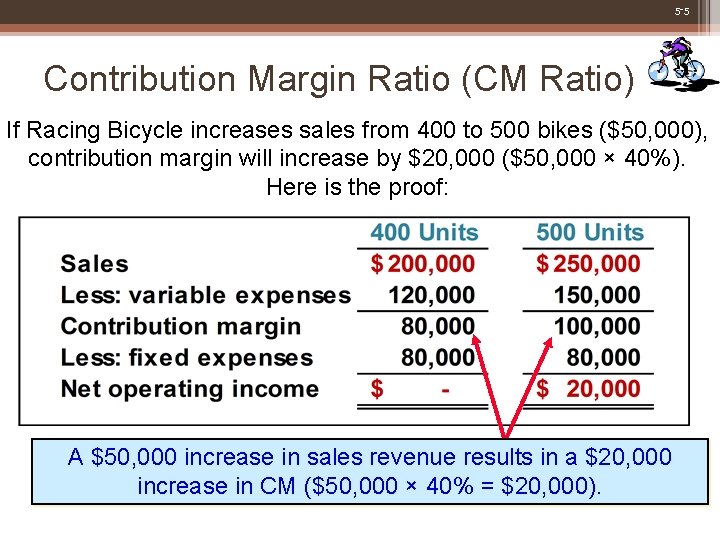
5 -5 Contribution Margin Ratio (CM Ratio) If Racing Bicycle increases sales from 400 to 500 bikes ($50, 000), contribution margin will increase by $20, 000 ($50, 000 × 40%). Here is the proof: A $50, 000 increase in sales revenue results in a $20, 000 increase in CM ($50, 000 × 40% = $20, 000).
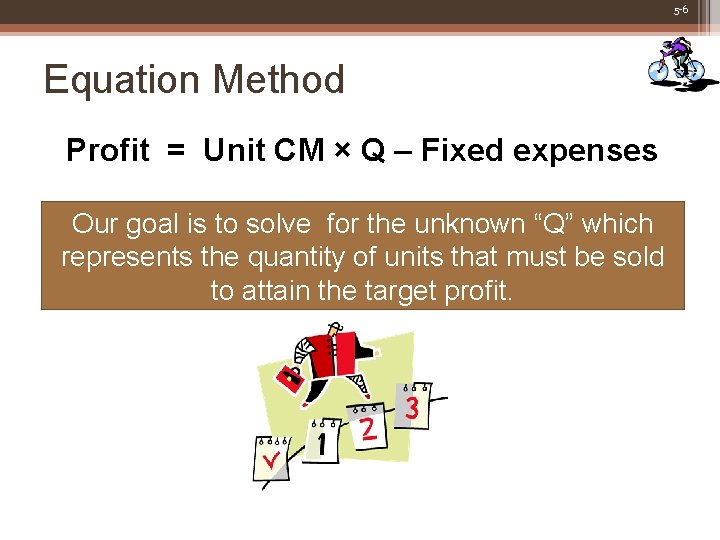
5 -6 Equation Method Profit = Unit CM × Q – Fixed expenses Our goal is to solve for the unknown “Q” which represents the quantity of units that must be sold to attain the target profit.
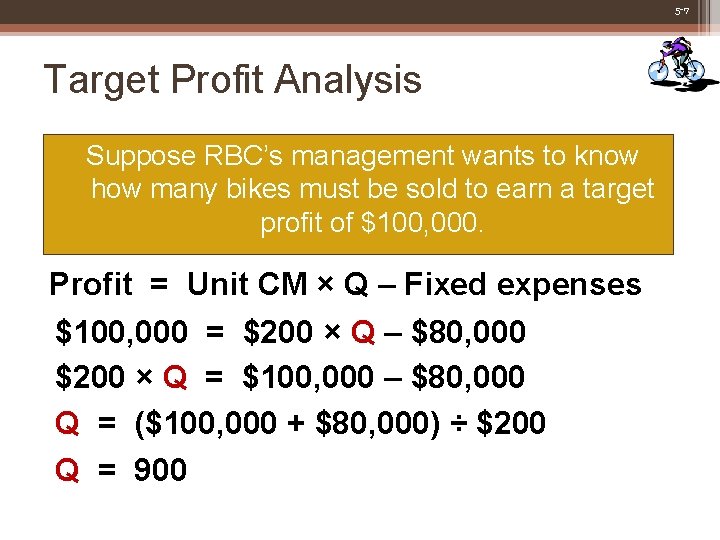
5 -7 Target Profit Analysis Suppose RBC’s management wants to know how many bikes must be sold to earn a target profit of $100, 000. Profit = Unit CM × Q – Fixed expenses $100, 000 = $200 × Q – $80, 000 $200 × Q = $100, 000 – $80, 000 Q = ($100, 000 + $80, 000) ÷ $200 Q = 900
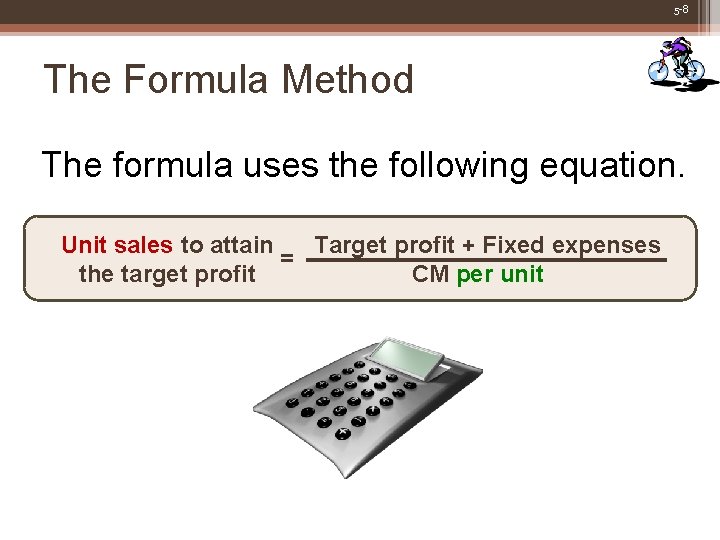
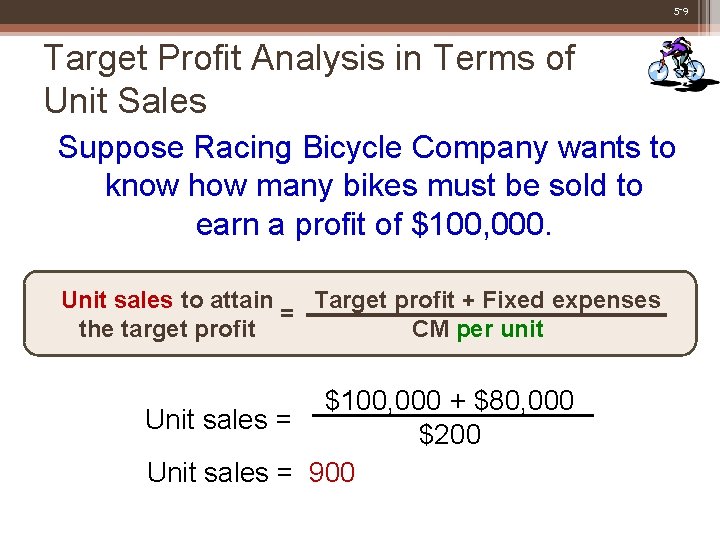
5 -8 The Formula Method The formula uses the following equation. Unit sales to attain Target profit + Fixed expenses = the target profit CM per unit
5 -9 Target Profit Analysis in Terms of Unit Sales Suppose Racing Bicycle Company wants to know how many bikes must be sold to earn a profit of $100, 000. Unit sales to attain Target profit + Fixed expenses = the target profit CM per unit $100, 000 + $80, 000 Unit sales = $200 Unit sales = 900
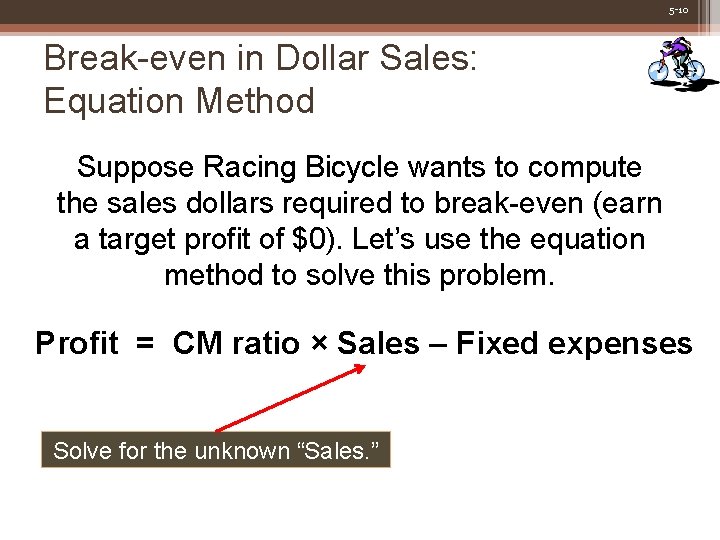
5 -10 Break-even in Dollar Sales: Equation Method Suppose Racing Bicycle wants to compute the sales dollars required to break-even (earn a target profit of $0). Let’s use the equation method to solve this problem. Profit = CM ratio × Sales – Fixed expenses Solve for the unknown “Sales. ”
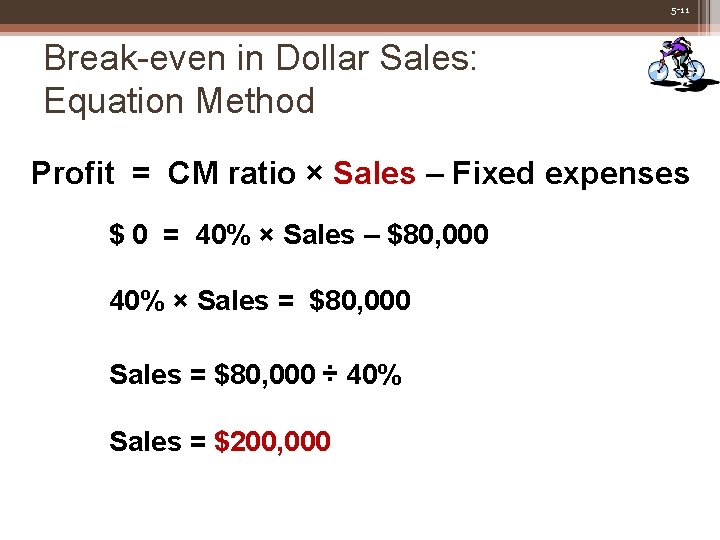
5 -11 Break-even in Dollar Sales: Equation Method Profit = CM ratio × Sales – Fixed expenses $ 0 = 40% × Sales – $80, 000 40% × Sales = $80, 000 ÷ 40% Sales = $200, 000
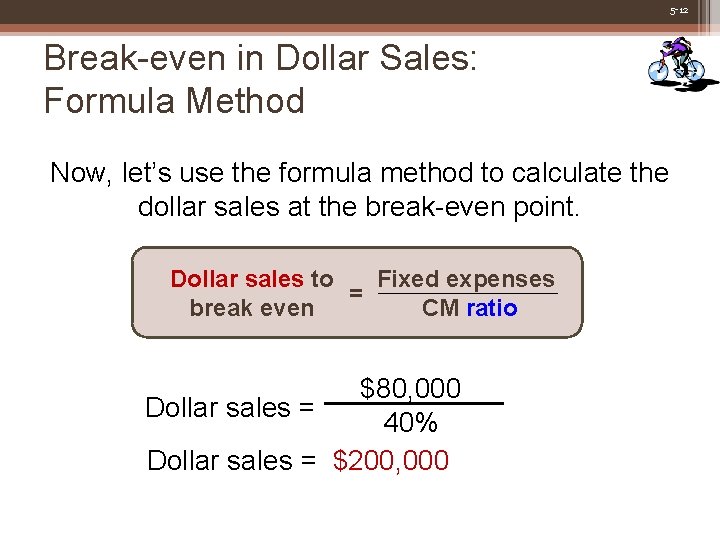
5 -12 Break-even in Dollar Sales: Formula Method Now, let’s use the formula method to calculate the dollar sales at the break-even point. Dollar sales to Fixed expenses = break even CM ratio $80, 000 Dollar sales = 40% Dollar sales = $200, 000
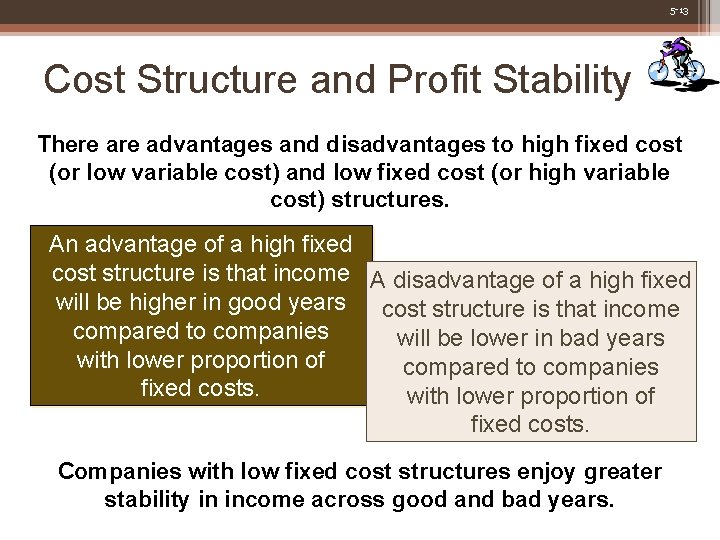
5 -13 Cost Structure and Profit Stability There advantages and disadvantages to high fixed cost (or low variable cost) and low fixed cost (or high variable cost) structures. An advantage of a high fixed cost structure is that income A disadvantage of a high fixed will be higher in good years cost structure is that income compared to companies will be lower in bad years with lower proportion of compared to companies fixed costs. with lower proportion of fixed costs. Companies with low fixed cost structures enjoy greater stability in income across good and bad years.
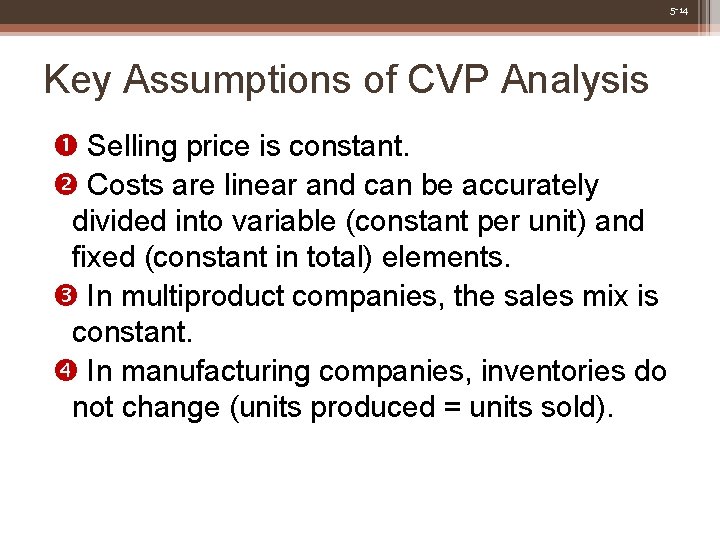
5 -14 Key Assumptions of CVP Analysis Selling price is constant. Costs are linear and can be accurately divided into variable (constant per unit) and fixed (constant in total) elements. In multiproduct companies, the sales mix is constant. In manufacturing companies, inventories do not change (units produced = units sold).
5 -15 End of Chapter 05