
Costs The meaning of the word cost A

- Slides: 36
Costs
The meaning of the word “cost” • A cost is simply an item of expenditure • Costs are defined as the normal business • • • expenses incurred in bring the goods (or services) to their present location and condition. The word “cost” is both a noun and a verb. As a noun: an amount of expenditure incurred on or attributed to a specified thing or activity. As a verb: to cost something is to ascertain the cost of a specified thing or activity.
Some terms • A cost object is anything you wish to cost. • It is any business object to which costs can be attached; e. g. – – a department a project an individual product a specified activity • A cost centre is defined as a “production or service • • • location, function, activity or item of equipment whose costs may be attributed to cost units”. (CIMA) A cost unit is a unit of the product or service in relation to which costs are ascertained Cost accumulation- the collection of cost data Attribution- the process of attaching costs to a cost object
Cost accounting • Cost accounting is the classification, recording • • and appropriate allocation of expenditure in order to determine the total cost of products or services Cost accounting is an essential element in the decision making process of a business It is the branch of management accounting which records all costs- past, present and future
Opportunity costs • Although by cost we mean usually mean the • monetary cost of buying/making goods and services, the term cost also relates to resources sacrificed or foregone This is known as opportunity costs which is: – the value of the benefit sacrificed when one course of action is chosen in preference to an alternative – the foregone potential benefit from the best rejected course of action • Example: a newsagent uses shelf space to stock a range of DVDs thus displacing other goods from the shelves. The opportunity cost is the lost sales of alternatives to the DVDs
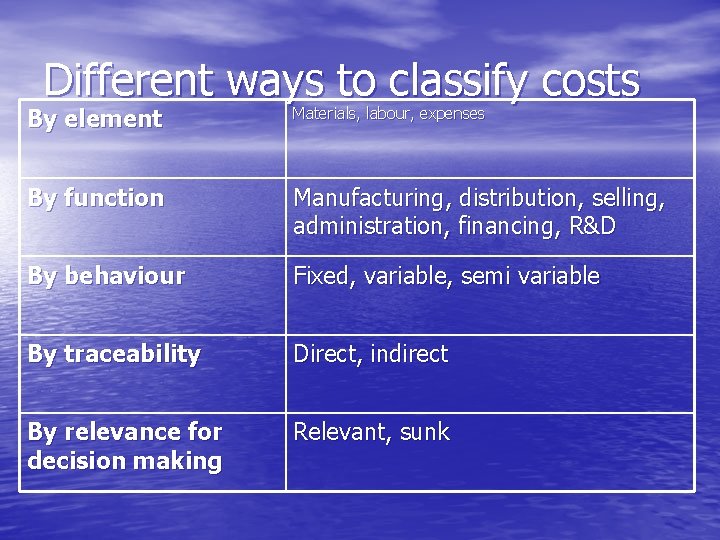
Different ways to classify costs By element Materials, labour, expenses By function Manufacturing, distribution, selling, administration, financing, R&D By behaviour Fixed, variable, semi variable By traceability Direct, indirect By relevance for decision making Relevant, sunk
Classifying in terms of the behaviour of costs Fixed costs Variable costs Semi variable costs
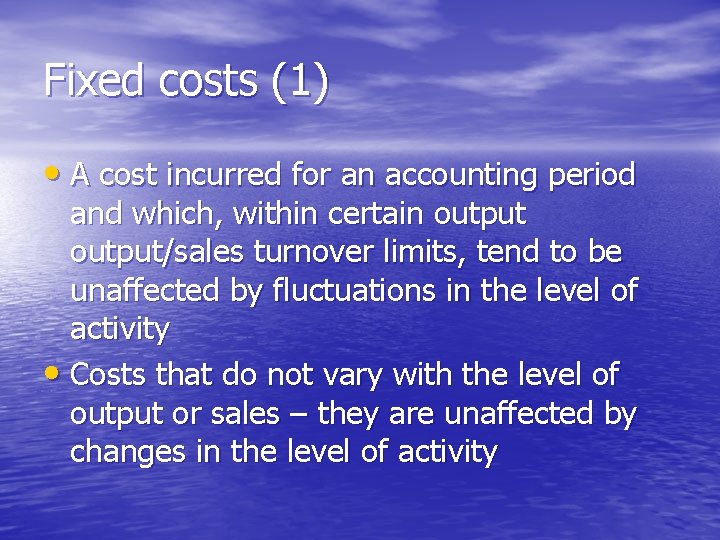
Fixed costs (1) • A cost incurred for an accounting period and which, within certain output/sales turnover limits, tend to be unaffected by fluctuations in the level of activity • Costs that do not vary with the level of output or sales – they are unaffected by changes in the level of activity
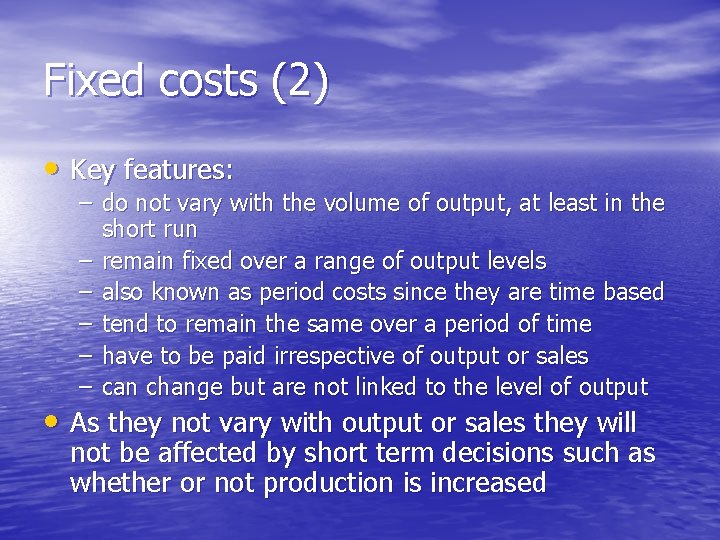
Fixed costs (2) • Key features: – do not vary with the volume of output, at least in the short run – remain fixed over a range of output levels – also known as period costs since they are time based – tend to remain the same over a period of time – have to be paid irrespective of output or sales – can change but are not linked to the level of output • As they not vary with output or sales they will not be affected by short term decisions such as whether or not production is increased
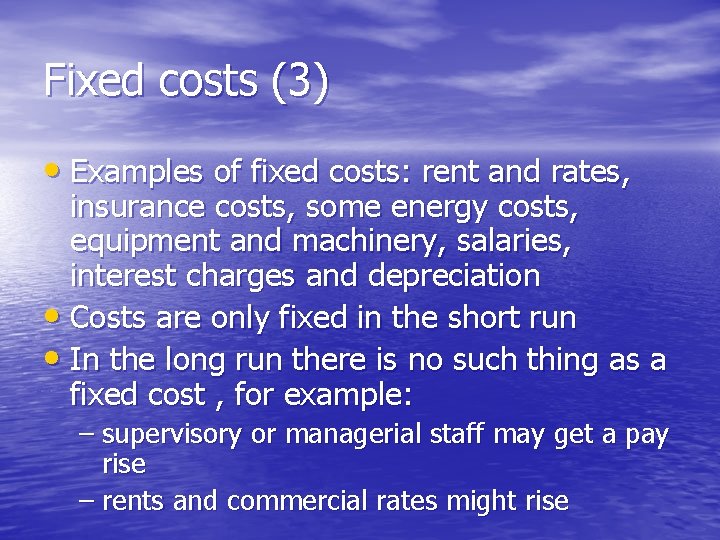
Fixed costs (3) • Examples of fixed costs: rent and rates, insurance costs, some energy costs, equipment and machinery, salaries, interest charges and depreciation • Costs are only fixed in the short run • In the long run there is no such thing as a fixed cost , for example: – supervisory or managerial staff may get a pay rise – rents and commercial rates might rise
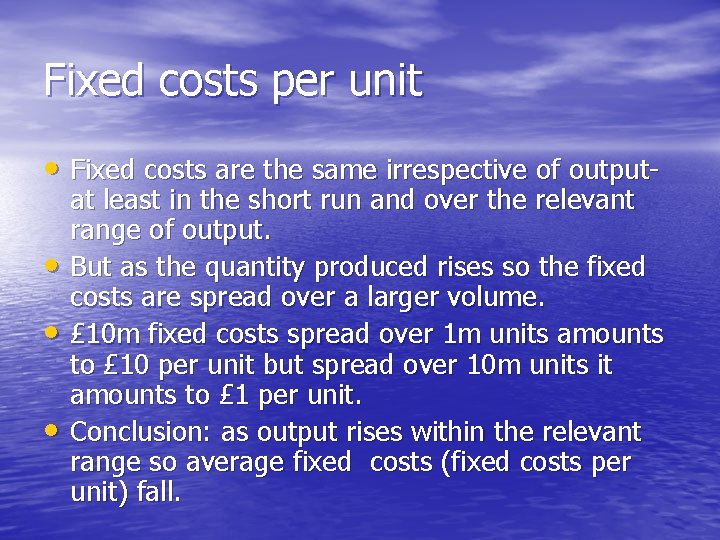
Fixed costs per unit • Fixed costs are the same irrespective of output • • • at least in the short run and over the relevant range of output. But as the quantity produced rises so the fixed costs are spread over a larger volume. £ 10 m fixed costs spread over 1 m units amounts to £ 10 per unit but spread over 10 m units it amounts to £ 1 per unit. Conclusion: as output rises within the relevant range so average fixed costs (fixed costs per unit) fall.
Variable costs • Variable costs are defined as costs that vary in • • • proportion to the level of business activity (i. e. production and sales) Therefore as output rises, so do variable costs and as output falls, so do variable costs Short term decisions making is primarily concerned with variable costs Examples : the cost of raw materials, direct labour costs, piece rate labour charges, direct energy costs
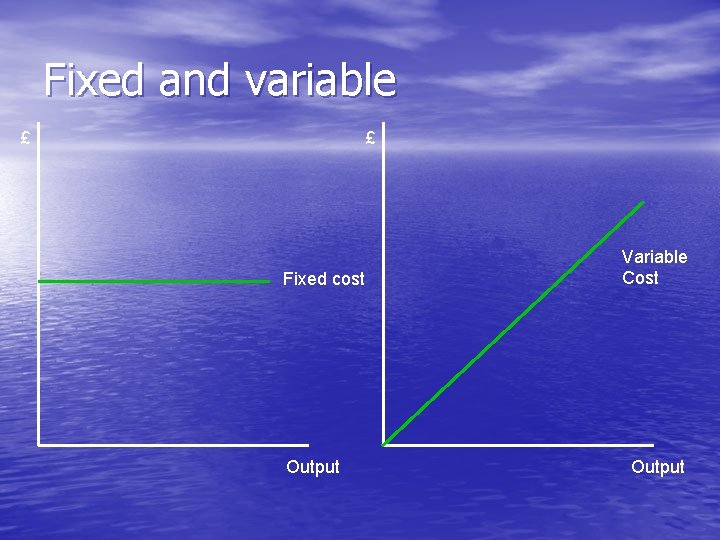
Fixed and variable £ £ Fixed cost Output Variable Cost Output
Is the distinction clear cut? • The distinction between fixed and variable costs is not • • • entirely clear cut Depending on the circumstances, a cost might be regarded as fixed or as variable Labour is usually regarded as a variable cost in that increased output is achieved by using existing workers on overtime and/or recruiting more workers. But supervisory or managerial labour as really a fixed costs. Moreover although labour is a flexible cost in an upward direction it tends to be “sticky” downwards Electricity used to power machinery in a factory is a variable costs - but electricity for lighting and heating in a shop is really a fixed cost
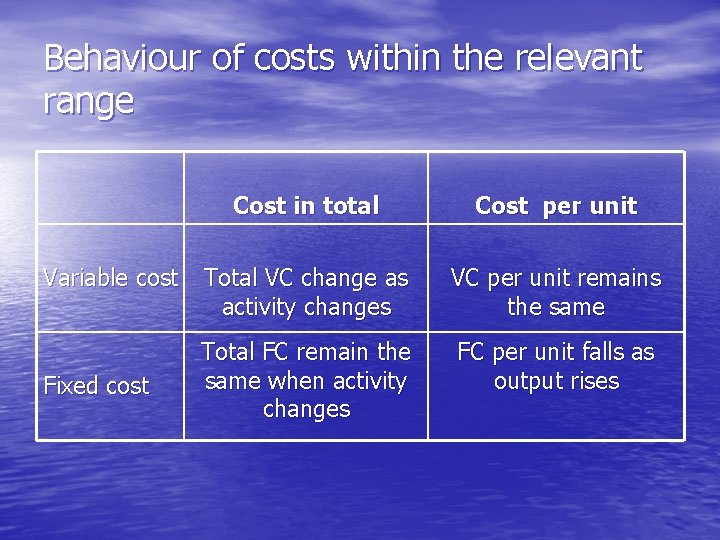
Behaviour of costs within the relevant range Variable cost Fixed cost Cost in total Cost per unit Total VC change as activity changes VC per unit remains the same Total FC remain the same when activity changes FC per unit falls as output rises
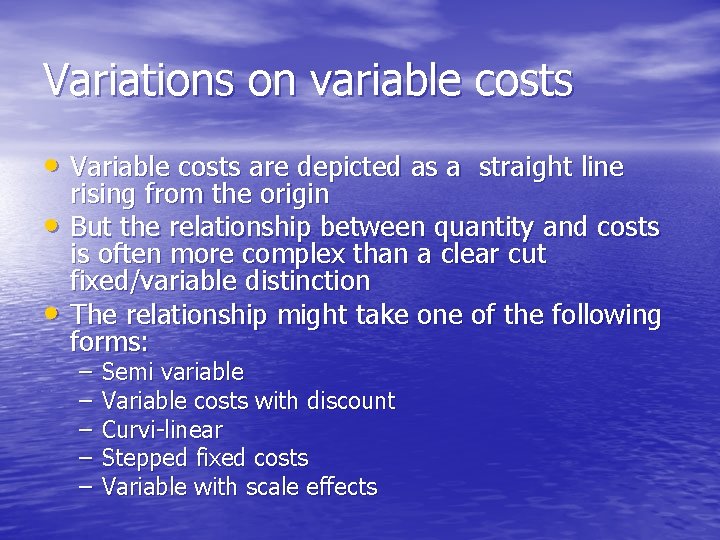
Variations on variable costs • Variable costs are depicted as a straight line • • rising from the origin But the relationship between quantity and costs is often more complex than a clear cut fixed/variable distinction The relationship might take one of the following forms: – – – Semi variable Variable costs with discount Curvi-linear Stepped fixed costs Variable with scale effects
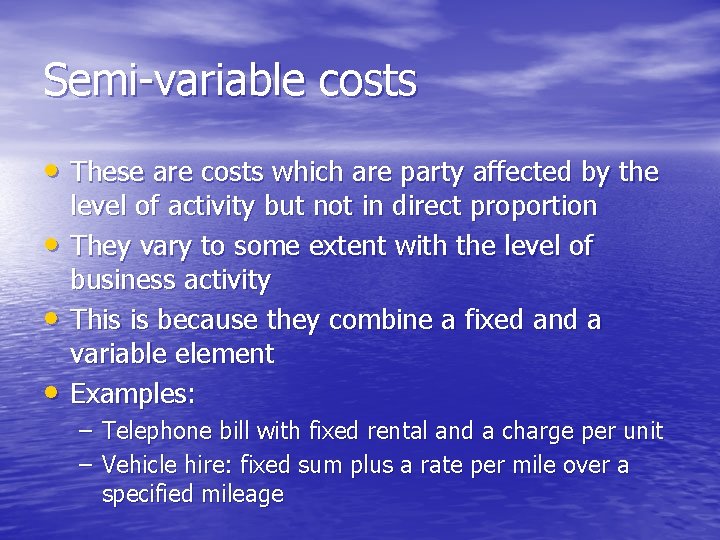
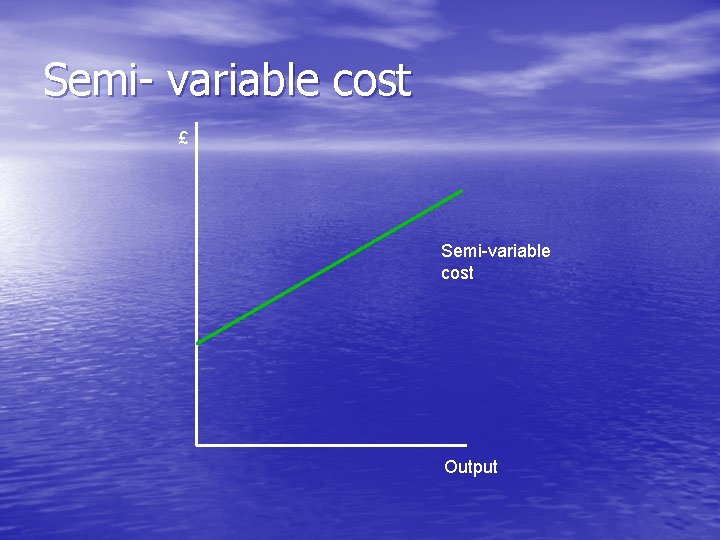
Semi-variable costs • These are costs which are party affected by the • • • level of activity but not in direct proportion They vary to some extent with the level of business activity This is because they combine a fixed and a variable element Examples: – Telephone bill with fixed rental and a charge per unit – Vehicle hire: fixed sum plus a rate per mile over a specified mileage
Semi- variable cost £ Semi-variable cost Output
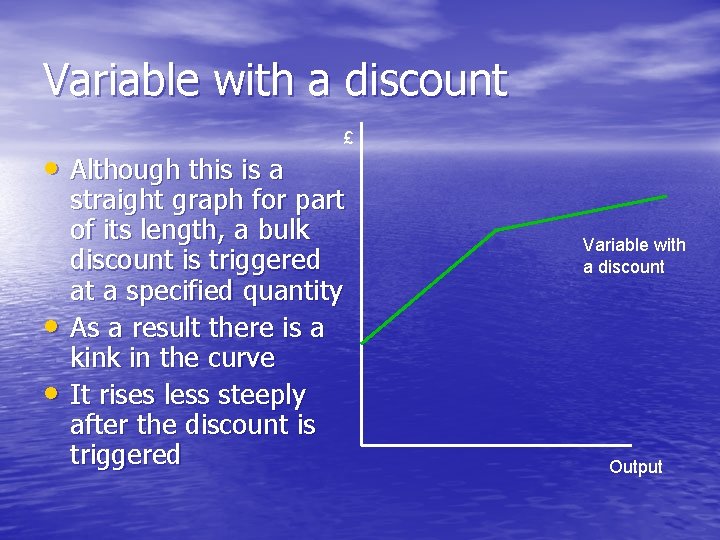
Variable with a discount • Although this is a • • £ straight graph for part of its length, a bulk discount is triggered at a specified quantity As a result there is a kink in the curve It rises less steeply after the discount is triggered Variable with a discount Output
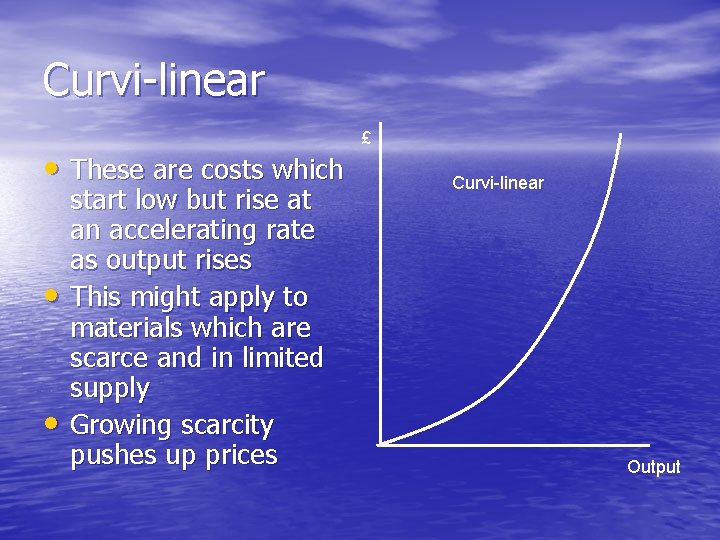
Curvi-linear • These are costs which • • start low but rise at an accelerating rate as output rises This might apply to materials which are scarce and in limited supply Growing scarcity pushes up prices £ Curvi-linear Output
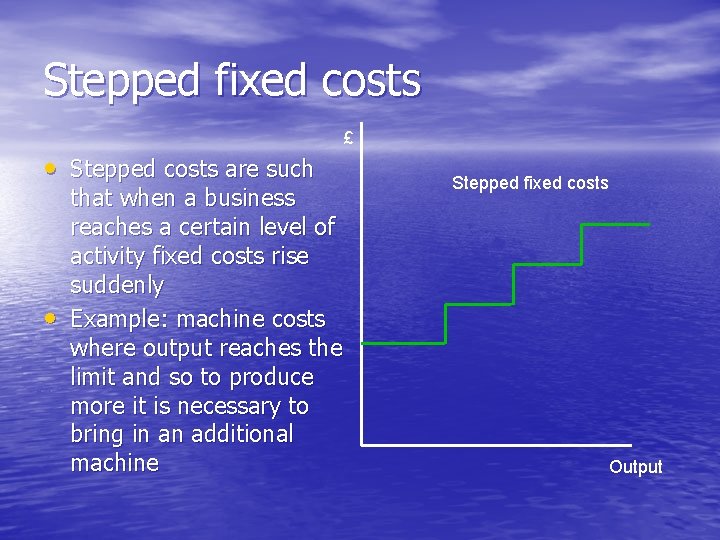
Stepped fixed costs £ • Stepped costs are such • that when a business reaches a certain level of activity fixed costs rise suddenly Example: machine costs where output reaches the limit and so to produce more it is necessary to bring in an additional machine Stepped fixed costs Output
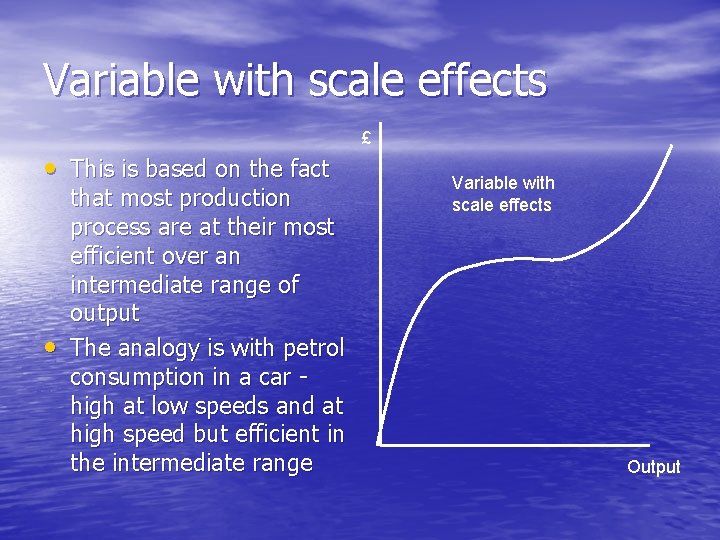
Variable with scale effects £ • This is based on the fact • that most production process are at their most efficient over an intermediate range of output The analogy is with petrol consumption in a car high at low speeds and at high speed but efficient in the intermediate range Variable with scale effects Output
Direct and indirect costs
Direct and indirect • Direct costs - costs which are wholly and exclusively identifiable with whatever is being costed. They are directly associated with output • Indirect costs - costs of production not easily associated with the production of specific goods and services. These overhead costs may be allocated on some arbitrary basis to specific products or departments
Direct costs (1) • Costs that can be easily and conveniently traced in full to • • • the product, service or department that is being costed Costs which can be identified with a particular cost centre (e. g. a product) and which vary directly with activity or output Costs that can be directly identified and attributed to a product or service Two tests for a direct costs: – Would cost be incurred if the cost object did not exist? – Is the cost measurable? • If no to first and yes to the second then the cost is direct
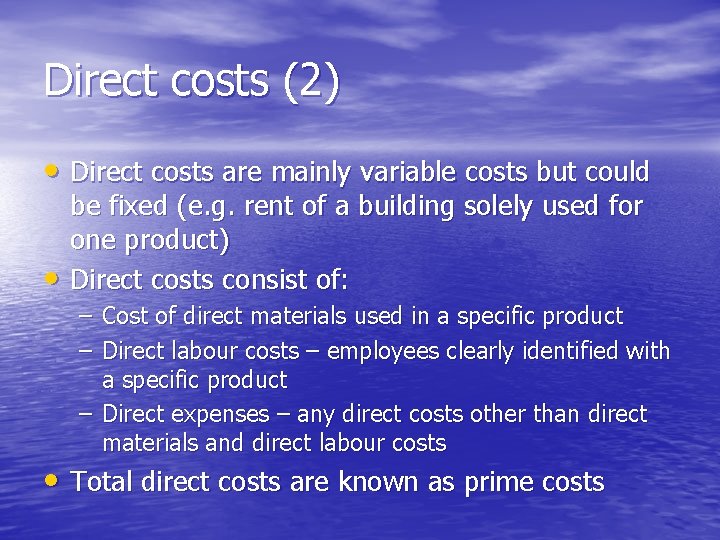
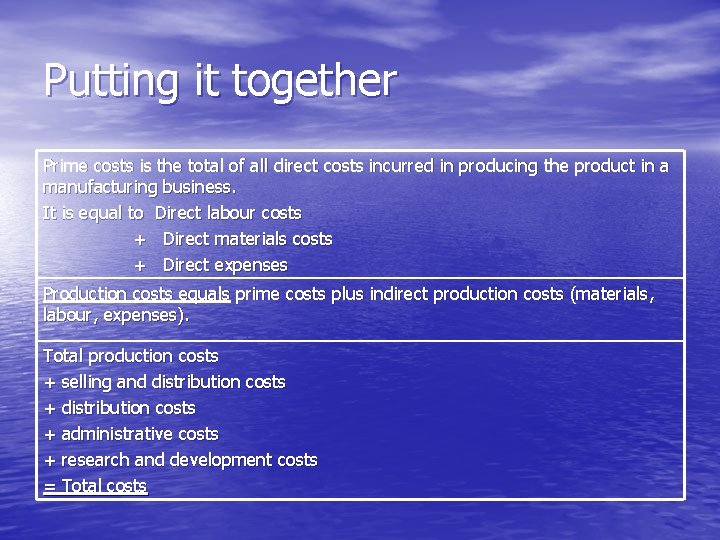
Direct costs (2) • Direct costs are mainly variable costs but could • be fixed (e. g. rent of a building solely used for one product) Direct costs consist of: – Cost of direct materials used in a specific product – Direct labour costs – employees clearly identified with a specific product – Direct expenses – any direct costs other than direct materials and direct labour costs • Total direct costs are known as prime costs
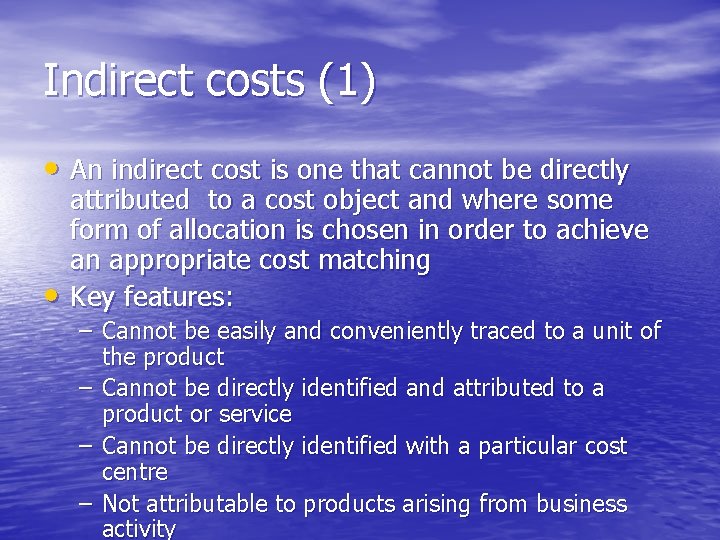
Indirect costs (1) • An indirect cost is one that cannot be directly • attributed to a cost object and where some form of allocation is chosen in order to achieve an appropriate cost matching Key features: – Cannot be easily and conveniently traced to a unit of the product – Cannot be directly identified and attributed to a product or service – Cannot be directly identified with a particular cost centre – Not attributable to products arising from business activity
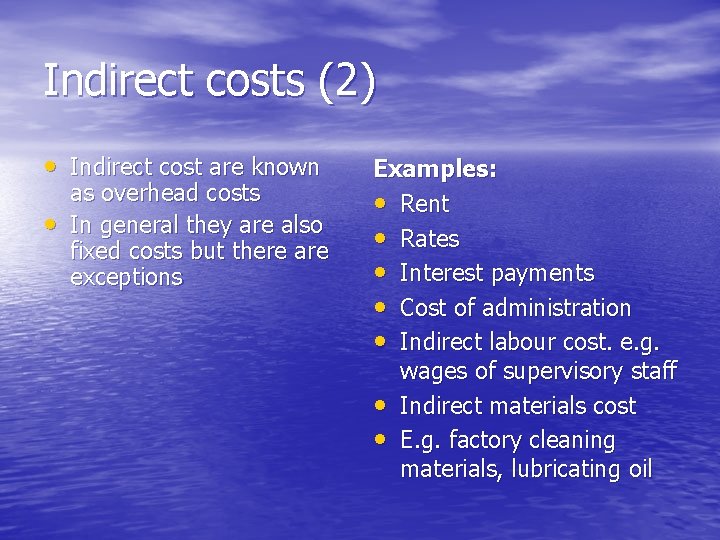
Indirect costs (2) • Indirect cost are known • as overhead costs In general they are also fixed costs but there are exceptions Examples: • Rent • Rates • Interest payments • Cost of administration • Indirect labour cost. e. g. wages of supervisory staff • Indirect materials cost • E. g. factory cleaning materials, lubricating oil
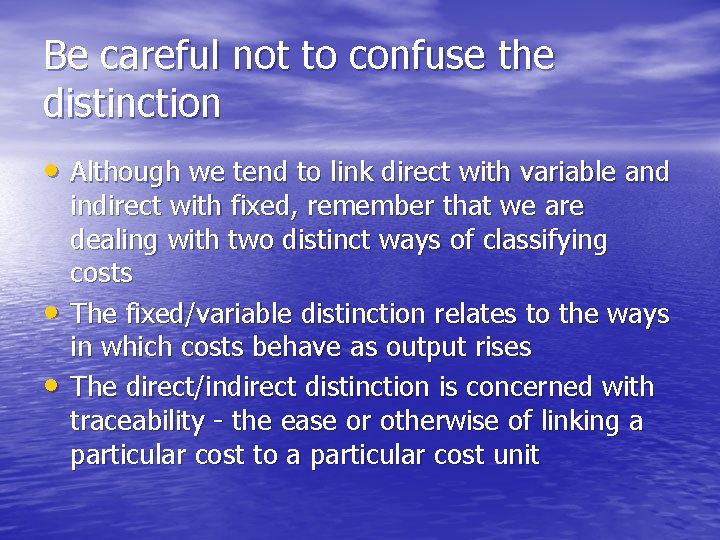
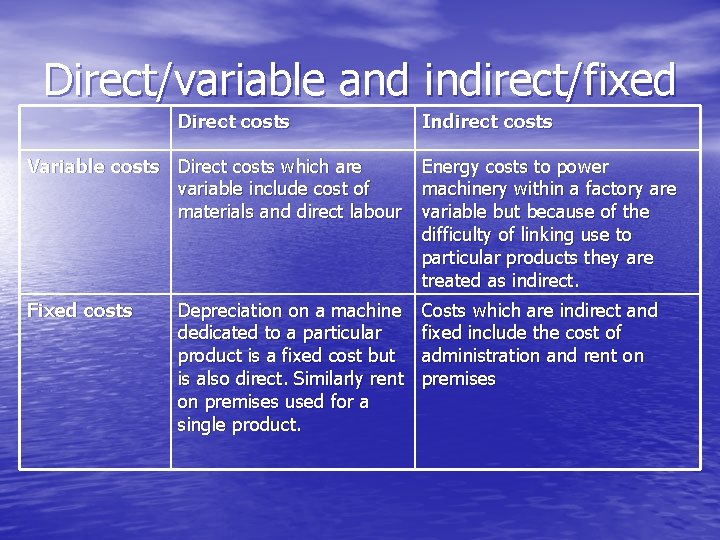
Be careful not to confuse the distinction • Although we tend to link direct with variable and • • indirect with fixed, remember that we are dealing with two distinct ways of classifying costs The fixed/variable distinction relates to the ways in which costs behave as output rises The direct/indirect distinction is concerned with traceability - the ease or otherwise of linking a particular cost to a particular cost unit
Direct/variable and indirect/fixed Direct costs Indirect costs Variable costs Direct costs which are Energy costs to power variable include cost of machinery within a factory are materials and direct labour variable but because of the difficulty of linking use to particular products they are treated as indirect. Fixed costs Depreciation on a machine dedicated to a particular product is a fixed cost but is also direct. Similarly rent on premises used for a single product. Costs which are indirect and fixed include the cost of administration and rent on premises
Putting it together Prime costs is the total of all direct costs incurred in producing the product in a manufacturing business. It is equal to Direct labour costs + Direct materials costs + Direct expenses Production costs equals prime costs plus indirect production costs (materials, labour, expenses). Total production costs + selling and distribution costs + administrative costs + research and development costs = Total costs
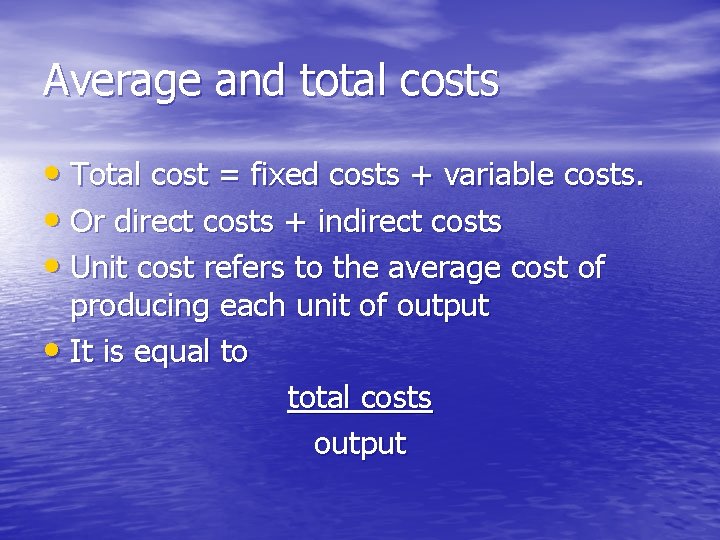
Average and total costs • Total cost = fixed costs + variable costs. • Or direct costs + indirect costs • Unit cost refers to the average cost of producing each unit of output • It is equal to total costs output
Classifying by relevance Relevant costs Sunk costs
Relevant costs • We should distinguish between relevant costs and sunk costs • When making choices between two or more alternative policies – Only future differential costs need be considered – Sunk costs should be ignored
Relevant costs • A relevant cost is one that is appropriate to a specific managerial decisions • Future differential costs are costs which – Belong to a project – Would be avoided if the project were not undertaken • They should be the only costs taken into consideration when deciding on action
Sunk costs • Sunk cost: a past cost with no ongoing implications for the future • Key features: – They have already been incurred – They cannot be recovered – A non-relevant cost – Irrelevant to a decision making – Should be excluded from decision making