
Costs of Sovereign Default Restructuring Strategies Bank Distress
Costs of Sovereign Default: Restructuring Strategies, Bank Distress and the Capital Flow-Credit Channel Tamon Asonumaa IMF Marcos Chamonb Aitor Ercec IMF ESM Akira Sasaharad University of Idaho September 26, 2019 7 th Annual Conference of the Bilateral Assistance and Capacity Building for Central Banks (BCC) programme The views expressed herein are those of the authors and should not be attributed to the European Stability Mechanism or the International Monetary Fund, their Executive Boards, or their Management. IMF, TAsonuma@imf. org c ESM, a. erce@esm. europa. eu a b d IMF, MChamon@imf. org UC Davis, sasahara@uidaho. edu 1
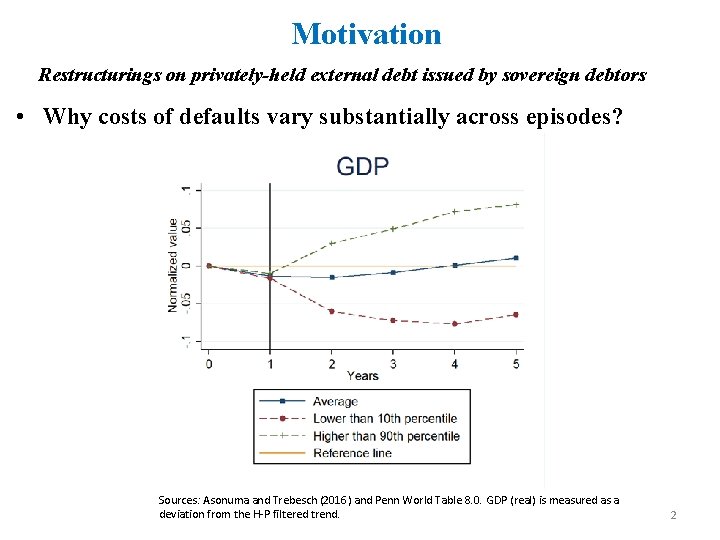
Motivation Restructurings on privately-held external debt issued by sovereign debtors • Why costs of defaults vary substantially across episodes? Sources: Asonuma and Trebesch (2016) and Penn World Table 8. 0. GDP (real) is measured as a deviation from the H-P filtered trend. 2
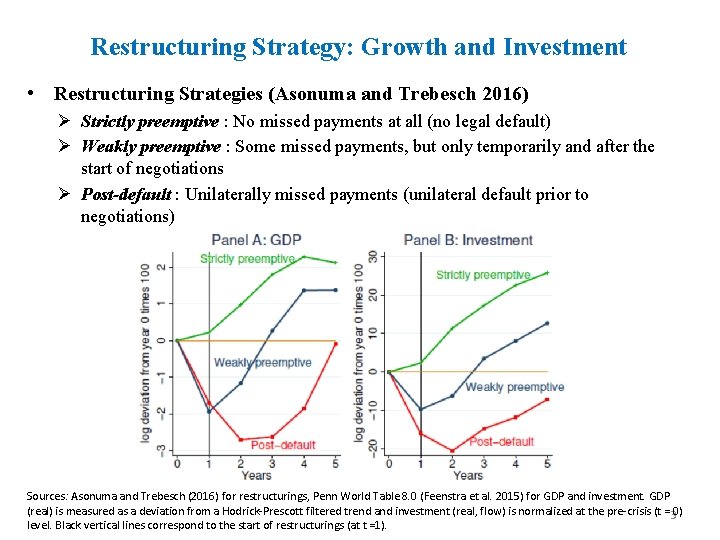
Restructuring Strategy: Growth and Investment • Restructuring Strategies (Asonuma and Trebesch 2016) Ø Strictly preemptive : No missed payments at all (no legal default) Ø Weakly preemptive : Some missed payments, but only temporarily and after the start of negotiations Ø Post-default : Unilaterally missed payments (unilateral default prior to negotiations) Sources: Asonuma and Trebesch (2016) for restructurings, Penn World Table 8. 0 (Feenstra et al. 2015) for GDP and investment. GDP (real) is measured as a deviation from a Hodrick-Prescott filtered trend and investment (real, flow) is normalized at the pre-crisis (t =30) level. Black vertical lines correspond to the start of restructurings (at t =1).
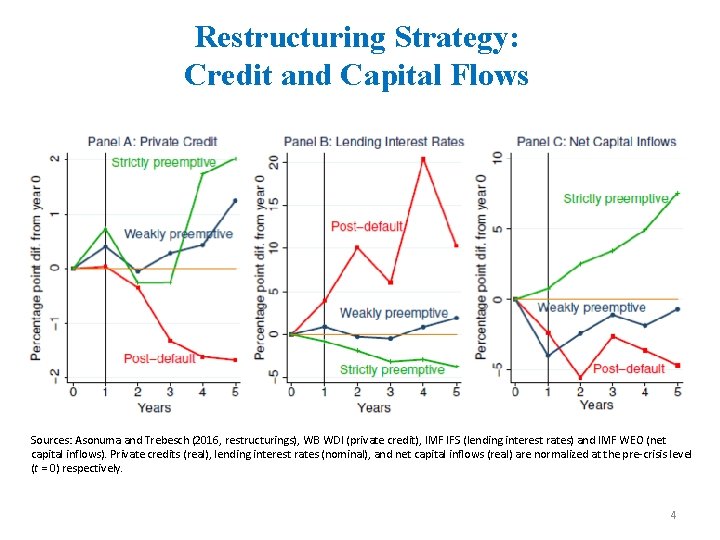
Restructuring Strategy: Credit and Capital Flows Sources: Asonuma and Trebesch (2016, restructurings), WB WDI (private credit), IMF IFS (lending interest rates) and IMF WEO (net capital inflows). Private credits (real), lending interest rates (nominal), and net capital inflows (real) are normalized at the pre-crisis level (t = 0) respectively. 4

Restructuring Sample • Sample of external debt restructurings in 1978 -2010 • Preemptive restructurings have on average (Asonuma and Trebesch 2016): Ø Shorter duration Ø Smaller haircuts Ø Shorter period of market exclusion 5
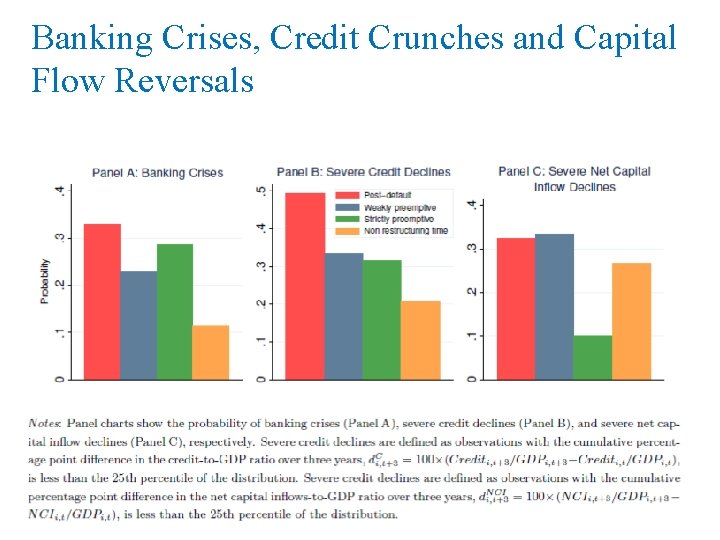
Banking Crises, Credit Crunches and Capital Flow Reversals 6
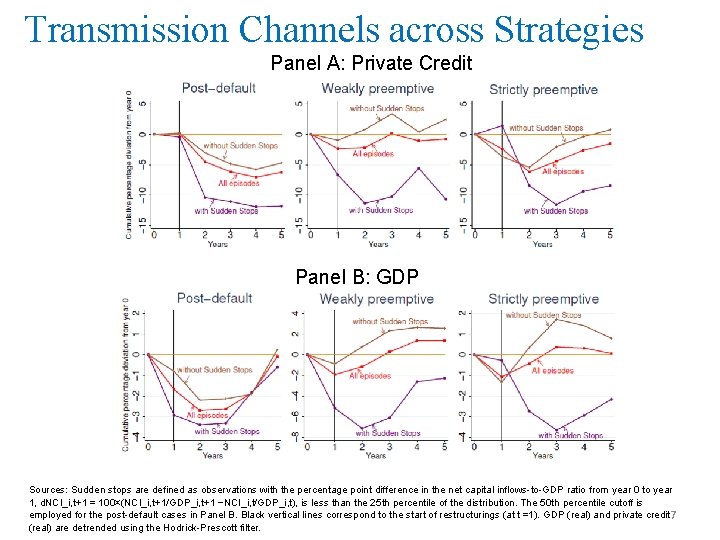
Transmission Channels across Strategies Panel A: Private Credit Panel B: GDP Sources: Sudden stops are defined as observations with the percentage point difference in the net capital inflows-to-GDP ratio from year 0 to year 1, d. NCI_i, t+1 = 100×(NCI_i, t+1/GDP_i, t+1 −NCI_i, t/GDP_i, t), is less than the 25 th percentile of the distribution. The 50 th percentile cutoff is employed for the post-default cases in Panel B. Black vertical lines correspond to the start of restructurings (at t =1). GDP (real) and private credit 7 (real) are detrended using the Hodrick-Prescott filter.
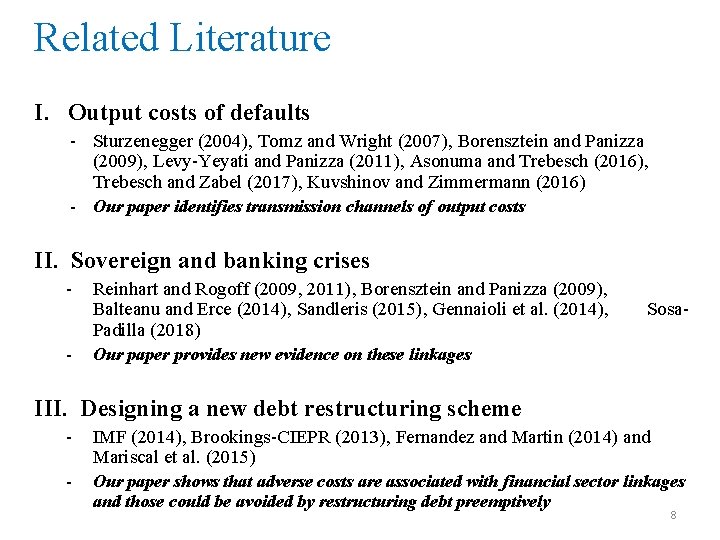
Related Literature I. Output costs of defaults - Sturzenegger (2004), Tomz and Wright (2007), Borensztein and Panizza (2009), Levy-Yeyati and Panizza (2011), Asonuma and Trebesch (2016), Trebesch and Zabel (2017), Kuvshinov and Zimmermann (2016) - Our paper identifies transmission channels of output costs II. Sovereign and banking crises - Reinhart and Rogoff (2009, 2011), Borensztein and Panizza (2009), Balteanu and Erce (2014), Sandleris (2015), Gennaioli et al. (2014), Padilla (2018) - Our paper provides new evidence on these linkages Sosa- III. Designing a new debt restructuring scheme - IMF (2014), Brookings-CIEPR (2013), Fernandez and Martin (2014) and Mariscal et al. (2015) - Our paper shows that adverse costs are associated with financial sector linkages and those could be avoided by restructuring debt preemptively 8
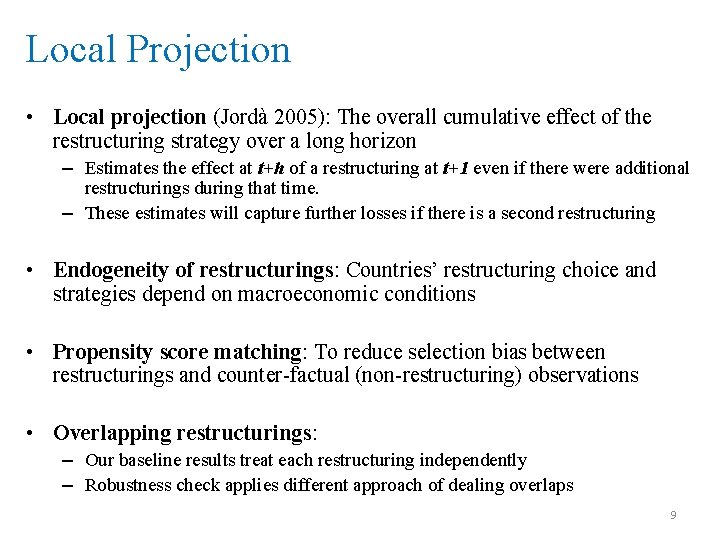
Local Projection • Local projection (Jordà 2005): The overall cumulative effect of the restructuring strategy over a long horizon – Estimates the effect at t+h of a restructuring at t+1 even if there were additional restructurings during that time. – These estimates will capture further losses if there is a second restructuring • Endogeneity of restructurings: Countries’ restructuring choice and strategies depend on macroeconomic conditions • Propensity score matching: To reduce selection bias between restructurings and counter-factual (non-restructuring) observations • Overlapping restructurings: – Our baseline results treat each restructuring independently – Robustness check applies different approach of dealing overlaps 9
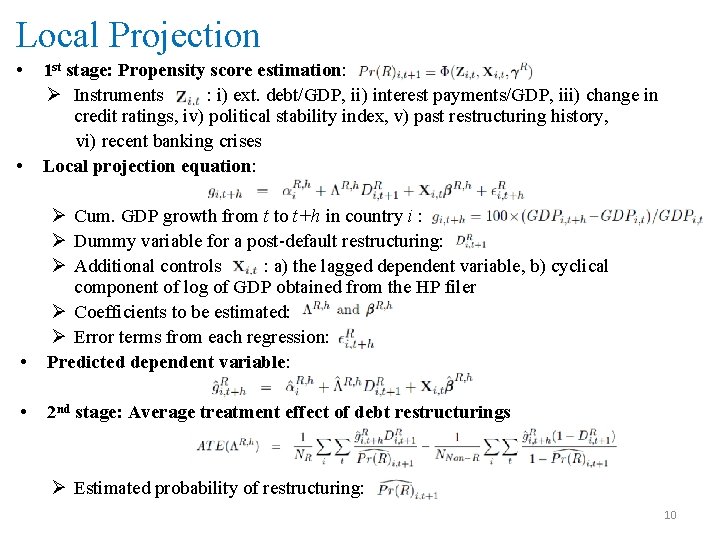
Local Projection • • 1 st stage: Propensity score estimation: Ø Instruments : i) ext. debt/GDP, ii) interest payments/GDP, iii) change in credit ratings, iv) political stability index, v) past restructuring history, vi) recent banking crises Local projection equation: • Ø Cum. GDP growth from t to t+h in country i : Ø Dummy variable for a post-default restructuring: Ø Additional controls : a) the lagged dependent variable, b) cyclical component of log of GDP obtained from the HP filer Ø Coefficients to be estimated: Ø Error terms from each regression: Predicted dependent variable: • 2 nd stage: Average treatment effect of debt restructurings Ø Estimated probability of restructuring: 10
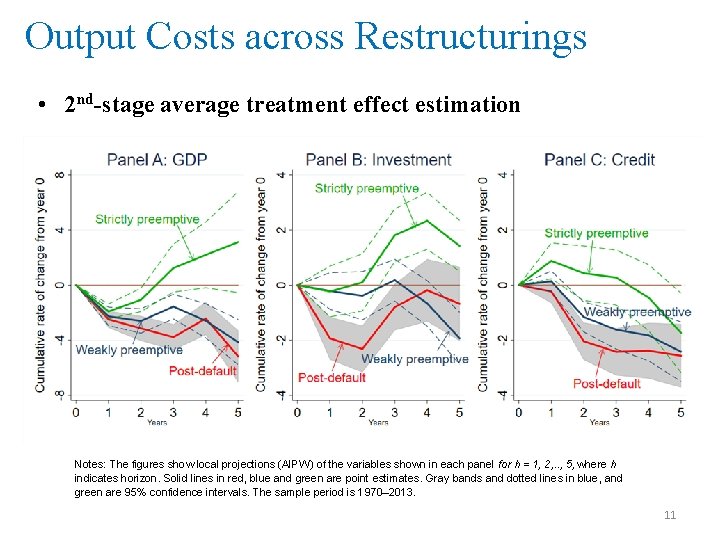
Output Costs across Restructurings • 2 nd-stage average treatment effect estimation Notes: The figures show local projections (AIPW) of the variables shown in each panel for h = 1, 2, . . , 5, where h indicates horizon. Solid lines in red, blue and green are point estimates. Gray bands and dotted lines in blue, and green are 95% confidence intervals. The sample period is 1970– 2013. 11
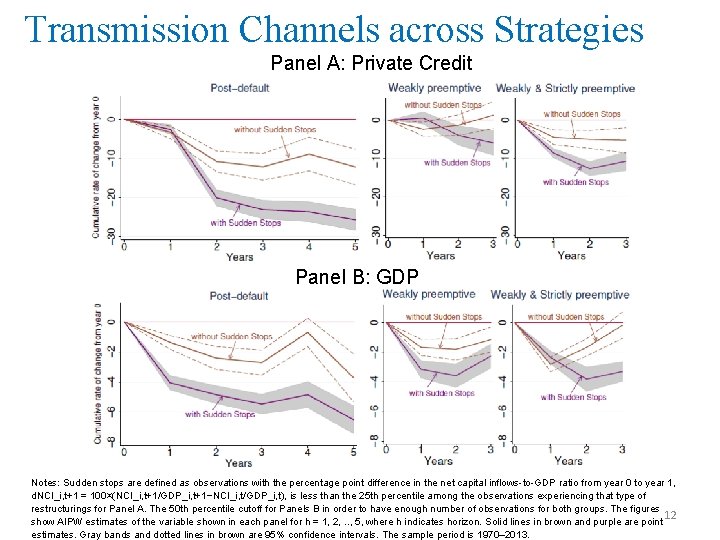
Transmission Channels across Strategies Panel A: Private Credit Panel B: GDP Notes: Sudden stops are defined as observations with the percentage point difference in the net capital inflows-to-GDP ratio from year 0 to year 1, d. NCI_i, t+1 = 100×(NCI_i, t+1/GDP_i, t+1−NCI_i, t/GDP_i, t), is less than the 25 th percentile among the observations experiencing that type of restructurings for Panel A. The 50 th percentile cutoff for Panels B in order to have enough number of observations for both groups. The figures 12 show AIPW estimates of the variable shown in each panel for h = 1, 2, . . , 5, where h indicates horizon. Solid lines in brown and purple are point estimates. Gray bands and dotted lines in brown are 95% confidence intervals. The sample period is 1970– 2013.
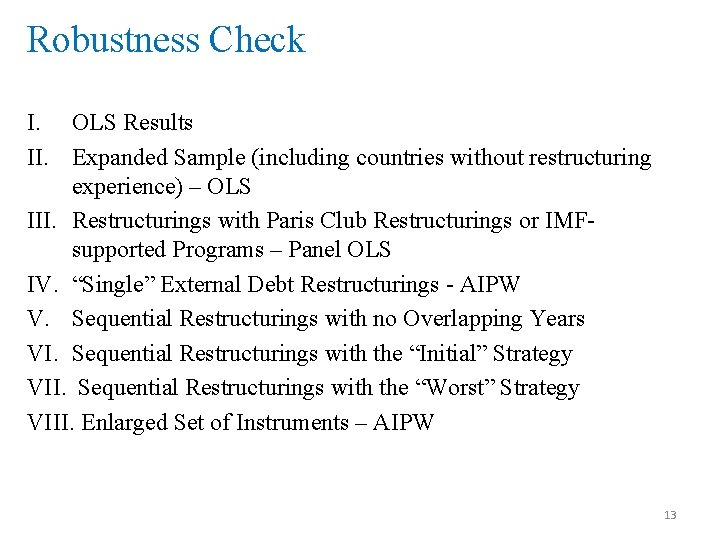
Robustness Check I. OLS Results II. Expanded Sample (including countries without restructuring experience) – OLS III. Restructurings with Paris Club Restructurings or IMFsupported Programs – Panel OLS IV. “Single” External Debt Restructurings - AIPW V. Sequential Restructurings with no Overlapping Years VI. Sequential Restructurings with the “Initial” Strategy VII. Sequential Restructurings with the “Worst” Strategy VIII. Enlarged Set of Instruments – AIPW 13
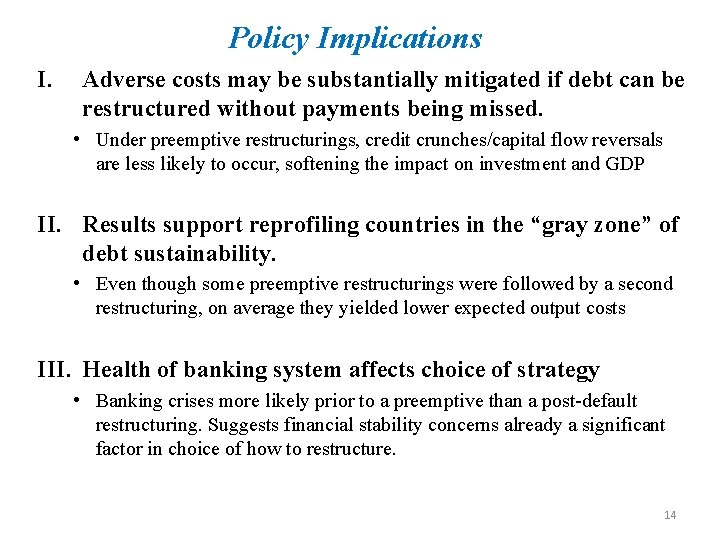
Policy Implications I. Adverse costs may be substantially mitigated if debt can be restructured without payments being missed. • Under preemptive restructurings, credit crunches/capital flow reversals are less likely to occur, softening the impact on investment and GDP II. Results support reprofiling countries in the “gray zone” of debt sustainability. • Even though some preemptive restructurings were followed by a second restructuring, on average they yielded lower expected output costs III. Health of banking system affects choice of strategy • Banking crises more likely prior to a preemptive than a post-default restructuring. Suggests financial stability concerns already a significant factor in choice of how to restructure. 14
Backup Slides 15
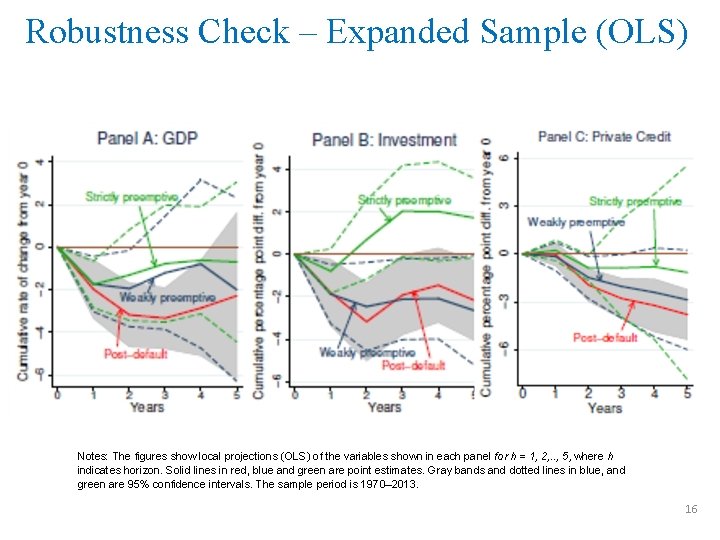
Robustness Check – Expanded Sample (OLS) Notes: The figures show local projections (OLS) of the variables shown in each panel for h = 1, 2, . . , 5, where h indicates horizon. Solid lines in red, blue and green are point estimates. Gray bands and dotted lines in blue, and green are 95% confidence intervals. The sample period is 1970– 2013. 16
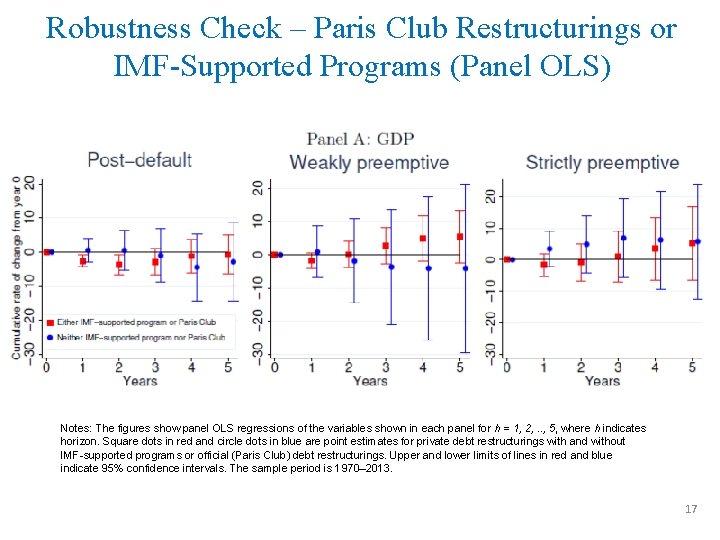
Robustness Check – Paris Club Restructurings or IMF-Supported Programs (Panel OLS) – Notes: The figures show panel OLS regressions of the variables shown in each panel for h = 1, 2, . . , 5, where h indicates horizon. Square dots in red and circle dots in blue are point estimates for private debt restructurings with and without IMF-supported programs or official (Paris Club) debt restructurings. Upper and lower limits of lines in red and blue indicate 95% confidence intervals. The sample period is 1970– 2013. 17
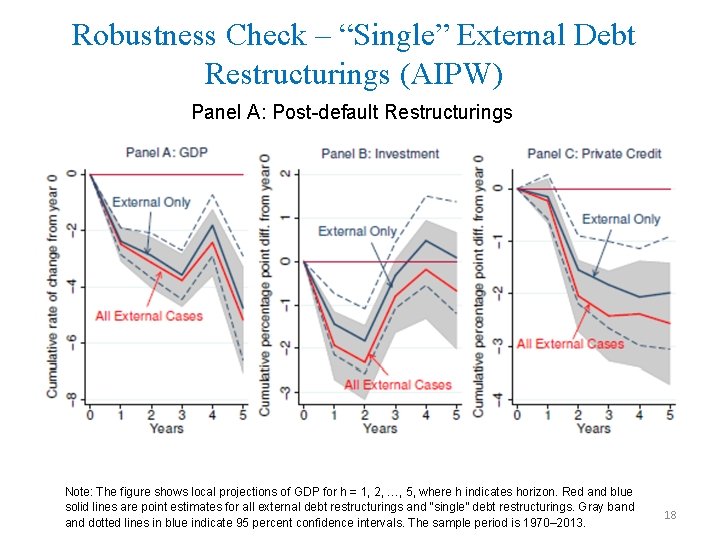
Robustness Check – “Single” External Debt Restructurings (AIPW) Panel A: Post-default Restructurings Note: The figure shows local projections of GDP for h = 1, 2, …, 5, where h indicates horizon. Red and blue solid lines are point estimates for all external debt restructurings and “single” debt restructurings. Gray band dotted lines in blue indicate 95 percent confidence intervals. The sample period is 1970– 2013. 18
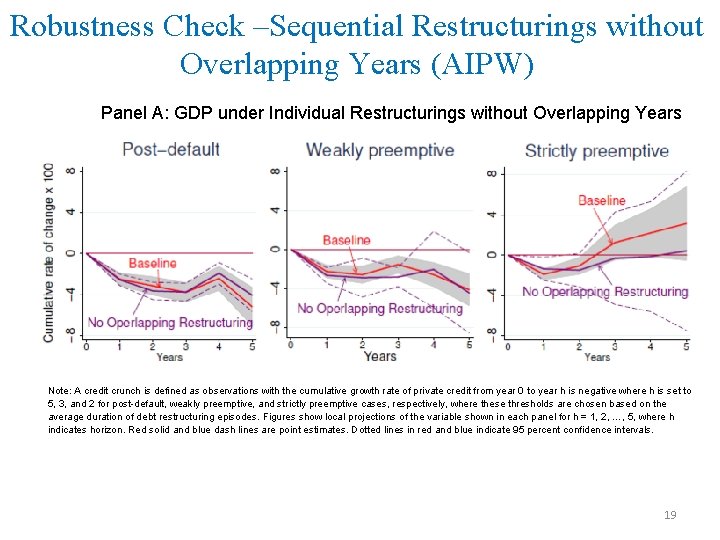
Robustness Check –Sequential Restructurings without Overlapping Years (AIPW) Panel A: GDP under Individual Restructurings without Overlapping Years Note: A credit crunch is defined as observations with the cumulative growth rate of private credit from year 0 to year h is negative where h is set to 5, 3, and 2 for post-default, weakly preemptive, and strictly preemptive cases, respectively, where these thresholds are chosen based on the average duration of debt restructuring episodes. Figures show local projections of the variable shown in each panel for h = 1, 2, …, 5, where h indicates horizon. Red solid and blue dash lines are point estimates. Dotted lines in red and blue indicate 95 percent confidence intervals. 19
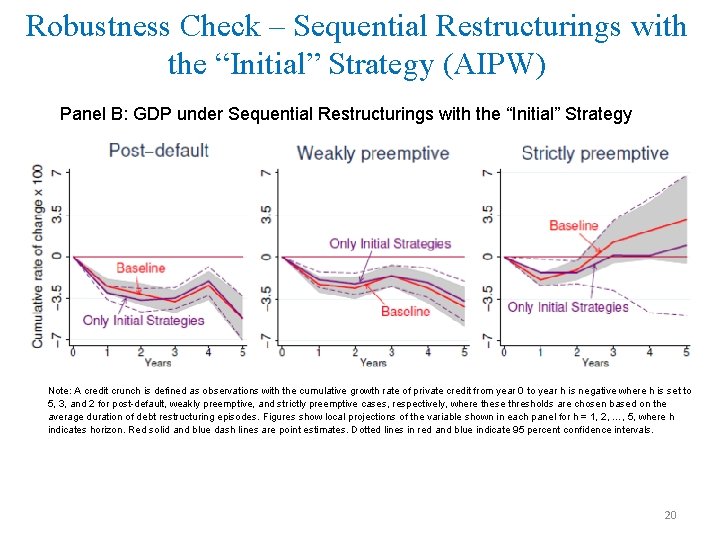
Robustness Check – Sequential Restructurings with the “Initial” Strategy (AIPW) Panel B: GDP under Sequential Restructurings with the “Initial” Strategy Note: A credit crunch is defined as observations with the cumulative growth rate of private credit from year 0 to year h is negative where h is set to 5, 3, and 2 for post-default, weakly preemptive, and strictly preemptive cases, respectively, where these thresholds are chosen based on the average duration of debt restructuring episodes. Figures show local projections of the variable shown in each panel for h = 1, 2, …, 5, where h indicates horizon. Red solid and blue dash lines are point estimates. Dotted lines in red and blue indicate 95 percent confidence intervals. 20
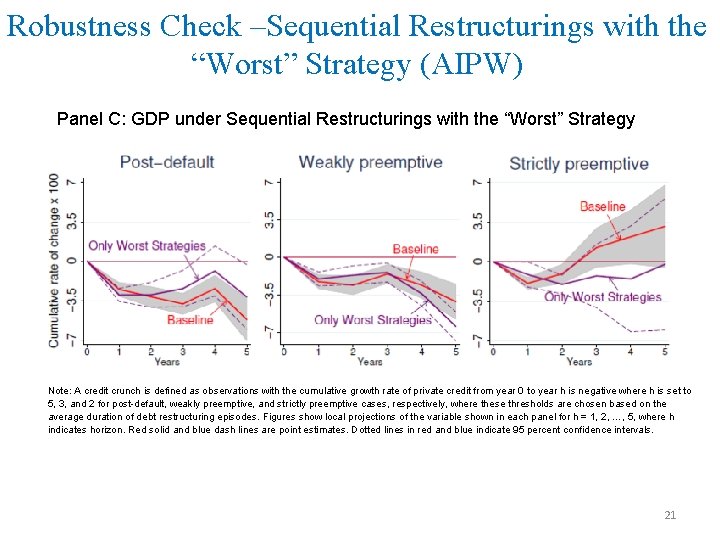
Robustness Check –Sequential Restructurings with the “Worst” Strategy (AIPW) Panel C: GDP under Sequential Restructurings with the “Worst” Strategy Note: A credit crunch is defined as observations with the cumulative growth rate of private credit from year 0 to year h is negative where h is set to 5, 3, and 2 for post-default, weakly preemptive, and strictly preemptive cases, respectively, where these thresholds are chosen based on the average duration of debt restructuring episodes. Figures show local projections of the variable shown in each panel for h = 1, 2, …, 5, where h indicates horizon. Red solid and blue dash lines are point estimates. Dotted lines in red and blue indicate 95 percent confidence intervals. 21
- Slides: 21