
Costing how much does it Cost Analysis how


- Slides: 41
Costing - how much does it? Cost Analysis: how, what, why, when & where? The quest for budget optimisation Nick Cowan 26/06/09
What am I going to cover? First a little bit about myself, then: q Section 1: Introduction: Costs & Reports q Section 2: Costing Services q Section 3: Costing Projects q Section 4: Cost Savings: An Approach q Section 5: Questions?
Section 1 INTRODUCTION: COSTS & REPORTS
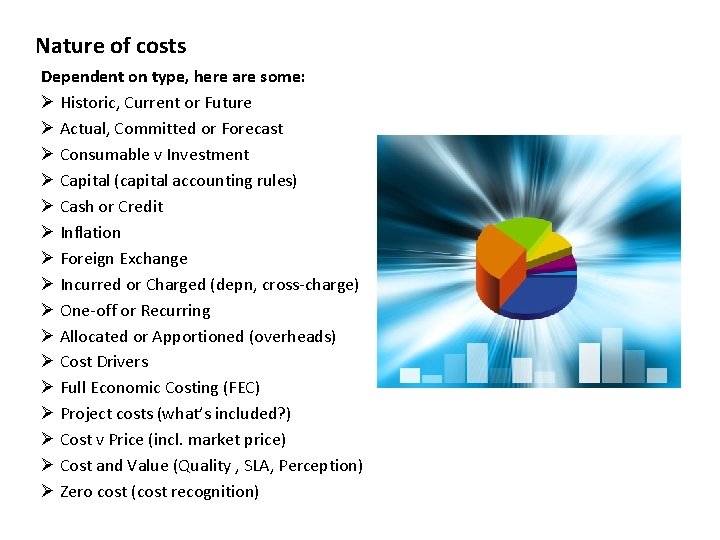
Nature of costs Dependent on type, here are some: Ø Historic, Current or Future Ø Actual, Committed or Forecast Ø Consumable v Investment Ø Capital (capital accounting rules) Ø Cash or Credit Ø Inflation Ø Foreign Exchange Ø Incurred or Charged (depn, cross-charge) Ø One-off or Recurring Ø Allocated or Apportioned (overheads) Ø Cost Drivers Ø Full Economic Costing (FEC) Ø Project costs (what’s included? ) Ø Cost v Price (incl. market price) Ø Cost and Value (Quality , SLA, Perception) Ø Zero cost (cost recognition)
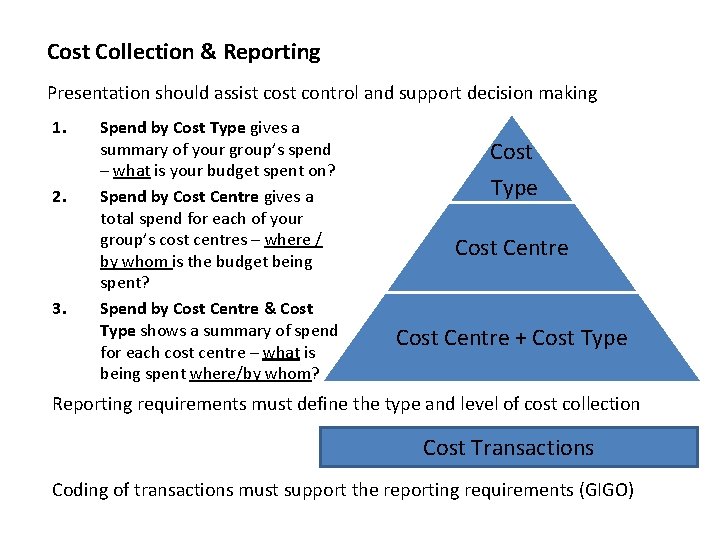
Cost Collection & Reporting Presentation should assist control and support decision making 1. 2. 3. Spend by Cost Type gives a summary of your group’s spend – what is your budget spent on? Spend by Cost Centre gives a total spend for each of your group’s cost centres – where / by whom is the budget being spent? Spend by Cost Centre & Cost Type shows a summary of spend for each cost centre – what is being spent where/by whom? Cost Type Cost Centre + Cost Type Reporting requirements must define the type and level of cost collection Cost Transactions Coding of transactions must support the reporting requirements (GIGO)
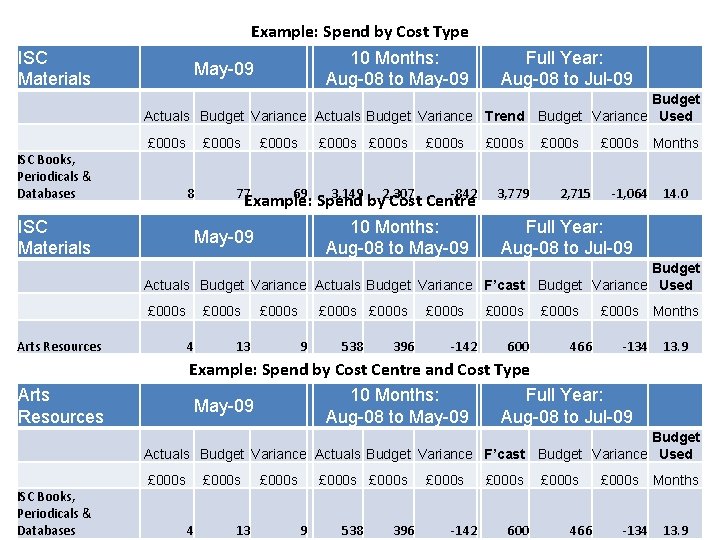
Example: Spend by Cost Type 10 Months: May-09 Aug-08 to May-09 ISC Materials Full Year: Aug-08 to Jul-09 Budget Actuals Budget Variance Trend Budget Variance Used £ 000 s ISC Books, Periodicals & Databases £ 000 s 8 £ 000 s 69 3, 149 2, 307 -842 Example: Spend by Cost Centre 10 Months: May-09 Aug-08 to May-09 ISC Materials 77 £ 000 s 3, 779 £ 000 s 2, 715 £ 000 s Months -1, 064 14. 0 Full Year: Aug-08 to Jul-09 Budget Actuals Budget Variance F’cast Budget Variance Used £ 000 s 13 £ 000 s 9 538 396 £ 000 s -142 £ 000 s 600 £ 000 s 466 £ 000 s Months Arts Resources 4 -134 Arts Resources Example: Spend by Cost Centre and Cost Type 10 Months: Full Year: May-09 Aug-08 to Jul-09 13. 9 Budget Actuals Budget Variance F’cast Budget Variance Used £ 000 s ISC Books, Periodicals & Databases £ 000 s 4 13 £ 000 s 9 538 396 £ 000 s -142 £ 000 s 600 £ 000 s 466 £ 000 s Months -134 13. 9
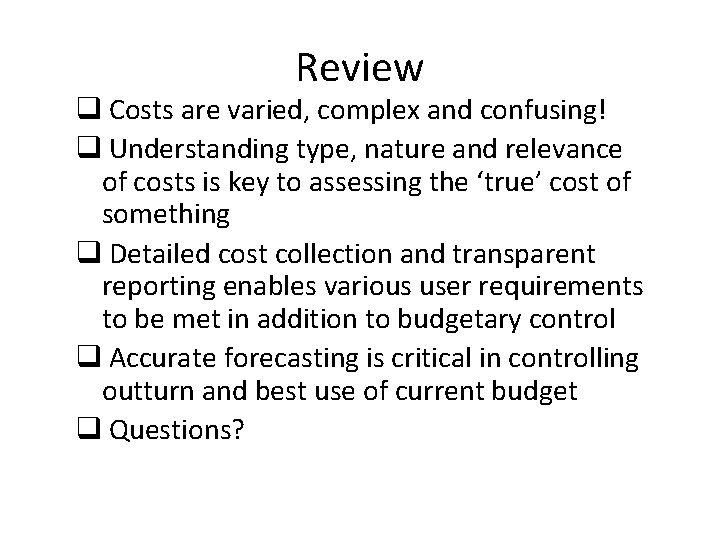
Review q Costs are varied, complex and confusing! q Understanding type, nature and relevance of costs is key to assessing the ‘true’ cost of something q Detailed cost collection and transparent reporting enables various user requirements to be met in addition to budgetary control q Accurate forecasting is critical in controlling outturn and best use of current budget q Questions?
Section 2 COSTING SERVICES
Cost Model for IS Shared Services Transition Business Case Calculating the Cost of IS Shared Services in terms of Service Offerings
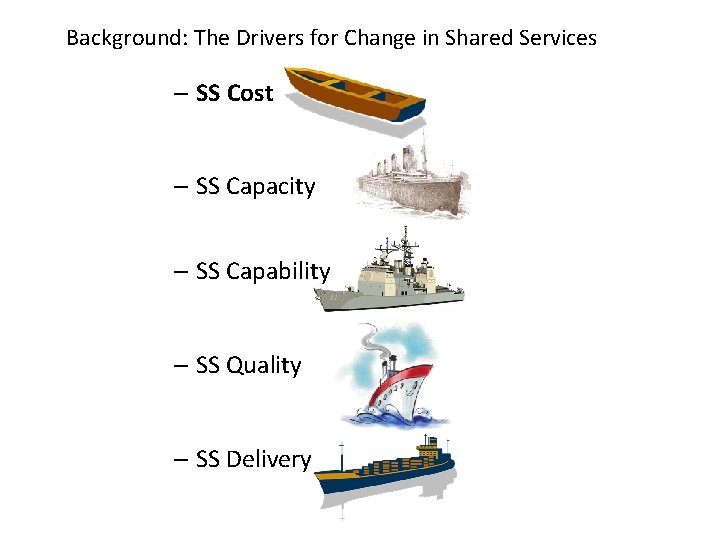
Background: The Drivers for Change in Shared Services – SS Cost – SS Capacity – SS Capability – SS Quality – SS Delivery
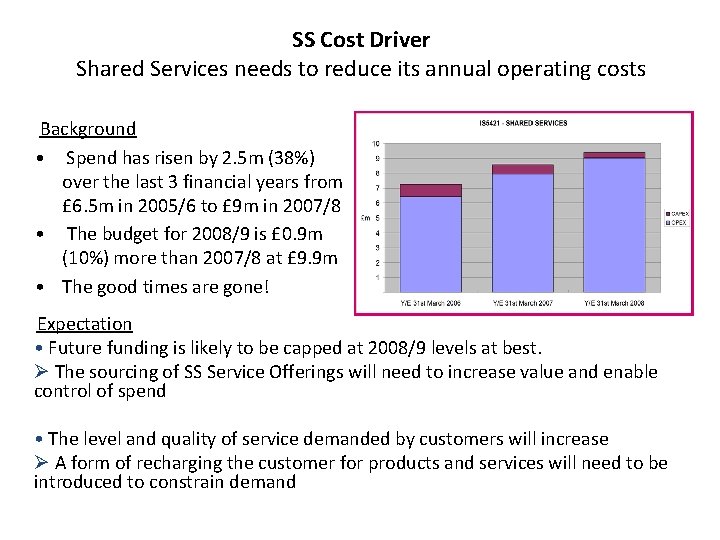
SS Cost Driver Shared Services needs to reduce its annual operating costs Background • Spend has risen by 2. 5 m (38%) over the last 3 financial years from £ 6. 5 m in 2005/6 to £ 9 m in 2007/8 • The budget for 2008/9 is £ 0. 9 m (10%) more than 2007/8 at £ 9. 9 m • The good times are gone! Expectation • Future funding is likely to be capped at 2008/9 levels at best. Ø The sourcing of SS Service Offerings will need to increase value and enable control of spend • The level and quality of service demanded by customers will increase Ø A form of recharging the customer for products and services will need to be introduced to constrain demand
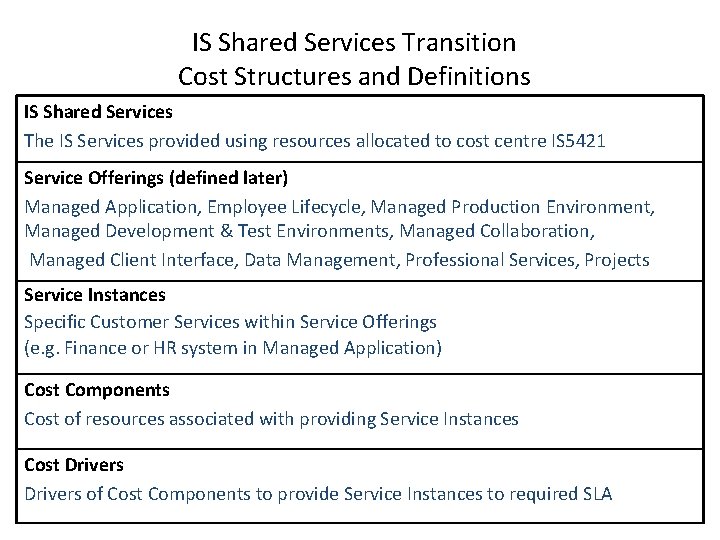
IS Shared Services Transition Cost Structures and Definitions IS Shared Services The IS Services provided using resources allocated to cost centre IS 5421 Service Offerings (defined later) Managed Application, Employee Lifecycle, Managed Production Environment, Managed Development & Test Environments, Managed Collaboration, Managed Client Interface, Data Management, Professional Services, Projects Service Instances Specific Customer Services within Service Offerings (e. g. Finance or HR system in Managed Application) Cost Components Cost of resources associated with providing Service Instances Cost Drivers of Cost Components to provide Service Instances to required SLA
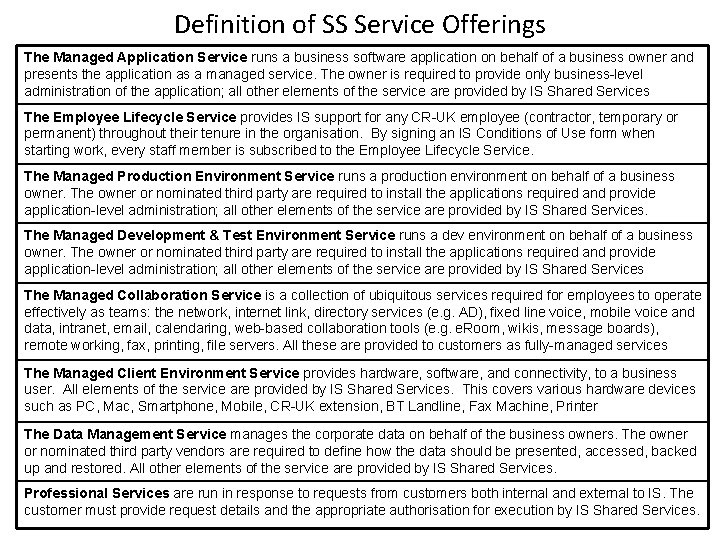
Definition of SS Service Offerings The Managed Application Service runs a business software application on behalf of a business owner and presents the application as a managed service. The owner is required to provide only business-level administration of the application; all other elements of the service are provided by IS Shared Services The Employee Lifecycle Service provides IS support for any CR-UK employee (contractor, temporary or permanent) throughout their tenure in the organisation. By signing an IS Conditions of Use form when starting work, every staff member is subscribed to the Employee Lifecycle Service. The Managed Production Environment Service runs a production environment on behalf of a business owner. The owner or nominated third party are required to install the applications required and provide application-level administration; all other elements of the service are provided by IS Shared Services. The Managed Development & Test Environment Service runs a dev environment on behalf of a business owner. The owner or nominated third party are required to install the applications required and provide application-level administration; all other elements of the service are provided by IS Shared Services The Managed Collaboration Service is a collection of ubiquitous services required for employees to operate effectively as teams: the network, internet link, directory services (e. g. AD), fixed line voice, mobile voice and data, intranet, email, calendaring, web-based collaboration tools (e. g. e. Room, wikis, message boards), remote working, fax, printing, file servers. All these are provided to customers as fully-managed services The Managed Client Environment Service provides hardware, software, and connectivity, to a business user. All elements of the service are provided by IS Shared Services. This covers various hardware devices such as PC, Mac, Smartphone, Mobile, CR-UK extension, BT Landline, Fax Machine, Printer The Data Management Service manages the corporate data on behalf of the business owners. The owner or nominated third party vendors are required to define how the data should be presented, accessed, backed up and restored. All other elements of the service are provided by IS Shared Services. Professional Services are run in response to requests from customers both internal and external to IS. The customer must provide request details and the appropriate authorisation for execution by IS Shared Services.
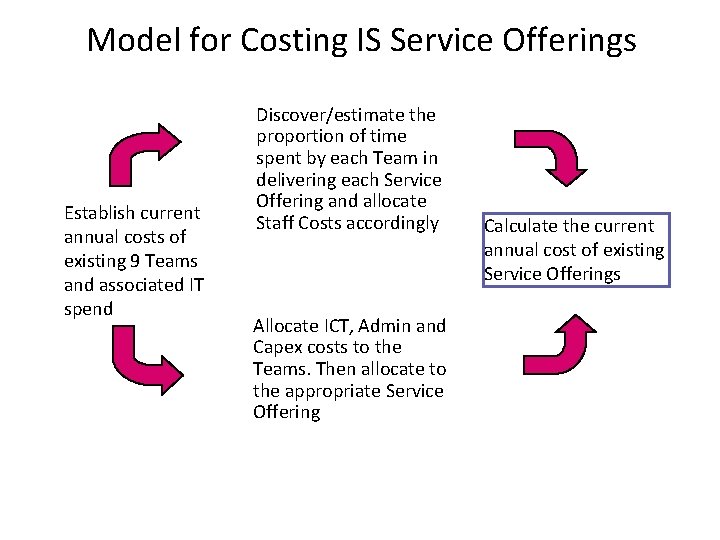
Model for Costing IS Service Offerings Establish current annual costs of existing 9 Teams and associated IT spend Discover/estimate the proportion of time spent by each Team in delivering each Service Offering and allocate Staff Costs accordingly Allocate ICT, Admin and Capex costs to the Teams. Then allocate to the appropriate Service Offering Calculate the current annual cost of existing Service Offerings
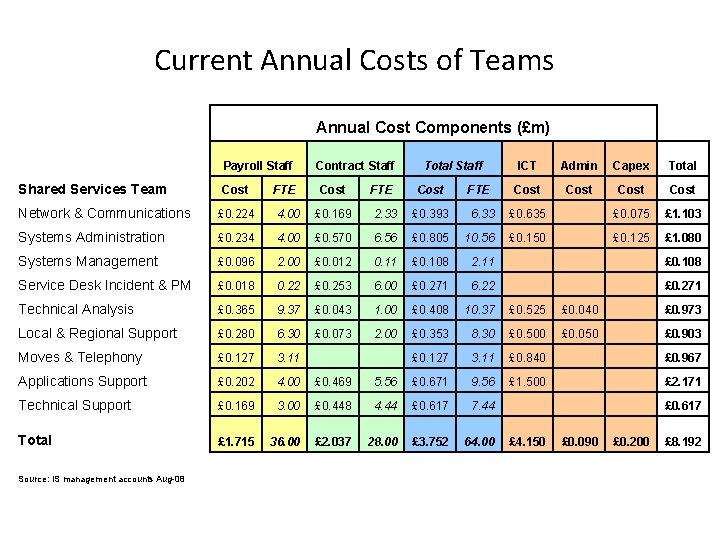
Current Annual Costs of Teams Annual Cost Components (£m) Shared Services Team Payroll Staff Contract Staff Cost FTE Total Staff Cost FTE ICT Admin Capex Total Cost Network & Communications £ 0. 224 4. 00 £ 0. 169 2. 33 £ 0. 393 6. 33 £ 0. 635 £ 0. 075 £ 1. 103 Systems Administration £ 0. 234 4. 00 £ 0. 570 6. 56 £ 0. 805 10. 56 £ 0. 150 £ 0. 125 £ 1. 080 Systems Management £ 0. 096 2. 00 £ 0. 012 0. 11 £ 0. 108 2. 11 £ 0. 108 Service Desk Incident & PM £ 0. 018 0. 22 £ 0. 253 6. 00 £ 0. 271 6. 22 £ 0. 271 Technical Analysis £ 0. 365 9. 37 £ 0. 043 1. 00 £ 0. 408 10. 37 £ 0. 525 £ 0. 040 £ 0. 973 Local & Regional Support £ 0. 280 6. 30 £ 0. 073 2. 00 £ 0. 353 8. 30 £ 0. 500 £ 0. 050 £ 0. 903 Moves & Telephony £ 0. 127 3. 11 £ 0. 840 £ 0. 967 Applications Support £ 0. 202 4. 00 £ 0. 469 5. 56 £ 0. 671 9. 56 £ 1. 500 £ 2. 171 Technical Support £ 0. 169 3. 00 £ 0. 448 4. 44 £ 0. 617 7. 44 Total £ 1. 715 36. 00 £ 2. 037 28. 00 £ 3. 752 64. 00 Source: IS management accounts Aug-08 £ 0. 617 £ 4. 150 £ 0. 090 £ 0. 200 £ 8. 192
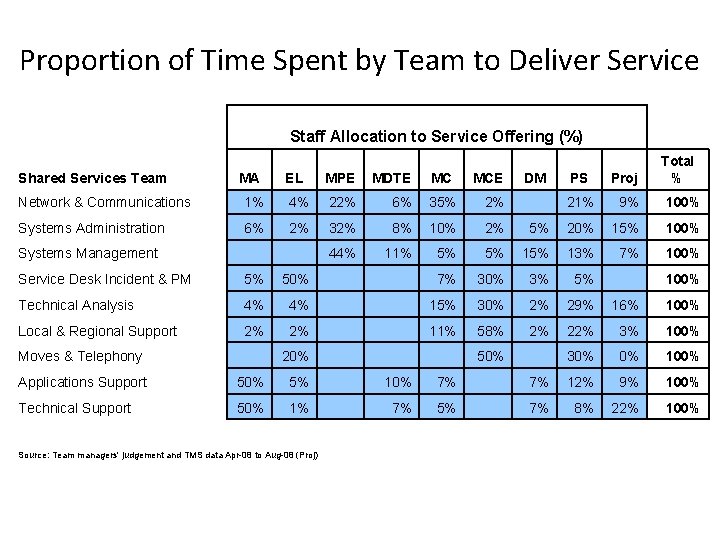
Proportion of Time Spent by Team to Deliver Service Staff Allocation to Service Offering (%) Shared Services Team MA EL MPE MDTE MC MCE Network & Communications 1% 4% 22% 6% 35% 2% Systems Administration 6% 2% 32% 8% 10% 2% 44% 11% 5% Systems Management DM PS Proj Total % 21% 9% 100% 5% 20% 15% 100% 5% 13% 7% 100% Service Desk Incident & PM 5% 50% 7% 30% 3% 5% Technical Analysis 4% 4% 15% 30% 2% 29% 16% 100% Local & Regional Support 2% 2% 11% 58% 2% 22% 3% 100% 30% 0% 100% Moves & Telephony 20% 50% 100% Applications Support 50% 5% 10% 7% 7% 12% 9% 100% Technical Support 50% 1% 7% 5% 7% 8% 22% 100% Source: Team managers' judgement and TMS data Apr-08 to Aug-08 (Proj)
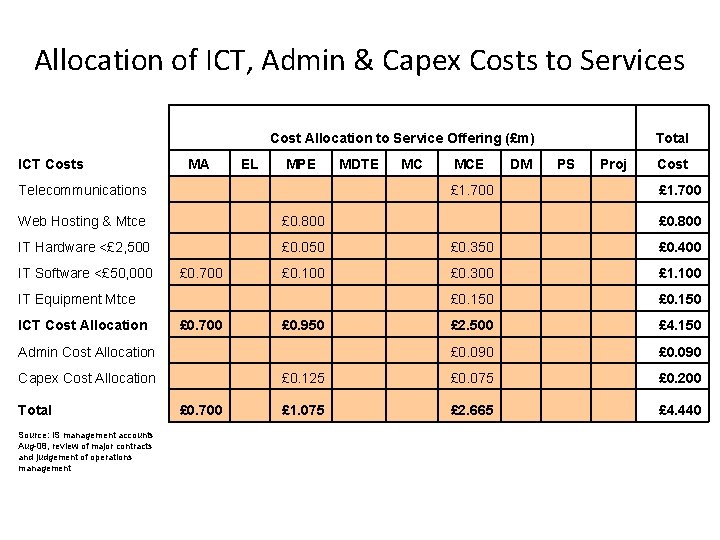
Allocation of ICT, Admin & Capex Costs to Services Cost Allocation to Service Offering (£m) ICT Costs MA EL MPE Telecommunications MDTE MC MCE £ 1. 700 DM Total PS Proj Cost £ 1. 700 Web Hosting & Mtce £ 0. 800 IT Hardware <£ 2, 500 £ 0. 050 £ 0. 350 £ 0. 400 £ 0. 100 £ 0. 300 £ 1. 100 £ 0. 150 £ 2. 500 £ 4. 150 £ 0. 090 £ 0. 125 £ 0. 075 £ 0. 200 £ 1. 075 £ 2. 665 £ 4. 440 IT Software <£ 50, 000 £ 0. 700 IT Equipment Mtce ICT Cost Allocation £ 0. 700 £ 0. 950 Admin Cost Allocation Capex Cost Allocation Total Source: IS management accounts Aug-08, review of major contracts and judgement of operations management £ 0. 700 £ 0. 800
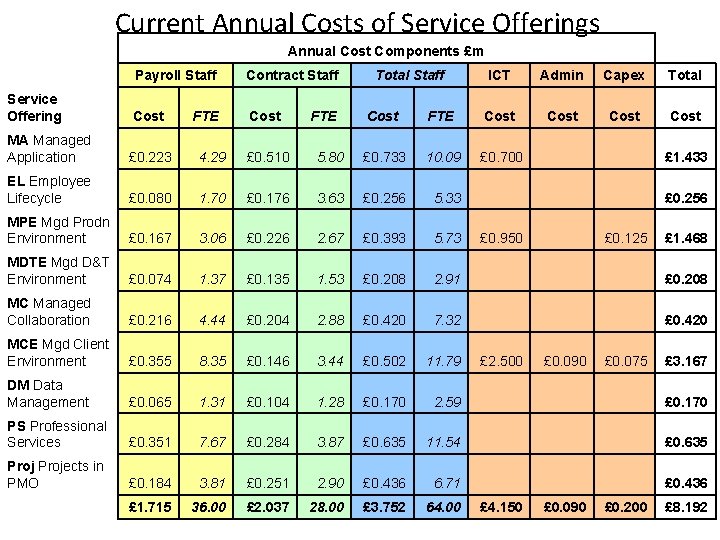
Current Annual Costs of Service Offerings Annual Cost Components £m Payroll Staff Contract Staff Service Offering Cost MA Managed Application £ 0. 223 4. 29 £ 0. 510 EL Employee Lifecycle £ 0. 080 1. 70 MPE Mgd Prodn Environment £ 0. 167 MDTE Mgd D&T Environment FTE Total Staff ICT Admin Capex Total Cost FTE Cost 5. 80 £ 0. 733 10. 09 £ 0. 700 £ 0. 176 3. 63 £ 0. 256 5. 33 3. 06 £ 0. 226 2. 67 £ 0. 393 5. 73 £ 0. 074 1. 37 £ 0. 135 1. 53 £ 0. 208 2. 91 £ 0. 208 MC Managed Collaboration £ 0. 216 4. 44 £ 0. 204 2. 88 £ 0. 420 7. 32 £ 0. 420 MCE Mgd Client Environment £ 0. 355 8. 35 £ 0. 146 3. 44 £ 0. 502 11. 79 DM Data Management £ 0. 065 1. 31 £ 0. 104 1. 28 £ 0. 170 2. 59 £ 0. 170 PS Professional Services £ 0. 351 7. 67 £ 0. 284 3. 87 £ 0. 635 11. 54 £ 0. 635 Projects in PMO £ 0. 184 3. 81 £ 0. 251 2. 90 £ 0. 436 6. 71 £ 0. 436 £ 1. 715 36. 00 £ 2. 037 28. 00 £ 3. 752 64. 00 £ 1. 433 £ 0. 256 £ 0. 950 £ 2. 500 £ 4. 150 £ 0. 125 £ 0. 090 £ 0. 075 £ 0. 200 £ 1. 468 £ 3. 167 £ 8. 192
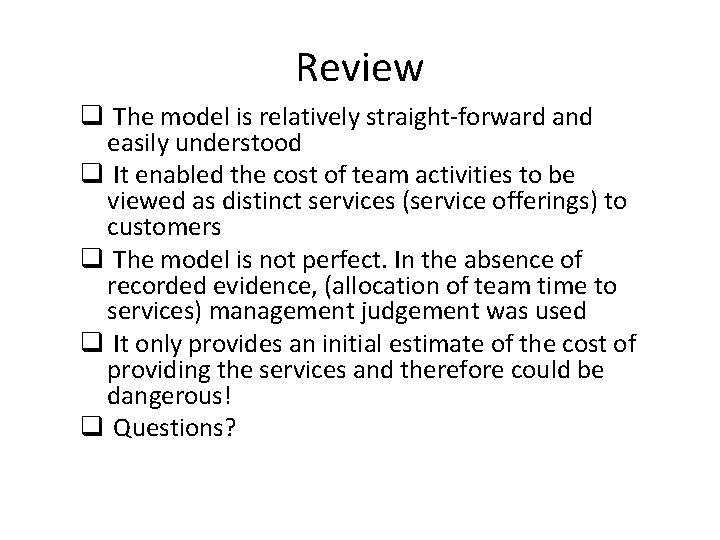
Review q The model is relatively straight-forward and easily understood q It enabled the cost of team activities to be viewed as distinct services (service offerings) to customers q The model is not perfect. In the absence of recorded evidence, (allocation of team time to services) management judgement was used q It only provides an initial estimate of the cost of providing the services and therefore could be dangerous! q Questions?
Section 3 COSTING PROJECTS
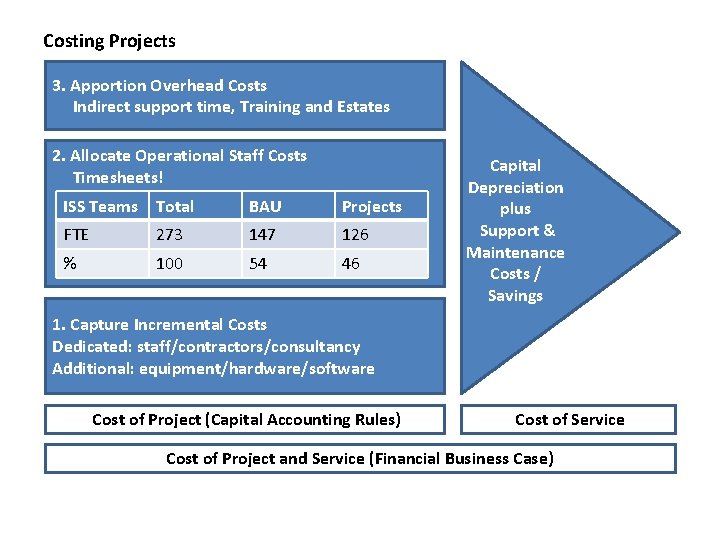
Costing Projects 3. Apportion Overhead Costs Indirect support time, Training and Estates 2. Allocate Operational Staff Costs Timesheets! ISS Teams Total BAU Projects FTE 273 147 126 % 100 54 46 Capital Depreciation plus Support & Maintenance Costs / Savings 1. Capture Incremental Costs Dedicated: staff/contractors/consultancy Additional: equipment/hardware/software Cost of Project (Capital Accounting Rules) Cost of Service Cost of Project and Service (Financial Business Case)
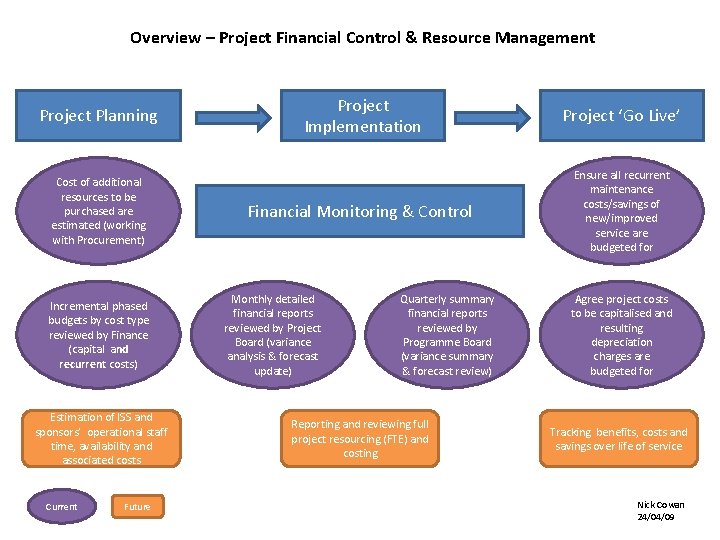
Overview – Project Financial Control & Resource Management Project Planning Cost of additional resources to be purchased are estimated (working with Procurement) Incremental phased budgets by cost type reviewed by Finance (capital and recurrent costs) Estimation of ISS and sponsors’ operational staff time, availability and associated costs Current Future Project Implementation Project ‘Go Live’ Financial Monitoring & Control Ensure all recurrent maintenance costs/savings of new/improved service are budgeted for Monthly detailed financial reports reviewed by Project Board (variance analysis & forecast update) Quarterly summary financial reports reviewed by Programme Board (variance summary & forecast review) Reporting and reviewing full project resourcing (FTE) and costing Agree project costs to be capitalised and resulting depreciation charges are budgeted for Tracking benefits, costs and savings over life of service Nick Cowan 24/04/09
Section 4 COST SAVINGS: AN APPROACH INSTITUTE OF FISCAL STUDIES ESTIMATES A 2 -3% REDUCTION IN PUBLIC SPENDING IN REAL TERMS BETWEEN 2011 AND 2014 (WITH EXCEPTION OF SCHOOLS AND HEALTH)
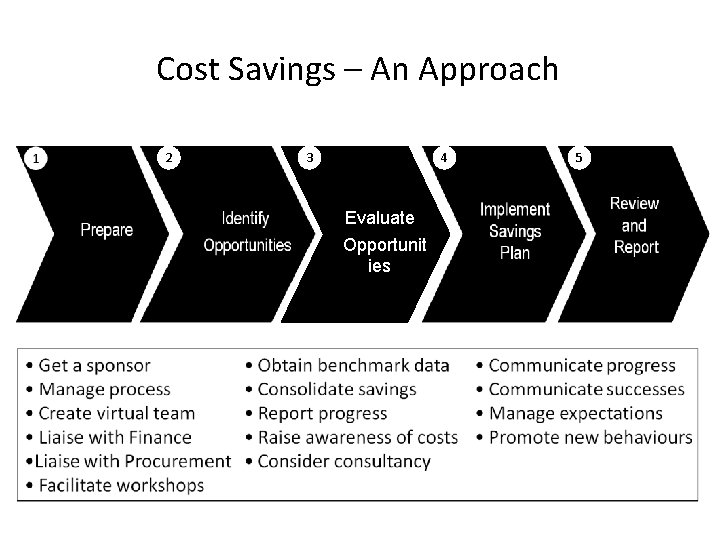
Cost Savings – An Approach 2 3 4 Evaluate Opportunit ies 5
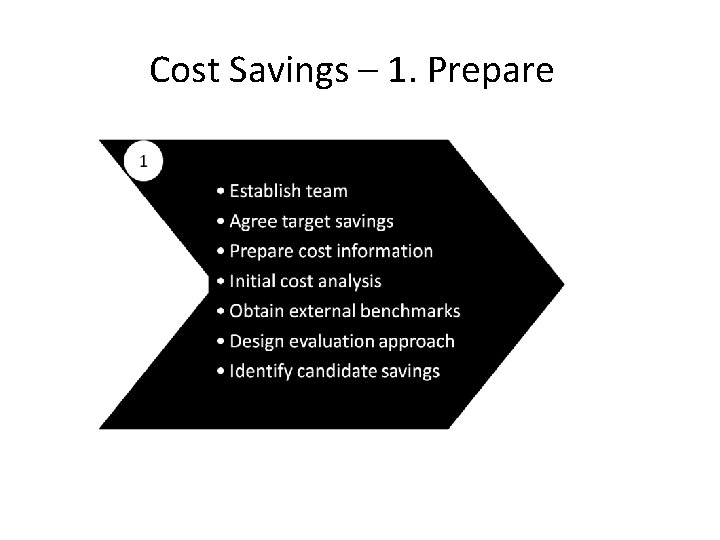
Cost Savings – 1. Prepare
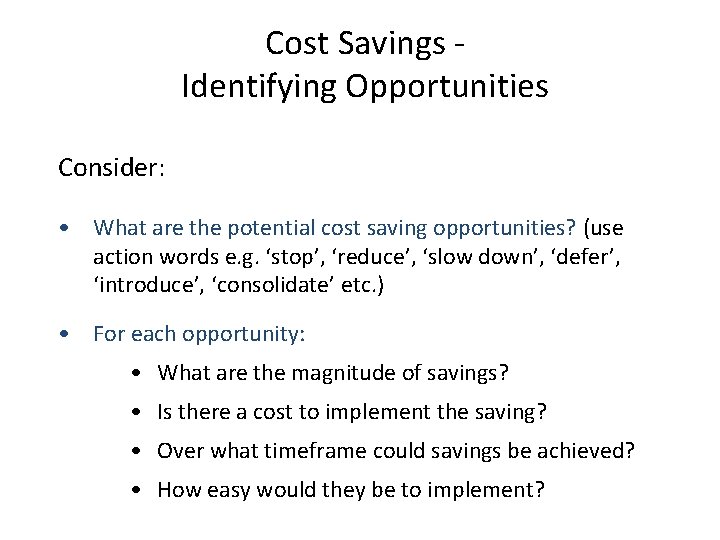
Cost Savings Identifying Opportunities Consider: • What are the potential cost saving opportunities? (use action words e. g. ‘stop’, ‘reduce’, ‘slow down’, ‘defer’, ‘introduce’, ‘consolidate’ etc. ) • For each opportunity: • What are the magnitude of savings? • Is there a cost to implement the saving? • Over what timeframe could savings be achieved? • How easy would they be to implement?
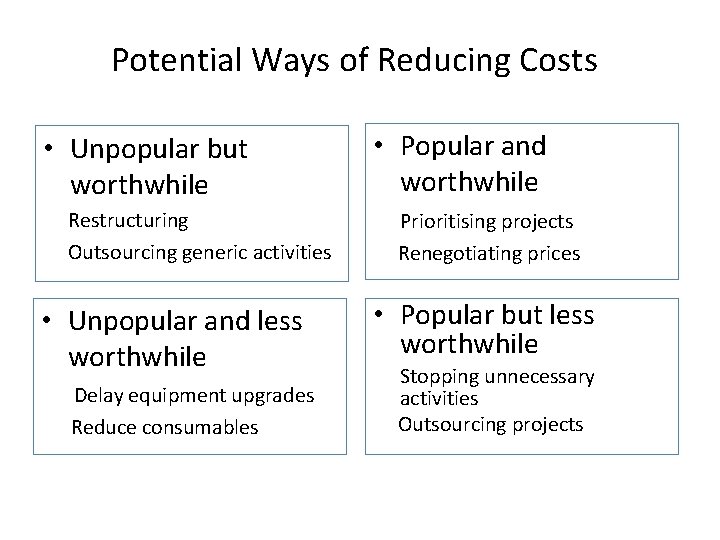
Potential Ways of Reducing Costs • Unpopular but worthwhile Restructuring Outsourcing generic activities • Unpopular and less worthwhile Delay equipment upgrades Reduce consumables • Popular and worthwhile Prioritising projects Renegotiating prices • Popular but less worthwhile Stopping unnecessary activities Outsourcing projects
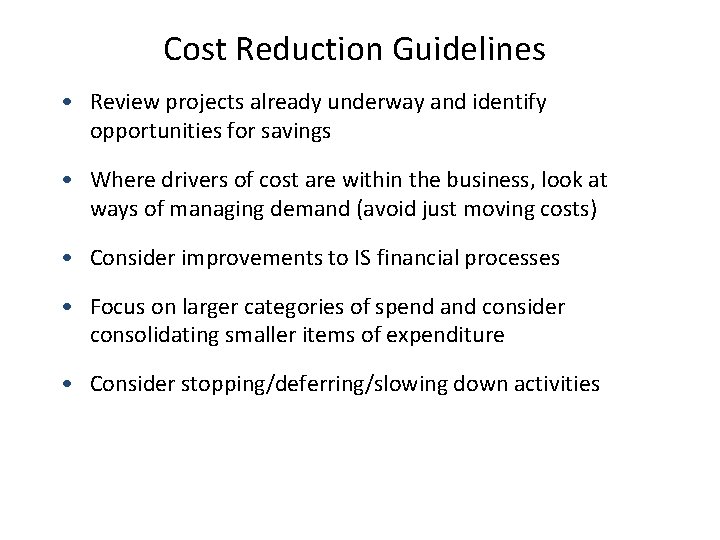
Cost Reduction Guidelines • Review projects already underway and identify opportunities for savings • Where drivers of cost are within the business, look at ways of managing demand (avoid just moving costs) • Consider improvements to IS financial processes • Focus on larger categories of spend and consider consolidating smaller items of expenditure • Consider stopping/deferring/slowing down activities
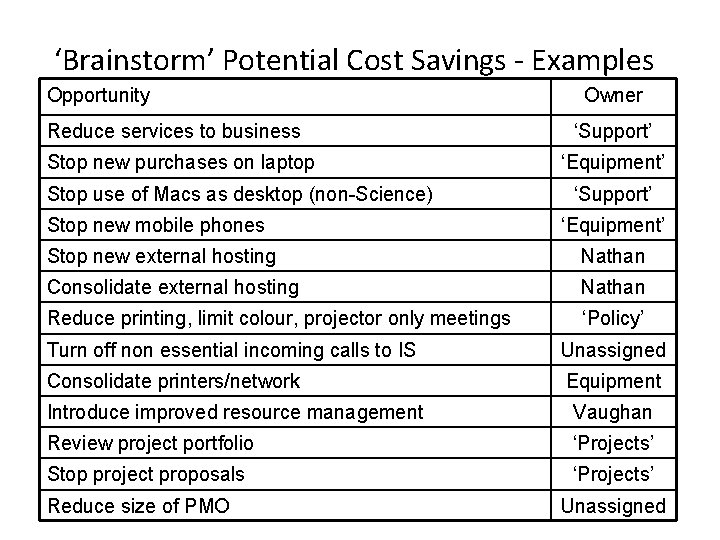
‘Brainstorm’ Potential Cost Savings - Examples Opportunity Reduce services to business Stop new purchases on laptop Stop use of Macs as desktop (non-Science) Owner ‘Support’ ‘Equipment’ ‘Support’ Stop new mobile phones ‘Equipment’ Stop new external hosting Nathan Consolidate external hosting Nathan Reduce printing, limit colour, projector only meetings ‘Policy’ Turn off non essential incoming calls to IS Unassigned Consolidate printers/network Equipment Introduce improved resource management Vaughan Review project portfolio ‘Projects’ Stop project proposals ‘Projects’ Reduce size of PMO Unassigned
Cost Savings – 2. Identify Opportunities • Present cost info • Analyse cost info • Identify opportunities • Highlight ‘quick wins’ • Prioritise opportunities
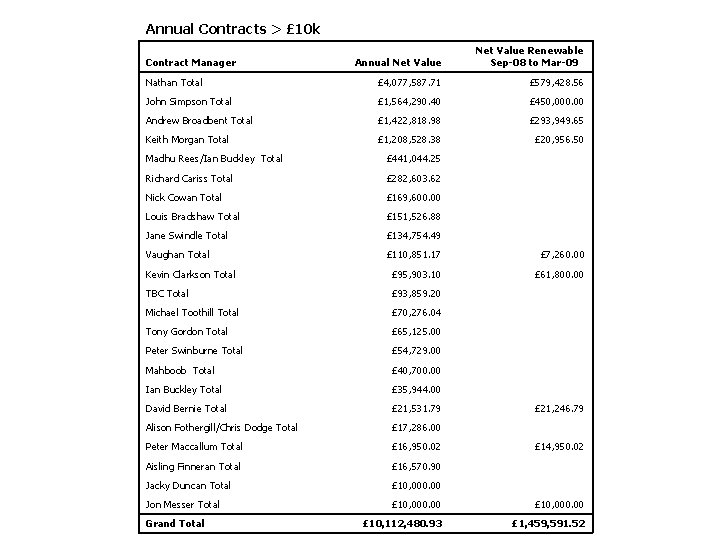
Annual Contracts > £ 10 k Annual Net Value Renewable Sep-08 to Mar-09 Nathan Total £ 4, 077, 587. 71 £ 579, 428. 56 John Simpson Total £ 1, 564, 290. 40 £ 450, 000. 00 Andrew Broadbent Total £ 1, 422, 818. 98 £ 293, 949. 65 Keith Morgan Total £ 1, 208, 528. 38 £ 20, 956. 50 Contract Manager Madhu Rees/Ian Buckley Total £ 441, 044. 25 Richard Cariss Total £ 282, 603. 62 Nick Cowan Total £ 169, 600. 00 Louis Bradshaw Total £ 151, 526. 88 Jane Swindle Total £ 134, 754. 49 Vaughan Total £ 110, 851. 17 £ 7, 260. 00 Kevin Clarkson Total £ 95, 903. 10 £ 61, 800. 00 TBC Total £ 93, 859. 20 Michael Toothill Total £ 70, 276. 04 Tony Gordon Total £ 65, 125. 00 Peter Swinburne Total £ 54, 729. 00 Mahboob Total £ 40, 700. 00 Ian Buckley Total £ 35, 944. 00 David Bernie Total £ 21, 531. 79 Alison Fothergill/Chris Dodge Total £ 17, 286. 00 Peter Maccallum Total £ 16, 950. 02 Aisling Finneran Total £ 16, 570. 90 Jacky Duncan Total £ 10, 000. 00 Jon Messer Total £ 10, 000. 00 £ 10, 112, 480. 93 £ 1, 459, 591. 52 Grand Total £ 21, 246. 79 £ 14, 950. 02
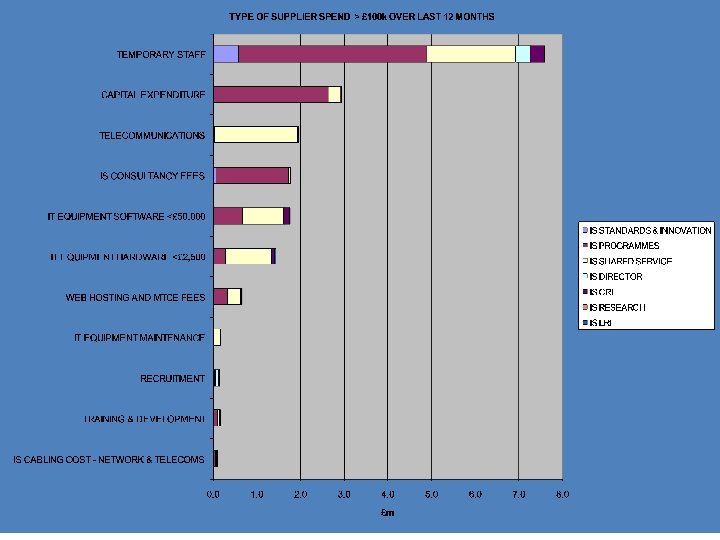
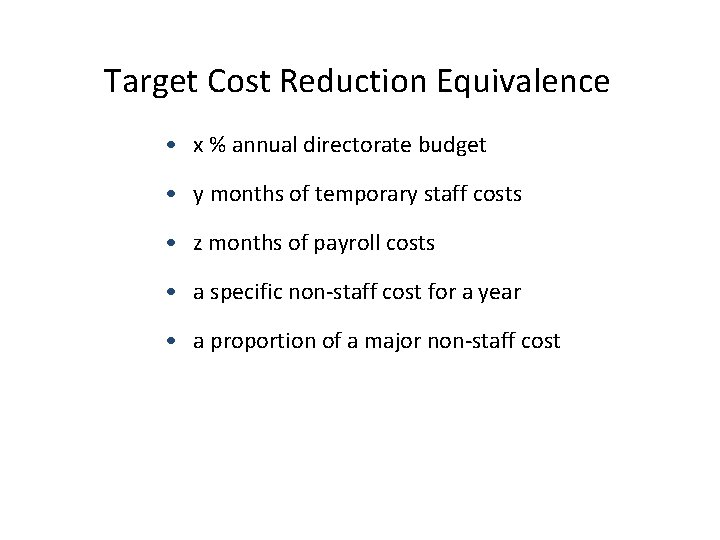
Target Cost Reduction Equivalence • x % annual directorate budget • y months of temporary staff costs • z months of payroll costs • a specific non-staff cost for a year • a proportion of a major non-staff cost
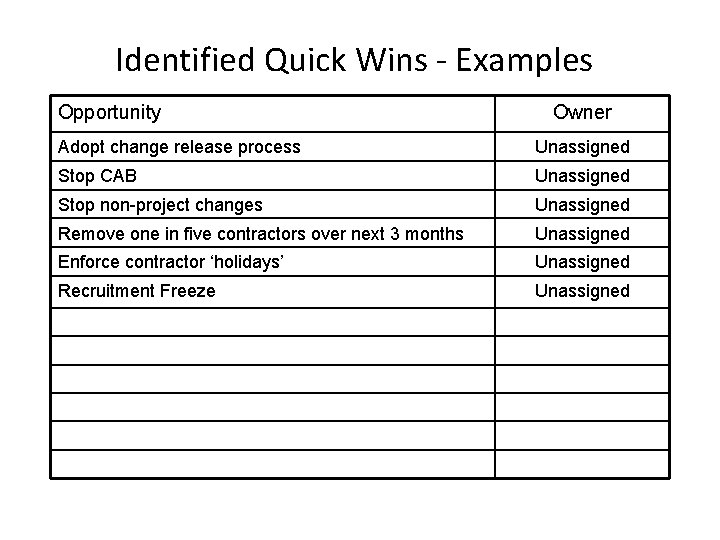
Identified Quick Wins - Examples Opportunity Owner Adopt change release process Unassigned Stop CAB Unassigned Stop non-project changes Unassigned Remove one in five contractors over next 3 months Unassigned Enforce contractor ‘holidays’ Unassigned Recruitment Freeze Unassigned
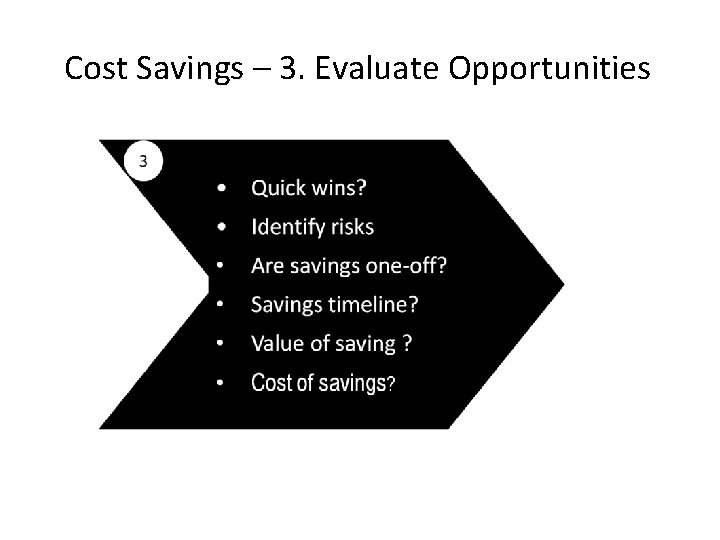
Cost Savings – 3. Evaluate Opportunities
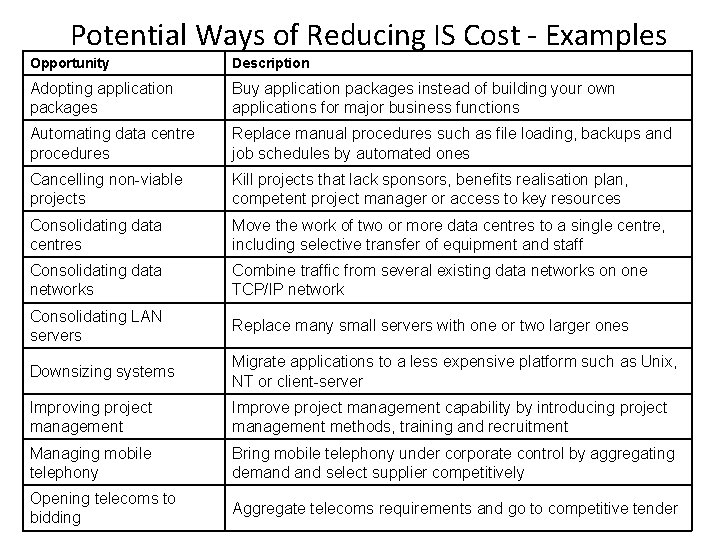
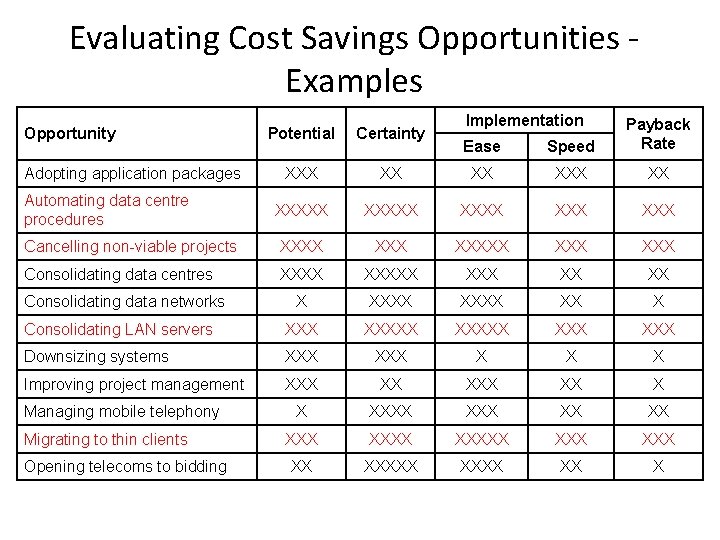
Potential Ways of Reducing IS Cost - Examples Opportunity Description Adopting application packages Buy application packages instead of building your own applications for major business functions Automating data centre procedures Replace manual procedures such as file loading, backups and job schedules by automated ones Cancelling non-viable projects Kill projects that lack sponsors, benefits realisation plan, competent project manager or access to key resources Consolidating data centres Move the work of two or more data centres to a single centre, including selective transfer of equipment and staff Consolidating data networks Combine traffic from several existing data networks on one TCP/IP network Consolidating LAN servers Replace many small servers with one or two larger ones Downsizing systems Migrate applications to a less expensive platform such as Unix, NT or client-server Improving project management Improve project management capability by introducing project management methods, training and recruitment Managing mobile telephony Bring mobile telephony under corporate control by aggregating demand select supplier competitively Opening telecoms to bidding Aggregate telecoms requirements and go to competitive tender
Evaluating Cost Savings Opportunities Examples Implementation Ease Speed Payback Rate XX XX XXXXX XXX Cancelling non-viable projects XXXX XXX XXX Consolidating data centres XXXXX XX XXXX XX X Consolidating LAN servers XXXXX XXX XXX Downsizing systems XXX X X X Improving project management XXX XX X X XXX XXXX XXXXX XX X Opportunity Adopting application packages Automating data centre procedures Consolidating data networks Managing mobile telephony Migrating to thin clients Opening telecoms to bidding Potential Certainty XXX
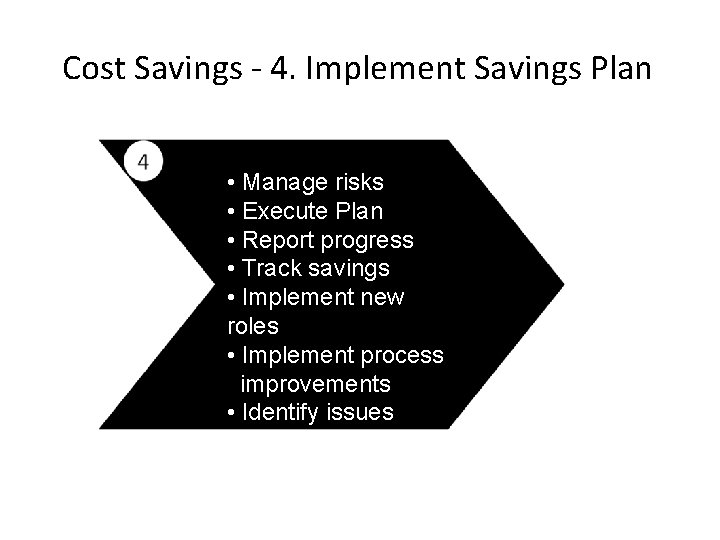
Cost Savings - 4. Implement Savings Plan • Manage risks • Execute Plan • Report progress • Track savings • Implement new roles • Implement process improvements • Identify issues
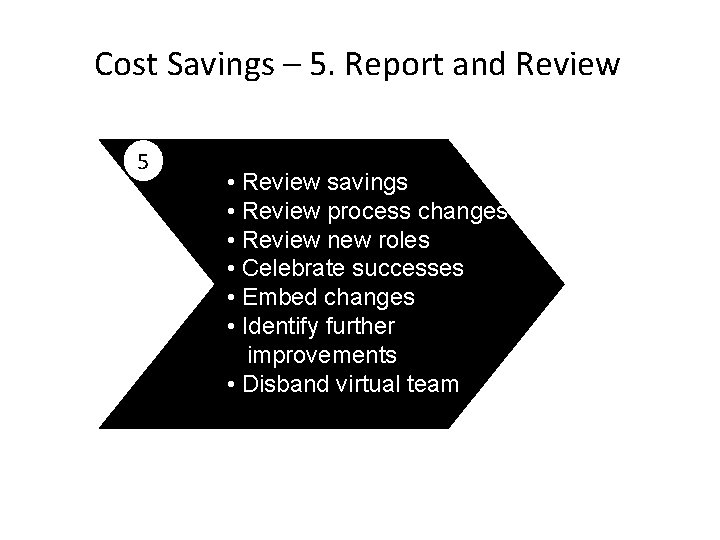
Cost Savings – 5. Report and Review 5 • Review savings • Review process changes • Review new roles • Celebrate successes • Embed changes • Identify further improvements • Disband virtual team
Section 5 ANY QUESTIONS?