
CostEffectiveness Valuation Framework for Demand Response Resources Guidelines
- Slides: 14
Cost-Effectiveness Valuation Framework for Demand Response Resources: Guidelines and Suggestions Chuck Goldman Lawrence Berkeley National Laboratory cagoldman@lbl. gov Pacific Northwest Demand Response Project Portland OR September 12, 2008 Energy Analysis Department
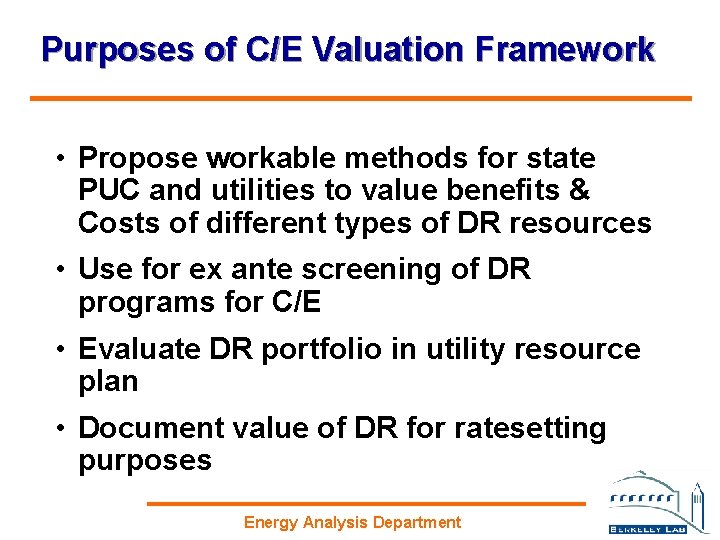
Purposes of C/E Valuation Framework • Propose workable methods for state PUC and utilities to value benefits & Costs of different types of DR resources • Use for ex ante screening of DR programs for C/E • Evaluate DR portfolio in utility resource plan • Document value of DR for ratesetting purposes Energy Analysis Department
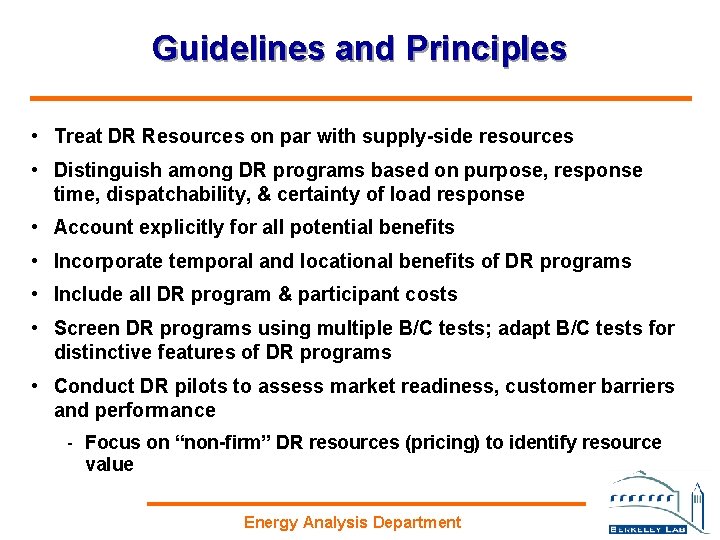
Guidelines and Principles • Treat DR Resources on par with supply-side resources • Distinguish among DR programs based on purpose, response time, dispatchability, & certainty of load response • Account explicitly for all potential benefits • Incorporate temporal and locational benefits of DR programs • Include all DR program & participant costs • Screen DR programs using multiple B/C tests; adapt B/C tests for distinctive features of DR programs • Conduct DR pilots to assess market readiness, customer barriers and performance - Focus on “non-firm” DR resources (pricing) to identify resource value Energy Analysis Department
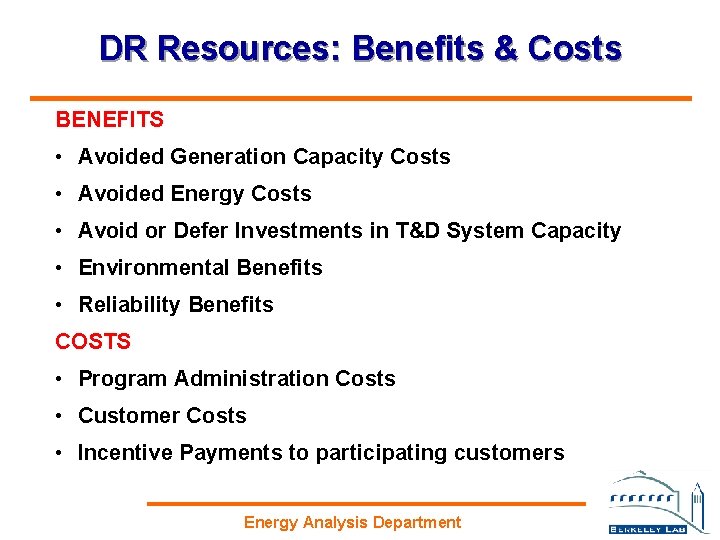
DR Resources: Benefits & Costs BENEFITS • Avoided Generation Capacity Costs • Avoided Energy Costs • Avoid or Defer Investments in T&D System Capacity • Environmental Benefits • Reliability Benefits COSTS • Program Administration Costs • Customer Costs • Incentive Payments to participating customers Energy Analysis Department
Benefits: Avoided Generation Capacity Costs • “Firm” DR resources which are directly integrated into IRP process can avoid need for some peaking capacity • New CT as benchmark proxy for market value of capacity avoided by “firm” DR resources ($50 -85/k. W-year) • Allocate avoided capacity costs to specific time periods appropriate for Pac NW - Linked to relative need for generation capacity in each hour (e. g. LOLE) • Adjusted “upward” for avoided T&D losses and reserve margin • Adjusted “downward” to include DR program operational constraints compared to use of CT Energy Analysis Department
Benefits: Avoided Energy Costs • Load shifting or curtailments enable utilities to avoid energy costs • Expected wholesale market elect. price in each future time period is relevant opportunity cost for estimating value of elect. avoided by DR resource • Adjust “upwards” to capture line losses avoided during events • Likely necessary to further adjust “upwards” for “event-based” DR programs as likely to be called in hours when prices are higher than average peak period prices • Two options to estimate avoided energy costs: - Wholesale energy privces averaged over highest prices hours of price forecast - Stochastic methods that analyze correlation between DR events and elect prices & which can explicitly address uncertainty in future loads, prices, hydro conditions Energy Analysis Department
Benefits: Avoid or Defer T&D System Capacity • Key Elements of T&D System: Interties, Local Network Transmission, Local Distribution System • DR resources that provide highly predictable load reductions on short notice in congested locations may allow utilities to defer T&D capacity investments • Two options for setting value: - Estimate on a case-specific basis using geographically specific T&D studies - Develop a default value for DR programs (e. g. , avoided cost of transformer capacity) that meet pre-established “right place” and “right certainty” criteria Energy Analysis Department
Benefits: Environmental & Reliability • Environmental - DR resources may avoid emissions from peaking generation units and some potential conservation effects - Depends on emissions profile of utility generation mix and customer’s DR strategy (e. g. shifting, curtailment, onsite generation) - For DR resources that yield load curtailments, emission rate characteristics of a new CT are reasonable proxy for estimating avoided GHG emissions • Reliability - Joint consideration of economic and reliability benefits is challenging - Once “firm” DR incorporated into IRP process, resources become part of planned capacity - “Non-firm” DR (e. g. , voluntary “emergency” programs) are not counted on as system resource and thus can provide reliability assurance - Reasonable proxy for monetizing value of “non-firm” load curtailments is VOLL ($3 -5/k. Wh) * Expected Unserved Energy Analysis Department
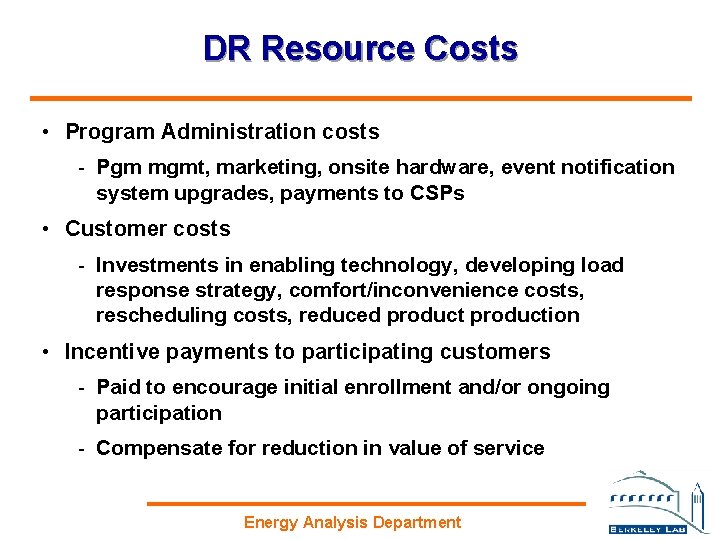
DR Resource Costs • Program Administration costs - Pgm mgmt, marketing, onsite hardware, event notification system upgrades, payments to CSPs • Customer costs - Investments in enabling technology, developing load response strategy, comfort/inconvenience costs, rescheduling costs, reduced production • Incentive payments to participating customers - Paid to encourage initial enrollment and/or ongoing participation - Compensate for reduction in value of service Energy Analysis Department
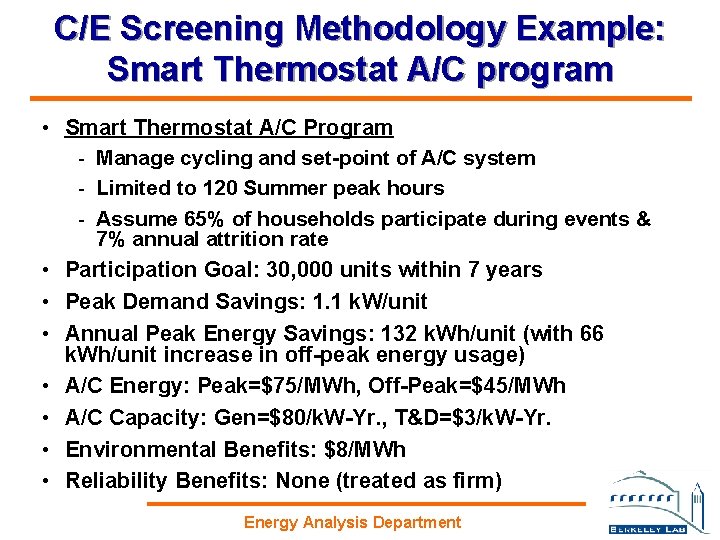
C/E Screening Methodology Example: Smart Thermostat A/C program • Smart Thermostat A/C Program - Manage cycling and set-point of A/C system - Limited to 120 Summer peak hours - Assume 65% of households participate during events & 7% annual attrition rate • Participation Goal: 30, 000 units within 7 years • Peak Demand Savings: 1. 1 k. W/unit • Annual Peak Energy Savings: 132 k. Wh/unit (with 66 k. Wh/unit increase in off-peak energy usage) • A/C Energy: Peak=$75/MWh, Off-Peak=$45/MWh • A/C Capacity: Gen=$80/k. W-Yr. , T&D=$3/k. W-Yr. • Environmental Benefits: $8/MWh • Reliability Benefits: None (treated as firm) Energy Analysis Department
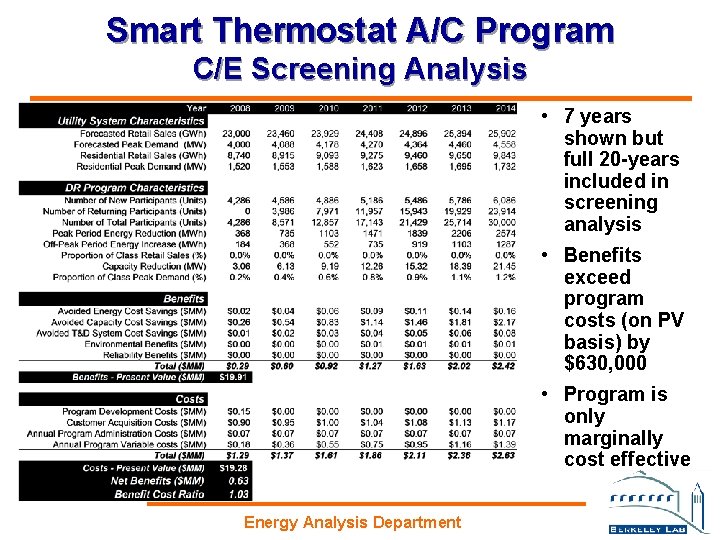
Smart Thermostat A/C Program C/E Screening Analysis • 7 years shown but full 20 -years included in screening analysis • Benefits exceed program costs (on PV basis) by $630, 000 • Program is only marginally cost effective Energy Analysis Department
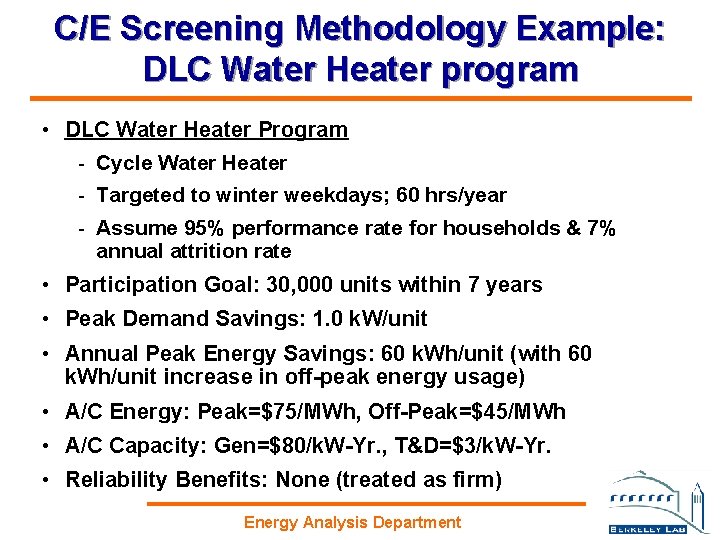
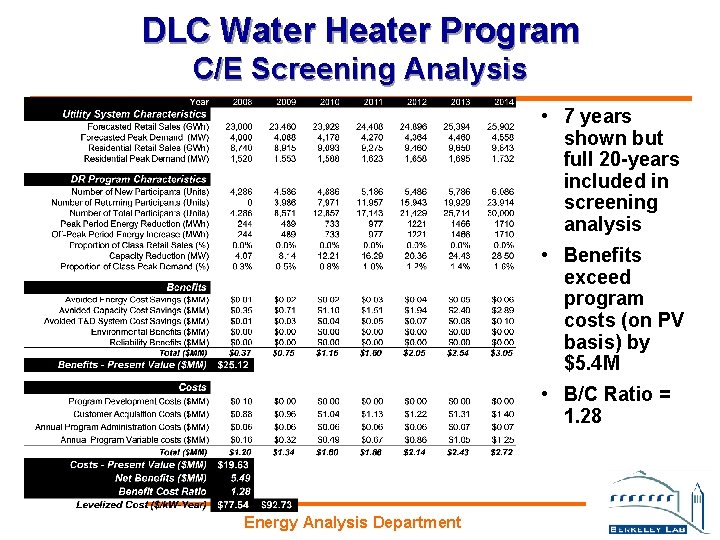
C/E Screening Methodology Example: DLC Water Heater program • DLC Water Heater Program - Cycle Water Heater - Targeted to winter weekdays; 60 hrs/year - Assume 95% performance rate for households & 7% annual attrition rate • Participation Goal: 30, 000 units within 7 years • Peak Demand Savings: 1. 0 k. W/unit • Annual Peak Energy Savings: 60 k. Wh/unit (with 60 k. Wh/unit increase in off-peak energy usage) • A/C Energy: Peak=$75/MWh, Off-Peak=$45/MWh • A/C Capacity: Gen=$80/k. W-Yr. , T&D=$3/k. W-Yr. • Reliability Benefits: None (treated as firm) Energy Analysis Department
DLC Water Heater Program C/E Screening Analysis • 7 years shown but full 20 -years included in screening analysis • Benefits exceed program costs (on PV basis) by $5. 4 M • B/C Ratio = 1. 28 Energy Analysis Department
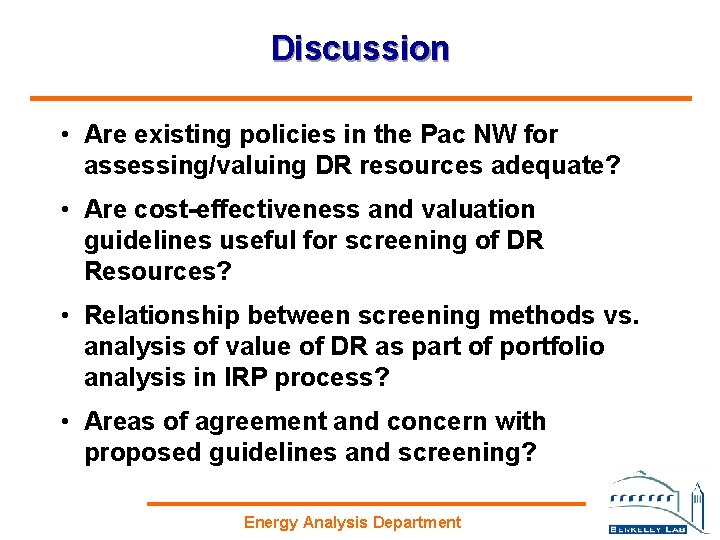
Discussion • Are existing policies in the Pac NW for assessing/valuing DR resources adequate? • Are cost-effectiveness and valuation guidelines useful for screening of DR Resources? • Relationship between screening methods vs. analysis of value of DR as part of portfolio analysis in IRP process? • Areas of agreement and concern with proposed guidelines and screening? Energy Analysis Department