
Costeffective Outbreak Detection in Networks Jure Leskovec Machine
Cost-effective Outbreak Detection in Networks Jure Leskovec Machine Learning Department, CMU Joint work with Andreas Krause, Carlos Guestrin, Christos Faloutsos, Jeanne Van. Briesen, and Natalie Glance
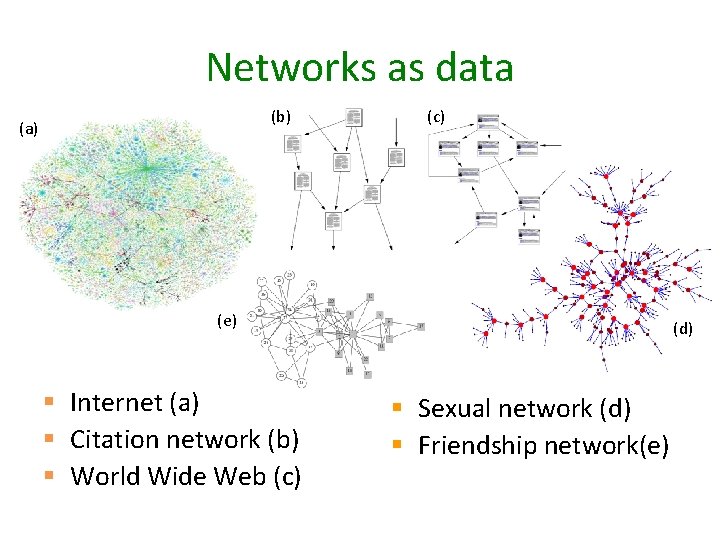
Networks as data (b) (a) (c) (e) § Internet (a) § Citation network (b) § World Wide Web (c) (d) § Sexual network (d) § Friendship network(e)
Networks – Social and Technological § Social network analysis: sociologists and computer scientists – influence goes both ways – Large-scale network data in “traditional” sociological domains • Friendship and informal contacts among people • Collaboration/influence in companies, organizations, professional communities, political movements, markets, … – Emerge of rich social structure in computing applications • Content creation, on-line communication, blogging, social networks, social media, electronic markets, … • People seeking information from other people vs. more formal channels: My. Space, del. icio. us, Flickr, Linked. In, Yahoo Answers, Facebook, …
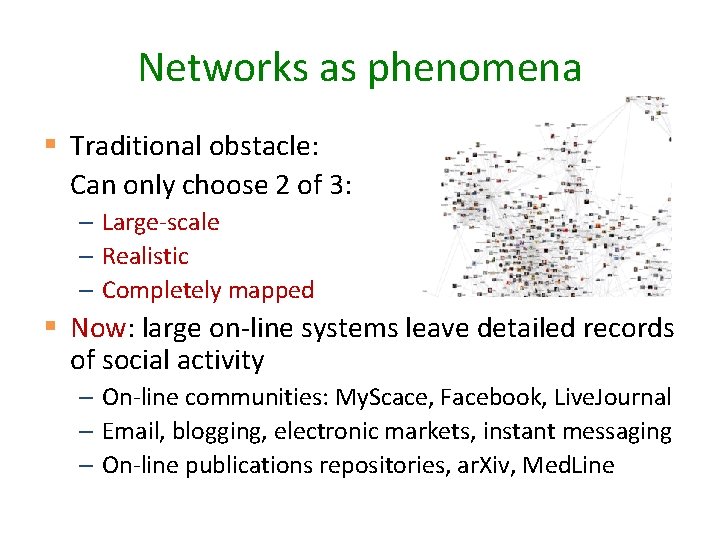
Networks as phenomena § Traditional obstacle: Can only choose 2 of 3: – Large-scale – Realistic – Completely mapped § Now: large on-line systems leave detailed records of social activity – On-line communities: My. Scace, Facebook, Live. Journal – Email, blogging, electronic markets, instant messaging – On-line publications repositories, ar. Xiv, Med. Line
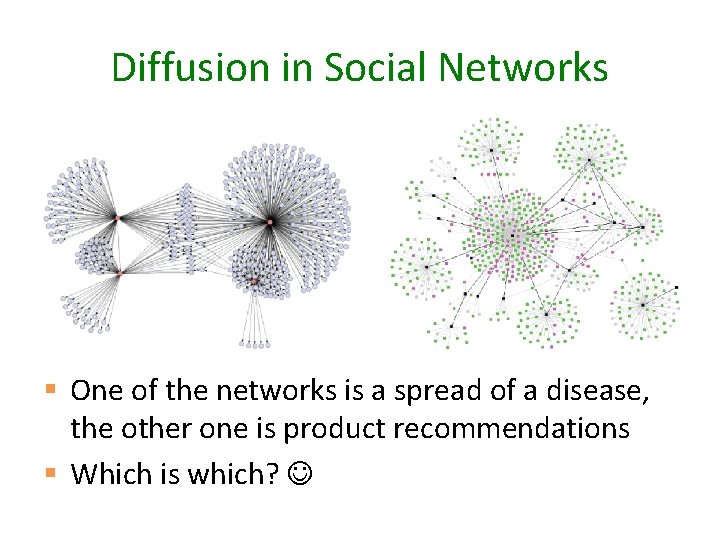
Diffusion in Social Networks § One of the networks is a spread of a disease, the other one is product recommendations § Which is which?
Diffusion in Social Networks § A fundamental process in social networks: Behaviors that cascade from node to node like an epidemic – News, opinions, rumors, fads, urban legends, … – Word-of-mouth effects in marketing: rise of new websites, free web based services – Virus, disease propagation – Change in social priorities: smoking, recycling – Saturation news coverage: topic diffusion among bloggers – Internet-energized political campaigns – Cascading failures in financial markets – Localized effects: riots, people walking out of a lecture
Empirical Studies of Diffusion § Experimental studies of diffusion have long history: – Spread of new agricultural practices [Ryan-Gross 1943] • Adoption of a new hybrid-corn between the 259 farmers in Iowa • Classical study of diffusion • Interpersonal network plays important role in adoption Diffusion is a social process – Spread of new medical practices [Coleman et al 1966] • Studied the adoption of a new drug between doctors in Illinois • Clinical studies and scientific evaluations were not sufficient to convince the doctors • It was the social power of peers that led to adoption
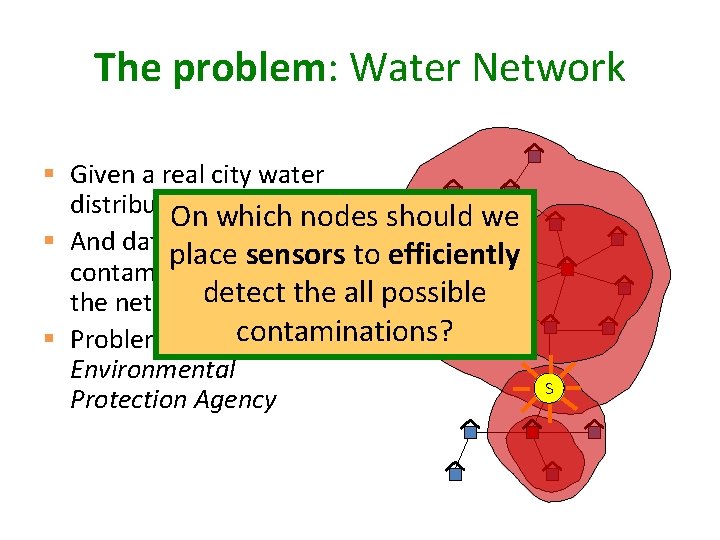
The problem: Water Network § Given a real city water distribution Onnetwork which nodes should we § And dataplace on how sensors to efficiently contaminants spread in the networkdetect the all possible § Problem posedcontaminations? by US Environmental Protection Agency S
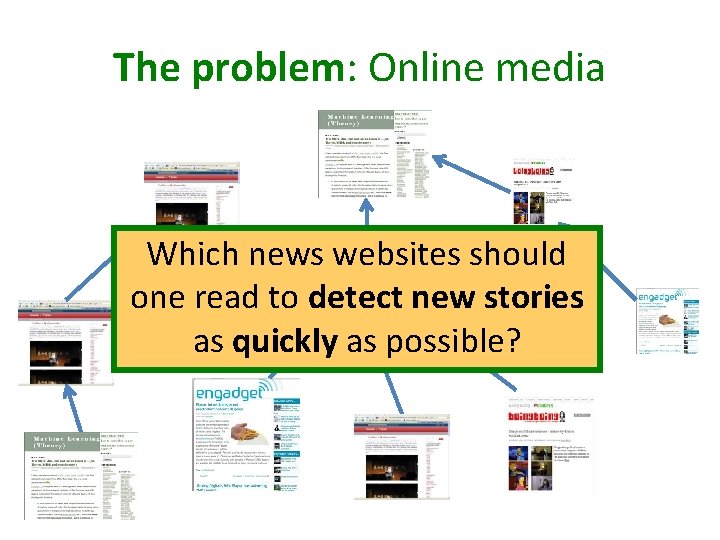
The problem: Online media Which news websites should one read to detect new stories as quickly as possible?
Cascade Detection: General Problem § Given a dynamic process spreading over the network § We want to select a set of nodes to detect the spreading process effectively § Many other applications: – Epidemics – Network security
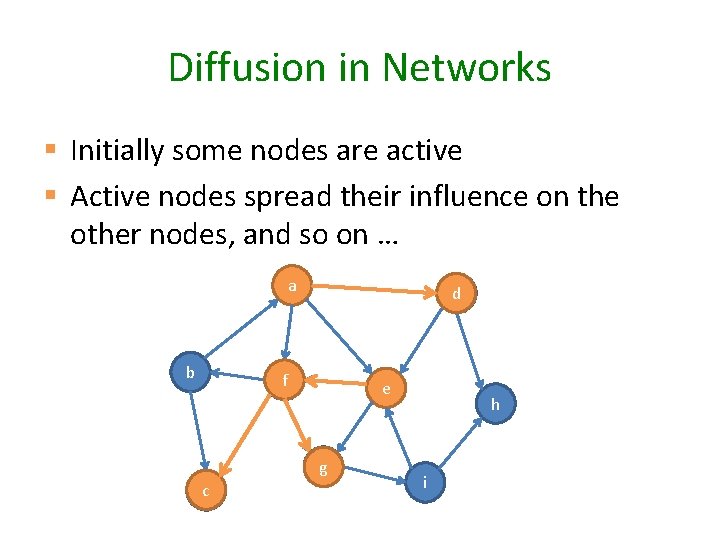
Diffusion in Networks § Initially some nodes are active § Active nodes spread their influence on the other nodes, and so on … a b d f e g c h i
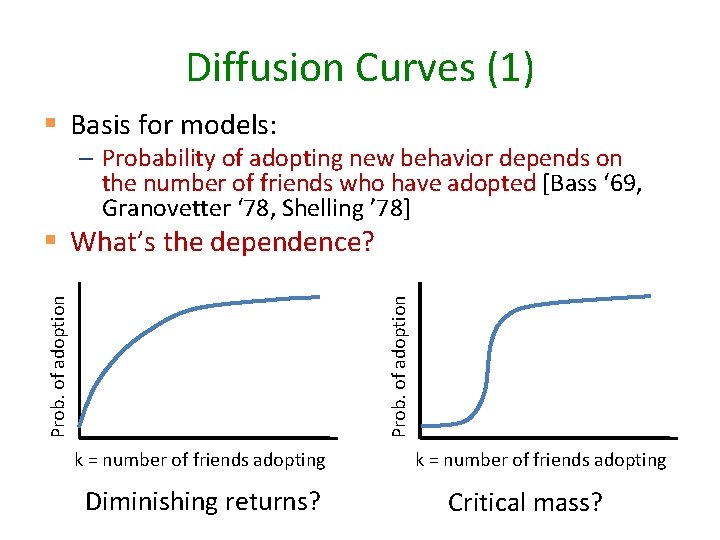
Diffusion Curves (1) § Basis for models: – Probability of adopting new behavior depends on the number of friends who have adopted [Bass ‘ 69, Granovetter ‘ 78, Shelling ’ 78] Prob. of adoption § What’s the dependence? k = number of friends adopting Diminishing returns? k = number of friends adopting Critical mass?
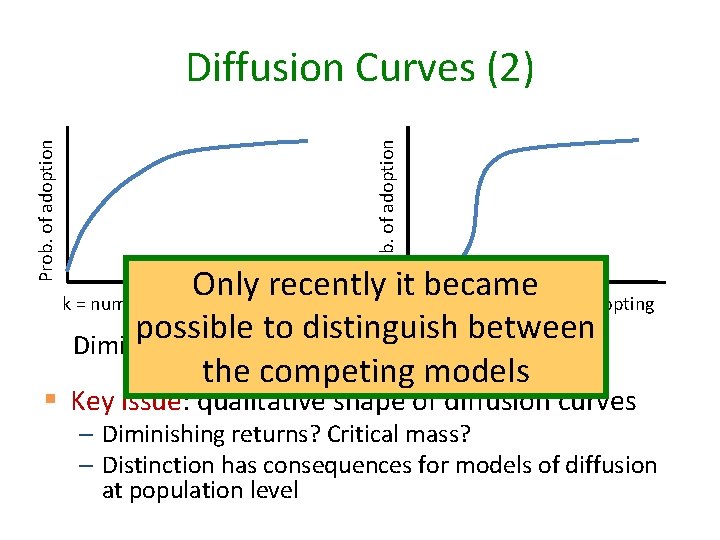
Prob. of adoption Diffusion Curves (2) Only recently it became k = number of friends adopting possible to distinguish between Diminishing returns? Critical mass? the competing models § Key issue: qualitative shape of diffusion curves – Diminishing returns? Critical mass? – Distinction has consequences for models of diffusion at population level
![Diffusion in Viral Marketing [2006] § Senders and followers of recommendations receive discounts on](http://slidetodoc.com/presentation_image/d16bb4ad960b56d91ba9a95fe9aba8f7/image-14.jpg "Diffusion in Viral Marketing [2006] § Senders and followers of recommendations receive discounts on")
Diffusion in Viral Marketing [2006] § Senders and followers of recommendations receive discounts on products 10% credit 10% off • Data – Incentivized Viral Marketing program • 16 million recommendations • 4 million people • 500, 000 products
![How do diffusion curves look like? § Viral marketing – DVD purchases [2006]: k](http://slidetodoc.com/presentation_image/d16bb4ad960b56d91ba9a95fe9aba8f7/image-15.jpg "How do diffusion curves look like? § Viral marketing – DVD purchases [2006]: k")
How do diffusion curves look like? § Viral marketing – DVD purchases [2006]: k (number of in-recommendations) – Mainly diminishing returns (saturation) – Turns upward for k = 0, 1, 2, …
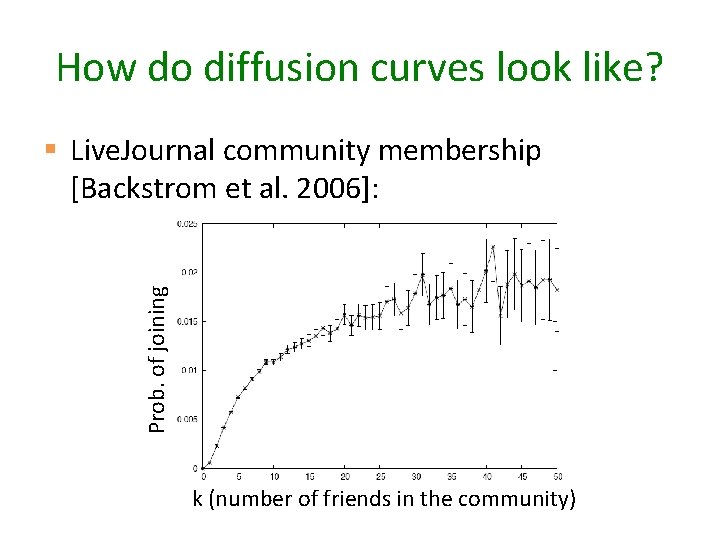
How do diffusion curves look like? Prob. of joining § Live. Journal community membership [Backstrom et al. 2006]: k (number of friends in the community)
![How do diffusion curves look like? § Email probability [Kossinets-Watts 2006]: Prob. of email](http://slidetodoc.com/presentation_image/d16bb4ad960b56d91ba9a95fe9aba8f7/image-17.jpg "How do diffusion curves look like? § Email probability [Kossinets-Watts 2006]: Prob. of email")
How do diffusion curves look like? § Email probability [Kossinets-Watts 2006]: Prob. of email – Email network of large university – Prob. of a link as a function of # of common friends k (number of common friends)
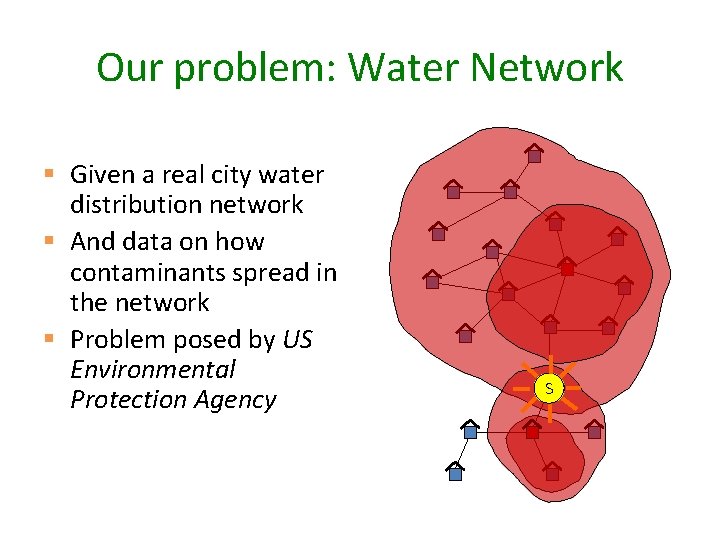
Our problem: Water Network § Given a real city water distribution network § And data on how contaminants spread in the network § Problem posed by US Environmental Protection Agency S
Two Parts to the Problem § Reward, e. g. : – 1) Minimize time to detection – 2) Maximize number of detected propagations – 3) Minimize number of infected people § Cost (location dependent): – Reading big blogs is more time consuming – Placing a sensor in a remote location is expensive
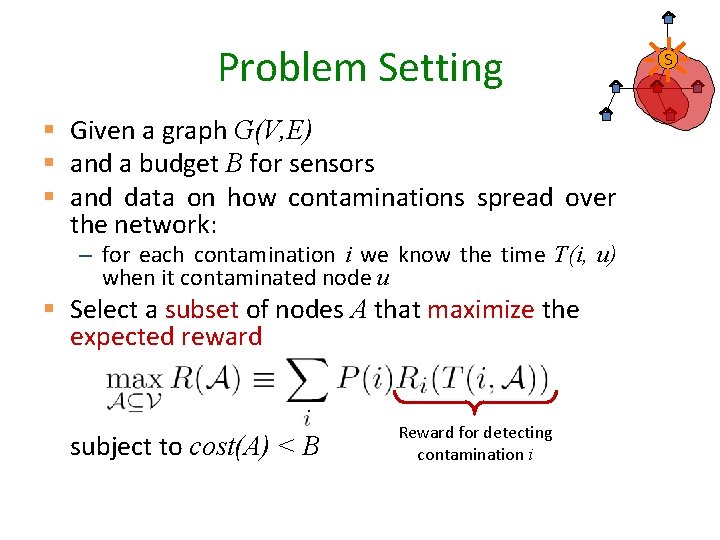
Problem Setting § Given a graph G(V, E) § and a budget B for sensors § and data on how contaminations spread over the network: – for each contamination i we know the time T(i, u) when it contaminated node u § Select a subset of nodes A that maximize the expected reward subject to cost(A) < B Reward for detecting contamination i S
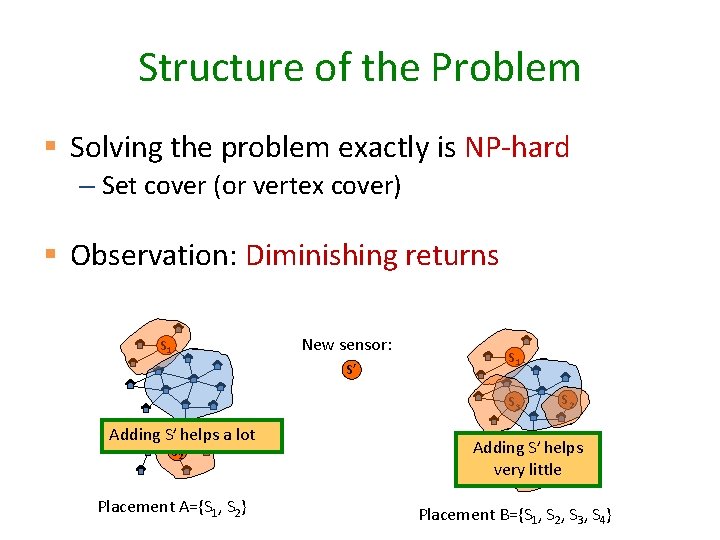
Structure of the Problem § Solving the problem exactly is NP-hard – Set cover (or vertex cover) § Observation: Diminishing returns S 1 New sensor: S’ S 1 S 3 Adding S’ helps a lot S 2 Placement A={S 1, S 2} S 2 Adding S’ helps very. S 4 little Placement B={S 1, S 2, S 3, S 4}
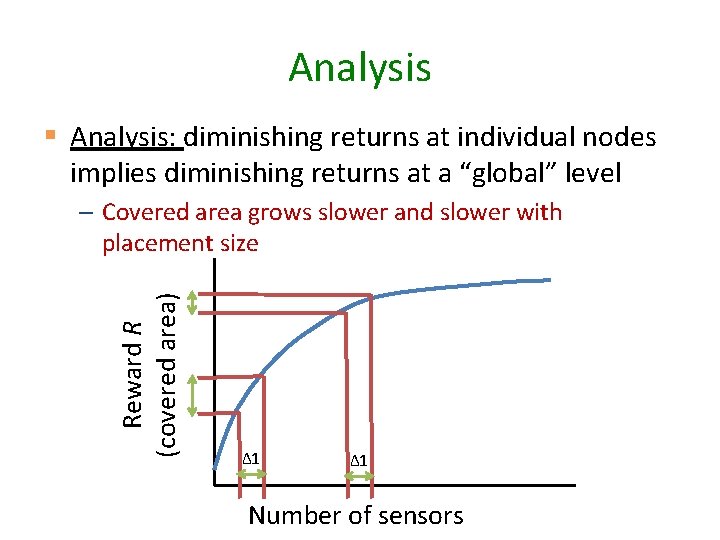
Analysis § Analysis: diminishing returns at individual nodes implies diminishing returns at a “global” level Reward R (covered area) – Covered area grows slower and slower with placement size Δ 1 Number of sensors
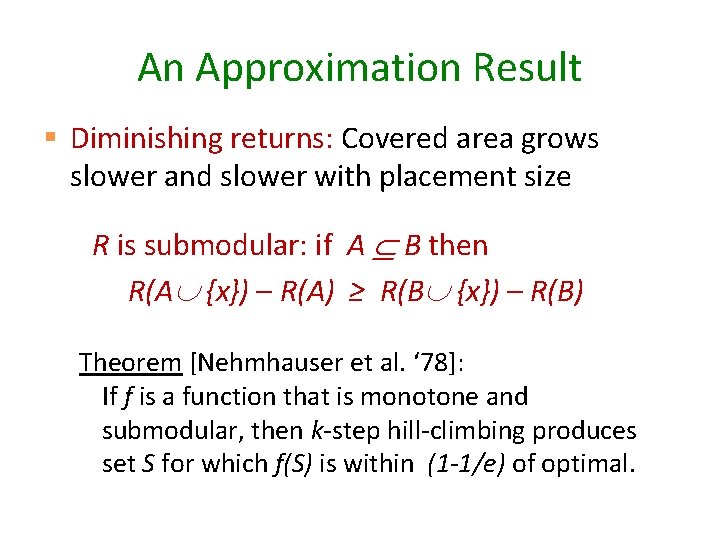
An Approximation Result § Diminishing returns: Covered area grows slower and slower with placement size R is submodular: if A B then R(A {x}) – R(A) ≥ R(B {x}) – R(B) Theorem [Nehmhauser et al. ‘ 78]: If f is a function that is monotone and submodular, then k-step hill-climbing produces set S for which f(S) is within (1 -1/e) of optimal.
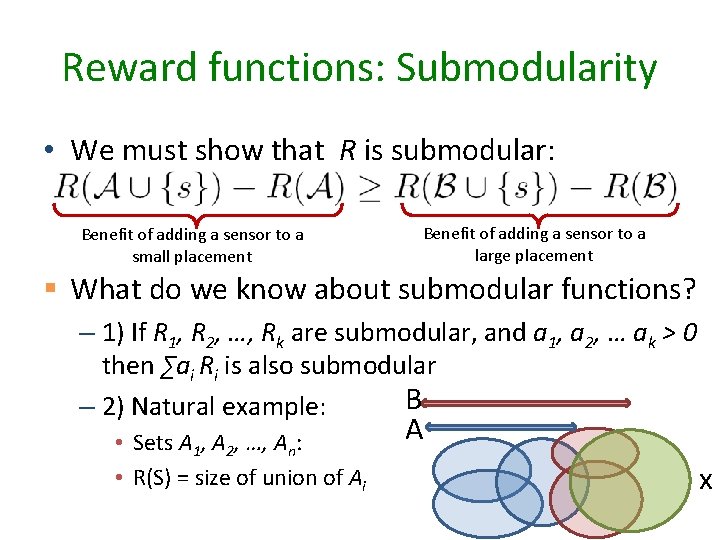
Reward functions: Submodularity • We must show that R is submodular: Benefit of adding a sensor to a small placement Benefit of adding a sensor to a large placement § What do we know about submodular functions? – 1) If R 1, R 2, …, Rk are submodular, and a 1, a 2, … ak > 0 then ∑ai Ri is also submodular B – 2) Natural example: • Sets A 1, A 2, …, An: • R(S) = size of union of Ai A x
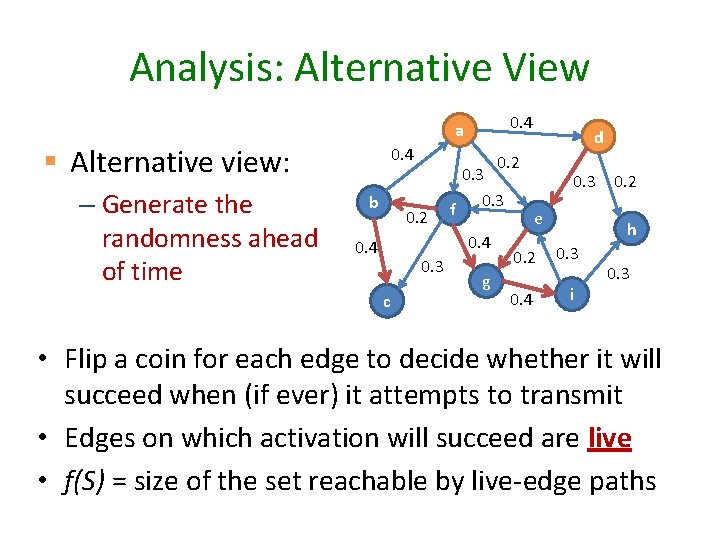
Analysis: Alternative View a § Alternative view: – Generate the randomness ahead of time 0. 4 d 0. 2 0. 3 b f 0. 2 e h 0. 4 0. 2 0. 3 g i 0. 4 c • Flip a coin for each edge to decide whether it will succeed when (if ever) it attempts to transmit • Edges on which activation will succeed are live • f(S) = size of the set reachable by live-edge paths
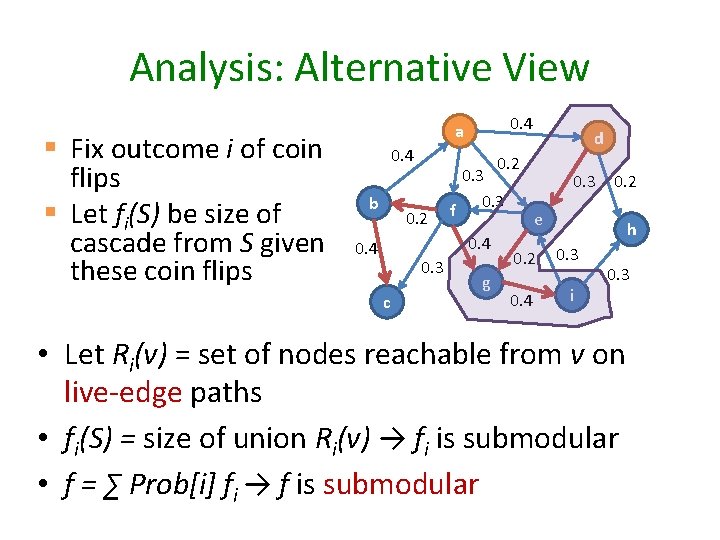
Analysis: Alternative View § Fix outcome i of coin flips § Let fi(S) be size of cascade from S given these coin flips a 0. 4 d 0. 2 0. 3 b f 0. 2 e h 0. 4 0. 3 0. 2 0. 3 g i 0. 4 c • Let Ri(v) = set of nodes reachable from v on live-edge paths • fi(S) = size of union Ri(v) → fi is submodular • f = ∑ Prob[i] fi → f is submodular
Reward Functions are Submodular § Objective functions from Battle of Water Sensor Networks competition [Ostfeld et al]: – 1) Time to detection (DT) • How long does it take to detect a contamination? – 2) Detection likelihood (DL) • How many contaminations do we detect? – 3) Population affected (PA) • How many people drank contaminated water? are all submodular

Background: Submodular functions What do we know about optimizing submodular functions? § A hill-climbing (i. e. , greedy) is near optimal (1 -1/e (~63%) of optimal) Hill-climbing reward d a b c b § But a c d e Add sensor with highest marginal gain e – 1) this only works for unit cost case (each sensor/location costs the same) – 2) Hill-climbing algorithm is slow • At each iteration we need to re-evaluate marginal gains • It scales as O(|V|B)
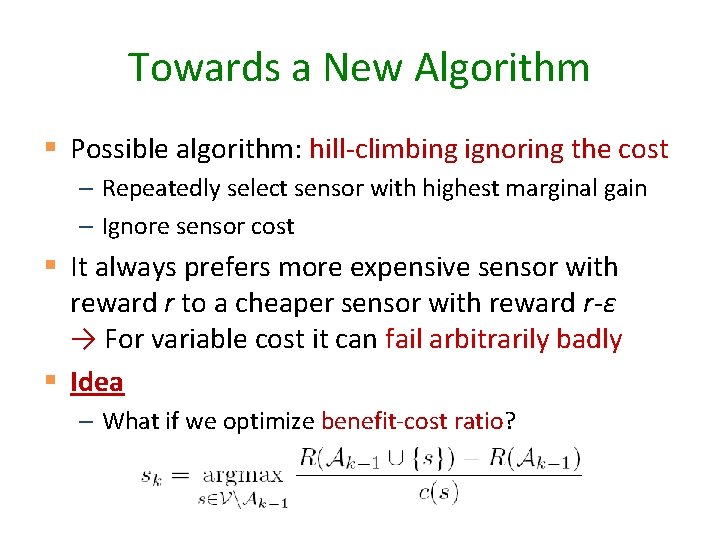
Towards a New Algorithm § Possible algorithm: hill-climbing ignoring the cost – Repeatedly select sensor with highest marginal gain – Ignore sensor cost § It always prefers more expensive sensor with reward r to a cheaper sensor with reward r-ε → For variable cost it can fail arbitrarily badly § Idea – What if we optimize benefit-cost ratio?

Benefit-Cost: More Problems § Bad news: Optimizing benefit-cost ratio can fail arbitrarily badly § Example: Given a budget B, consider: – 2 locations s 1 and s 2: What if we take best of bothratio solutions? – Then benefit-cost is • Costs: c(s 1)=ε, c(s 2)=B • Only 1 cascade with reward: R(s 1)=2ε, R(s 2)=B • bc(s 1)=2 and bc(s 2)=1 – So, we first select s 1 and then can not afford s 2 →We get reward 2ε instead of B Now send ε to 0 and we get arbitrarily bad
Solution: CELF Algorithm § CELF (cost-effective lazy forward-selection): A two pass greedy algorithm: • Set (solution) A: use benefit-cost greedy • Set (solution) B: use unit cost greedy – Final solution: argmax(R(A), R(B)) § How far is CELF from (unknown) optimal solution? § Theorem: CELF is near optimal – CELF achieves ½(1 -1/e) factor approximation § CELF is much faster than standard hill-climbing
How good is the solution? § Traditional bound (1 -1/e) tells us: How far from optimal are we even before seeing the data and running the algorithm § Can we do better? Yes! § We develop a new tighter bound. Intuition: – Marginal gains are decreasing with the solution size – We use this to get tighter bound on the solution
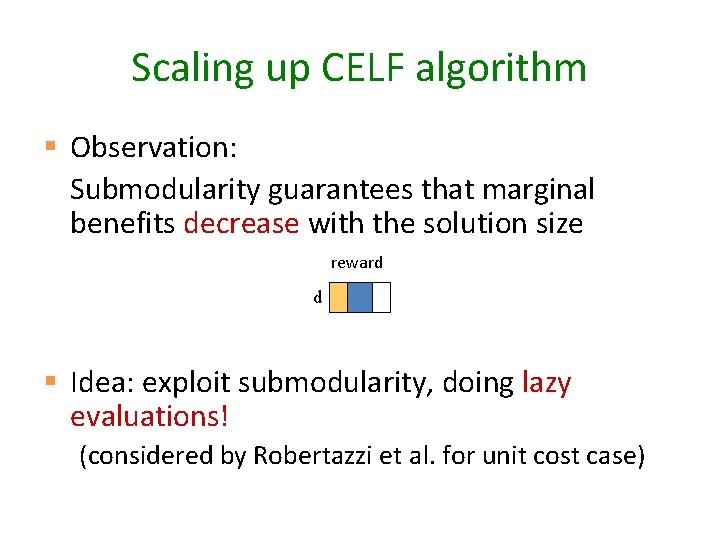
Scaling up CELF algorithm § Observation: Submodularity guarantees that marginal benefits decrease with the solution size reward d § Idea: exploit submodularity, doing lazy evaluations! (considered by Robertazzi et al. for unit cost case)
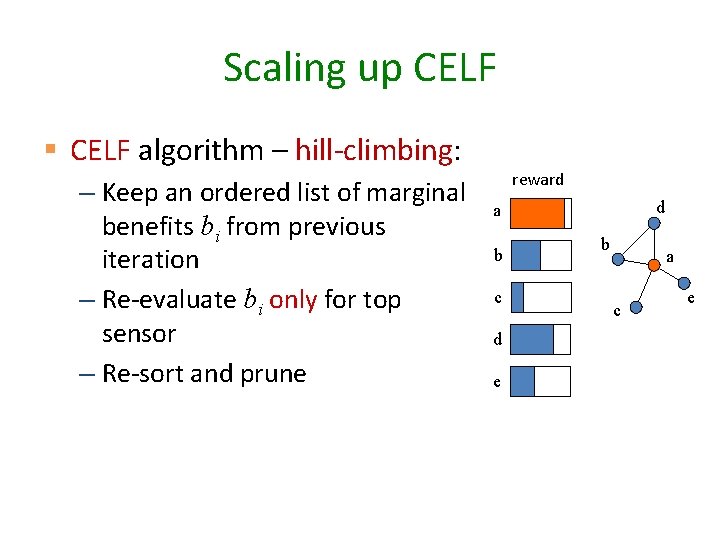
Scaling up CELF § CELF algorithm – hill-climbing: – Keep an ordered list of marginal benefits bi from previous iteration – Re-evaluate bi only for top sensor – Re-sort and prune reward d a b c d e b a c e
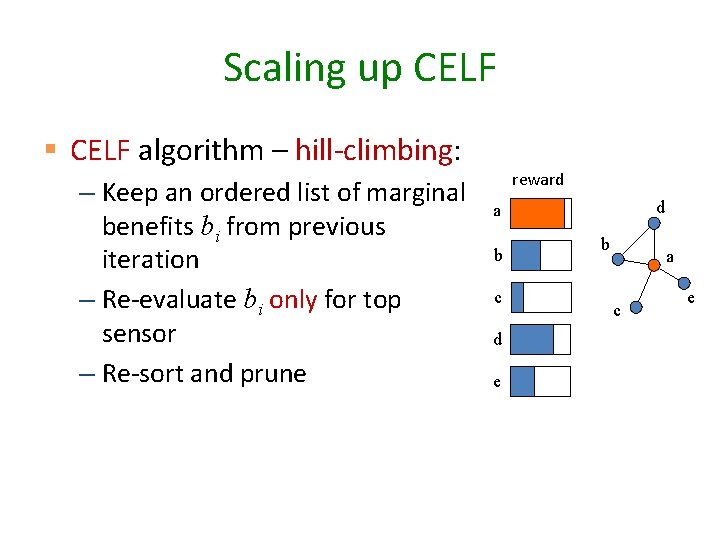
Scaling up CELF § CELF algorithm – hill-climbing: – Keep an ordered list of marginal benefits bi from previous iteration – Re-evaluate bi only for top sensor – Re-sort and prune reward d a b c d e b a c e
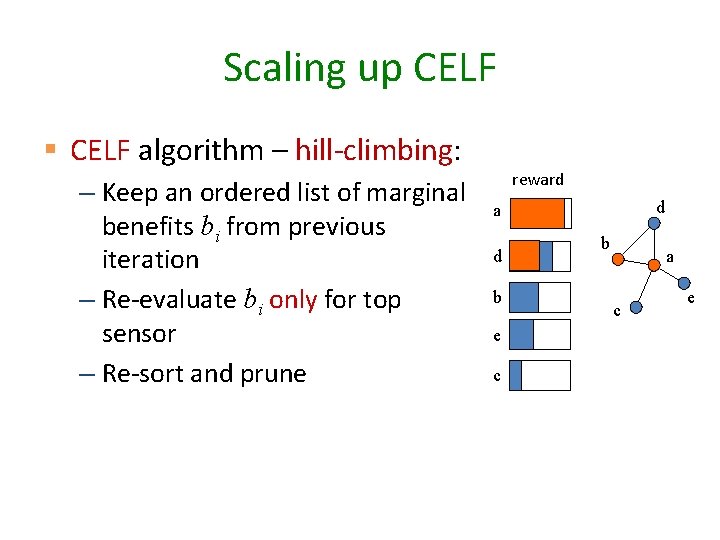
Scaling up CELF § CELF algorithm – hill-climbing: – Keep an ordered list of marginal benefits bi from previous iteration – Re-evaluate bi only for top sensor – Re-sort and prune reward d a d b e c b a c e
Experiments: 2 Case Studies § We have real propagation data – Blog network: • We crawled blogs for 1 year • We identified cascades – temporal propagation of information – Water distribution network: • Real city water distribution networks • Realistic simulator of water consumption provided by US Environmental Protection Agency
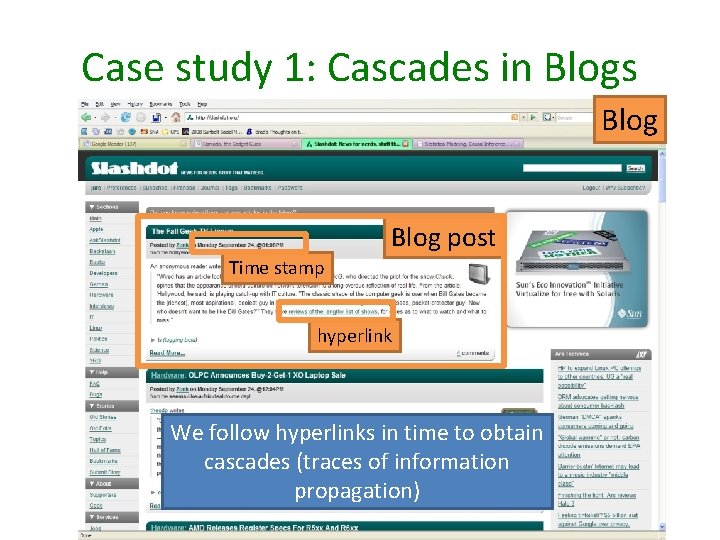
Case study 1: Cascades in Blogs Blog post Time stamp hyperlink We follow hyperlinks in time to obtain cascades (traces of information propagation)
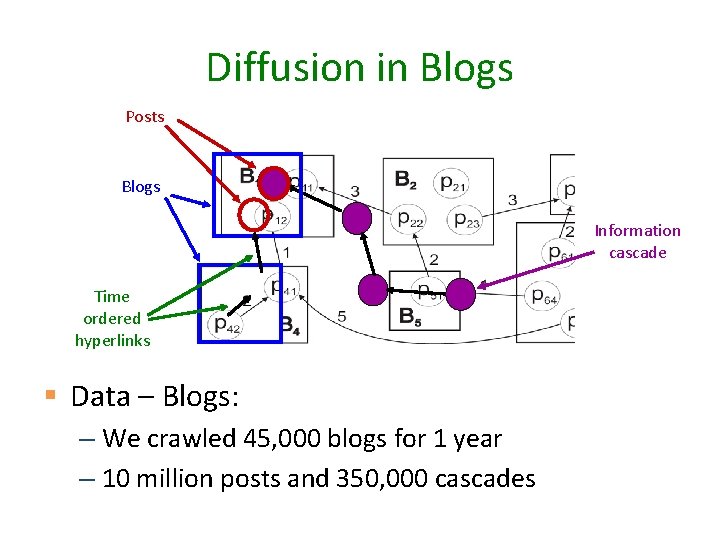
Diffusion in Blogs Posts Blogs Information cascade Time ordered hyperlinks § Data – Blogs: – We crawled 45, 000 blogs for 1 year – 10 million posts and 350, 000 cascades
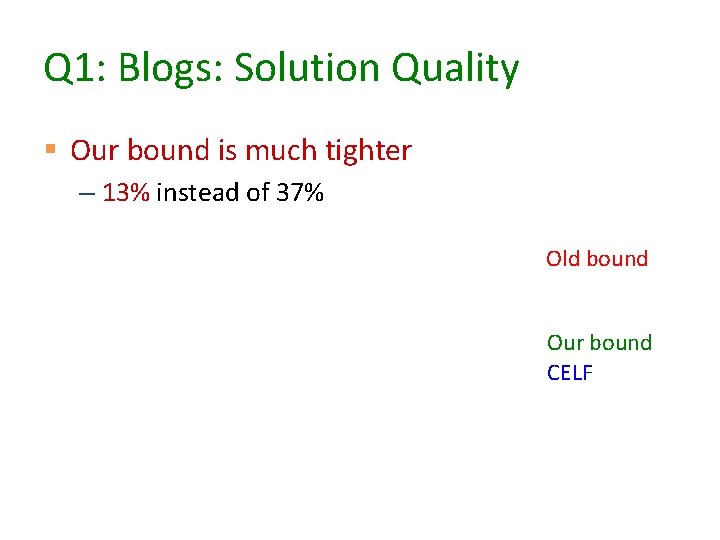
Q 1: Blogs: Solution Quality § Our bound is much tighter – 13% instead of 37% Old bound Our bound CELF
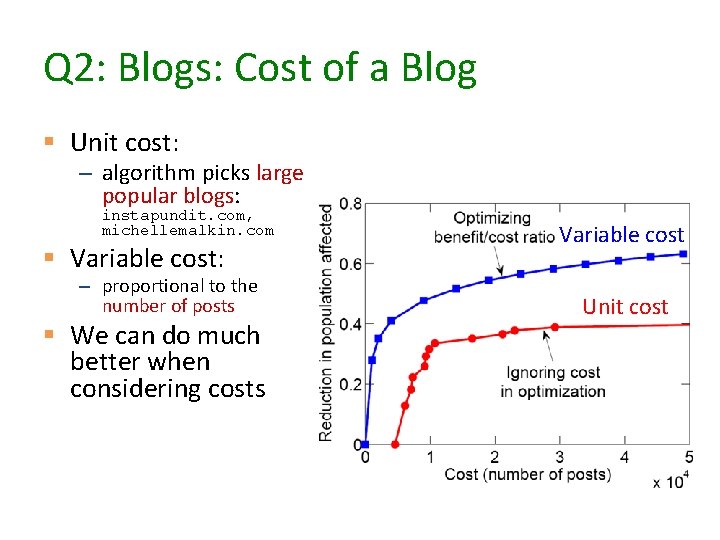
Q 2: Blogs: Cost of a Blog § Unit cost: – algorithm picks large popular blogs: instapundit. com, michellemalkin. com § Variable cost: – proportional to the number of posts § We can do much better when considering costs Variable cost Unit cost
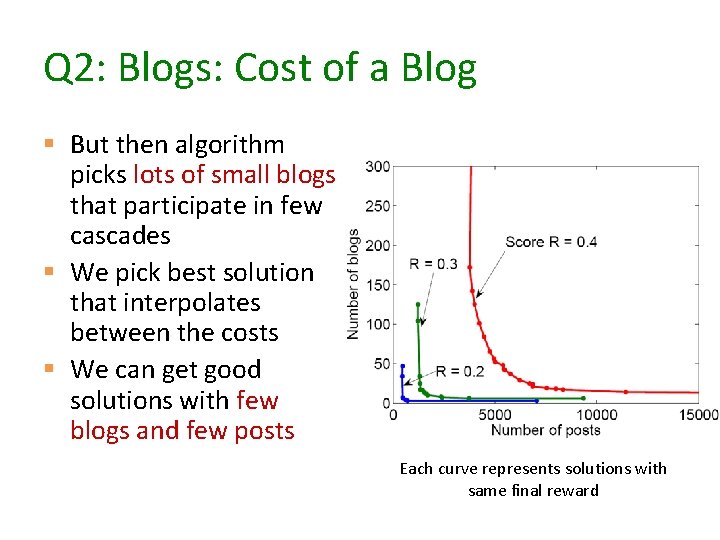
Q 2: Blogs: Cost of a Blog § But then algorithm picks lots of small blogs that participate in few cascades § We pick best solution that interpolates between the costs § We can get good solutions with few blogs and few posts Each curve represents solutions with same final reward
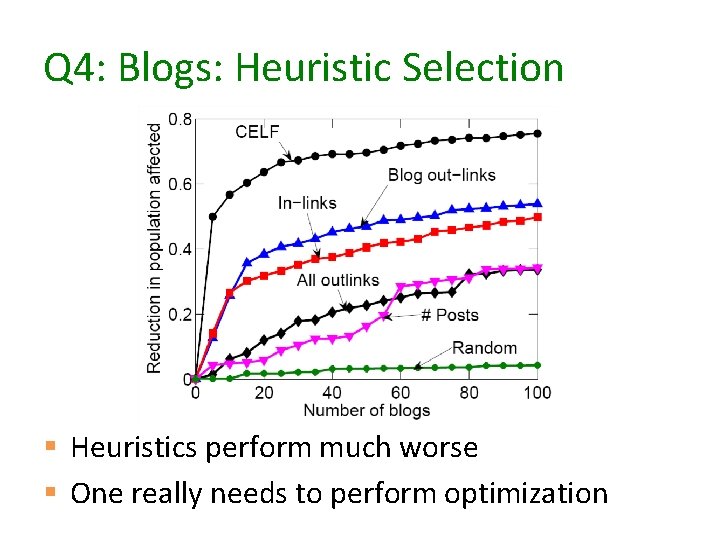
Q 4: Blogs: Heuristic Selection § Heuristics perform much worse § One really needs to perform optimization
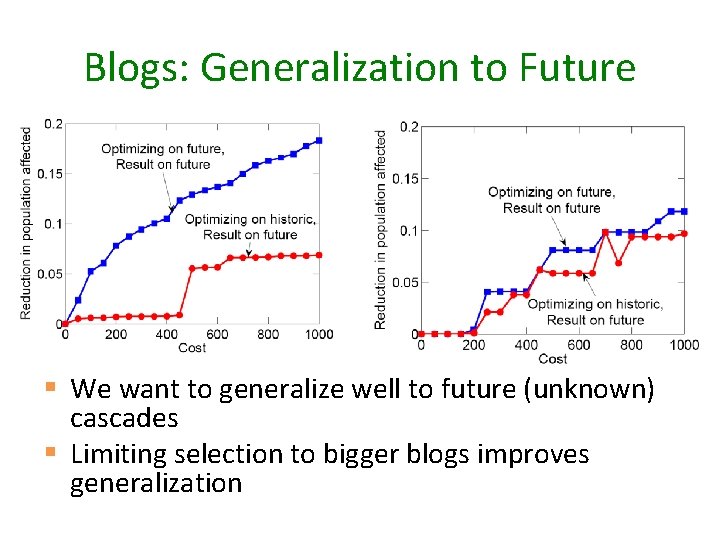
Blogs: Generalization to Future § We want to generalize well to future (unknown) cascades § Limiting selection to bigger blogs improves generalization
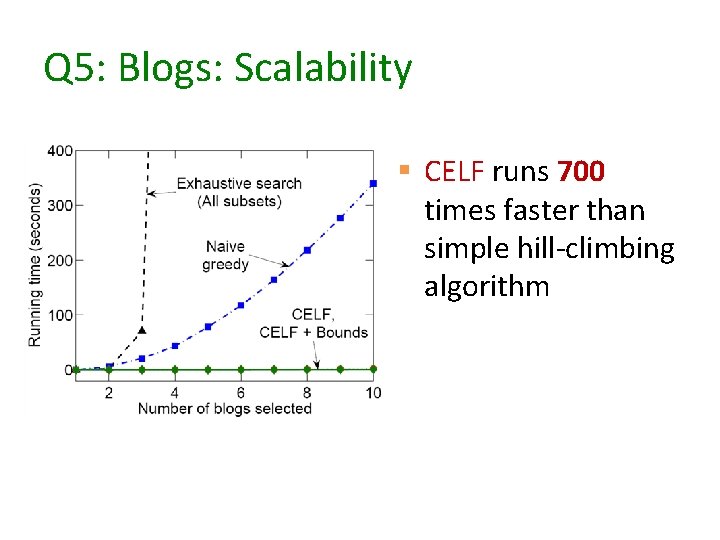
Q 5: Blogs: Scalability § CELF runs 700 times faster than simple hill-climbing algorithm
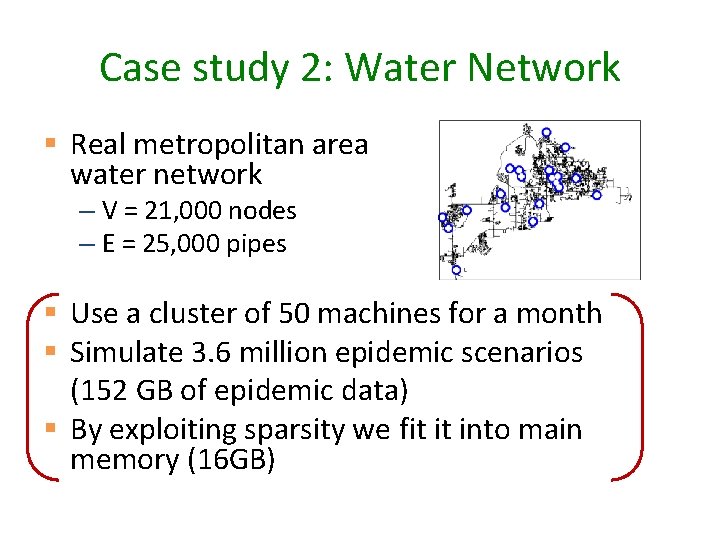
Case study 2: Water Network § Real metropolitan area water network – V = 21, 000 nodes – E = 25, 000 pipes § Use a cluster of 50 machines for a month § Simulate 3. 6 million epidemic scenarios (152 GB of epidemic data) § By exploiting sparsity we fit it into main memory (16 GB)
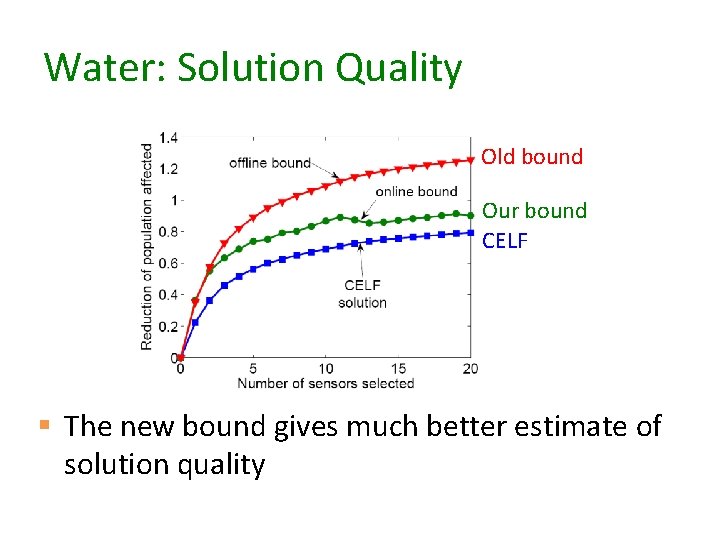
Water: Solution Quality Old bound Our bound CELF § The new bound gives much better estimate of solution quality
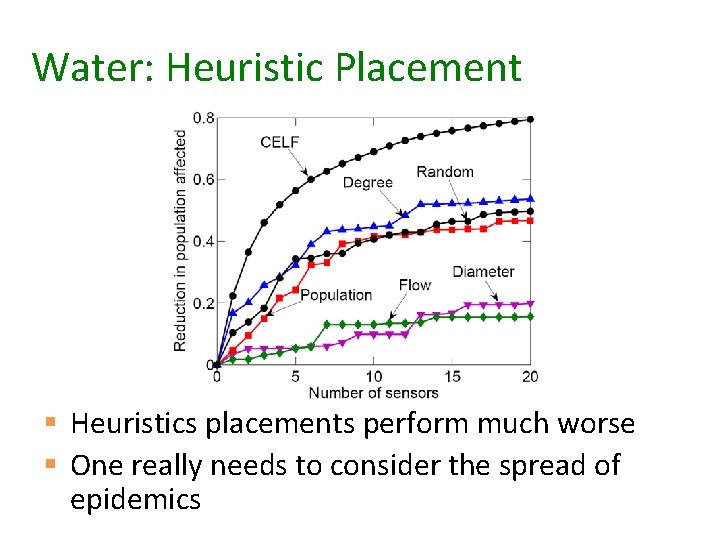
Water: Heuristic Placement § Heuristics placements perform much worse § One really needs to consider the spread of epidemics
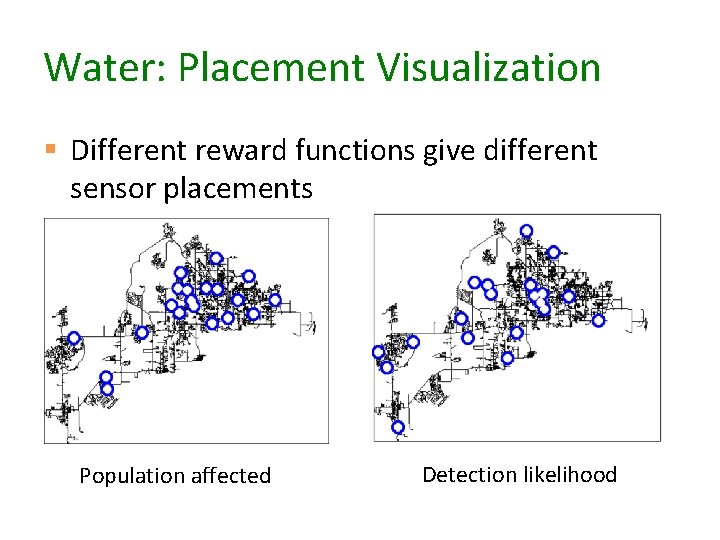
Water: Placement Visualization § Different reward functions give different sensor placements Population affected Detection likelihood
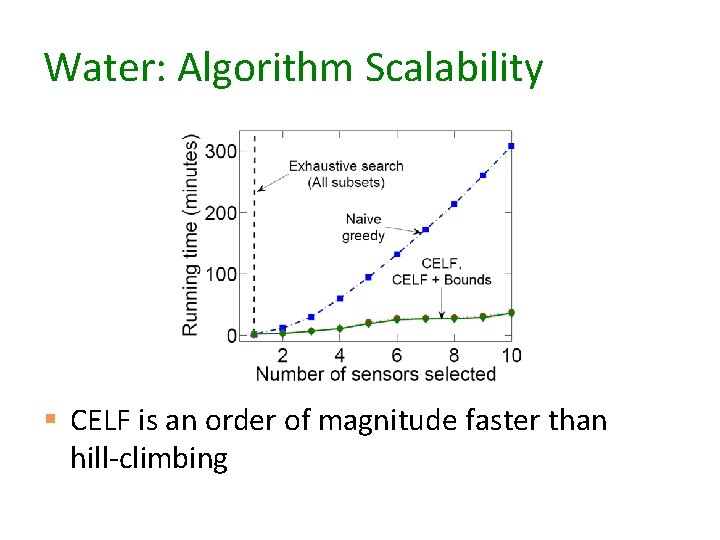
Water: Algorithm Scalability § CELF is an order of magnitude faster than hill-climbing
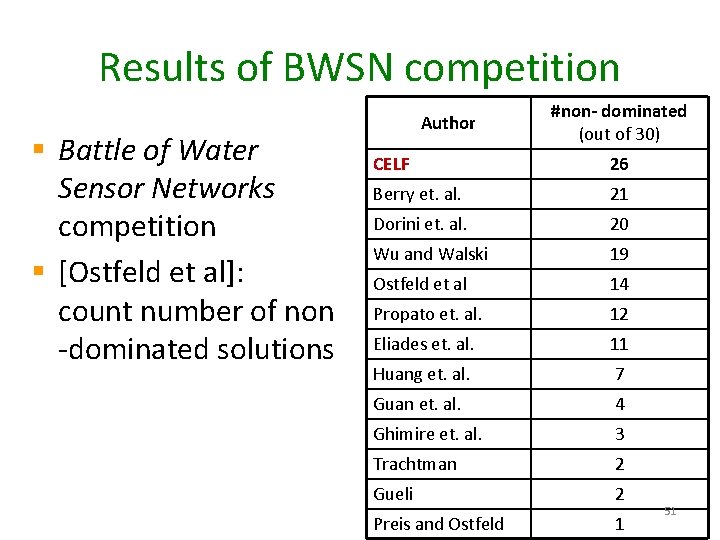
Results of BWSN competition § Battle of Water Sensor Networks competition § [Ostfeld et al]: count number of non -dominated solutions Author #non- dominated (out of 30) CELF 26 Berry et. al. 21 Dorini et. al. 20 Wu and Walski 19 Ostfeld et al 14 Propato et. al. 12 Eliades et. al. 11 Huang et. al. 7 Guan et. al. 4 Ghimire et. al. 3 Trachtman 2 Gueli 2 Preis and Ostfeld 1 51
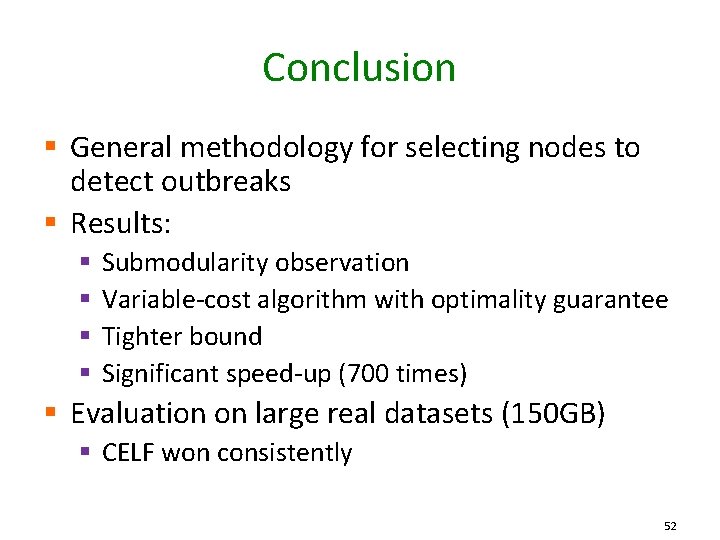
Conclusion § General methodology for selecting nodes to detect outbreaks § Results: § § Submodularity observation Variable-cost algorithm with optimality guarantee Tighter bound Significant speed-up (700 times) § Evaluation on large real datasets (150 GB) § CELF won consistently 52
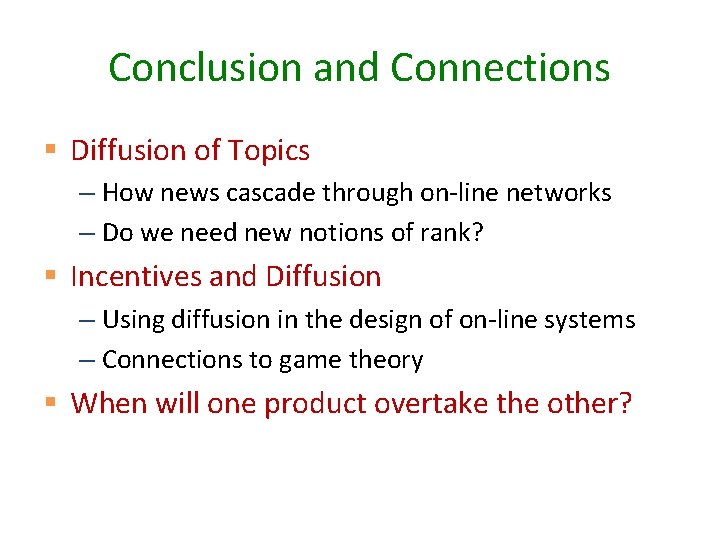
Conclusion and Connections § Diffusion of Topics – How news cascade through on-line networks – Do we need new notions of rank? § Incentives and Diffusion – Using diffusion in the design of on-line systems – Connections to game theory § When will one product overtake the other?
Further Connections § Diffusion of topics [Gruhl et al ‘ 04, Adar et al ‘ 04]: – News stories cascade through networks of bloggers – How do we track stories and rank news sources? § Recommendation incentive networks -Adamic-Huberman ‘ 07]: [Leskovec – How much reward is needed to make the product “workof-mouth” success? § Query incentive networks [Kleinberg-Raghavan ‘ 05]: – Pose a request to neighbors; offer reward for answer – Neighbors can pass on request by offering (smaller) reward – How much reward is needed to produce an answer?
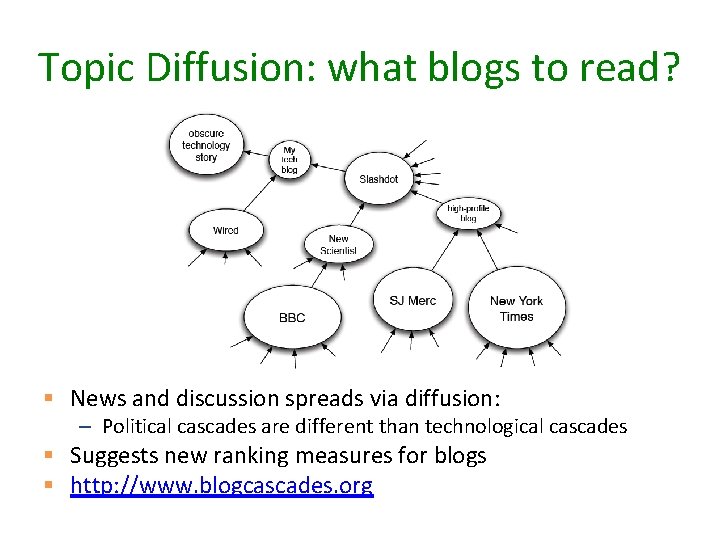
Topic Diffusion: what blogs to read? § News and discussion spreads via diffusion: – Political cascades are different than technological cascades § Suggests new ranking measures for blogs § http: //www. blogcascades. org
References § D. Kempe, J. Kleinberg, E. Tardos. Maximizing the Spread of Influence through a Social Network. ACM KDD, 2003. § Jure Leskovec, Lada Adamic, Bernardo Huberman. The Dynamics of Viral Marketing. ACM TWEB, 2007. § Jure Leskovec, Mary Mc. Glohon, Christos Faloutsos, Natalie Glance, Matthew Hurst. Cascading Behavior in Large Blog Graphs. SIAM Data Mining, 2007. § Jure Leskovec, Ajit Singh, Jon Kleinberg. Patterns of Influence in a Recommendation Network. PAKDD, 2006. § Jure Leskovec, Andreas Krause, Carlos Guestrin, Christos Faloutsos, Jeanne Van. Briesen, Natalie Glance. Cost-effective Outbreak Detection in Networks. ACM KDD, 2007. http: //www. blogcascades. org
- Slides: 56