
Costa Rica Geography Borders the Caribbean Sea and
Costa Rica
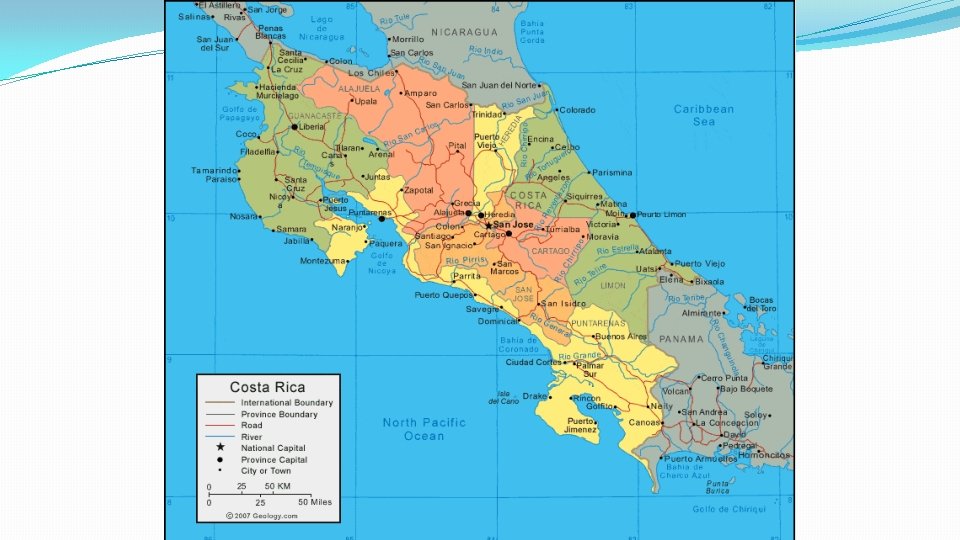
Geography �Borders the Caribbean Sea and the North Pacific Ocean and is between Nicaragua and Panama �Total area: 51, 100 square kilometers �Capital city: San José �Other big cities: Alajuela, Cartago, Heredia, Puntarenas
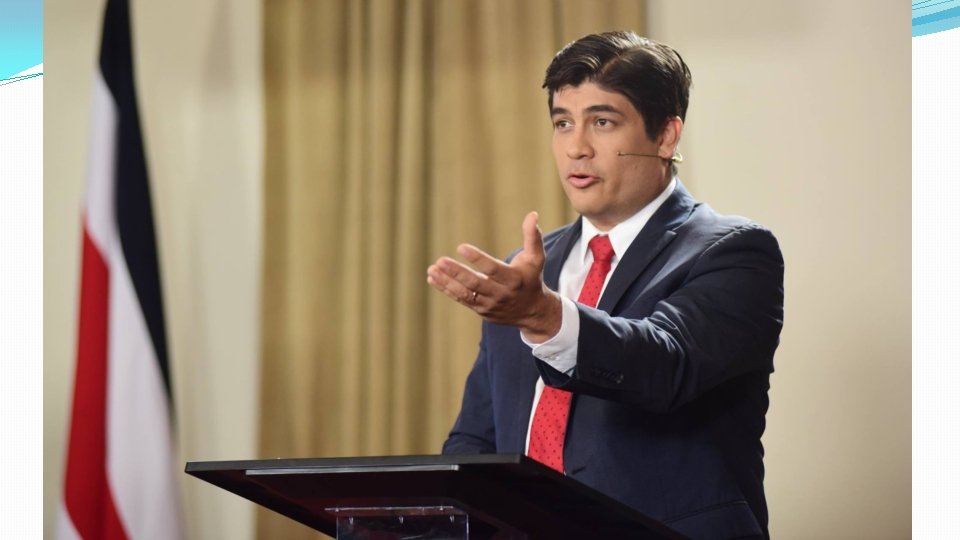
Political �A permanent settlement of Cartago was established as a colony under Spanish rule in 1563 for about two and a half centuries. In 1821, Costa Rica joined a group of other Central American provinces that jointly declared their independence from Spain. Since the late 19 th century, only two brief periods of violence have marred the country’s democratic development and in 1948, the country dissolved its armed forces. �Current government type: presidential republic �Current president: Carlos Alvarado Quesada
Carlos Alvarado Quesada �Carlos Alvarado Quesada is the 48 th President of Costa Rica and is a member of the center-left Citizens’ Action Party. �He was previously Minister of Labor and Social Security during the Presidency of Solís Rivera. �He is the youngest serving Costa Rica President since Alfredo González Flores in 1914. �Alvarado Quesada argued to respect the Inter-American Court of Human Rights’ ruling that Costa Rica recognize same-sex marriages, resulting in him winning the election in a landslide.
People �Population: 4, 930, 258 (2017) �Ethnic groups: white or mestizo 83. 6%, mulatto 6. 7%, indigenous 2. 4%, black of African descent 1. 1%, other 1. 1%, none 2. 9%, unspecified 2. 2% �Religions: Roman Catholic 71. 8%, Evangelical and Pentecostal 12. 3%, other Protestant 2. 6%, Jehovah’s Witness 0. 5%, other 2. 4%, none 10. 4% �Languages: Spanish, English �Literacy Rate: 97. 8% of the total population ages 15 and over can read and write �Major infectious diseases: bacterial diarrhea, dengue fever
Economy �Since 2010, Costa Rica has enjoyed strong and stable economic growth. Foreign investors are attracted by the country’s political stability and relatively high education levels. However, the economy faces challenges due to a rising fiscal deficit, rising public debt, and relatively low levels of domestic revenue. Poverty has remained around 20 -25% for almost 20 years. �GDP – per capita: $16, 900 (2017) �$1 = 582. 50 Costa Rican Colón �GDP – composition by sector of origin: agriculture 5. 5%, industry 21%, services 73. 5% �Population below poverty line: 21. 7% (2014) �Unemployment rate: 8. 1% (2017)
Transnational Issues �Costa Rica and Nicaragua regularly file border dispute cases over the delimitations of the San Juan River and the northern tip of Calero Island to the International Court of Justice (ICJ). �There are currently 11, 528 refugees in Costa Rica, with 71 stateless persons. �Costa Rica is a source, transit, and destination country for men, women, and children subjected to sex trafficking and forced labor. It has a tier rating of tier 2 watch list, meaning that it does not fully comply with the minimum standards for the elimination of trafficking, but is making efforts to do so. �It is a transshipment country for cocaine and heroine from South America, there is illicit production of cannabis, there is domestic cocaine consumption, and a significant consumption of amphetamines.
Operation World: Prayer Challenge �The Roman Catholic Church is deeply impacted by charismatic renewal. Many have come to a living, personal faith in Christ, which has strengthened the Catholic Church (higher mass attendance, more indigenous seminarians and priests). Although 73% of the nation is Catholic, this percent declines ever year, and most Catholics are quite nominal in their faith. From the charismatic renewal, many left the Catholic Church for evangelical churches; however, large and increasing numbers of “post-evangelicals” have returned to the familiarity and structure of Catholicism. Pray for both charismatics who stayed in the Catholic Church and those who have returned – may their faith bring further renewal to the mainstream of Catholicism.
Operation World: Payer Challenge cont. There are signs of progress: �Increased cooperative efforts for outreach and mission, despite lingering hesitations on the part of some evangelicals. The Costa Rican Evangelical Alliance, representing the majority of denominations, initiated the programme “Costa Rica Century XXI” to promote the development of churches at every level. Pray for a cutting edge to this vision, and for the leaders of this ambitious programme. �Some of the best training options in Latin America. There are 26 Bible schools and seminaries and a very extensive and effective TEE programme (SEAM). Two of the most influential are UNELA (Evangelical University of the Americas) and UBILA (Latin American Biblical University); both train Christians to minister effectively to all segments of society – be it through church work, missions, or marketplace ministry. There are plenty of training opportunities; pray that Costa Ricans would use them to raise the bar for leadership and to strengthen the Church.
- Slides: 12