
Cost of Constructing and Operating Public Infrastructure Systems
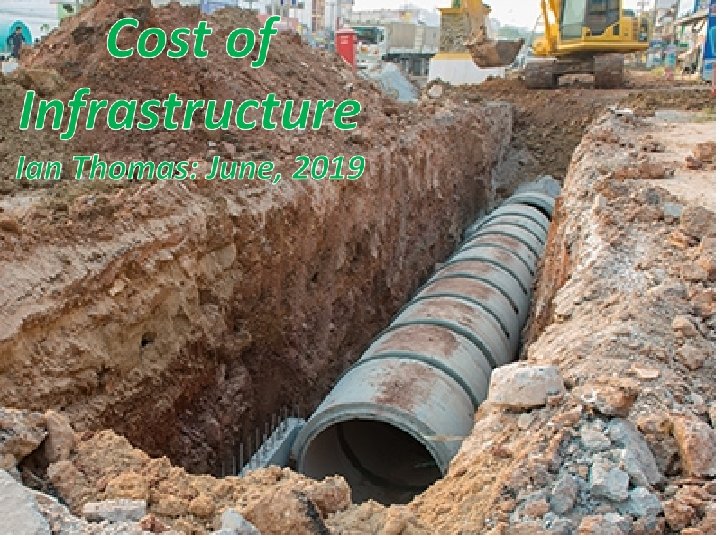
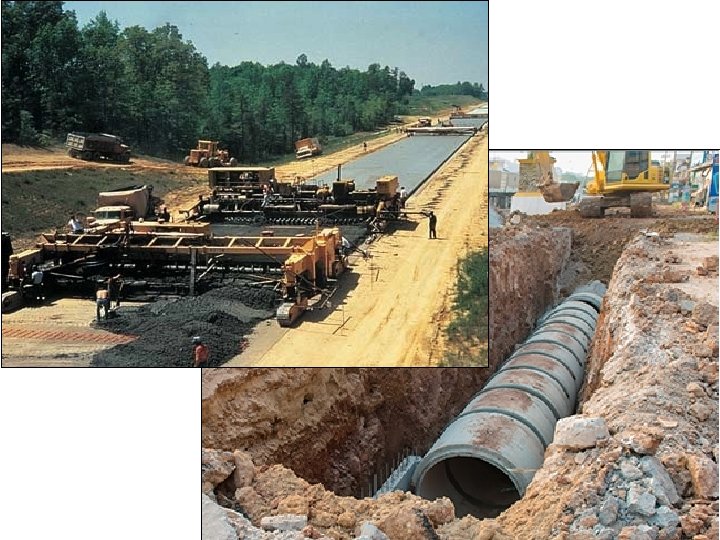
Cost of Constructing and Operating Public Infrastructure Systems Two Independent Cost Components Need to be Recovered: 1. One-time capital construction cost to add capacity: • Proportional to number/size of homes built • Efficiently and fairly recovered with one-time fee on new development 2. Ongoing operations, maintenance, and service delivery costs: • Proportional to quantity/usage of service • Efficiently and fairly recovered by combining with ongoing per unit of consumption cost of service delivery
Cost of Constructing and Operating Public Infrastructure Systems Two Independent Cost Components Need to be Recovered: 1. One-time capital construction cost to add capacity: • Proportional to number/size of homes built • Efficiently and fairly recovered with one-time fee on new development 2. Ongoing operations, maintenance, and service delivery costs: • Proportional to quantity/usage of service • Efficiently and fairly recovered by combining with ongoing per unit of consumption cost of service delivery
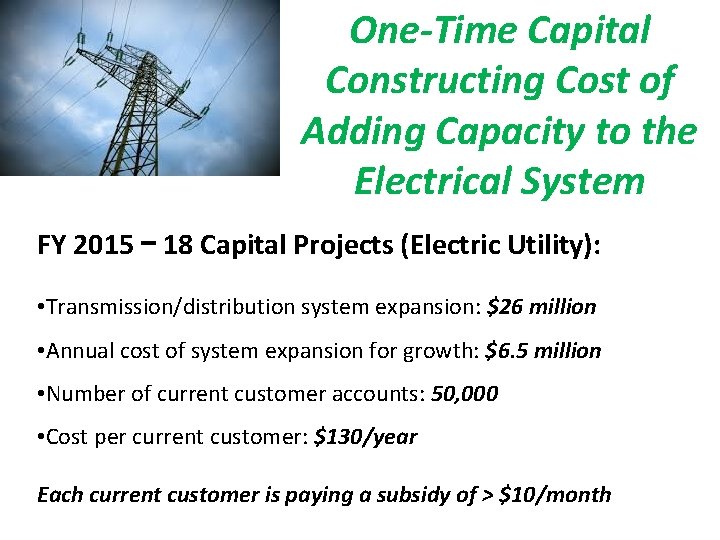
One-Time Capital Constructing Cost of Adding Capacity to the Electrical System FY 2015 – 18 Capital Projects (Electric Utility): • Transmission/distribution system expansion: $26 million • Annual cost of system expansion for growth: $6. 5 million • Number of current customer accounts: 50, 000 • Cost per current customer: $130/year Each current customer is paying a subsidy of > $10/month
Strategic Plan 2016 – 2019 Focus on Social Equity Columbia, a Tale of Two Cities We did not experience the type of suffering that some cities endured during the last recession. There is … another story running beneath the economic recovery we’re also seeing increased poverty, decreased per capita income, . . . This imbalance is one of the greatest challenges we face in Columbia, our nation and across the globe. We prefer a community where everyone … can thrive. We can’t ignore this gap as long as there’s something we can do to open economic and social opportunities, …
Strategic Plan 2016 – 2019 Focus on Social Equity Columbia, a Tale of Two Cities We did not experience the type of suffering that some cities endured during the last recession. There is … another story running beneath the economic recovery we’re also seeing increased poverty, decreased per capita income, . . . This imbalance is one of the greatest challenges we face in Columbia, our nation and across the globe. We prefer a community where everyone … can thrive. We can’t ignore this gap as long as there’s something we can do to open economic and social opportunities, …
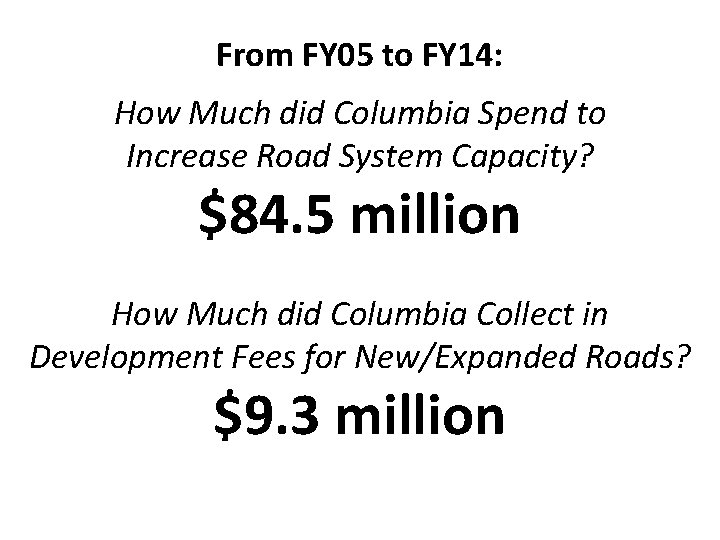
From FY 05 to FY 14: How Much did Columbia Spend to Increase Road System Capacity? $84. 5 million How Much did Columbia Collect in Development Fees for New/Expanded Roads? $9. 3 million
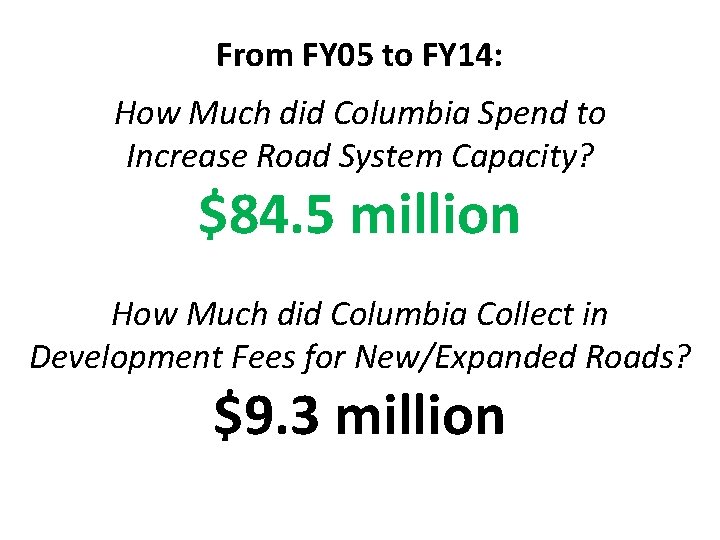
From FY 05 to FY 14: How Much did Columbia Spend to Increase Road System Capacity? $84. 5 million How Much did Columbia Collect in Development Fees for New/Expanded Roads? $9. 3 million
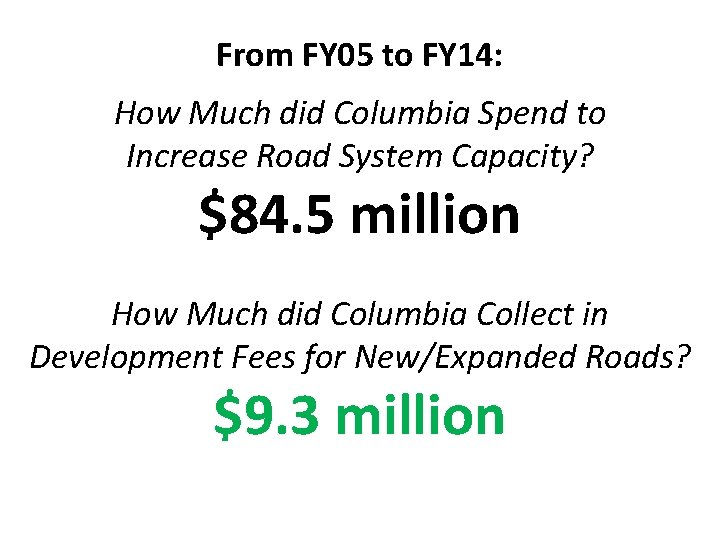
From FY 05 to FY 14: How Much did Columbia Spend to Increase Road System Capacity? $84. 5 million How Much did Columbia Collect in Development Fees for New/Expanded Roads? $9. 3 million
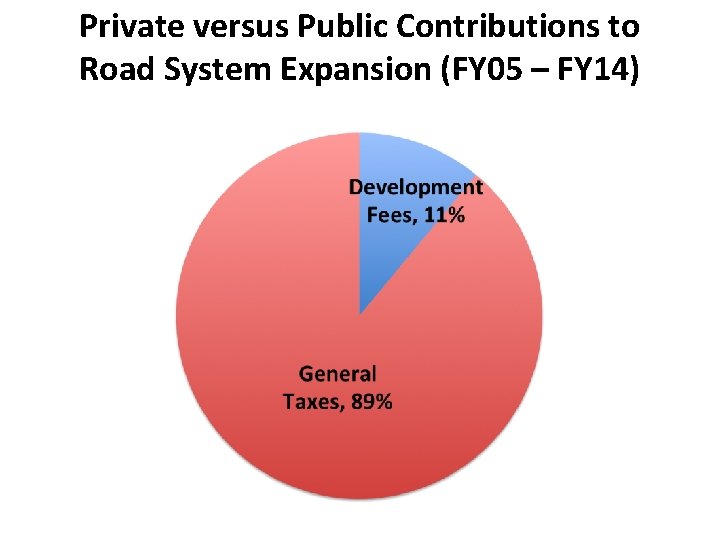
Private versus Public Contributions to Road System Expansion (FY 05 – FY 14)
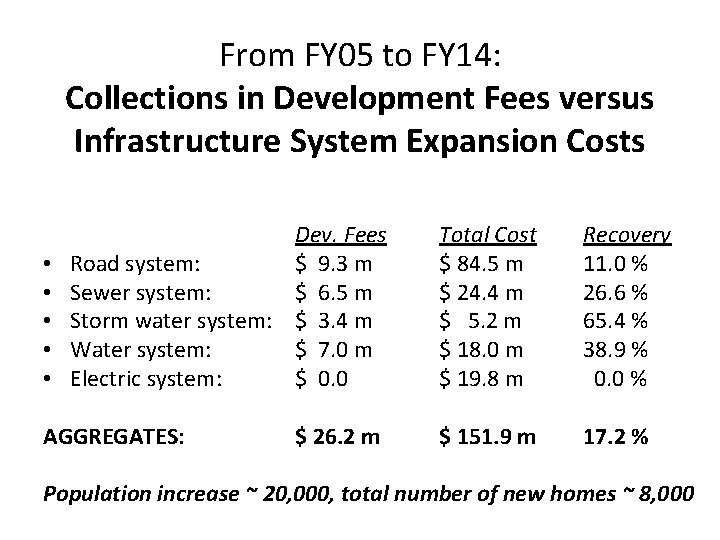
From FY 05 to FY 14: Collections in Development Fees versus Infrastructure System Expansion Costs • • • Dev. Fees Road system: $ 9. 3 m Sewer system: $ 6. 5 m Storm water system: $ 3. 4 m Water system: $ 7. 0 m Electric system: $ 0. 0 AGGREGATES: $ 26. 2 m Total Cost $ 84. 5 m $ 24. 4 m $ 5. 2 m $ 18. 0 m $ 19. 8 m Recovery 11. 0 % 26. 6 % 65. 4 % 38. 9 % 0. 0 % $ 151. 9 m 17. 2 % Population increase ~ 20, 000, total number of new homes ~ 8, 000
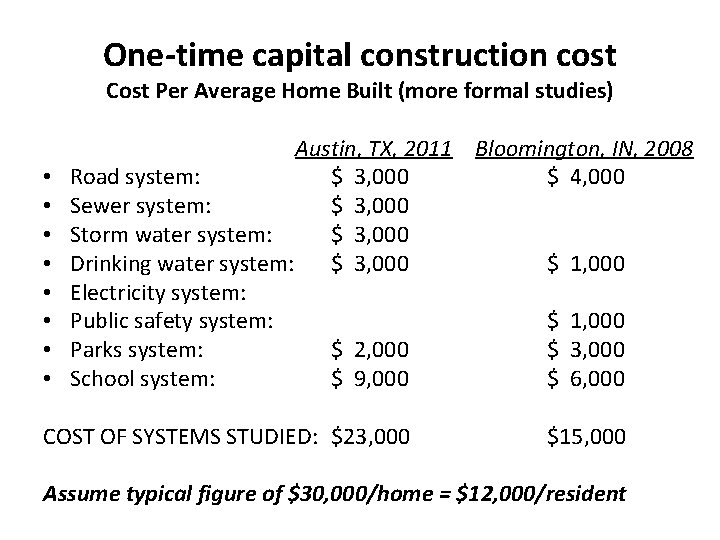
One-time capital construction cost Cost Per Average Home Built (more formal studies) • • Austin, TX, 2011 Bloomington, IN, 2008 Road system: $ 3, 000 $ 4, 000 Sewer system: $ 3, 000 Storm water system: $ 3, 000 Drinking water system: $ 3, 000 $ 1, 000 Electricity system: Public safety system: $ 1, 000 Parks system: $ 2, 000 $ 3, 000 School system: $ 9, 000 $ 6, 000 COST OF SYSTEMS STUDIED: $23, 000 $15, 000 Assume typical figure of $30, 000/home = $12, 000/resident
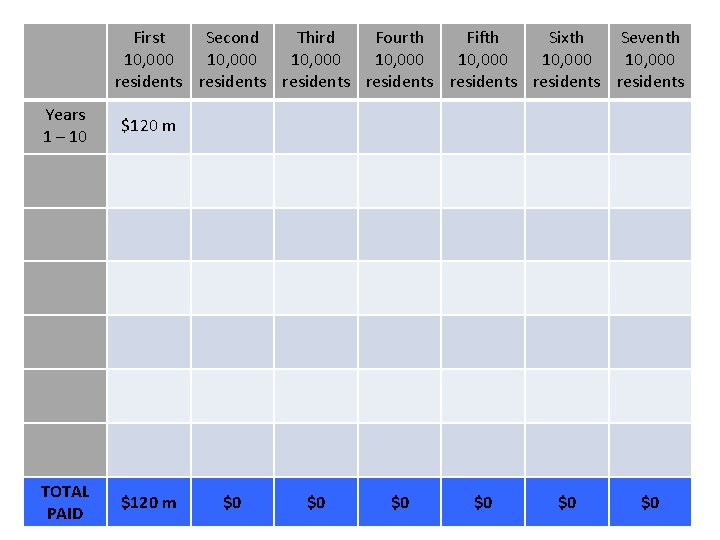
First Second Third Fourth Fifth Sixth Seventh 10, 000 10, 000 residents residents Years 1 – 10 $120 m TOTAL PAID $120 m $0 $0 $0
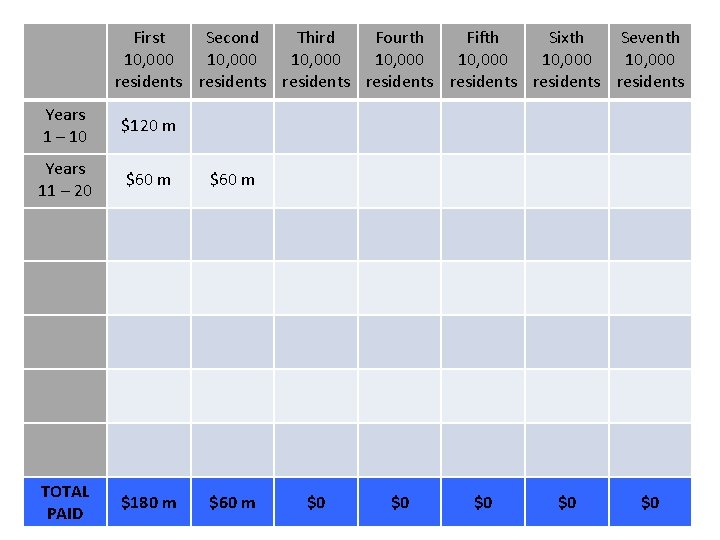
First Second Third Fourth Fifth Sixth Seventh 10, 000 10, 000 residents residents Years 1 – 10 $120 m Years 11 – 20 $60 m TOTAL PAID $180 m $60 m $0 $0 $0
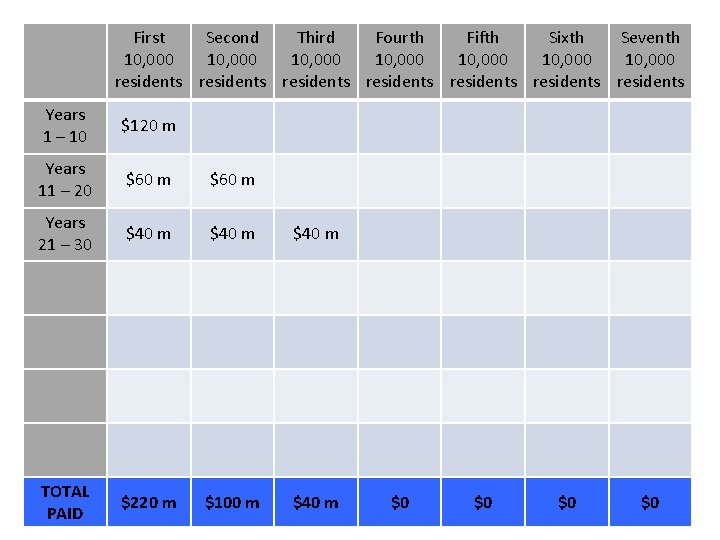
First Second Third Fourth Fifth Sixth Seventh 10, 000 10, 000 residents residents Years 1 – 10 $120 m Years 11 – 20 $60 m Years 21 – 30 $40 m TOTAL PAID $220 m $100 m $40 m $0 $0
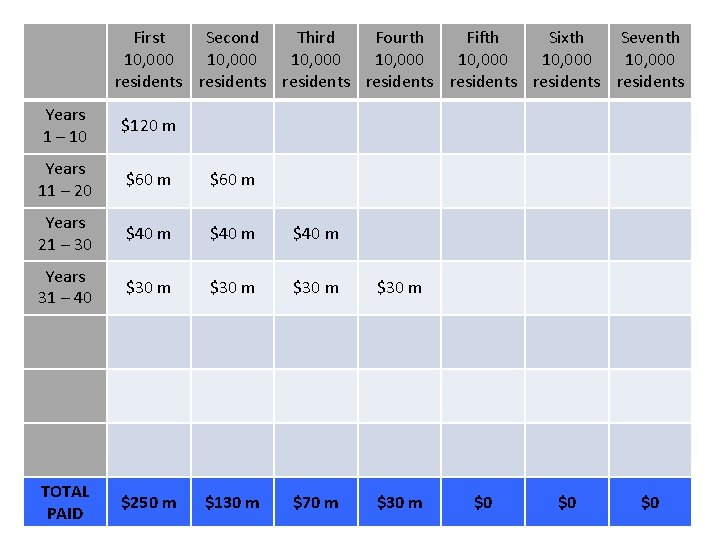
First Second Third Fourth Fifth Sixth Seventh 10, 000 10, 000 residents residents Years 1 – 10 $120 m Years 11 – 20 $60 m Years 21 – 30 $40 m Years 31 – 40 $30 m TOTAL PAID $250 m $130 m $70 m $30 m $0 $0 $0
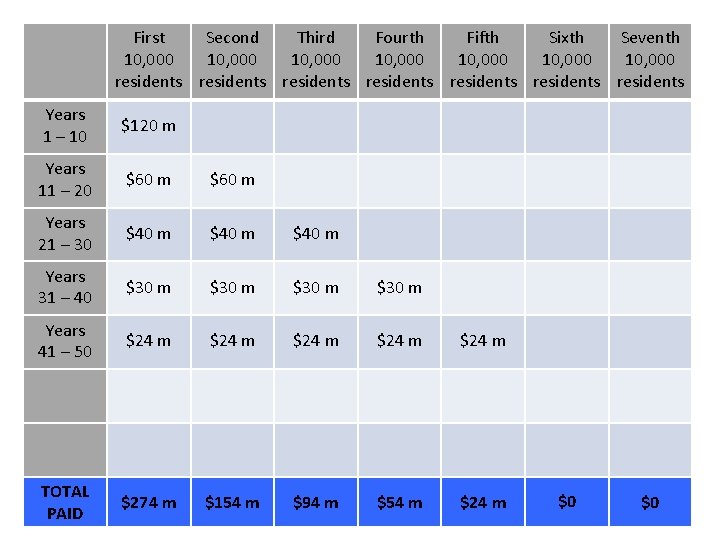
First Second Third Fourth Fifth Sixth Seventh 10, 000 10, 000 residents residents Years 1 – 10 $120 m Years 11 – 20 $60 m Years 21 – 30 $40 m Years 31 – 40 $30 m Years 41 – 50 $24 m $24 m TOTAL PAID $274 m $154 m $94 m $54 m $24 m $0 $0
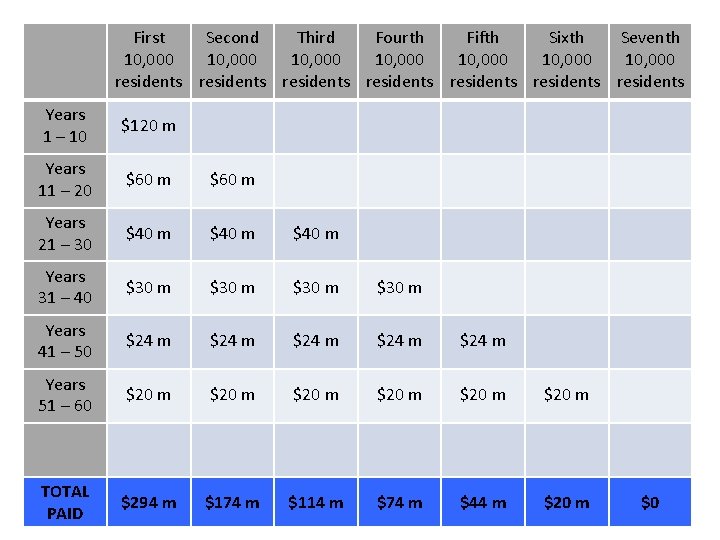
First Second Third Fourth Fifth Sixth Seventh 10, 000 10, 000 residents residents Years 1 – 10 $120 m Years 11 – 20 $60 m Years 21 – 30 $40 m Years 31 – 40 $30 m Years 41 – 50 $24 m $24 m Years 51 – 60 $20 m $20 m TOTAL PAID $294 m $174 m $114 m $74 m $44 m $20 m $0
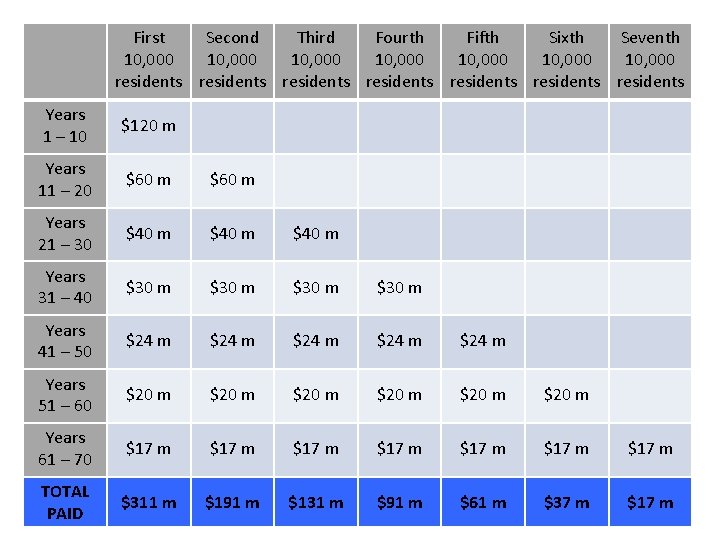
First Second Third Fourth Fifth Sixth Seventh 10, 000 10, 000 residents residents Years 1 – 10 $120 m Years 11 – 20 $60 m Years 21 – 30 $40 m Years 31 – 40 $30 m Years 41 – 50 $24 m $24 m Years 51 – 60 $20 m $20 m Years 61 – 70 $17 m $17 m TOTAL PAID $311 m $191 m $131 m $91 m $61 m $37 m $17 m
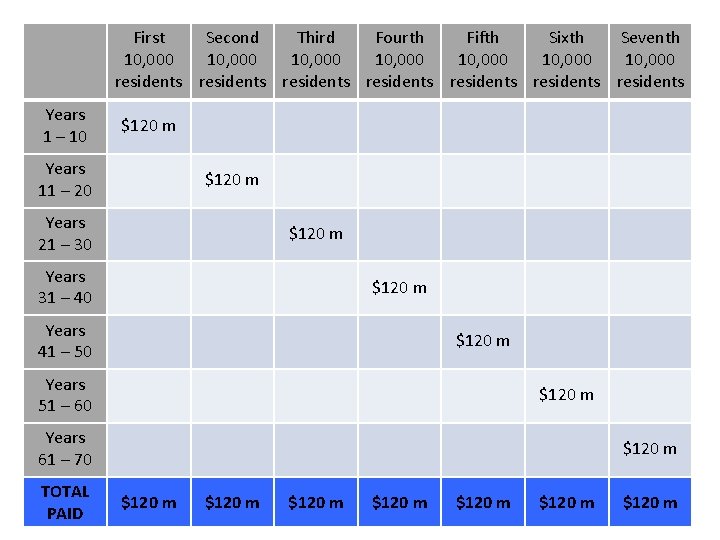
First Second Third Fourth Fifth Sixth Seventh 10, 000 10, 000 residents residents Years 1 – 10 $120 m Years 11 – 20 $120 m Years 21 – 30 $120 m Years 31 – 40 $120 m Years 41 – 50 $120 m Years 51 – 60 $120 m Years 61 – 70 TOTAL PAID $120 m $120 m
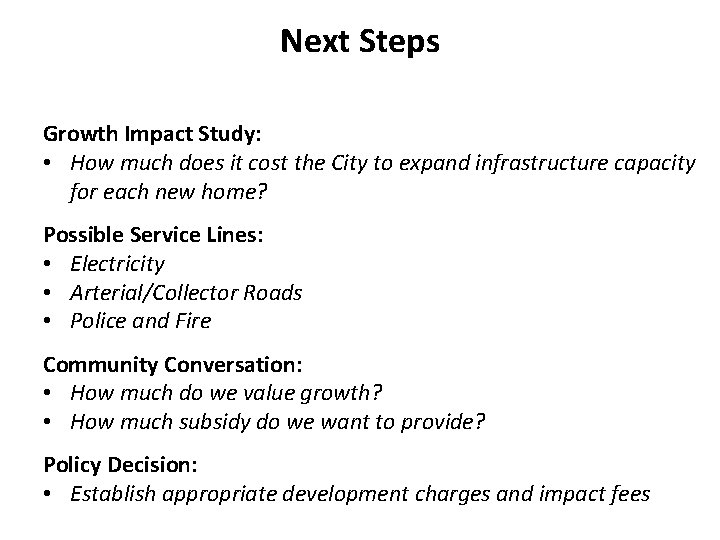
Next Steps Growth Impact Study: • How much does it cost the City to expand infrastructure capacity for each new home? Possible Service Lines: • Electricity • Arterial/Collector Roads • Police and Fire Community Conversation: • How much do we value growth? • How much subsidy do we want to provide? Policy Decision: • Establish appropriate development charges and impact fees
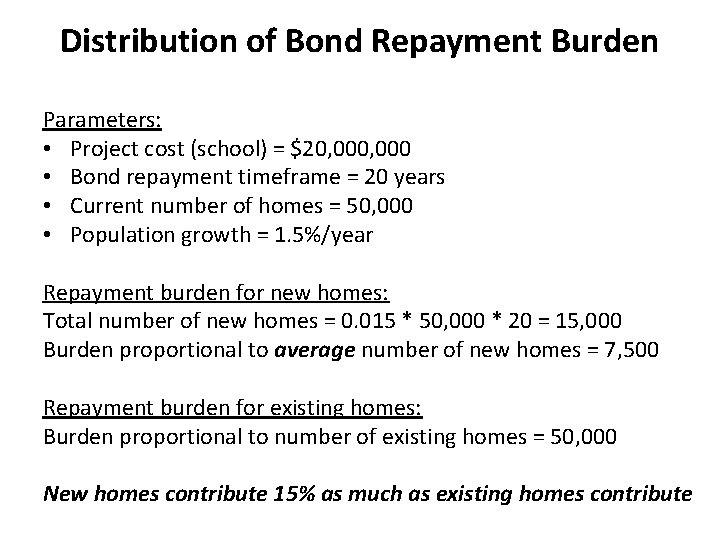
Distribution of Bond Repayment Burden Parameters: • Project cost (school) = $20, 000 • Bond repayment timeframe = 20 years • Current number of homes = 50, 000 • Population growth = 1. 5%/year Repayment burden for new homes: Total number of new homes = 0. 015 * 50, 000 * 20 = 15, 000 Burden proportional to average number of new homes = 7, 500 Repayment burden for existing homes: Burden proportional to number of existing homes = 50, 000 New homes contribute 15% as much as existing homes contribute
- Slides: 25