
Cost of Capital and Efficient Capital Markets Why
- Slides: 36
Cost of Capital and Efficient Capital Markets
Why Cost of Capital Is Important l l Cost of capital provides us with an indication of how the market views the risk of our assets Knowing cost of capital can help us determine the required return for capital budgeting projects
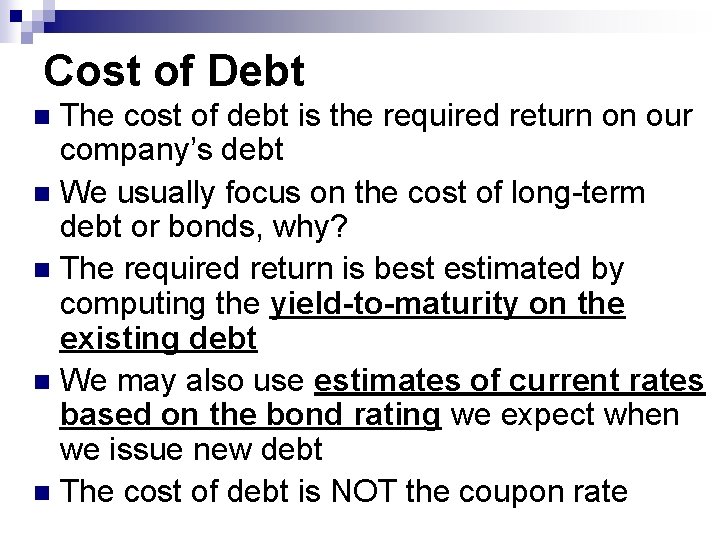
Cost of Debt The cost of debt is the required return on our company’s debt n We usually focus on the cost of long-term debt or bonds, why? n The required return is best estimated by computing the yield-to-maturity on the existing debt n We may also use estimates of current rates based on the bond rating we expect when we issue new debt n The cost of debt is NOT the coupon rate n
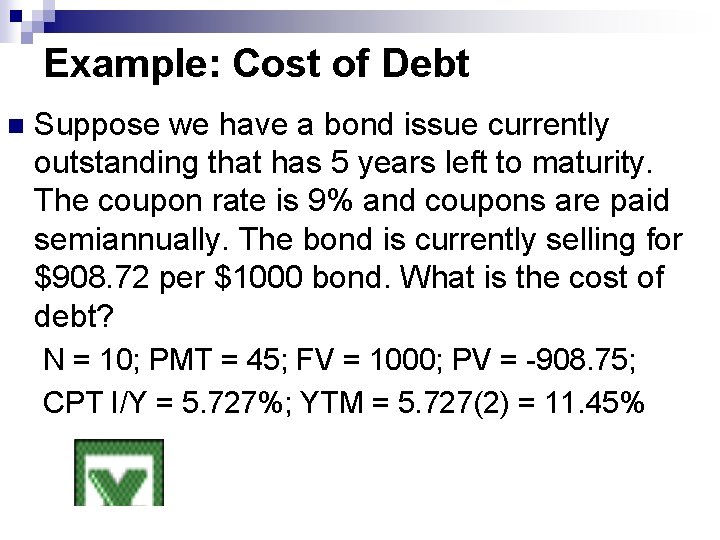
Example: Cost of Debt n Suppose we have a bond issue currently outstanding that has 5 years left to maturity. The coupon rate is 9% and coupons are paid semiannually. The bond is currently selling for $908. 72 per $1000 bond. What is the cost of debt? N = 10; PMT = 45; FV = 1000; PV = -908. 75; CPT I/Y = 5. 727%; YTM = 5. 727(2) = 11. 45%
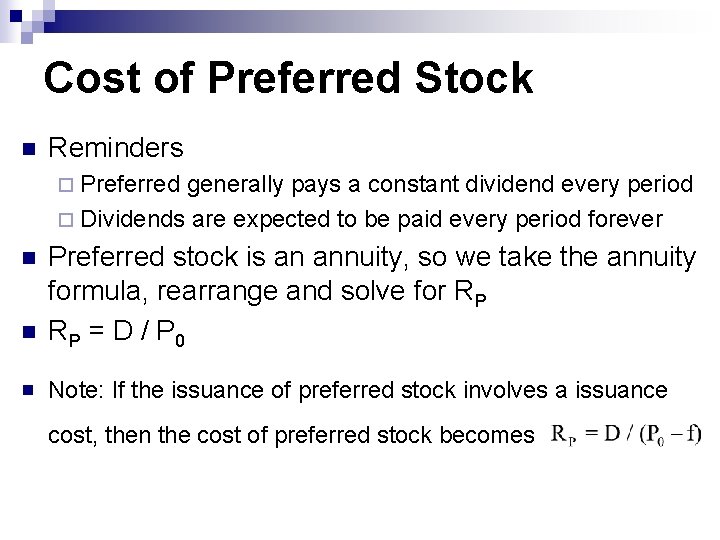
Cost of Preferred Stock n Reminders ¨ Preferred generally pays a constant dividend every period ¨ Dividends are expected to be paid every period forever n Preferred stock is an annuity, so we take the annuity formula, rearrange and solve for RP RP = D / P 0 n Note: If the issuance of preferred stock involves a issuance n cost, then the cost of preferred stock becomes
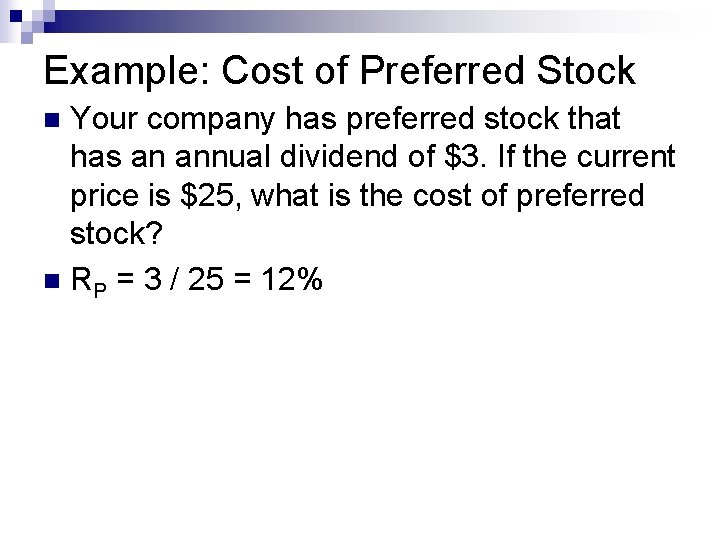
Example: Cost of Preferred Stock Your company has preferred stock that has an annual dividend of $3. If the current price is $25, what is the cost of preferred stock? n RP = 3 / 25 = 12% n
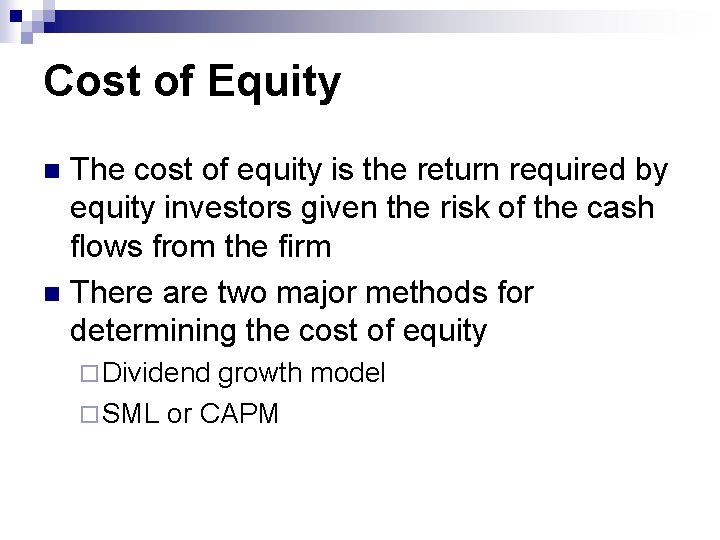
Cost of Equity The cost of equity is the return required by equity investors given the risk of the cash flows from the firm n There are two major methods for determining the cost of equity n ¨ Dividend growth model ¨ SML or CAPM
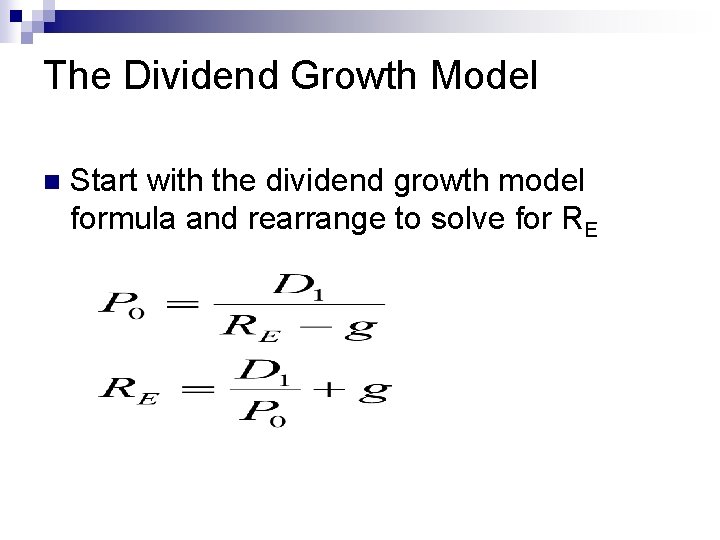
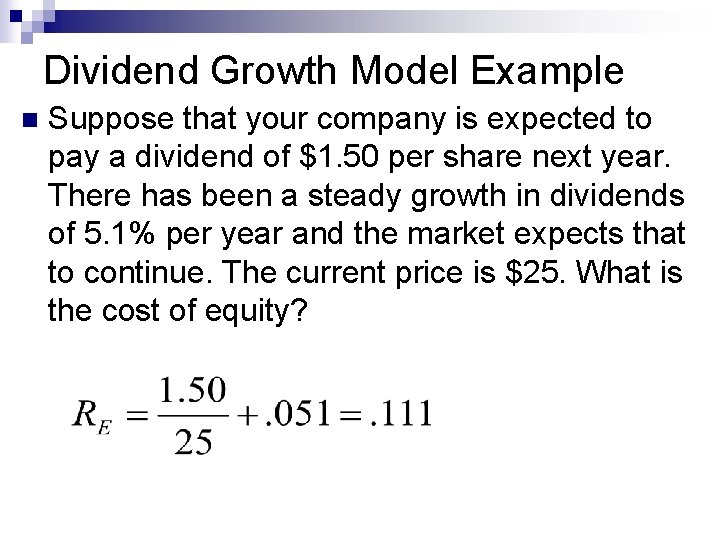
The Dividend Growth Model n Start with the dividend growth model formula and rearrange to solve for RE
Dividend Growth Model Example n Suppose that your company is expected to pay a dividend of $1. 50 per share next year. There has been a steady growth in dividends of 5. 1% per year and the market expects that to continue. The current price is $25. What is the cost of equity?
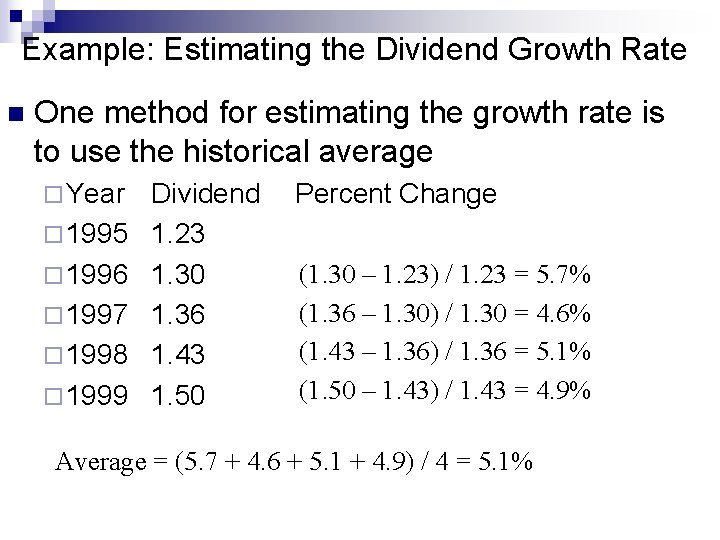
Example: Estimating the Dividend Growth Rate n One method for estimating the growth rate is to use the historical average ¨ Year ¨ 1995 ¨ 1996 ¨ 1997 ¨ 1998 ¨ 1999 Dividend 1. 23 1. 30 1. 36 1. 43 1. 50 Percent Change (1. 30 – 1. 23) / 1. 23 = 5. 7% (1. 36 – 1. 30) / 1. 30 = 4. 6% (1. 43 – 1. 36) / 1. 36 = 5. 1% (1. 50 – 1. 43) / 1. 43 = 4. 9% Average = (5. 7 + 4. 6 + 5. 1 + 4. 9) / 4 = 5. 1%
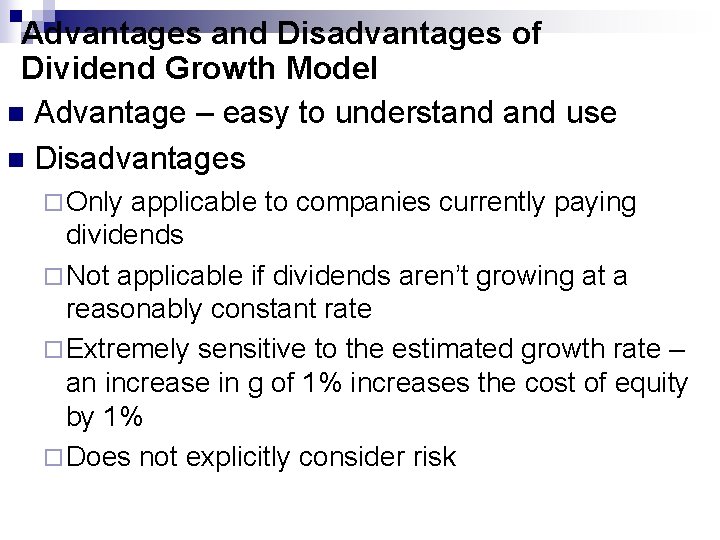
Advantages and Disadvantages of Dividend Growth Model n Advantage – easy to understand use n Disadvantages ¨ Only applicable to companies currently paying dividends ¨ Not applicable if dividends aren’t growing at a reasonably constant rate ¨ Extremely sensitive to the estimated growth rate – an increase in g of 1% increases the cost of equity by 1% ¨ Does not explicitly consider risk
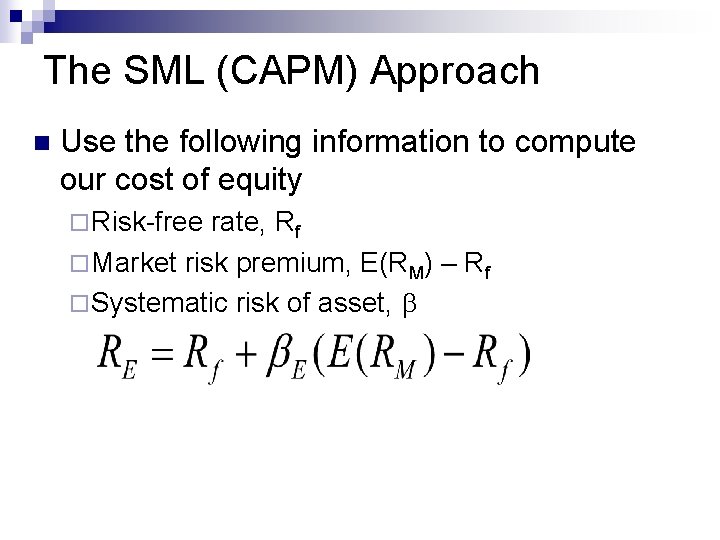
The SML (CAPM) Approach n Use the following information to compute our cost of equity ¨ Risk-free rate, Rf ¨ Market risk premium, E(RM) – Rf ¨ Systematic risk of asset,
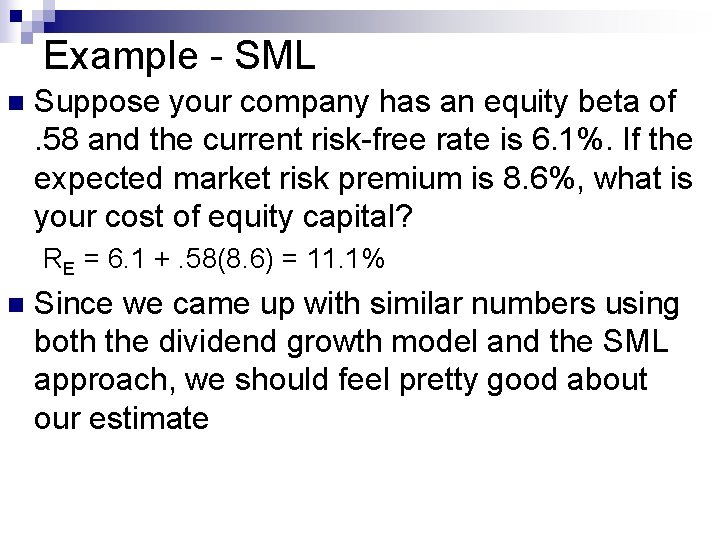
Example - SML n Suppose your company has an equity beta of. 58 and the current risk-free rate is 6. 1%. If the expected market risk premium is 8. 6%, what is your cost of equity capital? RE = 6. 1 +. 58(8. 6) = 11. 1% n Since we came up with similar numbers using both the dividend growth model and the SML approach, we should feel pretty good about our estimate
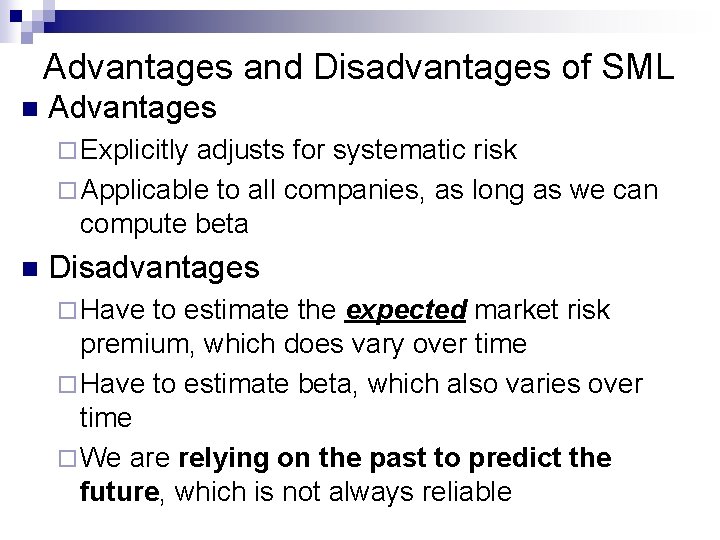
Advantages and Disadvantages of SML n Advantages ¨ Explicitly adjusts for systematic risk ¨ Applicable to all companies, as long as we can compute beta n Disadvantages ¨ Have to estimate the expected market risk premium, which does vary over time ¨ Have to estimate beta, which also varies over time ¨ We are relying on the past to predict the future, which is not always reliable
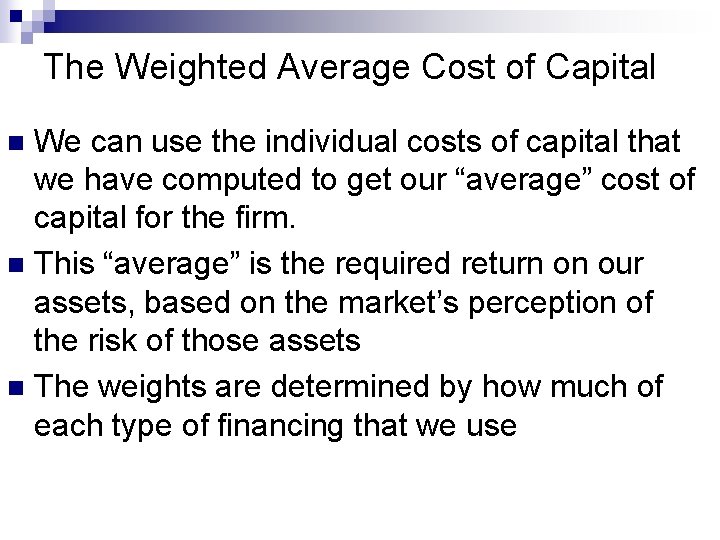
The Weighted Average Cost of Capital We can use the individual costs of capital that we have computed to get our “average” cost of capital for the firm. n This “average” is the required return on our assets, based on the market’s perception of the risk of those assets n The weights are determined by how much of each type of financing that we use n
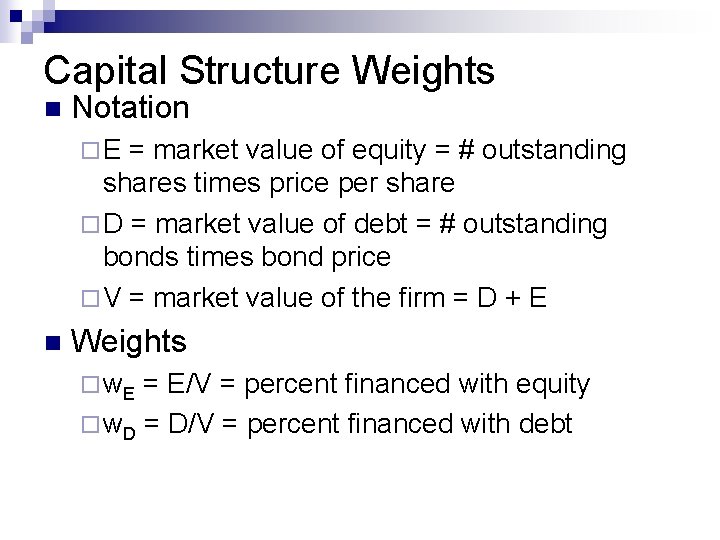
Capital Structure Weights n Notation ¨E = market value of equity = # outstanding shares times price per share ¨ D = market value of debt = # outstanding bonds times bond price ¨ V = market value of the firm = D + E n Weights ¨ w. E = E/V = percent financed with equity ¨ w. D = D/V = percent financed with debt
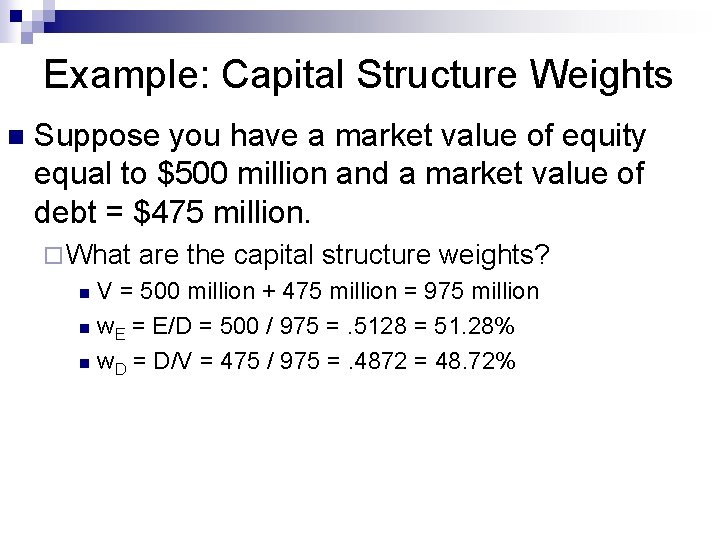
Example: Capital Structure Weights n Suppose you have a market value of equity equal to $500 million and a market value of debt = $475 million. ¨ What are the capital structure weights? V = 500 million + 475 million = 975 million n w. E = E/D = 500 / 975 =. 5128 = 51. 28% n w. D = D/V = 475 / 975 =. 4872 = 48. 72% n
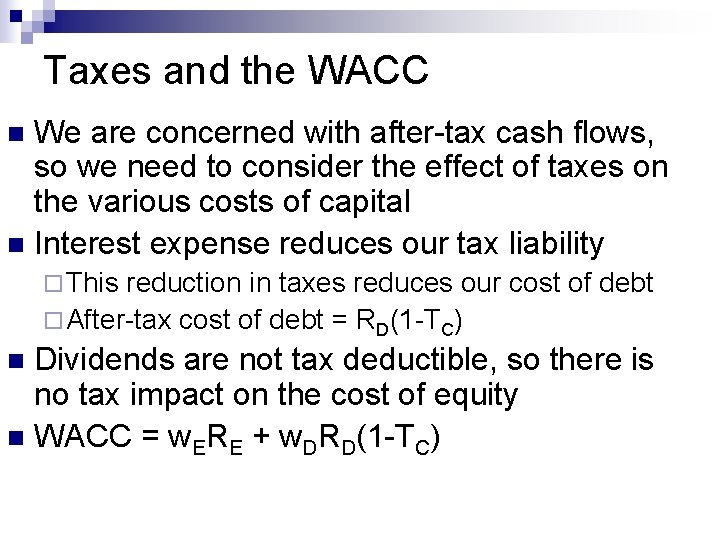
Taxes and the WACC We are concerned with after-tax cash flows, so we need to consider the effect of taxes on the various costs of capital n Interest expense reduces our tax liability n ¨ This reduction in taxes reduces our cost of debt ¨ After-tax cost of debt = RD(1 -TC) Dividends are not tax deductible, so there is no tax impact on the cost of equity n WACC = w. ERE + w. DRD(1 -TC) n
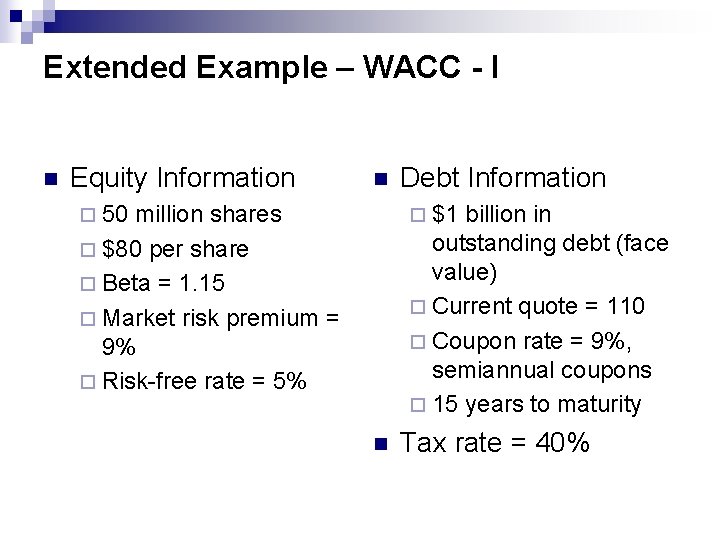
Extended Example – WACC - I n Equity Information n ¨ 50 million shares ¨ $80 per share ¨ Beta = 1. 15 ¨ Market risk premium = 9% ¨ Risk-free rate = 5% Debt Information ¨ $1 billion in outstanding debt (face value) ¨ Current quote = 110 ¨ Coupon rate = 9%, semiannual coupons ¨ 15 years to maturity n Tax rate = 40%
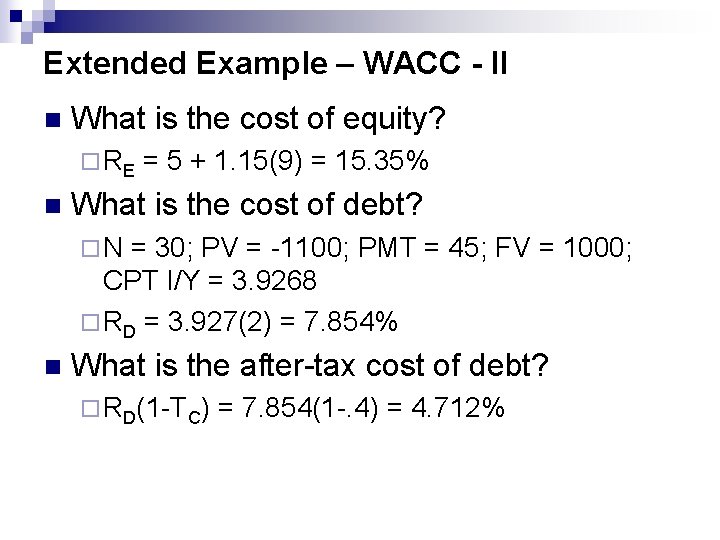
Extended Example – WACC - II n What is the cost of equity? ¨ RE n = 5 + 1. 15(9) = 15. 35% What is the cost of debt? ¨N = 30; PV = -1100; PMT = 45; FV = 1000; CPT I/Y = 3. 9268 ¨ RD = 3. 927(2) = 7. 854% n What is the after-tax cost of debt? ¨ RD(1 -TC) = 7. 854(1 -. 4) = 4. 712%
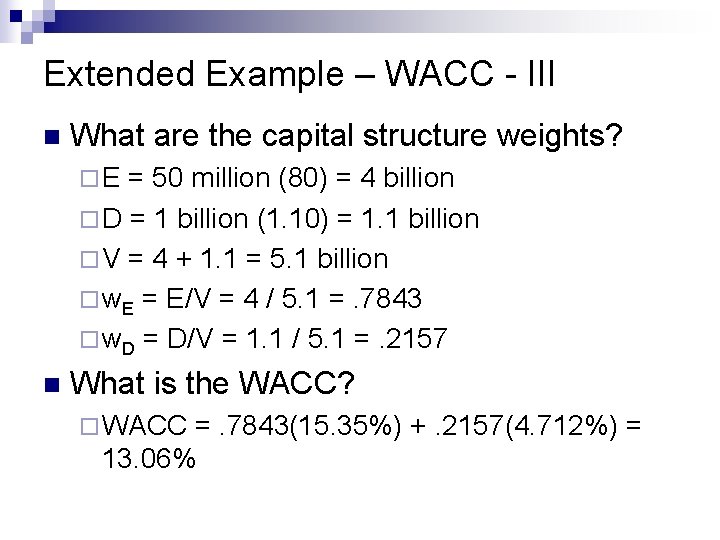
Extended Example – WACC - III n What are the capital structure weights? ¨E = 50 million (80) = 4 billion ¨ D = 1 billion (1. 10) = 1. 1 billion ¨ V = 4 + 1. 1 = 5. 1 billion ¨ w. E = E/V = 4 / 5. 1 =. 7843 ¨ w. D = D/V = 1. 1 / 5. 1 =. 2157 n What is the WACC? ¨ WACC =. 7843(15. 35%) +. 2157(4. 712%) = 13. 06%
Divisional and Project Costs of Capital (Hurdle Rates) n n n Using the WACC as our discount rate is only appropriate for projects that are the same risk as the firm’s current operations If we are looking at a project that is NOT the same risk as the firm, then we need to determine the appropriate discount rate for that project Divisions (Business Units) also often require separate discount rates
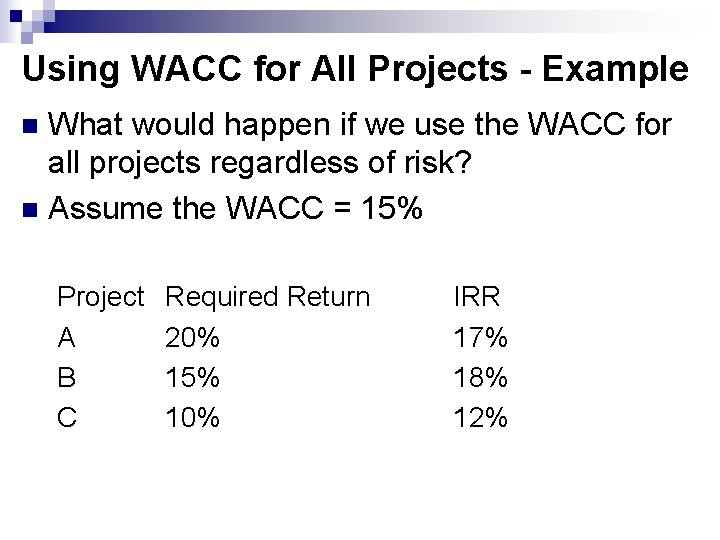
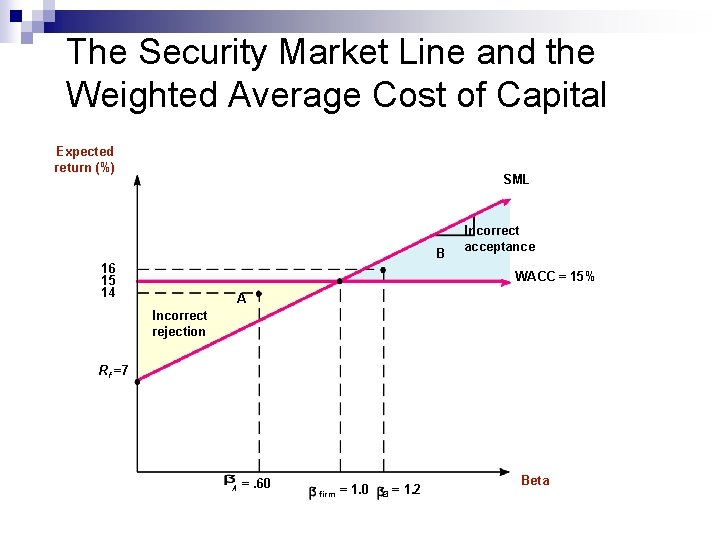
Using WACC for All Projects - Example What would happen if we use the WACC for all projects regardless of risk? n Assume the WACC = 15% n Project A B C Required Return 20% 15% 10% IRR 17% 18% 12%
The Pure Play Approach Find one or more companies that specialize in the product or service that we are considering n Compute the beta for each company n Take an average n Use that beta along with the CAPM to find the appropriate return for a project of that risk n Often difficult to find pure play companies n
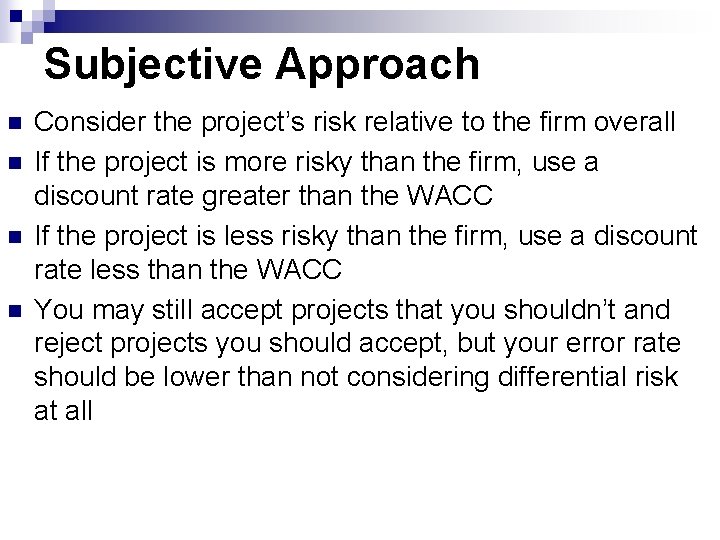
Subjective Approach n n Consider the project’s risk relative to the firm overall If the project is more risky than the firm, use a discount rate greater than the WACC If the project is less risky than the firm, use a discount rate less than the WACC You may still accept projects that you shouldn’t and reject projects you should accept, but your error rate should be lower than not considering differential risk at all
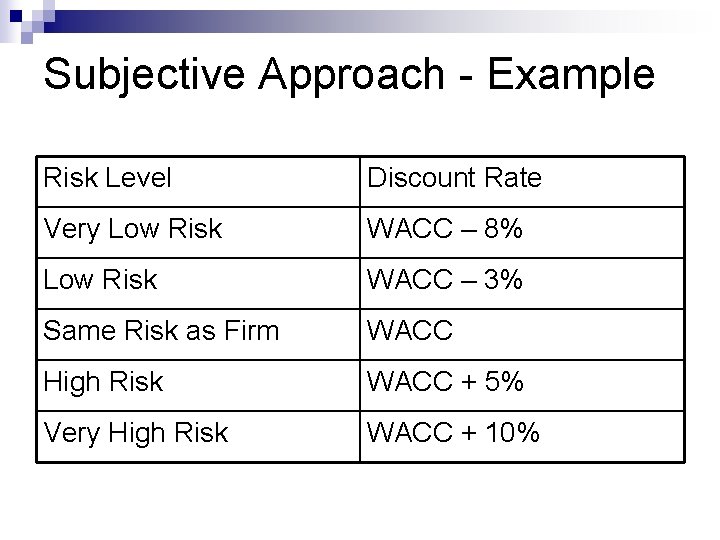
Subjective Approach - Example Risk Level Discount Rate Very Low Risk WACC – 8% Low Risk WACC – 3% Same Risk as Firm WACC High Risk WACC + 5% Very High Risk WACC + 10%
The Security Market Line and the Weighted Average Cost of Capital Expected return (%) SML B 16 15 14 Incorrect acceptance WACC = 15% A Incorrect rejection Rf =7 A =. 60 firm = 1. 0 B = 1. 2 Beta
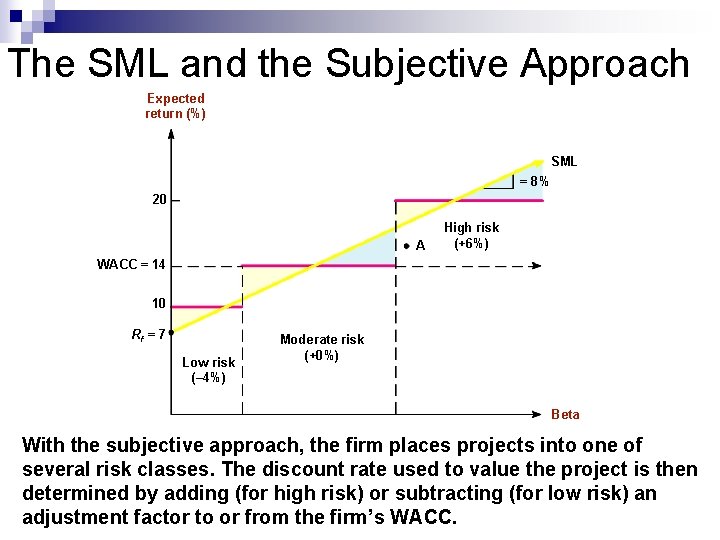
The SML and the Subjective Approach Expected return (%) SML = 8% 20 A High risk (+6%) WACC = 14 10 Rf = 7 Low risk (– 4%) Moderate risk (+0%) Beta With the subjective approach, the firm places projects into one of several risk classes. The discount rate used to value the project is then determined by adding (for high risk) or subtracting (for low risk) an adjustment factor to or from the firm’s WACC.
Efficient Capital Markets n In an efficient capital market, security prices adjust rapidly to the arrival of new information, therefore the current prices of securities reflect all information about the security
The premises of an efficient market n A large number of competing profit-maximizing participants analyze and value securities, each independently of the others n New information regarding securities comes to the market in a random fashion n Profit-maximizing investors adjust security prices rapidly to reflect the effect of new information n. Conclusion: the expected returns implicit in the current price of a security should reflect its risk
Alternative Efficient Market Hypotheses n Random Walk Hypothesis – changes in security prices occur randomly n Fair Game Model – current market price reflect all available information about a security and the expected return based upon this price is consistent with its risk
Efficient Market Hypotheses (EMH) n Efficient Market Hypothesis (EMH) - divided into three sub-hypotheses depending on the information set involved n Weak-Form EMH - prices reflect all security-market information n Semistrong-form EMH - prices reflect all public information n Strong-form EMH - prices reflect all public and private information
Weak-Form EMH n Current prices reflect all security-market information, including the historical sequence of prices, rates of return, trading volume data, and other market-generated information n This implies that past rates of return and other market data should have no relationship with future rates of return
Semistrong-Form EMH n Current security prices reflect all public information, including market and non-market information n This implies that decisions made on new information after it is public should not lead to above-average risk-adjusted profits from those transactions
Strong-Form EMH n Stock prices fully reflect all information from public and private sources n This implies that no group of investors should be able to consistently derive above-average risk-adjusted rates of return n This assumes perfect markets in which all information is cost-free and available to everyone at the same time
Implications of Efficient Capital Markets n Overall results indicate the capital markets are efficient as related to numerous sets of information n There are substantial instances where the market fails to rapidly adjust to public information