
Cost Management Week 6 7 Learning Objectives You
Cost Management Week 6 -7 Learning Objectives You should be able to: n Describe cost management processes and their inputs, outputs, activities, and tools n Distinguish between cost estimation and cost control n Apply a function point approach to cost estimating a business information system n List and define cost drivers used in COCOMO II to estimate software development effort n List the requirements of a Cost Control System
Cost Estimation Difficulties n n n Cost overruns occur because original estimates inaccurate Bias toward underestimating Cost = accounting, not IT Lack of experience, knowledge in cost management Requires significant effort for large complex software Frequent changes in technology? – Not a common cause of cost difficulties
Cost Management Basics n Profits = revenues - expenses – focus on impact on profits n n Profit margin = profits / revenues Life cycle costing – total cost of ownership – development, plus maintenance and support – cost of software defect increases over time
Cash Flow Analysis n n Estimated annual costs and benefits Internal Rate of Return (IRR) – discount rate that sets NPV to 0 n Tangible and intangible costs and benefits – tangible easier to measure and justify n n n Direct costs - PM has more control Indirect costs - overhead, admin Sunk costs - should NOT be considered Learning curve theory - like economy of scale Reserves: contingency, management
4 Cost Management Processes n Resource Planning – resources, quantities n Cost Estimation – software cost estimation n Budgeting – cost allocation n Cost Control – controlling changes
(1) Resource Planning n determining the resources & quantities needed to perform project activities – people, equipment, materials n n Difficulty of tasks Experience and skills of available workers Inputs: WBS, scope, resource pool, org. policy Tools: – expert judgment (internal, external), historical data n Outputs: resource requirements – staff acquisition, procurement may be needed
(2) Cost Estimation n Developing estimates of resource costs – how much will it cost the performing organization n n Differs from pricing Identifying alternatives and trade-offs ROM (rough order of magnitude) Budgetary (more accurate) Definitive (most accurate)
Cost Estimation Inputs n n n WBS Resource needs Resource rates Activity duration estimates Data – previous projects – commercial databases – team expertise and experience n Chart of accounts – performing organization’s financial reporting
Cost Estimation Outputs n Cost estimates – quantitative estimates of costs of resources – dollars or staff-hours/days – may be refined during project execution n Supporting detail – scope of work estimated – basis for estimate and assumptions – range of possible results n Cost management plan – how variances will be managed
Cost Estimating Tools n Analogous – top-down – use previous, similar project(s) – expert judgment n Bottom-up – costing individual work items – takes more time n Parametric – uses project characteristics (parameters) – based on reliable, accurate, quantifiable data n Cost estimation software tools
Software Cost Estimation Metrics n n n Lines of Code (LOC) Function Points Core Measures – – n Level of Effort (time) Labor cost: training, contract, travel, overhead Defects: pre- and post-implementation Duration New system vs. enhanced system vs. GUI (graphical user interface)
Common Software Metrics n n n n Size: of deliverables (programs) Effort: number of people X number of months Duration: number of months Development cost: labor cost of effort Productivity: size / effort Responsiveness: size / duration Quality: defects / size Business: cost / size
Software Estimating Models n n Estimate = Size * Complexity * Influencers COCOMO II + – – – n n modifies initial effort estimate Constructive Cost Model cost drivers / effort multipliers / factors product, platform, personnel, project depends on LOC, more recently added FP’s Software: Co. Star, Cost. Xpert, others COCOMO Process Maturity – integrated with CMM
Cost Factors (Drivers) General System Characteristics n n n n Data communication Distributed Data Processing Performance Heavily Used Configuration Transaction Rate On-line data entry End-user efficiency n n n n On-line update Complex Processing Reusability Installation ease Operational ease Multiple sites Facilitate change
Estimation issues n How to measure size: – LOC (lines of code), function points, classes? n n n Hard to estimate before developing specs Lack of experience Lack of historical data Depends on size, complexity, number of programmers, productivity, team, tools, . . . Brooks’ Law: – adding more programmers to a late project makes it later
(3) Budgeting Process n n Allocating overall cost to individual work items Inputs: cost estimates, WBS, schedule Outputs: Cost baseline Software measurement baselines – – collect, analyze, & calibrate data used to monitor progress systems/application and delivery baselines may be segmented by: • technology, platform, application, industry
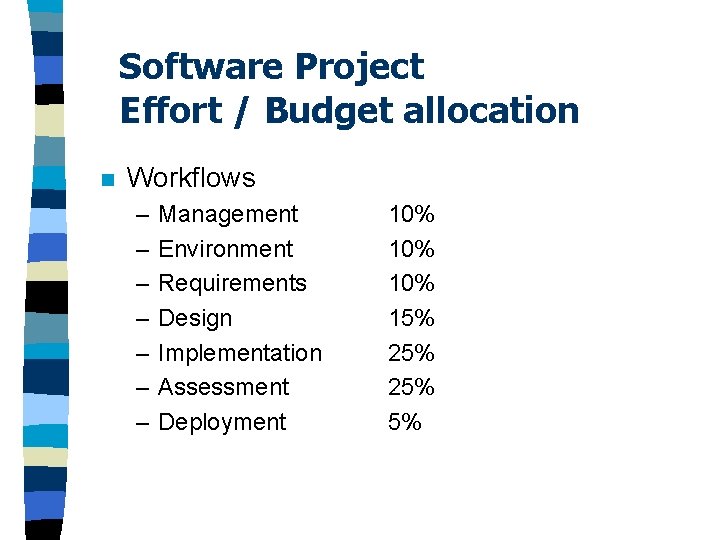
Software Project Effort / Budget allocation n Workflows – – – – Management Environment Requirements Design Implementation Assessment Deployment 10% 10% 15% 25% 5%
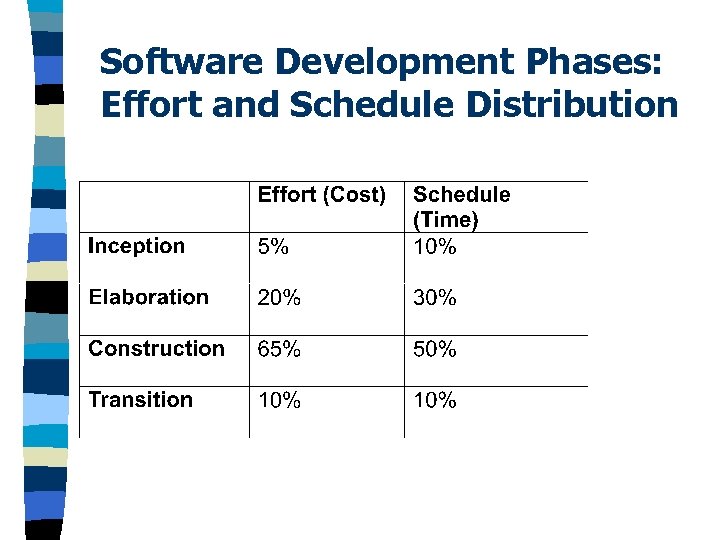
Software Development Phases: Effort and Schedule Distribution
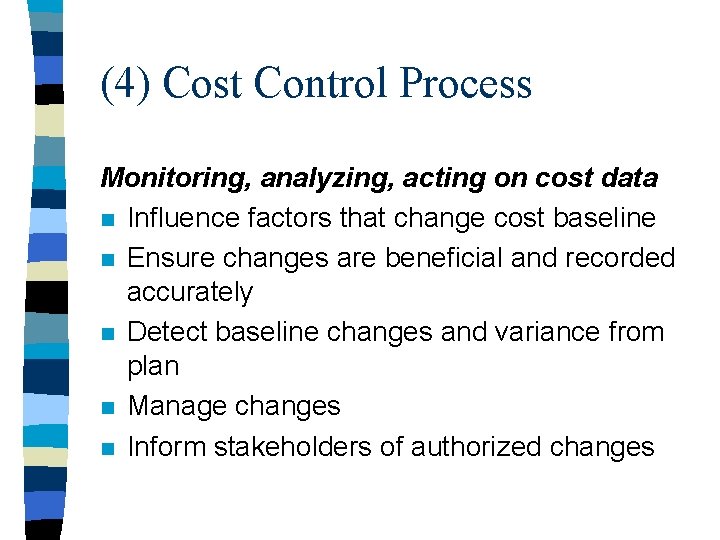
(4) Cost Control Process Monitoring, analyzing, acting on cost data n Influence factors that change cost baseline n Ensure changes are beneficial and recorded accurately n Detect baseline changes and variance from plan n Manage changes n Inform stakeholders of authorized changes
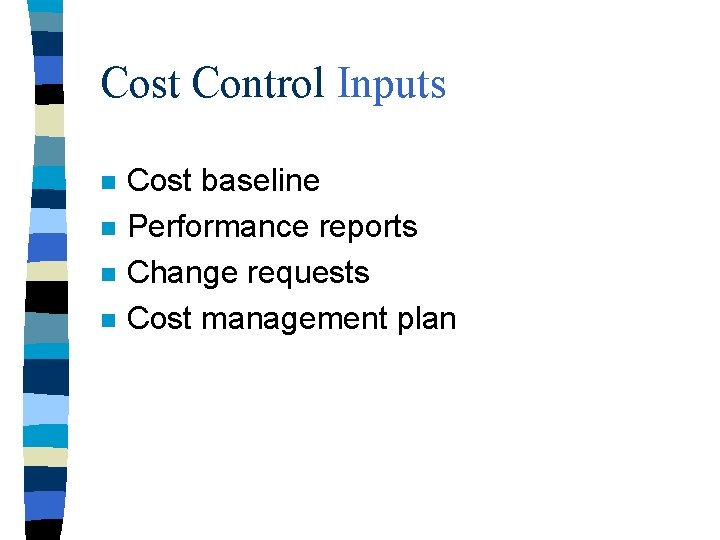
Cost Control Inputs n n Cost baseline Performance reports Change requests Cost management plan
Cost Control Outputs n n Revised cost estimates Budget updates – changes to approved baseline – revised in response to scope changes n n Corrective actions Estimate at Completion (EAC) – forecast of total project costs – actuals plus variations on remaining budget n Lessons Learned – causes of variances, why corrective actions, etc.
Cost Control Tools n Cost change control system – definition of procedures, approvals for change n Performance measurement – identify variances, magnitude, causes – Earned Value Analysis (EVA) n Software – tracks planned vs. actual costs – projects or forecasts effects of changes
Earned Value Analysis (EVA) n n Integrates scope, time, and cost data Compares actuals to baseline Baseline: original plan plus approved changes Actuals: how much of a WBS item has been completed n n n BCWP - budgeted cost of work performed ACWP - actual cost of work performed BCWS - budgeted cost of work scheduled
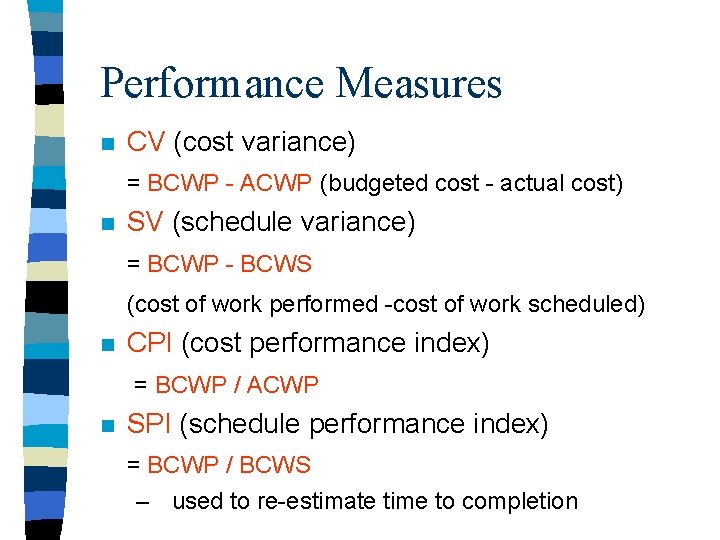
Performance Measures n CV (cost variance) = BCWP - ACWP (budgeted cost - actual cost) n SV (schedule variance) = BCWP - BCWS (cost of work performed -cost of work scheduled) n CPI (cost performance index) = BCWP / ACWP n SPI (schedule performance index) = BCWP / BCWS – used to re-estimate time to completion
Applying EVA to IT projects n n Estimates keep changing (budgeted) Simplified evaluation of percent complete for tasks can still provide useful tracking information
- Slides: 25