
Cost Estimate Review Christopher Chris Jacobsen DOE Independent
Cost Estimate Review Christopher (Chris) Jacobsen DOE Independent Project Review of PIP-II 15 November 2016
Christopher (Chris) Jacobsen • PIP-II Financial Manager • Over 25 years in a financial management role in not-for-profit and commercial environments with emphasis on budgeting and cost management • 4. 5 years experience in national laboratory environment at both Argonne National Laboratory and Fermilab • Certified Public Accountant (CPA) 1996 2 Your Name | DOE IPR 11/15/2016
Charge Item: #3 Outline • • • 3 Methodology International Deliverables Overview of the Total Project Cost Project Estimate in Core Costs (Point Estimate) Cost Range Summary/Next Steps Chris Jacobsen | DOE IPR 11/15/2016
Methodology • The starting point for the estimation is the P 5 estimate from 2013 – All 2013 estimates were reviewed/updated as necessary, in advance of the June 2015 IPR – Several items not included in the P 5 estimate were added: • • • SRF R&D LLRF: assumes PIP 2 IT LLRF is non-recoverable Warm magnets RF Interlocks Recycler upgrade Booster upgrade Main Injection upgrade Subtract potential International in-kind contributions Add overhead, contingency, escalation = Point Cost Estimate Apply DOE high/low percentages to develop the Cost Range Perform a benchmark cost estimate comparison with SNS linac – SNS actual costs adjusted to match PIP-II configuration and energy 4 Chris Jacobsen | DOE IPR 11/15/2016
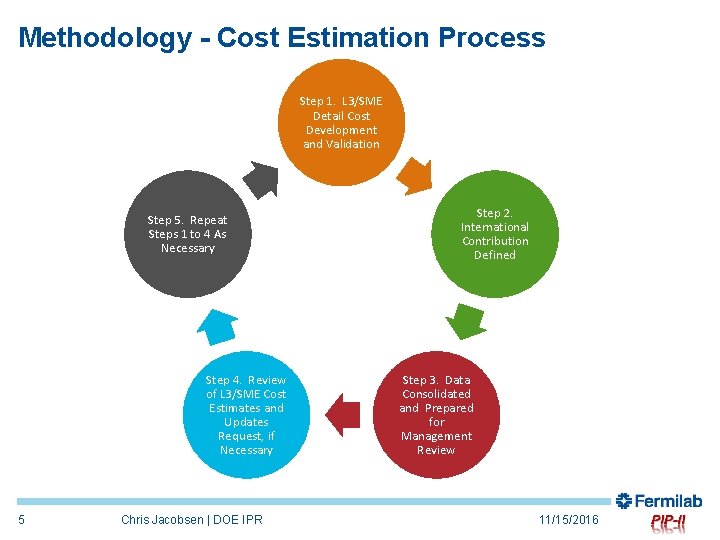
Methodology - Cost Estimation Process Step 1. L 3/SME Detail Cost Development and Validation Step 5. Repeat Steps 1 to 4 As Necessary Step 4. Review of L 3/SME Cost Estimates and Updates Request, if Necessary 5 Chris Jacobsen | DOE IPR Step 2. International Contribution Defined Step 3. Data Consolidated and Prepared for Management Review 11/15/2016
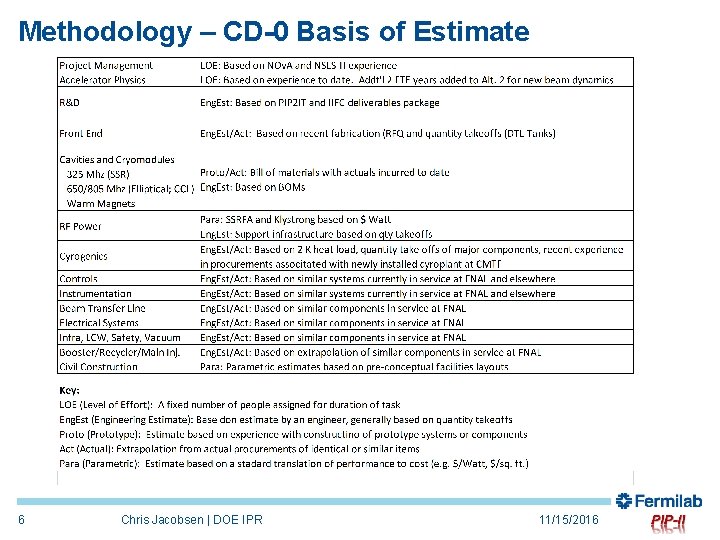
Methodology – CD-0 Basis of Estimate 6 Chris Jacobsen | DOE IPR 11/15/2016

Methodology – Basis of Estimate Examples • 325 MHz SSR 1 Cryomodule – Prototype/Actual • Bill of Materials (BOM) with actuals incurred to date – Engineering estimate • Based on BOMs • RF Power – Parametric estimate • Solid State RF Amplifier (SSRFA) based on $ per watt – Engineering estimate • Support infrastructure based on quantity/unit cost • Civil Construction – Parametric estimates • Based on pre-conceptual facilities layouts 7 Chris Jacobsen | DOE IPR 11/15/2016
International Deliverables Charge Item: 6 S. Mishra • In-kind contributions will come from multiple sources – India/DAE contributions • Signed agreements exist today – R&D phase: specific scope defined – Construction phase: - general scope and total value defined • Cost estimate based on model of contributions, consistent with R&D program and discussion to date – Other contributions • We are discussing additional opportunities for international collaboration with INFN and STFC (see S. Mishra presentation) • LB 650 MHz cryomodules are assumed to be an international inkind contribution – India and/or Europe (Italy/INFN) 8 Chris Jacobsen | DOE IPR 11/15/2016
Overview of Total Project Cost to DOE • Cost estimate covers the period from FY 16 through project completion (currently the same as June 2015 IPR) • Estimate all components as if constructed by Fermilab • Subtract all international in-kind contributions • M&S estimates were made for all major systems, conventional facilities, and R&D – Scope: R&D + Superconducting Linac + beam transfer line + upgrades to the Recycler Ring, Booster, and Main Ring Injector – Includes component fabrication and installation but not commissioning – Estimates in direct FY 13$ • The labor is estimated in person-years and by skills type (OHAP categories) – Translated to dollars at Fermilab FY 13 labor rates – Includes EDIA and Project Management • Apply Fermilab overhead rates • Apply contingency at 35% • Apply escalation of 18. 2% (FY 13 to FY 20 @ 2. 4%/year) 9 Chris Jacobsen | DOE IPR 11/15/2016
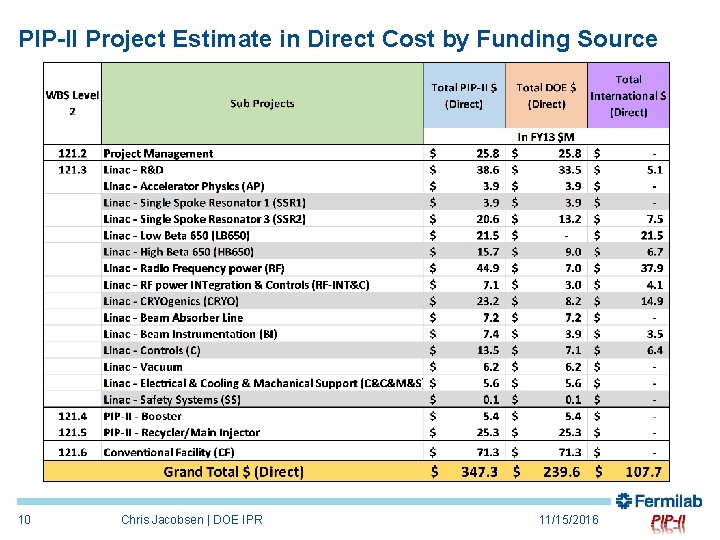
PIP-II Project Estimate in Direct Cost by Funding Source 10 Chris Jacobsen | DOE IPR 11/15/2016
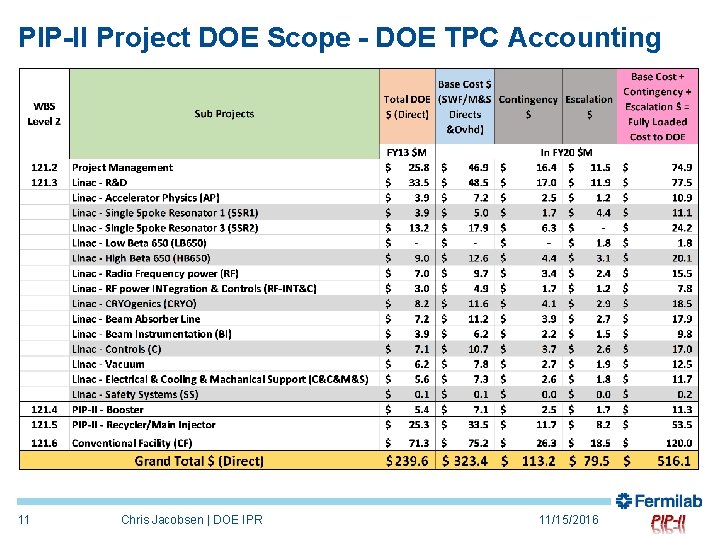
PIP-II Project DOE Scope - DOE TPC Accounting 11 Chris Jacobsen | DOE IPR 11/15/2016
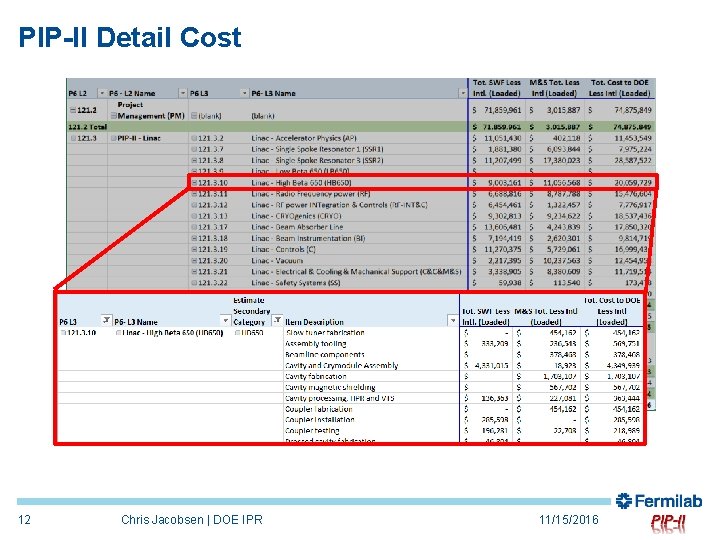
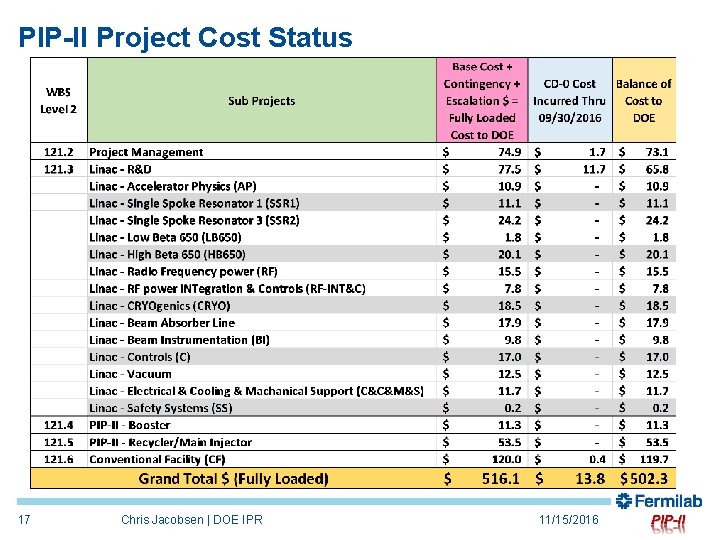
PIP-II Detail Cost 12 Chris Jacobsen | DOE IPR 11/15/2016

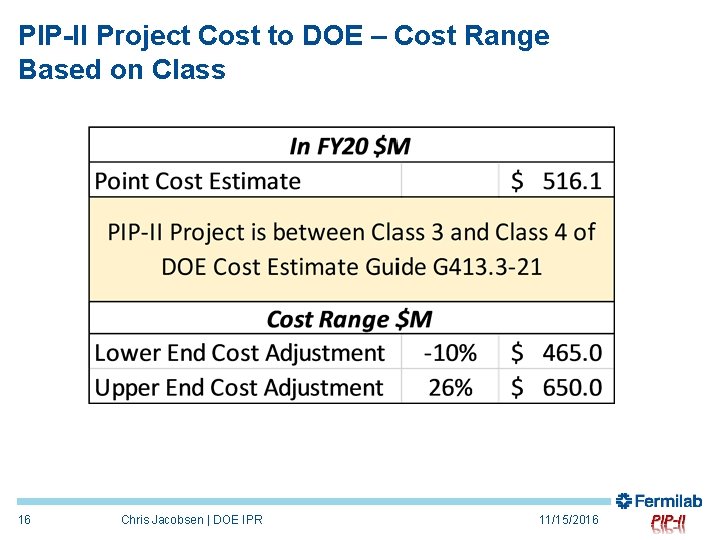
Methodology – Cost Range Per DOE Cost Estimating • Based on DOE Cost Estimating Guide (DOE Guide 413. 3 -21) • Inputs used to evaluate Project Definition – – – – Scope Requirements Specifications Project Plans Drawings Calculations Learning from Past Projects • Project Definition (% of complete definition, i. e. 100% = fully defined) – – 13 SRF Components – 40% Conventional Facilities – 20% Cryogenics Infrastructure - 25% Chris Jacobsen | DOE IPR 11/15/2016

Methodology – Cost Range cont. Expected Accuracy Range Low range: -10%, High range: 26% 14 Chris Jacobsen | DOE IPR 11/15/2016
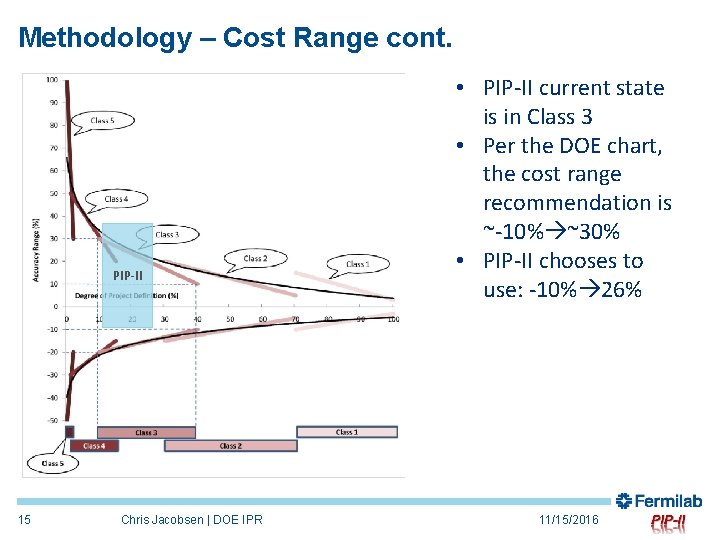
Methodology – Cost Range cont. PIP-II 15 Chris Jacobsen | DOE IPR • PIP-II current state is in Class 3 • Per the DOE chart, the cost range recommendation is ~-10% ~30% • PIP-II chooses to use: -10% 26% 11/15/2016
PIP-II Project Cost to DOE – Cost Range Based on Class 16 Chris Jacobsen | DOE IPR 11/15/2016
PIP-II Project Cost Status 17 Chris Jacobsen | DOE IPR 11/15/2016
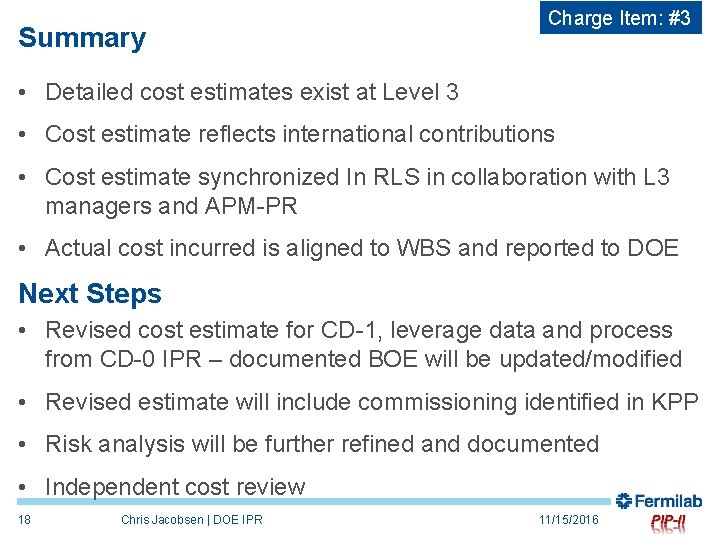
Summary Charge Item: #3 • Detailed cost estimates exist at Level 3 • Cost estimate reflects international contributions • Cost estimate synchronized In RLS in collaboration with L 3 managers and APM-PR • Actual cost incurred is aligned to WBS and reported to DOE Next Steps • Revised cost estimate for CD-1, leverage data and process from CD-0 IPR – documented BOE will be updated/modified • Revised estimate will include commissioning identified in KPP • Risk analysis will be further refined and documented • Independent cost review 18 Chris Jacobsen | DOE IPR 11/15/2016
Backup-Supplementary Slides • Backup and supplementary information to this presentation can be found after this slide 19 Chris Jacobsen | DOE IPR 11/15/2016
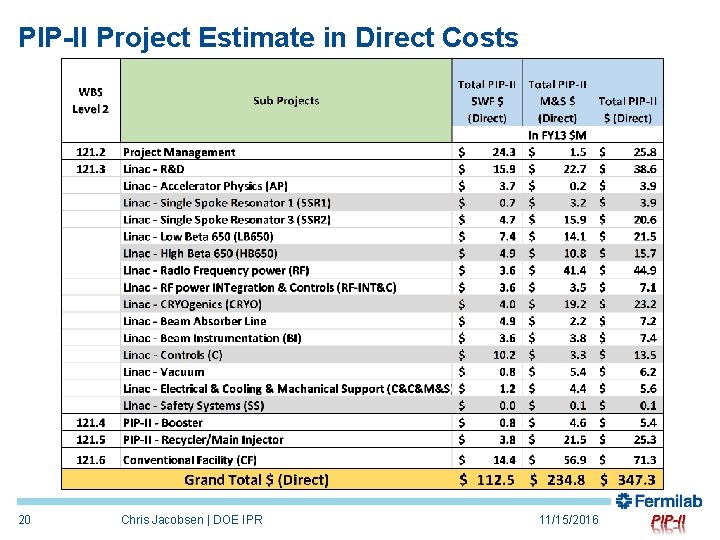
PIP-II Project Estimate in Direct Costs 20 Chris Jacobsen | DOE IPR 11/15/2016
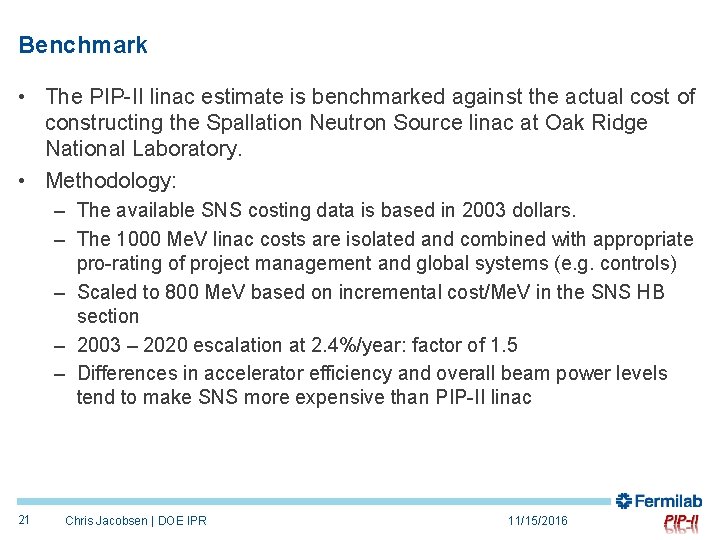
Benchmark • The PIP-II linac estimate is benchmarked against the actual cost of constructing the Spallation Neutron Source linac at Oak Ridge National Laboratory. • Methodology: – The available SNS costing data is based in 2003 dollars. – The 1000 Me. V linac costs are isolated and combined with appropriate pro-rating of project management and global systems (e. g. controls) – Scaled to 800 Me. V based on incremental cost/Me. V in the SNS HB section – 2003 – 2020 escalation at 2. 4%/year: factor of 1. 5 – Differences in accelerator efficiency and overall beam power levels tend to make SNS more expensive than PIP-II linac 21 Chris Jacobsen | DOE IPR 11/15/2016
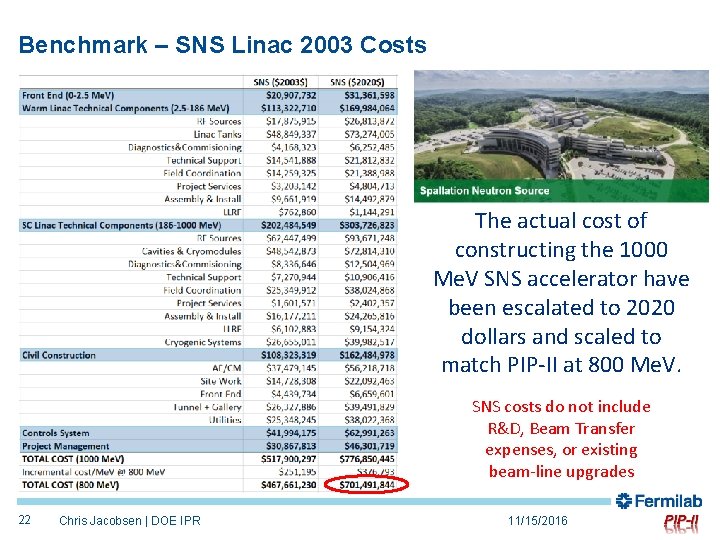
Benchmark – SNS Linac 2003 Costs The actual cost of constructing the 1000 Me. V SNS accelerator have been escalated to 2020 dollars and scaled to match PIP-II at 800 Me. V. SNS costs do not include R&D, Beam Transfer expenses, or existing beam-line upgrades 22 Chris Jacobsen | DOE IPR 11/15/2016
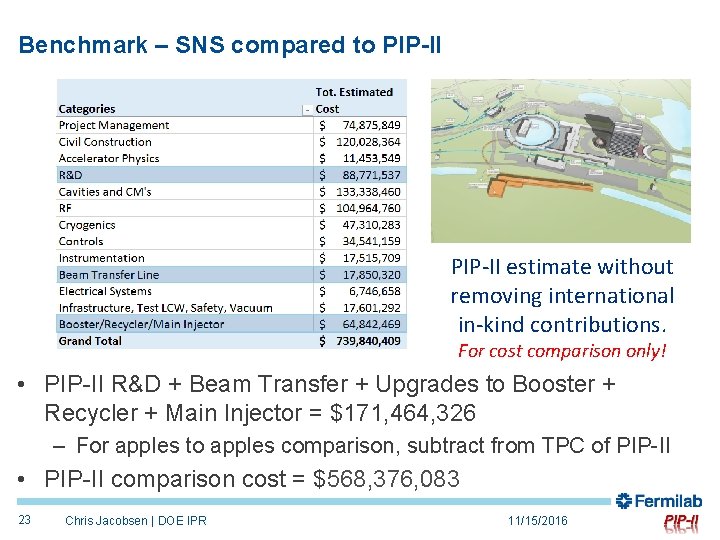
Benchmark – SNS compared to PIP-II estimate without removing international in-kind contributions. For cost comparison only! • PIP-II R&D + Beam Transfer + Upgrades to Booster + Recycler + Main Injector = $171, 464, 326 – For apples to apples comparison, subtract from TPC of PIP-II • PIP-II comparison cost = $568, 376, 083 23 Chris Jacobsen | DOE IPR 11/15/2016
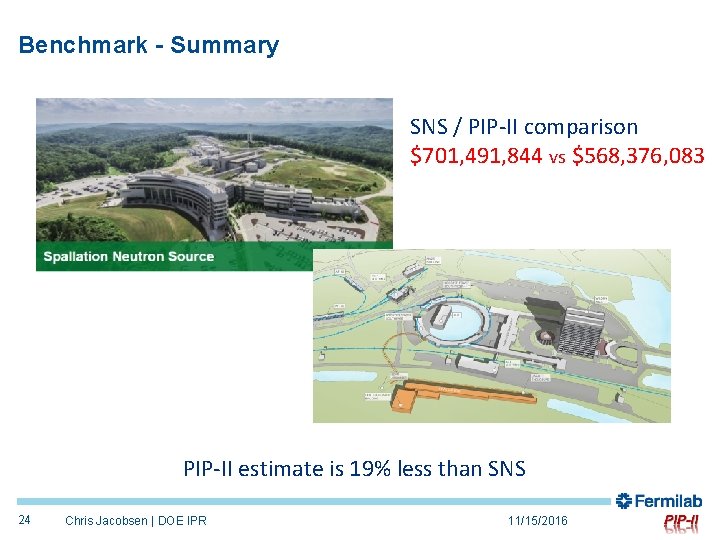
Benchmark - Summary SNS / PIP-II comparison $701, 491, 844 vs $568, 376, 083 PIP-II estimate is 19% less than SNS 24 Chris Jacobsen | DOE IPR 11/15/2016
- Slides: 24