
Cost Efficient CloudBased Video Streaming Through Quantifying Video
Cost Efficient Cloud-Based Video Streaming Through Quantifying Video Stream Hotness Mahmoud Darwich Dr. Magdy A. Bayoumi (Co-Advisor) Dr. Mohsen A. Salehi (Co-Advisor) 1
Outline • What is Video Transcoding? • Why Video Transcoding on Cloud? • What have been done so far? • My thesis focus • Conclusion 2
Outline • What is Video Transcoding? • Why Video Transcoding on Cloud? • What have been done so far? • My thesis focus • Conclusion 3

Different Characteristics Display Devices Over 16. 1 Billion display devices 2020 4
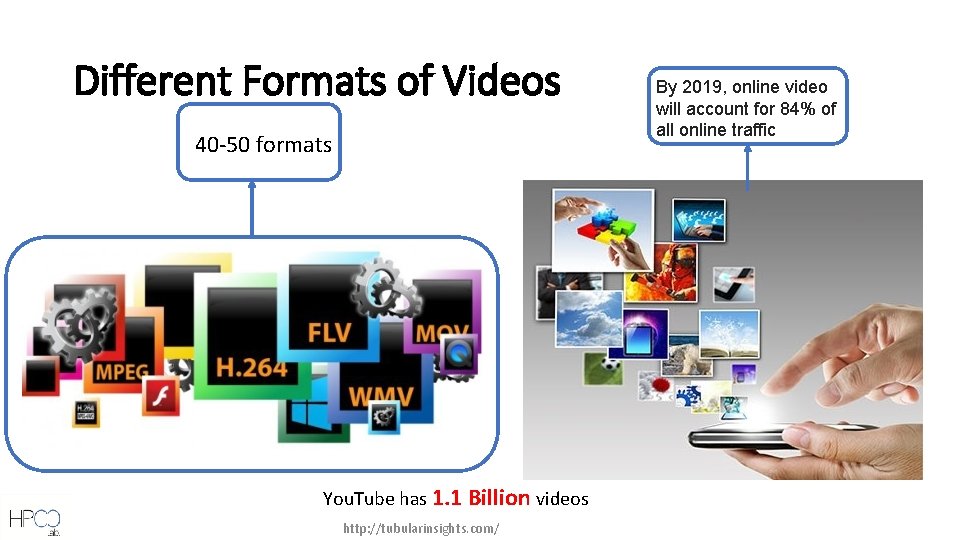
Different Formats of Videos 40 -50 formats You. Tube has 1. 1 Billion videos http: //tubularinsights. com/ By 2019, online video will account for 84% of all online traffic

Background: Video Stream Structure Video Stream Seq 1 Seq 2 Seq Header GOP header Seq 3 Seq 4 GOP 1 I GOP 2 P P P …. . Seq 5 …. . GOP 3 B P …. . Macroblock 6
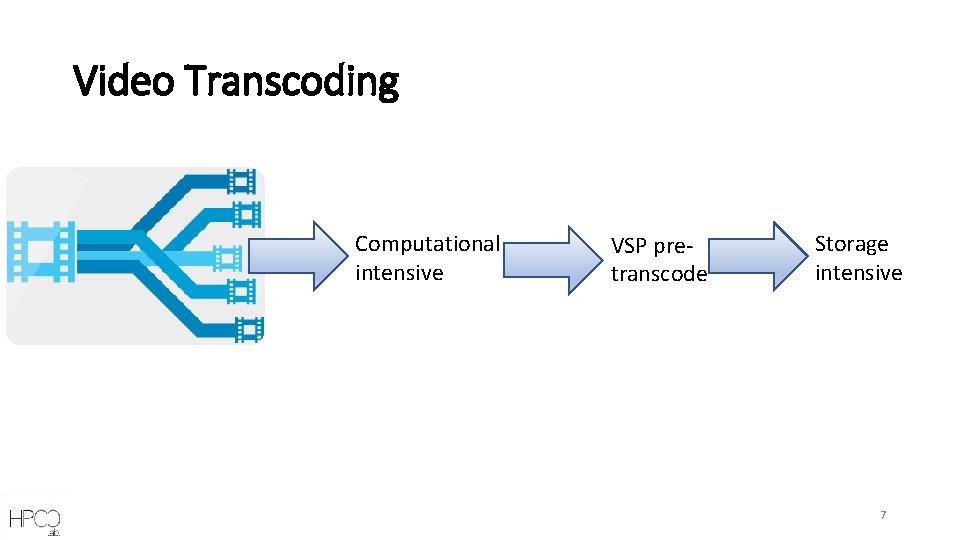
Video Transcoding Computational intensive VSP pretranscode Storage intensive 7
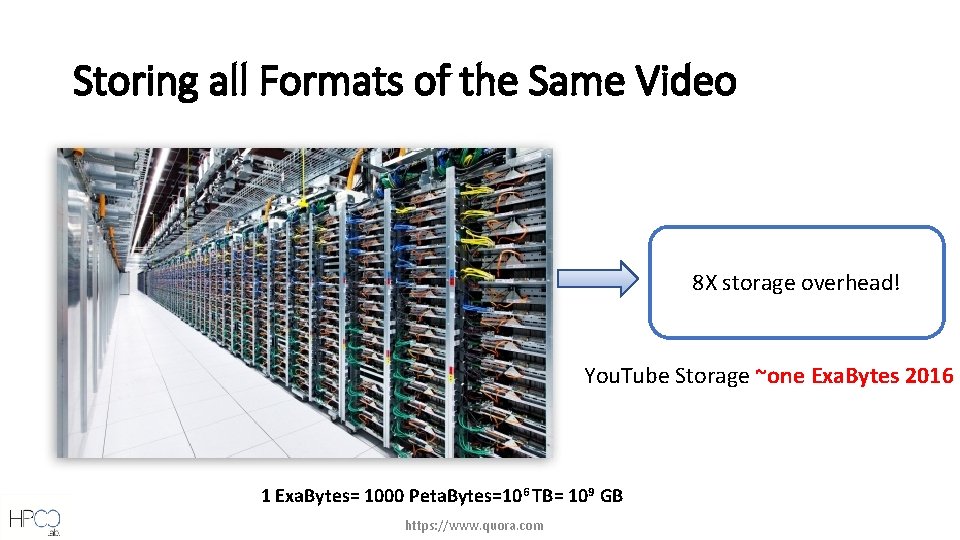
Storing all Formats of the Same Video 8 X storage overhead! You. Tube Storage ~one Exa. Bytes 2016 1 Exa. Bytes= 1000 Peta. Bytes=106 TB= 109 GB https: //www. quora. com
Storage Requirements for Video Stream • large capacity • Different formats • Different videos • high throughput • Support concurrent accesses of viewers to same video 9
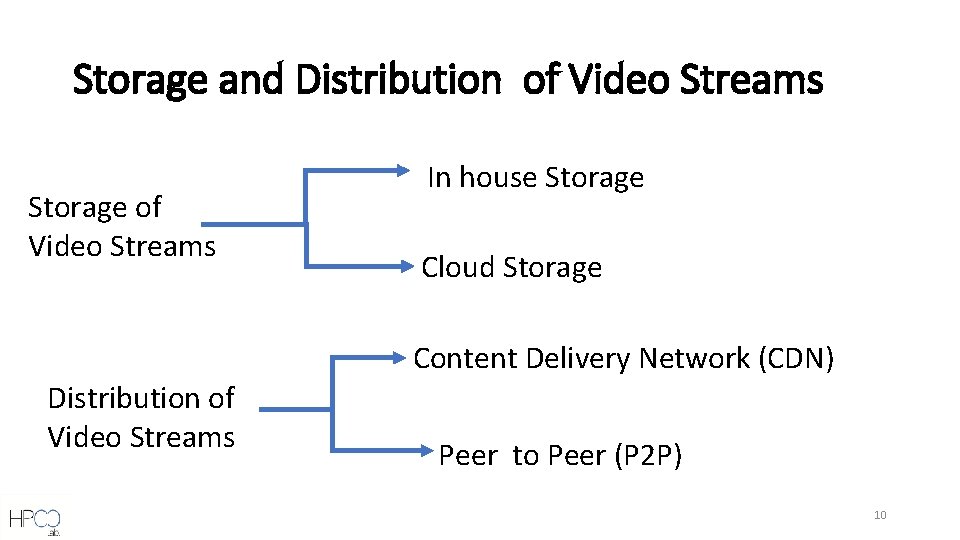
Storage and Distribution of Video Streams Storage of Video Streams In house Storage Cloud Storage Content Delivery Network (CDN) Distribution of Video Streams Peer to Peer (P 2 P) 10
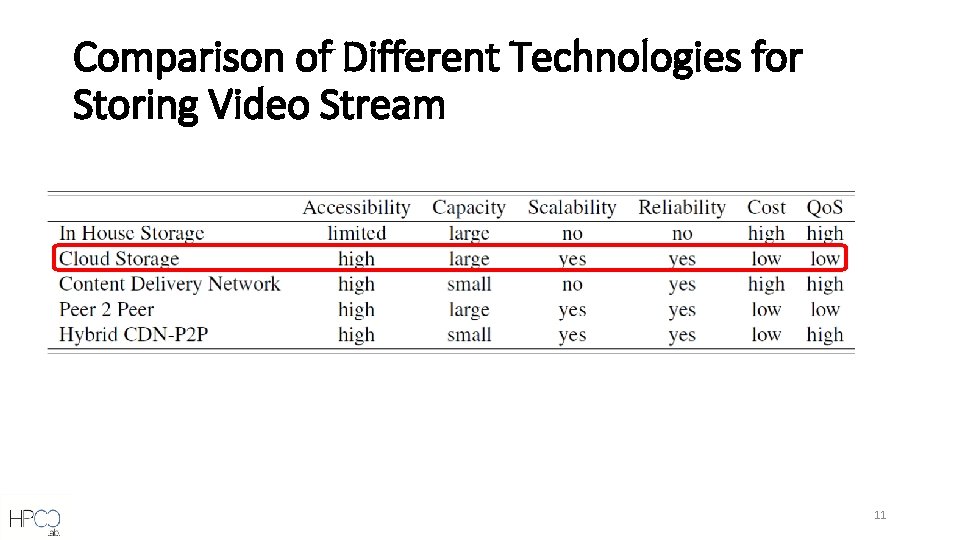
Comparison of Different Technologies for Storing Video Stream 11
Challenges in On-Demand Computation of Transcoding 1. Real-time video stream transcoding 2. Significant incurred Cost to buy infrastructure 3. Maintenance and Update 12
Video Transcoding in Cloud!! 13
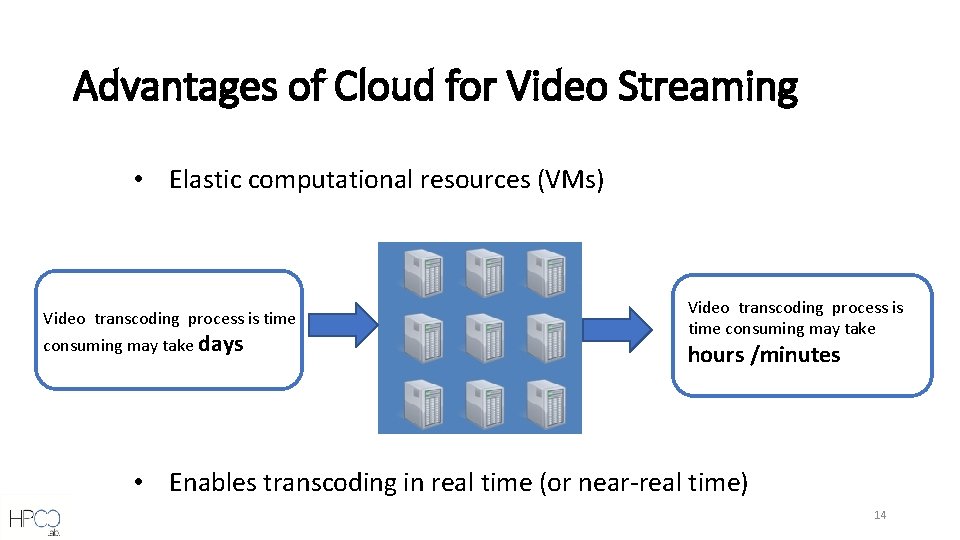
Advantages of Cloud for Video Streaming • Elastic computational resources (VMs) Video transcoding process is time consuming may take days Video transcoding process is time consuming may take hours /minutes • Enables transcoding in real time (or near-real time) 14
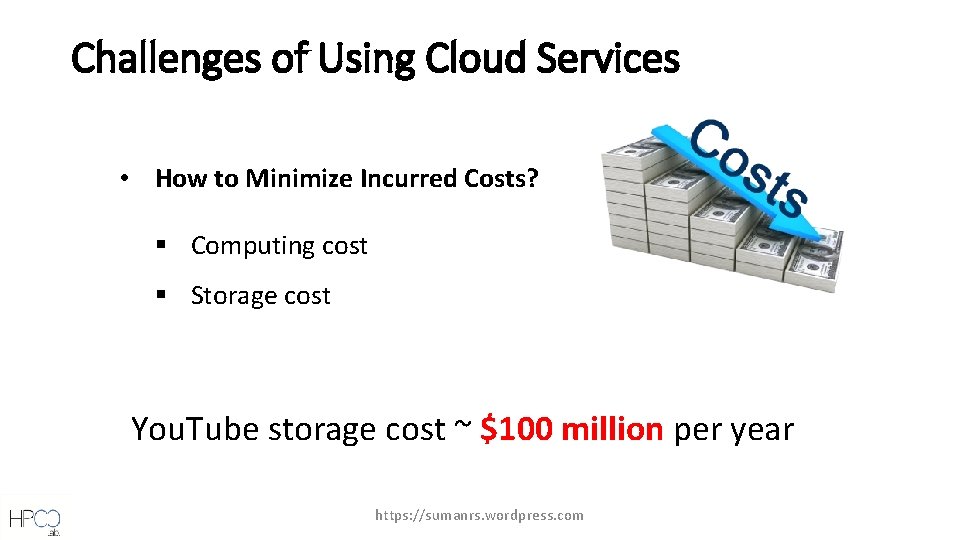
Challenges of Using Cloud Services • How to Minimize Incurred Costs? § Computing cost § Storage cost You. Tube storage cost ~ $100 million per year https: //sumanrs. wordpress. com
Outline • What is Video Transcoding? • Why Video Transcoding on Cloud? • What others have been done so far? • My thesis focus • Conclusion 16
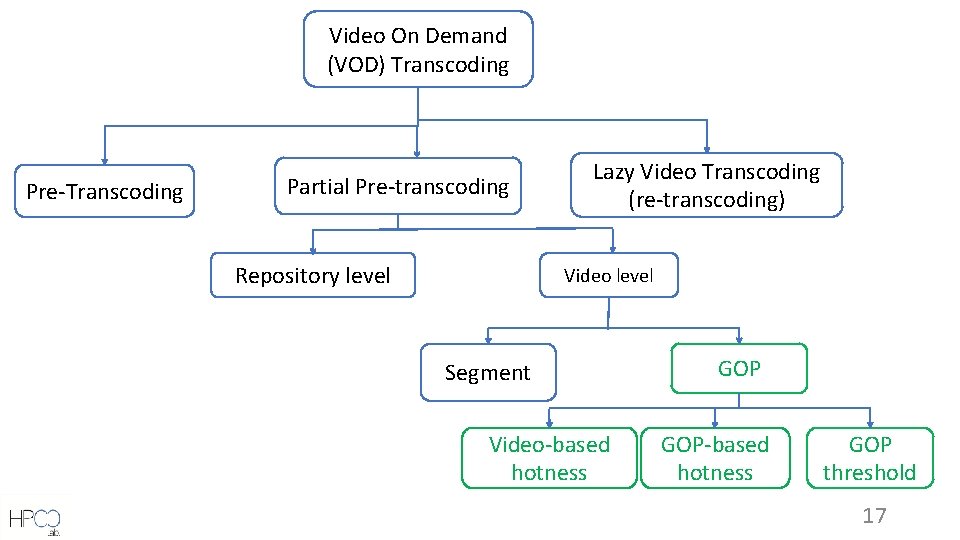
Video On Demand (VOD) Transcoding Pre-Transcoding Partial Pre-transcoding Repository level Lazy Video Transcoding (re-transcoding) Video level Segment Video-based hotness GOP-based hotness GOP threshold 17
Outline • What is Video Transcoding? • Why Video Transcoding on Cloud? • What have been done so far? • Focus of this thesis • Conclusion 18
Cost Efficient partial Pre-Transcoding of Video Streaming 19
Recap on Definitions • Two approaches for transcoding § Pre- Transcode: Ø store a format of video in repository. § Re-transcode: Ø transcode video format upon request 20
Problem Definition • When to pre-transcode a video? • When to apply partial pre-transcoding on videos? 21
Intuitive Solution • Pre-transcode all hot videos • Re-transcode all cold (non-hot) videos But, what is a hot video? Is there any way to quantify the hotness of a video? 22
Summary of Contributions 1. Providing a formal method to measure hotness of video streams. 2. Proposing cost-saving methods to reduce the incurred cost of cloud-based video streaming using the hotness measure. 3. Proposing methods to reduce the execution overhead time of cost-saving method 4. Analyzing the impact of the proposed methods on video streaming with different access models. 23
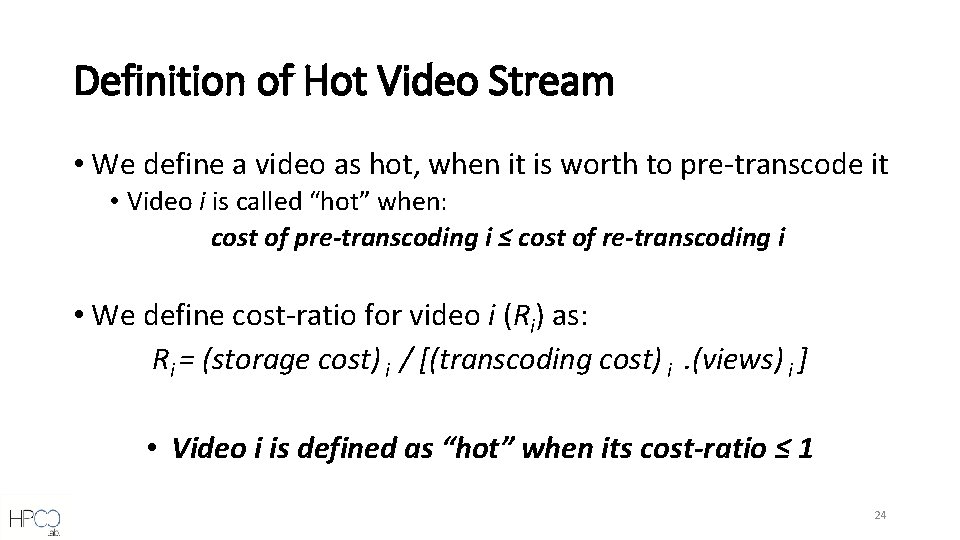
Definition of Hot Video Stream • We define a video as hot, when it is worth to pre-transcode it • Video i is called “hot” when: cost of pre-transcoding i ≤ cost of re-transcoding i • We define cost-ratio for video i (Ri) as: Ri = (storage cost) i / [(transcoding cost) i. (views) i ] • Video i is defined as “hot” when its cost-ratio ≤ 1 24
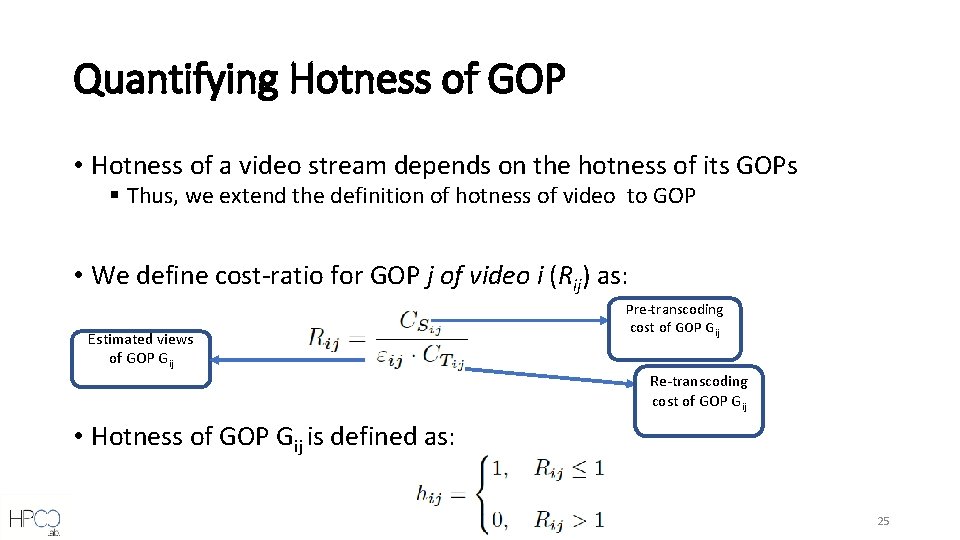
Quantifying Hotness of GOP • Hotness of a video stream depends on the hotness of its GOPs § Thus, we extend the definition of hotness of video to GOP • We define cost-ratio for GOP j of video i (Rij) as: Estimated views of GOP Gij Pre-transcoding cost of GOP Gij Re-transcoding cost of GOP Gij • Hotness of GOP Gij is defined as: 25
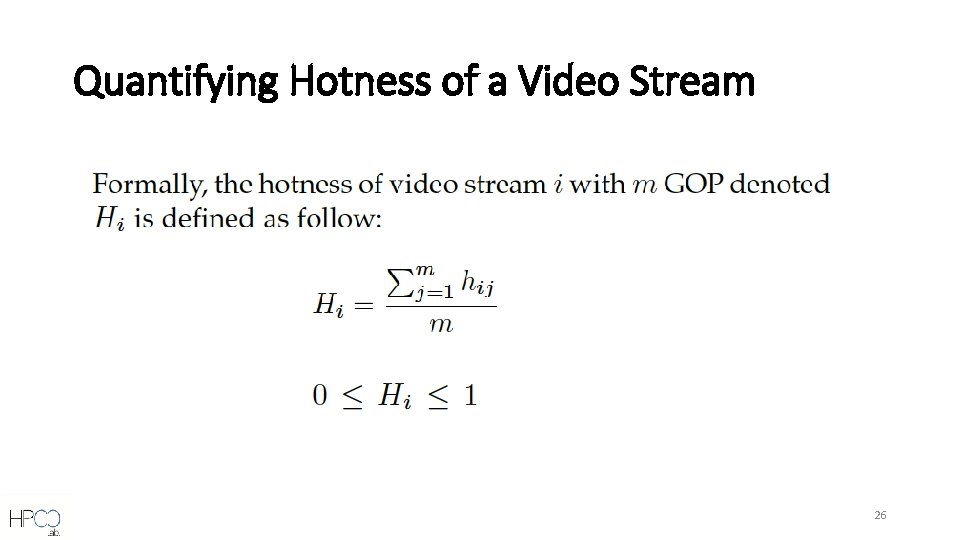
Quantifying Hotness of a Video Stream 26
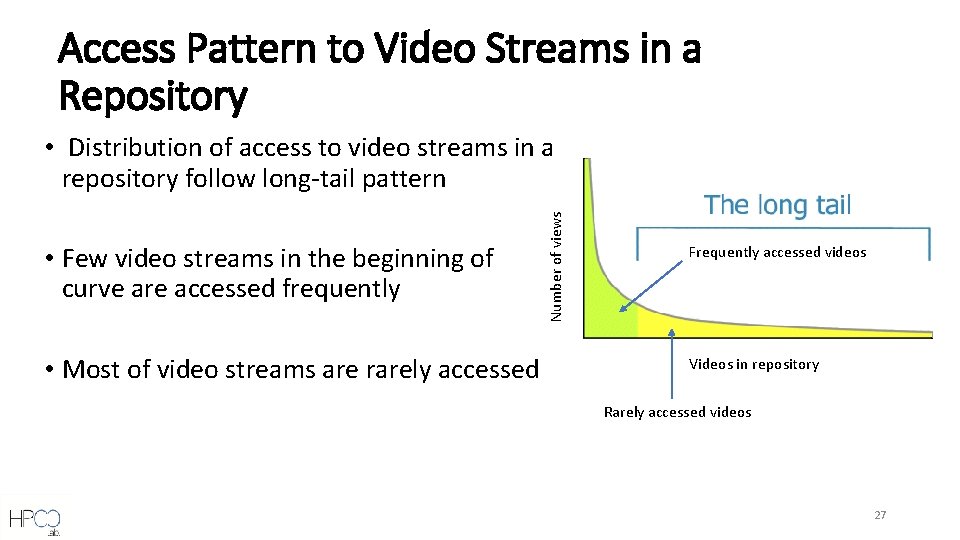
Access Pattern to Video Streams in a Repository • Few video streams in the beginning of curve are accessed frequently • Most of video streams are rarely accessed Number of views • Distribution of access to video streams in a repository follow long-tail pattern Frequently accessed videos Videos in repository Rarely accessed videos 27
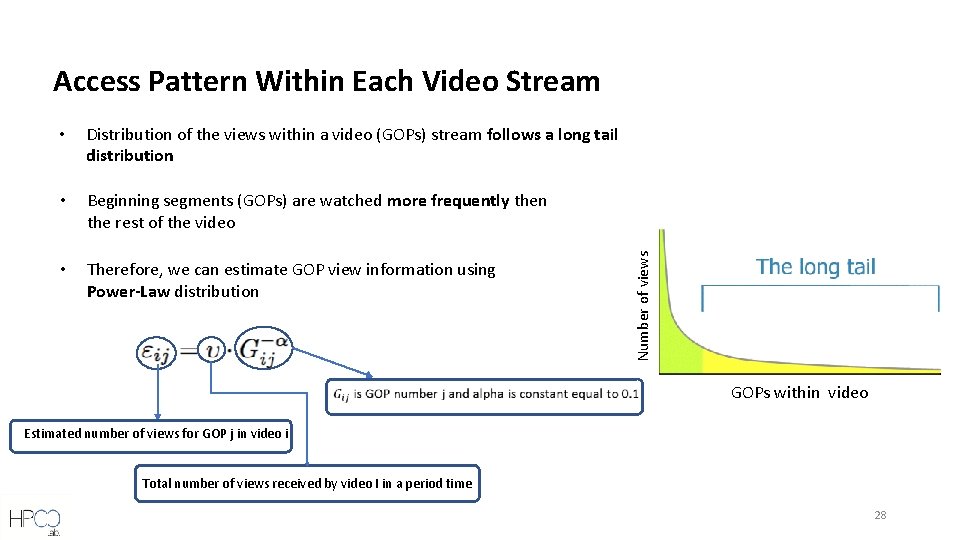
• Distribution of the views within a video (GOPs) stream follows a long tail distribution • Beginning segments (GOPs) are watched more frequently then the rest of the video • Therefore, we can estimate GOP view information using Power-Law distribution Number of views Access Pattern Within Each Video Stream GOPs within video Estimated number of views for GOP j in video i Total number of views received by video I in a period time 28
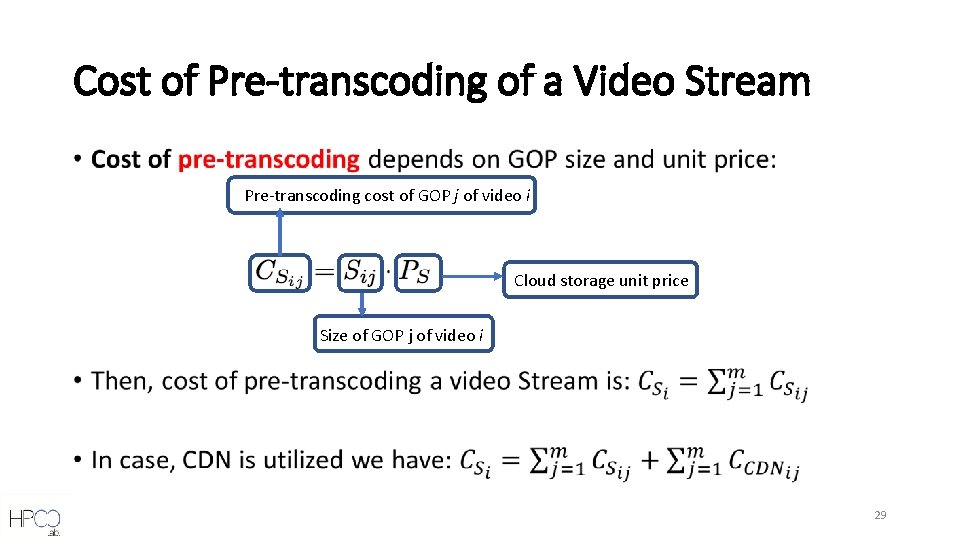
Cost of Pre-transcoding of a Video Stream • Pre-transcoding cost of GOP j of video i Cloud storage unit price Size of GOP j of video i 29
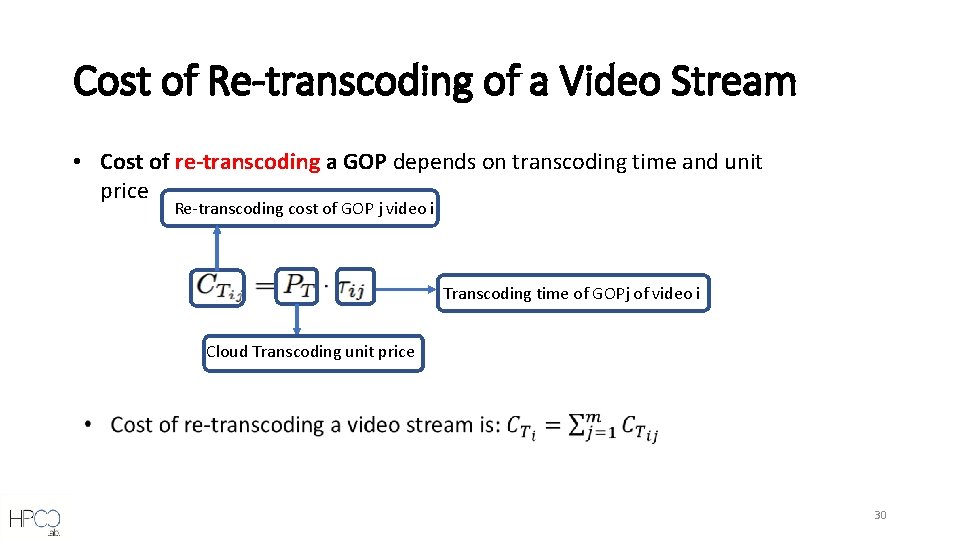
Cost of Re-transcoding of a Video Stream • Cost of re-transcoding a GOP depends on transcoding time and unit price Re-transcoding cost of GOP j video i Transcoding time of GOPj of video i Cloud Transcoding unit price 30

Algorithms for Partial Pre-transcoding 31
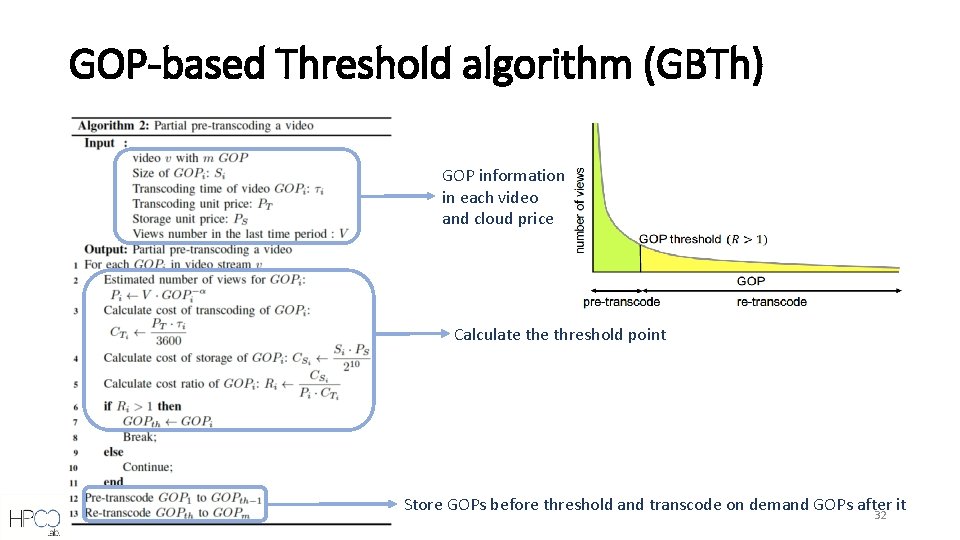
GOP-based Threshold algorithm (GBTh) GOP information in each video and cloud price Calculate threshold point Store GOPs before threshold and transcode on demand GOPs after it 32
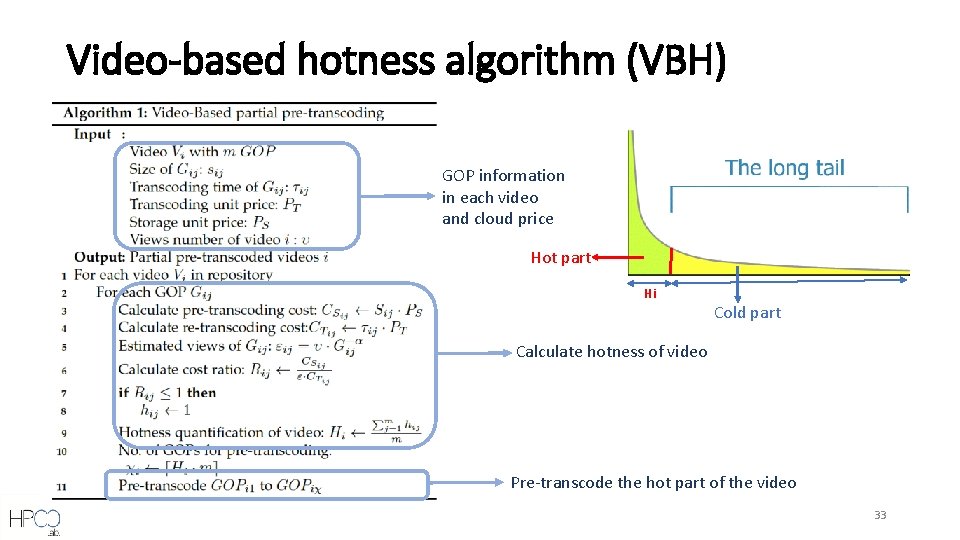
Video-based hotness algorithm (VBH) GOP information in each video and cloud price Hot part Hi Cold part Calculate hotness of video Pre-transcode the hot part of the video 33
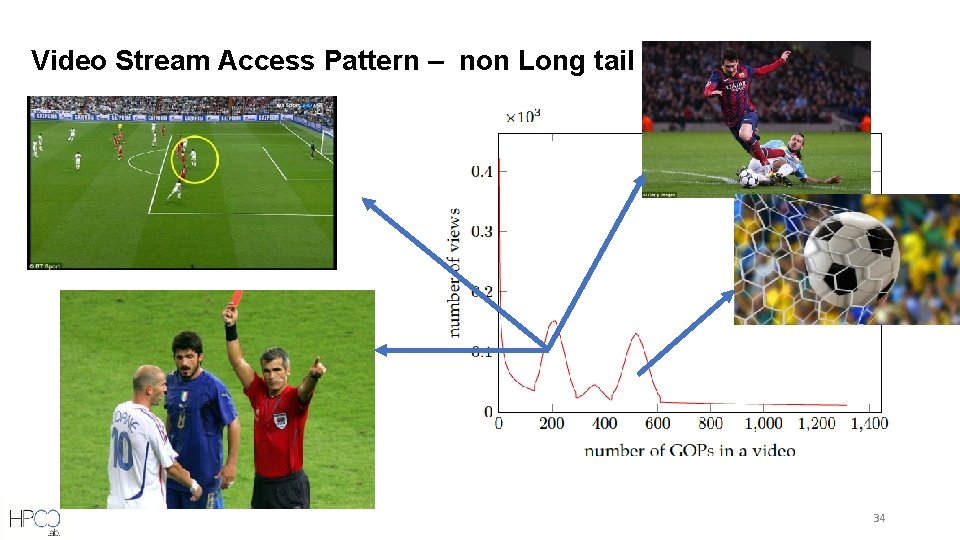
Video Stream Access Pattern – non Long tail 34
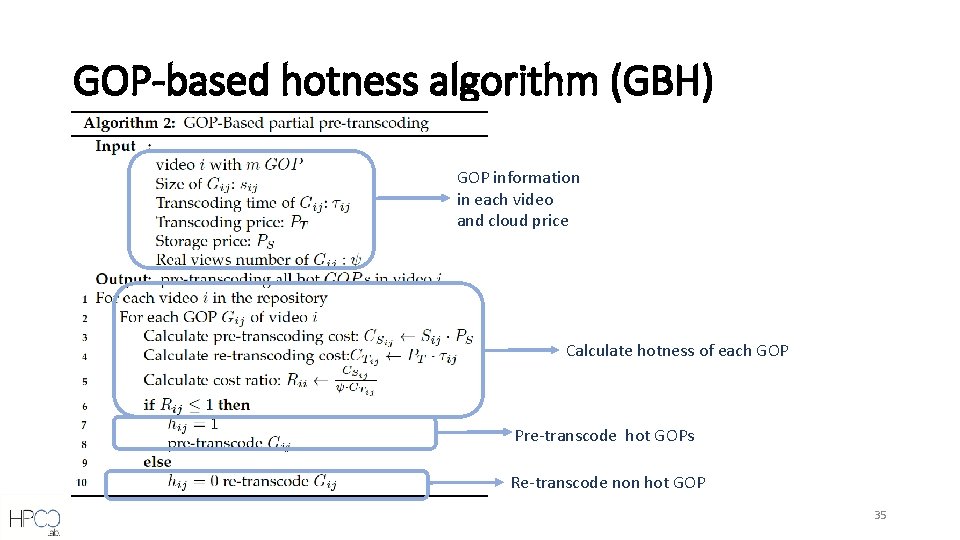
GOP-based hotness algorithm (GBH) GOP information in each video and cloud price Calculate hotness of each GOP Pre-transcode hot GOPs Re-transcode non hot GOP 35
How to Reduce the Time Overhead of Partial. Pre-transcoding Methods? • The proposed methods have to consider all videos in the repository. • This is time consuming • How can we improve the execution time of these methods? 36
Clustering Video Streams Based on Hotness • We classify video streams in a repository based on their hotness. • This algorithm partitions the repository into three subsets of video streams • We run partial pre-transcoding algorithm on the subset that contains partially hot videos 37
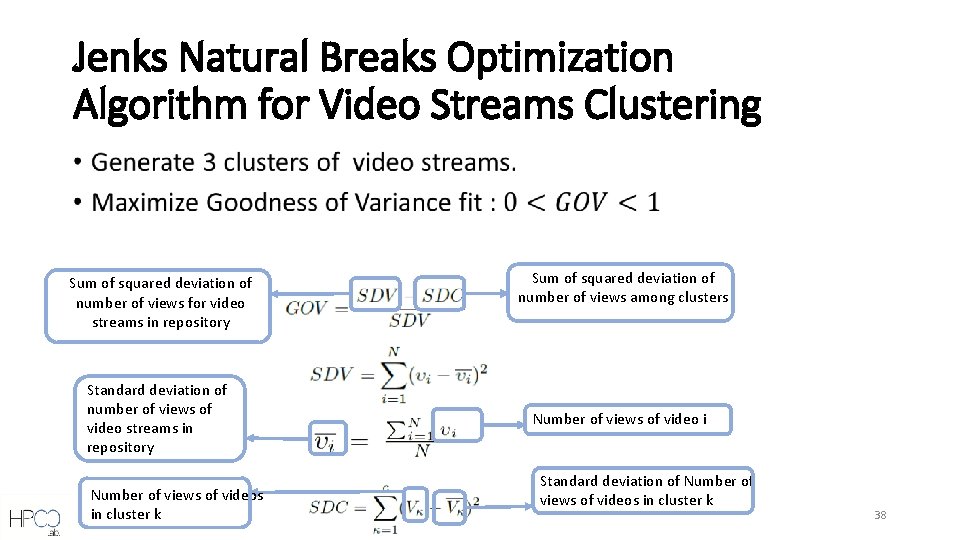
Jenks Natural Breaks Optimization Algorithm for Video Streams Clustering • Sum of squared deviation of number of views for video streams in repository Standard deviation of number of views of video streams in repository Number of views of videos in cluster k Sum of squared deviation of number of views among clusters Number of views of video i Standard deviation of Number of views of videos in cluster k 38
Experimental Setup • We need large number of videos with their number of views to evaluate the proposed methods. • Collecting such large number of videos with their views is time consuming and costly • Therefore, we synthesize our own videos repository. 39
Experimental Setup (Cont. ) • In order to synthesize videos, we need to know the characteristics of videos. • We downloaded 100 videos from You. Tube including fully movies, soccer game, public speech, News • we transcoded those videos to get transcoding time and GOP size 40
Experimental Setup (Cont. ) • Why do we need transcoding time and size for GOP? • Because we need to use GOP size in storage cost equation and transcoding time is transcoding cost equation 41
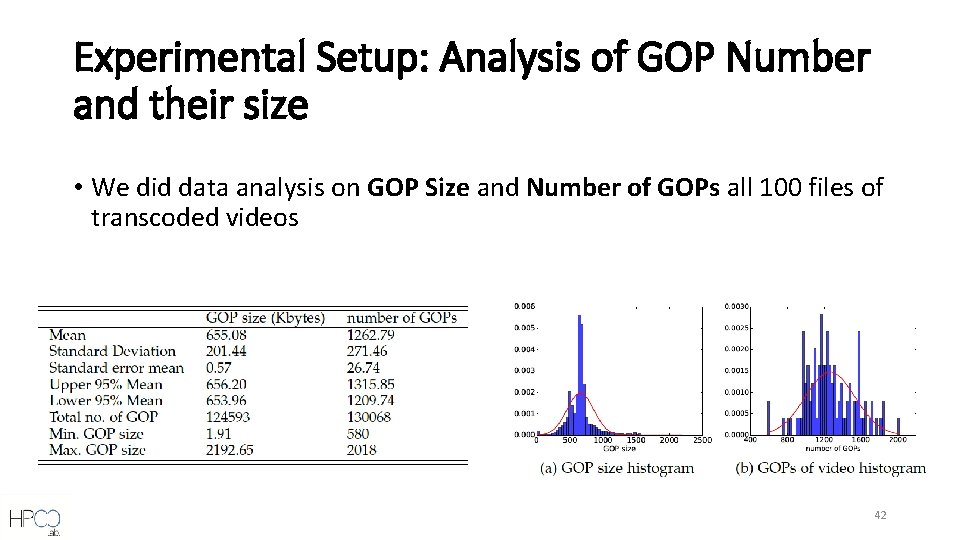
Experimental Setup: Analysis of GOP Number and their size • We did data analysis on GOP Size and Number of GOPs all 100 files of transcoded videos 42
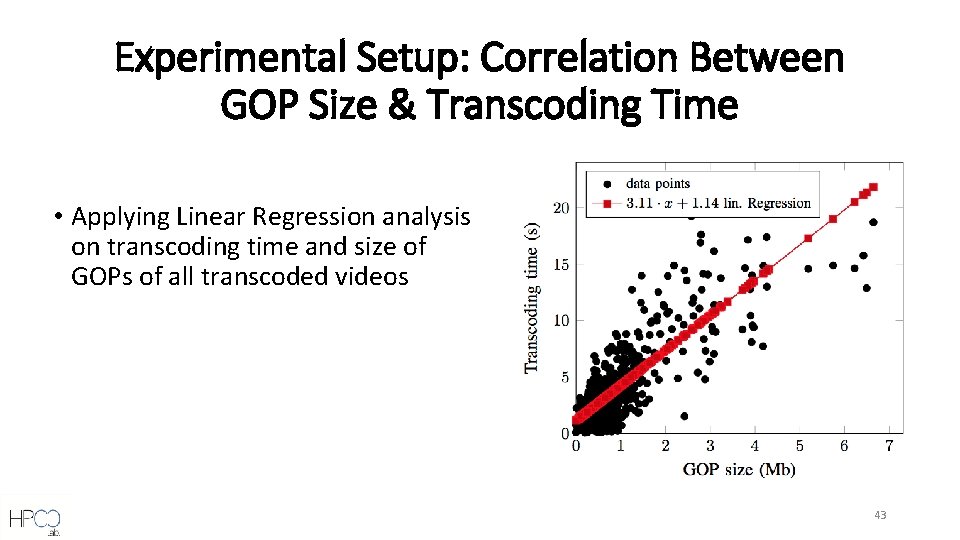
Experimental Setup: Correlation Between GOP Size & Transcoding Time • Applying Linear Regression analysis on transcoding time and size of GOPs of all transcoded videos 43
Experimental Setup: Video Synthesis • Video Synthesis : • we use the equation of linear regression to generate transcoding time as function of GOP size. • We assign number of views for each synthesized video by apply Power-law equation. 44
Generating Video Repositories: 1. Generate several videos repositories, each contains 100, 000 videos 2. Modeling video access pattern in a repository by applying a Weibull Function and adjust its parameters to follow a long tail as shown in table 3. We consider synthesized videos with long tail and non long tail access 4. For each experiments we repeat it 50 times with confidence interval 95% 45
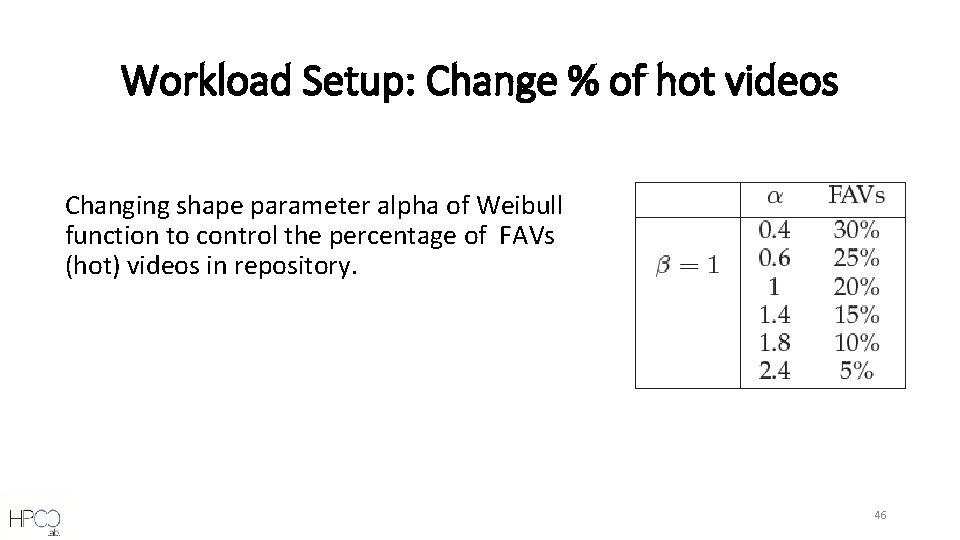
Workload Setup: Change % of hot videos Changing shape parameter alpha of Weibull function to control the percentage of FAVs (hot) videos in repository. 46
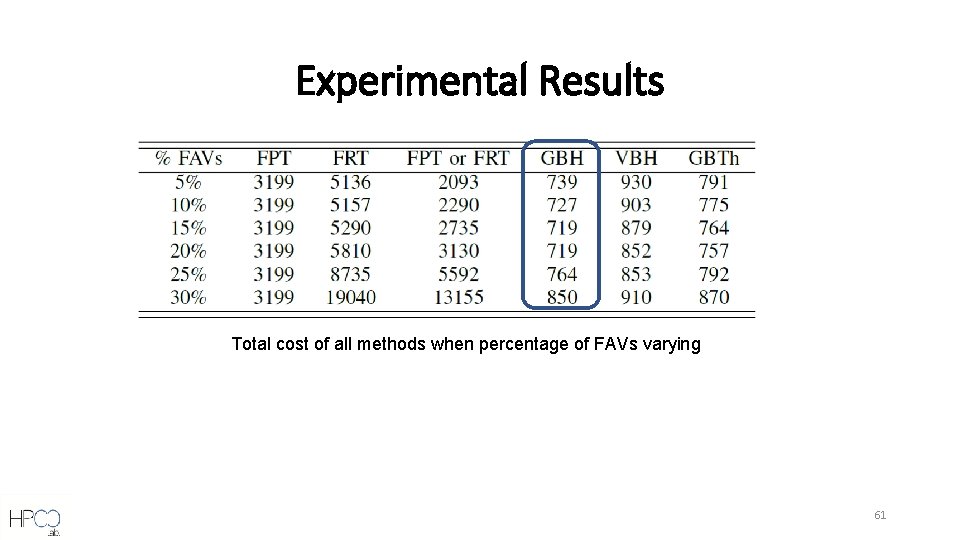
Methods Used For Comparison • VBH : Video Based Hotness • VLT: Video Level Transcoding (either store or transcode full video) • GBTh: GOP Based Threshold • GBH: GOP Based Hotness 47
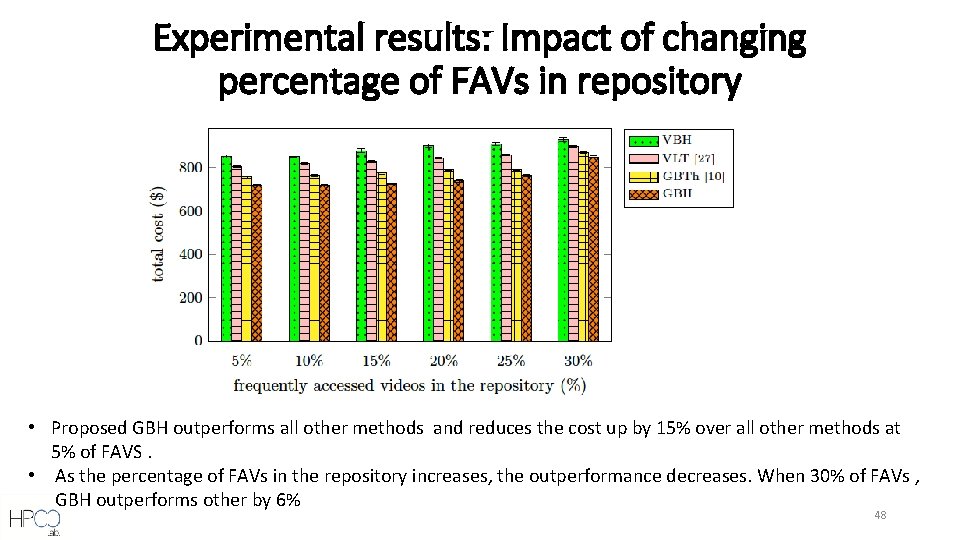
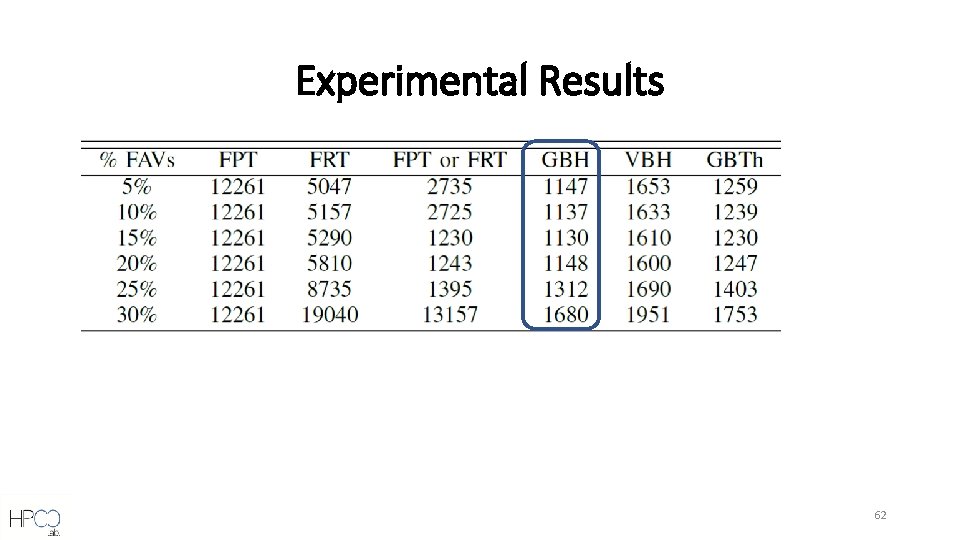
Experimental results: Impact of changing percentage of FAVs in repository • Proposed GBH outperforms all other methods and reduces the cost up by 15% over all other methods at 5% of FAVS. • As the percentage of FAVs in the repository increases, the outperformance decreases. When 30% of FAVs , GBH outperforms other by 6% 48
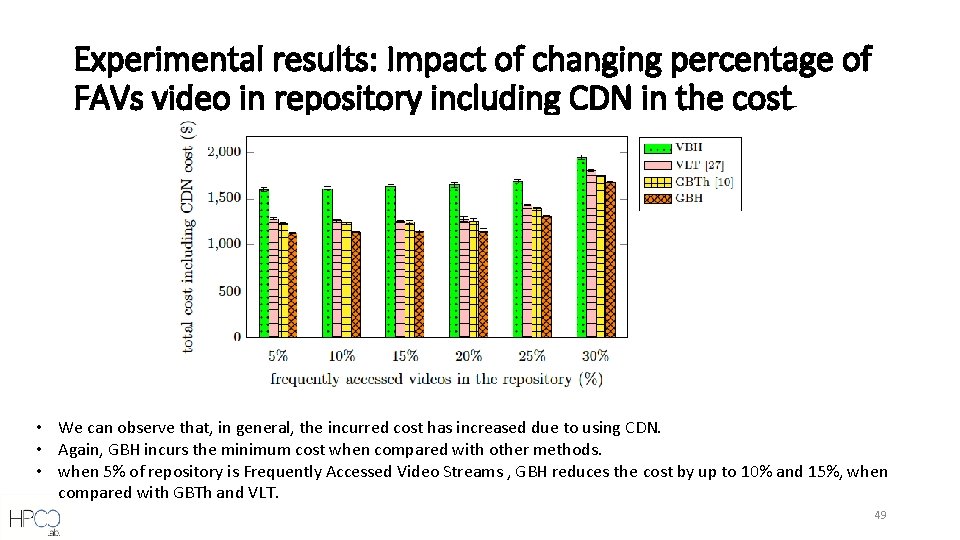
Experimental results: Impact of changing percentage of FAVs video in repository including CDN in the cost • We can observe that, in general, the incurred cost has increased due to using CDN. • Again, GBH incurs the minimum cost when compared with other methods. • when 5% of repository is Frequently Accessed Video Streams , GBH reduces the cost by up to 10% and 15%, when compared with GBTh and VLT. 49
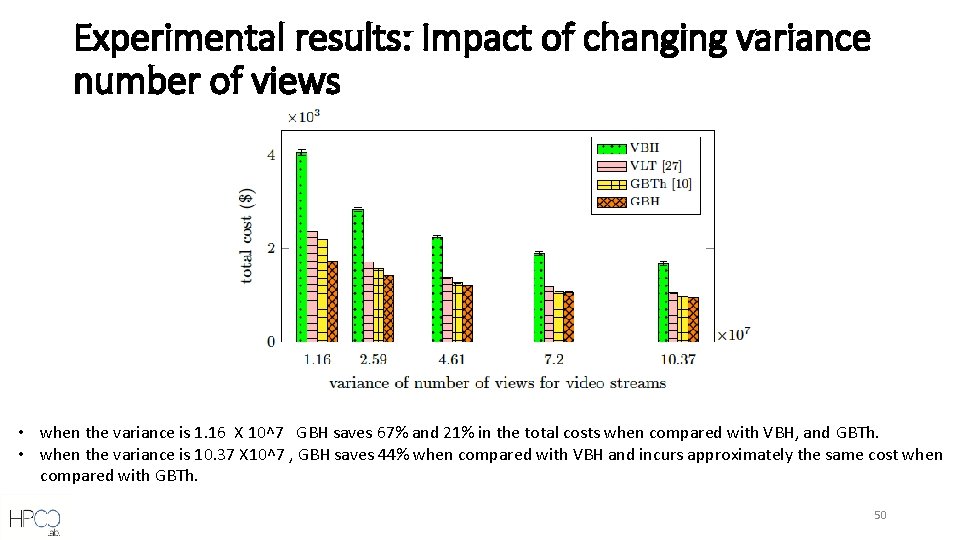
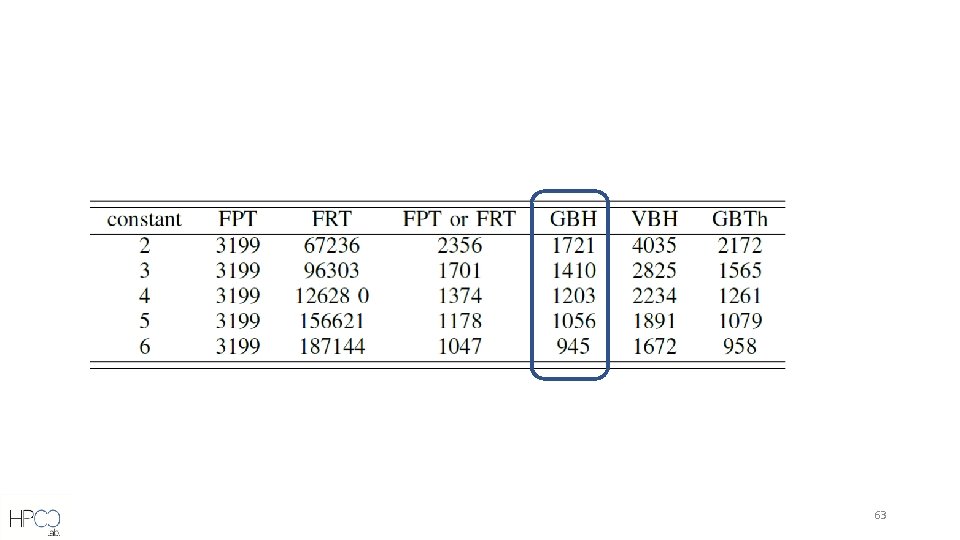
Experimental results: Impact of changing variance number of views • when the variance is 1. 16 X 10^7 GBH saves 67% and 21% in the total costs when compared with VBH, and GBTh. • when the variance is 10. 37 X 10^7 , GBH saves 44% when compared with VBH and incurs approximately the same cost when compared with GBTh. 50
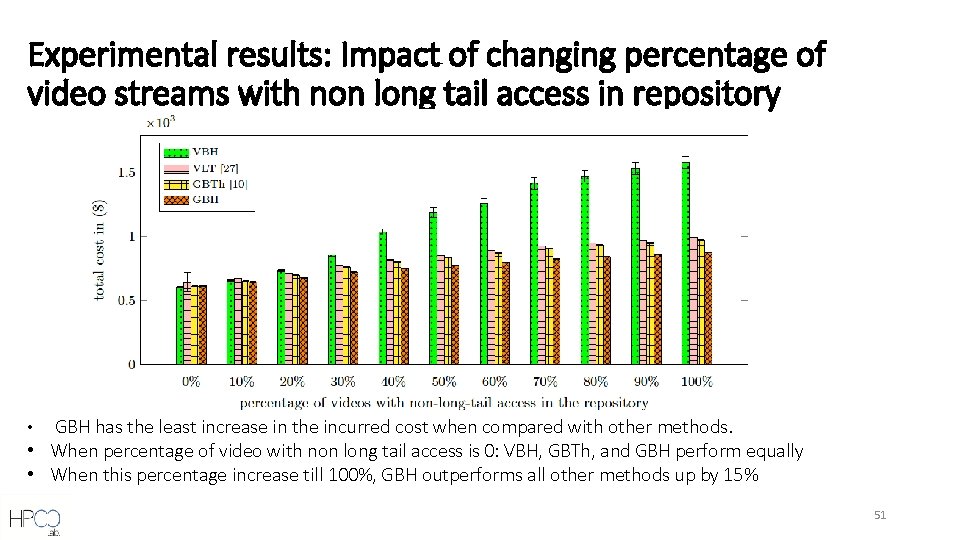
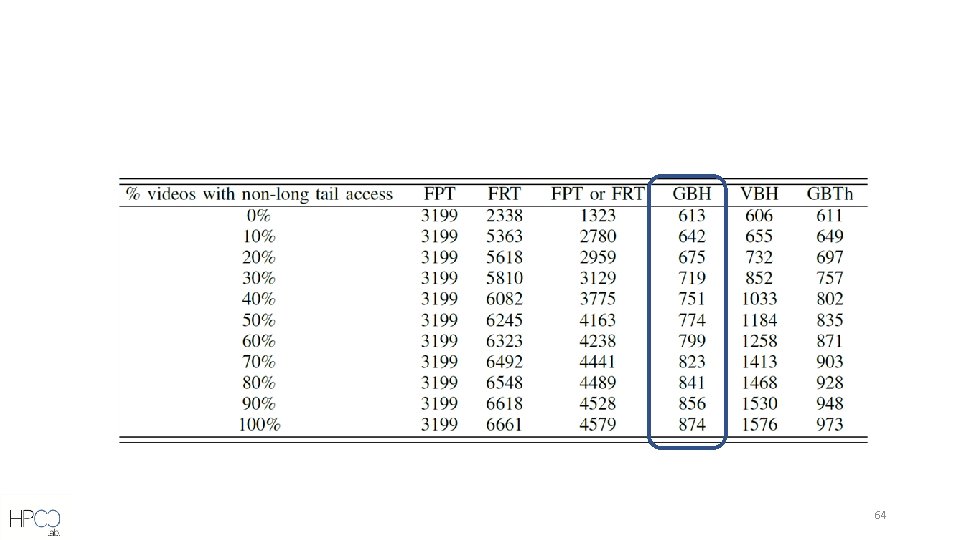
Experimental results: Impact of changing percentage of video streams with non long tail access in repository GBH has the least increase in the incurred cost when compared with other methods. • When percentage of video with non long tail access is 0: VBH, GBTh, and GBH perform equally • When this percentage increase till 100%, GBH outperforms all other methods up by 15% • 51
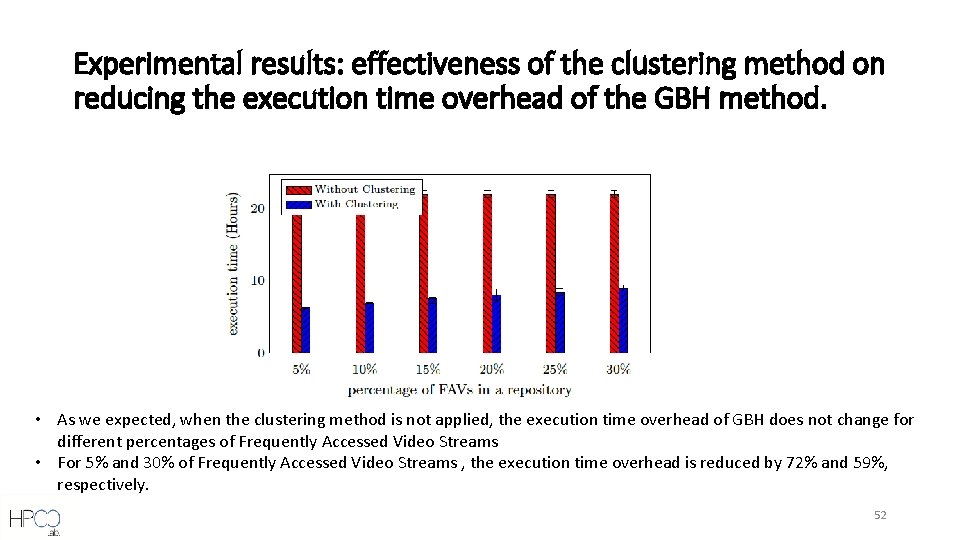
Experimental results: effectiveness of the clustering method on reducing the execution time overhead of the GBH method. • As we expected, when the clustering method is not applied, the execution time overhead of GBH does not change for different percentages of Frequently Accessed Video Streams • For 5% and 30% of Frequently Accessed Video Streams , the execution time overhead is reduced by 72% and 59%, respectively. 52
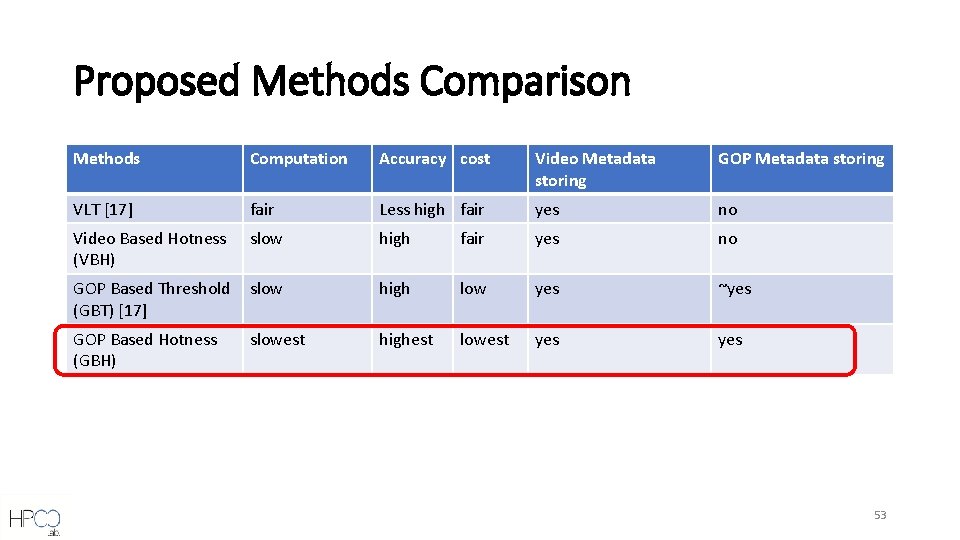
Proposed Methods Comparison Methods Computation Accuracy cost Video Metadata storing GOP Metadata storing VLT [17] fair Less high fair yes no Video Based Hotness (VBH) slow high fair yes no GOP Based Threshold slow (GBT) [17] high low yes ~yes GOP Based Hotness (GBH) highest lowest yes slowest 53
Outline • What is Video Transcoding? • Why Video Transcoding on Cloud? • What have been done so far? • My thesis focus • Conclusion 54
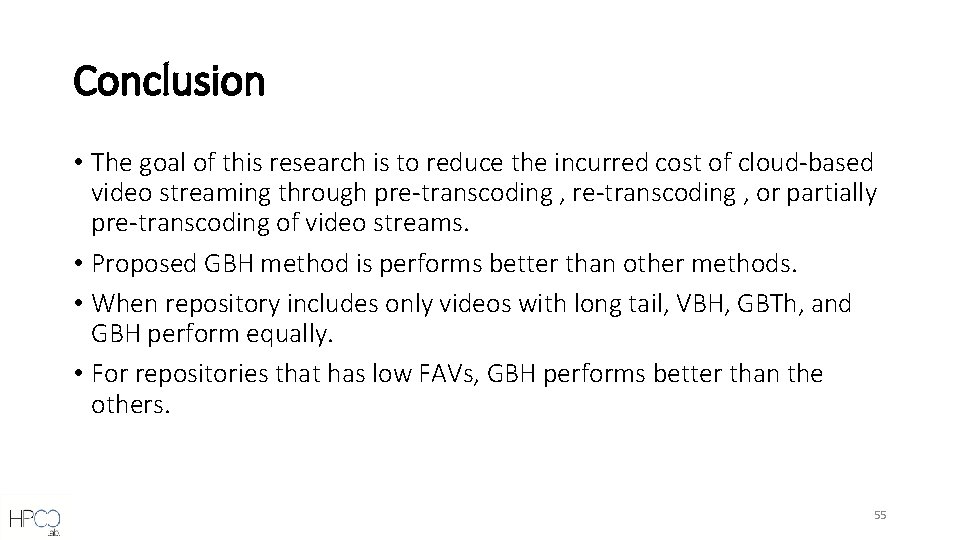
Conclusion • The goal of this research is to reduce the incurred cost of cloud-based video streaming through pre-transcoding , or partially pre-transcoding of video streams. • Proposed GBH method is performs better than other methods. • When repository includes only videos with long tail, VBH, GBTh, and GBH perform equally. • For repositories that has low FAVs, GBH performs better than the others. 55
Future Directions of Research • Prediction of hotness • Hierarchy of video streams storage • Video Summarization 56
Publications • Darwich M. , Beyazit E. , Amini Salhi M. , Bayoumi M. (2017) “Cost Efficient Cloud-Based Video Streaming Based on Quantifying Video Hotness ” Manuscript ready to submit. • Darwich M. , Beyazit E. , Amini Salhi M. , Bayoumi M. (2017) “Cost Efficient Repository Management for Cloud-based On-Demand Video Streaming” IEEE 5 th International Conference on Mobile Cloud Computing, Services and Engineering, 7 -9 April 2017, San Francisco, USA. • Darwich M. , Abdelgawad A. , Bayoumi M. (2016) “A Survey on the Power and Robustness of Fin. FET SRAM” IEEE 59 th International Midwest Symposium on Circuits and Systems (MWSCAS), 16 -19 October 2016, Abu Dhabi, UAE. • Li X. , Joshi Y. , Darwich M. , Landrenau B. , Amini Salehi M. , Bayoumi M. , “Performance Analysis and Modeling of Video Transcoding Using Heterogeneous Cloud Services”. Manuscript submitted. • Li X. , Darwich M. , Amini Salehi M. , Bayoumi M. , “Cloud-Based Video Streaming Services: A Survey” Manuscript in preparation. 57

Questions? 58

Thank you 59
Appendix 60
Experimental Results Total cost of all methods when percentage of FAVs varying 61
Experimental Results 62
63
64
- Slides: 64