
Cost Effective Offset Well Frachit Protection Solution 5
- Slides: 20
Cost Effective Offset Well Frac-hit Protection Solution 5 th ALRDC Seminar for New Artificial Lift Technology August 2, 2017 Presenter: Rob Hari, VP Product Development CONFIDENTIAL Multiple patents pending © HEAL Systems, 2017
Agenda 1. Horizontal well trends 2. Overview frac-hit 3. HEAL Slickline System 4. Artificial lift transition © HEAL Systems, 2017 | 2
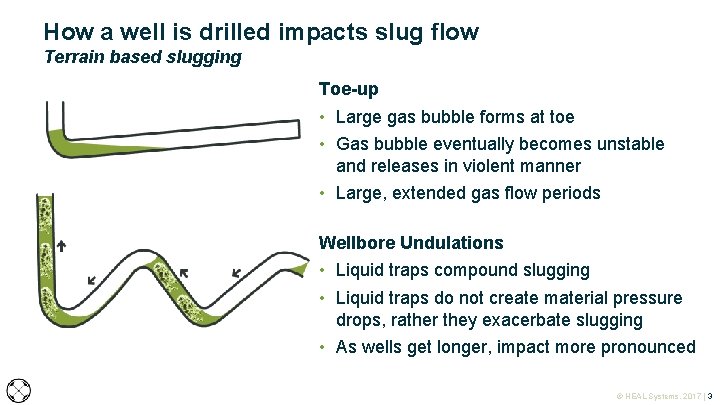
How a well is drilled impacts slug flow Terrain based slugging Toe-up • Large gas bubble forms at toe • Gas bubble eventually becomes unstable and releases in violent manner • Large, extended gas flow periods Wellbore Undulations • Liquid traps compound slugging • Liquid traps do not create material pressure drops, rather they exacerbate slugging • As wells get longer, impact more pronounced © HEAL Systems, 2017 | 3
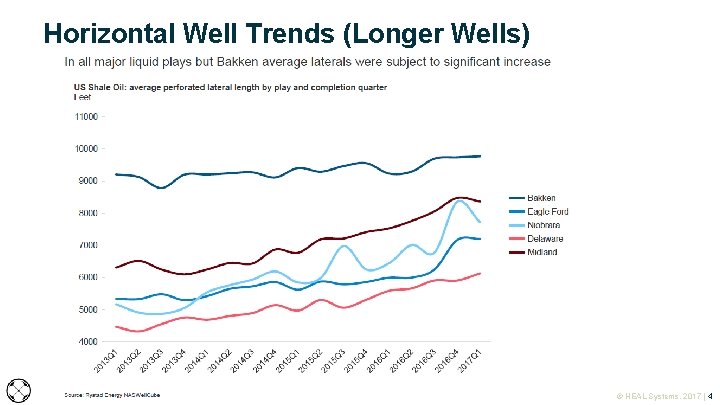
Horizontal Well Trends (Longer Wells) © HEAL Systems, 2017 | 4
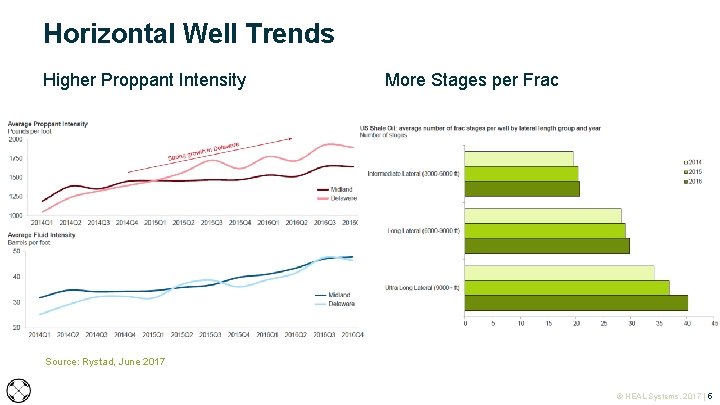
Horizontal Well Trends Higher Proppant Intensity More Stages per Frac Source: Rystad, June 2017 © HEAL Systems, 2017 | 5
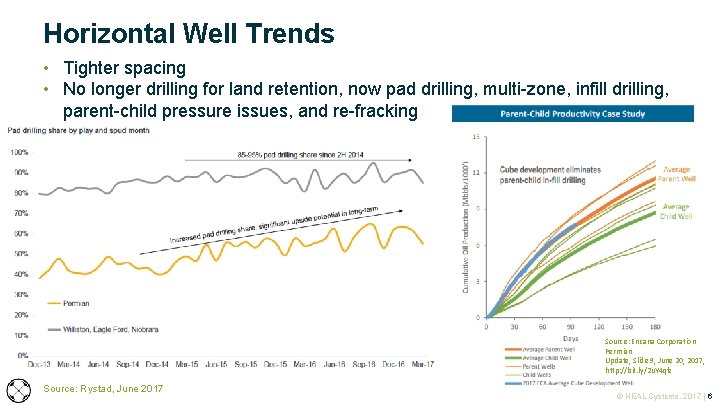
Horizontal Well Trends • Tighter spacing • No longer drilling for land retention, now pad drilling, multi-zone, infill drilling, parent-child pressure issues, and re-fracking Source: Encana Corporation Permian Update, Slide 9, June 20, 2017, http: //bit. ly/2 u. Y 4 qfz Source: Rystad, June 2017 © HEAL Systems, 2017 | 6
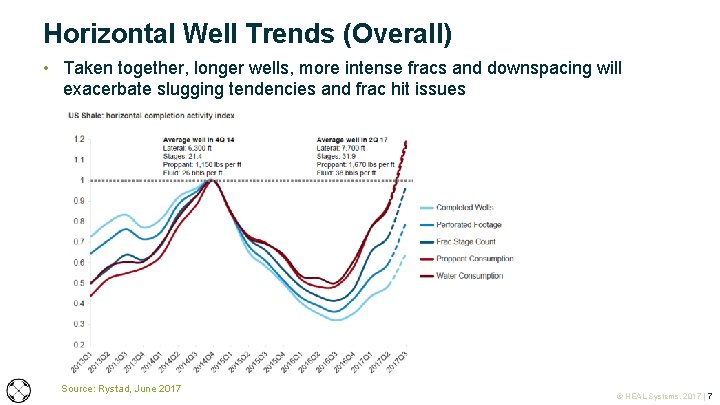
Horizontal Well Trends (Overall) • Taken together, longer wells, more intense fracs and downspacing will exacerbate slugging tendencies and frac hit issues Source: Rystad, June 2017 © HEAL Systems, 2017 | 7
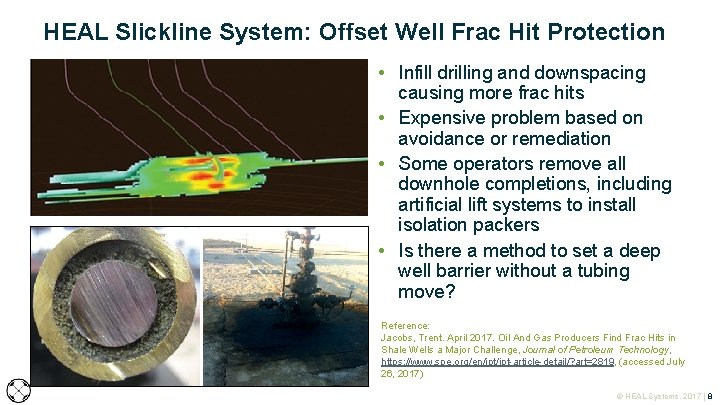
HEAL Slickline System: Offset Well Frac Hit Protection • Infill drilling and downspacing causing more frac hits • Expensive problem based on avoidance or remediation • Some operators remove all downhole completions, including artificial lift systems to install isolation packers • Is there a method to set a deep well barrier without a tubing move? Reference: Jacobs, Trent. April 2017. Oil And Gas Producers Find Frac Hits in Shale Wells a Major Challenge, Journal of Petroleum Technology, https: //www. spe. org/en/jpt-article-detail/? art=2819, (accessed July 26, 2017) © HEAL Systems, 2017 | 8
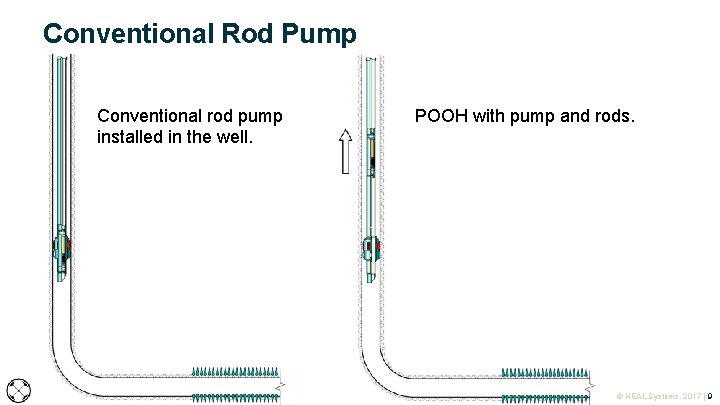
Conventional Rod Pump Conventional rod pump installed in the well. POOH with pump and rods. © HEAL Systems, 2017 | 9
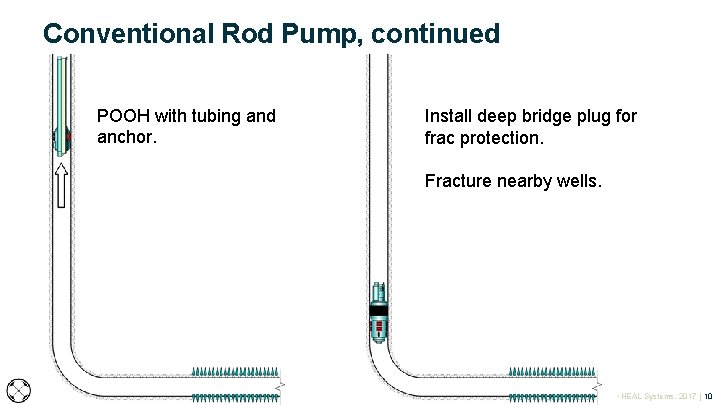
Conventional Rod Pump, continued POOH with tubing and anchor. Install deep bridge plug for frac protection. Fracture nearby wells. © HEAL Systems, 2017 | 10
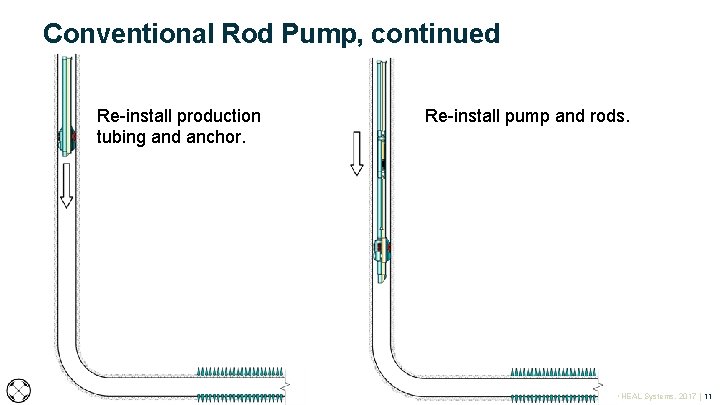
Conventional Rod Pump, continued Re-install production tubing and anchor. Re-install pump and rods. © HEAL Systems, 2017 | 11
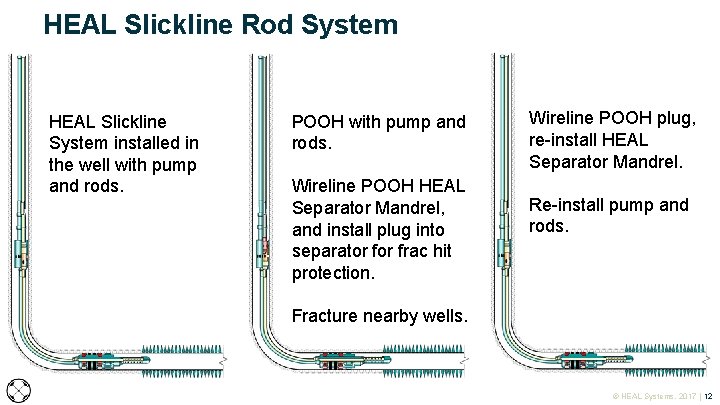
HEAL Slickline Rod System HEAL Slickline System installed in the well with pump and rods. POOH with pump and rods. Wireline POOH HEAL Separator Mandrel, and install plug into separator frac hit protection. Wireline POOH plug, re-install HEAL Separator Mandrel. Re-install pump and rods. Fracture nearby wells. © HEAL Systems, 2017 | 12
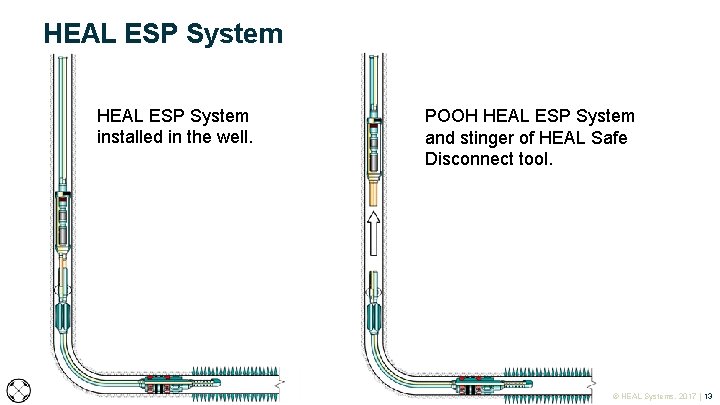
HEAL ESP System installed in the well. POOH HEAL ESP System and stinger of HEAL Safe Disconnect tool. © HEAL Systems, 2017 | 13
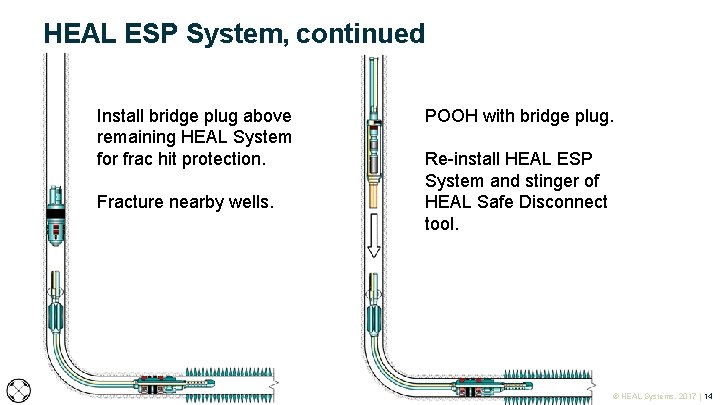
HEAL ESP System, continued Install bridge plug above remaining HEAL System for frac hit protection. Fracture nearby wells. POOH with bridge plug. Re-install HEAL ESP System and stinger of HEAL Safe Disconnect tool. © HEAL Systems, 2017 | 14
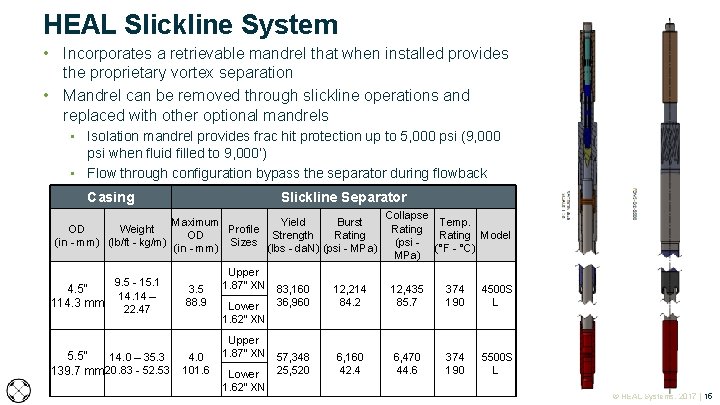
HEAL Slickline System • Incorporates a retrievable mandrel that when installed provides the proprietary vortex separation • Mandrel can be removed through slickline operations and replaced with other optional mandrels • Isolation mandrel provides frac hit protection up to 5, 000 psi (9, 000 psi when fluid filled to 9, 000’) • Flow through configuration bypass the separator during flowback Casing Slickline Separator Maximum Yield Burst OD Weight Profile OD Strength Rating (in - mm) (lb/ft - kg/m) Sizes (in - mm) (lbs - da. N) (psi - MPa) 9. 5 - 15. 1 4. 5" 14. 14 – 114. 3 mm 22. 47 5. 5" 14. 0 – 35. 3 139. 7 mm 20. 83 - 52. 53 3. 5 88. 9 Upper 1. 87” XN 83, 160 36, 960 Lower Collapse Temp. Rating Model (psi (°F - °C) MPa) 12, 214 84. 2 12, 435 85. 7 374 190 4500 S L 6, 160 42. 4 6, 470 44. 6 374 190 5500 S L 1. 62” XN 4. 0 101. 6 Upper 1. 87” XN 57, 348 25, 520 Lower 1. 62” XN © HEAL Systems, 2017 | 15
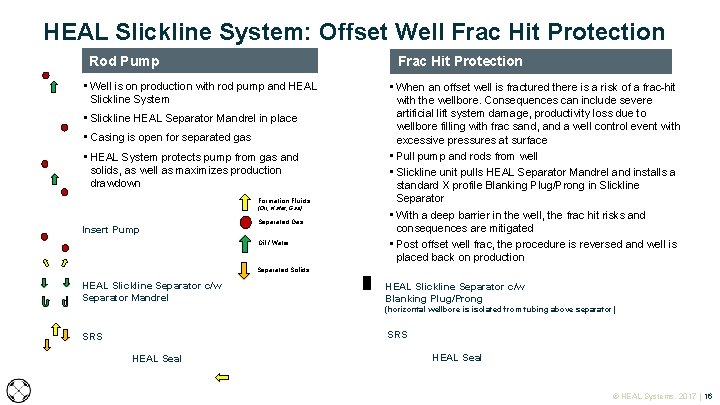
HEAL Slickline System: Offset Well Frac Hit Protection Rod Pump Frac Hit Protection • Well is on production with rod pump and HEAL Slickline System • Slickline HEAL Separator Mandrel in place • Casing is open for separated gas • HEAL System protects pump from gas and solids, as well as maximizes production drawdown Formation Fluids (Oil, Water, Gas) Insert Pump Separated Gas Oil / Water • When an offset well is fractured there is a risk of a frac-hit with the wellbore. Consequences can include severe artificial lift system damage, productivity loss due to wellbore filling with frac sand, and a well control event with excessive pressures at surface • Pull pump and rods from well • Slickline unit pulls HEAL Separator Mandrel and installs a standard X profile Blanking Plug/Prong in Slickline Separator • With a deep barrier in the well, the frac hit risks and consequences are mitigated • Post offset well frac, the procedure is reversed and well is placed back on production Separated Solids HEAL Slickline Separator c/w Separator Mandrel HEAL Slickline Separator c/w Blanking Plug/Prong (horizontal wellbore is isolated from tubing above separator) SRS HEAL Seal © HEAL Systems, 2017 | 16
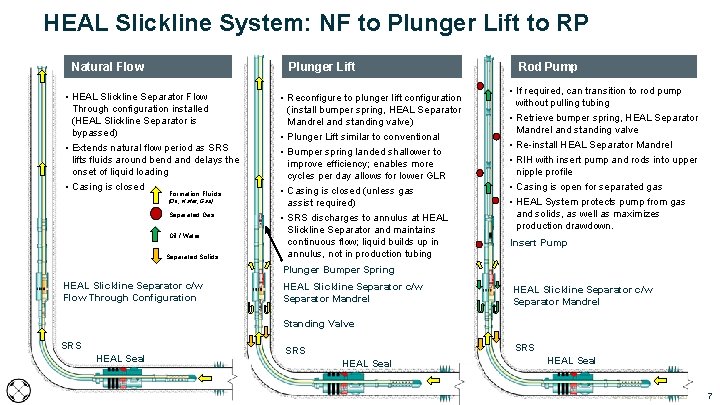
HEAL Slickline System: NF to Plunger Lift to RP Natural Flow Plunger Lift • HEAL Slickline Separator Flow Through configuration installed (HEAL Slickline Separator is bypassed) • Extends natural flow period as SRS lifts fluids around bend and delays the onset of liquid loading • Casing is closed Formation Fluids (Oil, Water, Gas) Separated Gas Oil / Water Separated Solids HEAL Slickline Separator c/w Flow Through Configuration • Reconfigure to plunger lift configuration (install bumper spring, HEAL Separator Mandrel and standing valve) • Plunger Lift similar to conventional • Bumper spring landed shallower to improve efficiency; enables more cycles per day allows for lower GLR • Casing is closed (unless gas assist required) • SRS discharges to annulus at HEAL Slickline Separator and maintains continuous flow; liquid builds up in annulus, not in production tubing Plunger Bumper Spring HEAL Slickline Separator c/w Separator Mandrel Rod Pump • If required, can transition to rod pump without pulling tubing • Retrieve bumper spring, HEAL Separator Mandrel and standing valve • Re-install HEAL Separator Mandrel • RIH with insert pump and rods into upper nipple profile • Casing is open for separated gas • HEAL System protects pump from gas and solids, as well as maximizes production drawdown. Insert Pump HEAL Slickline Separator c/w Separator Mandrel Standing Valve SRS HEAL Seal © HEAL Systems, 2017 | 17
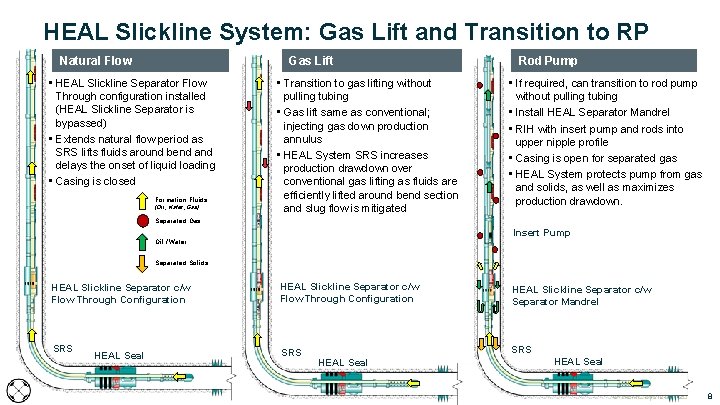
HEAL Slickline System: Gas Lift and Transition to RP Natural Flow Gas Lift • HEAL Slickline Separator Flow Through configuration installed (HEAL Slickline Separator is bypassed) • Extends natural flow period as SRS lifts fluids around bend and delays the onset of liquid loading • Casing is closed Formation Fluids (Oil, Water, Gas) • Transition to gas lifting without pulling tubing • Gas lift same as conventional; injecting gas down production annulus • HEAL System SRS increases production drawdown over conventional gas lifting as fluids are efficiently lifted around bend section and slug flow is mitigated Rod Pump • If required, can transition to rod pump without pulling tubing • Install HEAL Separator Mandrel • RIH with insert pump and rods into upper nipple profile • Casing is open for separated gas • HEAL System protects pump from gas and solids, as well as maximizes production drawdown. Separated Gas Insert Pump Oil / Water Separated Solids HEAL Slickline Separator c/w Flow Through Configuration HEAL Slickline Separator c/w Separator Mandrel SRS SRS HEAL Seal © HEAL Systems, 2017 | 18
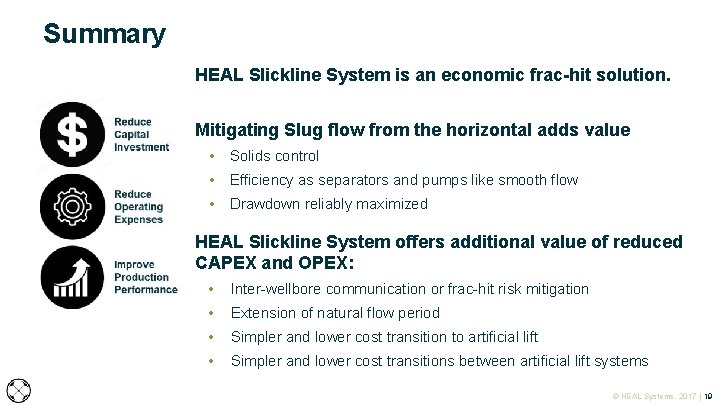
Summary HEAL Slickline System is an economic frac-hit solution. Mitigating Slug flow from the horizontal adds value • Solids control • Efficiency as separators and pumps like smooth flow • Drawdown reliably maximized HEAL Slickline System offers additional value of reduced CAPEX and OPEX: • Inter-wellbore communication or frac-hit risk mitigation • Extension of natural flow period • Simpler and lower cost transition to artificial lift • Simpler and lower cost transitions between artificial lift systems © HEAL Systems, 2017 | 19
ROB HARI Questions and Discussion 403 -473 -1937 rhari@healsystems. com CONTACT 403 -536 -8311 info@healsystems. com www. healsystems. com ADDRESS 10 th Floor 200, 125 – 9 th Avenue S. E. Calgary, AB T 2 G 0 P 6 DISCLAIMER This presentation is for use by the HEAL System™ user (User) only. User has sole responsibility for the use of the HEAL System™ and any field operations and installation activities in relation thereto and neither HEAL Systems. nor any of its affiliates or representatives (collectively, HEAL Systems) shall have any liability to User under any circumstances in relation to any field operations of or installation activities conducted by User. HEAL Systems does not makes any representations or warranties express, implied, statutory or otherwise as to the HEAL System™ (including as to the merchantability or fitness for a particular purpose thereof) or as to the procedures contained in this guide. No certainty of results is assured by HEAL Systems and HEAL Systems makes no warranty concerning the accuracy or completeness of any data, the effectiveness of material used, recommendations given, or results of these procedures or technology. User's use of the HEAL System™ is subject to the terms and conditions of its master sales agreement with HEAL Systems. © HEAL Systems, 2017 | 20