
Cost Classification Cost classification Grouping of costs under

- Slides: 17
Cost Classification
Cost classification • Grouping of costs under common characteristics. • Examples include – direct or – indirect costs, – fixed or – variable costs
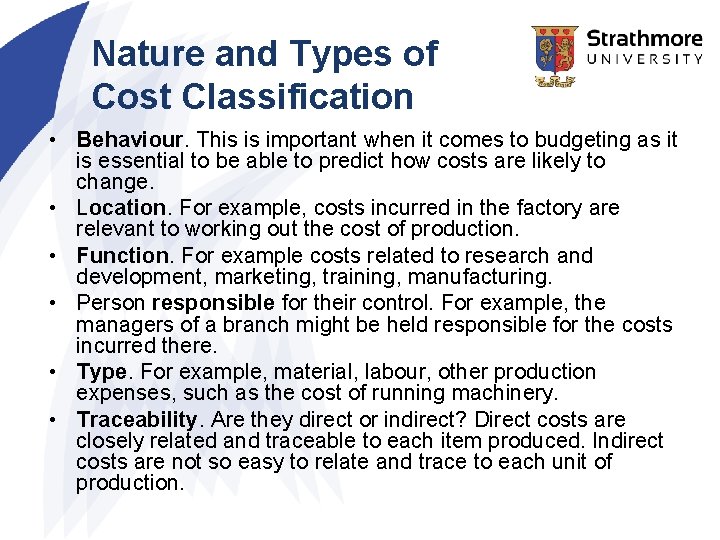
Nature and Types of Cost Classification • Behaviour. This is important when it comes to budgeting as it is essential to be able to predict how costs are likely to change. • Location. For example, costs incurred in the factory are relevant to working out the cost of production. • Function. For example costs related to research and development, marketing, training, manufacturing. • Person responsible for their control. For example, the managers of a branch might be held responsible for the costs incurred there. • Type. For example, material, labour, other production expenses, such as the cost of running machinery. • Traceability. Are they direct or indirect? Direct costs are closely related and traceable to each item produced. Indirect costs are not so easy to relate and trace to each unit of production.
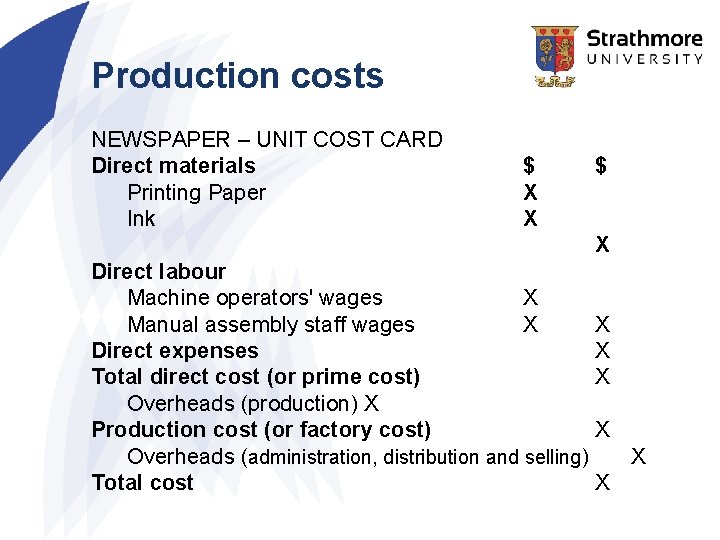
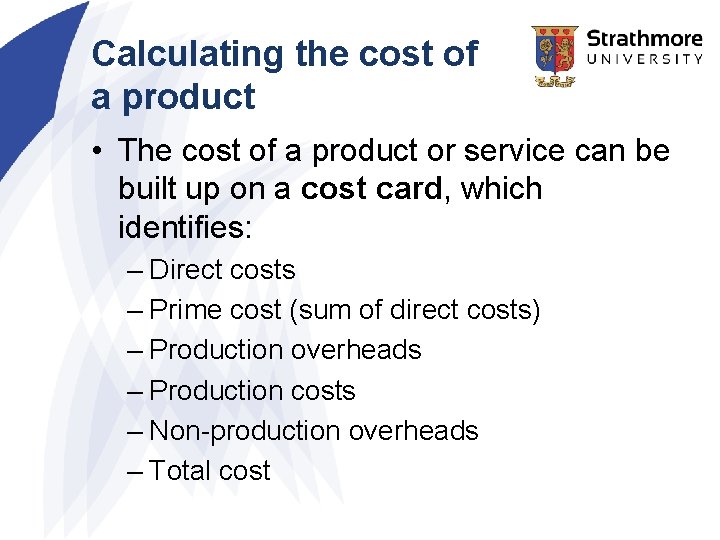
Production costs NEWSPAPER – UNIT COST CARD Direct materials Printing Paper Ink $ X X $ X Direct labour Machine operators' wages X Manual assembly staff wages X X Direct expenses X Total direct cost (or prime cost) X Overheads (production) X Production cost (or factory cost) X Overheads (administration, distribution and selling) X Total cost X
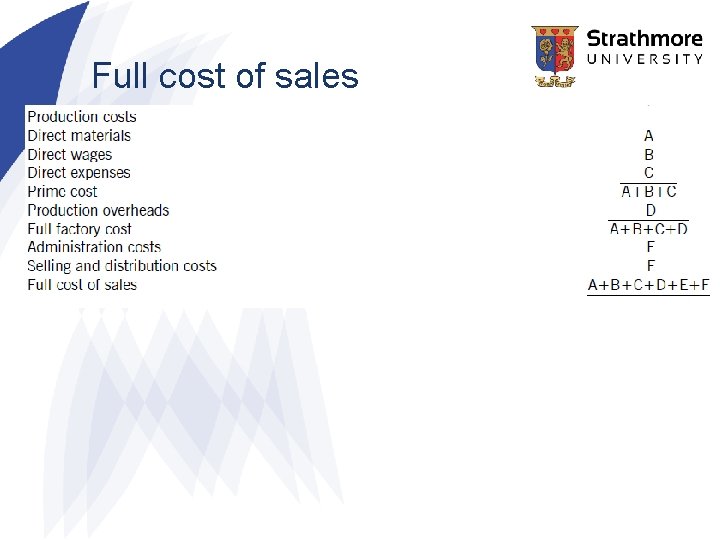
Full cost of sales
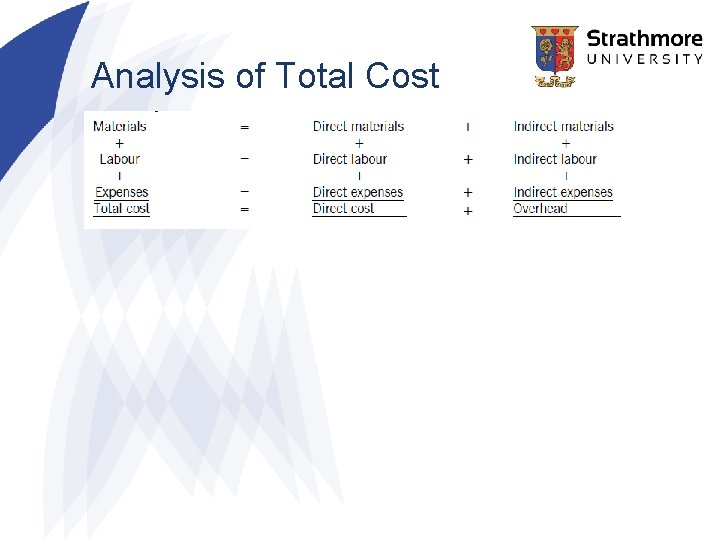
Direct and indirect costs • Costs can be divided into three elements, – materials, – labour and – expenses.
• Costs can be classified as – direct or – Indirect • Direct costs can be traced specifically to a cost unit. – Direct materials – which form part of the end product – Direct labour – involved directly in making the product – Direct expenses – it is rare for expenses to be directly traceable to the product • The sum of the direct costs is known as the prime cost.
• The factory will also have indirect costs or factory overheads which are not directly traceable to the product but are still part of the cost of making it. – Indirect materials – such as lubricants for machinery – Indirect labor – such as supervisors and maintenance workers – Indirect expenses – such as heating and lighting for the factory
• Non-manufacturing overheads – not included in the production cost of goods or for inventory valuation purposes. – An appropriate portion of these overheads is sometimes included on the cost card so that an appropriate price can be set. • Examples include: – The accountant's salary (a nonmanufacturing labour cost) – The office rent (non-manufacturing expenses)
Analysis of Total Cost
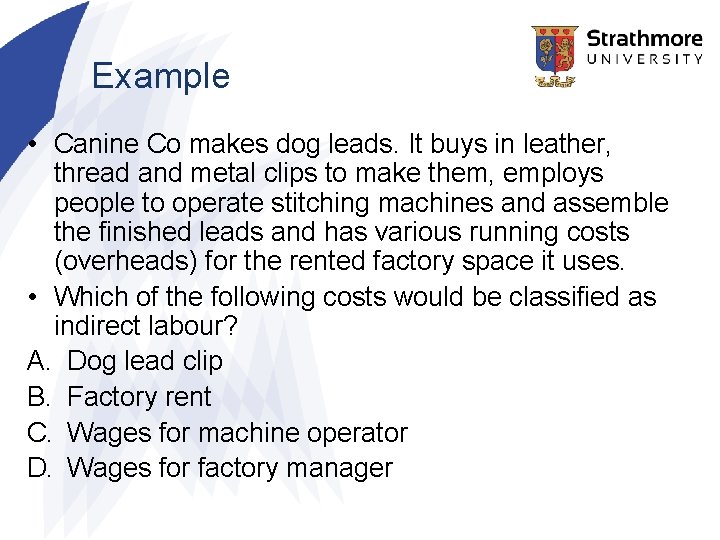
Example • Canine Co makes dog leads. It buys in leather, thread and metal clips to make them, employs people to operate stitching machines and assemble the finished leads and has various running costs (overheads) for the rented factory space it uses. • Which of the following costs would be classified as indirect labour? A. Dog lead clip B. Factory rent C. Wages for machine operator D. Wages for factory manager
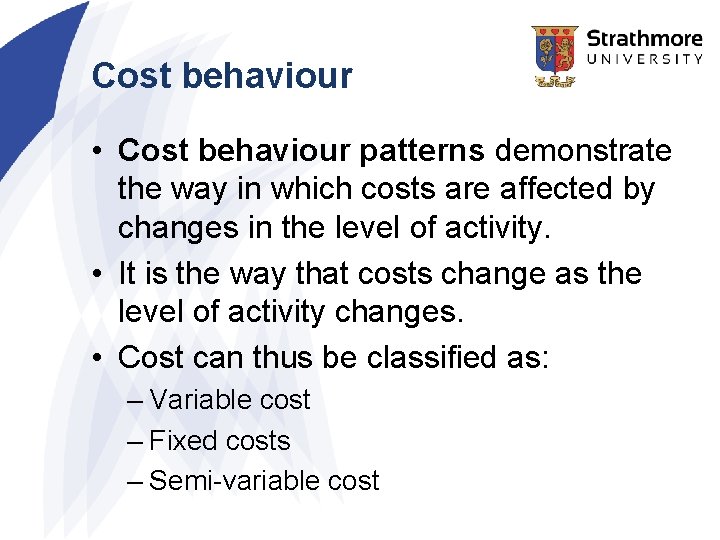
Cost behaviour • Cost behaviour patterns demonstrate the way in which costs are affected by changes in the level of activity. • It is the way that costs change as the level of activity changes. • Cost can thus be classified as: – Variable cost – Fixed costs – Semi-variable cost
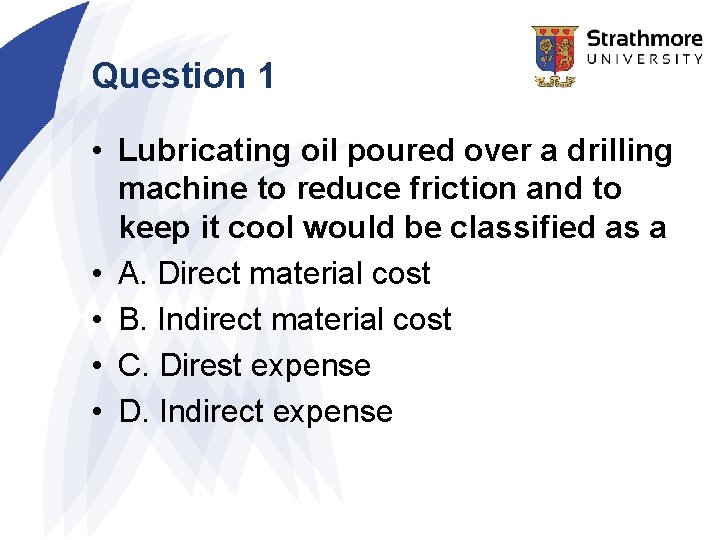
Question 1 • Lubricating oil poured over a drilling machine to reduce friction and to keep it cool would be classified as a • A. Direct material cost • B. Indirect material cost • C. Direst expense • D. Indirect expense
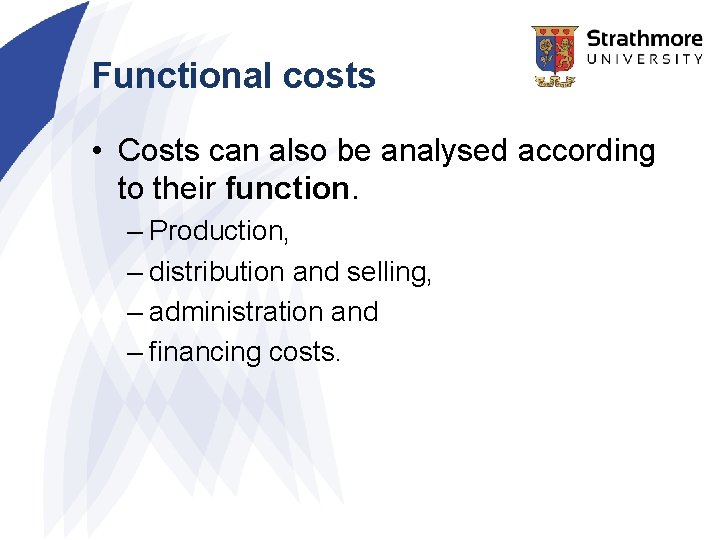
Functional costs • Costs can also be analysed according to their function. – Production, – distribution and selling, – administration and – financing costs.
Calculating the cost of a product • The cost of a product or service can be built up on a cost card, which identifies: – Direct costs – Prime cost (sum of direct costs) – Production overheads – Production costs – Non-production overheads – Total cost
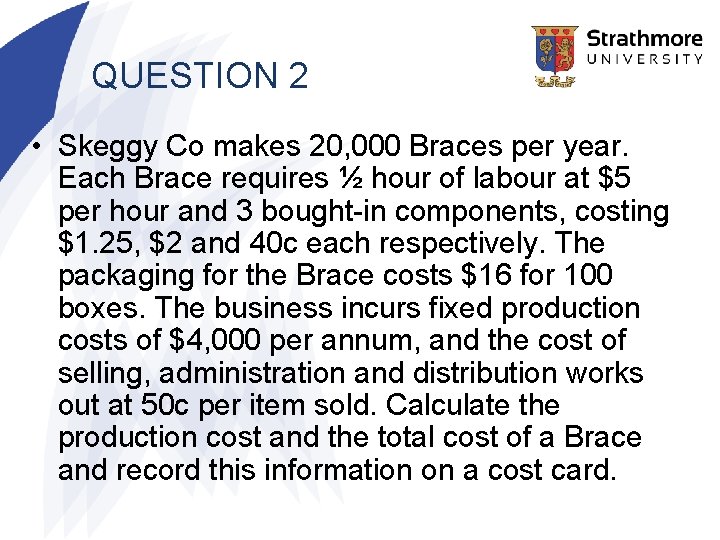
QUESTION 2 • Skeggy Co makes 20, 000 Braces per year. Each Brace requires ½ hour of labour at $5 per hour and 3 bought-in components, costing $1. 25, $2 and 40 c each respectively. The packaging for the Brace costs $16 for 100 boxes. The business incurs fixed production costs of $4, 000 per annum, and the cost of selling, administration and distribution works out at 50 c per item sold. Calculate the production cost and the total cost of a Brace and record this information on a cost card.
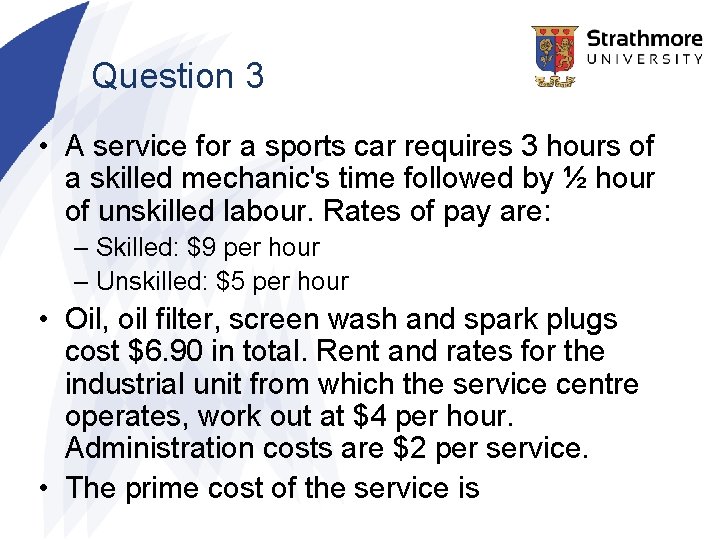
Question 3 • A service for a sports car requires 3 hours of a skilled mechanic's time followed by ½ hour of unskilled labour. Rates of pay are: – Skilled: $9 per hour – Unskilled: $5 per hour • Oil, oil filter, screen wash and spark plugs cost $6. 90 in total. Rent and rates for the industrial unit from which the service centre operates, work out at $4 per hour. Administration costs are $2 per service. • The prime cost of the service is