
Cost Analysis of Using Soil Electrical Conductivity Information
- Slides: 17
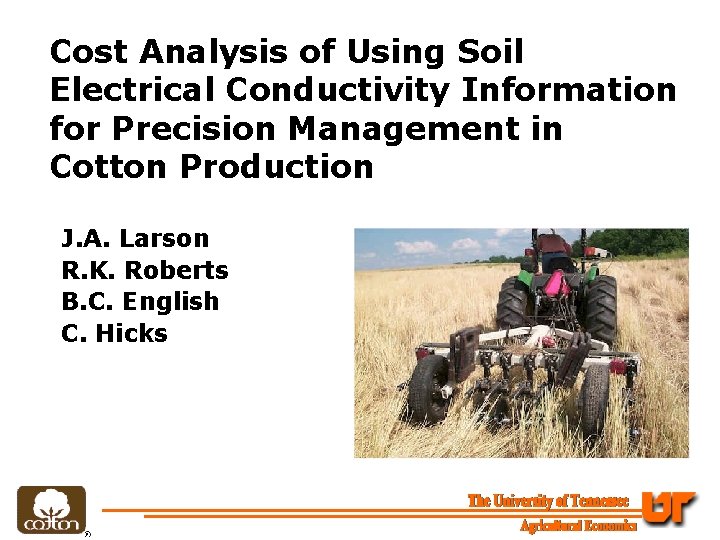
Cost Analysis of Using Soil Electrical Conductivity Information for Precision Management in Cotton Production J. A. Larson R. K. Roberts B. C. English C. Hicks
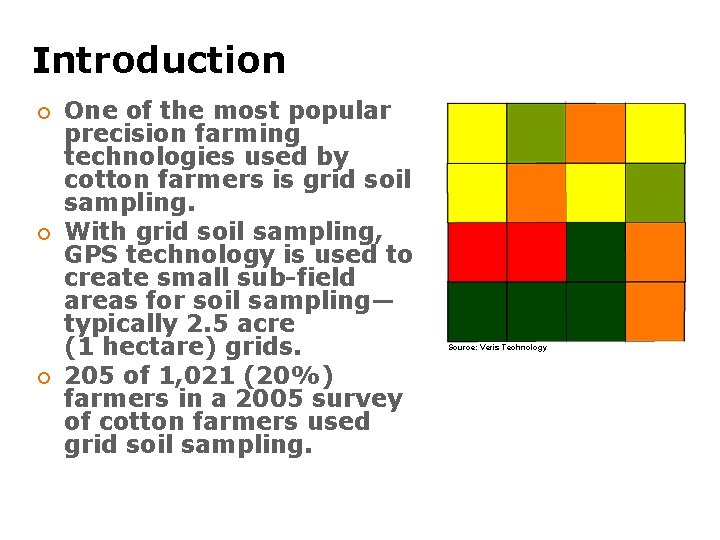
Introduction ¡ ¡ ¡ One of the most popular precision farming technologies used by cotton farmers is grid soil sampling. With grid soil sampling, GPS technology is used to create small sub-field areas for soil sampling— typically 2. 5 acre (1 hectare) grids. 205 of 1, 021 (20%) farmers in a 2005 survey of cotton farmers used grid soil sampling. Source: Veris Technology
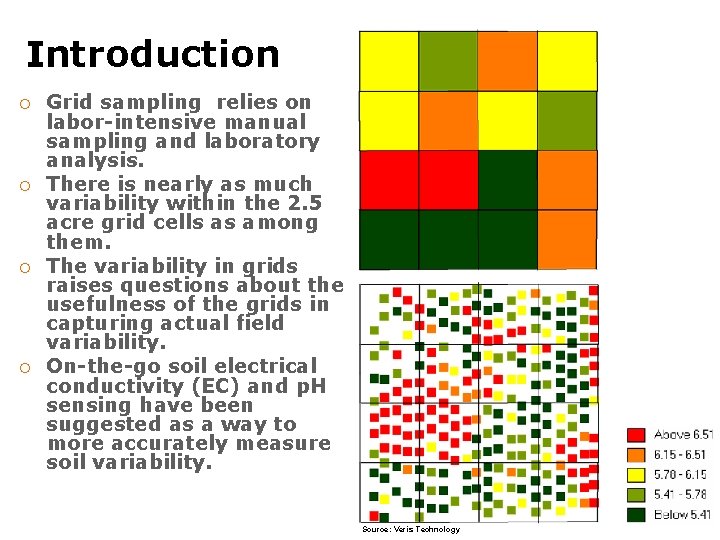
Introduction ¡ ¡ Grid sampling relies on labor-intensive manual sampling and laboratory analysis. There is nearly as much variability within the 2. 5 acre grid cells as among them. The variability in grids raises questions about the usefulness of the grids in capturing actual field variability. On-the-go soil electrical conductivity (EC) and p. H sensing have been suggested as a way to more accurately measure soil variability. Source: Veris Technology
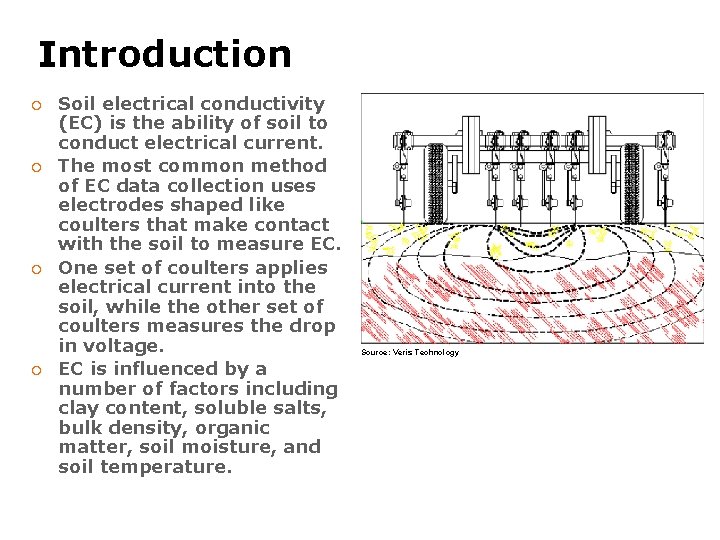
Introduction ¡ ¡ Soil electrical conductivity (EC) is the ability of soil to conduct electrical current. The most common method of EC data collection uses electrodes shaped like coulters that make contact with the soil to measure EC. One set of coulters applies electrical current into the soil, while the other set of coulters measures the drop in voltage. EC is influenced by a number of factors including clay content, soluble salts, bulk density, organic matter, soil moisture, and soil temperature. Source: Veris Technology
Introduction ¡ Potential uses of EC information include: l l ¡ Estimating soil properties—texture (sand, silt, clay), soil moisture, organic matter, topsoil depth, and soil salinity; Measuring nutrient levels in the soil (e. g. , nitrogen, potassium, etc); Predicting pest distributions in fields; Interpretation of yield maps; and Guidance for placement and interpretation of onfarm tests. Potential management applications include: l l l Directed soil sampling within more accurate soil boundaries, Drainage remediation, Soil salinity remediation, Delineation of management zones for input applications, Variable rate pesticide application, and Variable rate nutrient application.
Introduction ¡ ¡ Currently, very little research has been done on the costs of collecting on-the-go EC and p. H information versus the potential benefits to cotton farmers. Whether it is economically feasible for farmers to use on-the-go EC and p. H data will depend on what VRT decisions are made using the EC information. Like any precision agriculture technology, if farmers can decrease their input costs or increase their yields using EC and p. H information, they may be able to improve crop profitability. Information on costs of on-the-go EC and p. H data collection would be useful to farmers considering purchasing equipment and to consultants, input suppliers, and others interested in providing custom on-the-go services.
Objectives ¡ Evaluate an equipment compliment designed to collect on-the-go EC and p. H data in farm fields: l l Ownership and operating costs as a function of farm size. Breakeven values to cover the cost of the system: Lint yield gains and ¡ Reduced input costs. ¡
Assumed Components of an EC and p. H Information System ¡ ¡ Veris Mobile Sensor Platform (MSP) with the EC/p. H instrument package, dual array EC surveyor kit, and a Veris soil p. H manager. Ag. Leader GPS 3100 unit. l ¡ Ag. Leader Advanced Lightbar unit. l ¡ The GPS unit provides a way to geo-reference the EC and p. H data to specific locations in the field. The lightbar technology provides a way to provide precision guidance of the unit as it makes measurements throughout the field. 65 -HP tractor to pull the MSP unit through the field.
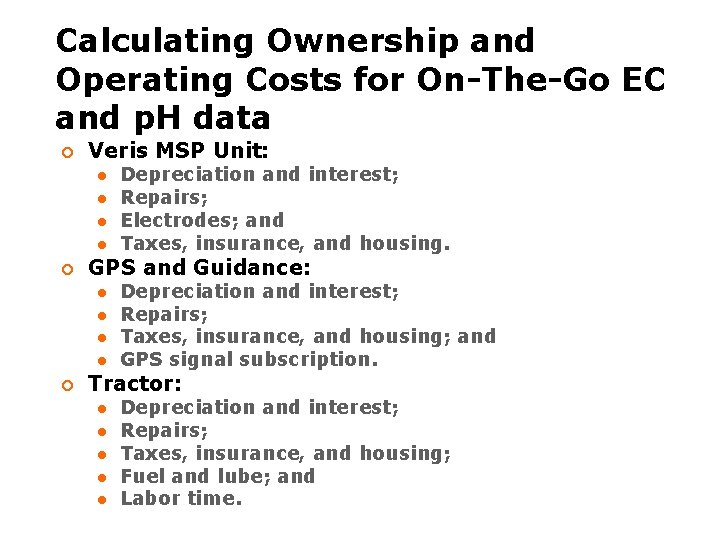
Calculating Ownership and Operating Costs for On-The-Go EC and p. H data ¡ Veris MSP Unit: l l ¡ GPS and Guidance: l l ¡ Depreciation and interest; Repairs; Electrodes; and Taxes, insurance, and housing. Depreciation and interest; Repairs; Taxes, insurance, and housing; and GPS signal subscription. Tractor: l l l Depreciation and interest; Repairs; Taxes, insurance, and housing; Fuel and lube; and Labor time.
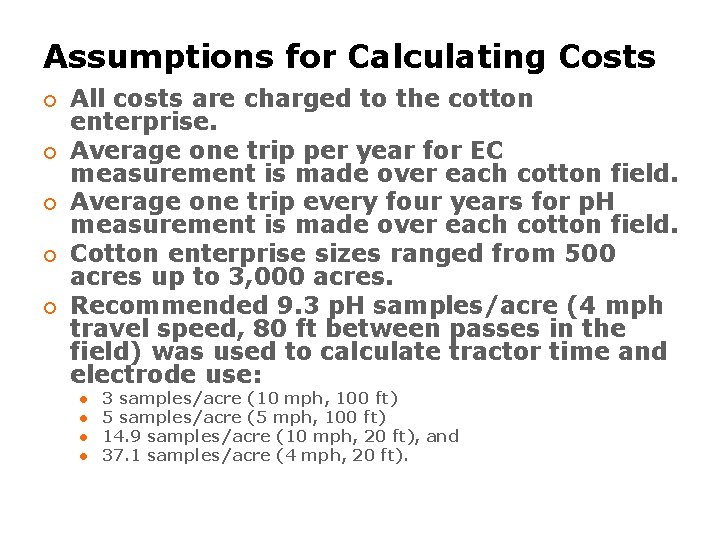
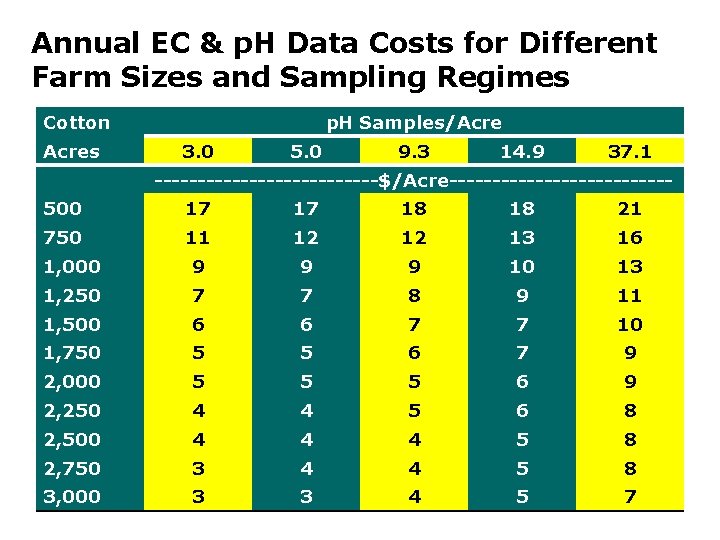
Assumptions for Calculating Costs ¡ ¡ ¡ All costs are charged to the cotton enterprise. Average one trip per year for EC measurement is made over each cotton field. Average one trip every four years for p. H measurement is made over each cotton field. Cotton enterprise sizes ranged from 500 acres up to 3, 000 acres. Recommended 9. 3 p. H samples/acre (4 mph travel speed, 80 ft between passes in the field) was used to calculate tractor time and electrode use: l l 3 samples/acre (10 mph, 100 ft) 5 samples/acre (5 mph, 100 ft) 14. 9 samples/acre (10 mph, 20 ft), and 37. 1 samples/acre (4 mph, 20 ft).
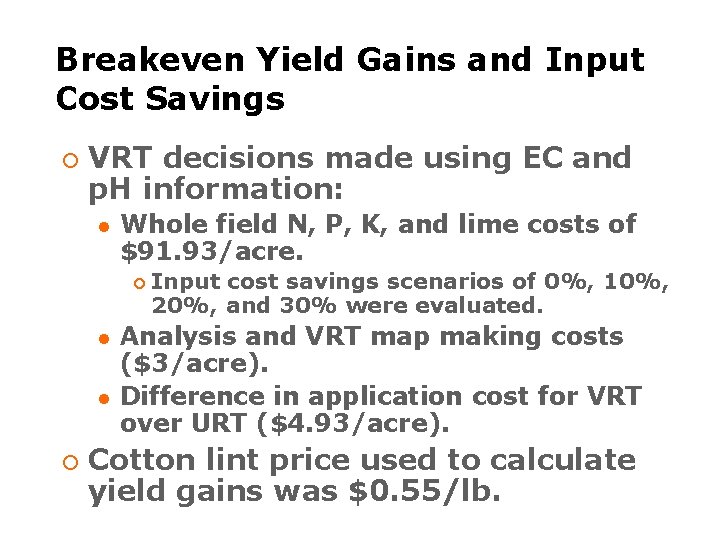
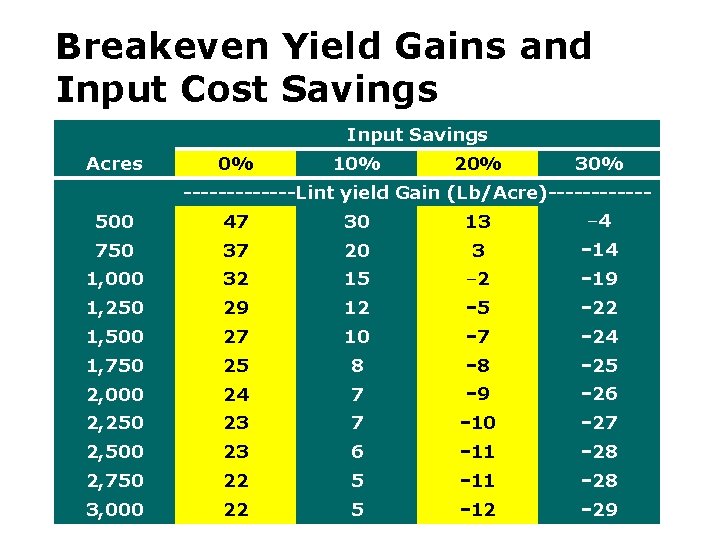
Breakeven Yield Gains and Input Cost Savings ¡ VRT decisions made using EC and p. H information: l Whole field N, P, K, and lime costs of $91. 93/acre. ¡ l l ¡ Input cost savings scenarios of 0%, 10%, 20%, and 30% were evaluated. Analysis and VRT map making costs ($3/acre). Difference in application cost for VRT over URT ($4. 93/acre). Cotton lint price used to calculate yield gains was $0. 55/lb.
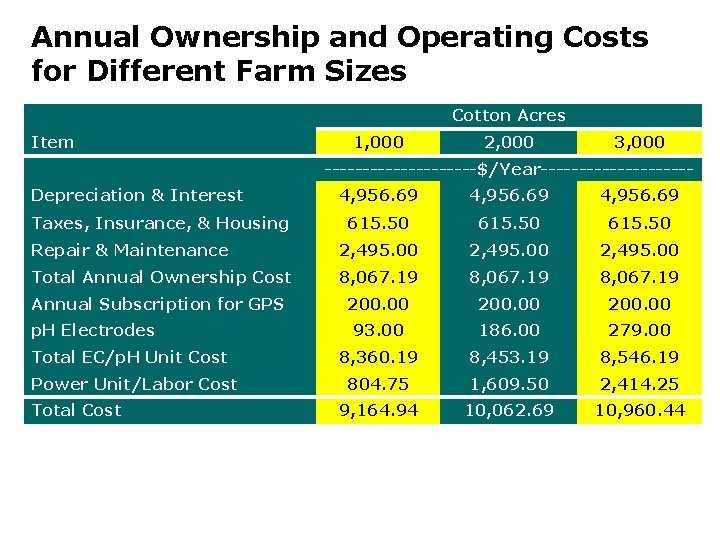
Annual Ownership and Operating Costs for Different Farm Sizes Cotton Acres Item 1, 000 2, 000 3, 000 ----------$/Year----------Depreciation & Interest 4, 956. 69 615. 50 Repair & Maintenance 2, 495. 00 Total Annual Ownership Cost 8, 067. 19 Annual Subscription for GPS 200. 00 93. 00 186. 00 279. 00 8, 360. 19 8, 453. 19 8, 546. 19 804. 75 1, 609. 50 2, 414. 25 9, 164. 94 10, 062. 69 10, 960. 44 Taxes, Insurance, & Housing p. H Electrodes Total EC/p. H Unit Cost Power Unit/Labor Cost Total Cost
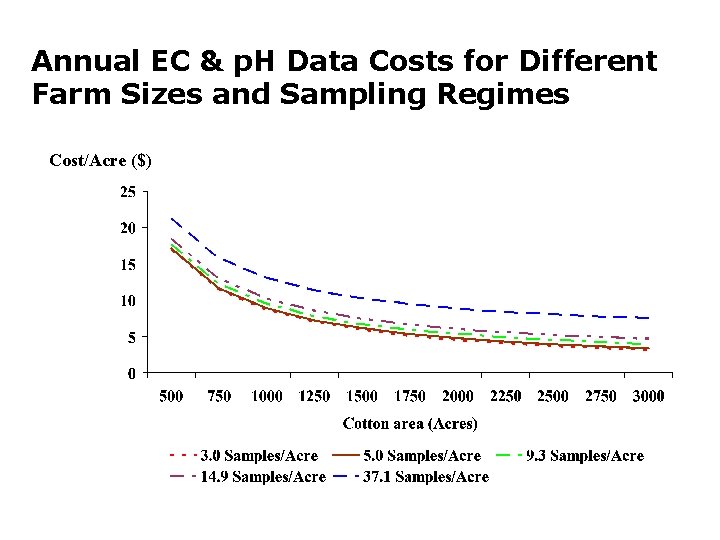
Annual EC & p. H Data Costs for Different Farm Sizes and Sampling Regimes Cotton Acres p. H Samples/Acre 3. 0 5. 0 9. 3 14. 9 37. 1 -------------$/Acre-------------500 17 17 18 18 21 750 11 12 12 13 16 1, 000 9 9 9 10 13 1, 250 7 7 8 9 11 1, 500 6 6 7 7 10 1, 750 5 5 6 7 9 2, 000 5 5 5 6 9 2, 250 4 4 5 6 8 2, 500 4 4 4 5 8 2, 750 3 4 4 5 8 3, 000 3 3 4 5 7
Annual EC & p. H Data Costs for Different Farm Sizes and Sampling Regimes Cost/Acre ($)
Breakeven Yield Gains and Input Cost Savings Input Savings Acres 0% 10% 20% 30% -------Lint yield Gain (Lb/Acre)------500 47 30 13 − 4 750 37 20 3 − 14 1, 000 32 15 − 2 − 19 1, 250 29 12 − 5 − 22 1, 500 27 10 − 7 − 24 1, 750 25 8 − 25 2, 000 24 7 − 9 − 26 2, 250 23 7 − 10 − 27 2, 500 23 6 − 11 − 28 2, 750 22 5 − 11 − 28 3, 000 22 5 − 12 − 29
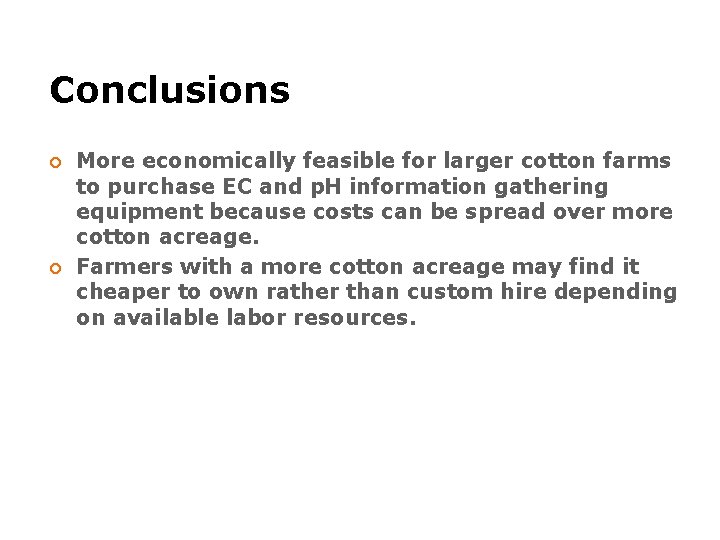
Conclusions ¡ ¡ More economically feasible for larger cotton farms to purchase EC and p. H information gathering equipment because costs can be spread over more cotton acreage. Farmers with a more cotton acreage may find it cheaper to own rather than custom hire depending on available labor resources.
Conclusions ¡ If overall input usage remains the same, the required yield gains to payback the investment in EC and p. H information range from: l l ¡ 47 lb/acre for a 500 acre cotton enterprise, to 22 lb/acre for a 3, 000 acre cotton enterprise. Yield gains to payback the investment are smaller if overall input usage is reduced from using on-the -go EC and p. H information to make input decisions.