
Cosmology The study of the origin present structure
- Slides: 19
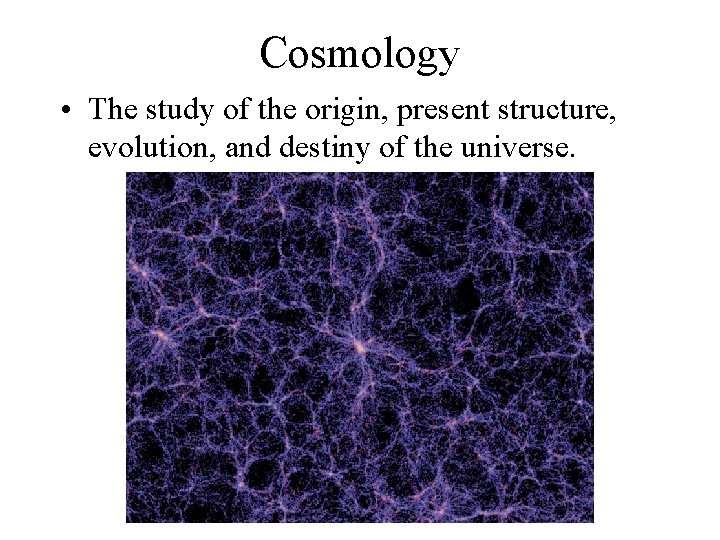
Cosmology • The study of the origin, present structure, evolution, and destiny of the universe.
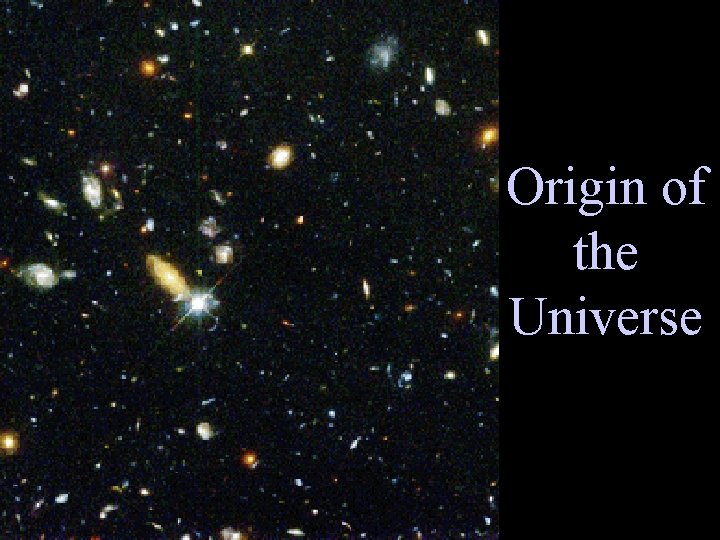
Origin of the Universe
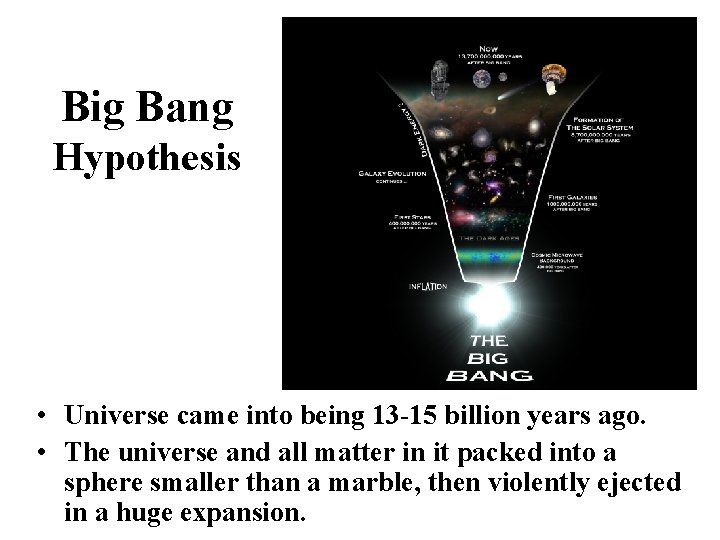
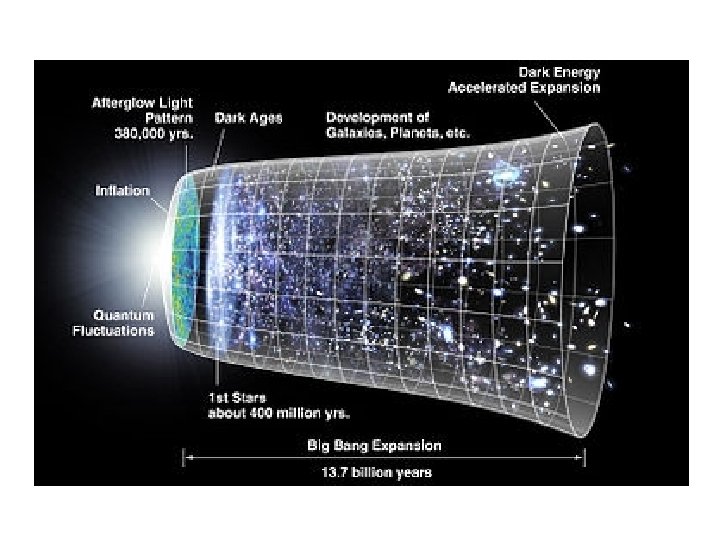
Big Bang Hypothesis • Universe came into being 13 -15 billion years ago. • The universe and all matter in it packed into a sphere smaller than a marble, then violently ejected in a huge expansion.
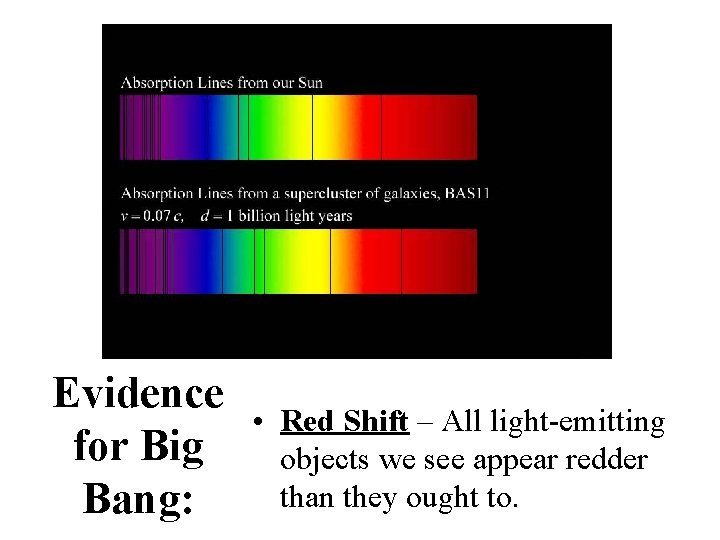
Evidence for Big Bang: • Red Shift – All light-emitting objects we see appear redder than they ought to.
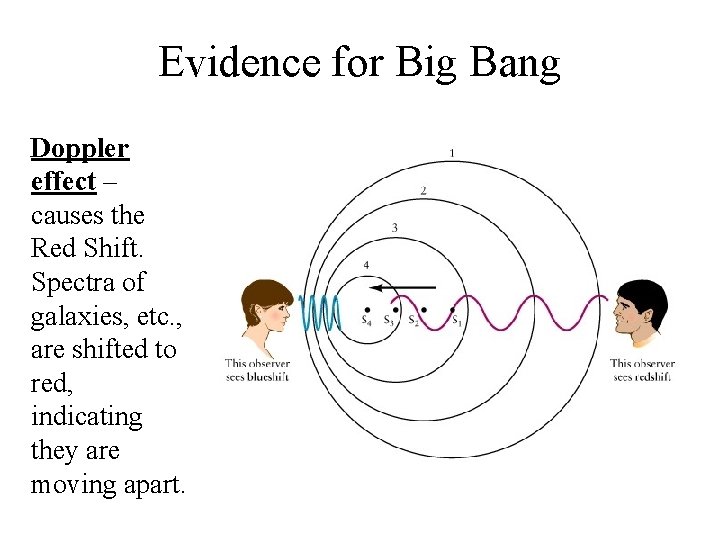
Evidence for Big Bang Doppler effect – causes the Red Shift. Spectra of galaxies, etc. , are shifted to red, indicating they are moving apart.
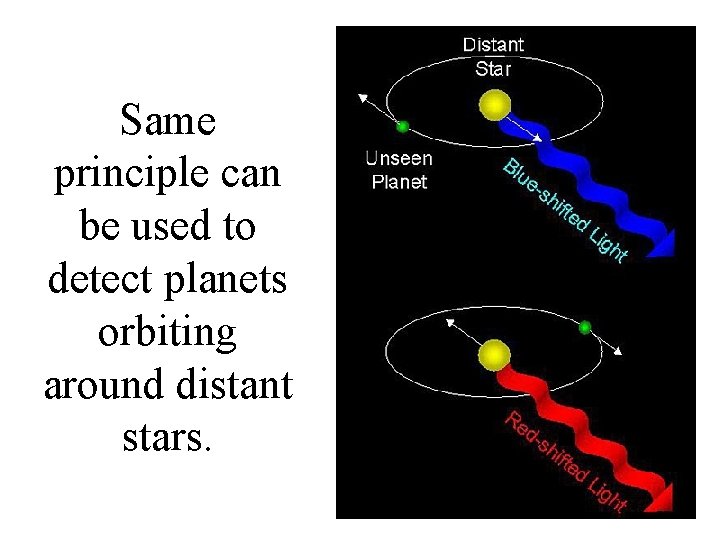
Same principle can be used to detect planets orbiting around distant stars.
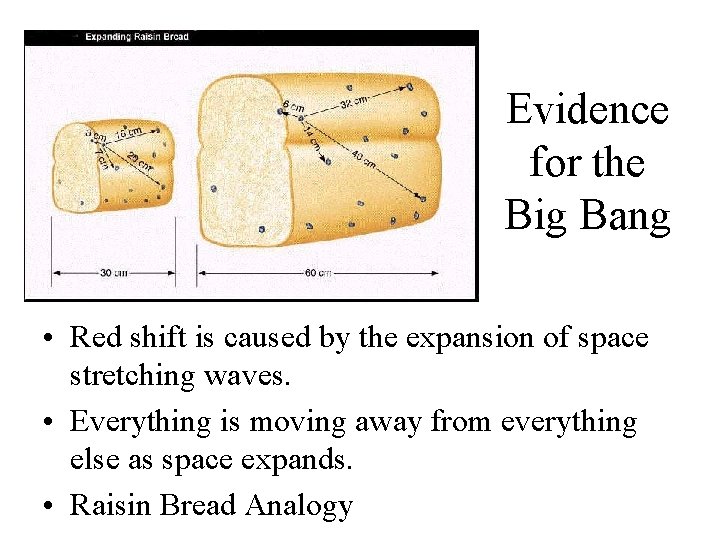
Evidence for the Big Bang • Red shift is caused by the expansion of space stretching waves. • Everything is moving away from everything else as space expands. • Raisin Bread Analogy
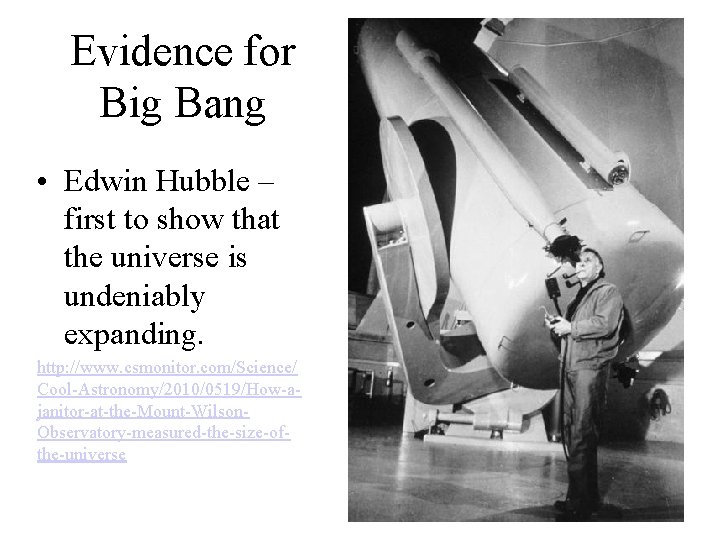
Evidence for Big Bang • Edwin Hubble – first to show that the universe is undeniably expanding. http: //www. csmonitor. com/Science/ Cool-Astronomy/2010/0519/How-ajanitor-at-the-Mount-Wilson. Observatory-measured-the-size-ofthe-universe
Evidence for the Big Bang • Velocity-distance relationship • Hubble Law – a galaxy’s velocity of recession (v) is proportionate to its distance (d). • V=Hd, where H is the Hubble Constant • Hubble Constant also used to calculate distance to galaxies from their measured redshifts.
Evidence for Big Bang • Most distant galaxies are moving away fastest.
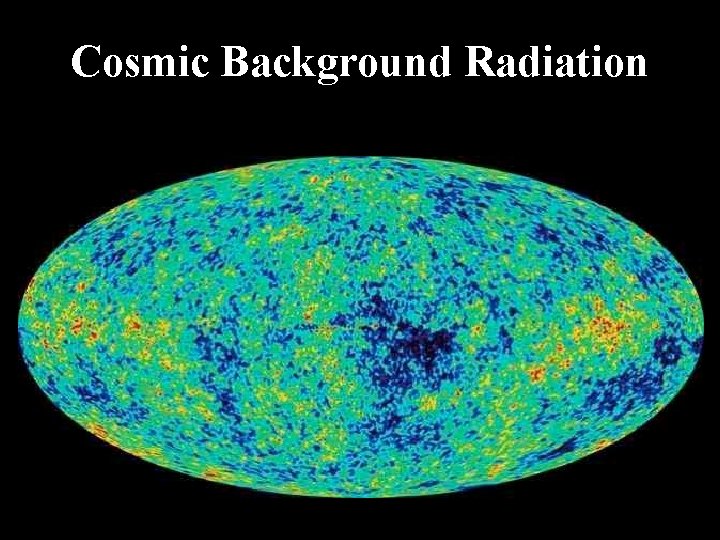
Evidence for Big Bang • Detection of cosmic background radiation as predicted by theory. • http: //titan. bloomfield. edu/facstaff/dnicolai/ Astro/astro-lectures/lecture 10. htm
Cosmic Background Radiation
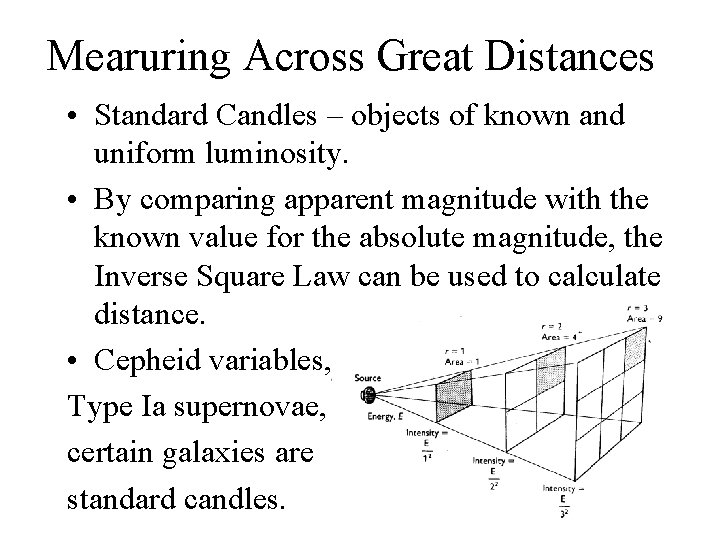
Mearuring Across Great Distances • Standard Candles – objects of known and uniform luminosity. • By comparing apparent magnitude with the known value for the absolute magnitude, the Inverse Square Law can be used to calculate distance. • Cepheid variables, Type Ia supernovae, certain galaxies are standard candles.
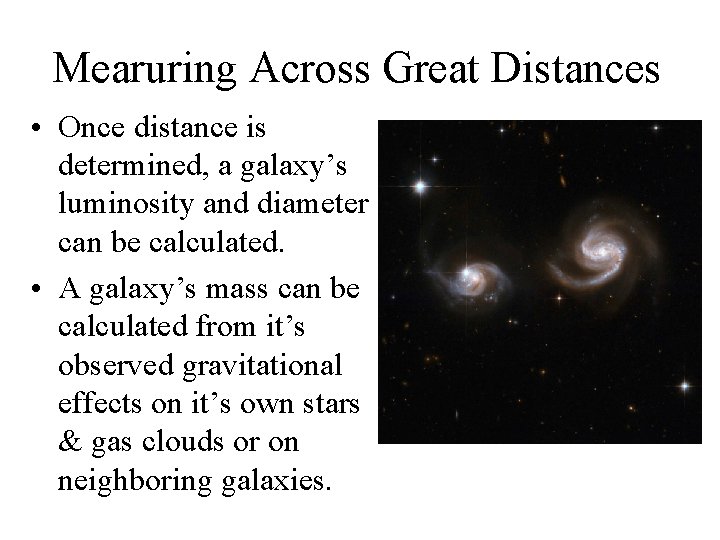
Mearuring Across Great Distances • Once distance is determined, a galaxy’s luminosity and diameter can be calculated. • A galaxy’s mass can be calculated from it’s observed gravitational effects on it’s own stars & gas clouds or on neighboring galaxies.
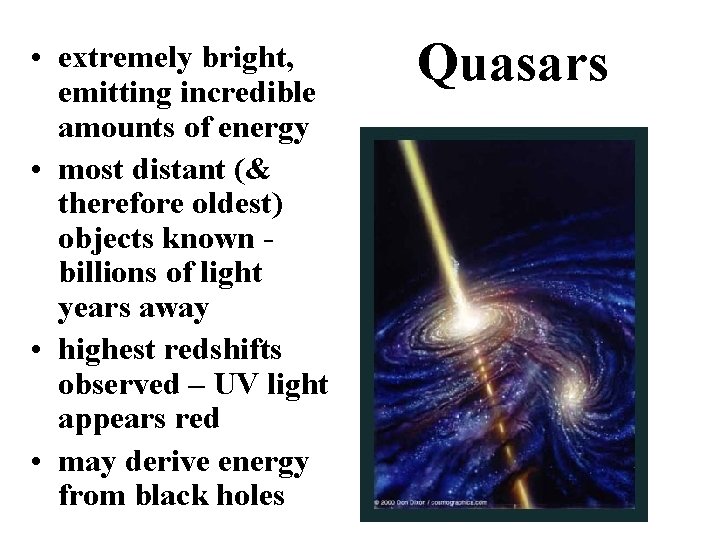
• extremely bright, emitting incredible amounts of energy • most distant (& therefore oldest) objects known billions of light years away • highest redshifts observed – UV light appears red • may derive energy from black holes Quasars
When I heard the learn'd astronomer, When the proofs, the figures, were ranged in columns before me, When I was shown the charts and diagrams, to add, divide, and measure them, When I sitting heard the astronomer where he lectured with much applause in the lecture-room, How soon unaccountable I became tired and sick, Till rising and gliding out I wander'd off by myself, In the mystical moist night-air, and from time to time, Look'd up in perfect silence at the stars. Walt Whitman, 1865
Go have a look at your galaxy tonight!