
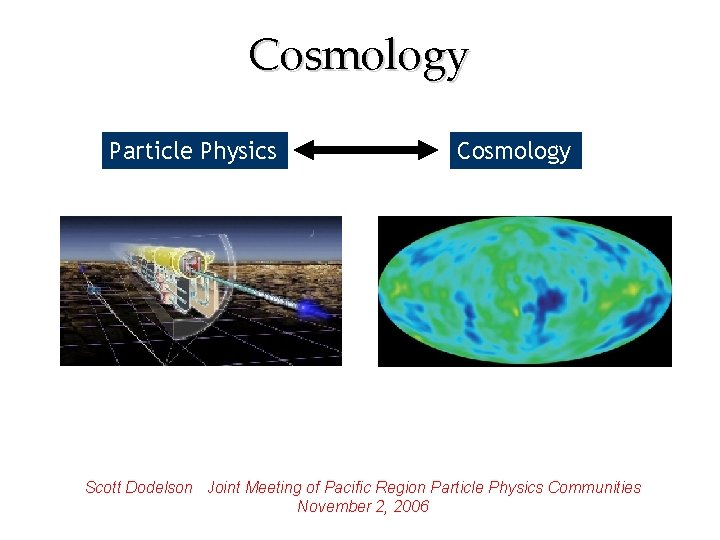
Cosmology Particle Physics Cosmology Scott Dodelson Joint Meeting
![[(V’’/V)-(1/2)(V’/V)2]/(8πG) I n f l a t i o n These Translate Into Constraints](https://slidetodoc.com/presentation_image_h2/e3d8bd45a9640bf99513f5a3f5daf003/image-61.jpg "[(V’’/V)-(1/2)(V’/V)2]/(8πG) I n f l a t i o n These Translate Into Constraints")
- Slides: 64
Cosmology Particle Physics Cosmology Scott Dodelson Joint Meeting of Pacific Region Particle Physics Communities November 2, 2006
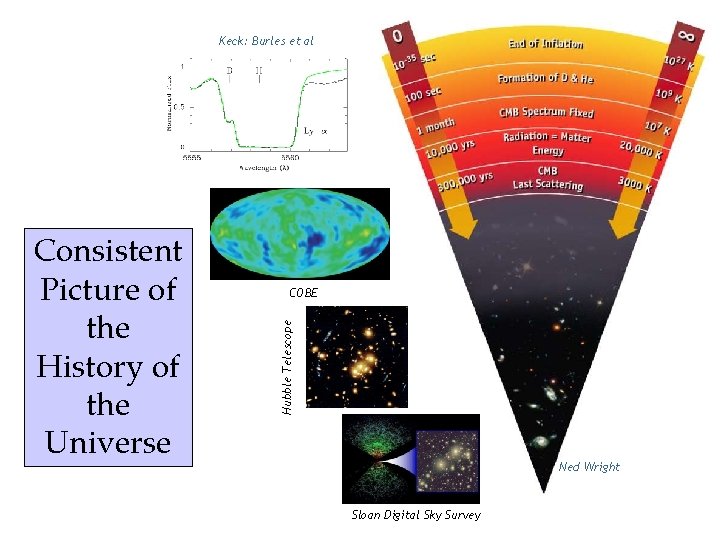
Keck: Burles et al COBE Hubble Telescope Consistent Picture of the History of the Universe Ned Wright Sloan Digital Sky Survey
Beyond the Standard Model Cosmology q Certain cosmological observations cannot be understood in the framework of the Standard Model q These observations, and their complements on the ground, probe physics beyond the Standard Model
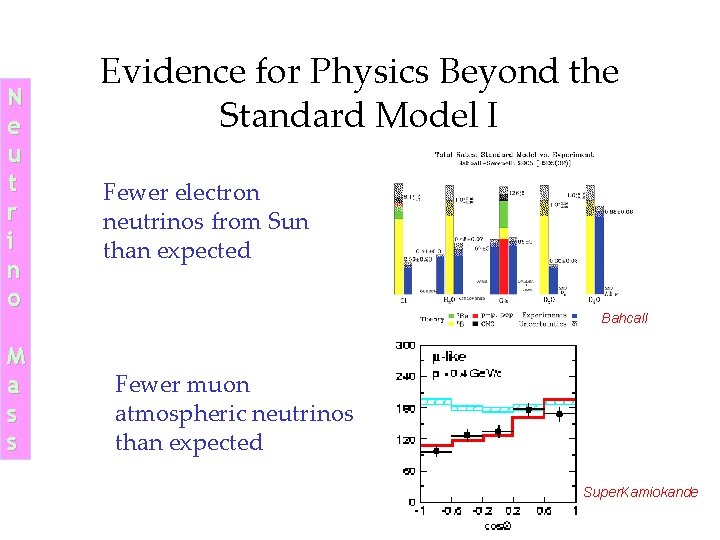
N e u t r i n o M a s s Evidence for Physics Beyond the Standard Model I Fewer electron neutrinos from Sun than expected Bahcall Fewer muon atmospheric neutrinos than expected Super. Kamiokande
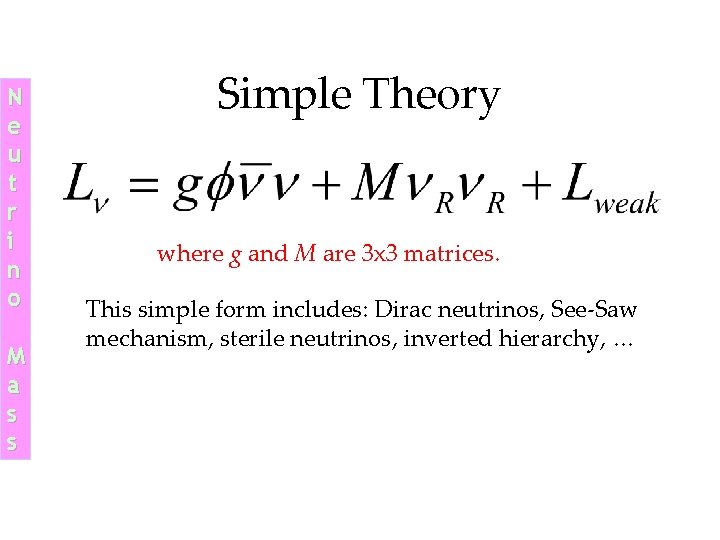
N e u t r i n o M a s s Simple Theory where g and M are 3 x 3 matrices. This simple form includes: Dirac neutrinos, See-Saw mechanism, sterile neutrinos, inverted hierarchy, …
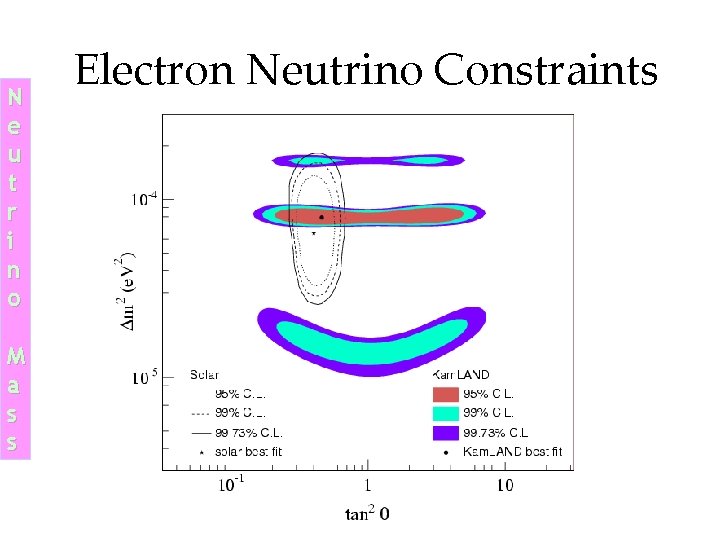
N e u t r i n o M a s s Electron Neutrino Constraints
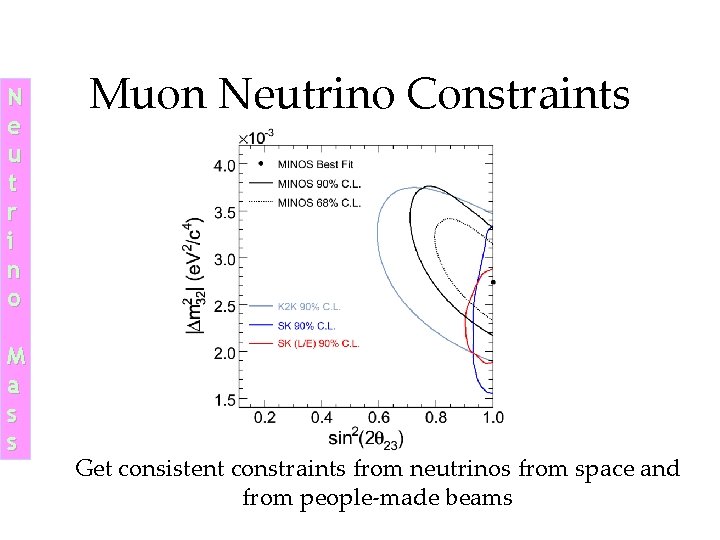
N e u t r i n o M a s s Muon Neutrino Constraints Get consistent constraints from neutrinos from space and from people-made beams
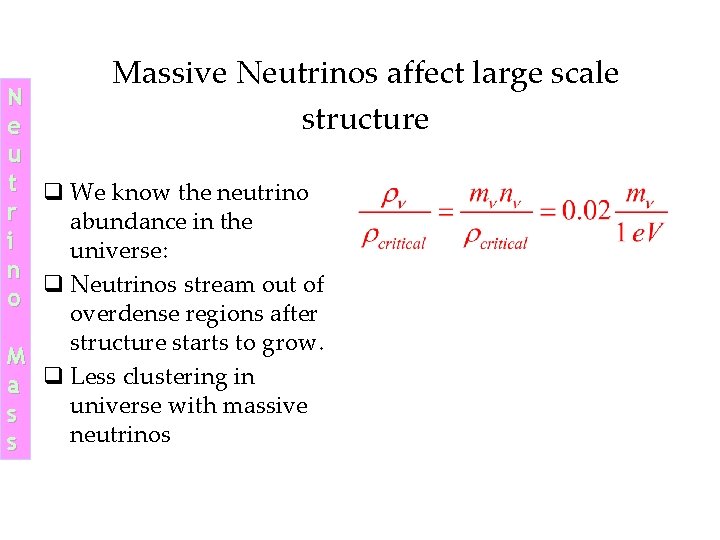
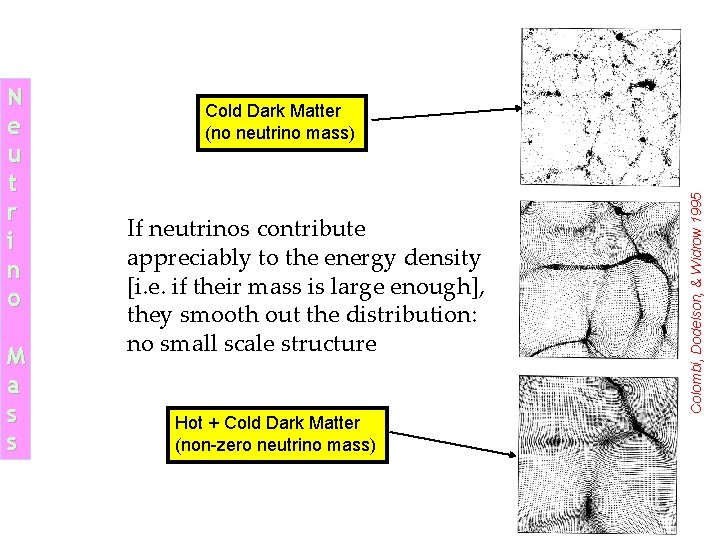
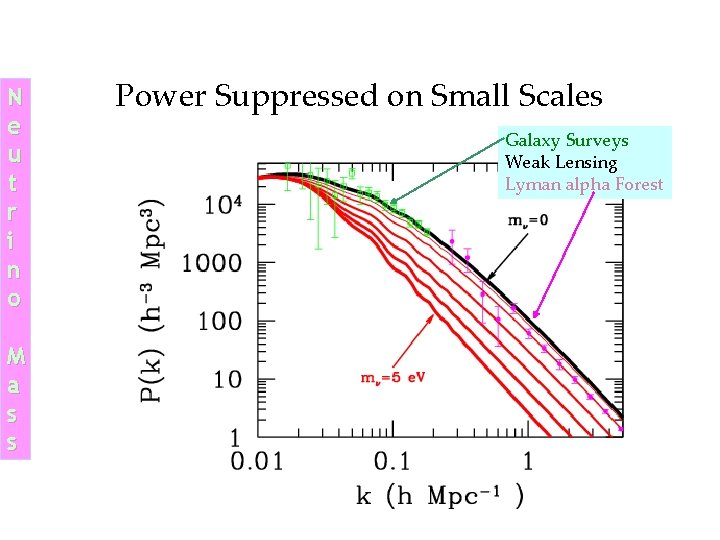
Massive Neutrinos affect large scale structure N e u t q We know the neutrino r abundance in the i universe: n q Neutrinos stream out of o overdense regions after structure starts to grow. M a q Less clustering in universe with massive s neutrinos s
M a s s Cold Dark Matter (no neutrino mass) If neutrinos contribute appreciably to the energy density [i. e. if their mass is large enough], they smooth out the distribution: no small scale structure Hot + Cold Dark Matter (non-zero neutrino mass) Colombi, Dodelson, & Widrow 1995 N e u t r i n o
N e u t r i n o M a s s Power Suppressed on Small Scales Galaxy Surveys Weak Lensing Lyman alpha Forest
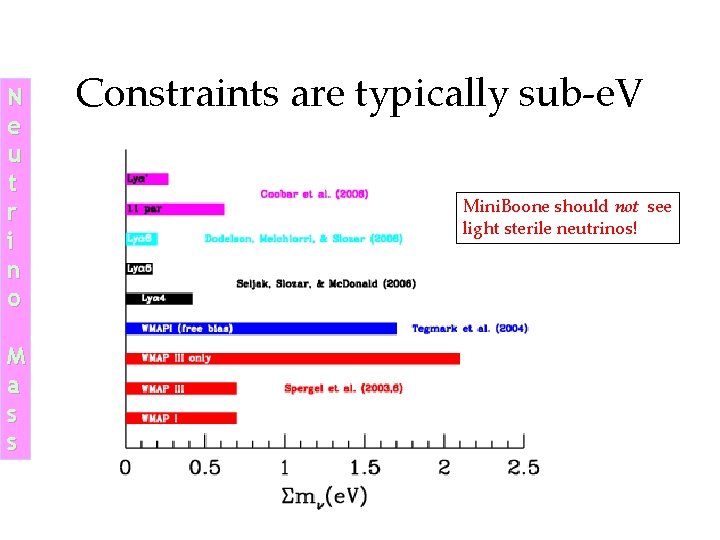
N e u t r i n o M a s s Constraints are typically sub-e. V Mini. Boone should not see light sterile neutrinos!
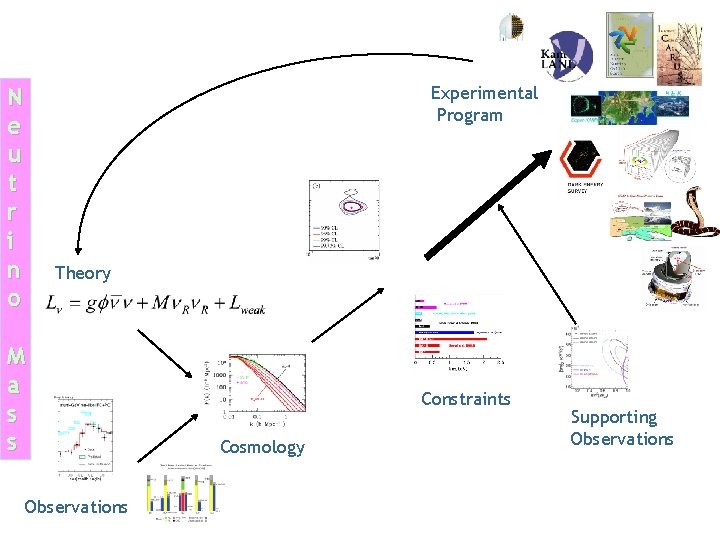
Experimental Program N e u t r i n o Theory M a s s Observations Constraints Cosmology Supporting Observations
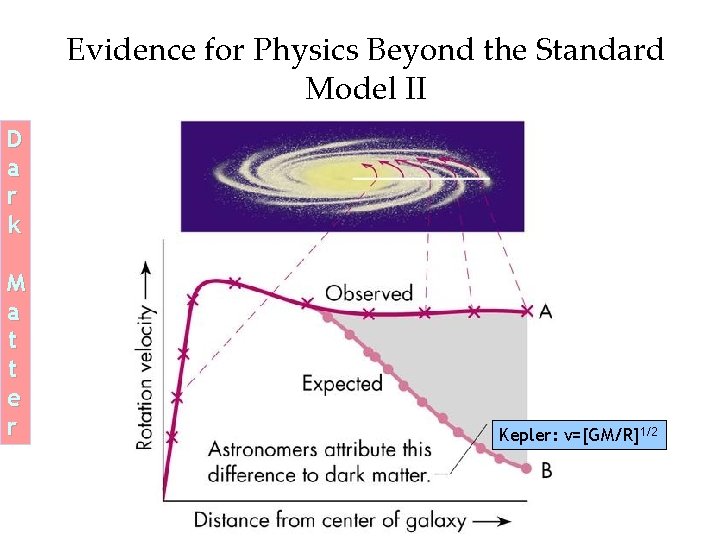
Evidence for Physics Beyond the Standard Model II D a r k M a t t e r Kepler: v=[GM/R]1/2
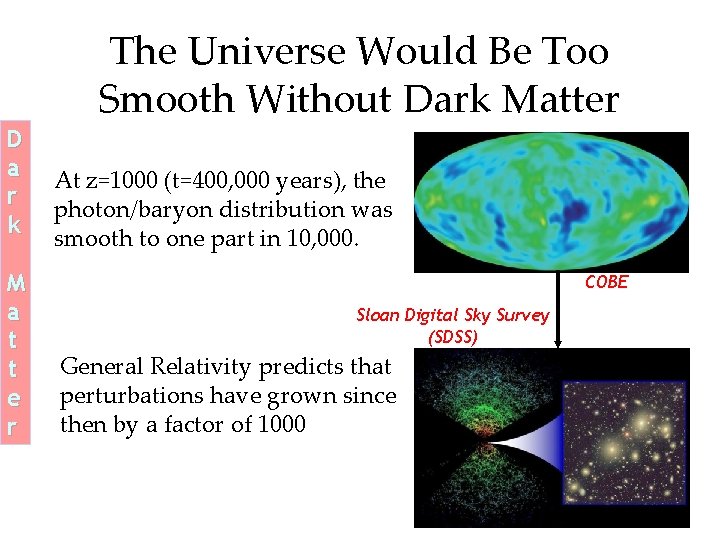
The Universe Would Be Too Smooth Without Dark Matter D a r k M a t t e r At z=1000 (t=400, 000 years), the photon/baryon distribution was smooth to one part in 10, 000. COBE Sloan Digital Sky Survey (SDSS) General Relativity predicts that perturbations have grown since then by a factor of 1000
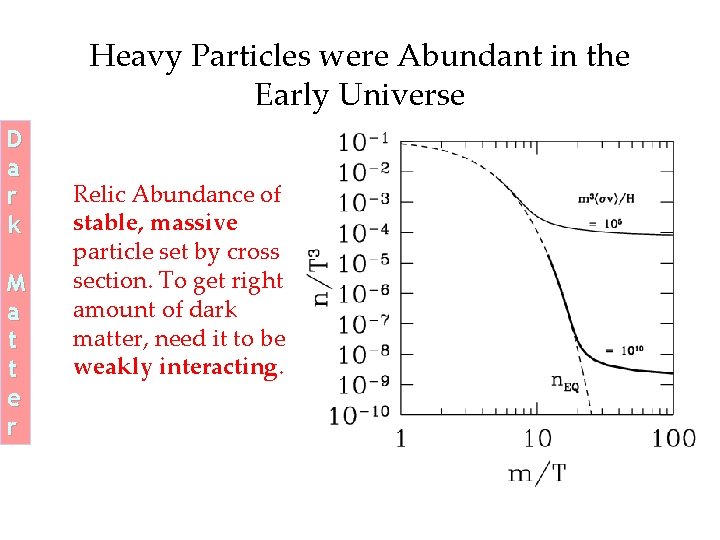
Heavy Particles were Abundant in the Early Universe D a r k M a t t e r Relic Abundance of stable, massive particle set by cross section. To get right amount of dark matter, need it to be weakly interacting.
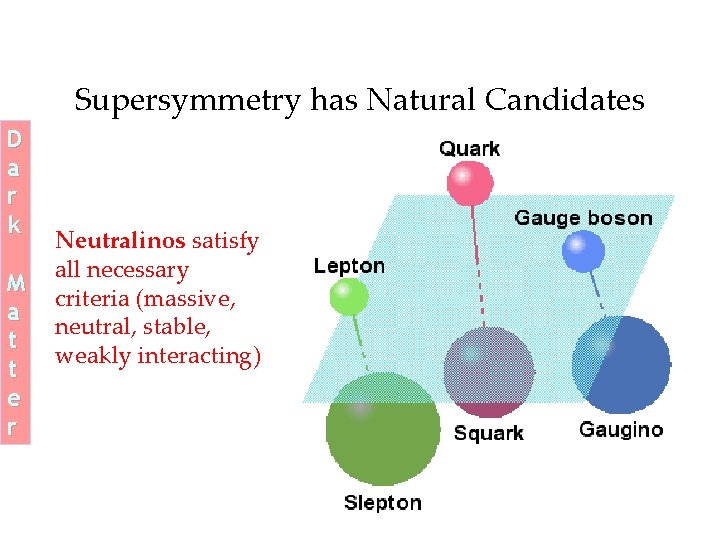
Supersymmetry has Natural Candidates D a r k M a t t e r Neutralinos satisfy all necessary criteria (massive, neutral, stable, weakly interacting)
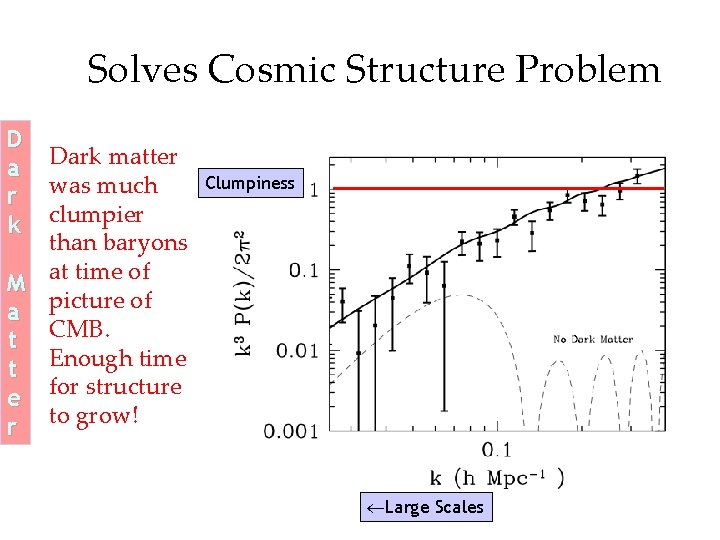
Solves Cosmic Structure Problem D a r k Dark matter was much clumpier than baryons M at time of a picture of t CMB. t Enough time e for structure r to grow! Clumpiness Large Scales
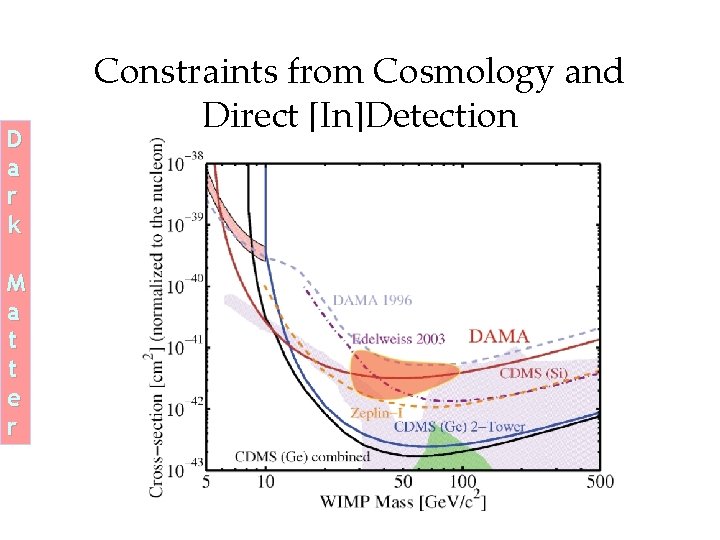
D a r k M a t t e r Constraints from Cosmology and Direct [In]Detection
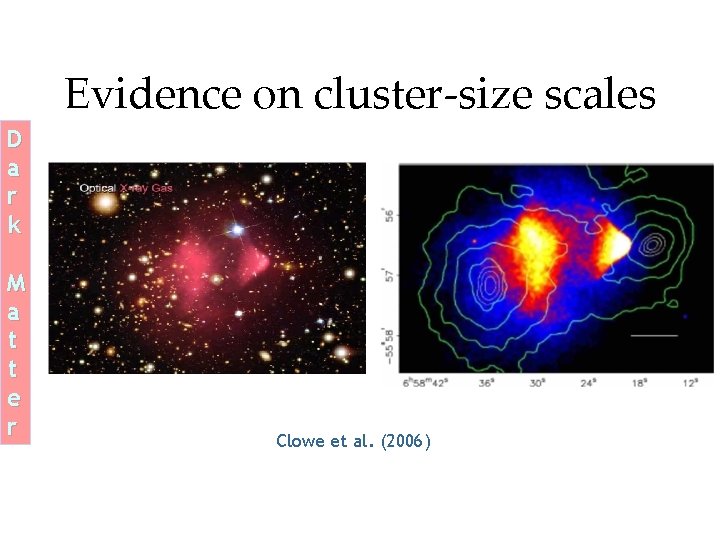
Evidence on cluster-size scales D a r k M a t t e r Clowe et al. (2006)
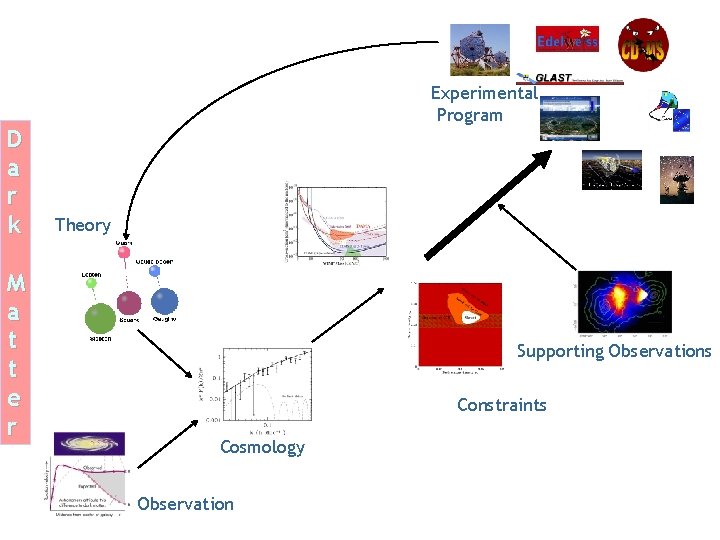
D a r k M a t t e r Experimental Program Theory Supporting Observations Constraints Cosmology Observation
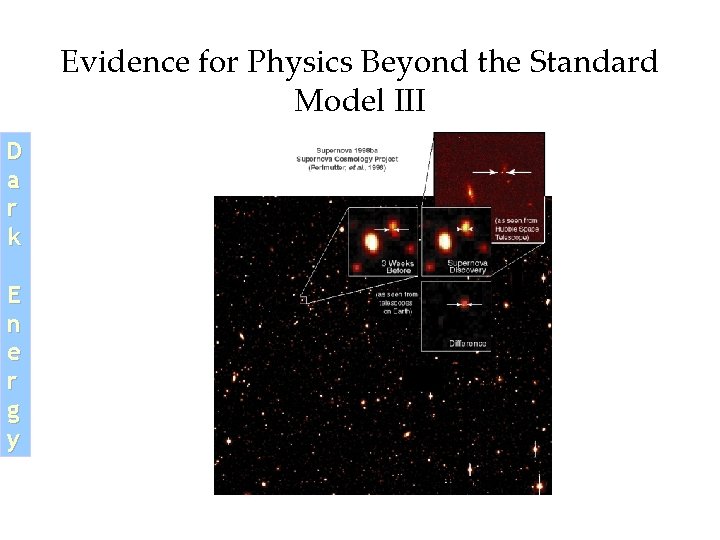
Evidence for Physics Beyond the Standard Model III D a r k E n e r g y
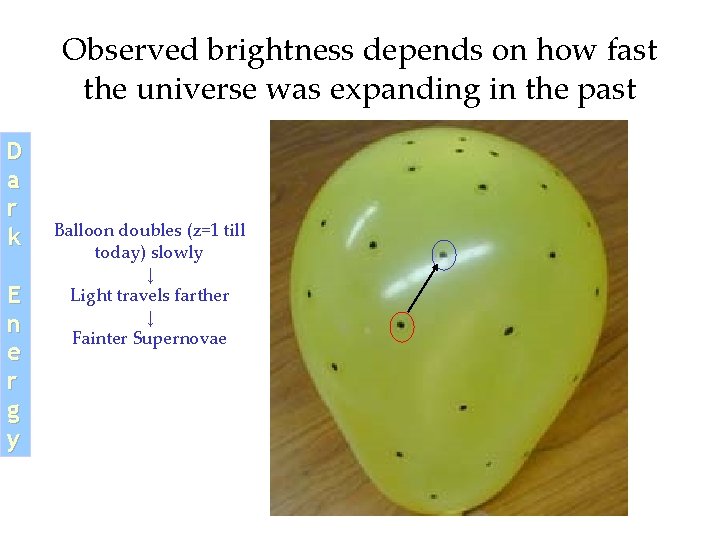
Observed brightness depends on how fast the universe was expanding in the past D a r k E n e r g y Balloon doubles (z=1 till today) slowly ↓ Light travels farther ↓ Fainter Supernovae
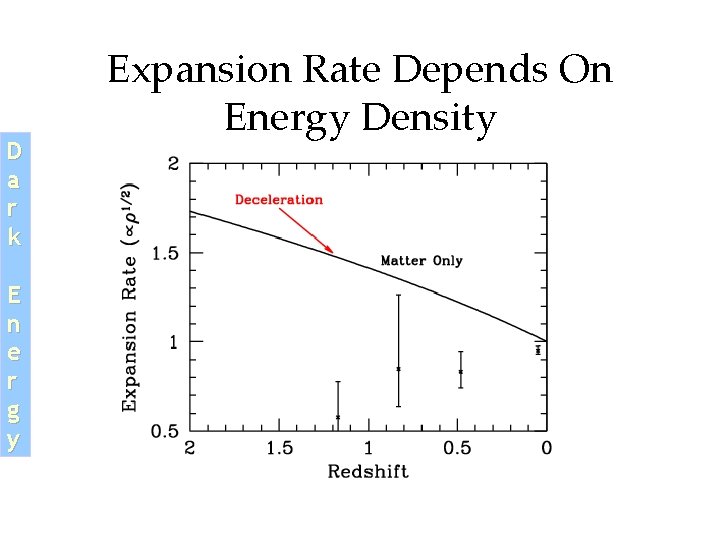
D a r k E n e r g y Expansion Rate Depends On Energy Density
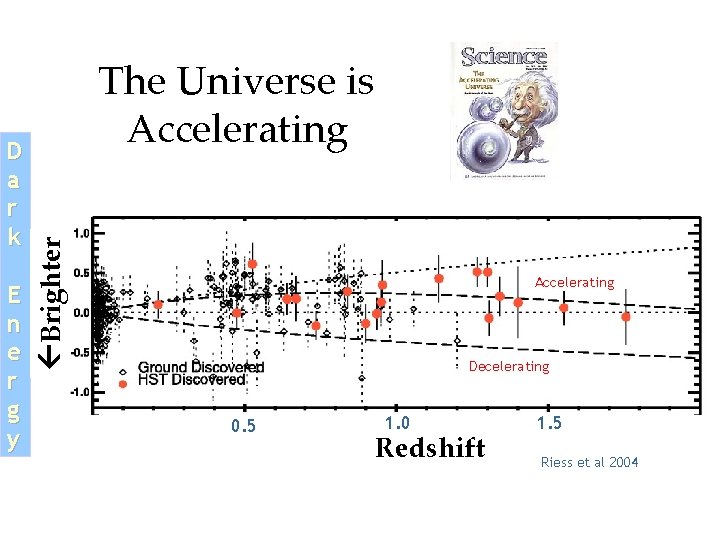
E n e r g y Brighter D a r k The Universe is Accelerating Decelerating 0. 5 1. 0 Redshift 1. 5 Riess et al 2004
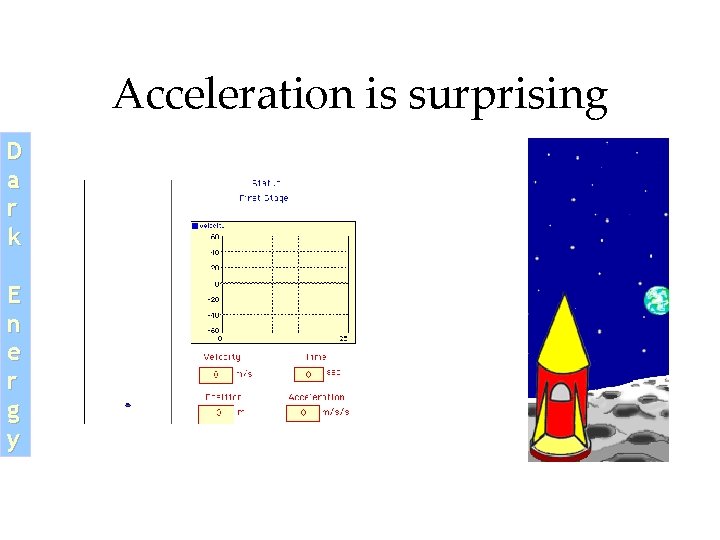
Acceleration is surprising D a r k E n e r g y
D a r k E n e r g y To get acceleration in the context of general relativity … Need substance whose energy density remains roughly constant as the universe expands
Theory? D a r k E n e r g y r Can add new scalar field (but require m<10 -33 e. V) r Vacuum Energy/Cosmological Constant (Naïve answer off by 10128!) r Modify Gravity? r Add Extra Dimensions?
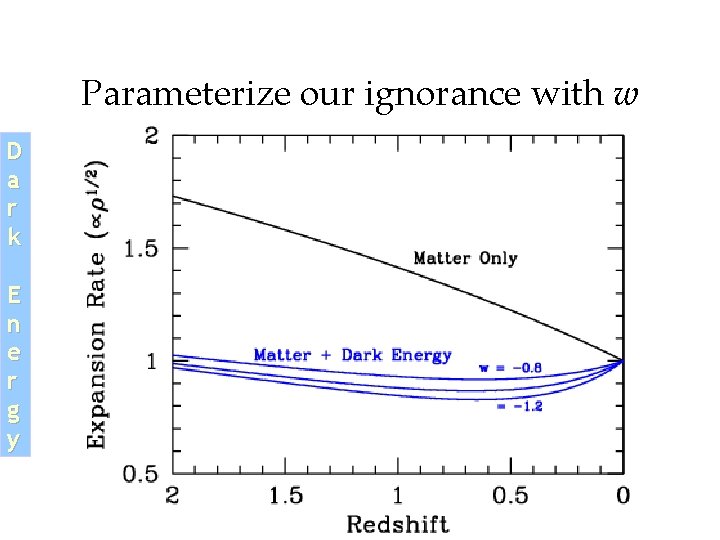
Parameterize our ignorance with w D a r k E n e r g y
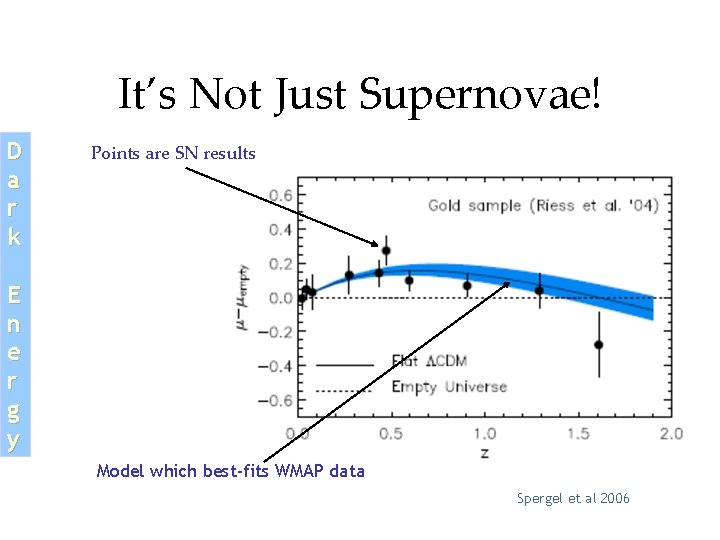
It’s Not Just Supernovae! D a r k Points are SN results E n e r g y Model which best-fits WMAP data Spergel et al 2006
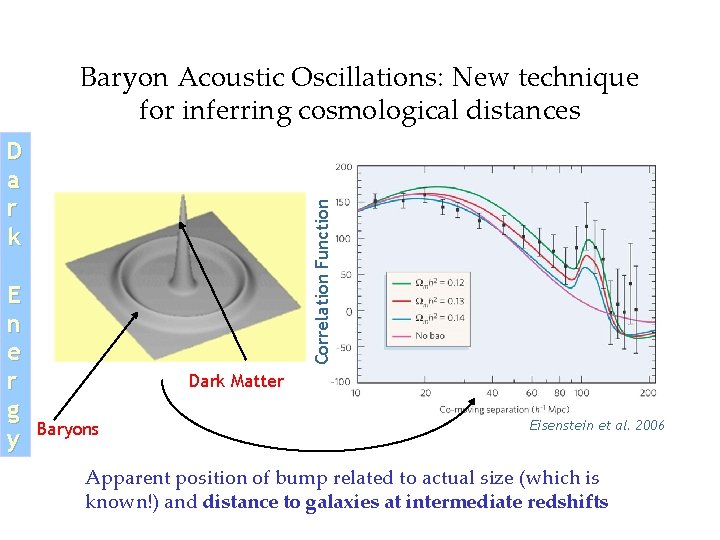
Baryon Acoustic Oscillations: New technique for inferring cosmological distances E n e r g y Correlation Function D a r k Dark Matter Baryons Eisenstein et al. 2006 Apparent position of bump related to actual size (which is known!) and distance to galaxies at intermediate redshifts
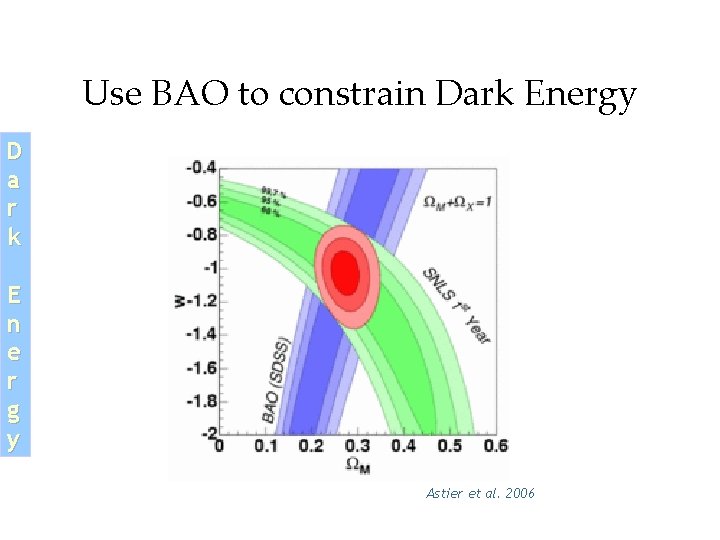
Use BAO to constrain Dark Energy D a r k E n e r g y Astier et al. 2006
Decaying Gravitational Potentials D a r k E n e r g y q. Standard gravitational growth: Potential wells get deeper as overdense regions accrete more matter q. Expanding Universe with matter: Accretion has to battle against expansion, potential well depths remain constant q. Expanding universe with smooth dark energy: potential wells decay
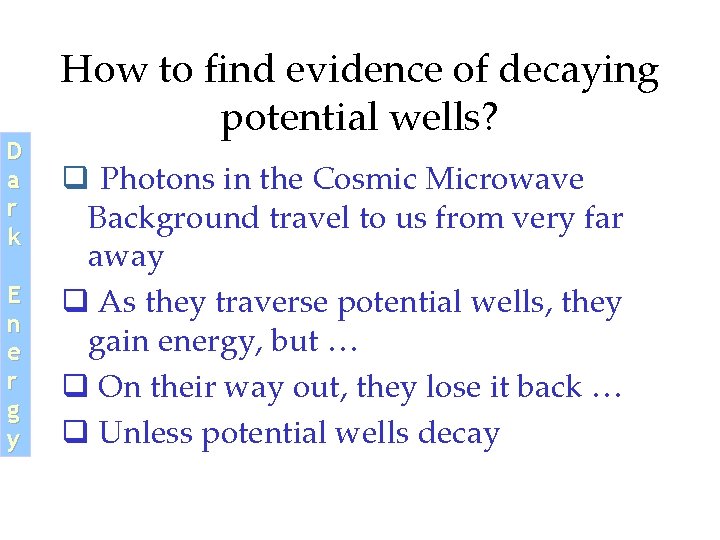
D a r k E n e r g y How to find evidence of decaying potential wells? q Photons in the Cosmic Microwave Background travel to us from very far away q As they traverse potential wells, they gain energy, but … q On their way out, they lose it back … q Unless potential wells decay
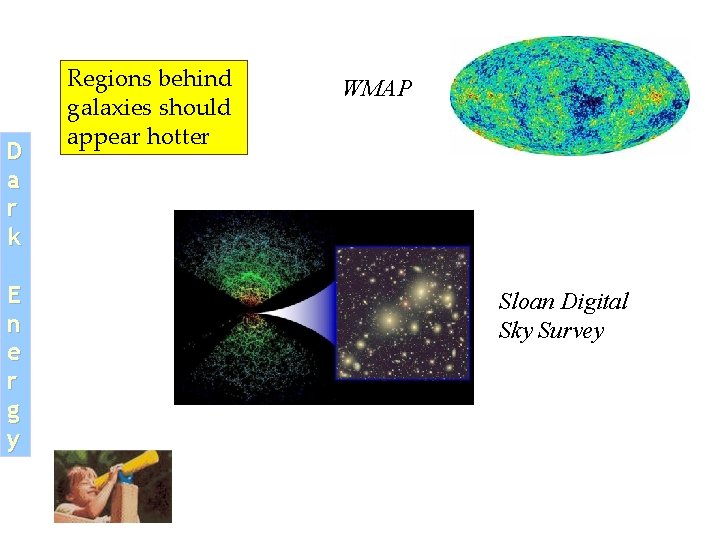
D a r k E n e r g y Regions behind galaxies should appear hotter WMAP Sloan Digital Sky Survey
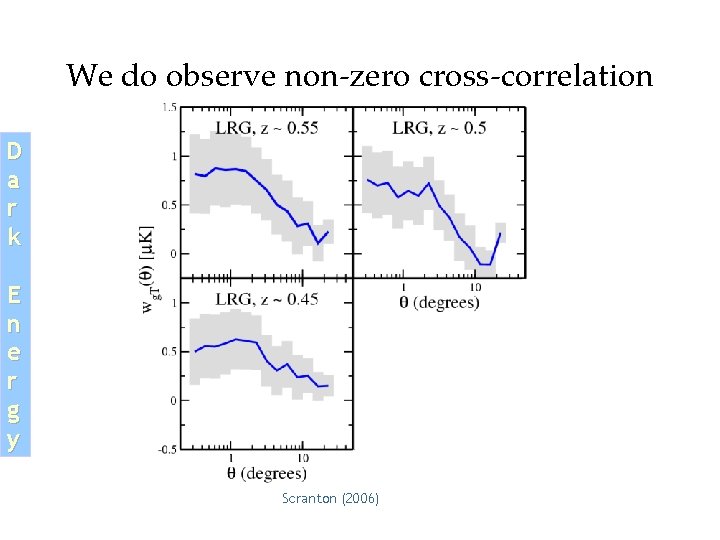
We do observe non-zero cross-correlation D a r k E n e r g y Scranton (2006)
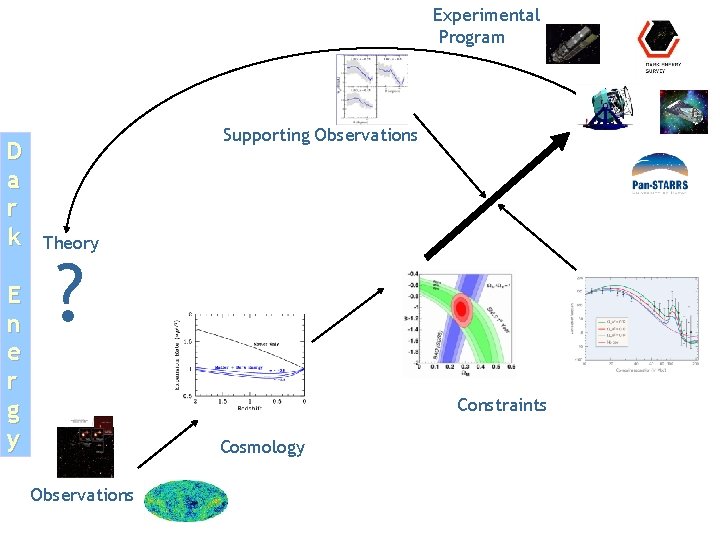
Experimental Program D a r k E n e r g y Supporting Observations Theory ? Constraints Cosmology Observations
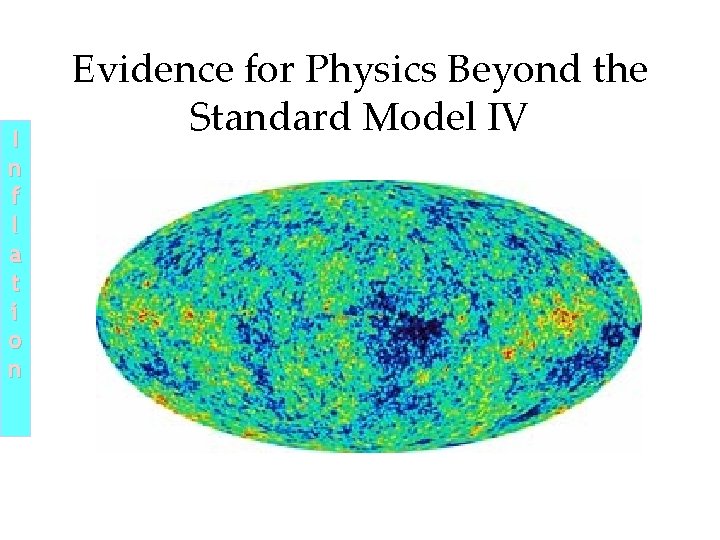
I n f l a t i o n Evidence for Physics Beyond the Standard Model IV
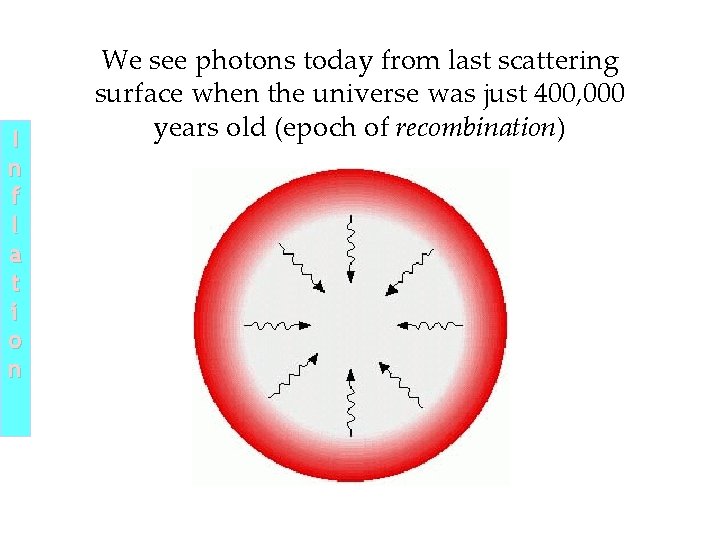
I n f l a t i o n We see photons today from last scattering surface when the universe was just 400, 000 years old (epoch of recombination)
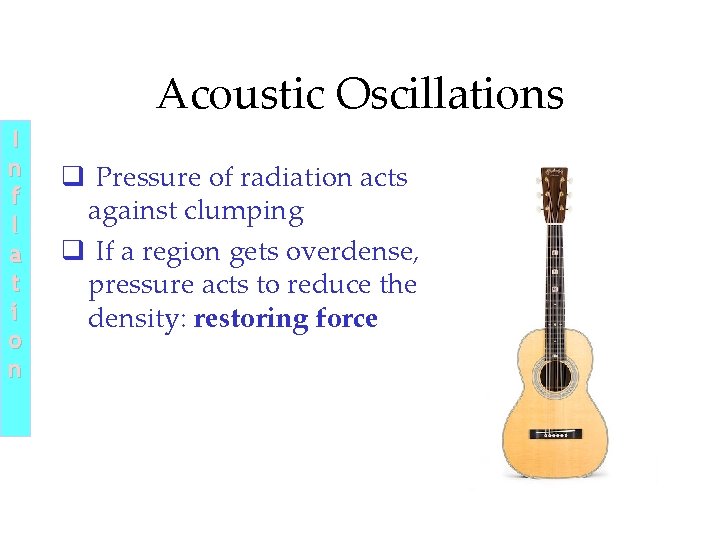
Acoustic Oscillations I n f l a t i o n q Pressure of radiation acts against clumping q If a region gets overdense, pressure acts to reduce the density: restoring force
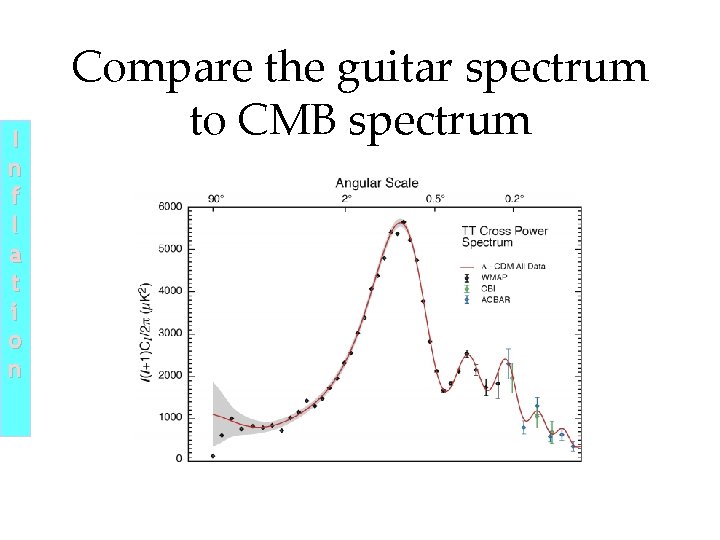
I n f l a t i o n Compare the guitar spectrum to CMB spectrum
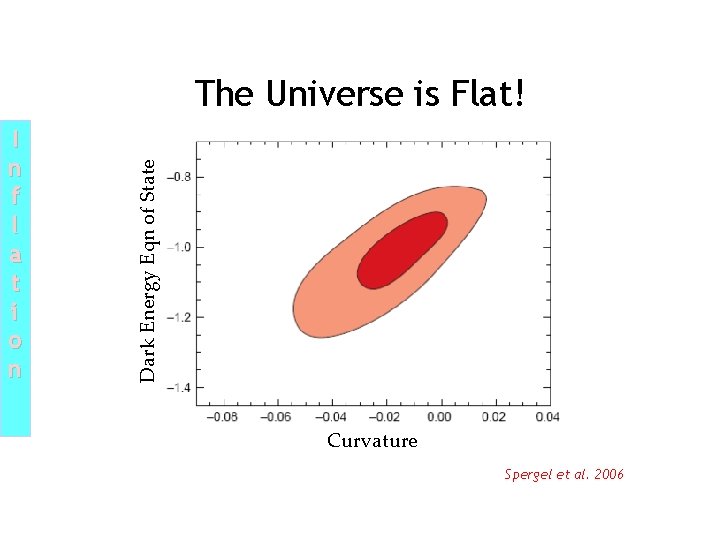
I n f l a t i o n Dark Energy Eqn of State The Universe is Flat! Curvature Spergel et al. 2006
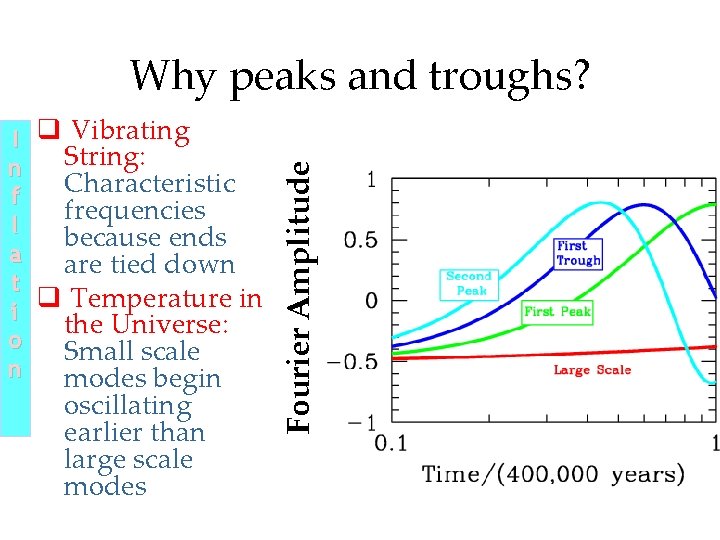
I q Vibrating String: n Characteristic f frequencies l because ends a are tied down t q Temperature in i the Universe: o Small scale n modes begin oscillating earlier than large scale modes Fourier Amplitude Why peaks and troughs?
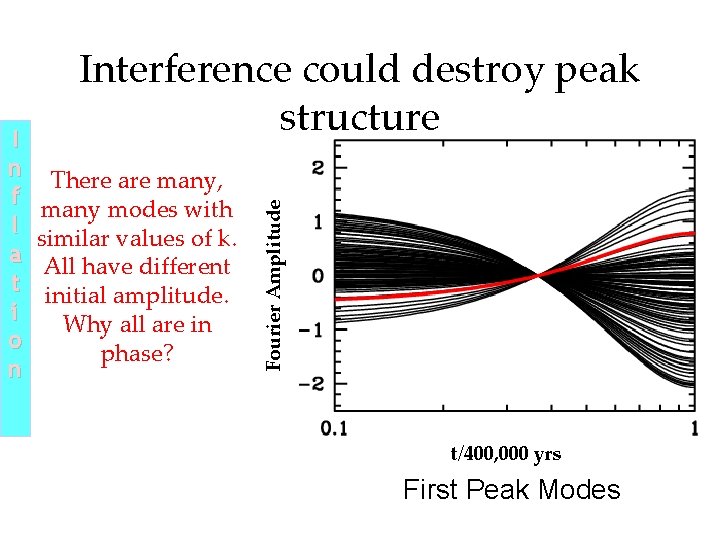
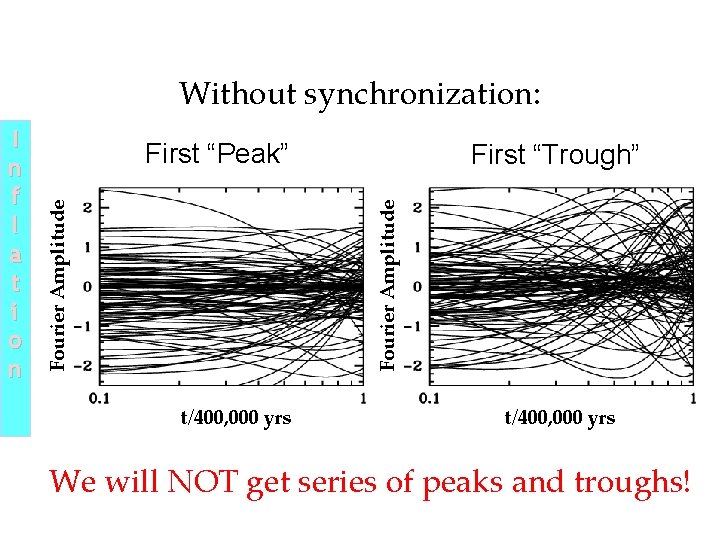
There are many, many modes with similar values of k. All have different initial amplitude. Why all are in phase? Fourier Amplitude I n f l a t i o n Interference could destroy peak structure t/400, 000 yrs First Peak Modes
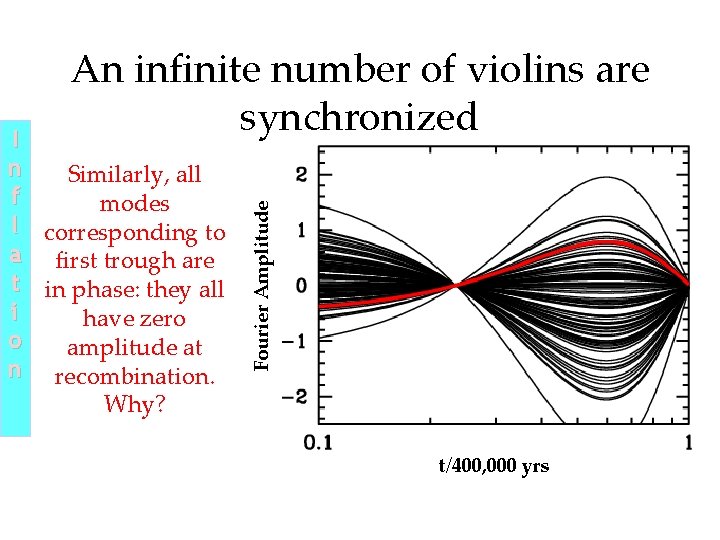
I n Similarly, all f modes l corresponding to a first trough are t in phase: they all i have zero o amplitude at n recombination. Why? Fourier Amplitude An infinite number of violins are synchronized t/400, 000 yrs
Without synchronization: First “Peak” First “Trough” Fourier Amplitude I n f l a t i o n t/400, 000 yrs We will NOT get series of peaks and troughs!
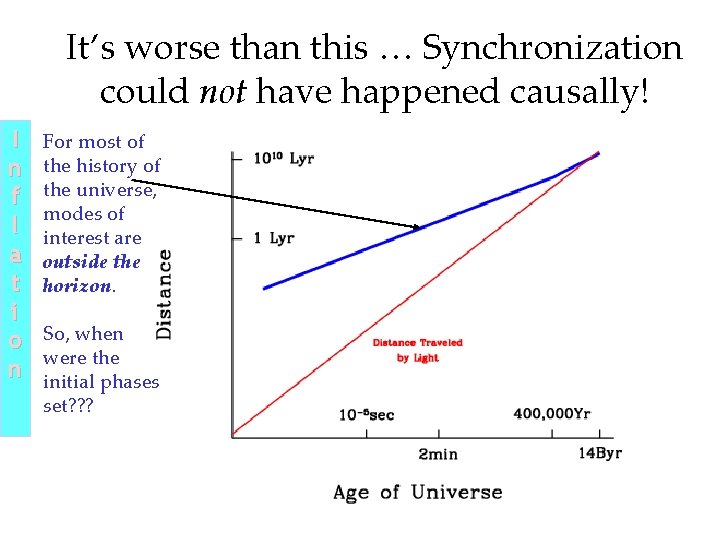
It’s worse than this … Synchronization could not have happened causally! I n f l a t i o n For most of the history of the universe, modes of interest are outside the horizon. So, when were the initial phases set? ? ?
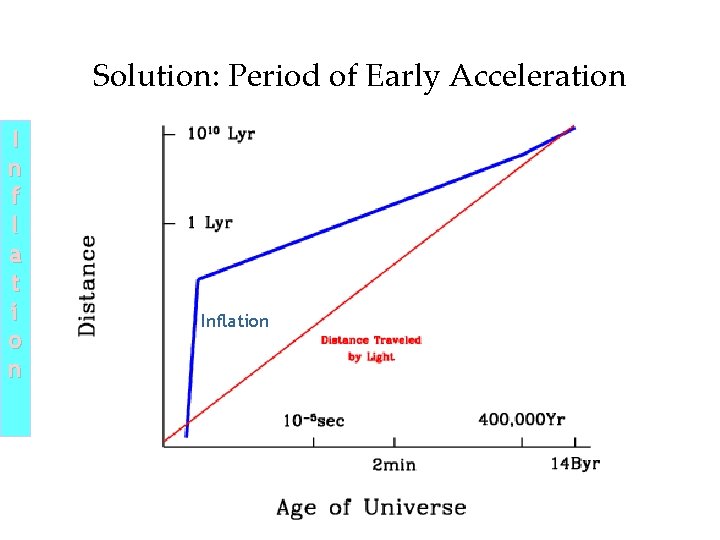
Solution: Period of Early Acceleration I n f l a t i o n Inflation
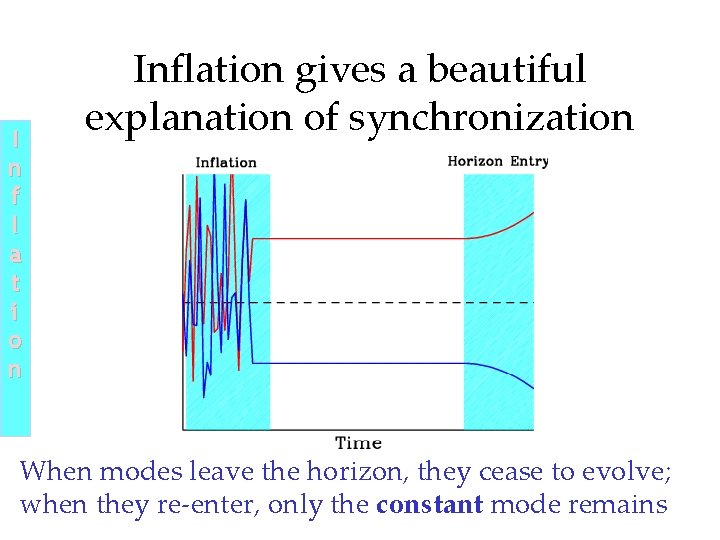
I n f l a t i o n Inflation gives a beautiful explanation of synchronization When modes leave the horizon, they cease to evolve; when they re-enter, only the constant mode remains
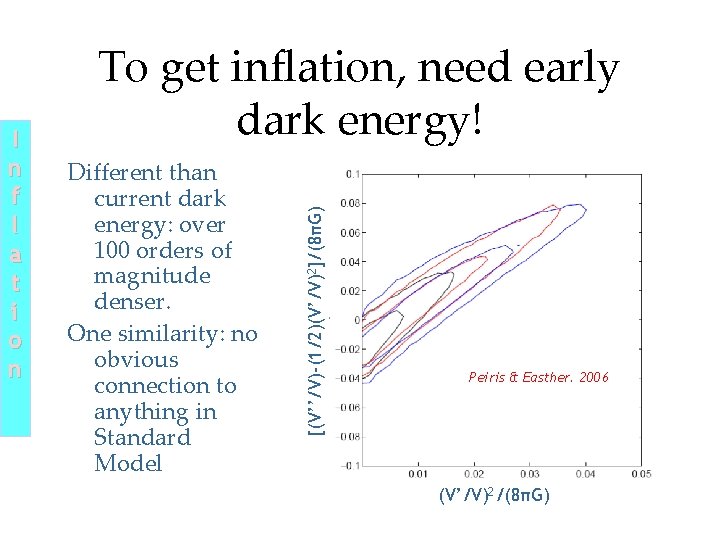
Different than current dark energy: over 100 orders of magnitude denser. One similarity: no obvious connection to anything in Standard Model [(V’’/V)-(1/2)(V’/V)2]/(8πG) I n f l a t i o n To get inflation, need early dark energy! Peiris & Easther. 2006 (V’/V)2/(8πG)
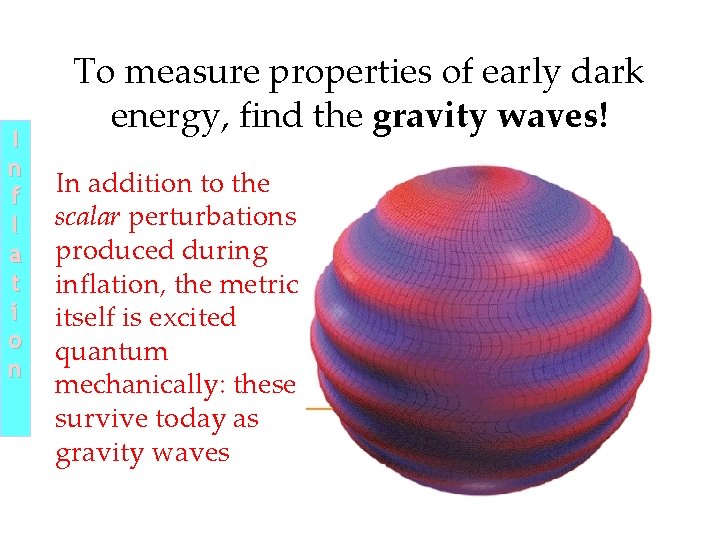
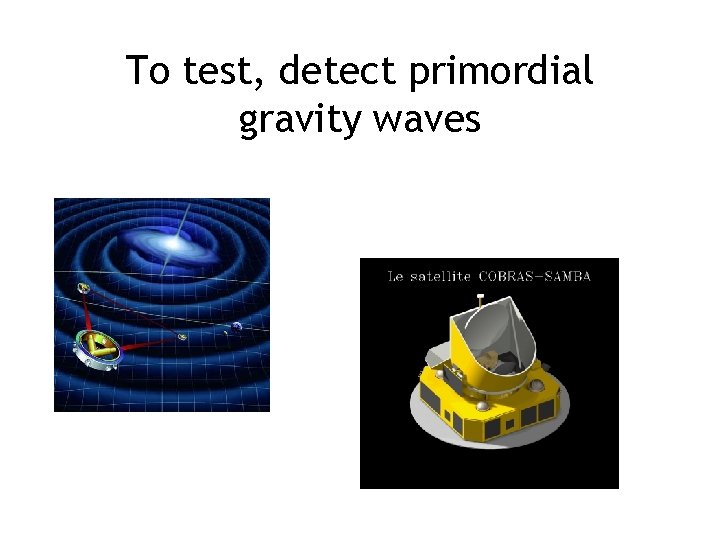
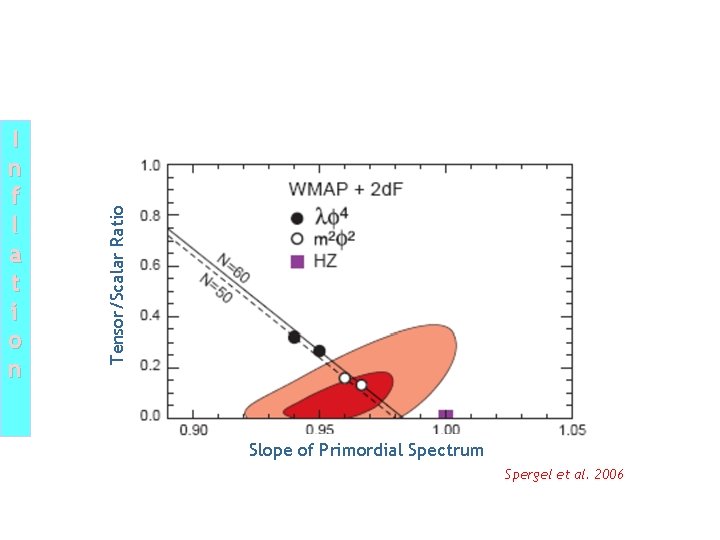
I n f l a t i o n To measure properties of early dark energy, find the gravity waves! In addition to the scalar perturbations produced during inflation, the metric itself is excited quantum mechanically: these survive today as gravity waves
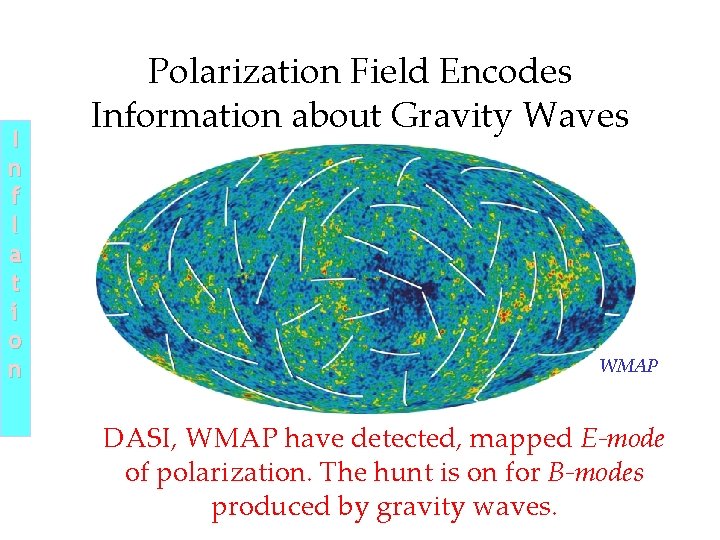
I n f l a t i o n Polarization Field Encodes Information about Gravity Waves WMAP DASI, WMAP have detected, mapped E-mode of polarization. The hunt is on for B-modes produced by gravity waves.
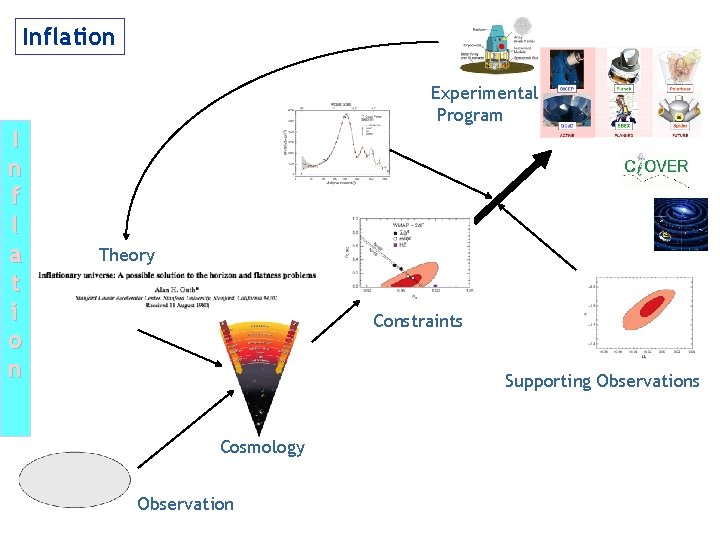
Inflation I n f l a t i o n Experimental Program Theory Constraints Supporting Observations Cosmology Observation
Conclusions q There is robust cosmological evidence for 4 pieces of physics Beyond the Standard Model q The theories underlying this physics are uncertain but will likely lead to fundamental changes in our understanding of nature q Upcoming observations/experiments will shed light on these crucial questions
To test, detect primordial gravity waves
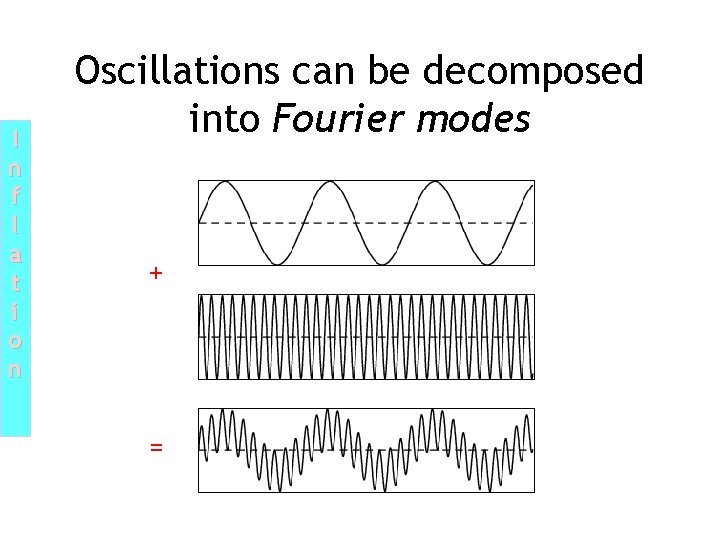
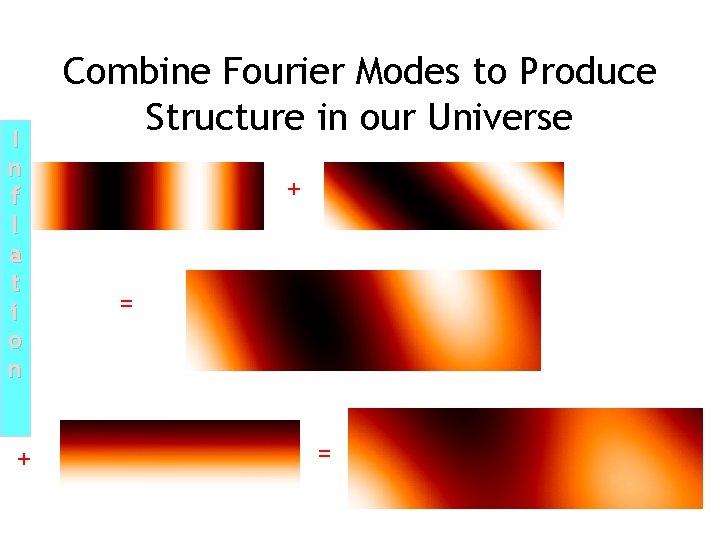
I n f l a t i o n Oscillations can be decomposed into Fourier modes + =
I n f l a t i o n
I n f l a t i o n + Combine Fourier Modes to Produce Structure in our Universe + = =
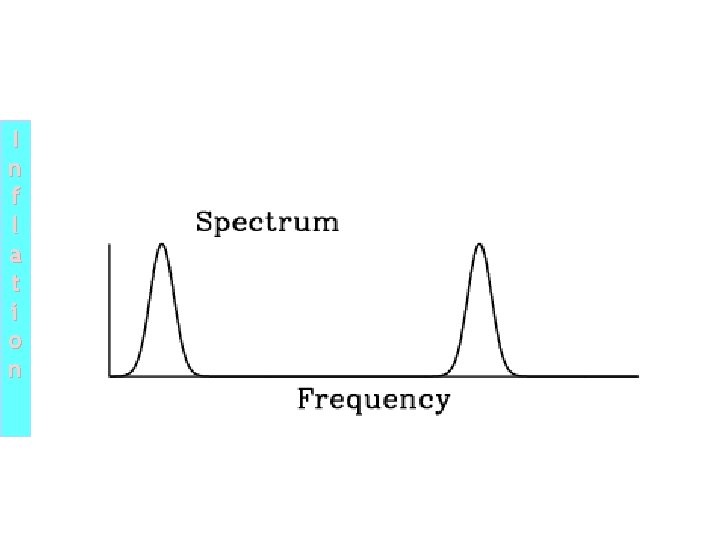
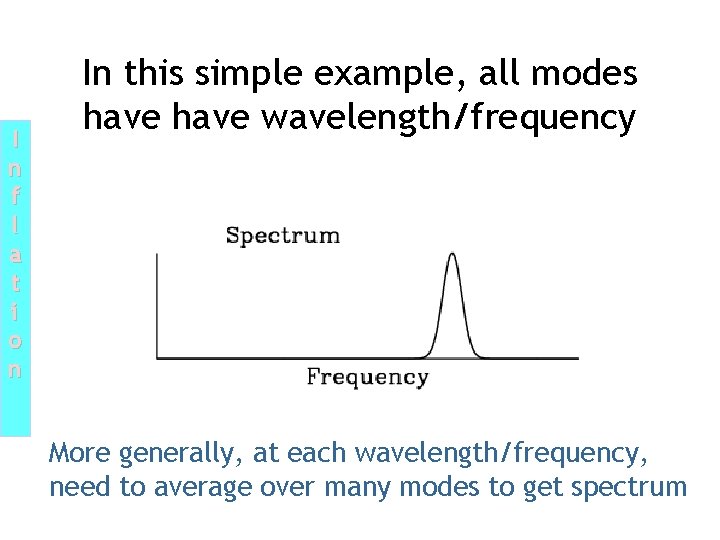
I n f l a t i o n In this simple example, all modes have wavelength/frequency More generally, at each wavelength/frequency, need to average over many modes to get spectrum
Available at www. amazon. com
Tensor/Scalar Ratio I n f l a t i o n Slope of Primordial Spectrum Spergel et al. 2006
[(V’’/V)-(1/2)(V’/V)2]/(8πG) I n f l a t i o n These Translate Into Constraints On The Inflationary Potential Peiris & Easther. 2006 (V’/V)2/(8πG)
CMB is different because … I n f l a t i o n q Fourier Transform of spatial, not temporal, signal q Time scale much longer (400, 000 yrs vs. 1/260 sec) q No finite length: all k allowed!
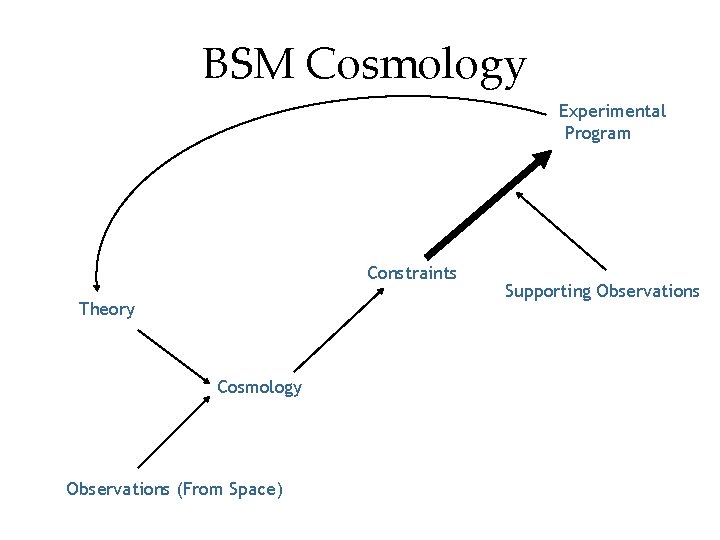
Four Highlights of BSM Cosmology q Initial Evidence from Space q Confirmed by independent observations q Theory of BSM physics well-developed enough to make cosmological predictions, obtain constraints q Rich, observational/experimental program charted out for the coming decade
BSM Cosmology Experimental Program Constraints Theory Cosmology Observations (From Space) Supporting Observations