
Cosmology lect 4 Dynamics of FRWL Universes Dynamics


- Slides: 51
Cosmology, lect. 4 Dynamics of FRWL Universes
Dynamics FRW Universe
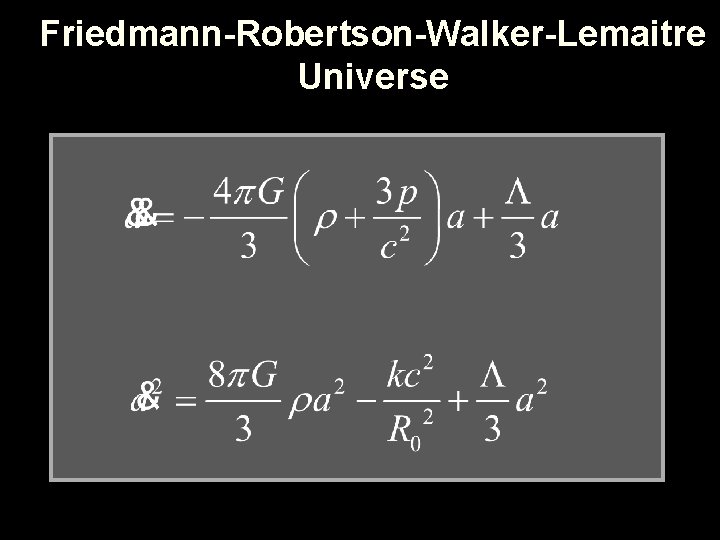
Friedmann-Robertson-Walker-Lemaitre Universe
Cosmic Constituents: Evolving Energy Density
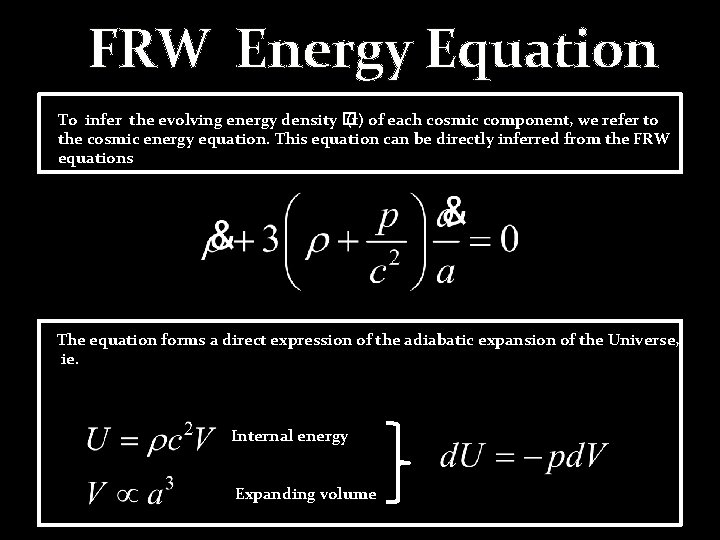
FRW Energy Equation To infer the evolving energy density � (t) of each cosmic component, we refer to the cosmic energy equation. This equation can be directly inferred from the FRW equations The equation forms a direct expression of the adiabatic expansion of the Universe, ie. Internal energy Expanding volume
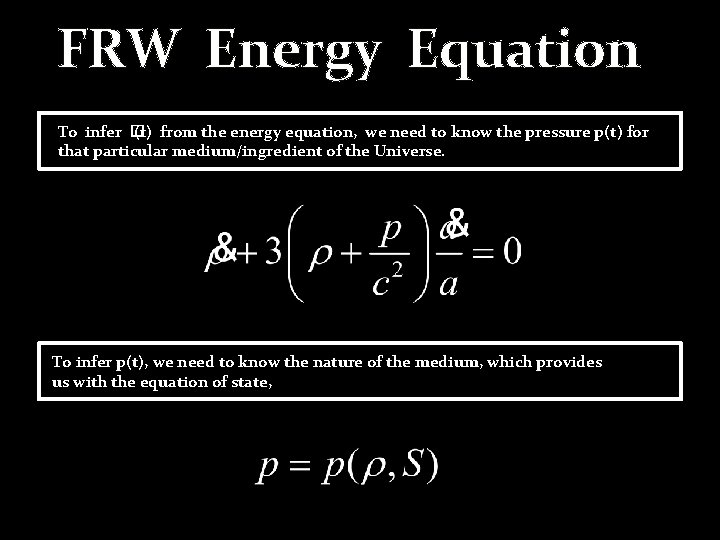
FRW Energy Equation To infer � (t) from the energy equation, we need to know the pressure p(t) for that particular medium/ingredient of the Universe. To infer p(t), we need to know the nature of the medium, which provides us with the equation of state,
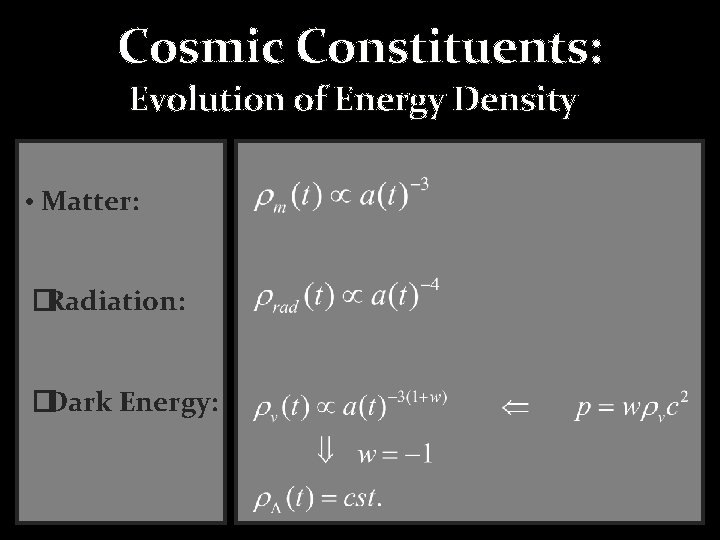
Cosmic Constituents: Evolution of Energy Density • Matter: �Radiation: �Dark Energy:
FRWL Dynamics & Cosmological Density
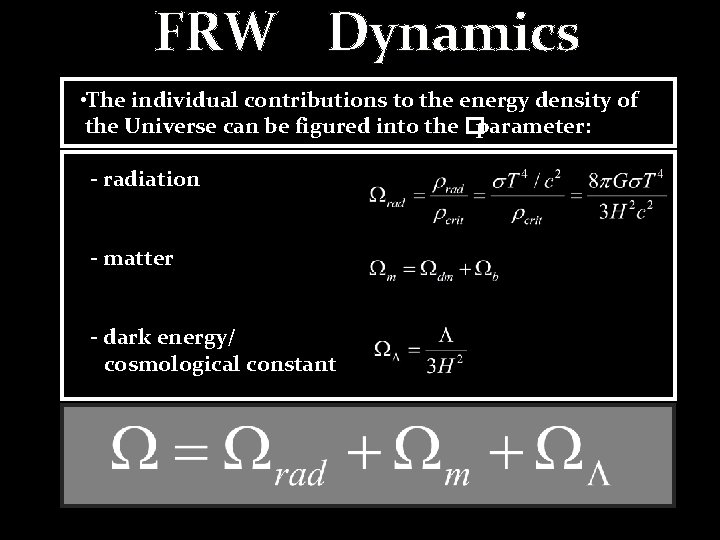
FRW Dynamics • The individual contributions to the energy density of the Universe can be figured into the �parameter: - radiation - matter - dark energy/ cosmological constant
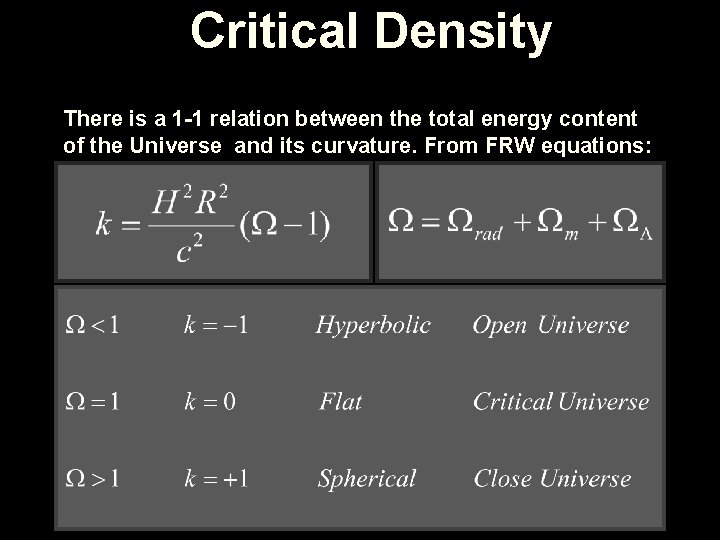
Critical Density There is a 1 -1 relation between the total energy content of the Universe and its curvature. From FRW equations:
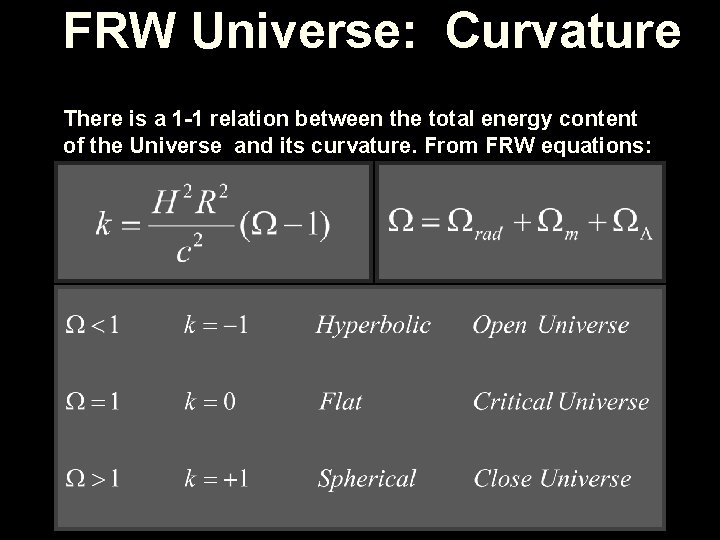
FRW Universe: Curvature There is a 1 -1 relation between the total energy content of the Universe and its curvature. From FRW equations:
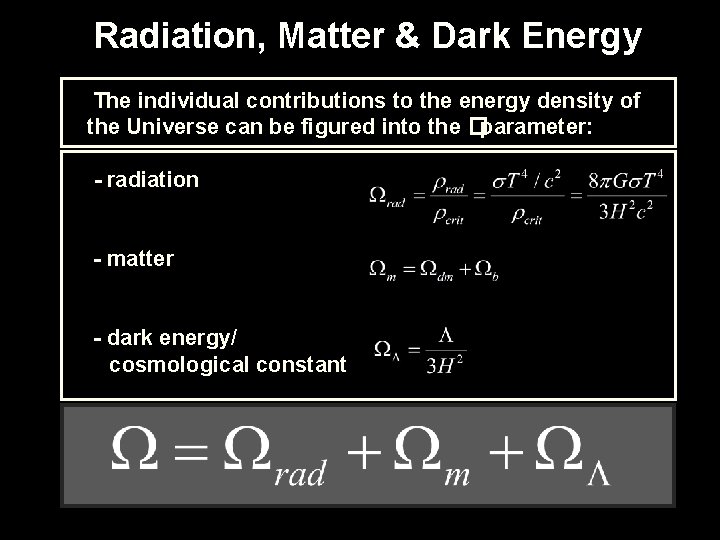
Radiation, Matter & Dark Energy · The individual contributions to the energy density of the Universe can be figured into the �parameter: - radiation - matter - dark energy/ cosmological constant
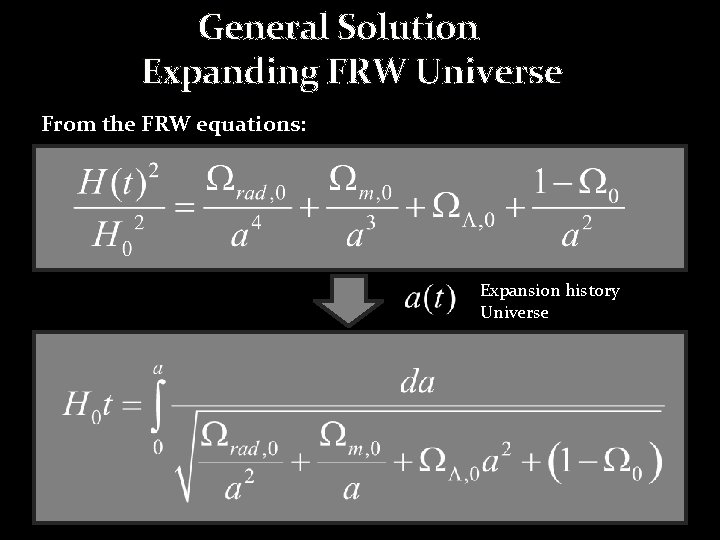
General Solution Expanding FRW Universe From the FRW equations: Expansion history Universe
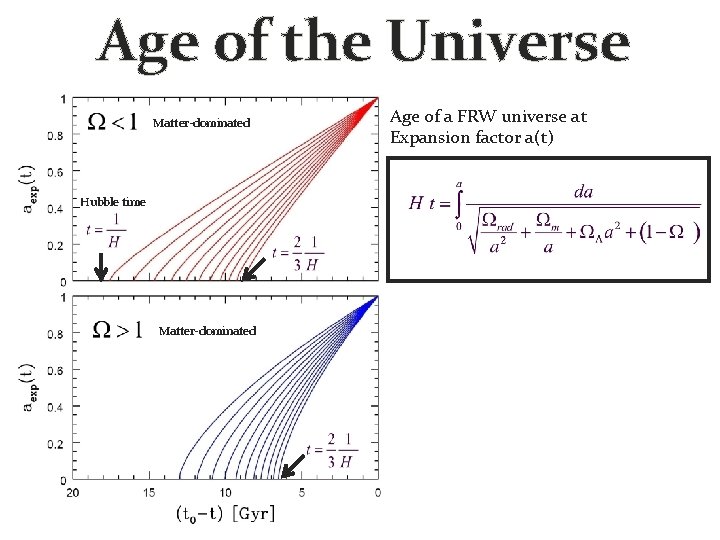
Age of the Universe Matter-dominated Hubble time Matter-dominated Age of a FRW universe at Expansion factor a(t)
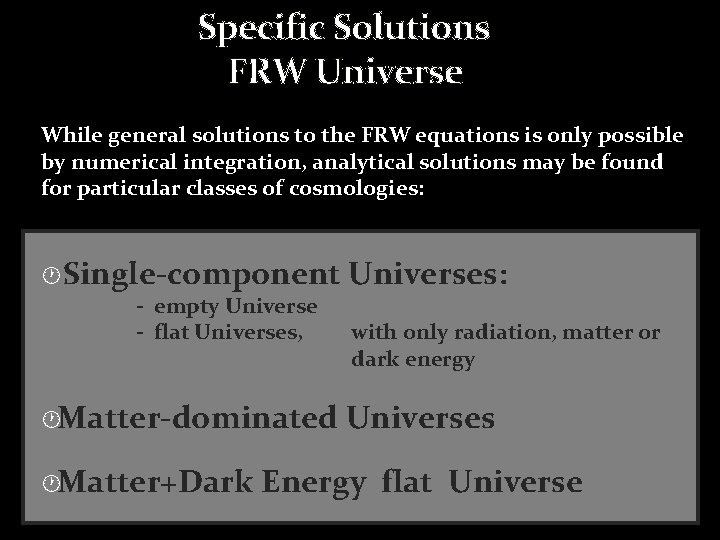
Specific Solutions FRW Universe While general solutions to the FRW equations is only possible by numerical integration, analytical solutions may be found for particular classes of cosmologies: · Single-component Universes: - empty Universe - flat Universes, with only radiation, matter or dark energy ·Matter-dominated ·Matter+Dark Universes Energy flat Universe
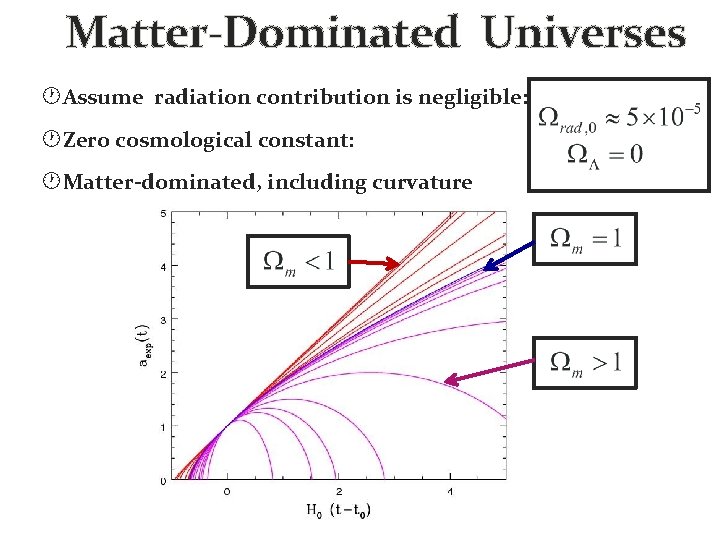
Matter-Dominated Universes · Assume radiation contribution is negligible: · Zero cosmological constant: · Matter-dominated, including curvature
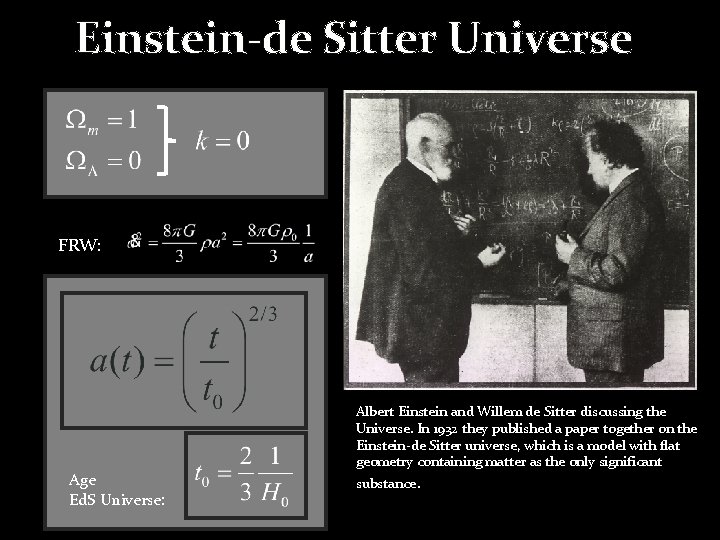
Einstein-de Sitter Universe FRW: Age Ed. S Universe: Albert Einstein and Willem de Sitter discussing the Universe. In 1932 they published a paper together on the Einstein-de Sitter universe, which is a model with flat geometry containing matter as the only significant substance.
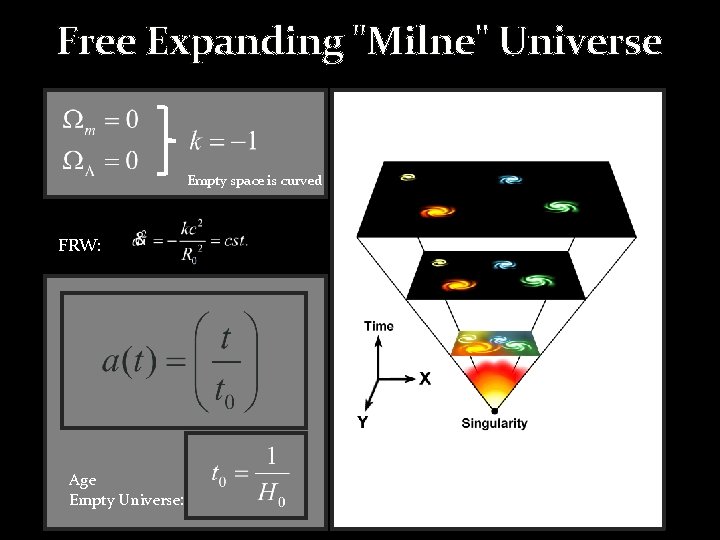
Free Expanding "Milne" Universe Empty space is curved FRW: Age Empty Universe:
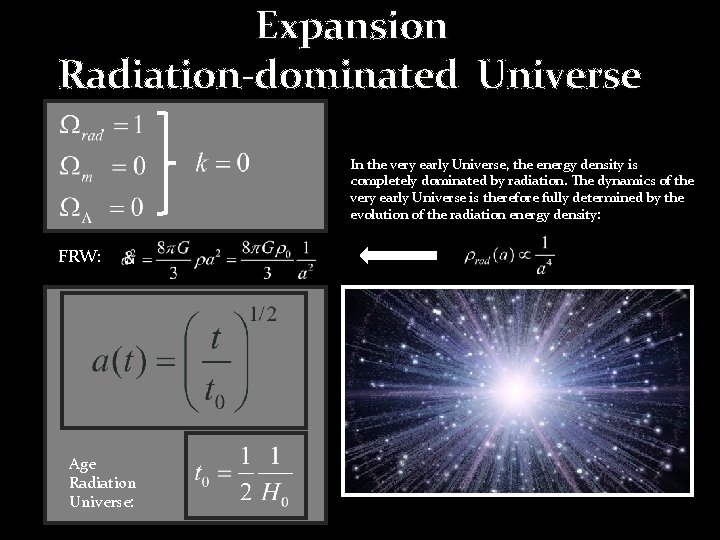
Expansion Radiation-dominated Universe In the very early Universe, the energy density is completely dominated by radiation. The dynamics of the very early Universe is therefore fully determined by the evolution of the radiation energy density: FRW: Age Radiation Universe:
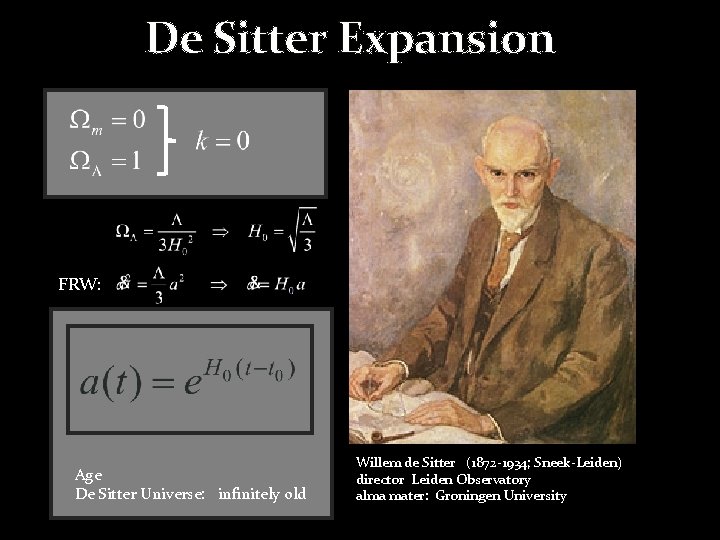
De Sitter Expansion FRW: Age De Sitter Universe: infinitely old Willem de Sitter (1872 -1934; Sneek-Leiden) director Leiden Observatory alma mater: Groningen University
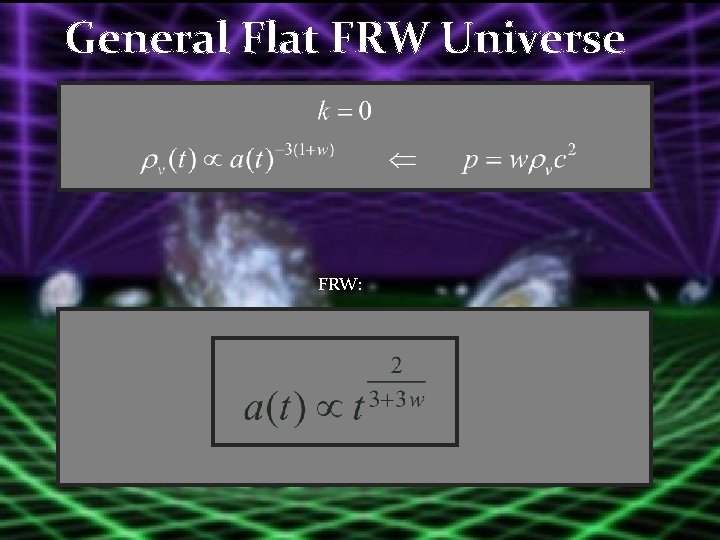
General Flat FRW Universe FRW:
Evolving Cosmic Composition
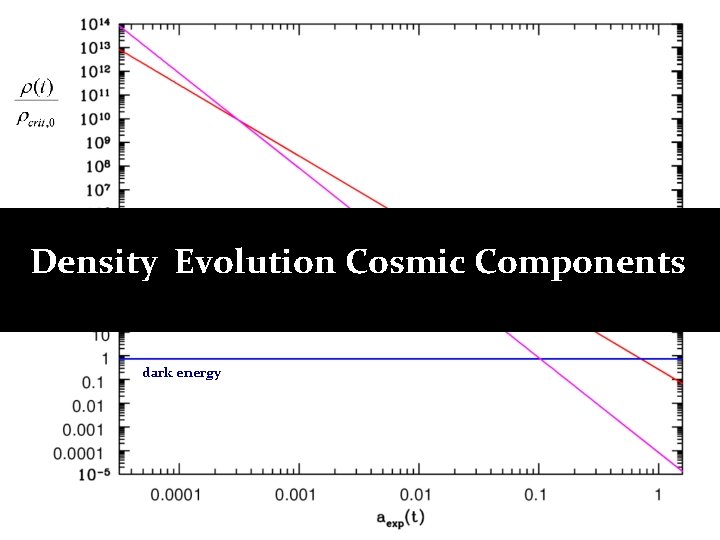
matter Density Evolution Cosmic Components radiation dark energy
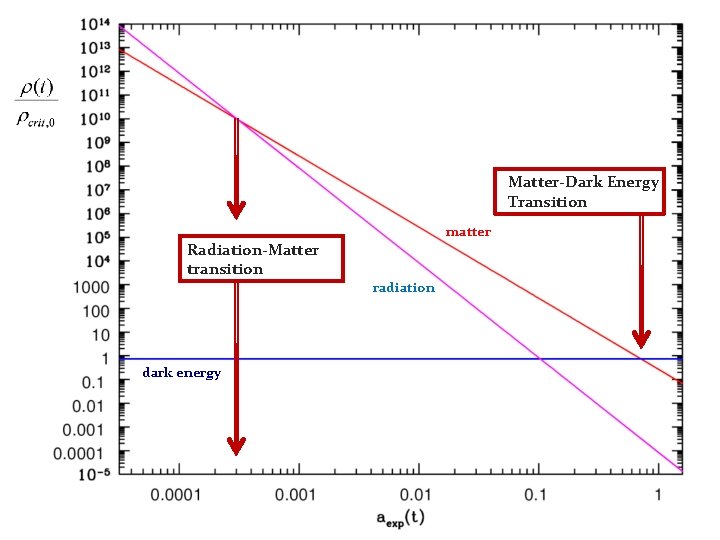
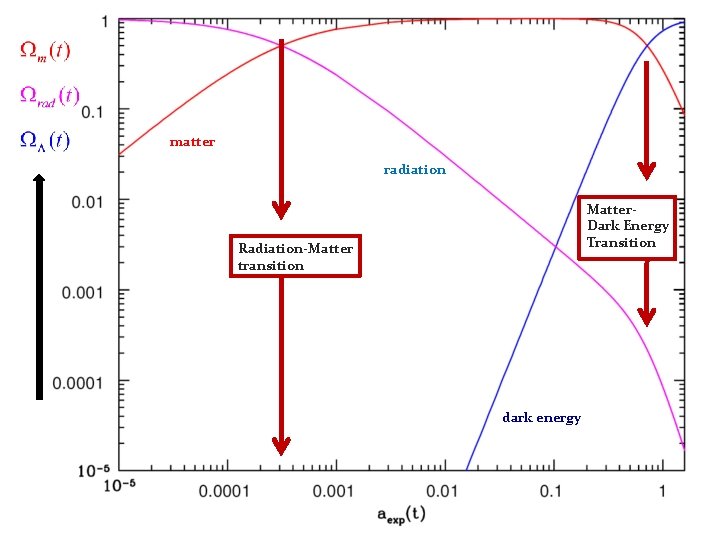
Matter-Dark Energy Transition matter Radiation-Matter transition radiation dark energy
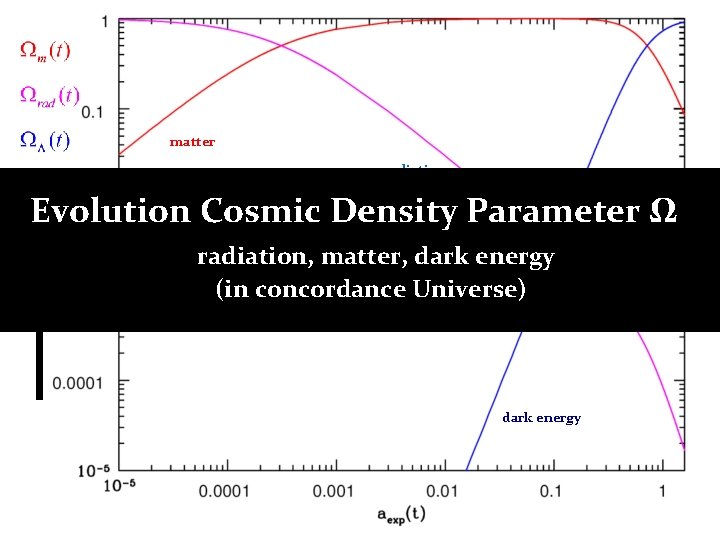
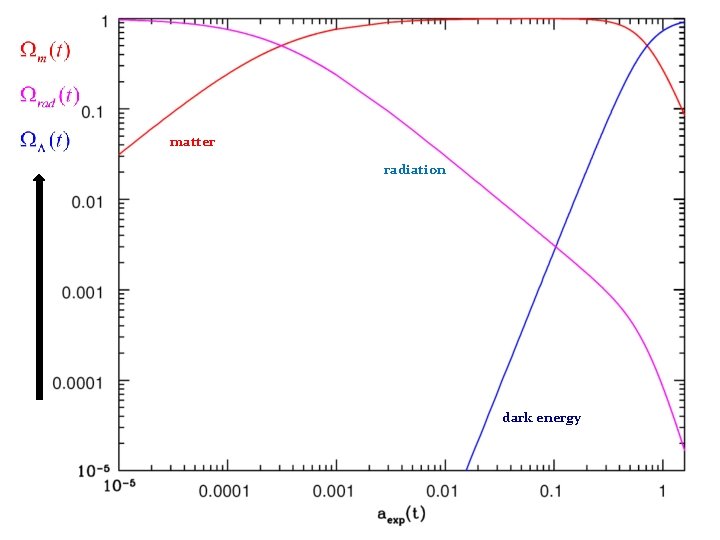
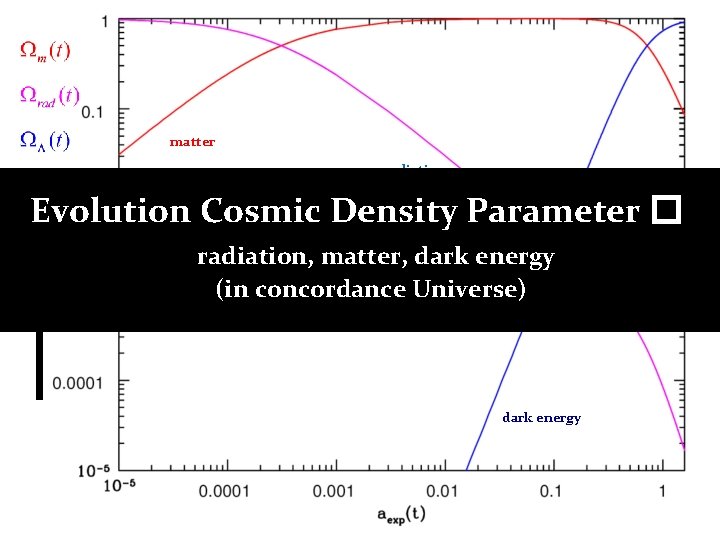
matter radiation Evolution Cosmic Density Parameter Ω radiation, matter, dark energy (in concordance Universe) dark energy
matter radiation dark energy
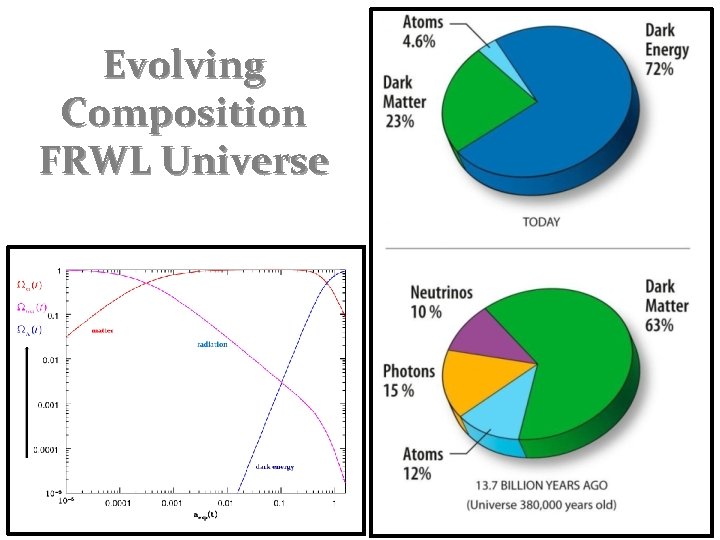
Evolving Composition FRWL Universe
Cosmological Transitions
Dynamical Transitions Because radiation, matter, dark energy (and curvature) of the Universe evolve differently as the Universe expands, at different epochs the energy density of the Universe is alternately dominated by these different ingredients. As the Universe is dominated by either radiation, matter, curvature or dark energy, the cosmic expansion a(t) proceeds differently. We therefore recognize the following epochs: �radiation-dominated era �matter-dominated era �curvature-dominated expansion �dark energy dominated epoch The different cosmic expansions at these eras have a huge effect on relevant physical processes
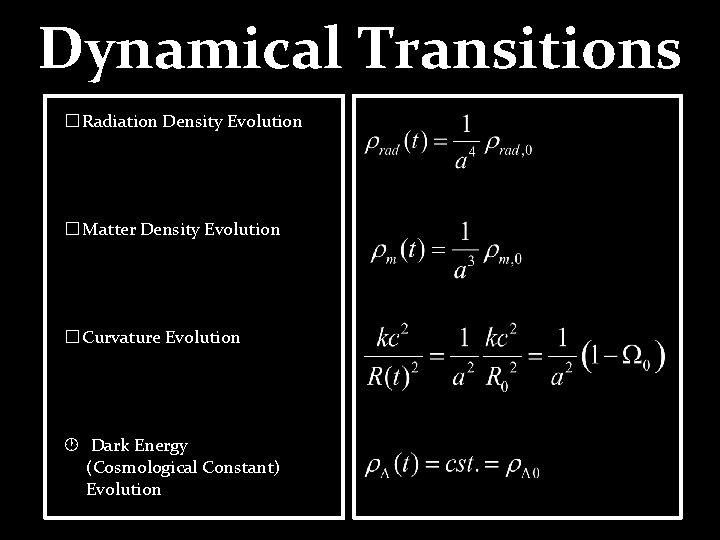
Dynamical Transitions � Radiation Density Evolution � Matter Density Evolution � Curvature Evolution · Dark Energy (Cosmological Constant) Evolution
matter radiation Evolution Cosmic Density Parameter � radiation, matter, dark energy (in concordance Universe) dark energy
matter radiation Matter. Dark Energy Transition Radiation-Matter transition dark energy
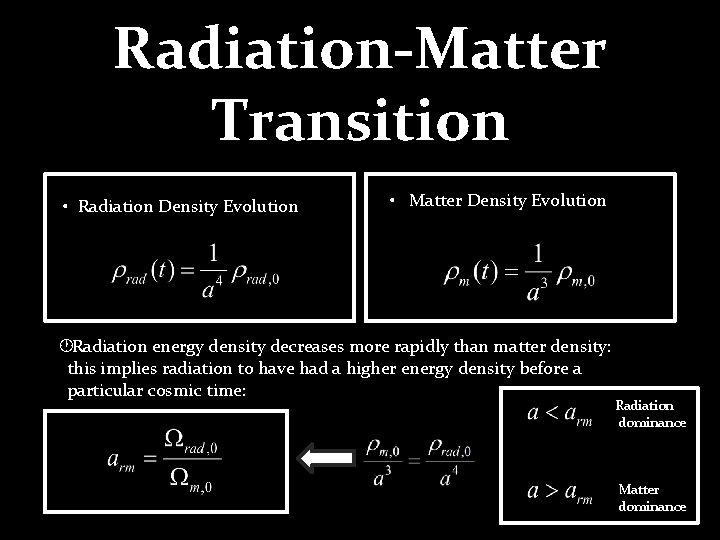
Radiation-Matter Transition • Radiation Density Evolution • Matter Density Evolution ·Radiation energy density decreases more rapidly than matter density: this implies radiation to have had a higher energy density before a particular cosmic time: Radiation dominance Matter dominance
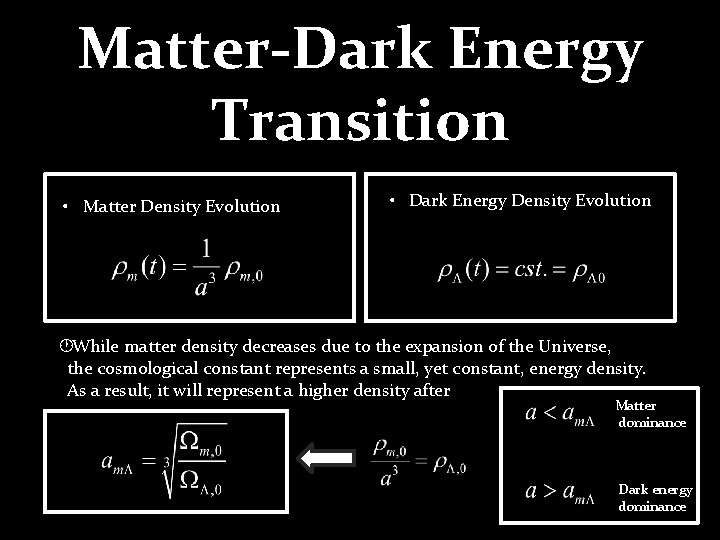
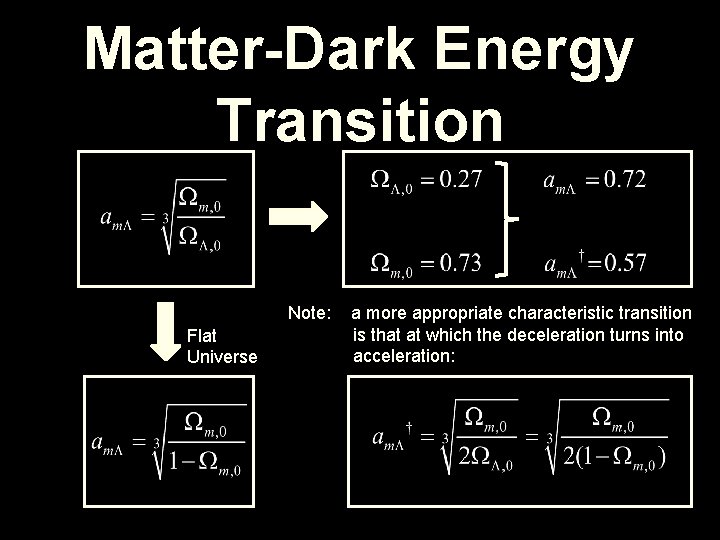
Matter-Dark Energy Transition • Matter Density Evolution • Dark Energy Density Evolution ·While matter density decreases due to the expansion of the Universe, the cosmological constant represents a small, yet constant, energy density. As a result, it will represent a higher density after Matter dominance Dark energy dominance
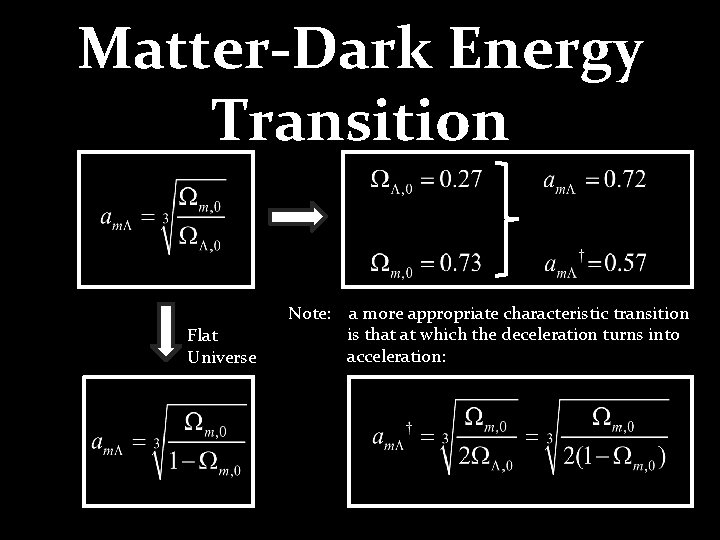
Matter-Dark Energy Transition Note: Flat Universe a more appropriate characteristic transition is that at which the deceleration turns into acceleration:
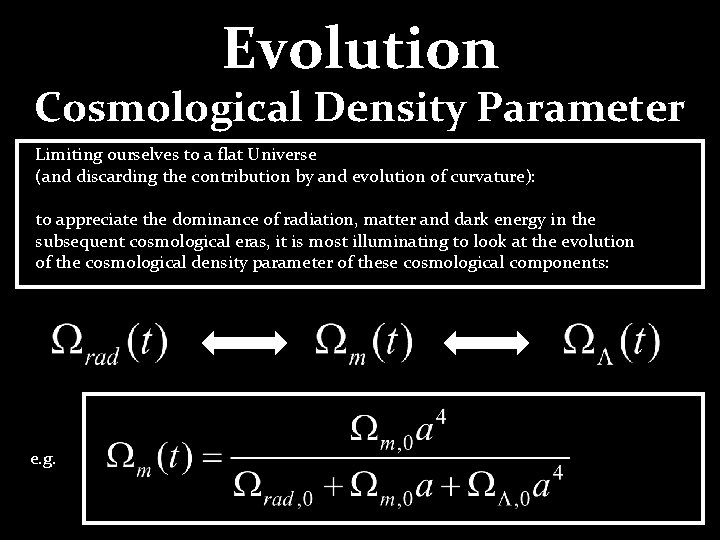
Evolution Cosmological Density Parameter Limiting ourselves to a flat Universe (and discarding the contribution by and evolution of curvature): to appreciate the dominance of radiation, matter and dark energy in the subsequent cosmological eras, it is most illuminating to look at the evolution of the cosmological density parameter of these cosmological components: e. g.
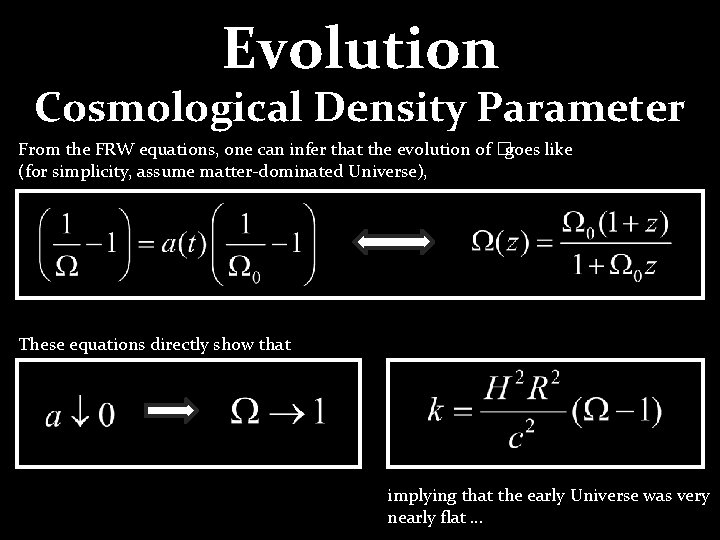
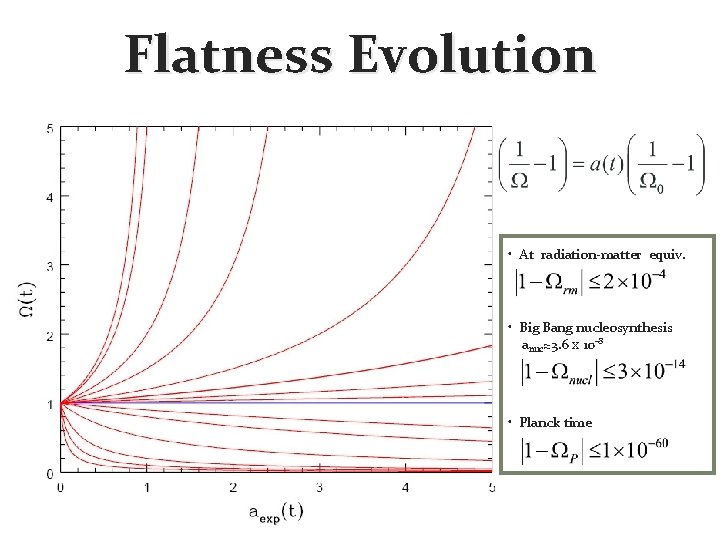
Evolution Cosmological Density Parameter From the FRW equations, one can infer that the evolution of �goes like (for simplicity, assume matter-dominated Universe), These equations directly show that implying that the early Universe was very nearly flat …
Flatness Evolution • At radiation-matter equiv. • Big Bang nucleosynthesis anuc≈3. 6 x 10 -8 • Planck time
Concordance Universe
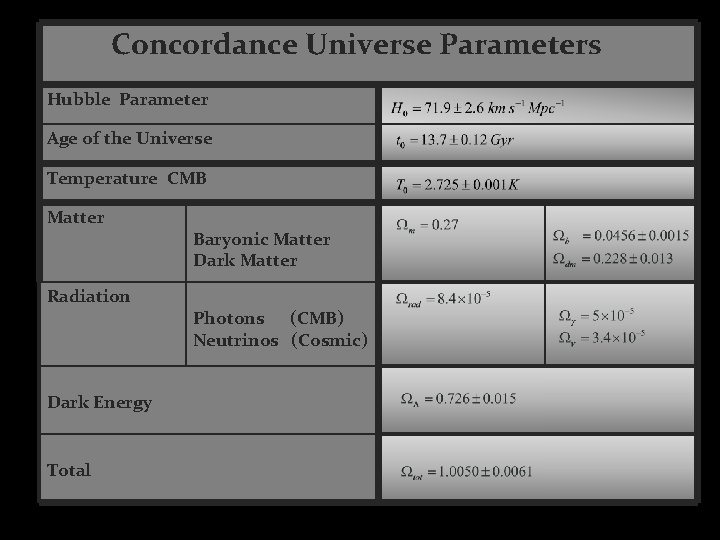
Concordance Universe Parameters Hubble Parameter Age of the Universe Temperature CMB Matter Radiation Dark Energy Total Baryonic Matter Dark Matter Photons (CMB) Neutrinos (Cosmic)
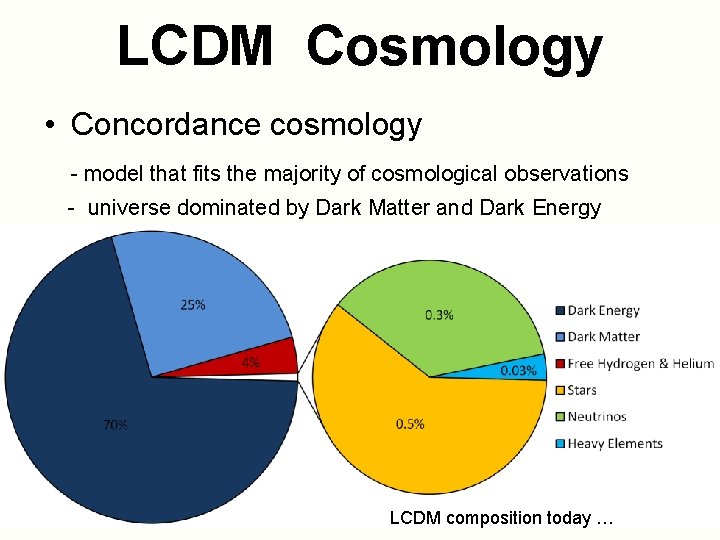
LCDM Cosmology • Concordance cosmology - model that fits the majority of cosmological observations - universe dominated by Dark Matter and Dark Energy LCDM composition today …
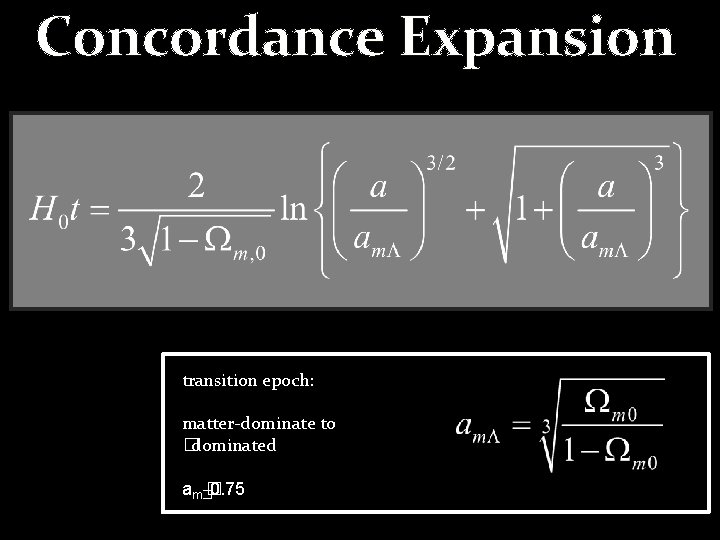
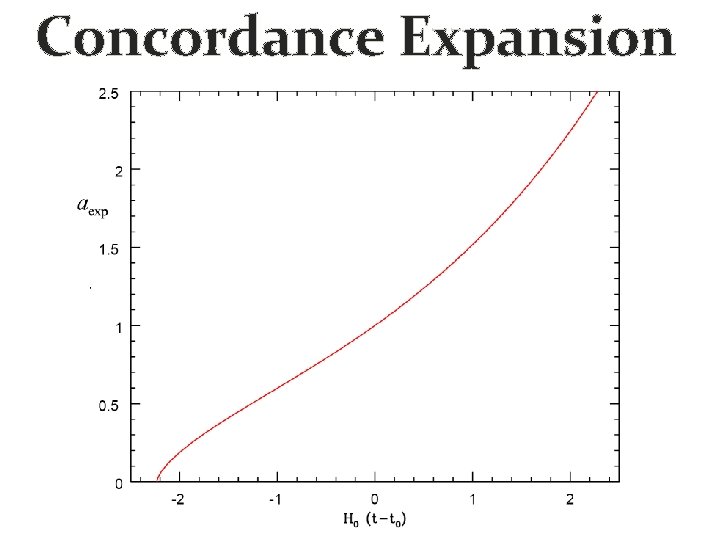
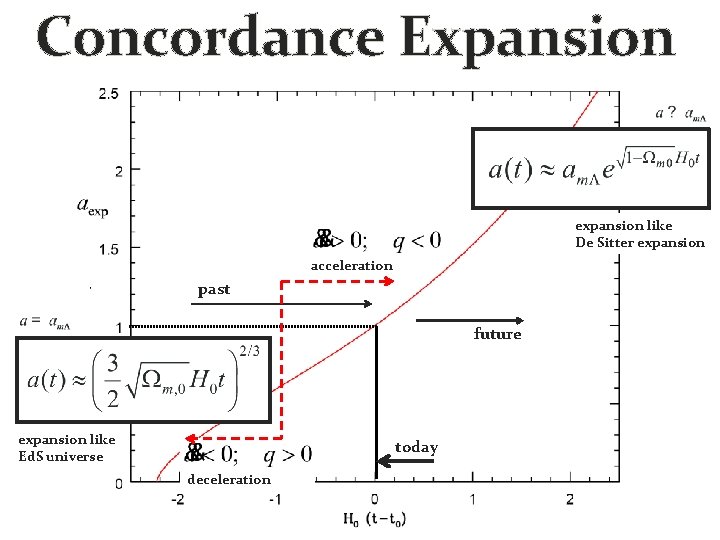
Concordance Expansion transition epoch: matter-dominate to �dominated am�� 0. 75
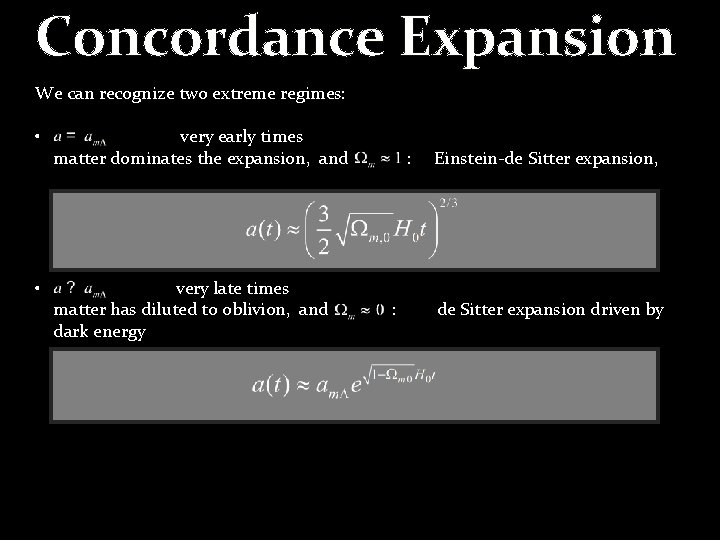
Concordance Expansion We can recognize two extreme regimes: • very early times matter dominates the expansion, and • very late times matter has diluted to oblivion, and dark energy : : Einstein-de Sitter expansion, de Sitter expansion driven by
Concordance Expansion
Concordance Expansion expansion like De Sitter expansion acceleration past future expansion like Ed. S universe today deceleration
Matter-Dark Energy Transition Note: Flat Universe a more appropriate characteristic transition is that at which the deceleration turns into acceleration:
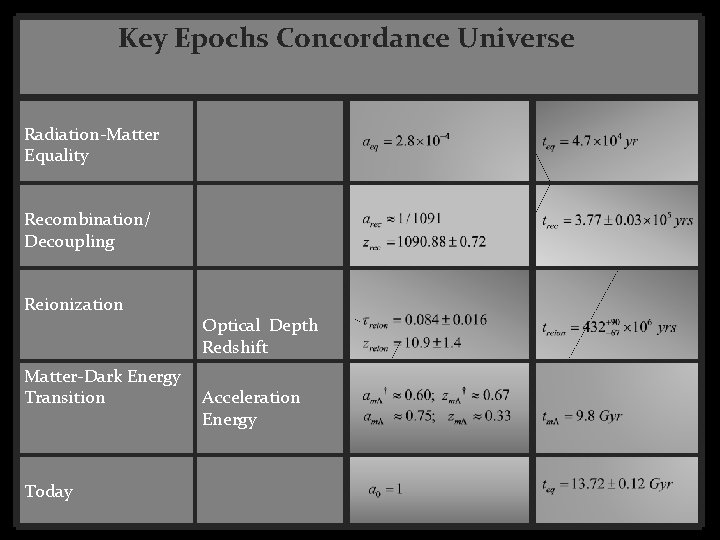
Key Epochs Concordance Universe Radiation-Matter Equality Recombination/ Decoupling Reionization Matter-Dark Energy Transition Today Optical Depth Redshift Acceleration Energy
General FRWL cxpansion histories: cosmic “phase diagram”
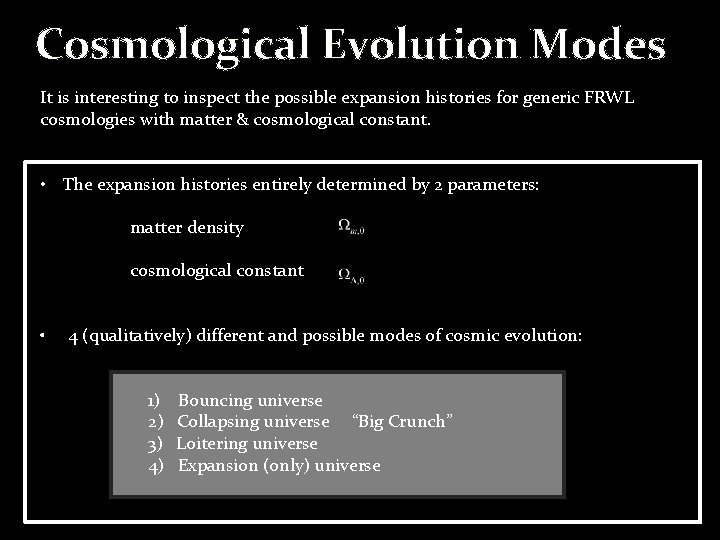
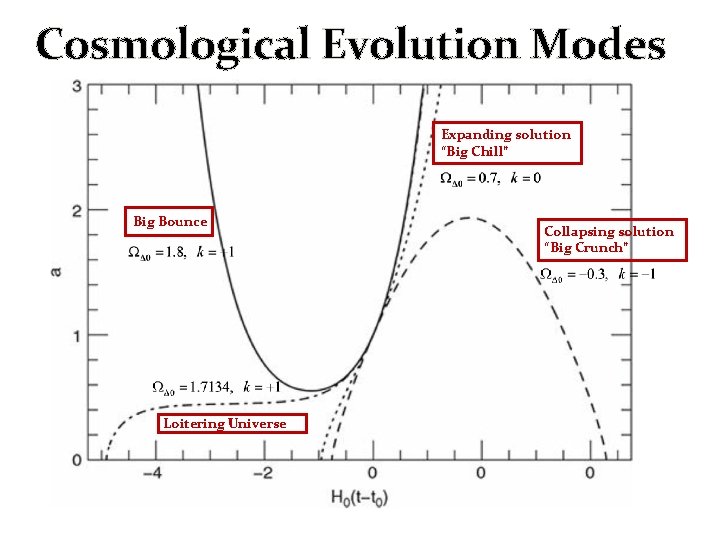
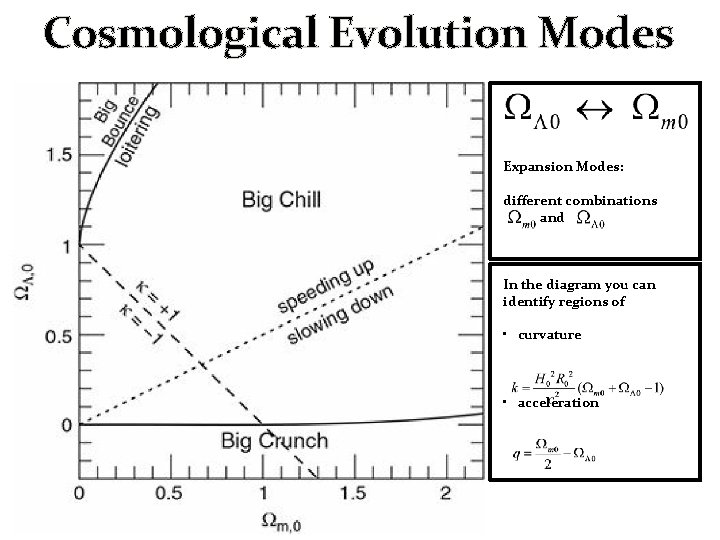
Cosmological Evolution Modes It is interesting to inspect the possible expansion histories for generic FRWL cosmologies with matter & cosmological constant. • The expansion histories entirely determined by 2 parameters: matter density cosmological constant • 4 (qualitatively) different and possible modes of cosmic evolution: 1) 2) 3) 4) Bouncing universe Collapsing universe “Big Crunch” Loitering universe Expansion (only) universe
Cosmological Evolution Modes Expanding solution “Big Chill” Big Bounce Loitering Universe Collapsing solution “Big Crunch”
Cosmological Evolution Modes Expansion Modes: different combinations and In the diagram you can identify regions of • curvature • acceleration