
Cosmology from CMB Dmitry Pogosyan University of Alberta
Cosmology from CMB Dmitry Pogosyan University of Alberta • Lecture 1: What can Cosmic Microwave Background tell us about the Universe ? A theoretical introduction. • Lecture 2: Recent successes in the mapping of CMB anisotropy: what pre-WMAP and WMAP data reveals. Lake Louise, February, 2003

Fundamentals of cosmology: Expansion of the Universe H 0 = 72 8 km/s/Mpc (HST key project, 2001)

Matter constituents according to modern view • • Dark energy ~ 70% Dark matter ~ 30% Baryons ~ 5% 3 K Radiation ~0. 01% • • P ≈ -ρ P=0 P≈0 P = ρ/3 ρ = const ρ = 1/a 3 ρ = 1/a 4

Fundamentals of cosmology: existence of Large-Scale Structures ¿Dark? Matter 8 ~ 1, averaged in spheres of 8 Mpc radius

What do cosmologists want to learn about the Universe ? • Matter content • Geometry of the space • Origin of structures and details of their formation • Origin of the Universe as we observe now. What theory describes the early epoch of evolution ?
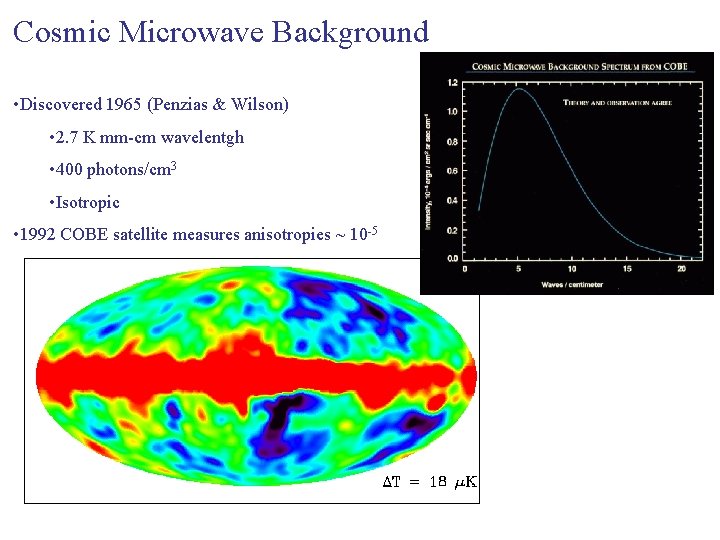
Cosmic Microwave Background • Discovered 1965 (Penzias & Wilson) • 2. 7 K mm-cm wavelentgh • 400 photons/cm 3 • Isotropic • 1992 COBE satellite measures anisotropies ~ 10 -5
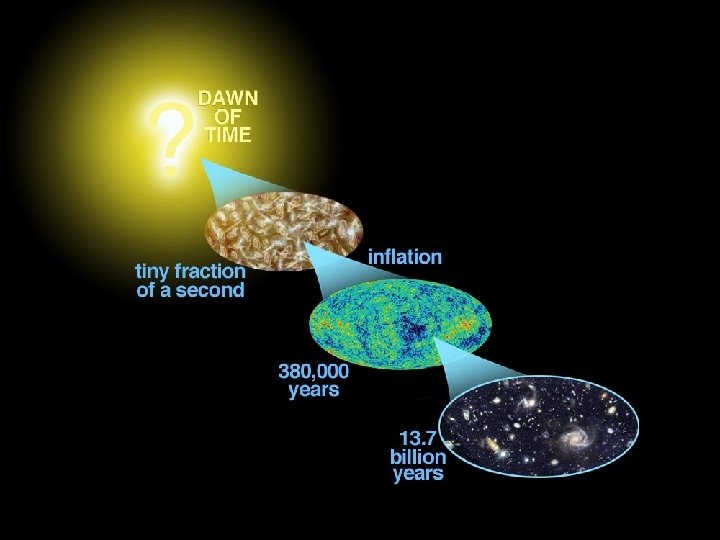

Secondary Anisotropies • Tightly coupled Photon-Baryon fluid oscillations • Linear regime of perturbations Decoupling LSS Primary Anisotropies • Gravitational redshifting • Non-Linear Evolution • Weak Lensing • Thermal and Kinetic SZ effect • Etc. reionization ~10 h-1 Mpc 14 Gyrs 10 Gyrs today

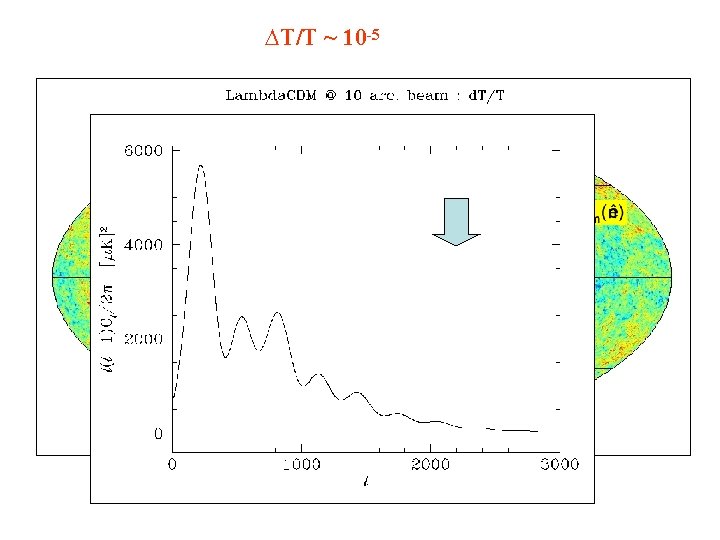
∆T/T ~ 10 -5
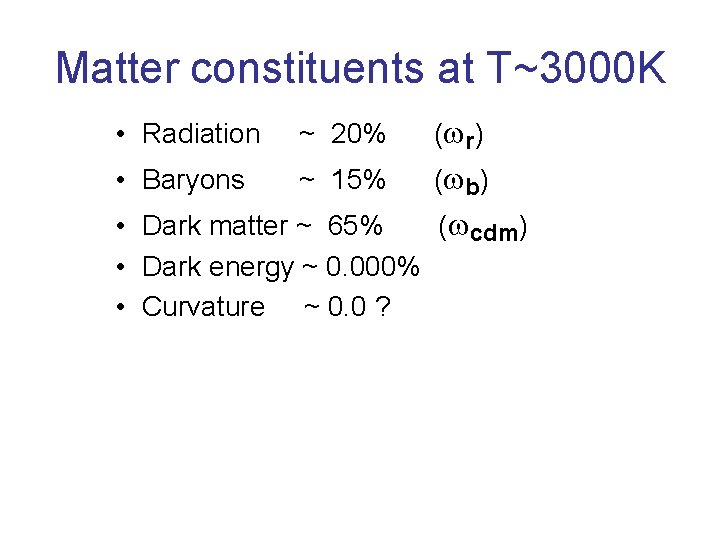
Matter constituents at T~3000 K • Radiation ~ 20% ( r ) • Baryons ~ 15% ( b ) • Dark matter ~ 65% ( cdm) • Dark energy ~ 0. 000% • Curvature ~ 0. 0 ?
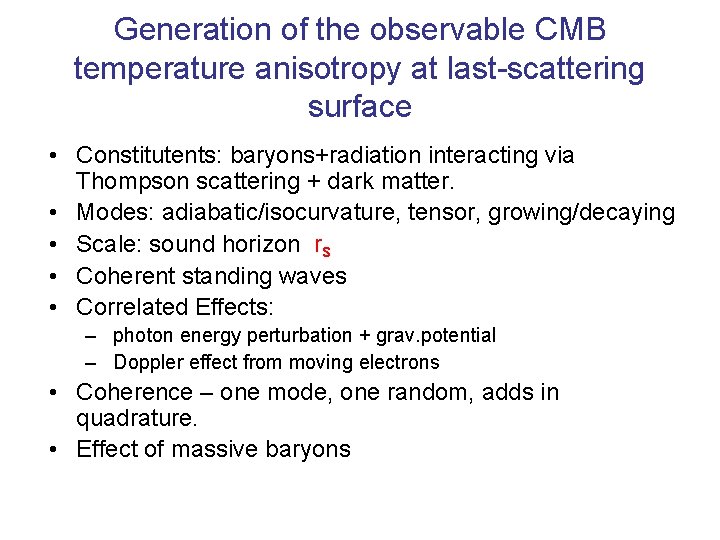
Generation of the observable CMB temperature anisotropy at last-scattering surface • Constitutents: baryons+radiation interacting via Thompson scattering + dark matter. • Modes: adiabatic/isocurvature, tensor, growing/decaying • Scale: sound horizon rs • Coherent standing waves • Correlated Effects: – photon energy perturbation + grav. potential – Doppler effect from moving electrons • Coherence – one mode, one random, adds in quadrature. • Effect of massive baryons
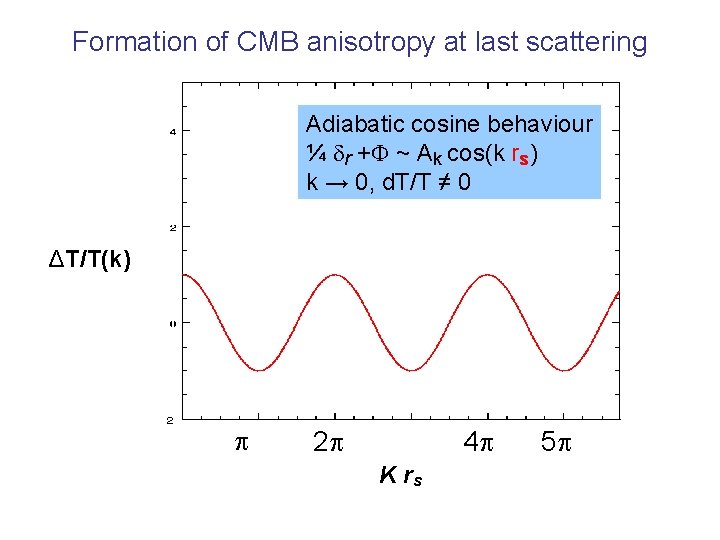
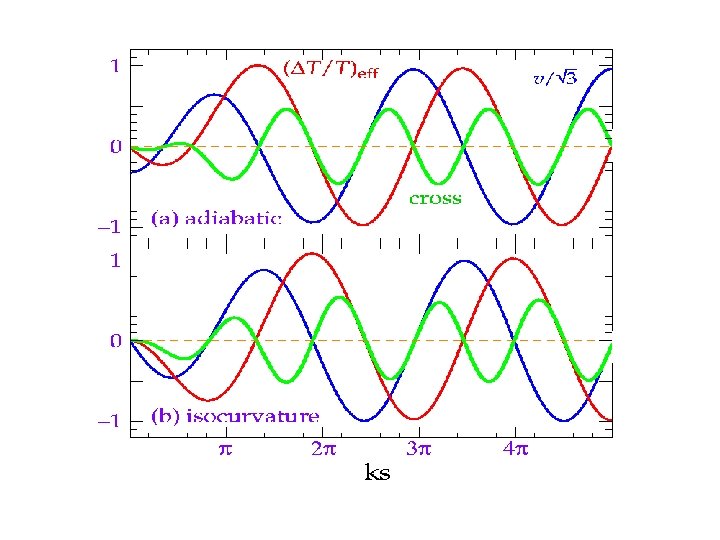
Formation of CMB anisotropy at last scattering Adiabatic cosine behaviour ¼ r + ~ Ak cos(k rs) k → 0, d. T/T ≠ 0 ΔT/T(k) 2 4 K rs 5
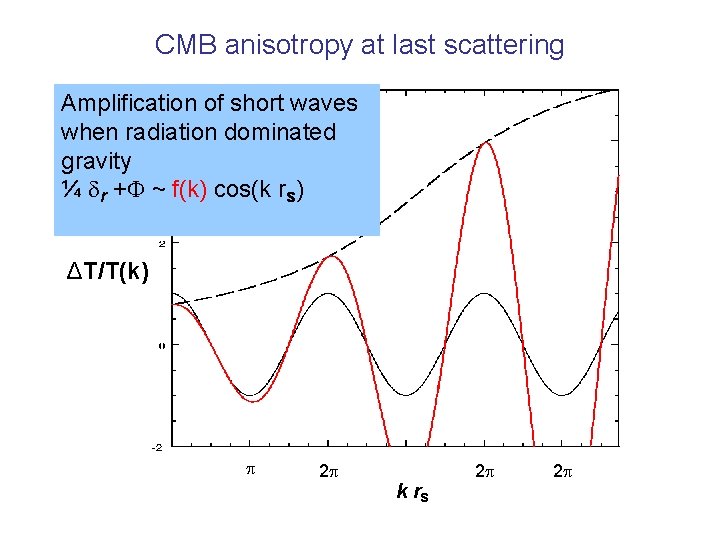
CMB anisotropy at last scattering Amplification of short waves when radiation dominated gravity ¼ r + ~ f(k) cos(k rs) ΔT/T(k) 2 k rs 2 2
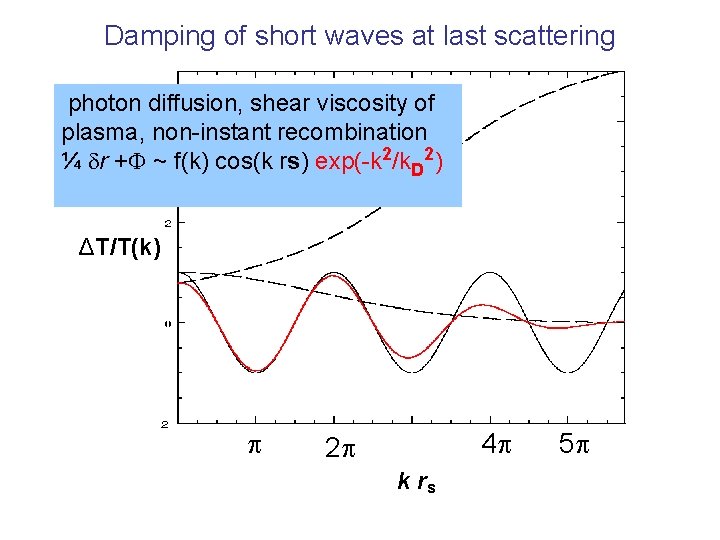
Damping of short waves at last scattering photon diffusion, shear viscosity of plasma, non-instant recombination ¼ r + ~ f(k) cos(k rs) exp(-k 2/k. D 2) ΔT/T(k) 4 2 k rs 5
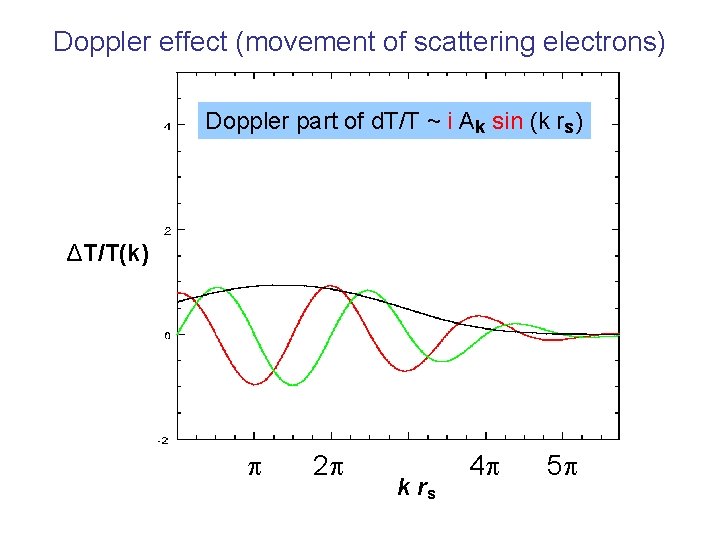
Doppler effect (movement of scattering electrons) Doppler part of d. T/T ~ i Ak sin (k rs) ΔT/T(k) 2 k rs 4 5
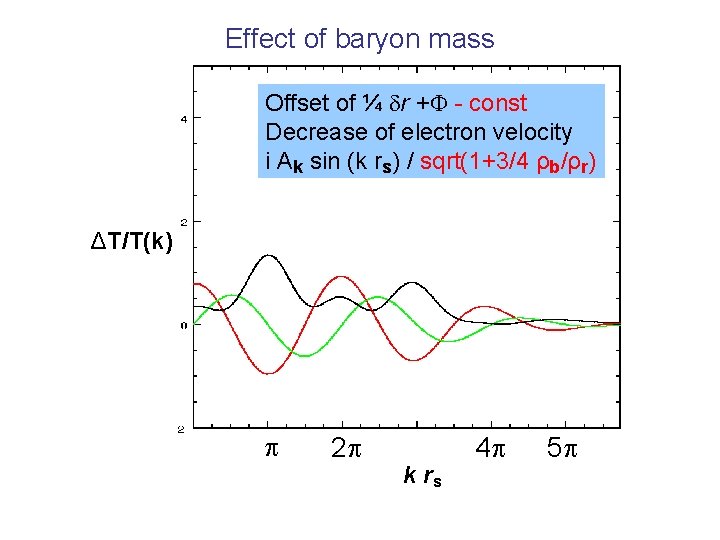
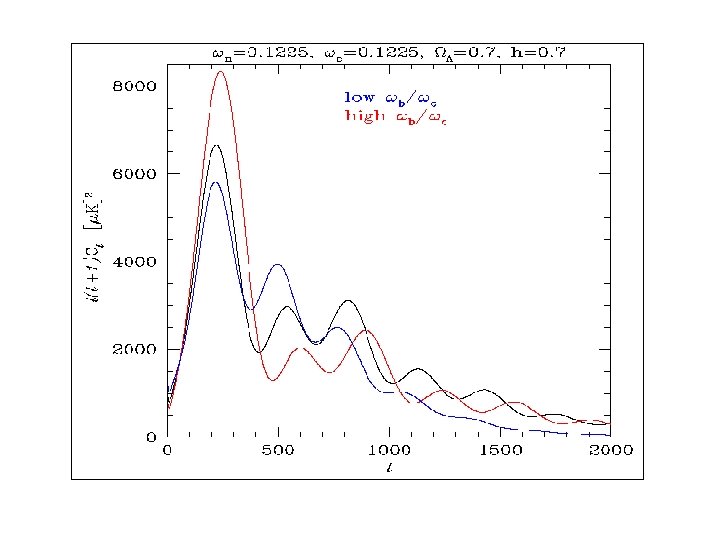
Effect of baryon mass Offset of ¼ r + - const Decrease of electron velocity i Ak sin (k rs) / sqrt(1+3/4 ρb/ρr) ΔT/T(k) 2 k rs 4 5
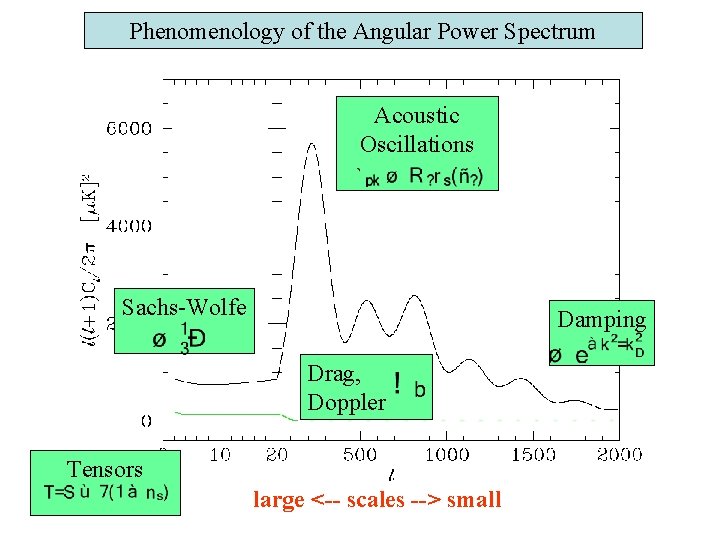
Phenomenology of the Angular Power Spectrum Acoustic Oscillations Sachs-Wolfe Damping Drag, Doppler Tensors large <-- scales --> small
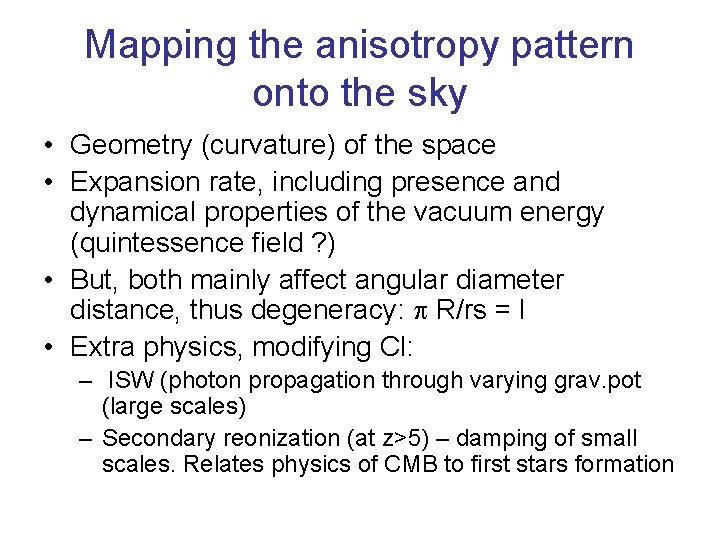
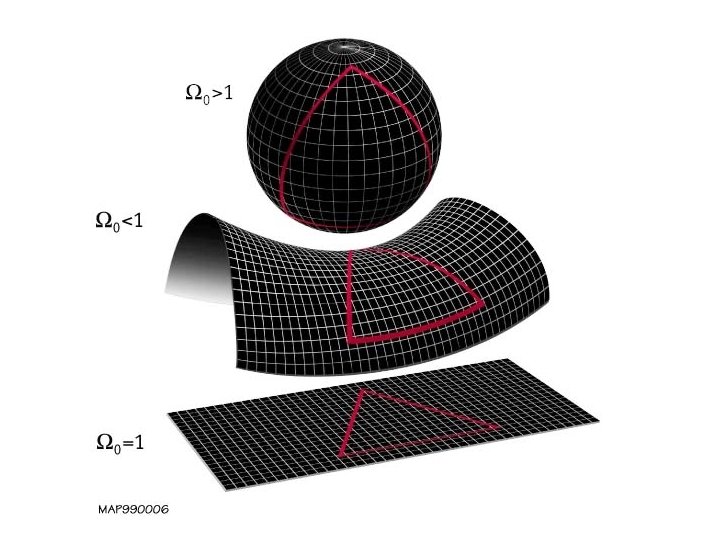
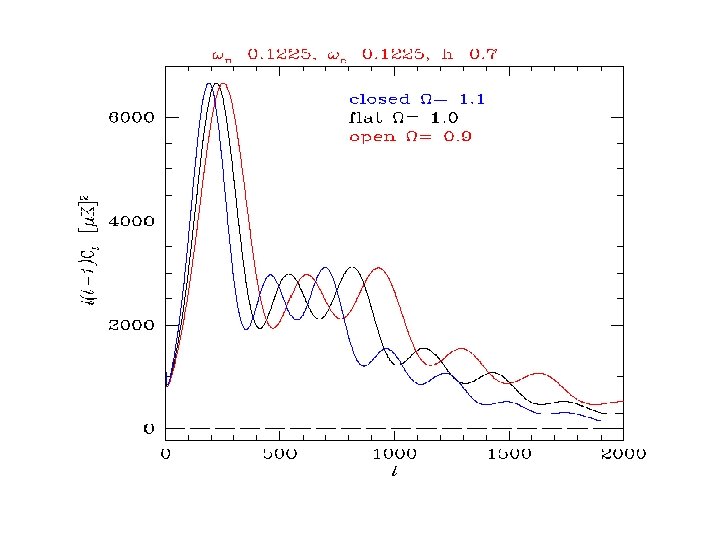
Mapping the anisotropy pattern onto the sky • Geometry (curvature) of the space • Expansion rate, including presence and dynamical properties of the vacuum energy (quintessence field ? ) • But, both mainly affect angular diameter distance, thus degeneracy: R/rs = l • Extra physics, modifying Cl: – ISW (photon propagation through varying grav. pot (large scales) – Secondary reonization (at z>5) – damping of small scales. Relates physics of CMB to first stars formation
Less well understood, thus more interesting ingredients, relating CMB to fundamental physics • Initial conditions – adiabatic -> inflation – slope, amplitude, potential. Easy to check given theory, less satisfying general case. Until recently, only simplest power-law parameterization was justified by the data quality. With WMAP, situation starts changing. • Generation of gravitational waves generation is a natural outcome of the early Universe. GW contributes to low l, its contribution is model dependent but to measure it would be an ultimate prize – GR support, mapping inflaton potential directly.
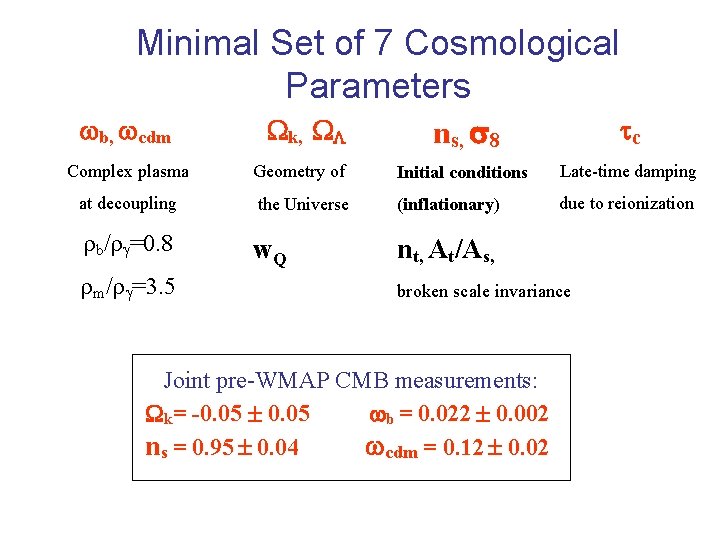
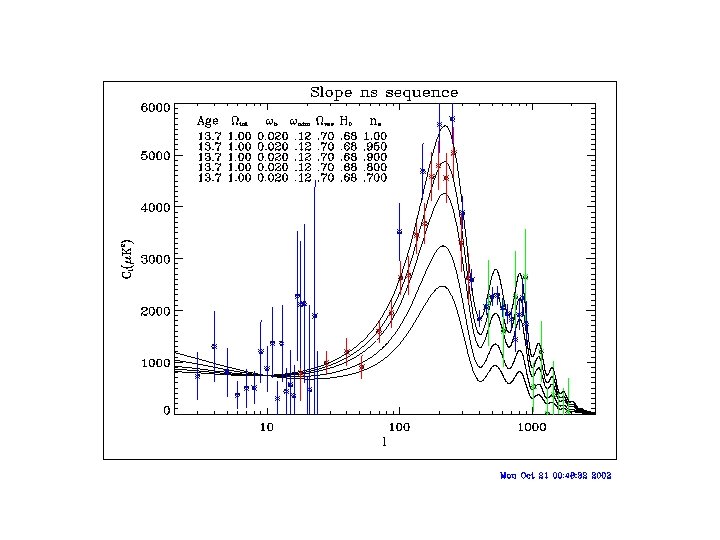
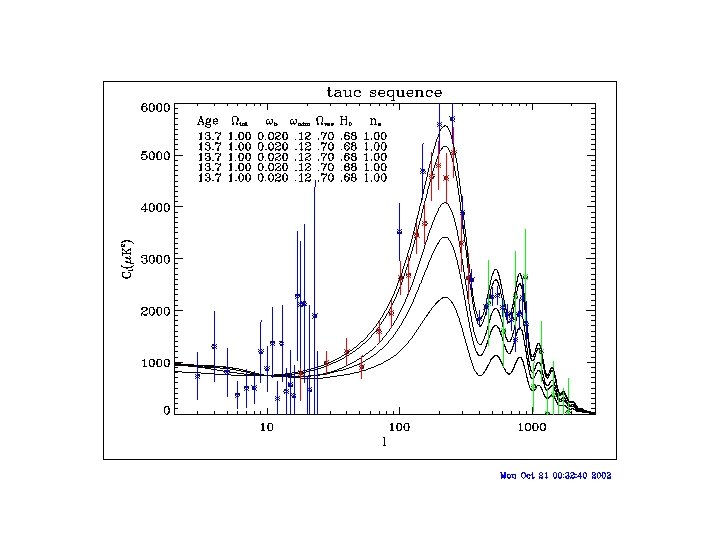
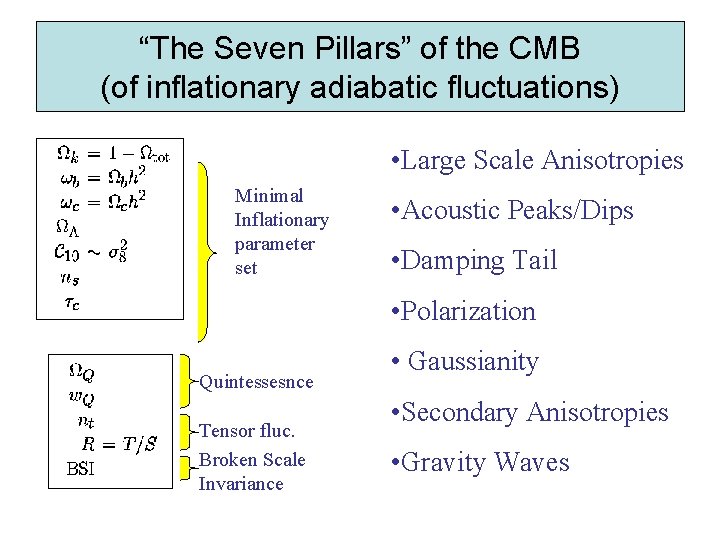
Minimal Set of 7 Cosmological Parameters b, cdm k, ns, 8 c Complex plasma Geometry of Initial conditions Late-time damping at decoupling the Universe (inflationary) due to reionization b/ =0. 8 w. Q nt, At/As, m/ =3. 5 broken scale invariance Joint pre-WMAP CMB measurements: k= -0. 05 b = 0. 022 0. 002 ns = 0. 95 0. 04 cdm = 0. 12 0. 02
Degeneracies • Angular diameter of the sound horizon • c – 8 as predicted from CMB • c – ns • c – gravitational waves • Degeracies are especially limiting on partial data, but some are difficult to break overall • One way – combine CMB data with other experiments, which place limits on different combinations • Another way – use polarization
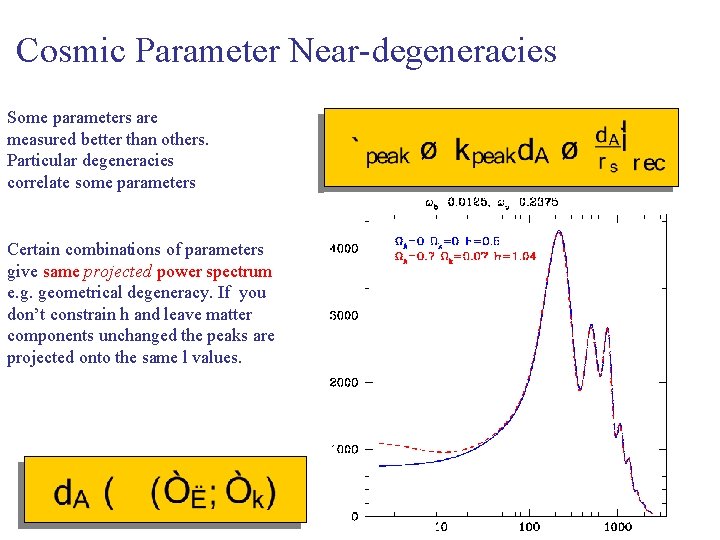
Cosmic Parameter Near-degeneracies Some parameters are measured better than others. Particular degeneracies correlate some parameters Certain combinations of parameters give same projected power spectrum e. g. geometrical degeneracy. If you don’t constrain h and leave matter components unchanged the peaks are projected onto the same l values.
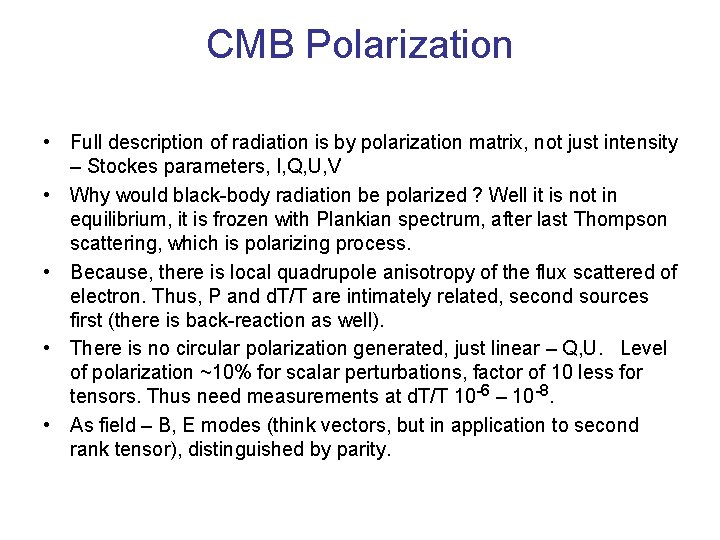
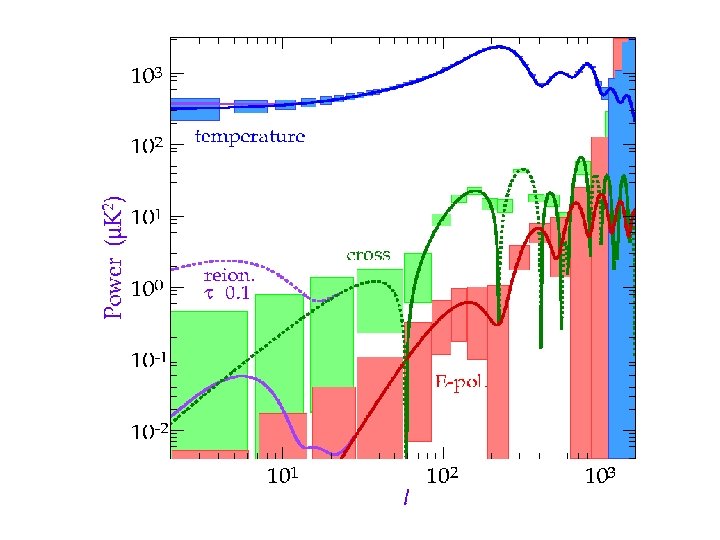
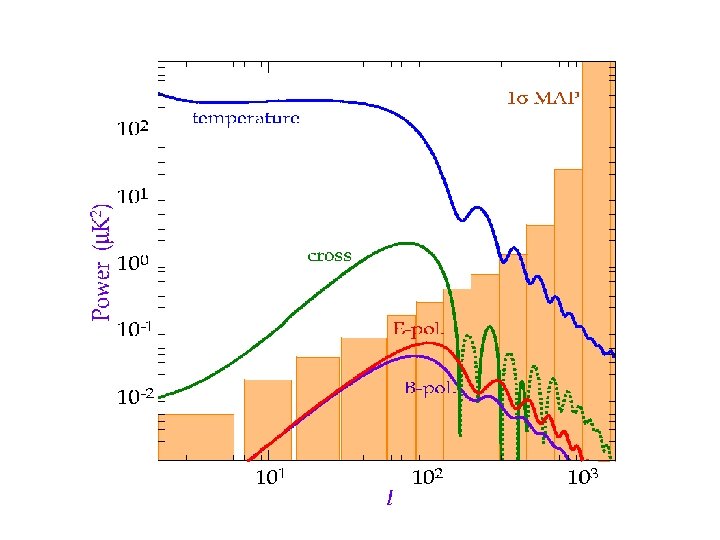
CMB Polarization • Full description of radiation is by polarization matrix, not just intensity – Stockes parameters, I, Q, U, V • Why would black-body radiation be polarized ? Well it is not in equilibrium, it is frozen with Plankian spectrum, after last Thompson scattering, which is polarizing process. • Because, there is local quadrupole anisotropy of the flux scattered of electron. Thus, P and d. T/T are intimately related, second sources first (there is back-reaction as well). • There is no circular polarization generated, just linear – Q, U. Level of polarization ~10% for scalar perturbations, factor of 10 less for tensors. Thus need measurements at d. T/T 10 -6 – 10 -8. • As field – B, E modes (think vectors, but in application to second rank tensor), distinguished by parity.
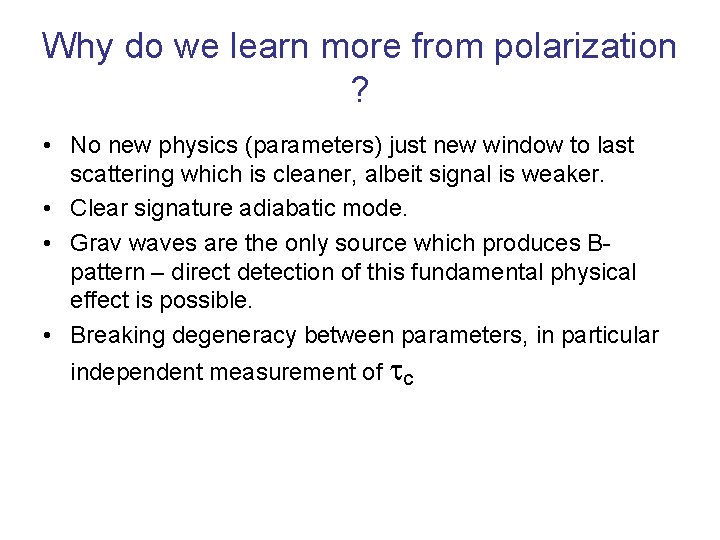
Why do we learn more from polarization ? • No new physics (parameters) just new window to last scattering which is cleaner, albeit signal is weaker. • Clear signature adiabatic mode. • Grav waves are the only source which produces Bpattern – direct detection of this fundamental physical effect is possible. • Breaking degeneracy between parameters, in particular independent measurement of c
“The Seven Pillars” of the CMB (of inflationary adiabatic fluctuations) • Large Scale Anisotropies Minimal Inflationary parameter set • Acoustic Peaks/Dips • Damping Tail • Polarization Quintessesnce Tensor fluc. Broken Scale Invariance • Gaussianity • Secondary Anisotropies • Gravity Waves
- Slides: 34