
COSMOLOGY AT COLLIDERS Jonathan Feng University of California
- Slides: 39
COSMOLOGY AT COLLIDERS Jonathan Feng University of California, Irvine 23 September 05 23 September 2005 So. Cal Strings Seminar Graphic: N. Graf
COSMOLOGY NOW We are living through a revolution in our understanding of the Universe on the largest scales For the first time in history, we have a complete picture of the Universe 23 September 05 2
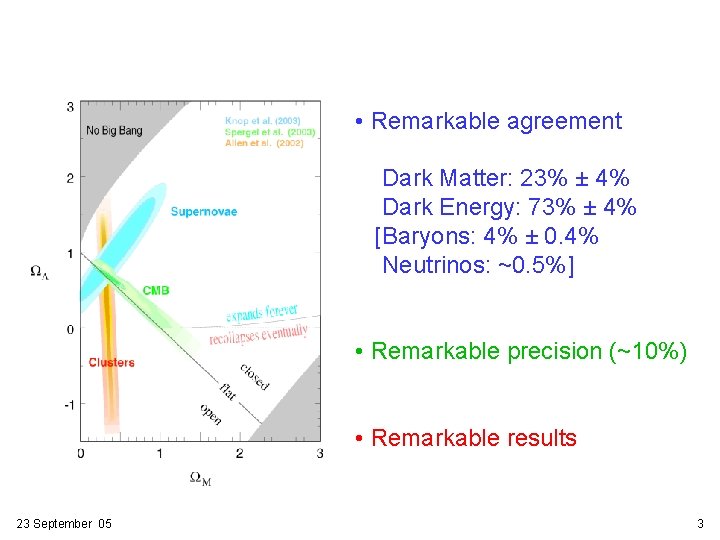
• Remarkable agreement Dark Matter: 23% ± 4% Dark Energy: 73% ± 4% [Baryons: 4% ± 0. 4% Neutrinos: ~0. 5%] • Remarkable precision (~10%) • Remarkable results 23 September 05 3
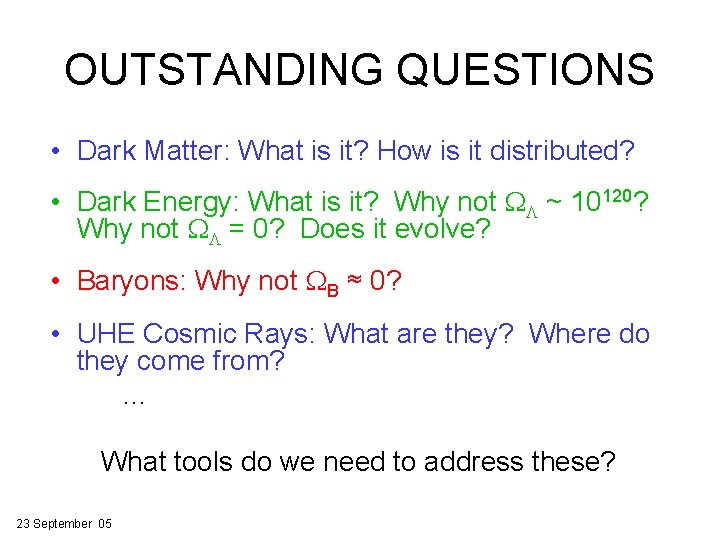
OUTSTANDING QUESTIONS • Dark Matter: What is it? How is it distributed? • Dark Energy: What is it? Why not WL ~ 10120? Why not WL = 0? Does it evolve? • Baryons: Why not WB ≈ 0? • UHE Cosmic Rays: What are they? Where do they come from? … What tools do we need to address these? 23 September 05
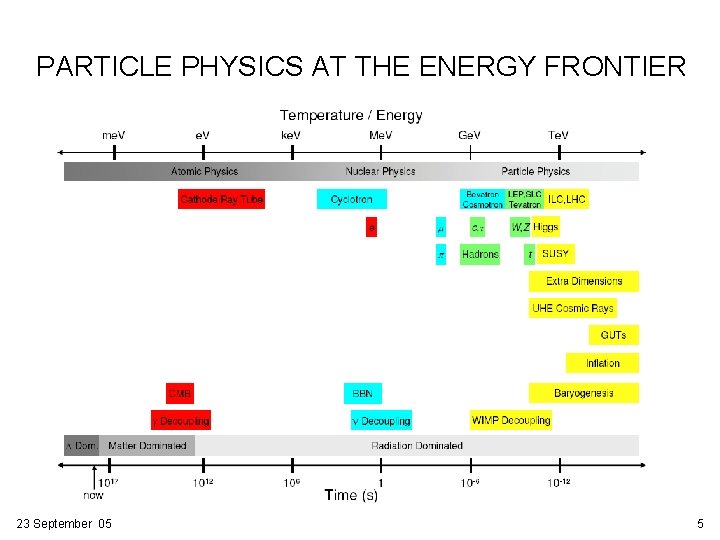
PARTICLE PHYSICS AT THE ENERGY FRONTIER 23 September 05 5
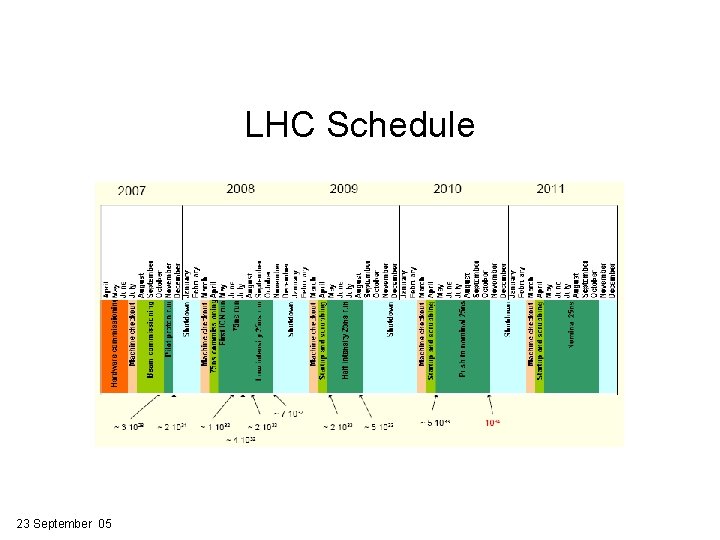
LHC Schedule 23 September 05
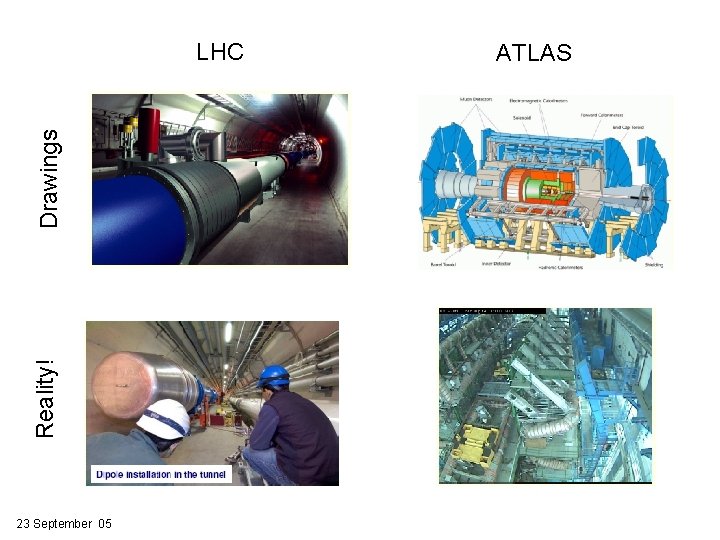
Reality! Drawings LHC 23 September 05 ATLAS
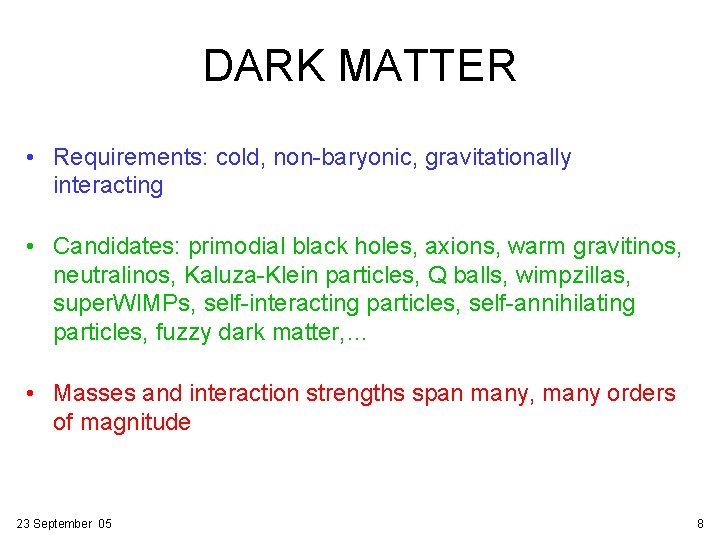
DARK MATTER • Requirements: cold, non-baryonic, gravitationally interacting • Candidates: primodial black holes, axions, warm gravitinos, neutralinos, Kaluza-Klein particles, Q balls, wimpzillas, super. WIMPs, self-interacting particles, self-annihilating particles, fuzzy dark matter, … • Masses and interaction strengths span many, many orders of magnitude 23 September 05 8
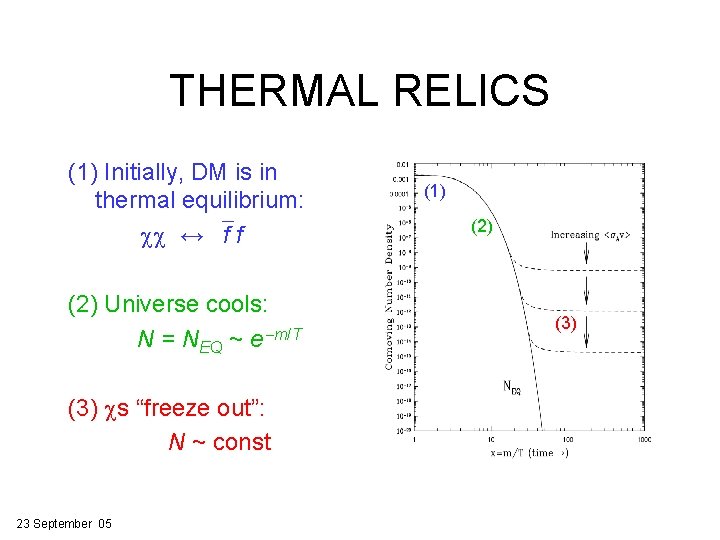
THERMAL RELICS (1) Initially, DM is in thermal equilibrium: cc ↔ f f (2) Universe cools: N = NEQ ~ e -m/T (3) cs “freeze out”: N ~ const 23 September 05 (1) (2) (3)
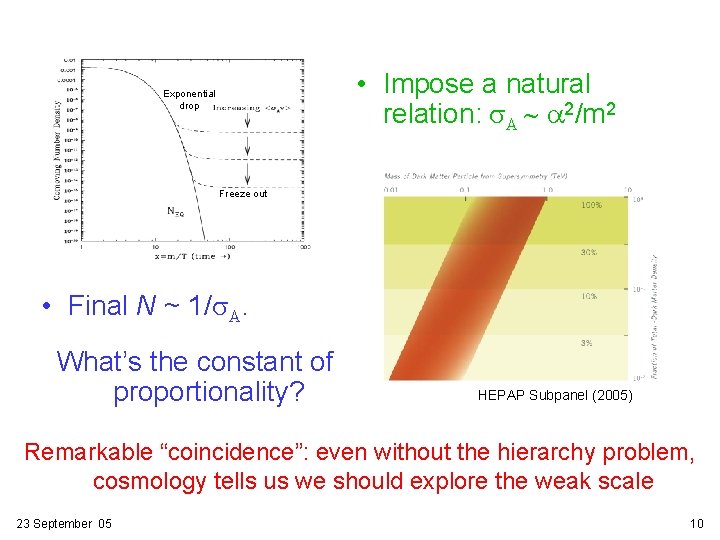
• Impose a natural relation: s. A ~ a 2/m 2 Exponential drop Freeze out • Final N ~ 1/s. A. What’s the constant of proportionality? HEPAP Subpanel (2005) Remarkable “coincidence”: even without the hierarchy problem, cosmology tells us we should explore the weak scale 23 September 05 10
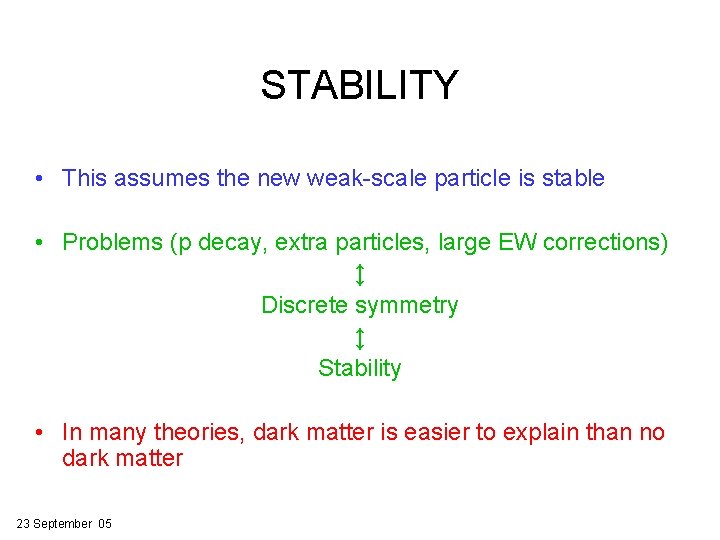
STABILITY • This assumes the new weak-scale particle is stable • Problems (p decay, extra particles, large EW corrections) ↕ Discrete symmetry ↕ Stability • In many theories, dark matter is easier to explain than no dark matter 23 September 05
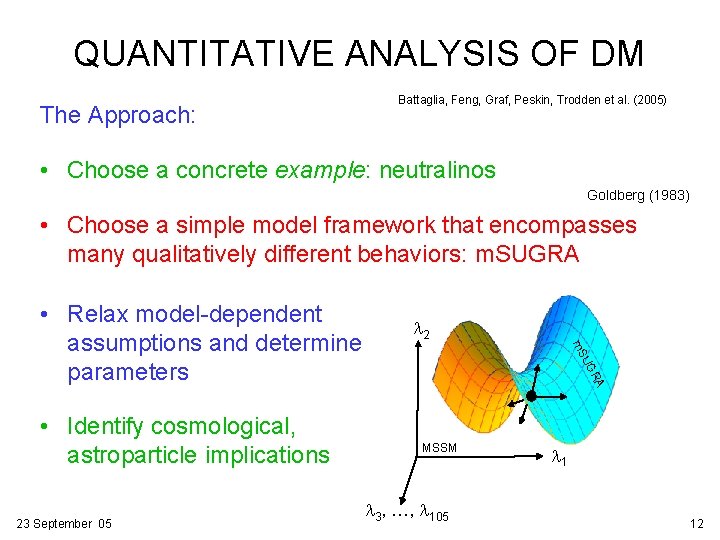
QUANTITATIVE ANALYSIS OF DM The Approach: Battaglia, Feng, Graf, Peskin, Trodden et al. (2005) • Choose a concrete example: neutralinos Goldberg (1983) • Choose a simple model framework that encompasses many qualitatively different behaviors: m. SUGRA A 23 September 05 GR • Identify cosmological, astroparticle implications l 2 U m. S • Relax model-dependent assumptions and determine parameters MSSM l 3, …, l 105 l 1 12
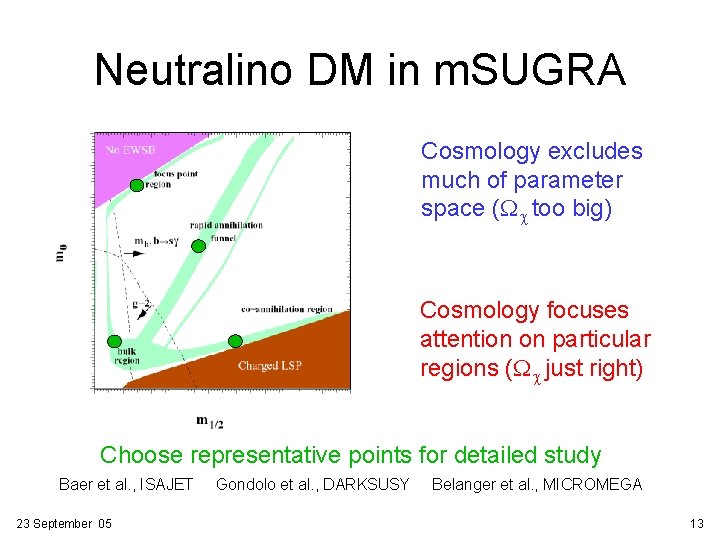
Neutralino DM in m. SUGRA Cosmology excludes much of parameter space (Wc too big) Cosmology focuses attention on particular regions (Wc just right) Choose representative points for detailed study Baer et al. , ISAJET 23 September 05 Gondolo et al. , DARKSUSY Belanger et al. , MICROMEGA 13
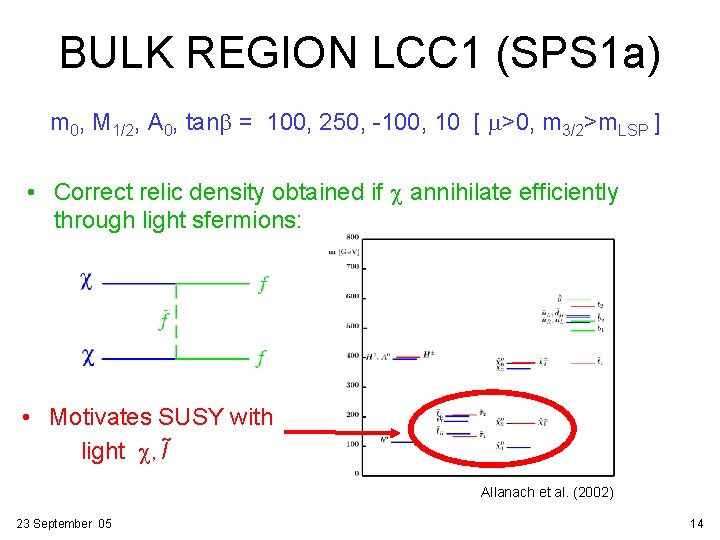
BULK REGION LCC 1 (SPS 1 a) m 0, M 1/2, A 0, tanb = 100, 250, -100, 10 [ m>0, m 3/2>m. LSP ] • Correct relic density obtained if c annihilate efficiently through light sfermions: • Motivates SUSY with light c, l Allanach et al. (2002) 23 September 05 14
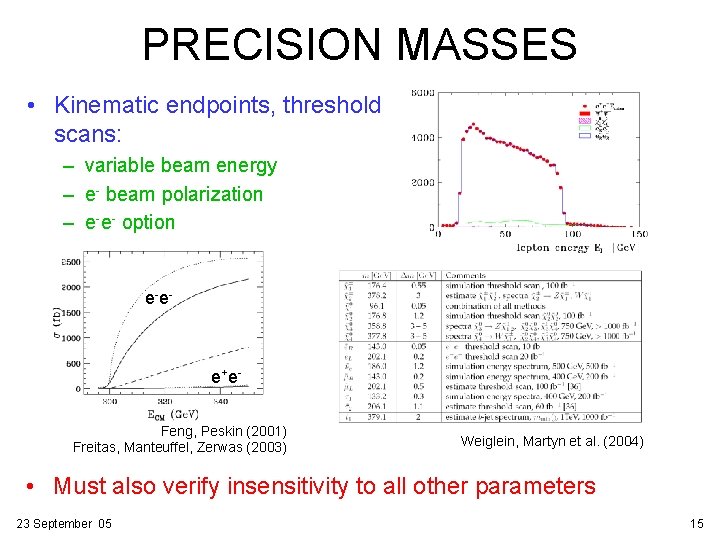
PRECISION MASSES • Kinematic endpoints, threshold scans: – variable beam energy – e- beam polarization – e-e- option e- e- e+ e. Feng, Peskin (2001) Freitas, Manteuffel, Zerwas (2003) Weiglein, Martyn et al. (2004) • Must also verify insensitivity to all other parameters 23 September 05 15
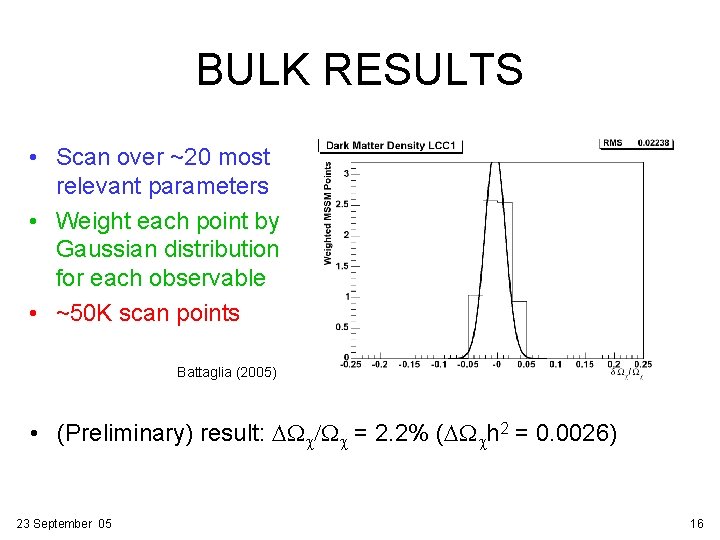
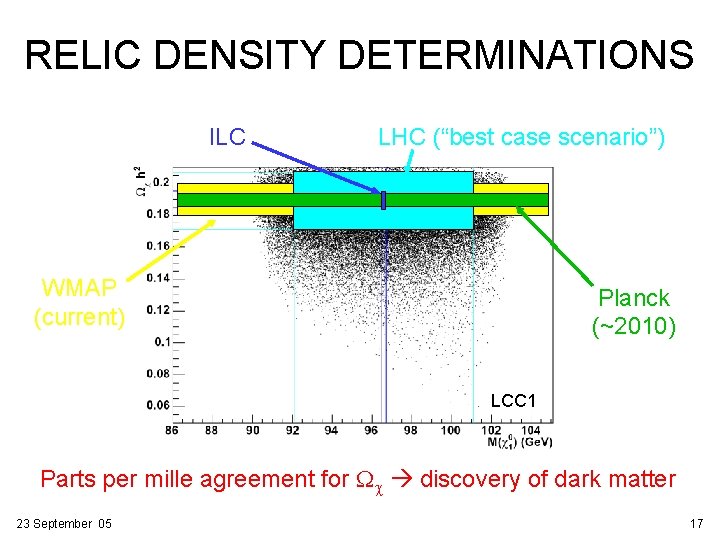
BULK RESULTS • Scan over ~20 most relevant parameters • Weight each point by Gaussian distribution for each observable • ~50 K scan points Battaglia (2005) • (Preliminary) result: DWc/Wc = 2. 2% (DWch 2 = 0. 0026) 23 September 05 16
RELIC DENSITY DETERMINATIONS ILC LHC (“best case scenario”) WMAP (current) Planck (~2010) LCC 1 Parts per mille agreement for Wc discovery of dark matter 23 September 05 17
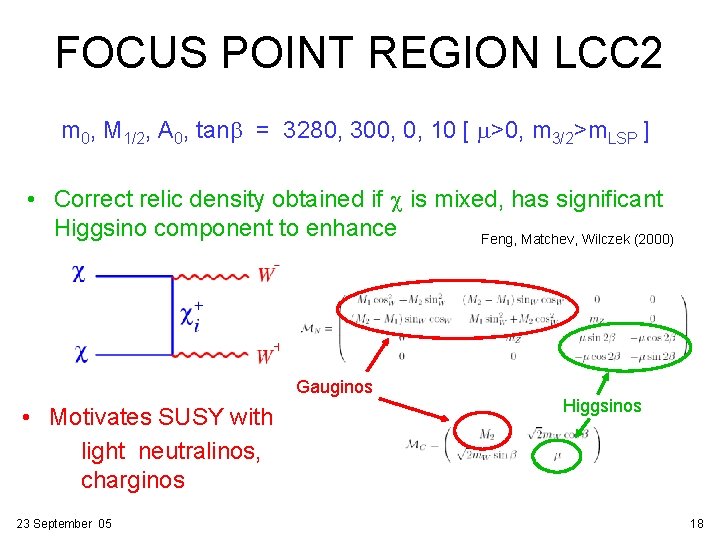
FOCUS POINT REGION LCC 2 m 0, M 1/2, A 0, tanb = 3280, 300, 0, 10 [ m>0, m 3/2>m. LSP ] • Correct relic density obtained if c is mixed, has significant Higgsino component to enhance Feng, Matchev, Wilczek (2000) Gauginos • Motivates SUSY with light neutralinos, charginos 23 September 05 Higgsinos 18
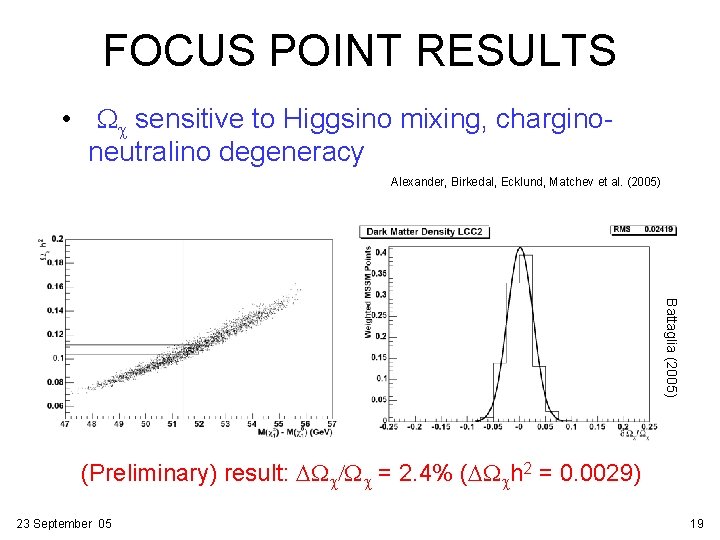
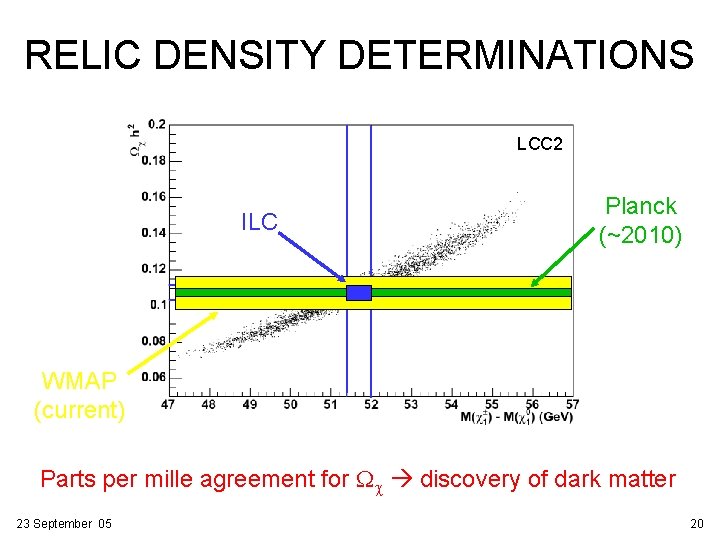
FOCUS POINT RESULTS • Wc sensitive to Higgsino mixing, charginoneutralino degeneracy Alexander, Birkedal, Ecklund, Matchev et al. (2005) Battaglia (2005) (Preliminary) result: DWc/Wc = 2. 4% (DWch 2 = 0. 0029) 23 September 05 19
RELIC DENSITY DETERMINATIONS LCC 2 ILC Planck (~2010) WMAP (current) Parts per mille agreement for Wc discovery of dark matter 23 September 05 20
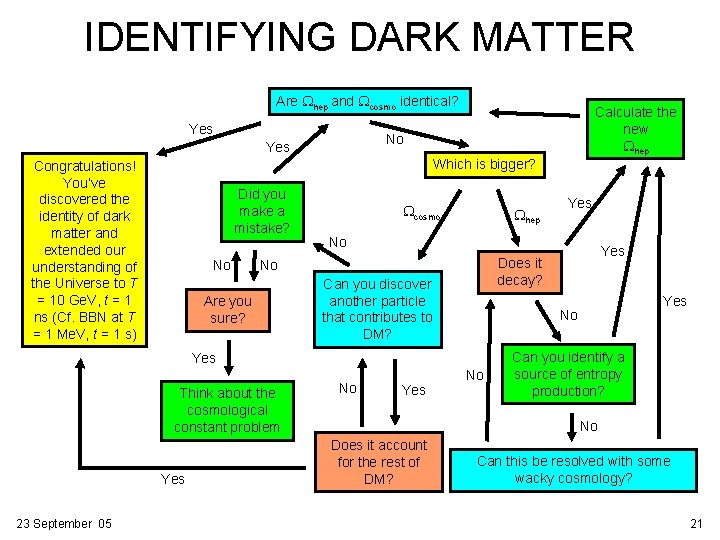
IDENTIFYING DARK MATTER Are Whep and Wcosmo identical? Yes Calculate the new Whep No Yes Which is bigger? Congratulations! You’ve discovered the identity of dark matter and extended our understanding of the Universe to T = 10 Ge. V, t = 1 ns (Cf. BBN at T = 1 Me. V, t = 1 s) Did you make a mistake? No Wcosmo Whep No Can you discover another particle that contributes to DM? Think about the cosmological constant problem Yes 23 September 05 Yes No Yes Does it decay? No Are you sure? Yes No Can you identify a source of entropy production? No Does it account for the rest of DM? Can this be resolved with some wacky cosmology? 21
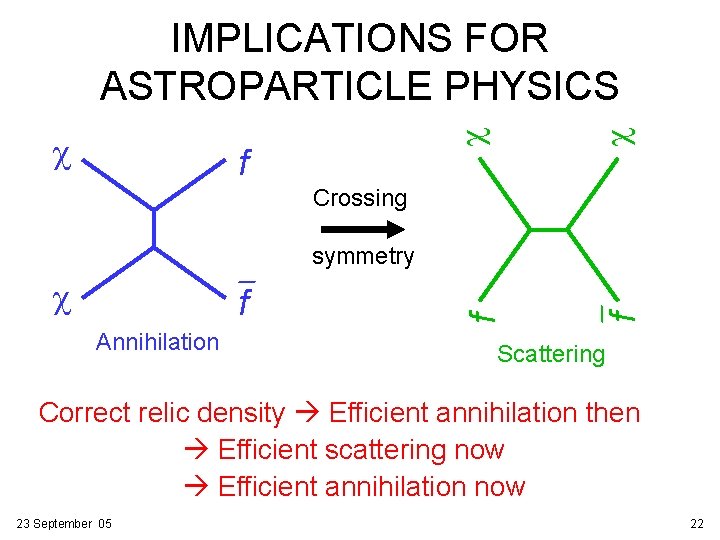
f c c c IMPLICATIONS FOR ASTROPARTICLE PHYSICS Crossing f Annihilation f c f symmetry Scattering Correct relic density Efficient annihilation then Efficient scattering now Efficient annihilation now 23 September 05 22
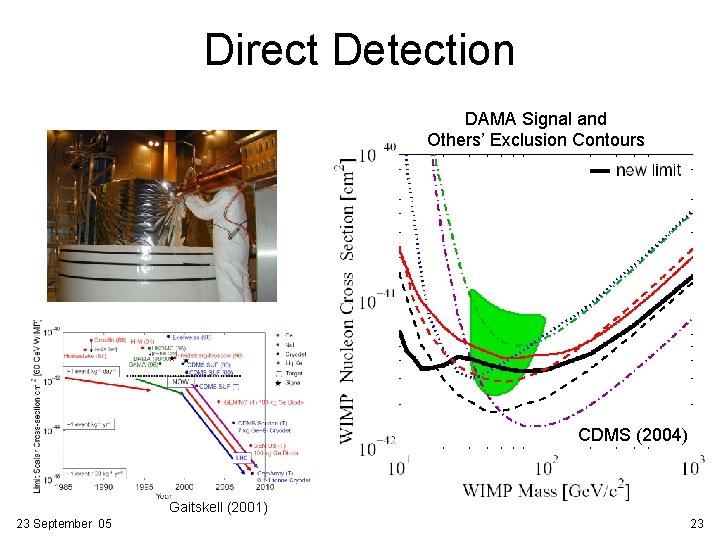
Direct Detection DAMA Signal and Others’ Exclusion Contours CDMS (2004) Gaitskell (2001) 23 September 05 23
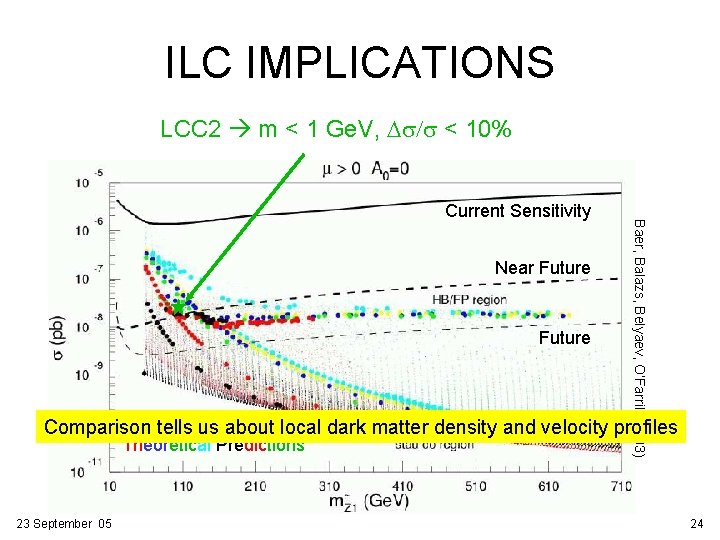
ILC IMPLICATIONS LCC 2 m < 1 Ge. V, Ds/s < 10% Near Future Baer, Balazs, Belyaev, O’Farrill (2003) Current Sensitivity Comparison tells us about local dark matter density and velocity profiles Theoretical Predictions 23 September 05 24
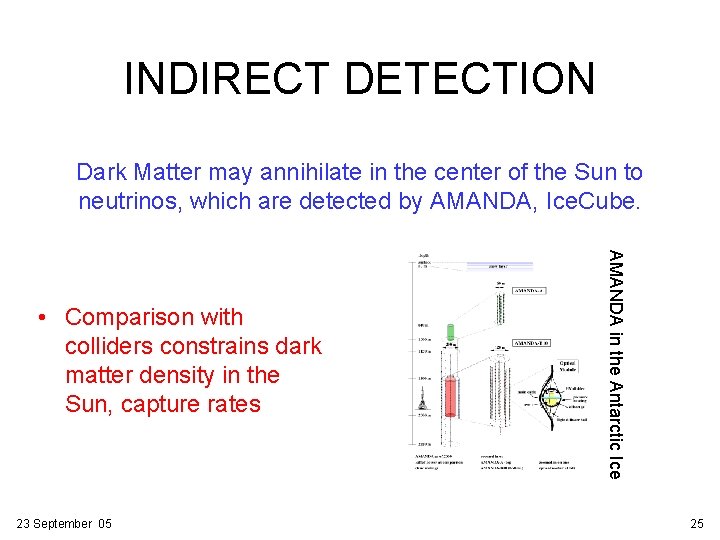
INDIRECT DETECTION Dark Matter may annihilate in the center of the Sun to neutrinos, which are detected by AMANDA, Ice. Cube. 23 September 05 AMANDA in the Antarctic Ice • Comparison with colliders constrains dark matter density in the Sun, capture rates 25
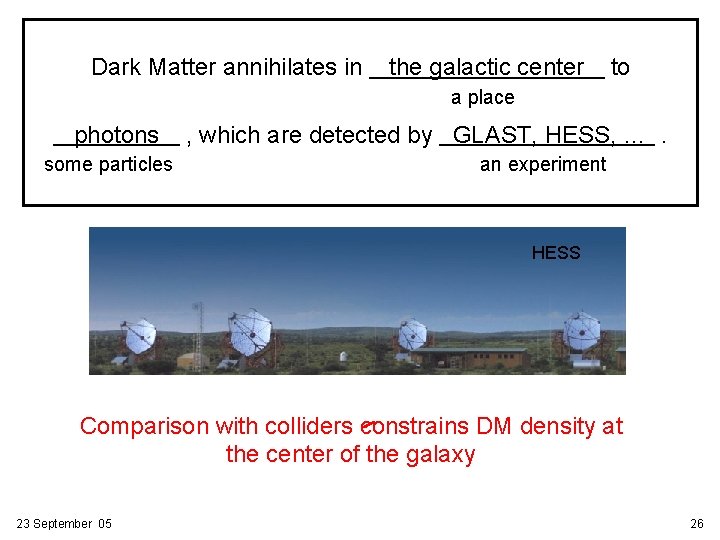
Dark Matter annihilates in the galactic center to a place photons some particles , which are detected by GLAST, HESS, …. an experiment HESS Comparison with colliders constrains DM density at the center of the galaxy 23 September 05 26
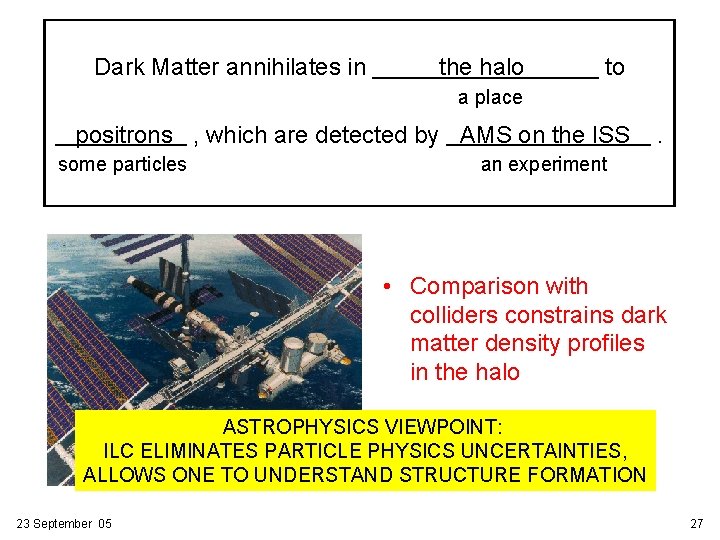
Dark Matter annihilates in the halo to a place positrons , which are detected by AMS on the ISS some particles . an experiment • Comparison with colliders constrains dark matter density profiles in the halo ASTROPHYSICS VIEWPOINT: ILC ELIMINATES PARTICLE PHYSICS UNCERTAINTIES, ALLOWS ONE TO UNDERSTAND STRUCTURE FORMATION 23 September 05 27
ALTERNATIVE DARK MATTER • All of these signals rely on DM having electroweak interactions. Is this required? • No – the only required DM interactions are gravitational (much weaker than electroweak). • But the relic density argument strongly prefers weak interactions. Is there an exception to this rule? 23 September 05
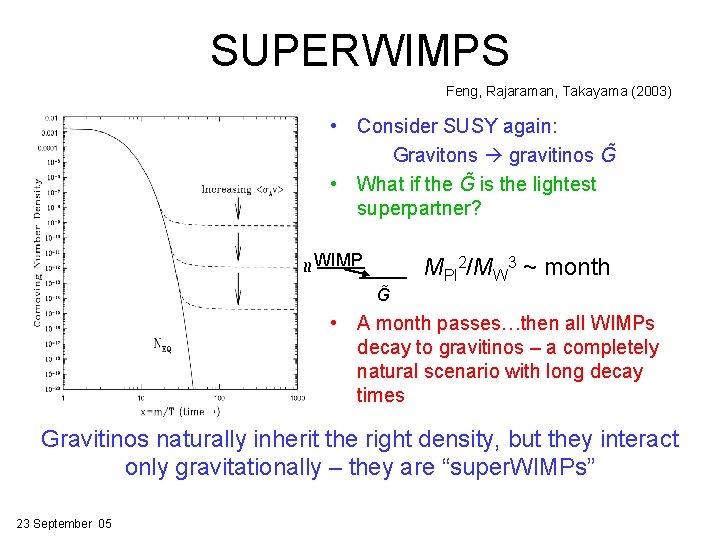
SUPERWIMPS Feng, Rajaraman, Takayama (2003) • Consider SUSY again: Gravitons gravitinos G • What if the G is the lightest superpartner? ≈ WIMP G MPl 2/MW 3 ~ month • A month passes…then all WIMPs decay to gravitinos – a completely natural scenario with long decay times Gravitinos naturally inherit the right density, but they interact only gravitationally – they are “super. WIMPs” 23 September 05
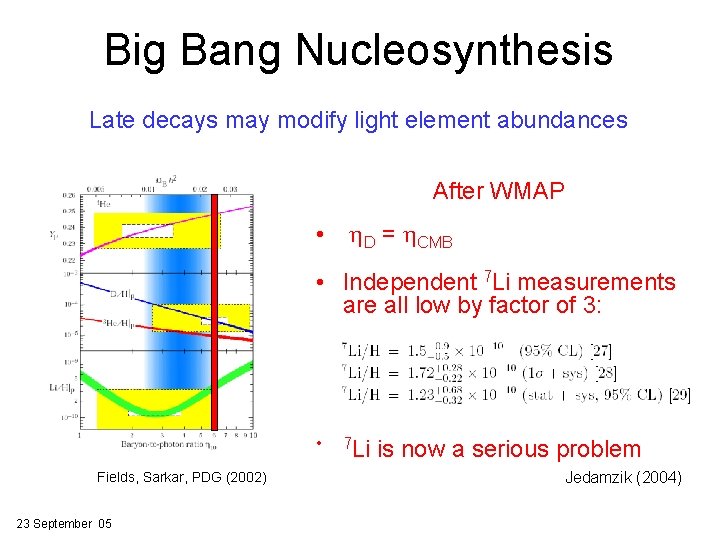
Big Bang Nucleosynthesis Late decays may modify light element abundances After WMAP • h. D = h. CMB • Independent 7 Li measurements are all low by factor of 3: • Fields, Sarkar, PDG (2002) 23 September 05 7 Li is now a serious problem Jedamzik (2004)
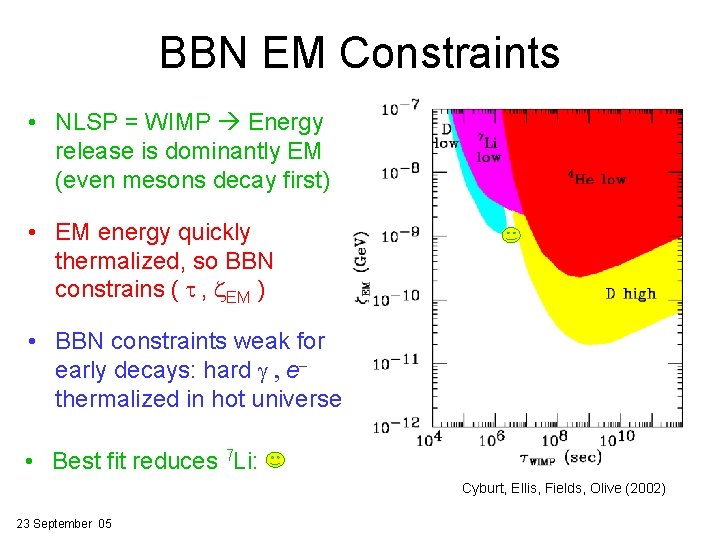
BBN EM Constraints • NLSP = WIMP Energy release is dominantly EM (even mesons decay first) • EM energy quickly thermalized, so BBN constrains ( t , z. EM ) • BBN constraints weak for early decays: hard g , ethermalized in hot universe • Best fit reduces 7 Li: Cyburt, Ellis, Fields, Olive (2002) 23 September 05
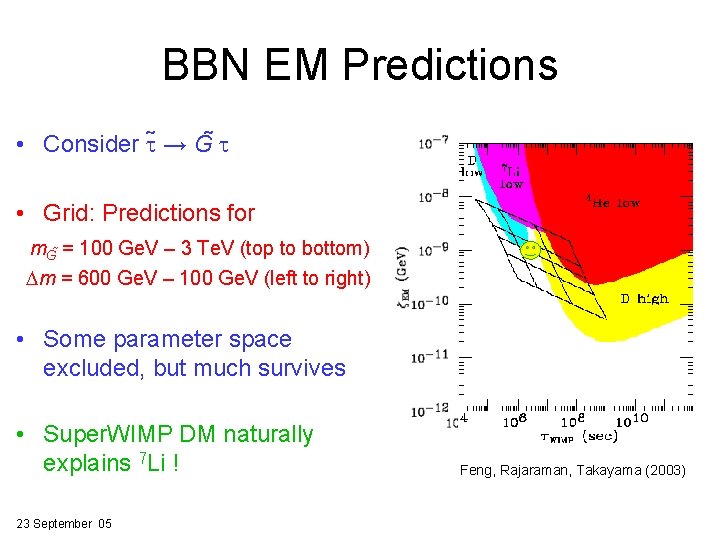
BBN EM Predictions • Consider t → G t • Grid: Predictions for m. G = 100 Ge. V – 3 Te. V (top to bottom) Dm = 600 Ge. V – 100 Ge. V (left to right) • Some parameter space excluded, but much survives • Super. WIMP DM naturally explains 7 Li ! 23 September 05 Feng, Rajaraman, Takayama (2003)
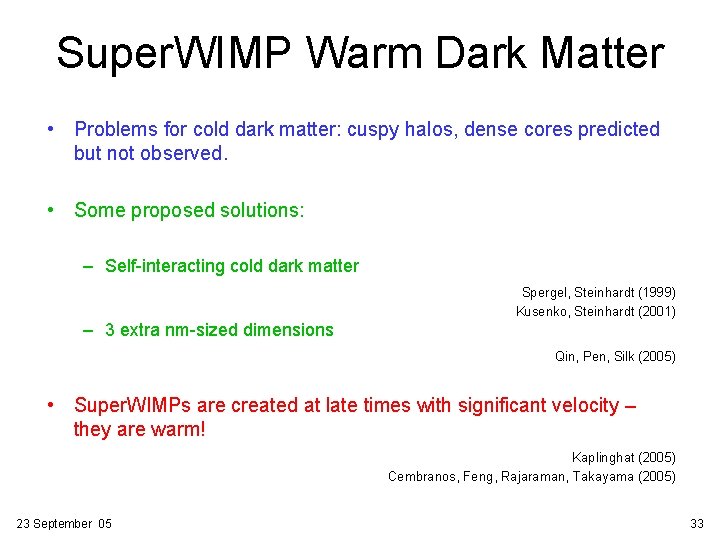
Super. WIMP Warm Dark Matter • Problems for cold dark matter: cuspy halos, dense cores predicted but not observed. • Some proposed solutions: – Self-interacting cold dark matter Spergel, Steinhardt (1999) Kusenko, Steinhardt (2001) – 3 extra nm-sized dimensions Qin, Pen, Silk (2005) • Super. WIMPs are created at late times with significant velocity – they are warm! Kaplinghat (2005) Cembranos, Feng, Rajaraman, Takayama (2005) 23 September 05 33
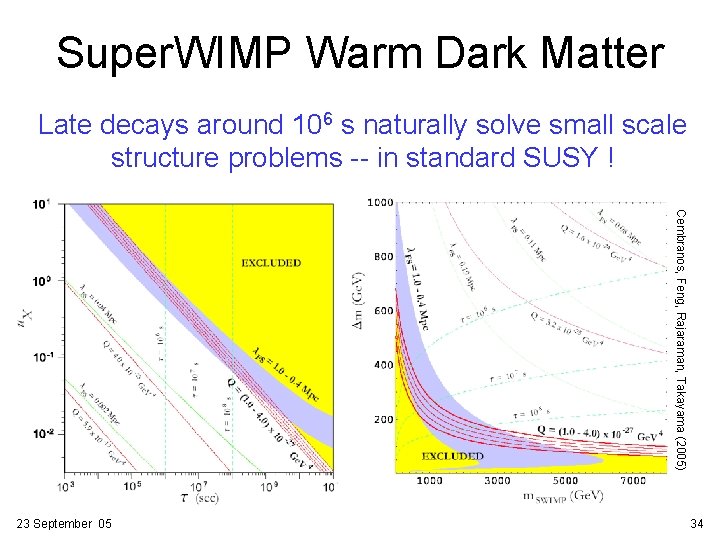
Super. WIMP Warm Dark Matter Late decays around 106 s naturally solve small scale structure problems -- in standard SUSY ! Cembranos, Feng, Rajaraman, Takayama (2005) 23 September 05 34
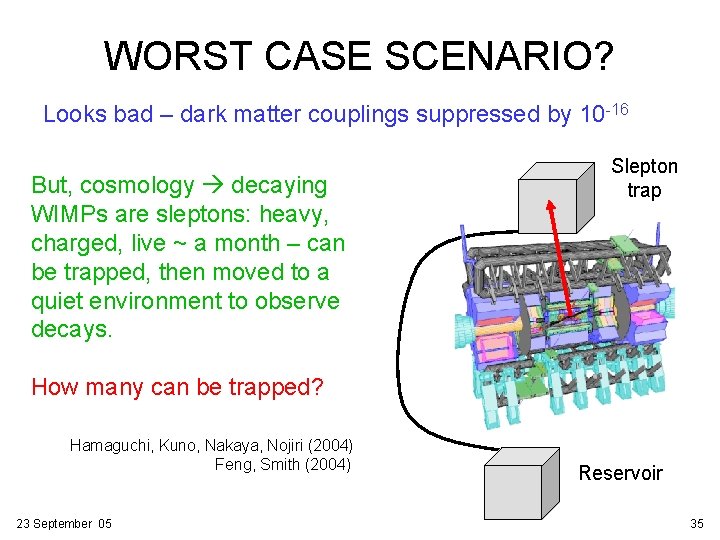
WORST CASE SCENARIO? Looks bad – dark matter couplings suppressed by 10 -16 But, cosmology decaying WIMPs are sleptons: heavy, charged, live ~ a month – can be trapped, then moved to a quiet environment to observe decays. Slepton trap How many can be trapped? Hamaguchi, Kuno, Nakaya, Nojiri (2004) Feng, Smith (2004) 23 September 05 Reservoir 35
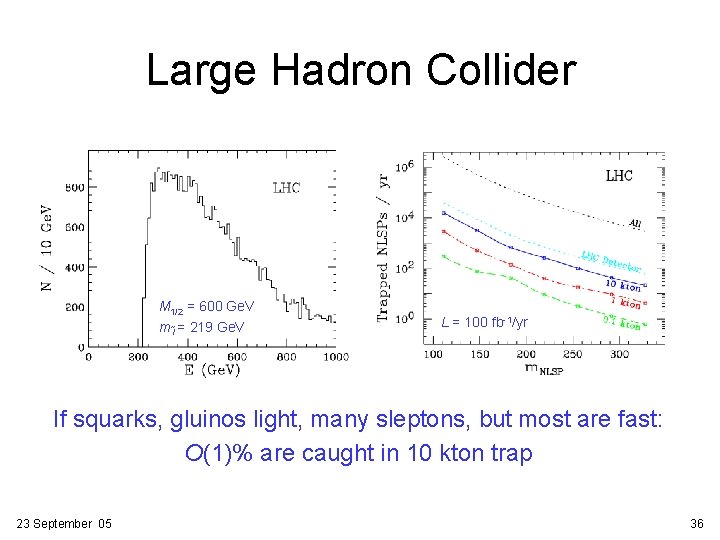
Large Hadron Collider M 1/2 = 600 Ge. V m l = 219 Ge. V L = 100 fb-1/yr If squarks, gluinos light, many sleptons, but most are fast: O(1)% are caught in 10 kton trap 23 September 05 36
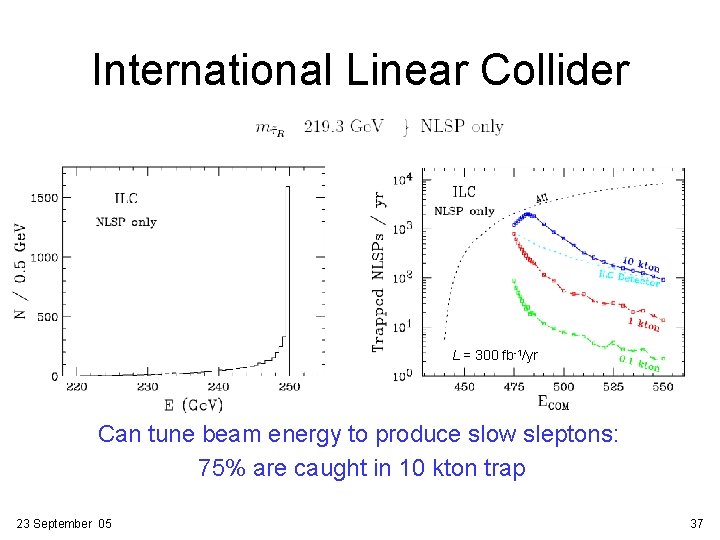
International Linear Collider L = 300 fb-1/yr Can tune beam energy to produce slow sleptons: 75% are caught in 10 kton trap 23 September 05 37
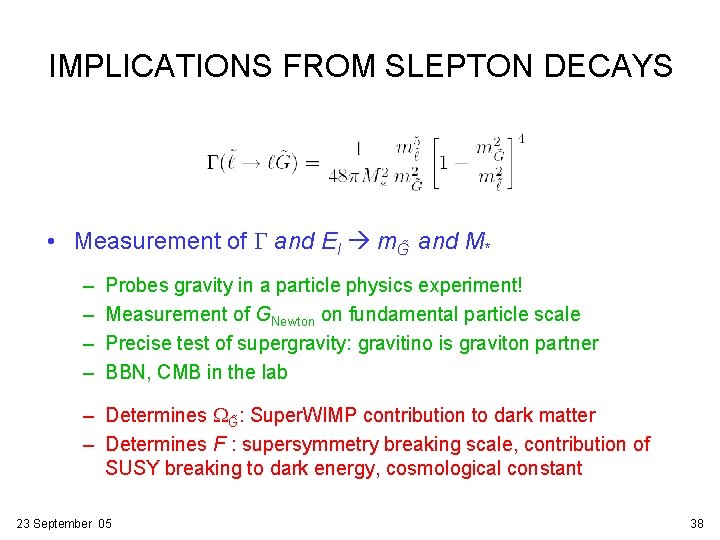
IMPLICATIONS FROM SLEPTON DECAYS • Measurement of G and El m. G and M* – – Probes gravity in a particle physics experiment! Measurement of GNewton on fundamental particle scale Precise test of supergravity: gravitino is graviton partner BBN, CMB in the lab – Determines WG : Super. WIMP contribution to dark matter – Determines F : supersymmetry breaking scale, contribution of SUSY breaking to dark energy, cosmological constant 23 September 05 38
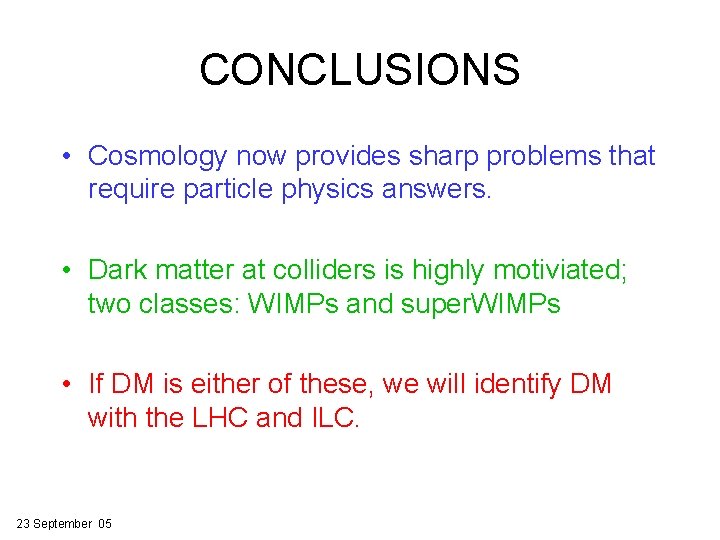
CONCLUSIONS • Cosmology now provides sharp problems that require particle physics answers. • Dark matter at colliders is highly motiviated; two classes: WIMPs and super. WIMPs • If DM is either of these, we will identify DM with the LHC and ILC. 23 September 05