
Cosmids Plasmids that contain l cos sites This
- Slides: 8
Cosmids: Plasmids that contain l cos sites. This allows them to be packaged into l particles. But don’t have l genes, therefore can clone larger insert fragments; 35 -45 kb. PACs: Based on P 1 bacteriophage. Replicate as low copy number plasmids inside E. coli. Can clone inserts in 80 -100 kb range. BACs: “Bacteria Artificial Chromosomes” Based on 7 kb F 1 plasmid (Ch. 7). Can clone inserts in 150 -300 kb range.
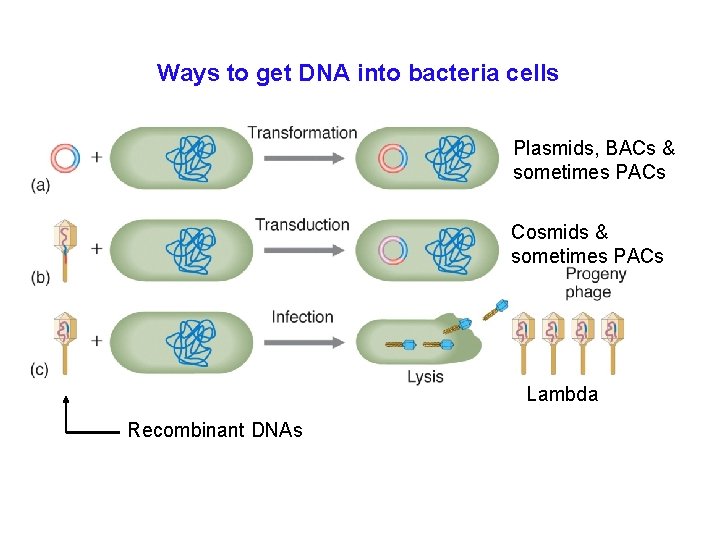
Ways to get DNA into bacteria cells Plasmids, BACs & sometimes PACs Cosmids & sometimes PACs Lambda Recombinant DNAs
Recombinant DNA Libraries Collection of many clones derived from a single DNA source. Genomic Libraries: Many clones, each of which contains a fragment of chromosomal DNA from a particular species. Complete genomic library: Entire genome is represented in at least one clone.
Making a Genomic Library 1. Digest chromosomal DNA & vector DNA with restriction enzyme(s). 2. Isolate desired size range of chromosomal DNA fragments. 3. (Gel Electrophoresis) 3. Ligate chromosomal restriction fragments with vector DNA. 4. Either package clones (l and cosmids) or use DNA to transform E. coli (PACs and BACs).
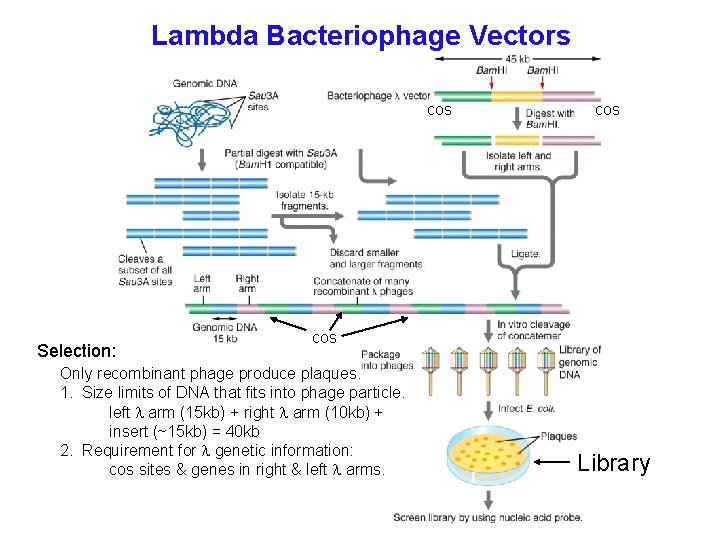
Lambda Bacteriophage Vectors cos Selection: cos Only recombinant phage produce plaques. 1. Size limits of DNA that fits into phage particle. left l arm (15 kb) + right l arm (10 kb) + insert (~15 kb) = 40 kb 2. Requirement for l genetic information: cos sites & genes in right & left l arms. Library
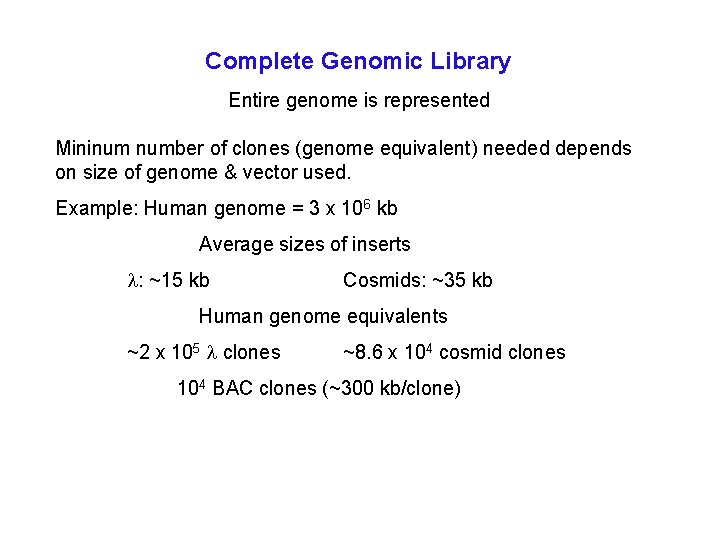
Complete Genomic Library Entire genome is represented Mininum number of clones (genome equivalent) needed depends on size of genome & vector used. Example: Human genome = 3 x 10⁶ kb Average sizes of inserts l: ~15 kb Cosmids: ~35 kb Human genome equivalents ~2 x 10⁵ l clones ~8. 6 x 10⁴ cosmid clones 104 BAC clones (~300 kb/clone)
Recombinant DNA Libraries Collection of many clones derived from a single DNA source. Genomic Libraries: Many clones, each of which contains a fragment of chromosomal DNA from a particular species. Complete genomic library: Entire genome is represented in at least one clone. c. DNA Libraries: c. DNAs = DNA copies of RNA molecules. c. DNA libraries: Each clone contains DNA copy of an individual m. RNA. Very useful for studying just the part of a gene that is present in m. RNA.
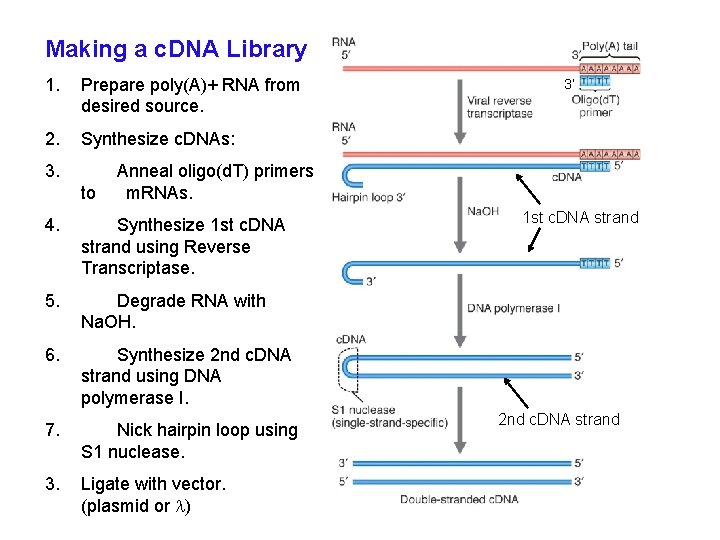
Making a c. DNA Library 1. Prepare poly(A)+ RNA from desired source. 2. Synthesize c. DNAs: 3. to 3’ Anneal oligo(d. T) primers m. RNAs. 4. Synthesize 1 st c. DNA strand using Reverse Transcriptase. 5. Degrade RNA with Na. OH. 6. Synthesize 2 nd c. DNA strand using DNA polymerase I. 7. Nick hairpin loop using S 1 nuclease. 3. Ligate with vector. (plasmid or l) 1 st c. DNA strand 2 nd c. DNA strand