
Cosmic voyage Morgan Freeman 40 min http www

- Slides: 92
Cosmic voyage (Morgan Freeman) 40 min http: //www. youtube. com/watch? v=Mjc. T 7 ac. Dz. Ao
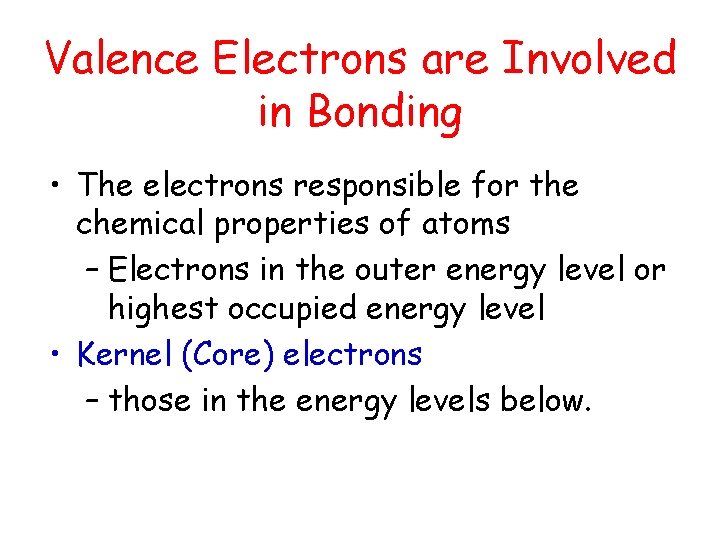
Valence Electrons are Involved in Bonding • The electrons responsible for the chemical properties of atoms – Electrons in the outer energy level or highest occupied energy level • Kernel (Core) electrons – those in the energy levels below.
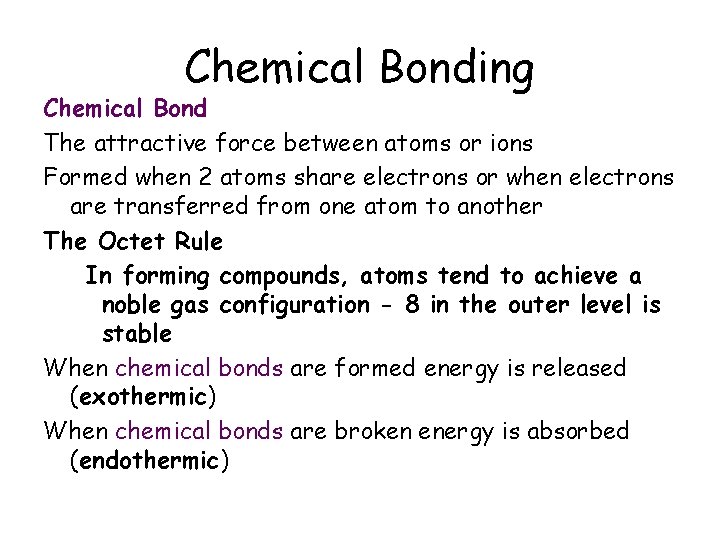
Chemical Bonding Chemical Bond The attractive force between atoms or ions Formed when 2 atoms share electrons or when electrons are transferred from one atom to another The Octet Rule In forming compounds, atoms tend to achieve a noble gas configuration - 8 in the outer level is stable When chemical bonds are formed energy is released (exothermic) When chemical bonds are broken energy is absorbed (endothermic)
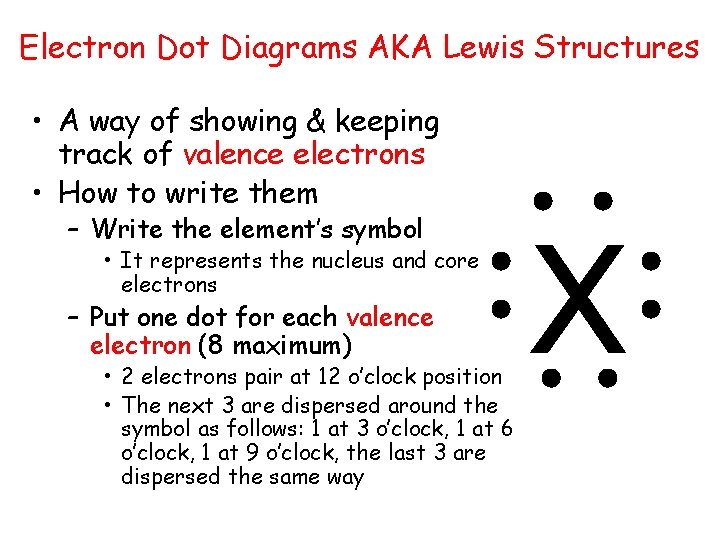
Electron Dot Diagrams AKA Lewis Structures • A way of showing & keeping track of valence electrons • How to write them – Write the element’s symbol • It represents the nucleus and core electrons – Put one dot for each valence electron (8 maximum) • 2 electrons pair at 12 o’clock position • The next 3 are dispersed around the symbol as follows: 1 at 3 o’clock, 1 at 6 o’clock, 1 at 9 o’clock, the last 3 are dispersed the same way X
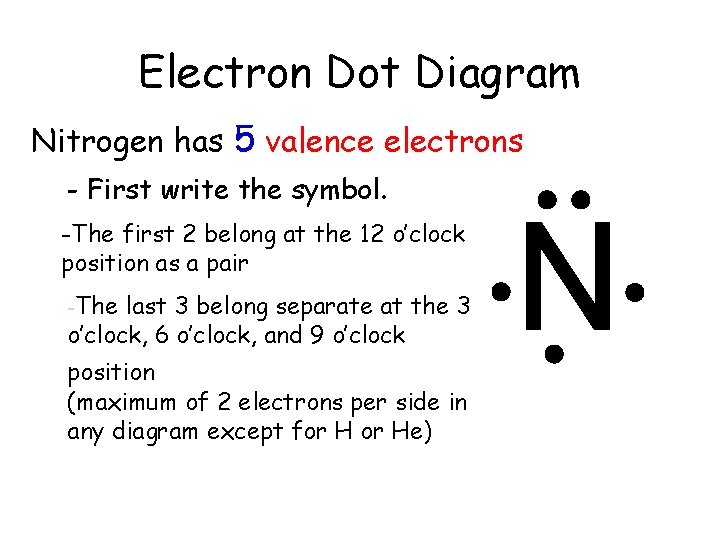
Electron Dot Diagram Nitrogen has 5 valence electrons - First write the symbol. -The first 2 belong at the 12 o’clock position as a pair -The last 3 belong separate at the 3 o’clock, 6 o’clock, and 9 o’clock position (maximum of 2 electrons per side in any diagram except for He) N
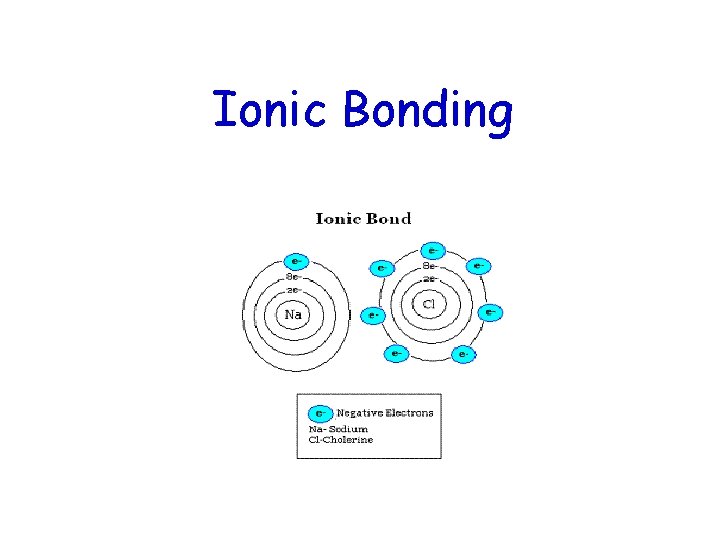
Ionic Bonding
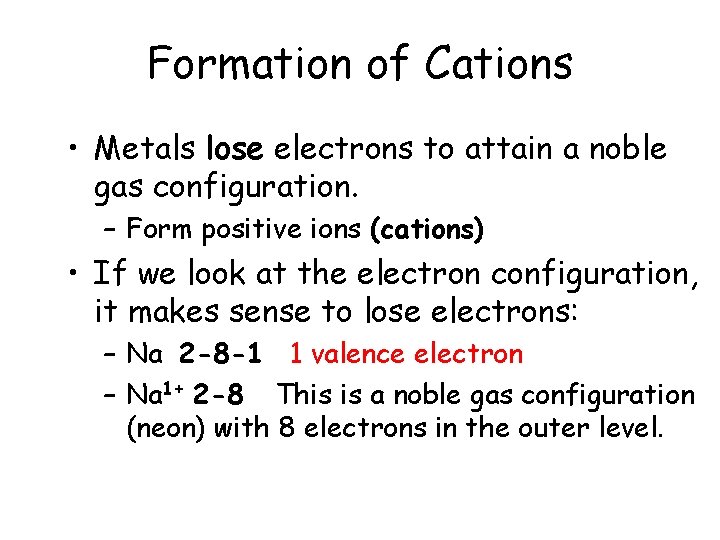
Formation of Cations • Metals lose electrons to attain a noble gas configuration. – Form positive ions (cations) • If we look at the electron configuration, it makes sense to lose electrons: – Na 2 -8 -1 1 valence electron – Na 1+ 2 -8 This is a noble gas configuration (neon) with 8 electrons in the outer level.
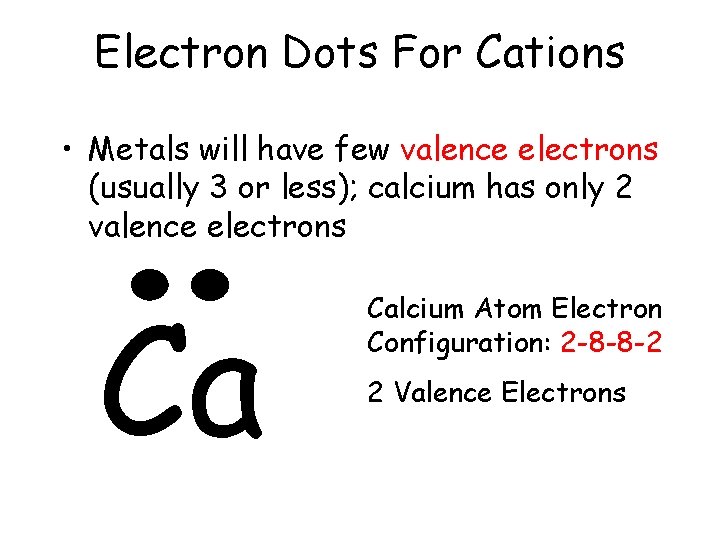
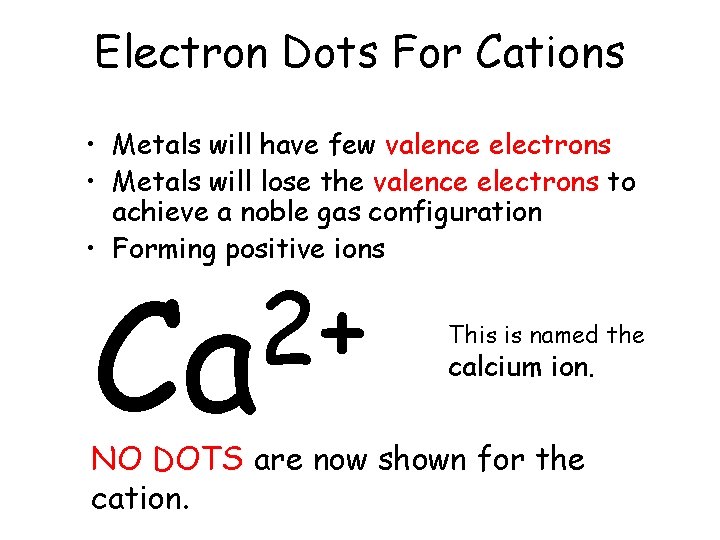
Electron Dots For Cations • Metals will have few valence electrons (usually 3 or less); calcium has only 2 valence electrons Ca Calcium Atom Electron Configuration: 2 -8 -8 -2 2 Valence Electrons
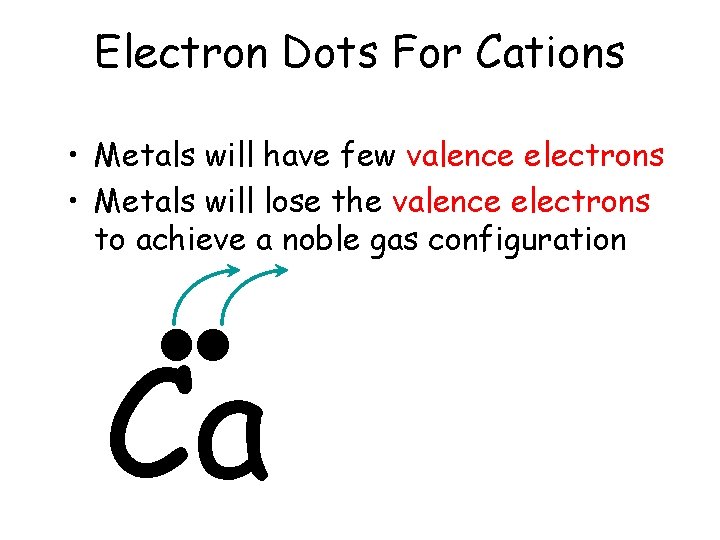
Electron Dots For Cations • Metals will have few valence electrons • Metals will lose the valence electrons to achieve a noble gas configuration Ca
Electron Dots For Cations • Metals will have few valence electrons • Metals will lose the valence electrons to achieve a noble gas configuration • Forming positive ions 2+ Ca This is named the calcium ion. NO DOTS are now shown for the cation.
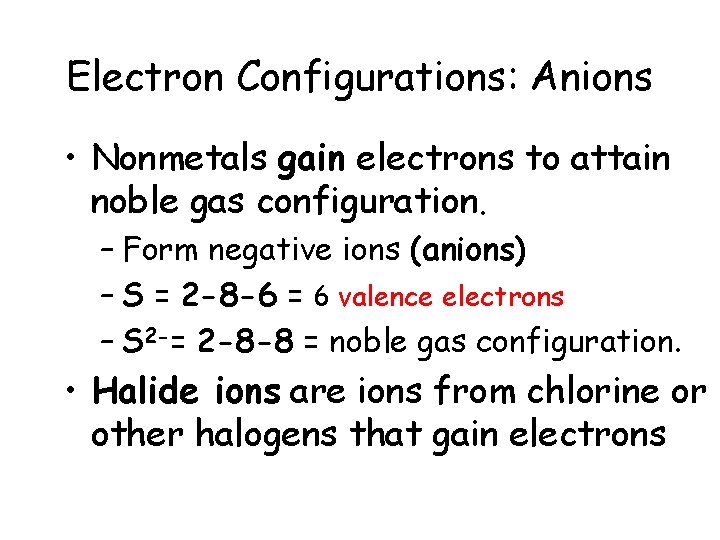
Electron Configurations: Anions • Nonmetals gain electrons to attain noble gas configuration. – Form negative ions (anions) – S = 2 -8 -6 = 6 valence electrons – S 2 -= 2 -8 -8 = noble gas configuration. • Halide ions are ions from chlorine or other halogens that gain electrons
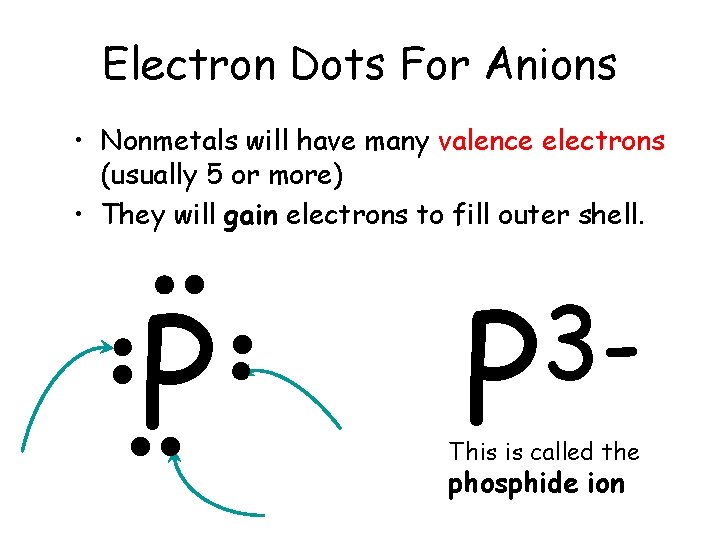
Electron Dots For Anions • Nonmetals will have many valence electrons (usually 5 or more) • They will gain electrons to fill outer shell. P 3 P This is called the phosphide ion
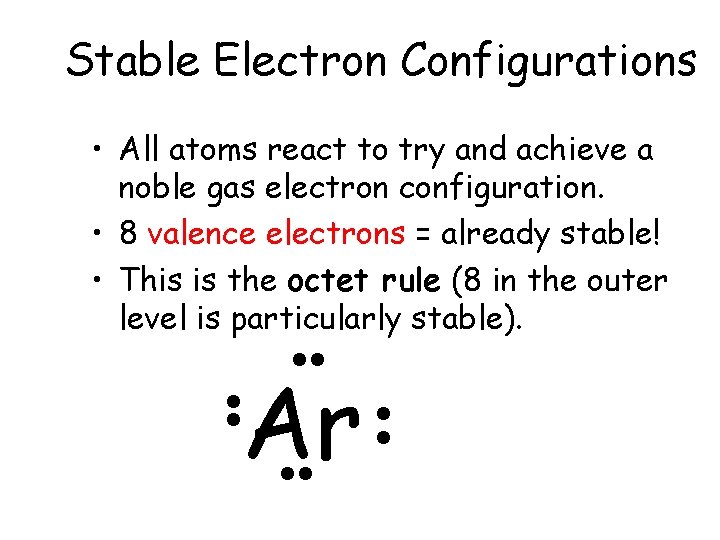
Stable Electron Configurations • All atoms react to try and achieve a noble gas electron configuration. • 8 valence electrons = already stable! • This is the octet rule (8 in the outer level is particularly stable). Ar
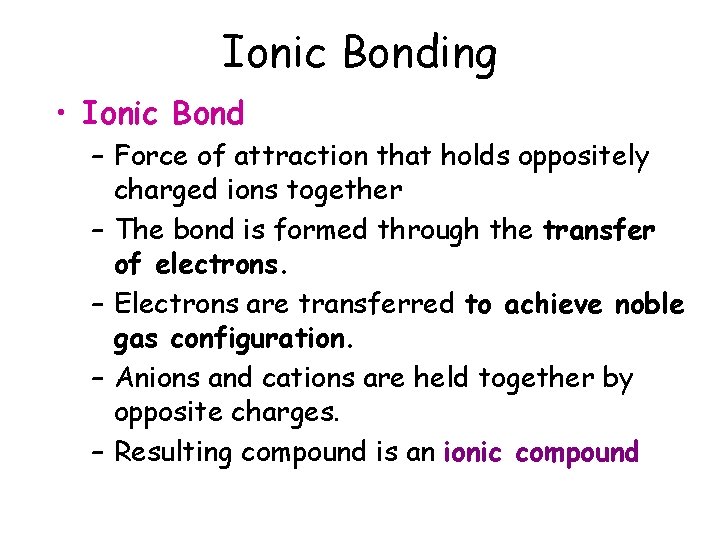
Ionic Bonding • Ionic Bond – Force of attraction that holds oppositely charged ions together – The bond is formed through the transfer of electrons. – Electrons are transferred to achieve noble gas configuration. – Anions and cations are held together by opposite charges. – Resulting compound is an ionic compound
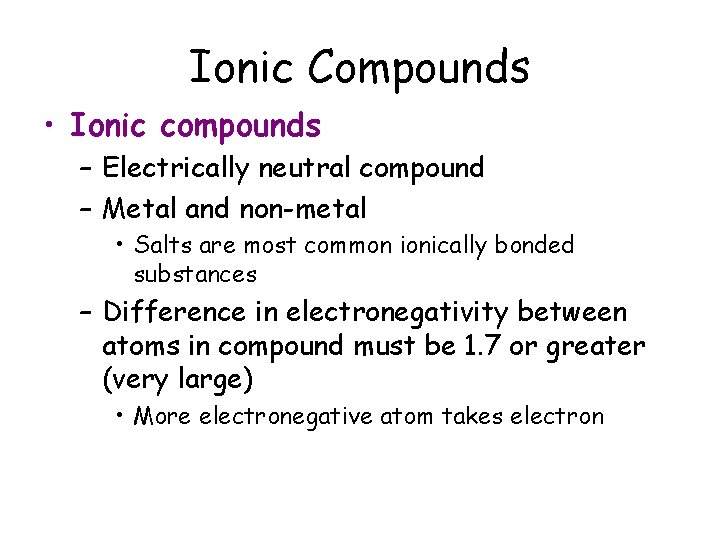
Ionic Compounds • Ionic compounds – Electrically neutral compound – Metal and non-metal • Salts are most common ionically bonded substances – Difference in electronegativity between atoms in compound must be 1. 7 or greater (very large) • More electronegative atom takes electron
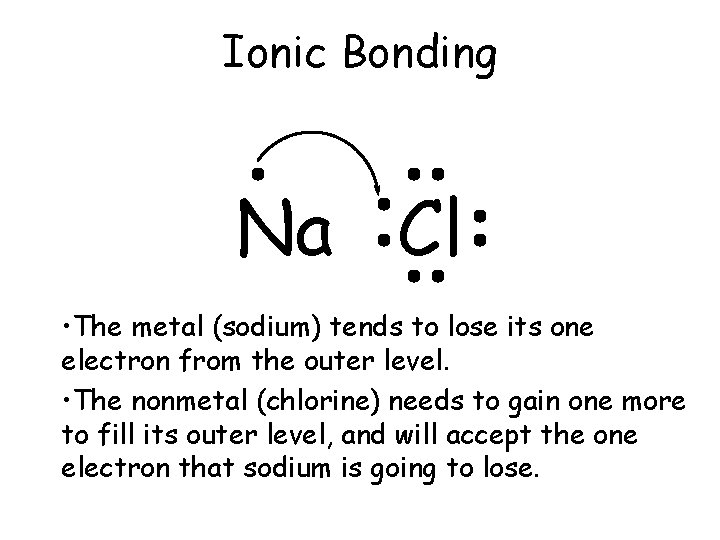
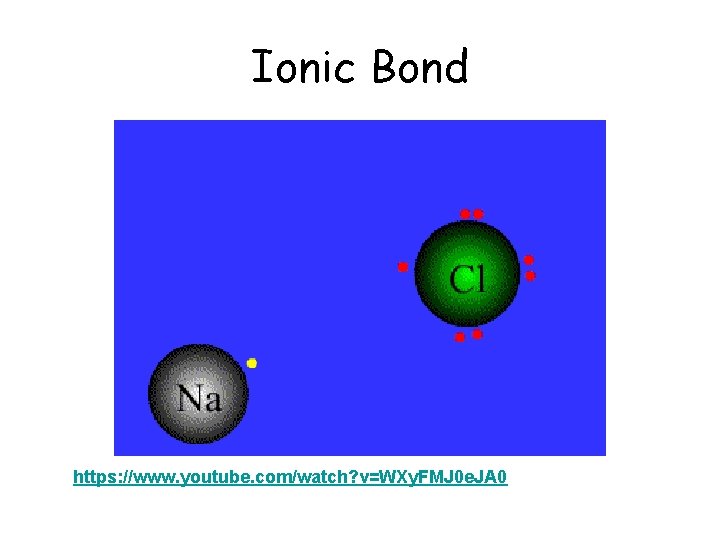
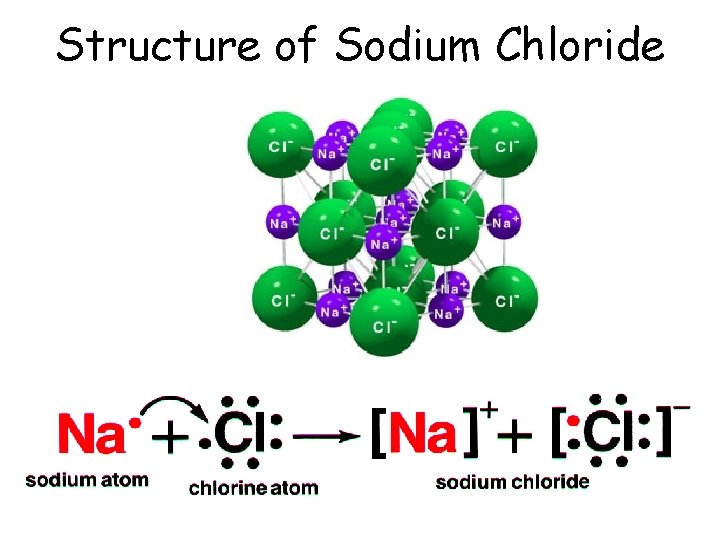
Ionic Bonding Na Cl • The metal (sodium) tends to lose its one electron from the outer level. • The nonmetal (chlorine) needs to gain one more to fill its outer level, and will accept the one electron that sodium is going to lose.
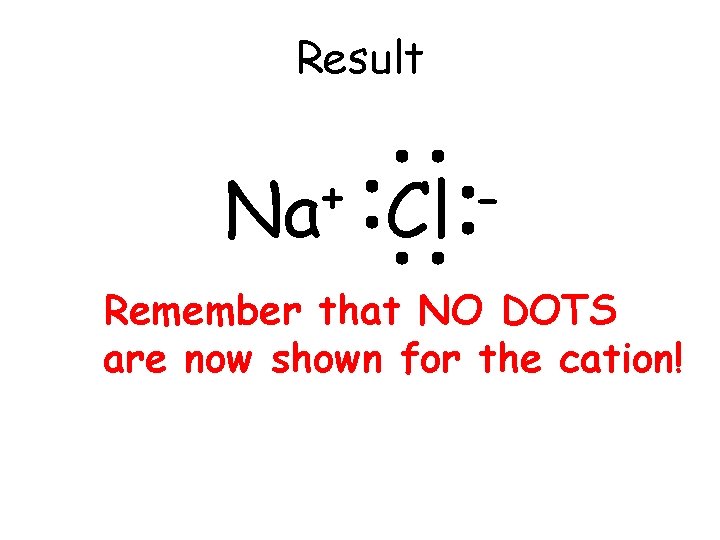
Result + Na Cl - Remember that NO DOTS are now shown for the cation!
Ionic Bond https: //www. youtube. com/watch? v=WXy. FMJ 0 e. JA 0
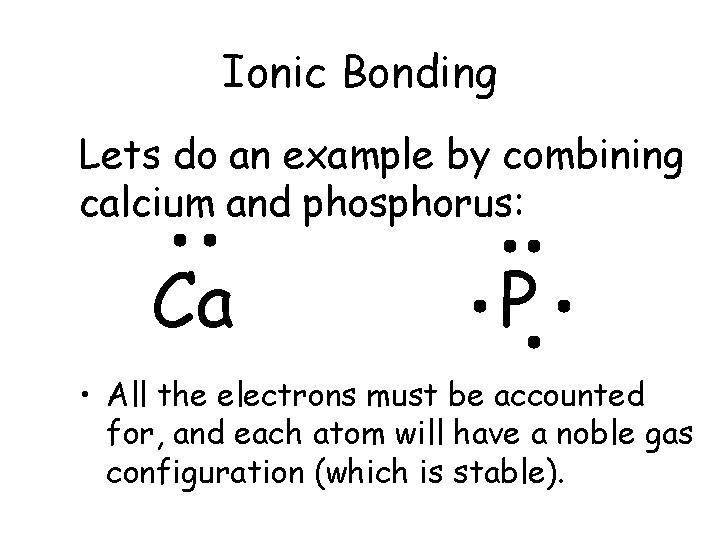
Ionic Bonding Lets do an example by combining calcium and phosphorus: Ca P • All the electrons must be accounted for, and each atom will have a noble gas configuration (which is stable).
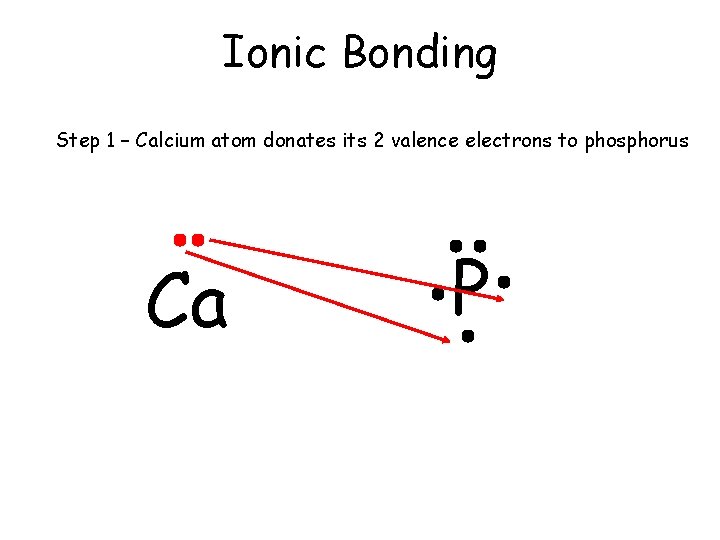
Ionic Bonding Step 1 – Calcium atom donates its 2 valence electrons to phosphorus Ca P
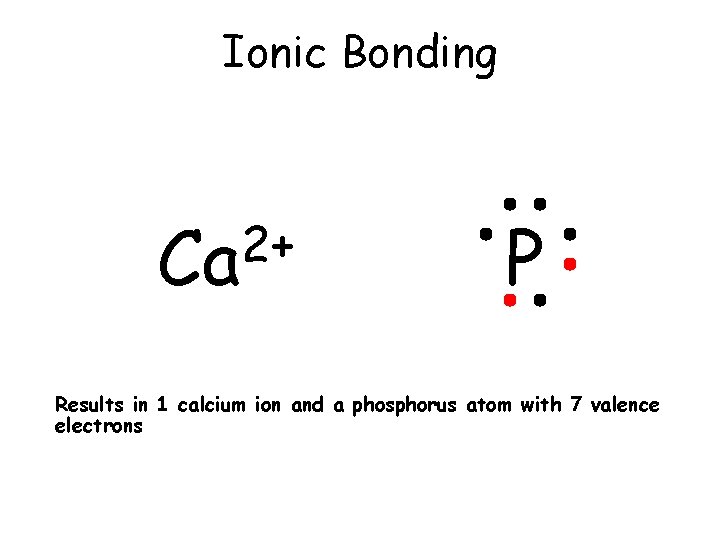
Ionic Bonding 2+ Ca P Results in 1 calcium ion and a phosphorus atom with 7 valence electrons
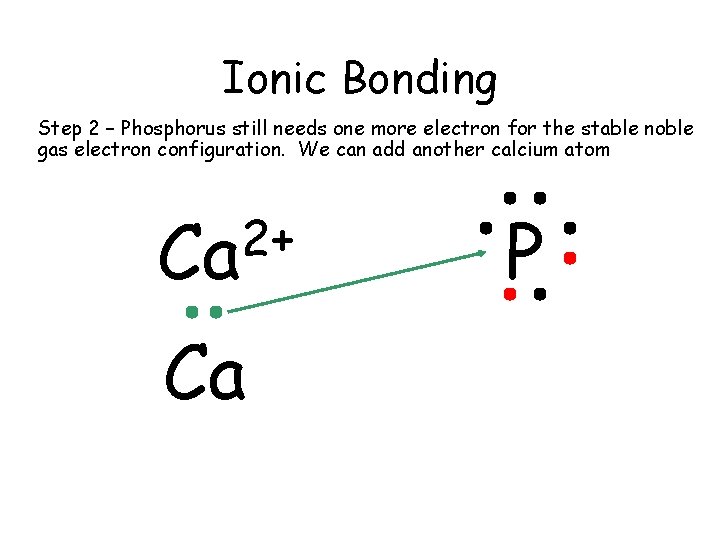
Ionic Bonding Step 2 – Phosphorus still needs one more electron for the stable noble gas electron configuration. We can add another calcium atom 2+ Ca Ca P
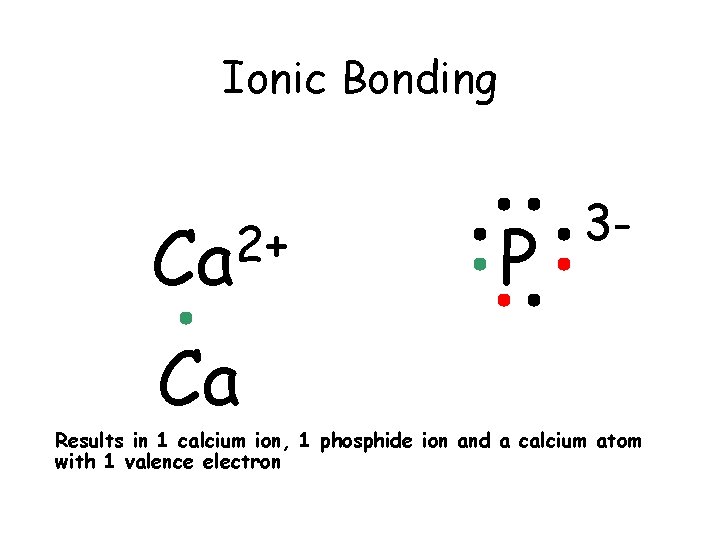
Ionic Bonding 2+ Ca Ca P 3 - Results in 1 calcium ion, 1 phosphide ion and a calcium atom with 1 valence electron
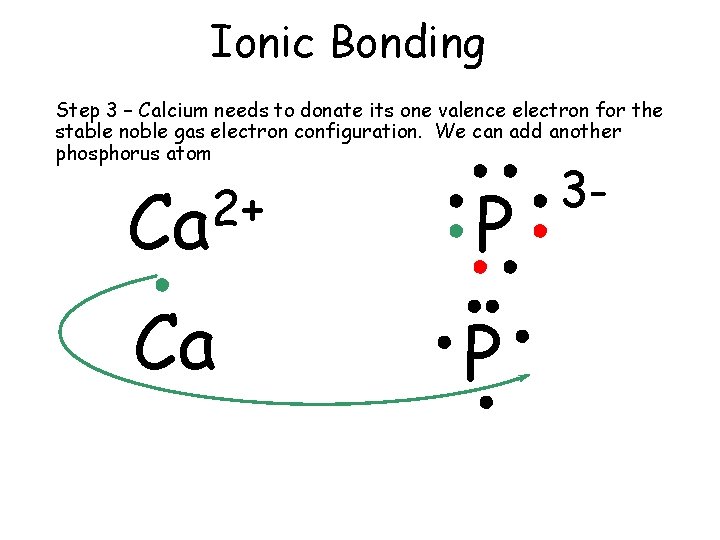
Ionic Bonding Step 3 – Calcium needs to donate its one valence electron for the stable noble gas electron configuration. We can add another phosphorus atom 2+ Ca P 3 -
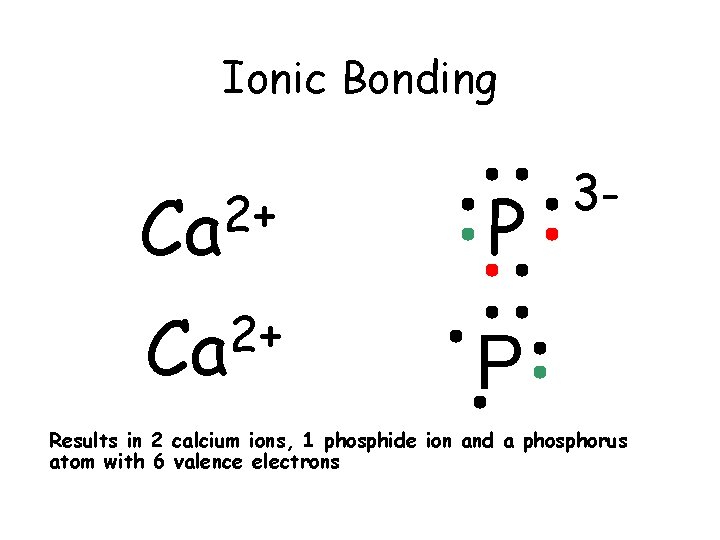
Ionic Bonding 2+ Ca P 3 - Results in 2 calcium ions, 1 phosphide ion and a phosphorus atom with 6 valence electrons
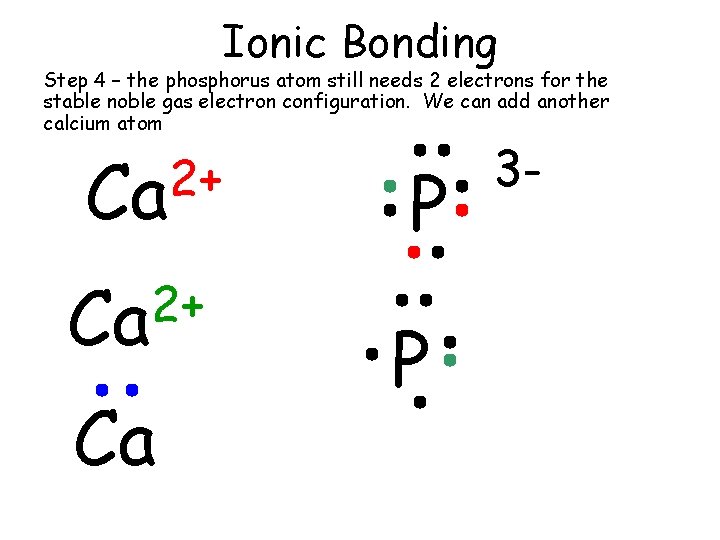
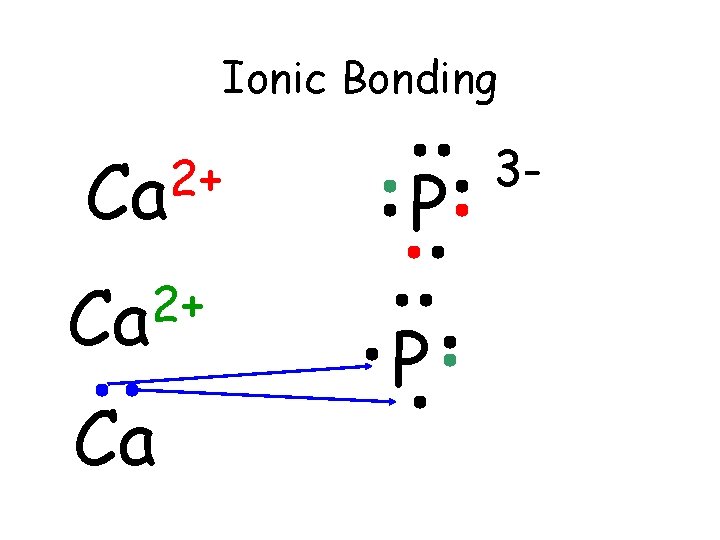
Ionic Bonding Step 4 – the phosphorus atom still needs 2 electrons for the stable noble gas electron configuration. We can add another calcium atom 2+ Ca Ca P P 3 -
Ionic Bonding 2+ Ca Ca P P 3 -
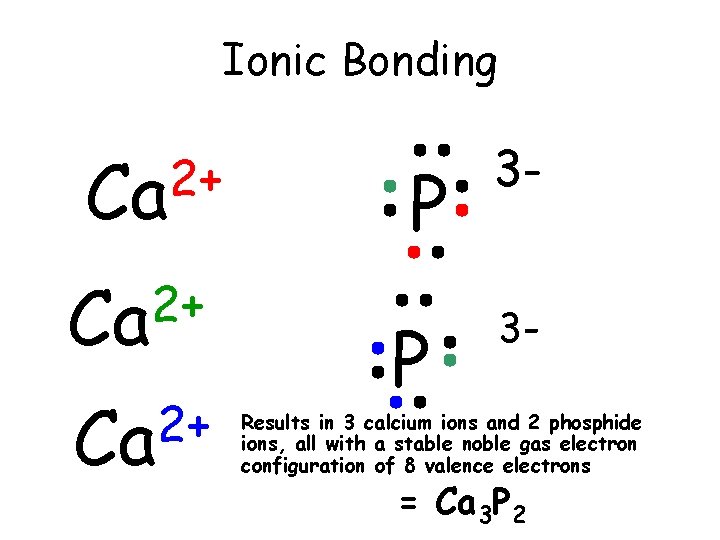
Ionic Bonding 2+ Ca P P 33 - Results in 3 calcium ions and 2 phosphide ions, all with a stable noble gas electron configuration of 8 valence electrons = Ca 3 P 2
Chemical formula refers to a ratio known as a formula unit • Formula unit – the lowest whole number ratio of ions in an ionic compound Note – the formula Na. Cl does not represent a single discrete unit like a molecule (it’s not a molecule!)
Structure of Sodium Chloride
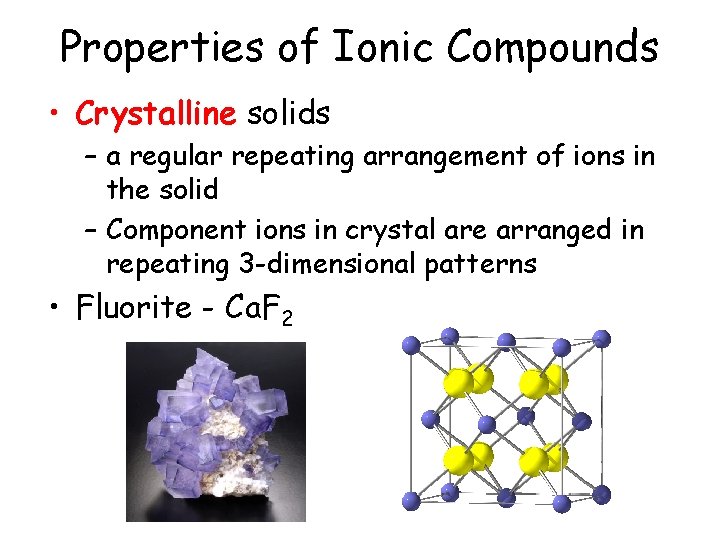
Properties of Ionic Compounds • Crystalline solids – a regular repeating arrangement of ions in the solid – Component ions in crystal are arranged in repeating 3 -dimensional patterns • Fluorite - Ca. F 2
Properties of Ionic Compounds • Ions are strongly bonded together. – – Structure is rigid High melting points Very stable structure Poor conductors in the solid state
Do Ionic Compounds Conduct Electricity ? • Conducting electricity means allowing charges to move. – In a solid, the ions (charged atoms) are locked in place • Do not conduct electricity • Ionic solids are insulators
Do Ionic Compounds Conduct Electricity? • When melted, the ions can move around. – Melted ionic compounds conduct electricity. – Na. Cl: must get to about 800ºC. • Dissolved in water, ionic compounds also conduct – Ions are free to move in aqueous solutions – When melted or dissolved regular crystal structure of ionic compound breaks and ions can move https: //www. youtube. com/watch? v=bow. Uxr 3 GUc. I
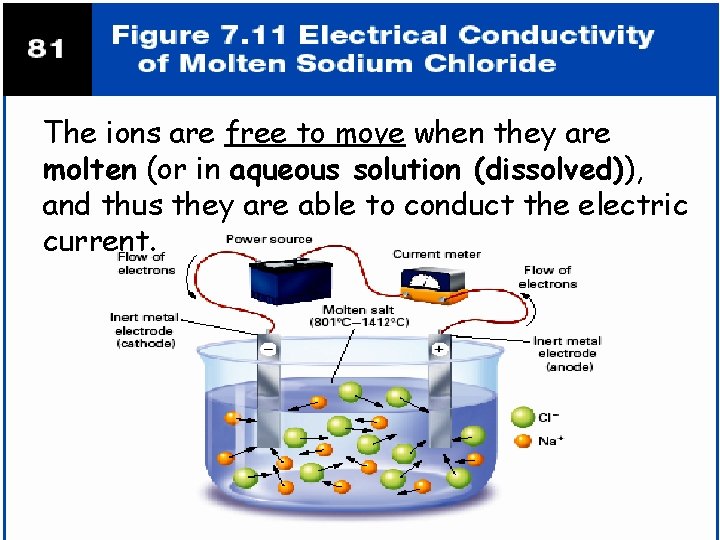
The ions are free to move when they are molten (or in aqueous solution (dissolved)), and thus they are able to conduct the electric current.
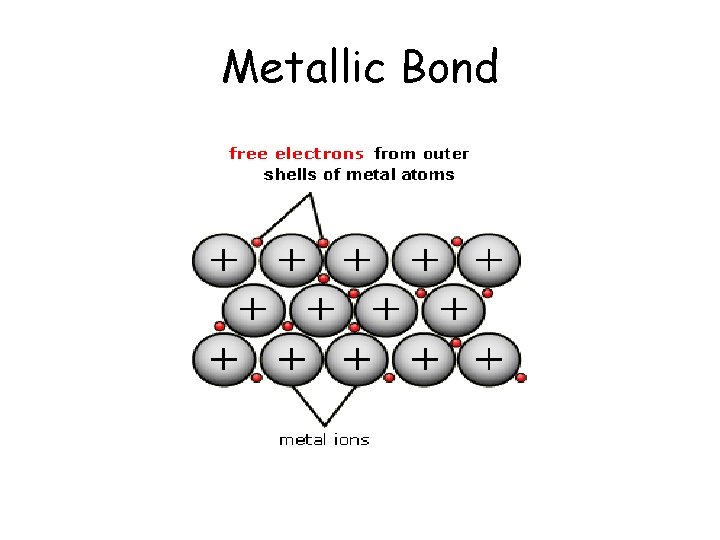
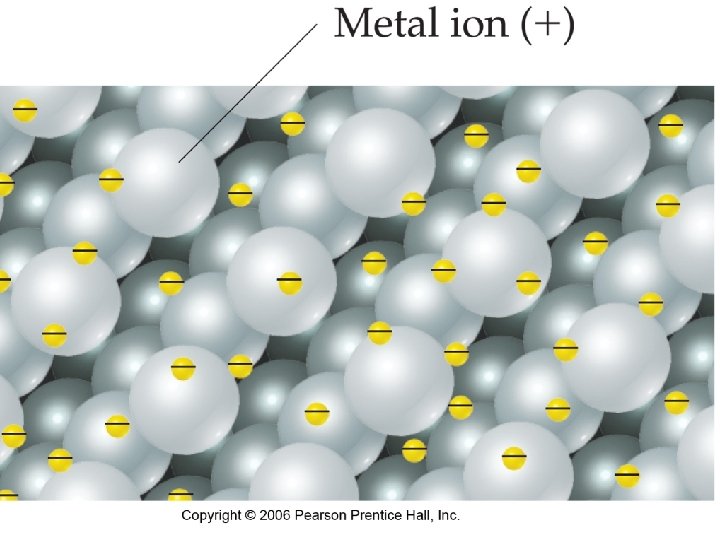
Metallic Bonds • Metals atoms lose valence electrons very easily • Metals are made of closely packed cations rather than neutral atoms – The force of attraction that holds metals together are called metallic bonds • Metallic bonds consist of the attraction of the free-floating valence electrons for the positively charged metal ions – Think of metal atoms as different metal ions (cations) floating in a sea of electrons
Metallic Bond
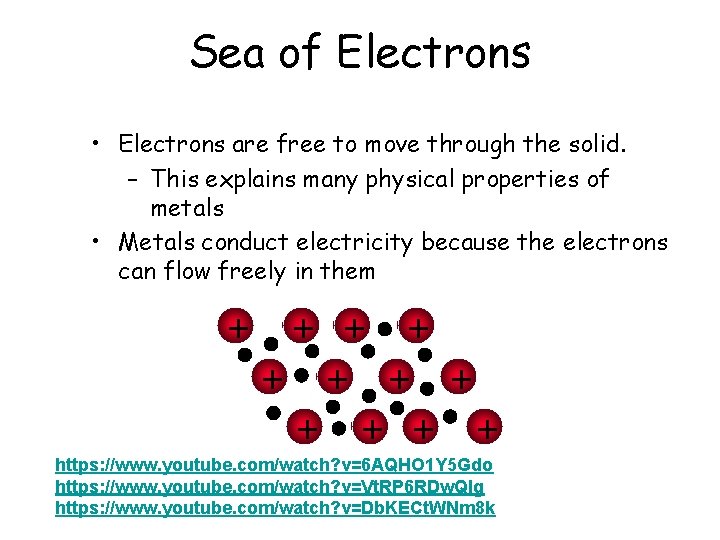
Sea of Electrons • Electrons are free to move through the solid. – This explains many physical properties of metals • Metals conduct electricity because the electrons can flow freely in them + + + https: //www. youtube. com/watch? v=6 AQHO 1 Y 5 Gdo https: //www. youtube. com/watch? v=Vt. RP 6 RDw. QIg https: //www. youtube. com/watch? v=Db. KECt. WNm 8 k
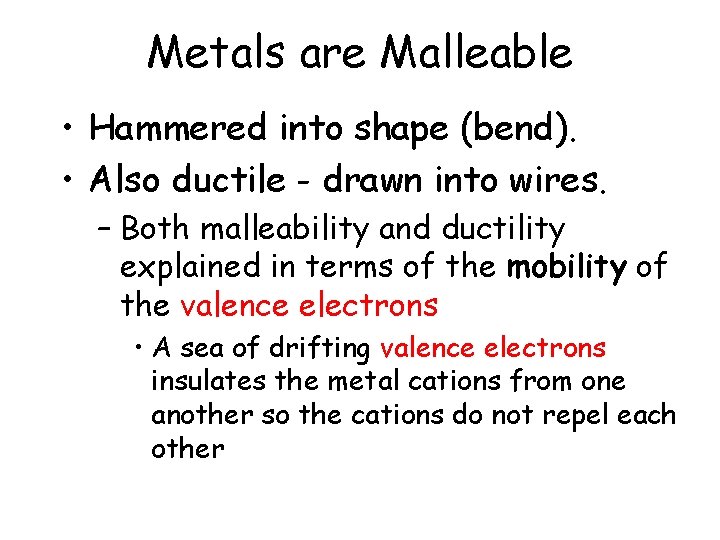
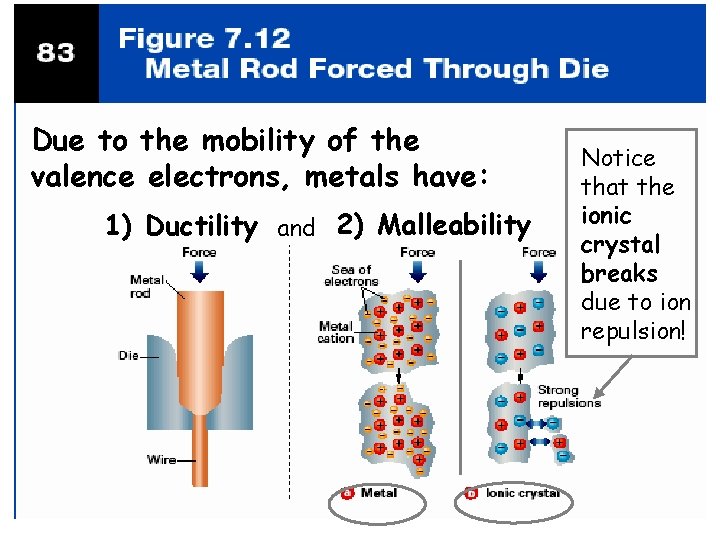
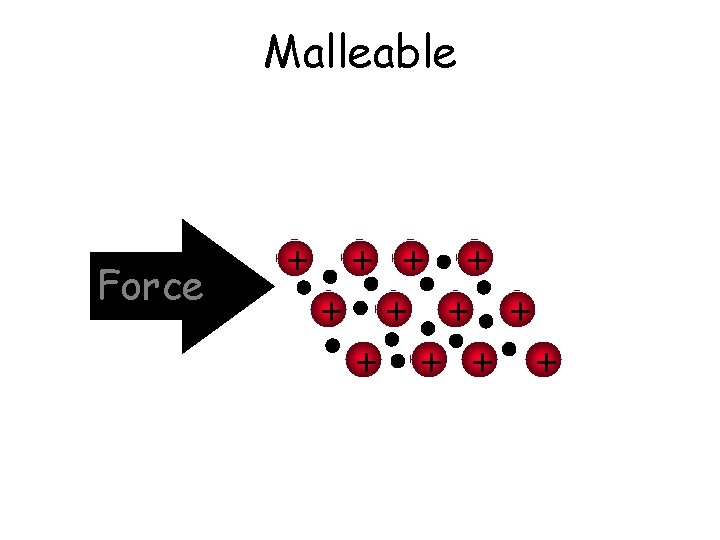
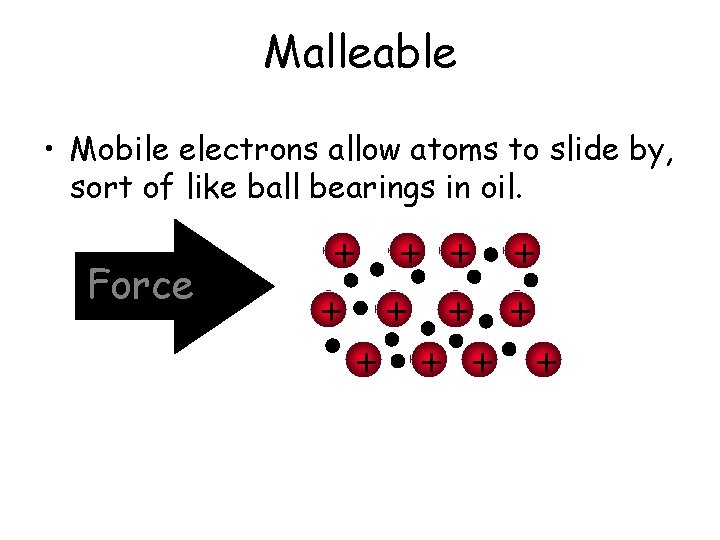
Metals are Malleable • Hammered into shape (bend). • Also ductile - drawn into wires. – Both malleability and ductility explained in terms of the mobility of the valence electrons • A sea of drifting valence electrons insulates the metal cations from one another so the cations do not repel each other
Due to the mobility of the valence electrons, metals have: 1) Ductility and 2) Malleability Notice that the ionic crystal breaks due to ion repulsion!
Malleable Force + + +
Malleable • Mobile electrons allow atoms to slide by, sort of like ball bearings in oil. Force + + +
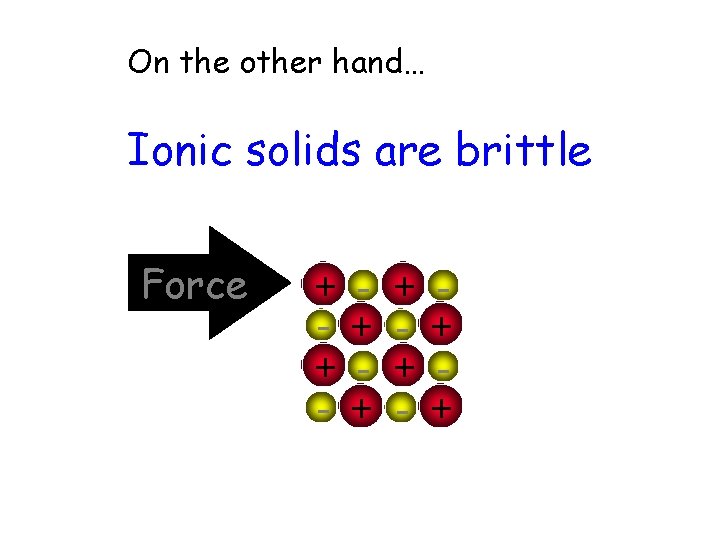
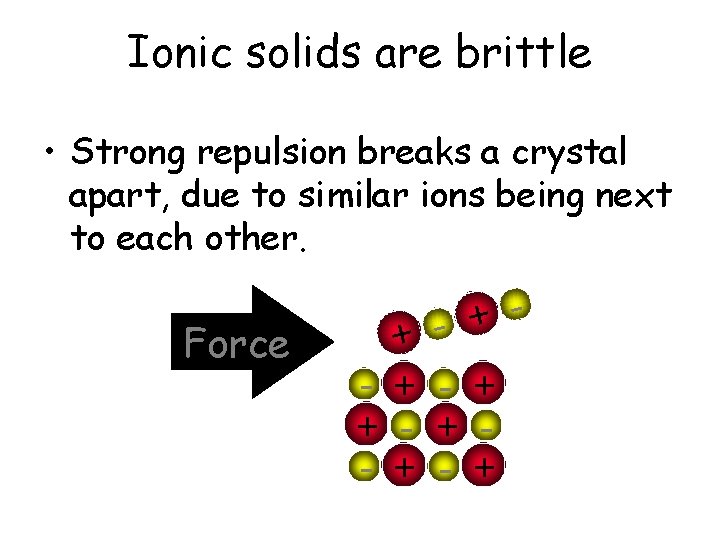
On the other hand… Ionic solids are brittle Force + + - + +
Ionic solids are brittle • Strong repulsion breaks a crystal apart, due to similar ions being next to each other. Force + + - + - + - +
Alloys • We use lots of metals every day, but few are pure metals – Alloys are mixtures of 2 or more elements, at least 1 is a metal • Made by melting a mixture of the ingredients, then cooling • Brass: an alloy of Cu and Zn • Bronze: Cu and Sn
Why use alloys? • Properties are often superior to the pure element – Sterling silver (92. 5% Ag, 7. 5% Cu) is harder and more durable than pure Ag, but still soft enough to make jewelry and tableware • Steels are very important alloys – corrosion resistant, ductility, hardness, toughness, cost
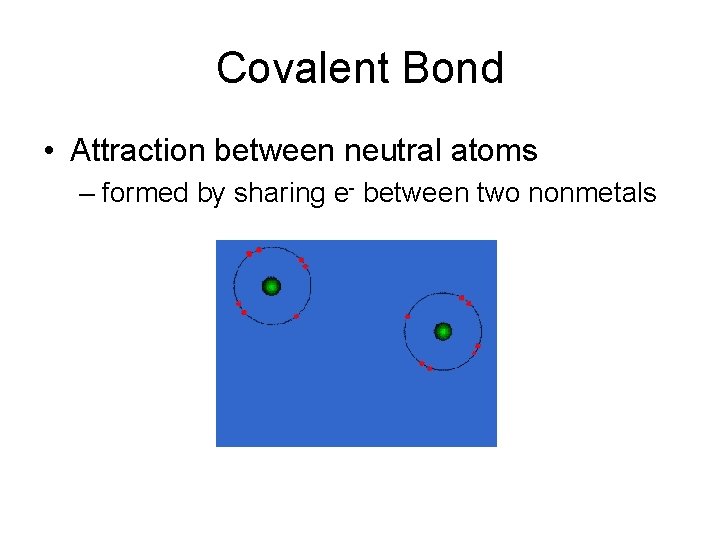
Covalent Bond • Attraction between neutral atoms – formed by sharing e- between two nonmetals
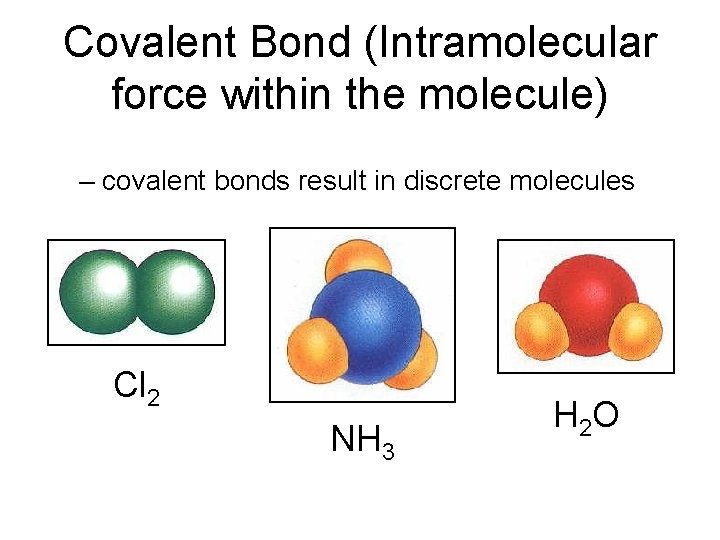
Covalent Bond (Intramolecular force within the molecule) – covalent bonds result in discrete molecules Cl 2 NH 3 H 2 O
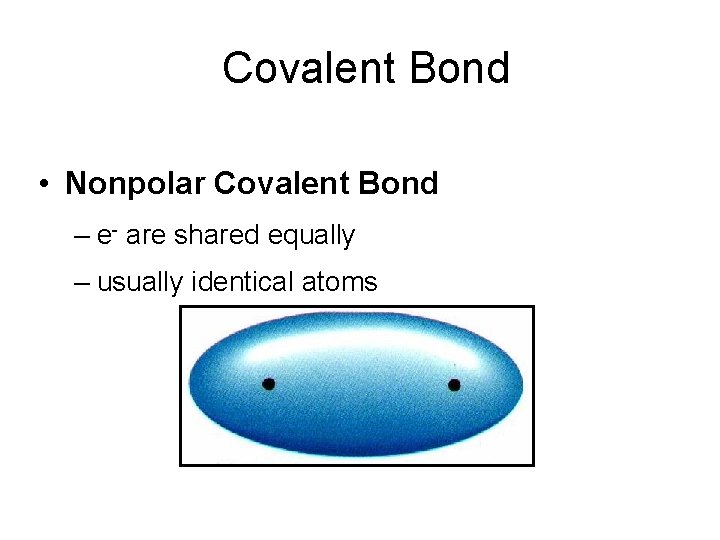
Covalent Bond • Nonpolar Covalent Bond – e- are shared equally – usually identical atoms
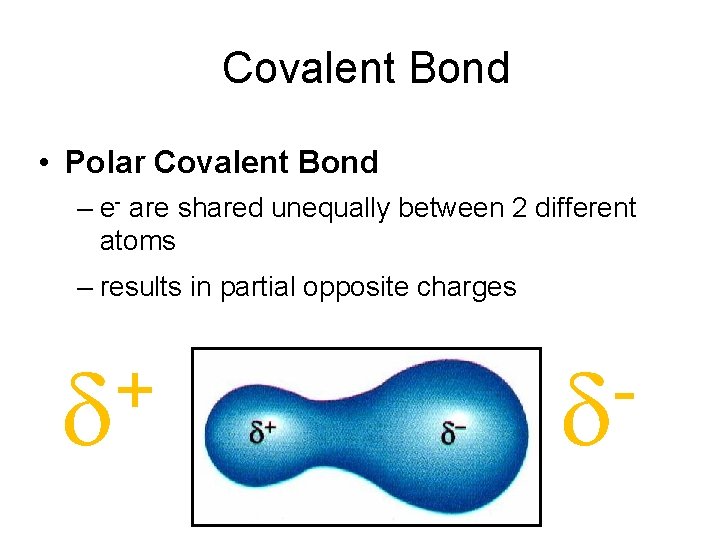
Covalent Bond • Polar Covalent Bond – e- are shared unequally between 2 different atoms – results in partial opposite charges +
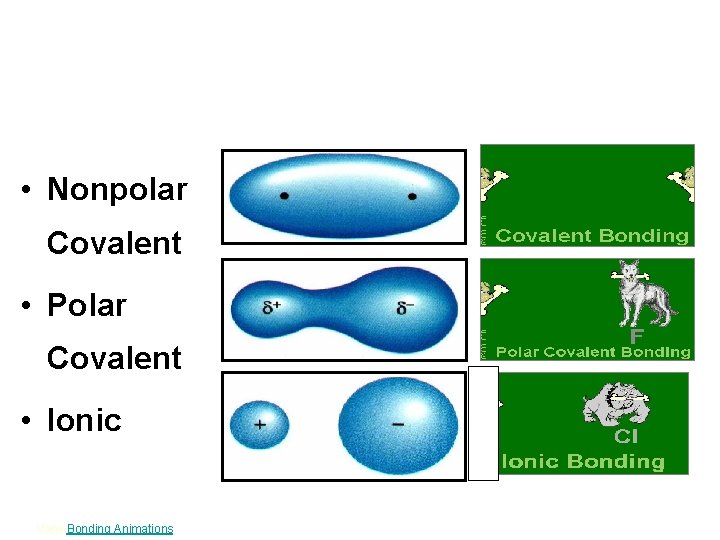
• Nonpolar Covalent • Polar Covalent • Ionic View Bonding Animations.
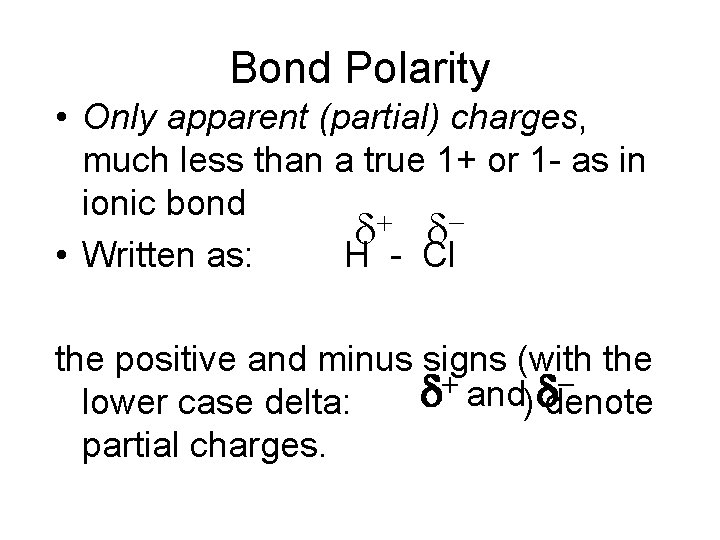
Bond Polarity • Only apparent (partial) charges, much less than a true 1+ or 1 - as in ionic bond + • Written as: H - Cl the positive and minus signs (with the + and dd lower case delta: ) denote partial charges.
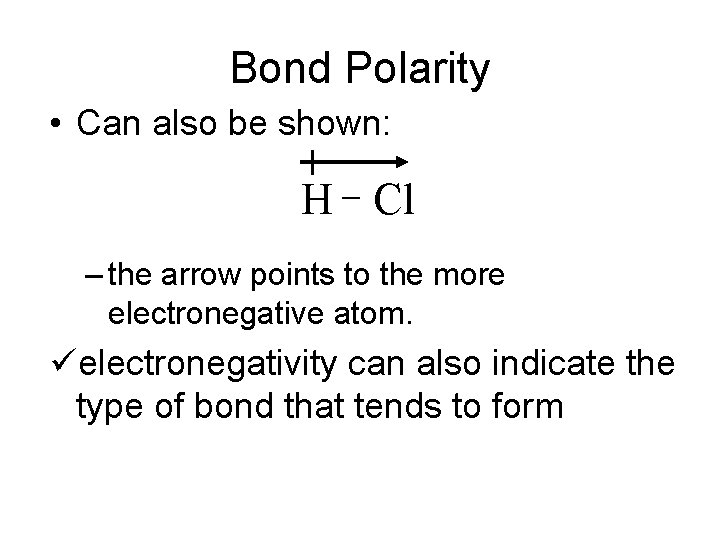
Bond Polarity • Can also be shown: H Cl – the arrow points to the more electronegative atom. üelectronegativity can also indicate the type of bond that tends to form
Polar molecules In small molecules a polar bond tends to make the entire molecule “polar” – areas of “difference” • HCl has polar bonds, thus is a polar molecule. – A molecule that has two poles is called dipole, like HCl
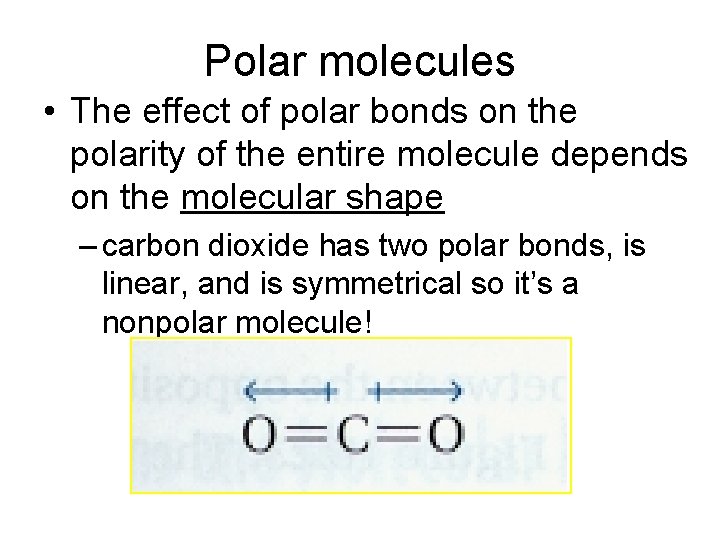
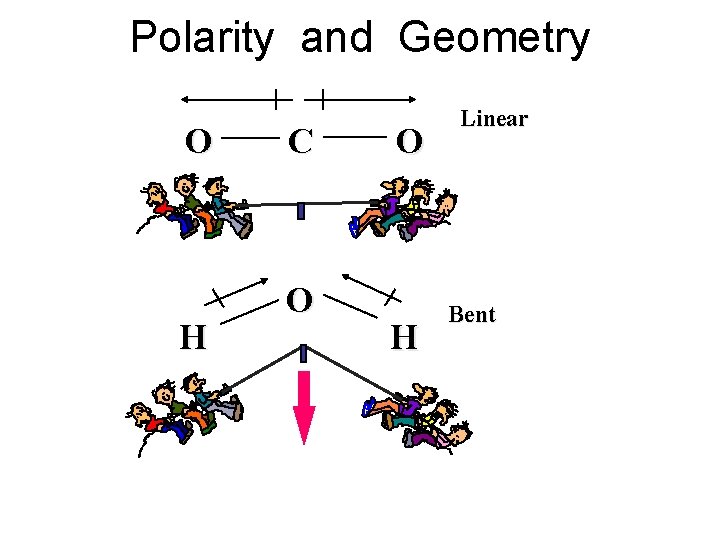
Polar molecules • The effect of polar bonds on the polarity of the entire molecule depends on the molecular shape – carbon dioxide has two polar bonds, is linear, and is symmetrical so it’s a nonpolar molecule!
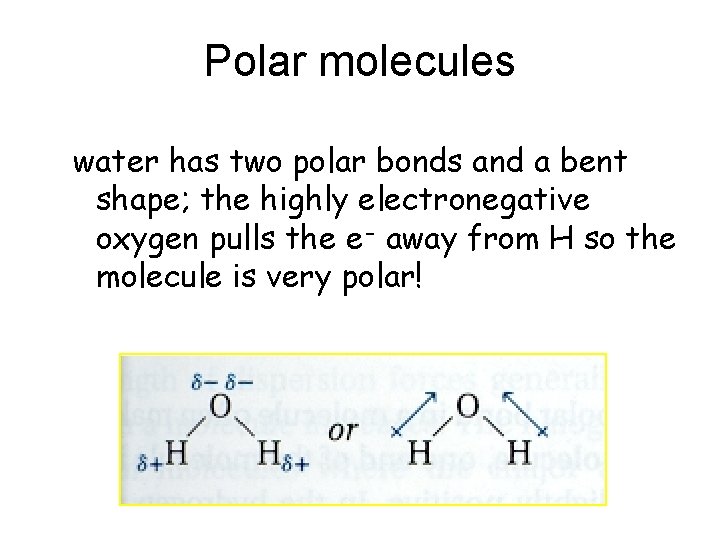
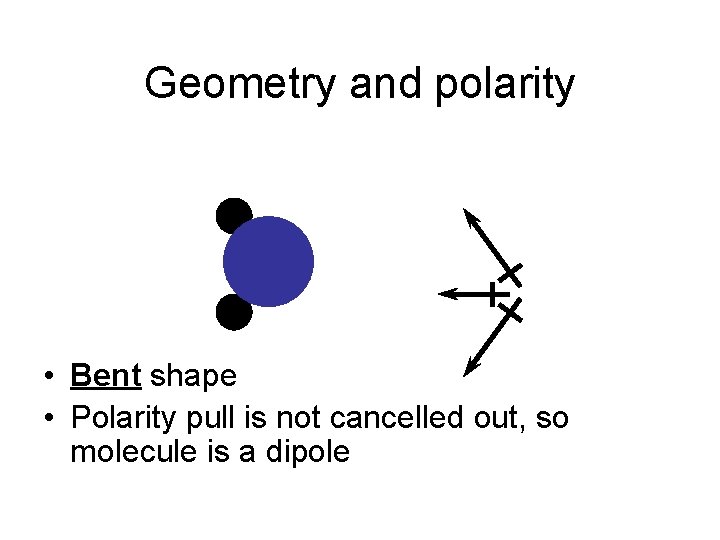
Polar molecules water has two polar bonds and a bent shape; the highly electronegative oxygen pulls the e- away from H so the molecule is very polar!
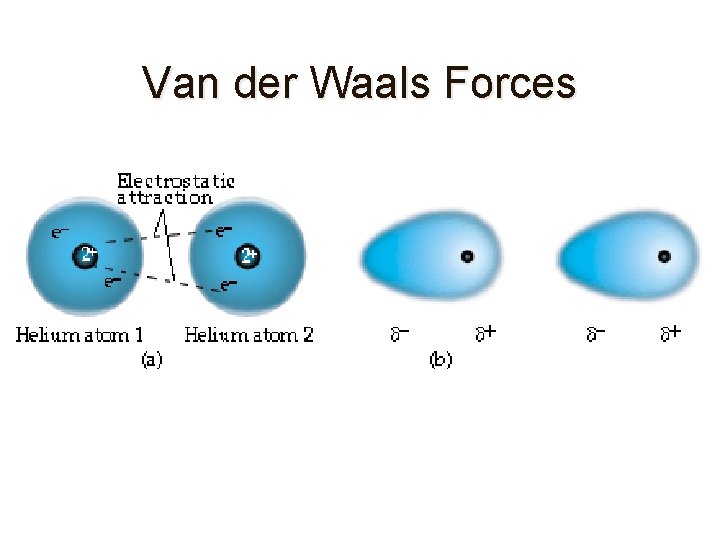
Attractions between molecules (Intermolecular Forces) • They are what make solid and liquid molecular compounds possible. 1. Dispersion forces (Van der Waal’s forces) weakest of all, caused by motion of eincreases as # e- increases Halogens start as gases, fluorine is gas; bromine is liquid; iodine is solid – all in Group 7 A. Although they are all nonpolar molecules, when more e- are present there is more attraction between molecules making them more like a solid.
Van der Waals Forces
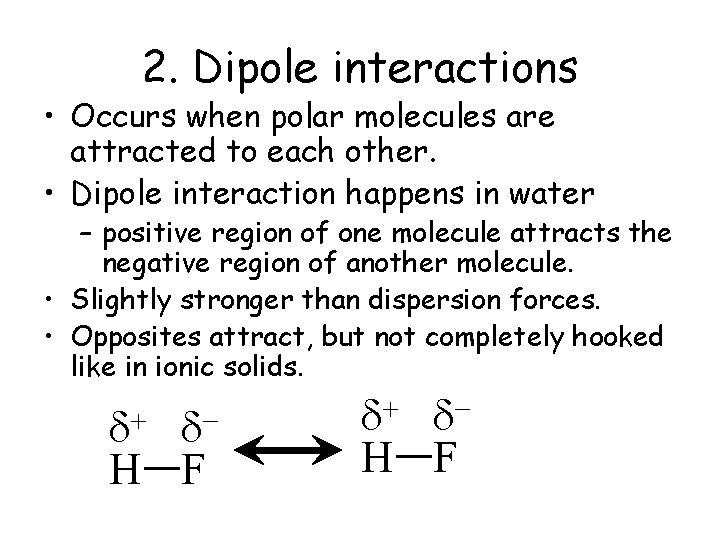
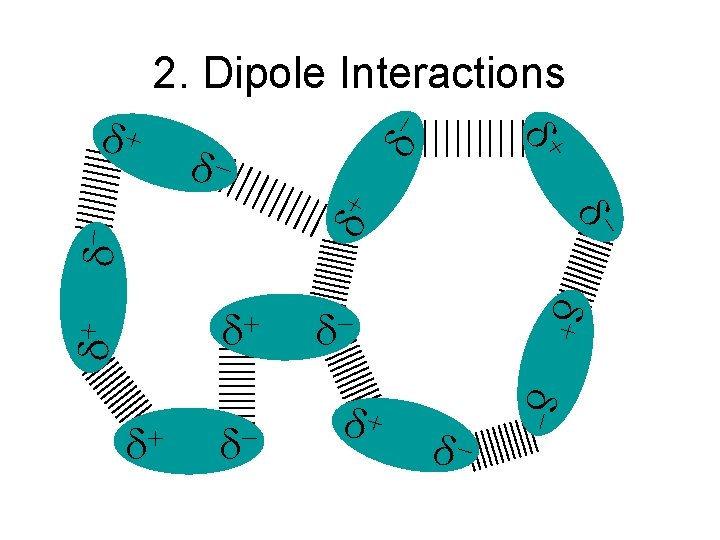
2. Dipole interactions • Occurs when polar molecules are attracted to each other. • Dipole interaction happens in water – positive region of one molecule attracts the negative region of another molecule. • Slightly stronger than dispersion forces. • Opposites attract, but not completely hooked like in ionic solids. + + - H F
+ - - + - - + + + - 2. Dipole Interactions
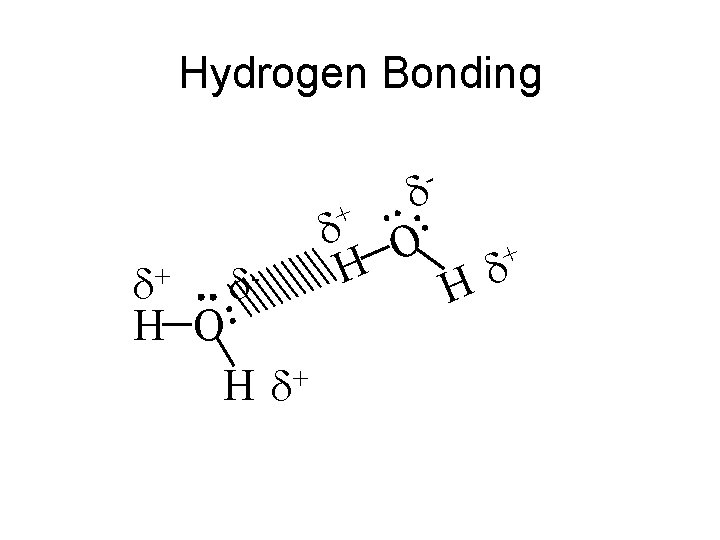
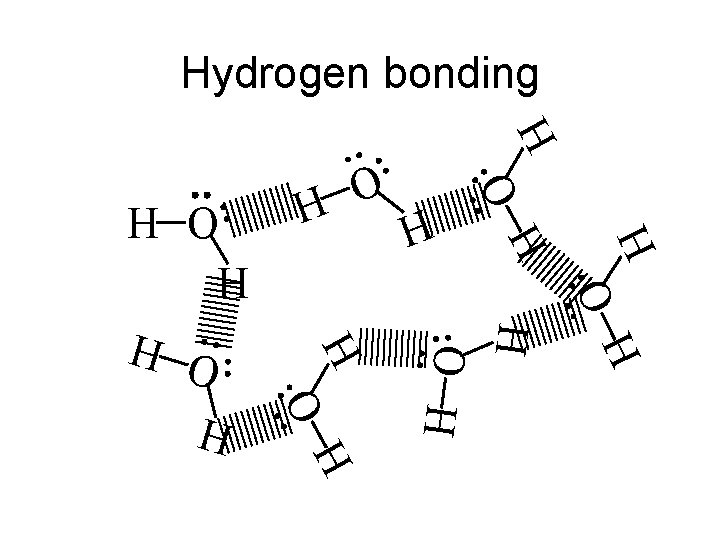
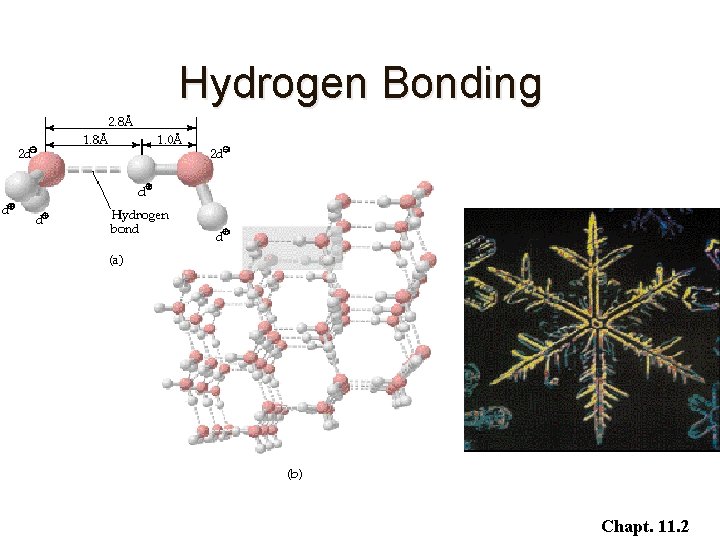
3. Hydrogen bonding? • …is the attractive force caused by hydrogen bonded to N, O, F, or Cl • N, O, F, and Cl are very electronegative, so this is a very strong dipole. • The hydrogen partially share with the lone pair in the molecule next to it. • This is the strongest of the intermolecular forces.
Why hydrogen? – Hydrogen has a higher electronegativity than metals, but has a lower electronegativity than most nonmetals. It’s the ONLY element with no shielding for its nucleus when involved in a covalent bond!
Hydrogen Bonding - + + H O + H H O + H
H H O H H O O H Hydrogen bonding
Hydrogen Bonding Chapt. 11. 2
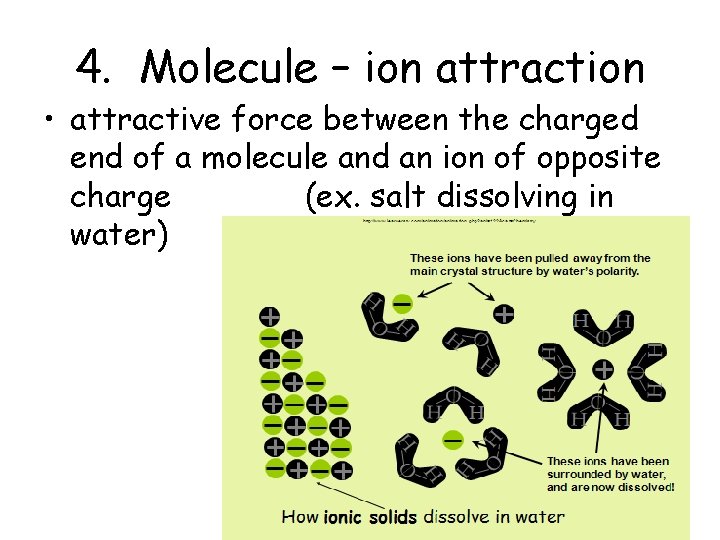
4. Molecule – ion attraction • attractive force between the charged end of a molecule and an ion of opposite charge (ex. salt dissolving in water)
Why are some chemicals gases, some liquids, some solids? – It depends on the type of forces between the particles!
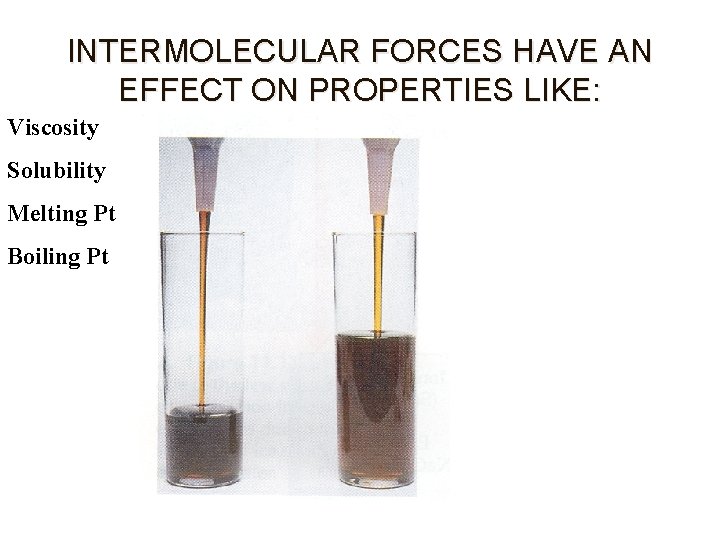
INTERMOLECULAR FORCES HAVE AN EFFECT ON PROPERTIES LIKE: Viscosity Solubility Melting Pt Boiling Pt
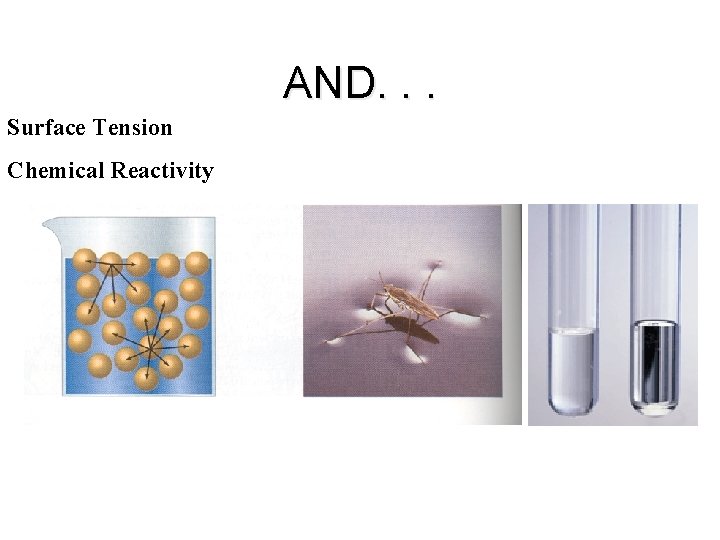
AND. . . Surface Tension Chemical Reactivity
• Network solids – solids in which all the atoms are covalently bonded to each other • melts at very high temperatures, or not at all – Diamond does not really melt, but vaporizes to a gas at 3500 o. C and beyond – Si. C, used in grinding, has a melting point of about 2700 o. C
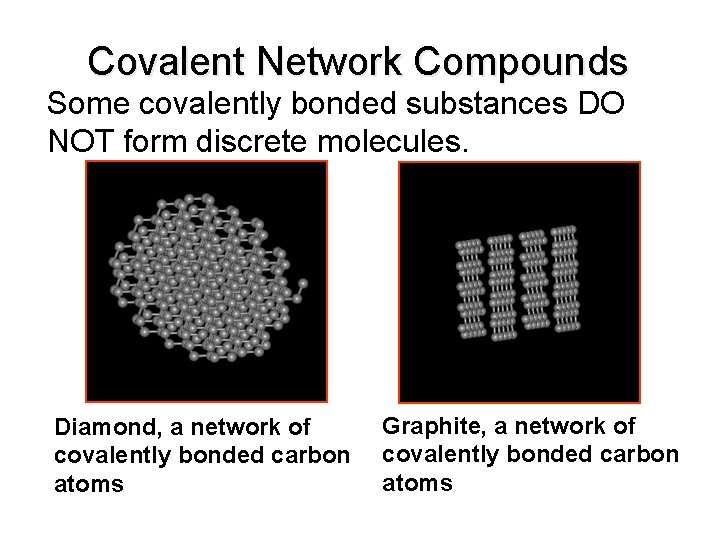
Covalent Network Compounds Some covalently bonded substances DO NOT form discrete molecules. Diamond, a network of covalently bonded carbon atoms Graphite, a network of covalently bonded carbon atoms
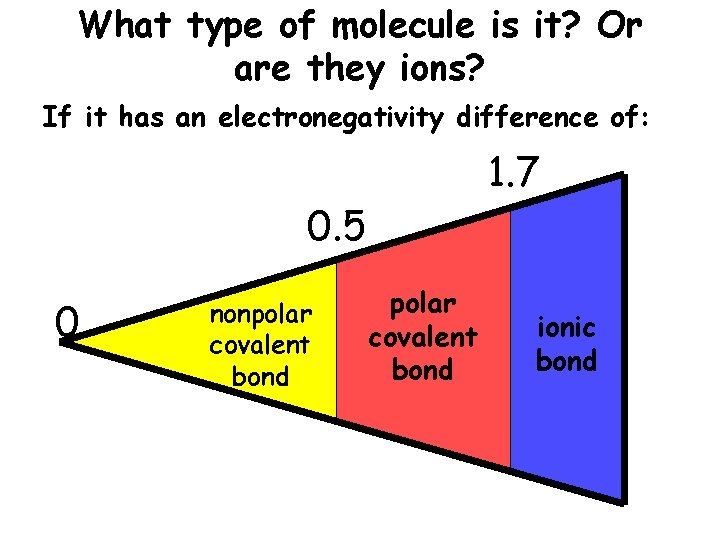
What type of molecule is it? Or are they ions? If it has an electronegativity difference of: 1. 7 0. 5 0 nonpolar covalent bond ionic bond
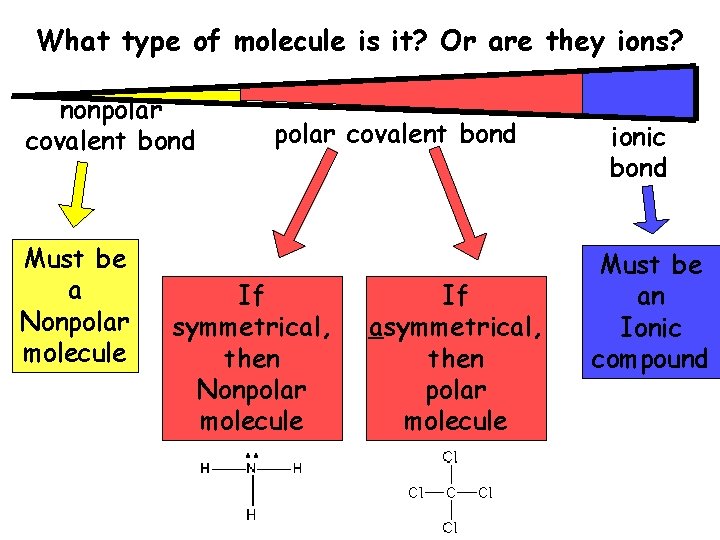
What type of molecule is it? Or are they ions? nonpolar covalent bond Must be a Nonpolar molecule polar covalent bond If symmetrical, then Nonpolar molecule If asymmetrical, then polar molecule ionic bond Must be an Ionic compound
VSEPR Theory • Valence Shell Electron Pair Repulsion Theory allows us to predict geometry • Molecules take a shape that puts electron pairs as far away from each other as possible. • Lewis structures tell us how the atoms are connected to each other. • The shape of a molecule can greatly affect its properties. • Lone electron pairs take up more space.
VSEPR • The number of pairs determines – bond angles – underlying structure • The number of atoms determines – actual shape
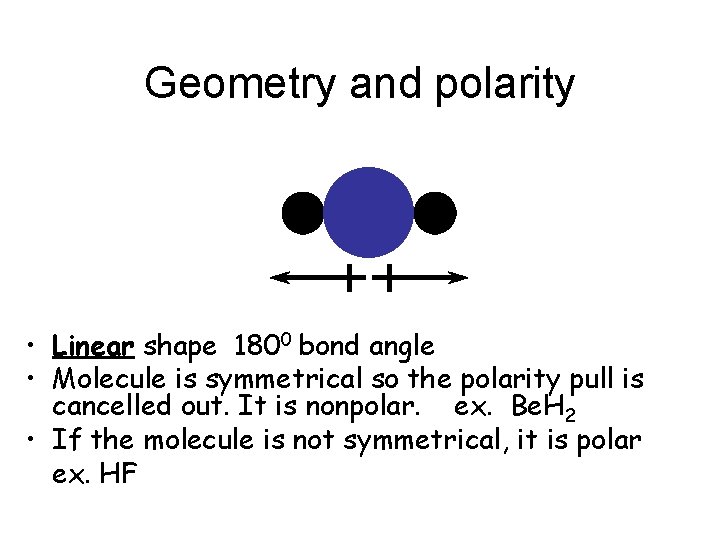
Geometry and polarity • Linear shape 1800 bond angle • Molecule is symmetrical so the polarity pull is cancelled out. It is nonpolar. ex. Be. H 2 • If the molecule is not symmetrical, it is polar ex. HF
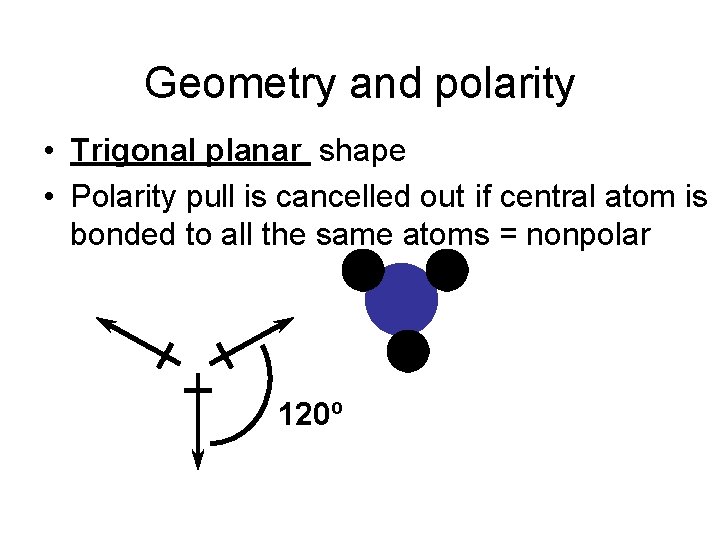
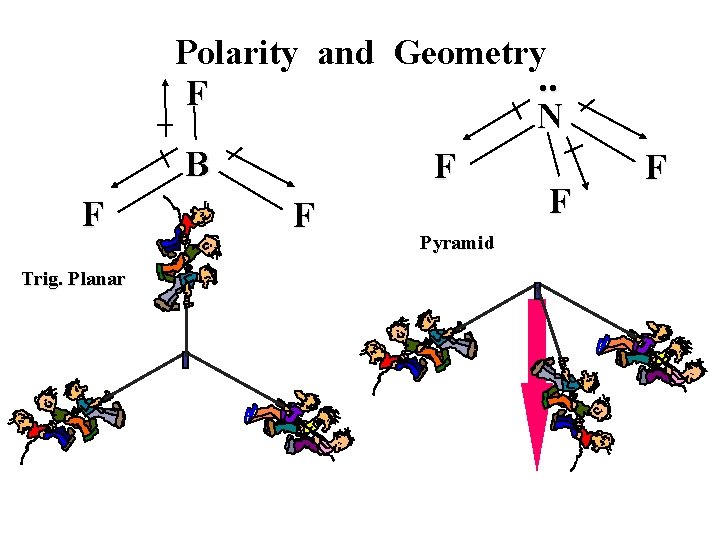
Geometry and polarity • Trigonal planar shape • Polarity pull is cancelled out if central atom is bonded to all the same atoms = nonpolar 120º
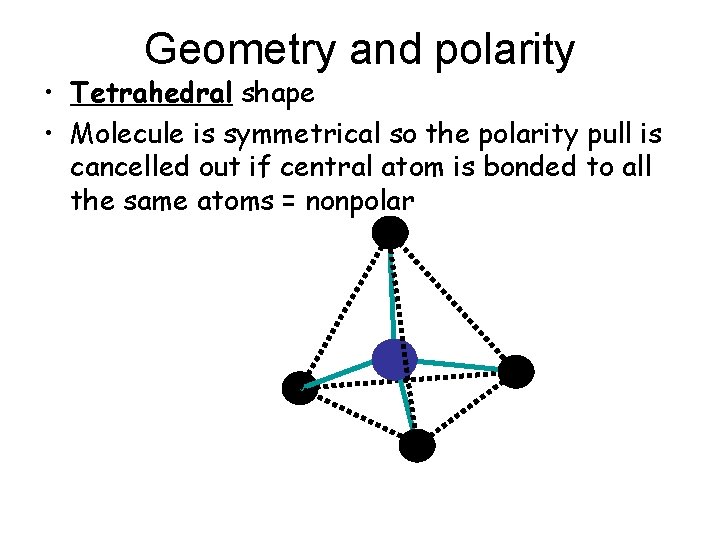
Geometry and polarity • Tetrahedral shape • Molecule is symmetrical so the polarity pull is cancelled out if central atom is bonded to all the same atoms = nonpolar
Geometry and polarity • Bent shape • Polarity pull is not cancelled out, so molecule is a dipole
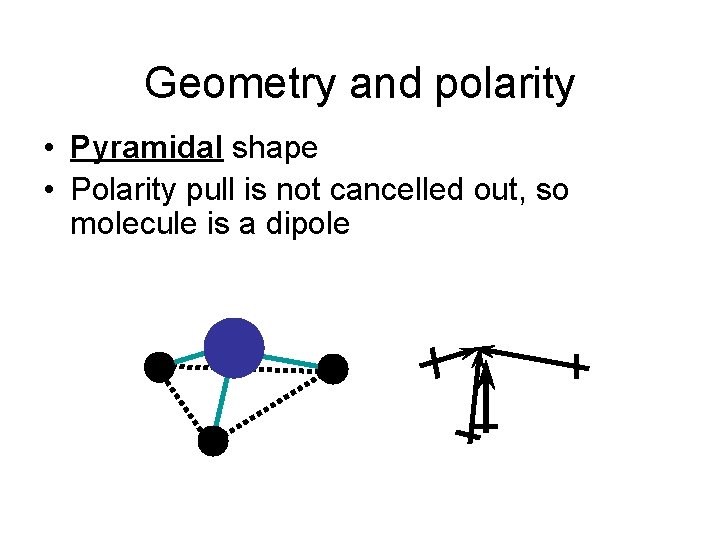
Geometry and polarity • Pyramidal shape • Polarity pull is not cancelled out, so molecule is a dipole
Polarity and Geometry O H C O O H Linear Bent
F Trig. Planar Polarity and Geometry. . F N B F F F Pyramid F
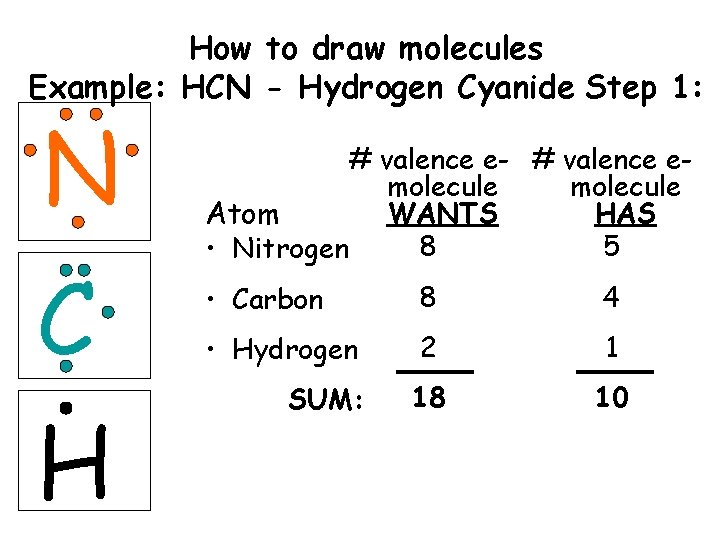
How to draw molecules Example: HCN - Hydrogen Cyanide Step 1: N C H # valence e- # valence emolecule WANTS HAS Atom 8 5 • Nitrogen • Carbon 8 4 • Hydrogen 2 1 18 10 SUM:
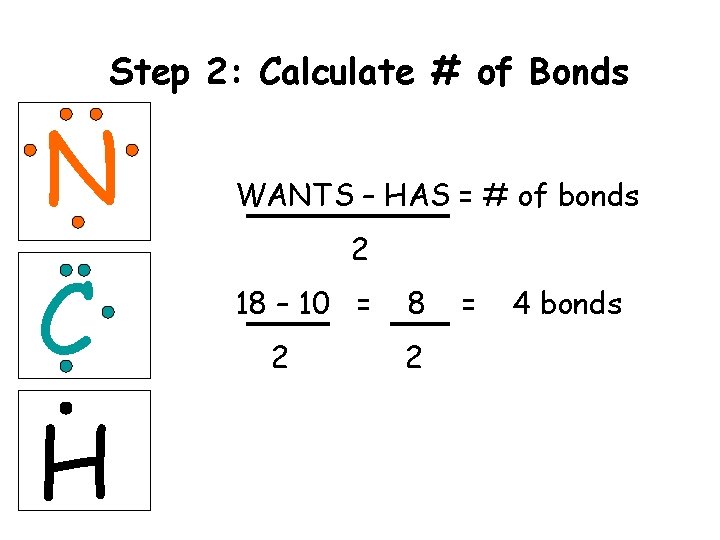
Step 2: Calculate # of Bonds N C H WANTS – HAS = # of bonds 2 18 – 10 = 2 8 2 = 4 bonds
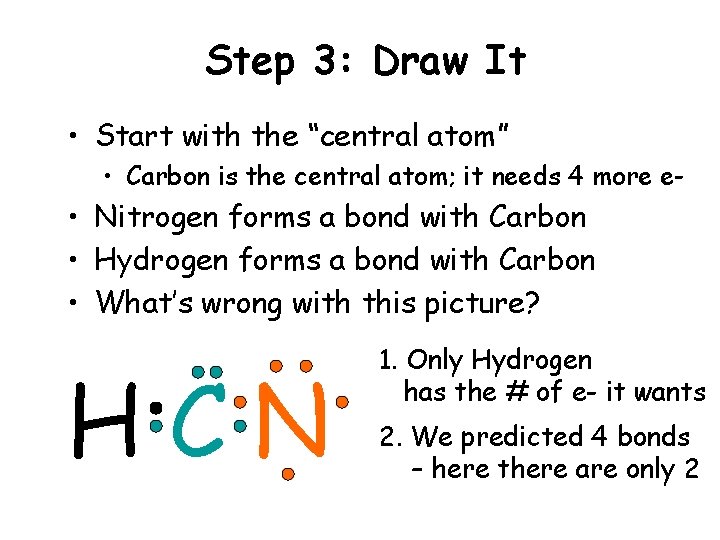
Step 3: Draw It • Start with the “central atom” • Carbon is the central atom; it needs 4 more e- • Nitrogen forms a bond with Carbon • Hydrogen forms a bond with Carbon • What’s wrong with this picture? HCN 1. Only Hydrogen has the # of e- it wants 2. We predicted 4 bonds – here there are only 2
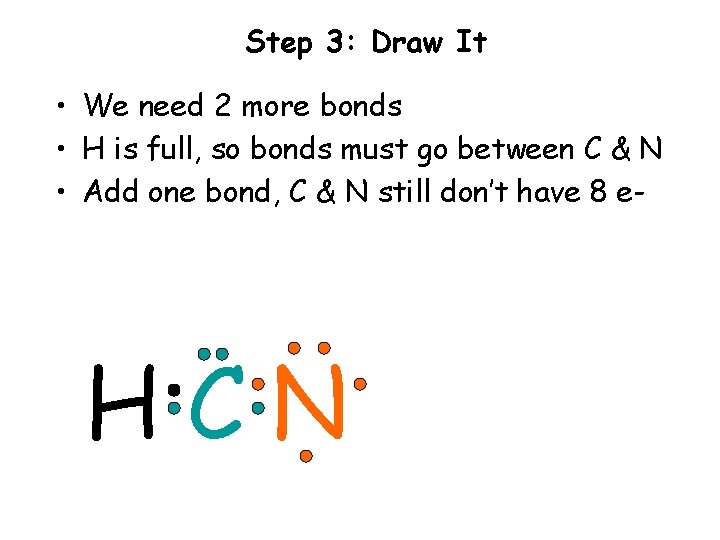
Step 3: Draw It • We need 2 more bonds • H is full, so bonds must go between C & N • Add one bond, C & N still don’t have 8 e- HCN
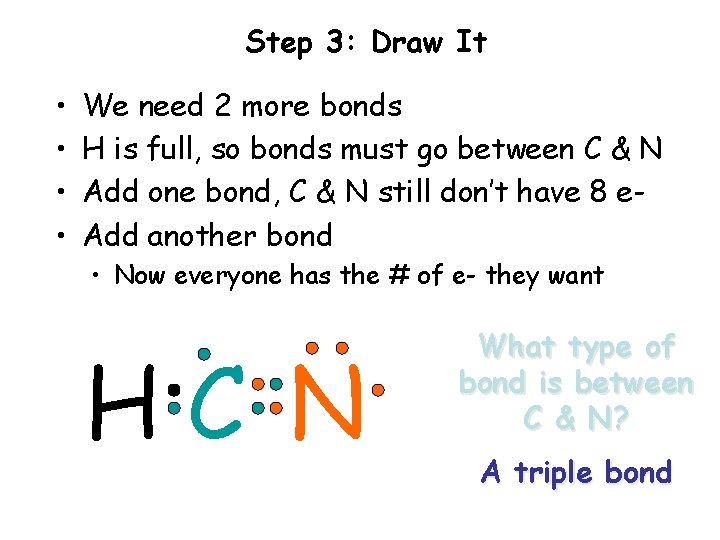
Step 3: Draw It • • We need 2 more bonds H is full, so bonds must go between C & N Add one bond, C & N still don’t have 8 e. Add another bond • Now everyone has the # of e- they want HC N What type of bond is between C & N? A triple bond
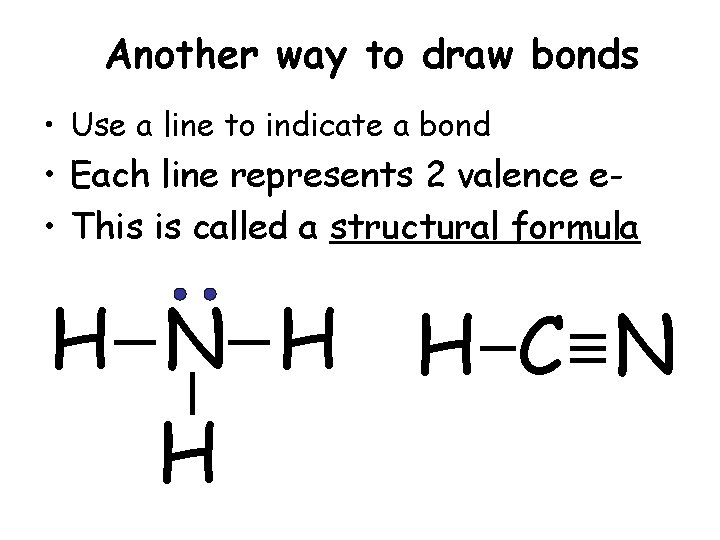
Another way to draw bonds • Use a line to indicate a bond • Each line represents 2 valence e • This is called a structural formula H N H H C N H
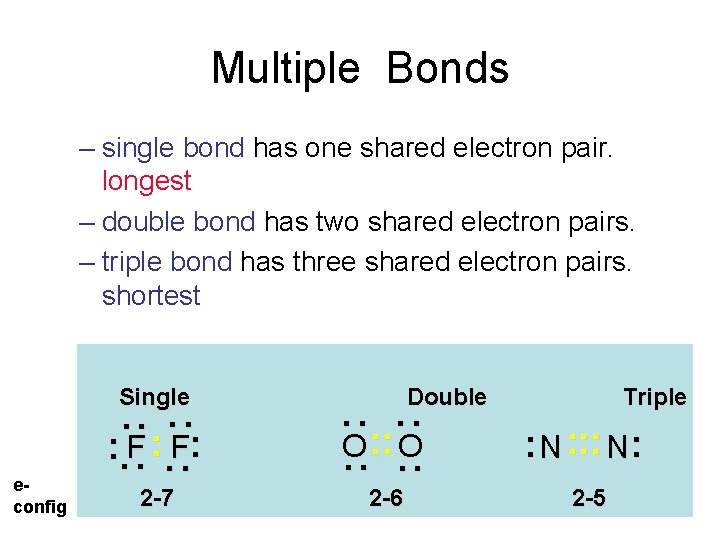
Multiple Bonds – single bond has one shared electron pair. longest – double bond has two shared electron pairs. – triple bond has three shared electron pairs. shortest Single econfig Double Triple . . : . F. : : O. . : N : : : N: 2 -7 2 -6 2 -5
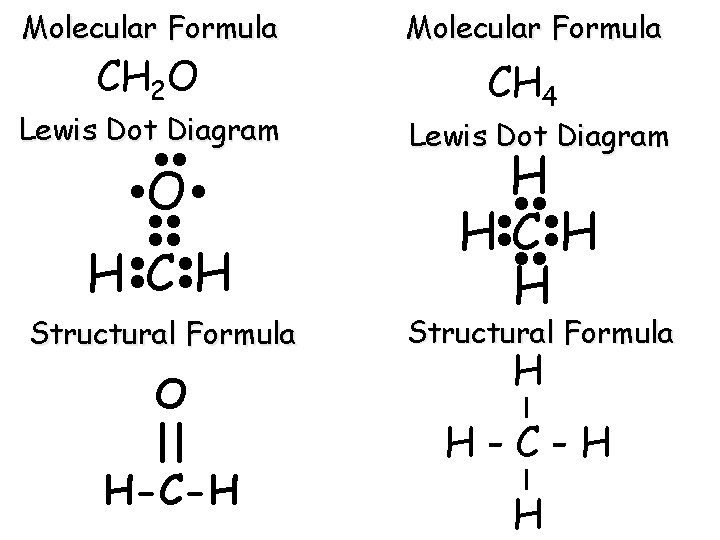
Molecular Formula CH 2 O Lewis Dot Diagram O H CH Structural Formula O || H-C-H Molecular Formula CH 4 Lewis Dot Diagram H HCH H Structural Formula H | H-C-H | H