
Cosmic Times Inquiring into the Nature of the
- Slides: 29
Cosmic Times: Inquiring into the Nature of the Universe Dr. James Lochner USRA & NASA/GSFC Cosmic Times NSTA - St. Louis 2007 1
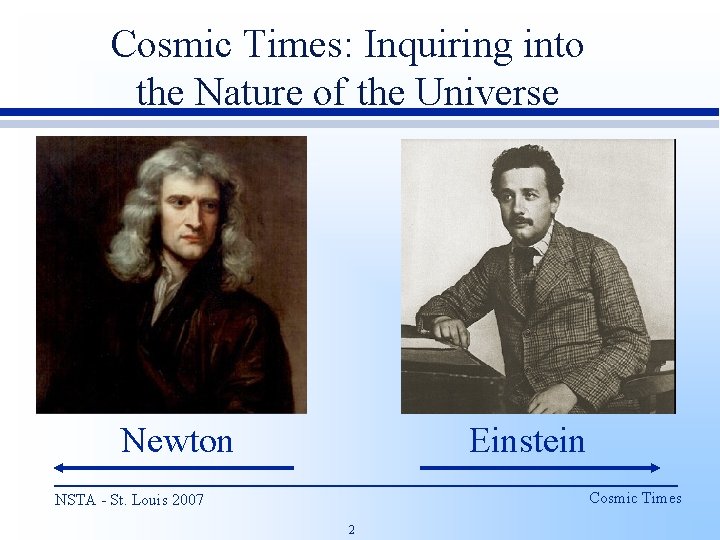
Cosmic Times: Inquiring into the Nature of the Universe Newton Einstein Cosmic Times NSTA - St. Louis 2007 2
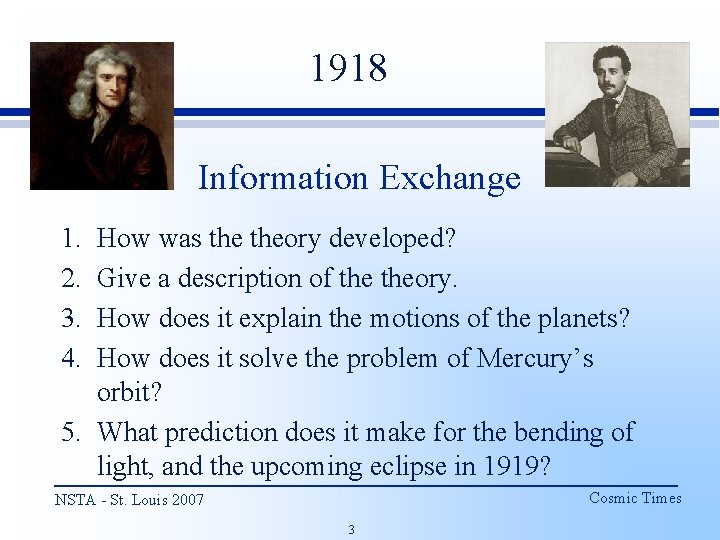
1918 Information Exchange 1. 2. 3. 4. How was theory developed? Give a description of theory. How does it explain the motions of the planets? How does it solve the problem of Mercury’s orbit? 5. What prediction does it make for the bending of light, and the upcoming eclipse in 1919? Cosmic Times NSTA - St. Louis 2007 3
Cosmic Times NSTA - St. Louis 2007 4
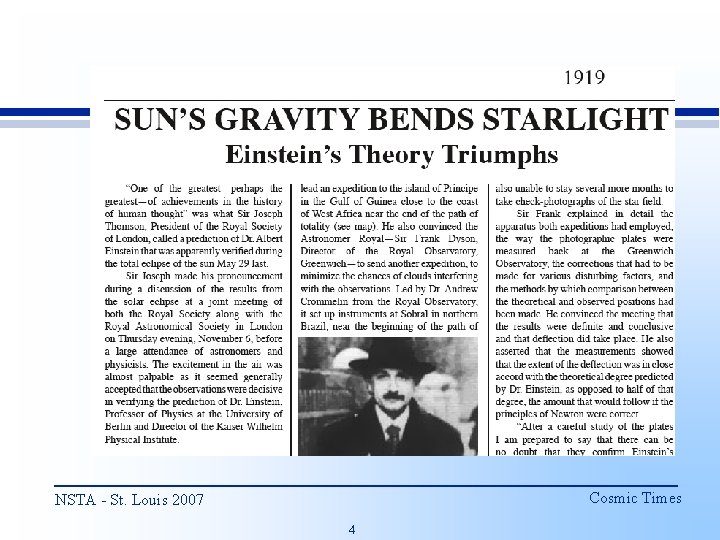
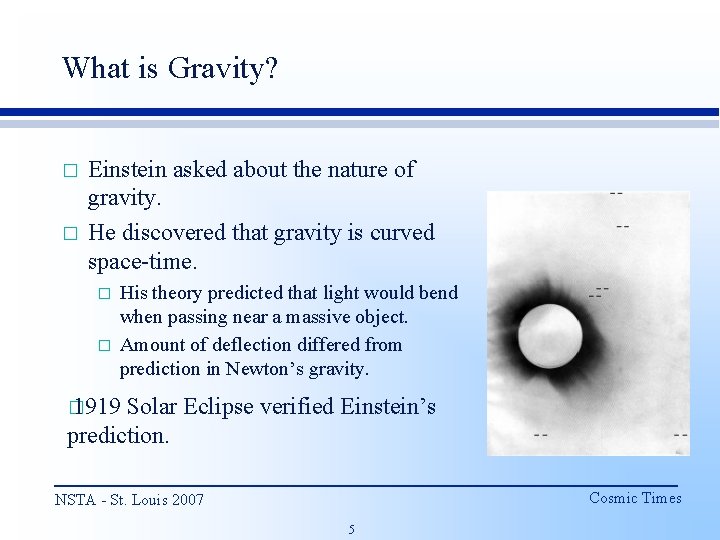
What is Gravity? � � Einstein asked about the nature of gravity. He discovered that gravity is curved space-time. � � His theory predicted that light would bend when passing near a massive object. Amount of deflection differed from prediction in Newton’s gravity. � 1919 Solar Eclipse verified Einstein’s prediction. Cosmic Times NSTA - St. Louis 2007 5
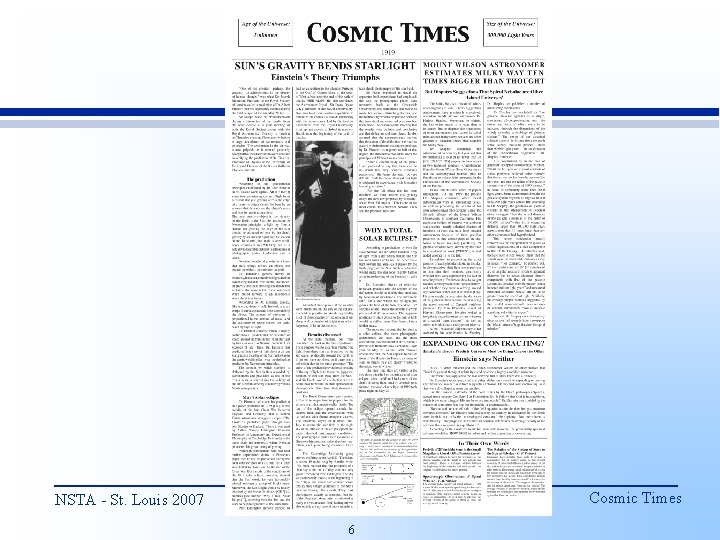
Cosmic Times NSTA - St. Louis 2007 6
Preview: Cosmic Times � Our “Cosmic Times” project will trace the understanding of the nature of the universe through the 20 th century. � � � Start in 1919 with confirmation of Einstein’s theory of gravity (and its implications for the nature of the universe). Continue through to discovery of Dark Energy, our current state of knowledge, and stepping stones to future. Will Consist of 6 Posters, with Classroom Lessons � Lessons at Middle School and High School level, covering topics in physics, astronomy and interdisciplinary Cosmic Times NSTA - St. Louis 2007 7
The Rest of the Story … � What are some questions we might ask? � And what are the tools we might use? Cosmic Times NSTA - St. Louis 2007 8
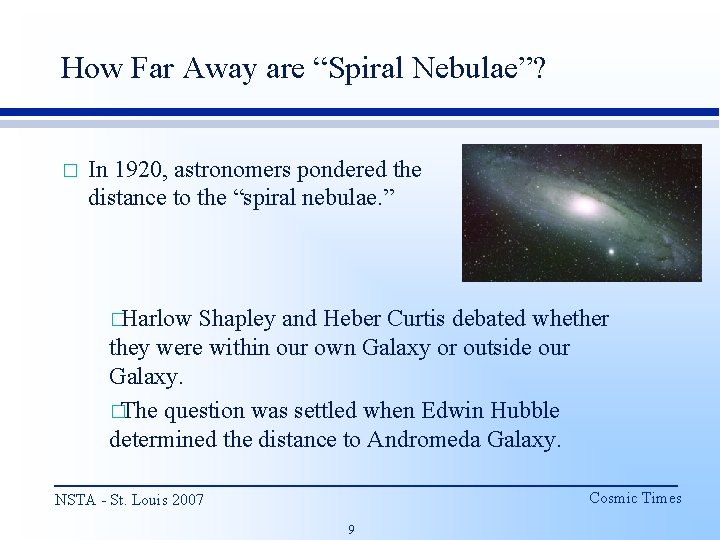
How Far Away are “Spiral Nebulae”? � In 1920, astronomers pondered the distance to the “spiral nebulae. ” �Harlow Shapley and Heber Curtis debated whether they were within our own Galaxy or outside our Galaxy. �The question was settled when Edwin Hubble determined the distance to Andromeda Galaxy. Cosmic Times NSTA - St. Louis 2007 9
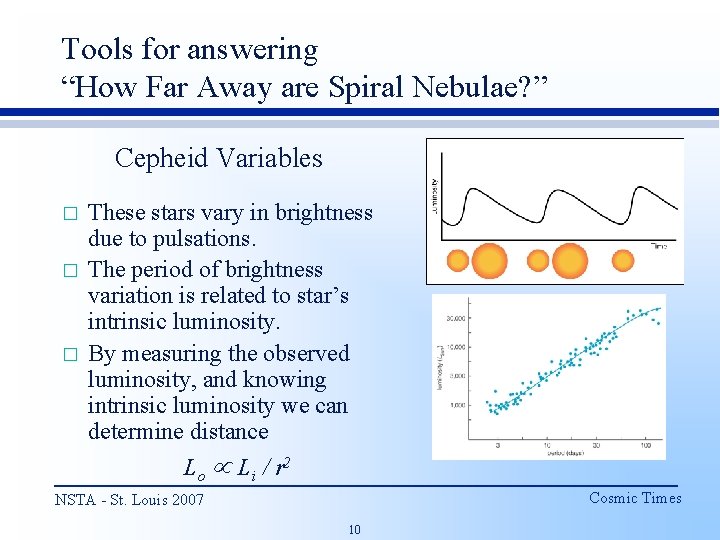
Tools for answering “How Far Away are Spiral Nebulae? ” Cepheid Variables � � � These stars vary in brightness due to pulsations. The period of brightness variation is related to star’s intrinsic luminosity. By measuring the observed luminosity, and knowing intrinsic luminosity we can determine distance L o µ L i / r 2 Cosmic Times NSTA - St. Louis 2007 10
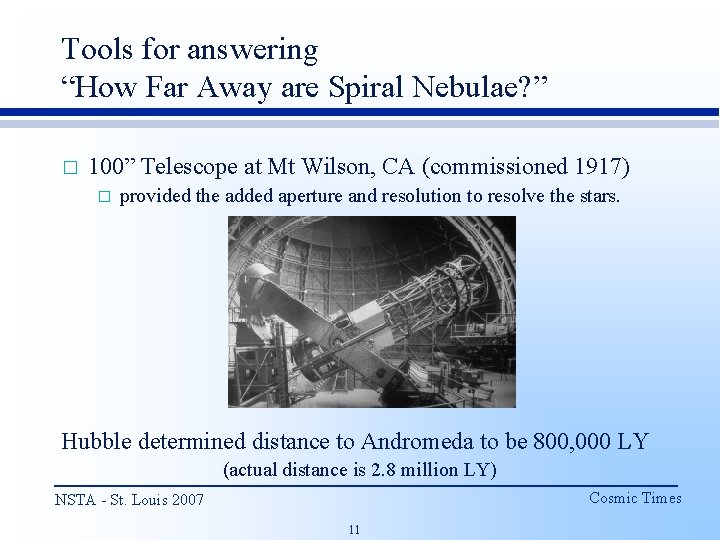
Tools for answering “How Far Away are Spiral Nebulae? ” � 100” Telescope at Mt Wilson, CA (commissioned 1917) � provided the added aperture and resolution to resolve the stars. Hubble determined distance to Andromeda to be 800, 000 LY (actual distance is 2. 8 million LY) Cosmic Times NSTA - St. Louis 2007 11
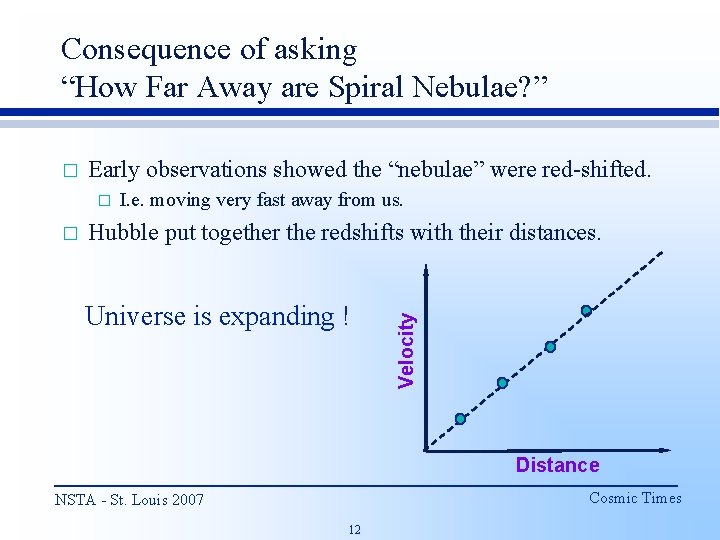
Consequence of asking “How Far Away are Spiral Nebulae? ” Early observations showed the “nebulae” were red-shifted. � � I. e. moving very fast away from us. Hubble put together the redshifts with their distances. Universe is expanding ! Velocity � Distance Cosmic Times NSTA - St. Louis 2007 12
Is Universe a “Steady State” or Did it originate from a “Big Bang? ” � Steady State Theory: As universe expands, matter is created. � � Creation rate - a few hundred atoms per year per galaxy Big Bang: running expansion backwards leads us to a point of high density and high temperature from which universe originated. (Create everything all at once) Cosmic Times NSTA - St. Louis 2007 13
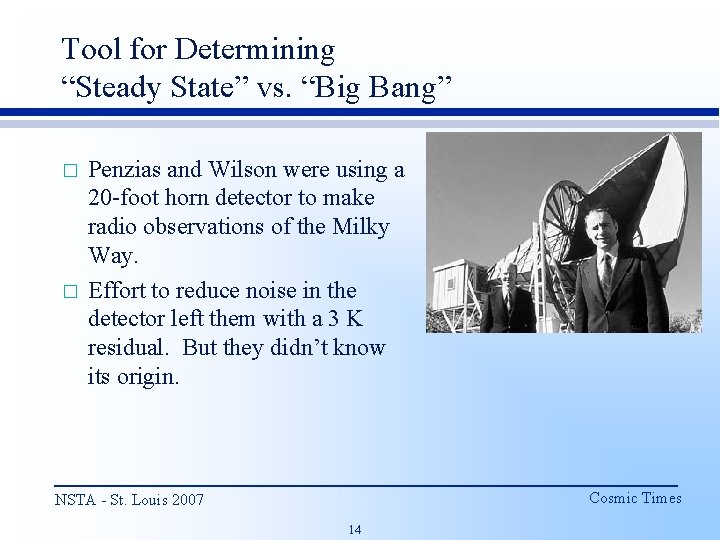
Tool for Determining “Steady State” vs. “Big Bang” � � Penzias and Wilson were using a 20 -foot horn detector to make radio observations of the Milky Way. Effort to reduce noise in the detector left them with a 3 K residual. But they didn’t know its origin. Cosmic Times NSTA - St. Louis 2007 14
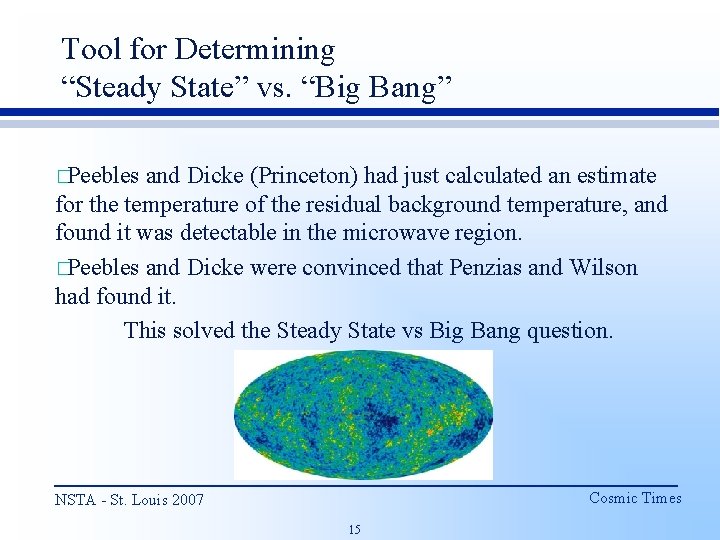
Tool for Determining “Steady State” vs. “Big Bang” �Peebles and Dicke (Princeton) had just calculated an estimate for the temperature of the residual background temperature, and found it was detectable in the microwave region. �Peebles and Dicke were convinced that Penzias and Wilson had found it. This solved the Steady State vs Big Bang question. Cosmic Times NSTA - St. Louis 2007 15
How Fast is the Expansion Slowing Down? � � Saul Perlmutter (UC Berkeley) wanted to determine the deceleration rate of the expansion. Amount of deceleration depends on average mass density. � � So we’d be “weighing the universe” This would lead to determining the curvature of the universe and whether the universe is infinite or not. Cosmic Times NSTA - St. Louis 2007 16
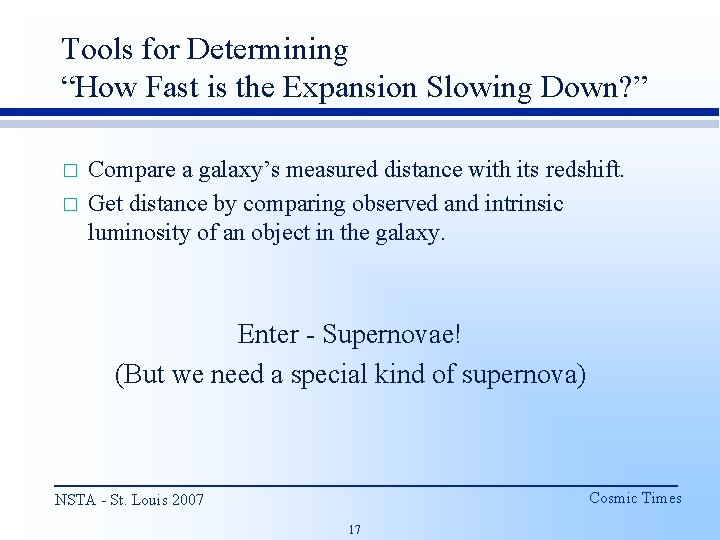
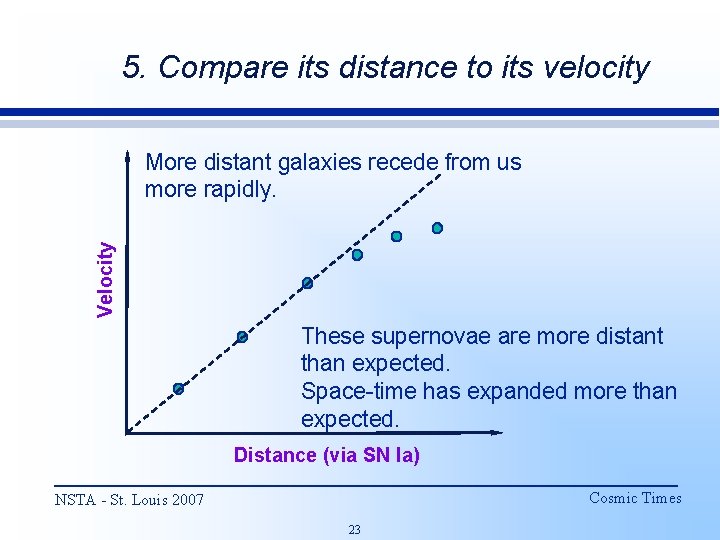
Tools for Determining “How Fast is the Expansion Slowing Down? ” � � Compare a galaxy’s measured distance with its redshift. Get distance by comparing observed and intrinsic luminosity of an object in the galaxy. Enter - Supernovae! (But we need a special kind of supernova) Cosmic Times NSTA - St. Louis 2007 17
Cosmic Times NSTA - St. Louis 2007 18
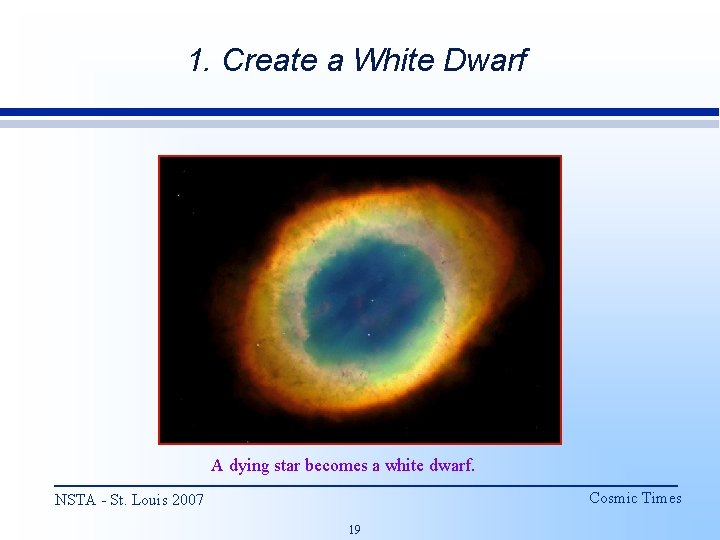
1. Create a White Dwarf A dying star becomes a white dwarf. Cosmic Times NSTA - St. Louis 2007 19
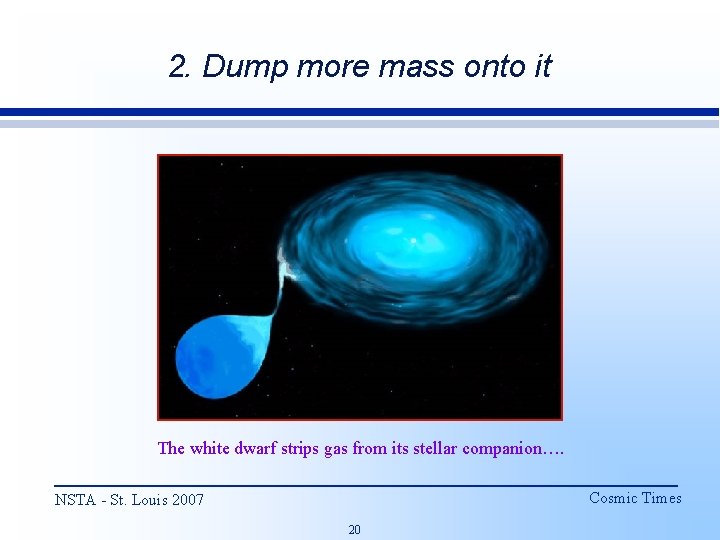
2. Dump more mass onto it The white dwarf strips gas from its stellar companion…. Cosmic Times NSTA - St. Louis 2007 20
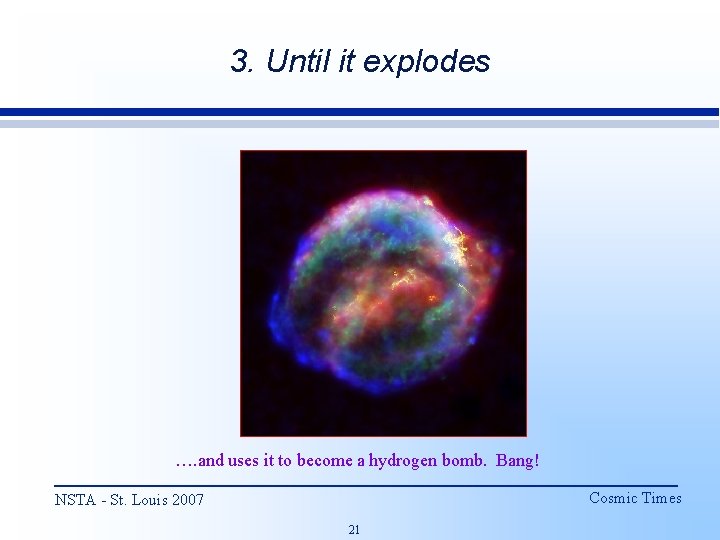
3. Until it explodes …. and uses it to become a hydrogen bomb. Bang! Cosmic Times NSTA - St. Louis 2007 21
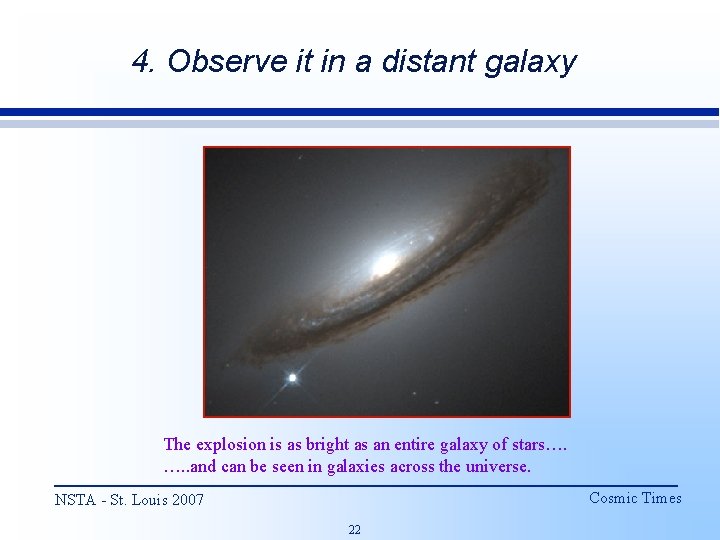
4. Observe it in a distant galaxy The explosion is as bright as an entire galaxy of stars…. …. . and can be seen in galaxies across the universe. Cosmic Times NSTA - St. Louis 2007 22
5. Compare its distance to its velocity Velocity More distant galaxies recede from us more rapidly. These supernovae are more distant than expected. Space-time has expanded more than expected. Distance (via SN Ia) Cosmic Times NSTA - St. Louis 2007 23
History of the Universe’s Expansion Cosmic Times NSTA - St. Louis 2007 24
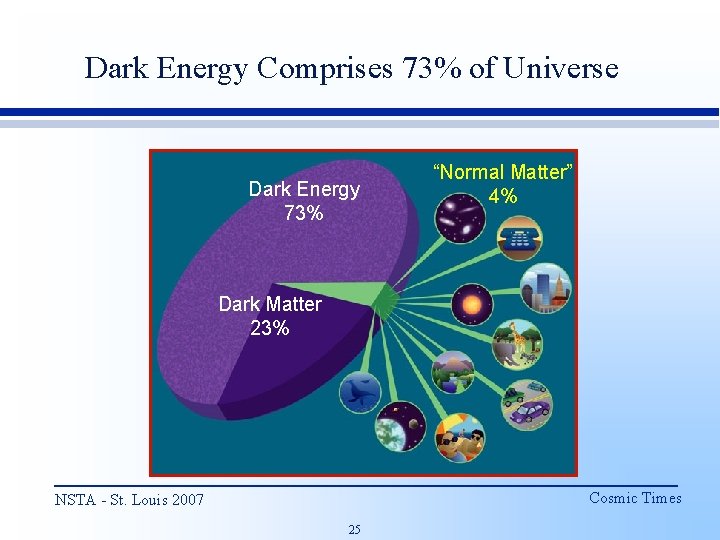
Dark Energy Comprises 73% of Universe Dark Energy 73% “Normal Matter” 4% Dark Matter 23% Cosmic Times NSTA - St. Louis 2007 25
Dark Energy is an Unfinished Story WE DON’T KNOW WHAT IT IS! But it traces the story of our understanding of the nature of the universe. � An ideal setting for illustrating the process of science: � � Science is alive and on-going. Our ideas change as the data changes. Scientific debate differs from social/political debate. Progress in science results from both individual and group efforts. Cosmic Times NSTA - St. Louis 2007 26
Cosmic Times: Scientific Themes � � � Our understanding of the Expansion of the Universe Nature of Supernovae The size and scale of the Universe A number of other themes will also appear. � � Role of Women in early astronomy. Impact of improved technology. Cosmic Times NSTA - St. Louis 2007 27
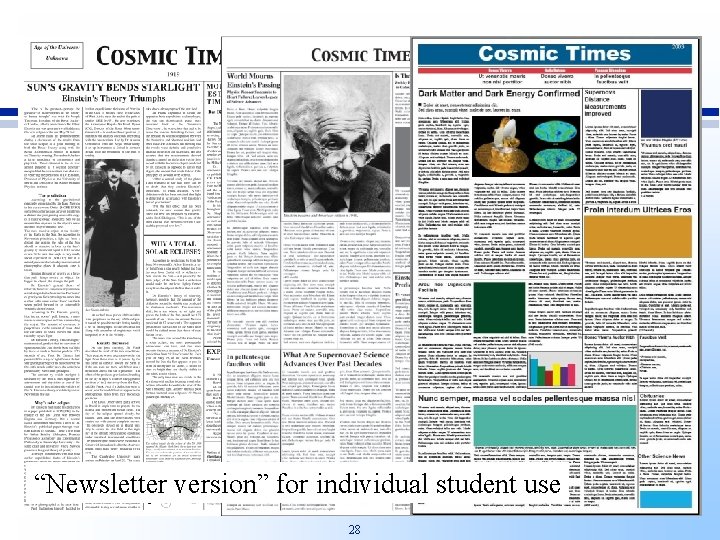
“Newsletter version” for individual student use NSTA - St. Louis 2007 28 Cosmic Times
Cosmic Times Web Site � http: //cosmictimes. gsfc. nasa. gov/ � Web site will contain Posters, Newsletters, Teacher Material, Lessons � Currently in Development, so check back often. Cosmic Times NSTA - St. Louis 2007 29