
Cosmic ray propagation models and interpretation of results

- Slides: 25
Cosmic ray propagation models and interpretation of results from recent space experiments Fiorenza Donato Department of Theoretical Physics, Un. Torino Marcel Grossman Meeting – Session AP 3 Paris, july 17, 2009
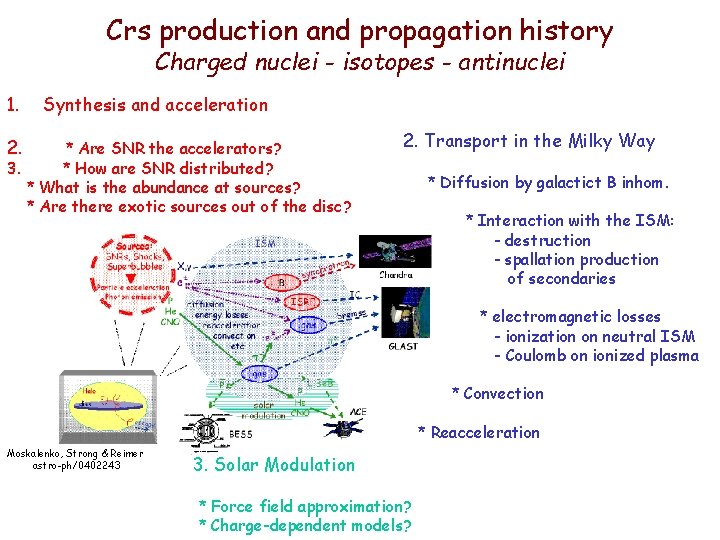
Crs production and propagation history Charged nuclei - isotopes - antinuclei 1. Synthesis and acceleration 2. * Are SNR the accelerators? 3. * How are SNR distributed? * What is the abundance at sources? * Are there exotic sources out of the disc? 2. Transport in the Milky Way * Diffusion by galactict B inhom. * Interaction with the ISM: - destruction - spallation production of secondaries * electromagnetic losses - ionization on neutral ISM - Coulomb on ionized plasma * Convection * Reacceleration Moskalenko, Strong & Reimer astro-ph/0402243 3. Solar Modulation * Force field approximation? * Charge-dependent models?
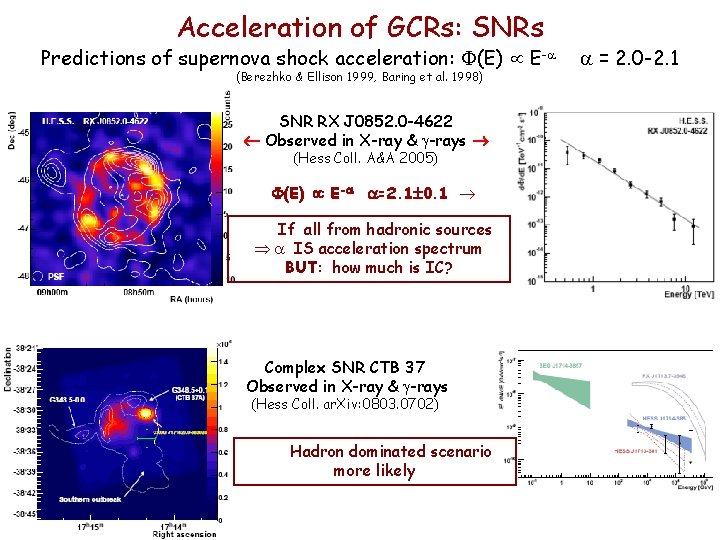
Acceleration of GCRs: SNRs Predictions of supernova shock acceleration: (E) E- (Berezhko & Ellison 1999, Baring et al. 1998) SNR RX J 0852. 0 -4622 Observed in X-ray & -rays (Hess Coll. A&A 2005) (E) E- =2. 1 0. 1 If all from hadronic sources IS acceleration spectrum BUT: how much is IC? Complex SNR CTB 37 Observed in X-ray & -rays (Hess Coll. ar. Xiv: 0803. 0702) Hadron dominated scenario more likely = 2. 0 -2. 1
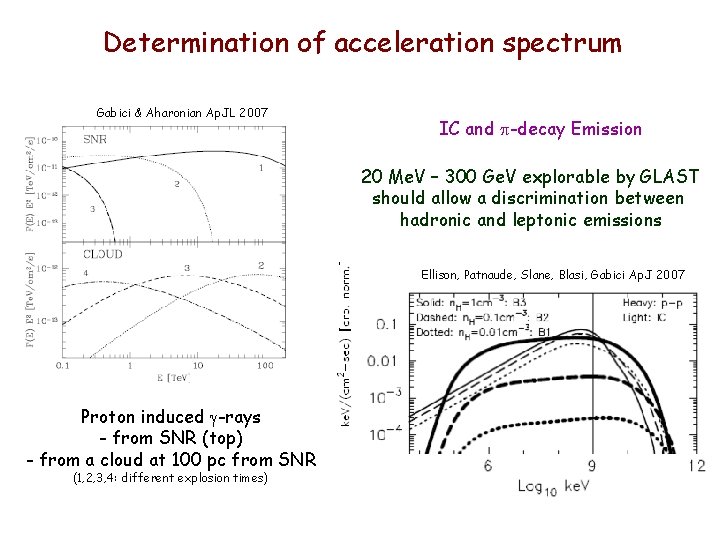
Determination of acceleration spectrum Gabici & Aharonian Ap. JL 2007 IC and -decay Emission 20 Me. V – 300 Ge. V explorable by GLAST should allow a discrimination between hadronic and leptonic emissions Ellison, Patnaude, Slane, Blasi, Gabici Ap. J 2007 Proton induced -rays - from SNR (top) - from a cloud at 100 pc from SNR (1, 2, 3, 4: different explosion times)
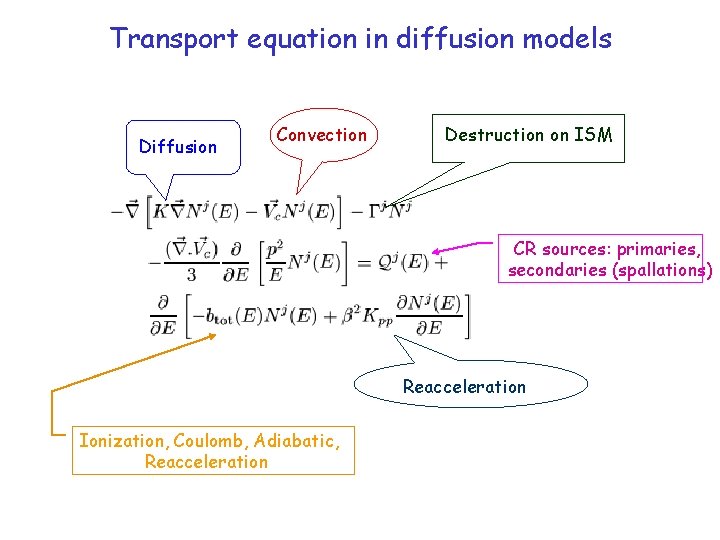
Transport equation in diffusion models Diffusion Convection Destruction on ISM CR sources: primaries, secondaries (spallations) Reacceleration Ionization, Coulomb, Adiabatic, Reacceleration
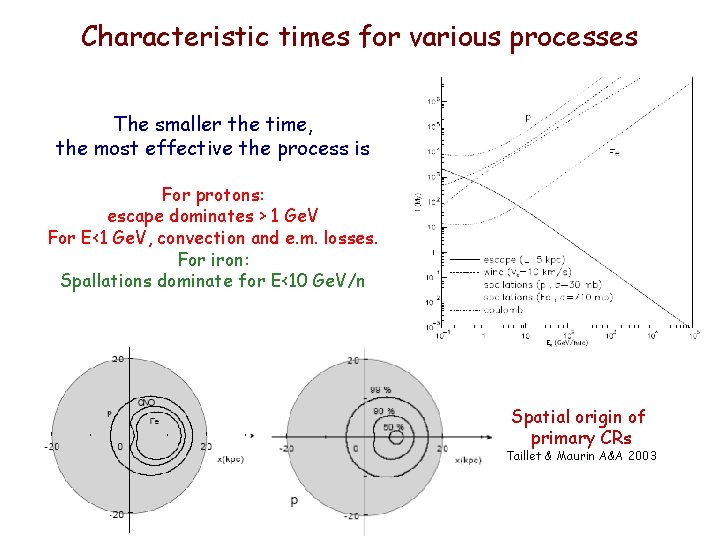
Characteristic times for various processes The smaller the time, the most effective the process is For protons: escape dominates > 1 Ge. V For E<1 Ge. V, convection and e. m. losses. For iron: Spallations dominate for E<10 Ge. V/n Spatial origin of primary CRs Taillet & Maurin A&A 2003
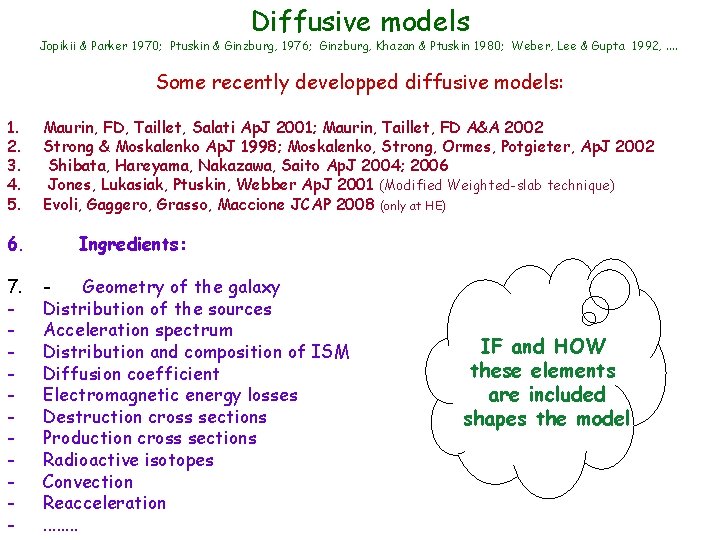
Diffusive models Jopikii & Parker 1970; Ptuskin & Ginzburg, 1976; Ginzburg, Khazan & Ptuskin 1980; Weber, Lee & Gupta 1992, . . Some recently developped diffusive models: 1. 2. 3. 4. 5. 6. 7. - Maurin, FD, Taillet, Salati Ap. J 2001; Maurin, Taillet, FD A&A 2002 Strong & Moskalenko Ap. J 1998; Moskalenko, Strong, Ormes, Potgieter, Ap. J 2002 Shibata, Hareyama, Nakazawa, Saito Ap. J 2004; 2006 Jones, Lukasiak, Ptuskin, Webber Ap. J 2001 (Modified Weighted-slab technique) Evoli, Gaggero, Grasso, Maccione JCAP 2008 (only at HE) Ingredients: Geometry of the galaxy Distribution of the sources Acceleration spectrum Distribution and composition of ISM Diffusion coefficient Electromagnetic energy losses Destruction cross sections Production cross sections Radioactive isotopes Convection Reacceleration. . . . IF and HOW these elements are included shapes the model
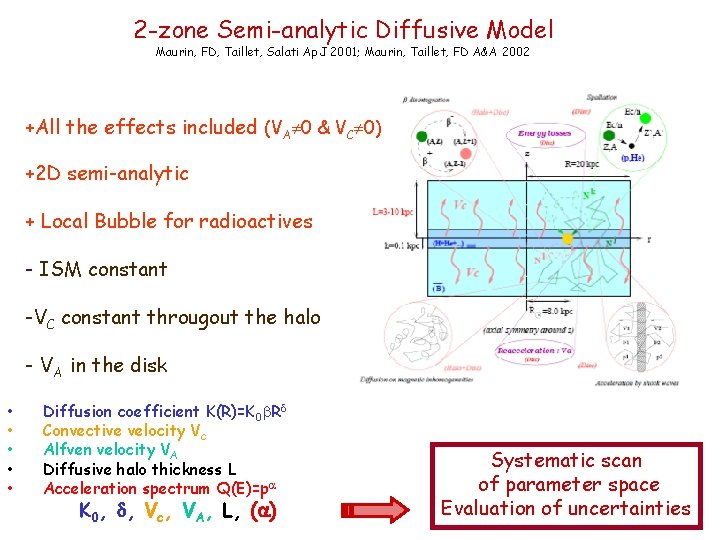
2 -zone Semi-analytic Diffusive Model Maurin, FD, Taillet, Salati Ap. J 2001; Maurin, Taillet, FD A&A 2002 +All the effects included (VA 0 & VC 0) +2 D semi-analytic + Local Bubble for radioactives - ISM constant -VC constant througout the halo - VA in the disk • • • Diffusion coefficient K(R)=K 0 b. R Convective velocity Vc Alfven velocity VA Diffusive halo thickness L Acceleration spectrum Q(E)=p K 0, d, Vc, VA, L, ( ) Systematic scan of parameter space Evaluation of uncertainties
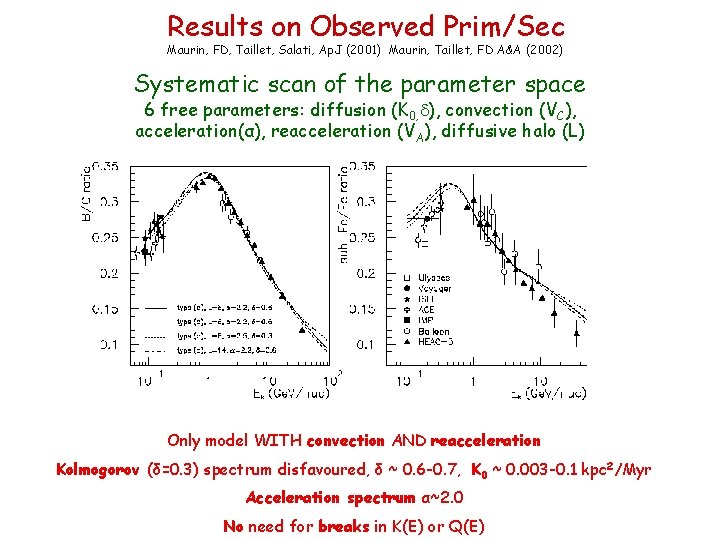
Results on Observed Prim/Sec Maurin, FD, Taillet, Salati, Ap. J (2001) Maurin, Taillet, FD A&A (2002) Systematic scan of the parameter space 6 free parameters: diffusion (K 0, ), convection (VC), acceleration(α), reacceleration (VA), diffusive halo (L) Only model WITH convection AND reacceleration Kolmogorov (δ=0. 3) spectrum disfavoured, δ ~ 0. 6 -0. 7, K 0 ~ 0. 003 -0. 1 kpc 2/Myr Acceleration spectrum α~2. 0 No need for breaks in K(E) or Q(E)
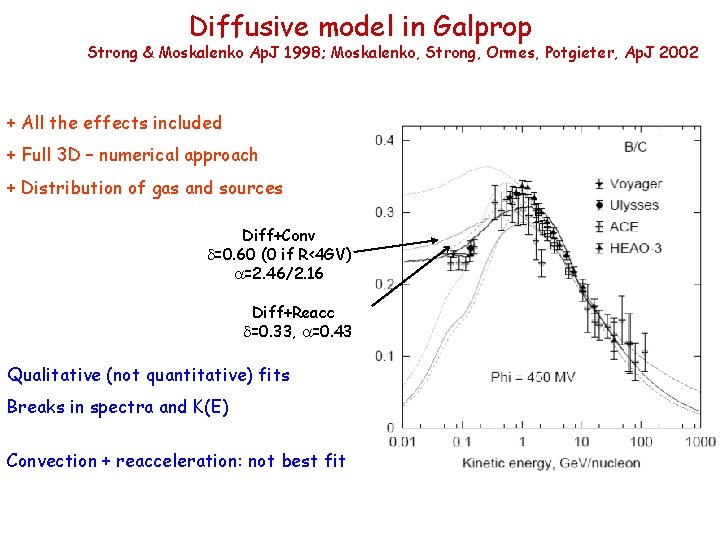
Diffusive model in Galprop Strong & Moskalenko Ap. J 1998; Moskalenko, Strong, Ormes, Potgieter, Ap. J 2002 + All the effects included + Full 3 D – numerical approach + Distribution of gas and sources Diff+Conv =0. 60 (0 if R<4 GV) =2. 46/2. 16 Diff+Reacc =0. 33, =0. 43 Qualitative (not quantitative) fits Breaks in spectra and K(E) Convection + reacceleration: not best fit
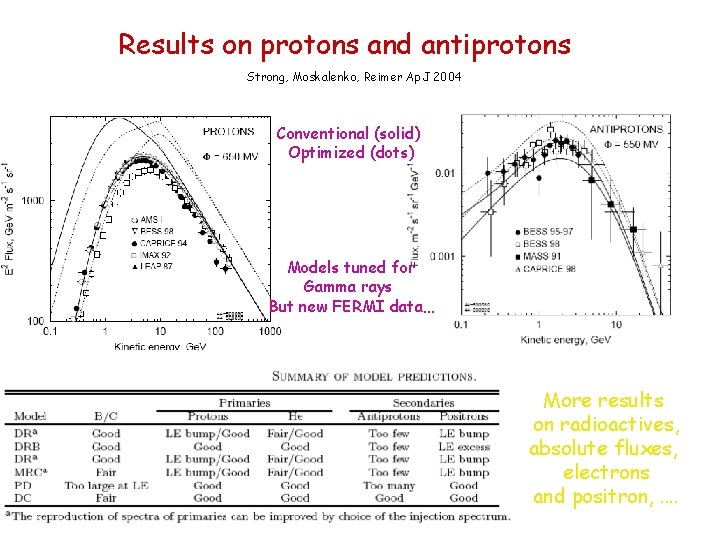
Results on protons and antiprotons Strong, Moskalenko, Reimer Ap. J 2004 Conventional (solid) Optimized (dots) Models tuned for Gamma rays But new FERMI data… More results on radioactives, absolute fluxes, electrons and positron, . .
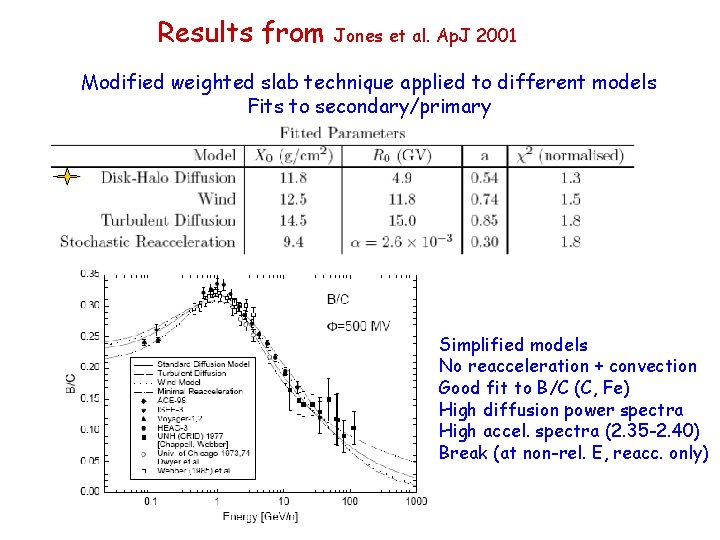
Results from Jones et al. Ap. J 2001 Modified weighted slab technique applied to different models Fits to secondary/primary Simplified models No reacceleration + convection Good fit to B/C (C, Fe) High diffusion power spectra High accel. spectra (2. 35 -2. 40) Break (at non-rel. E, reacc. only)
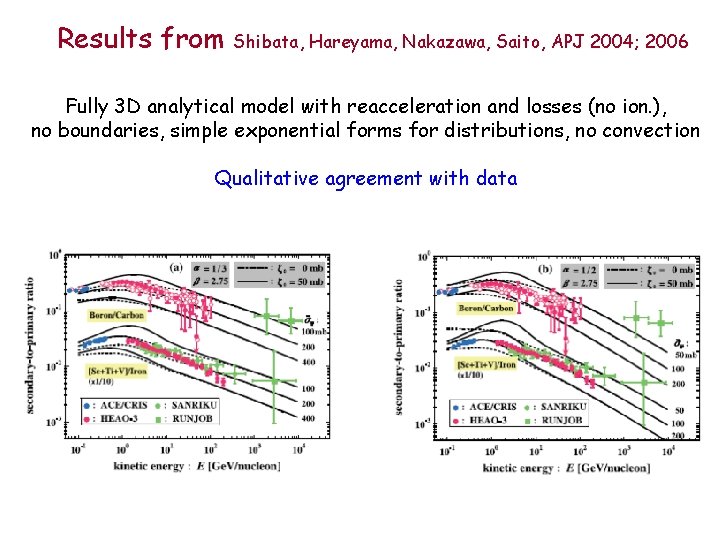
Results from Shibata, Hareyama, Nakazawa, Saito, APJ 2004; 2006 Fully 3 D analytical model with reacceleration and losses (no ion. ), no boundaries, simple exponential forms for distributions, no convection Qualitative agreement with data
No definite propagation model comes out High degeneracy of models Need more data around 1 Ge. V/n and at >20 -30 Ge. V/n What consequences on antimatter fluxes?
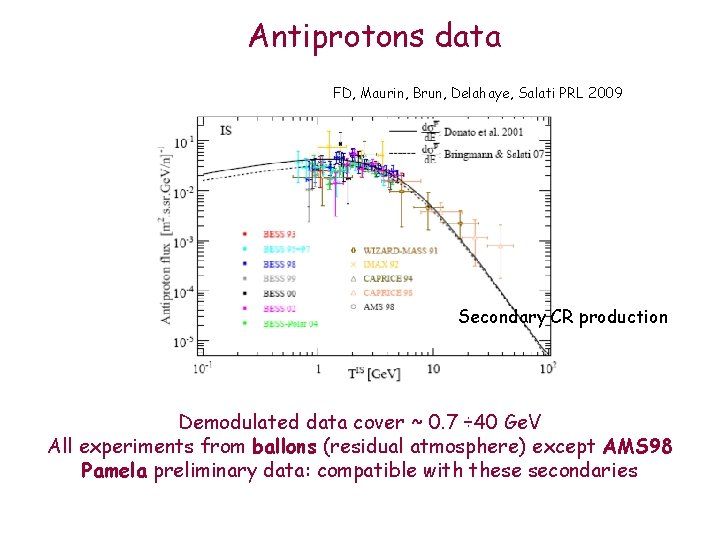
Antiprotons data FD, Maurin, Brun, Delahaye, Salati PRL 2009 Secondary CR production Demodulated data cover ~ 0. 7 ÷ 40 Ge. V All experiments from ballons (residual atmosphere) except AMS 98 Pamela preliminary data: compatible with these secondaries
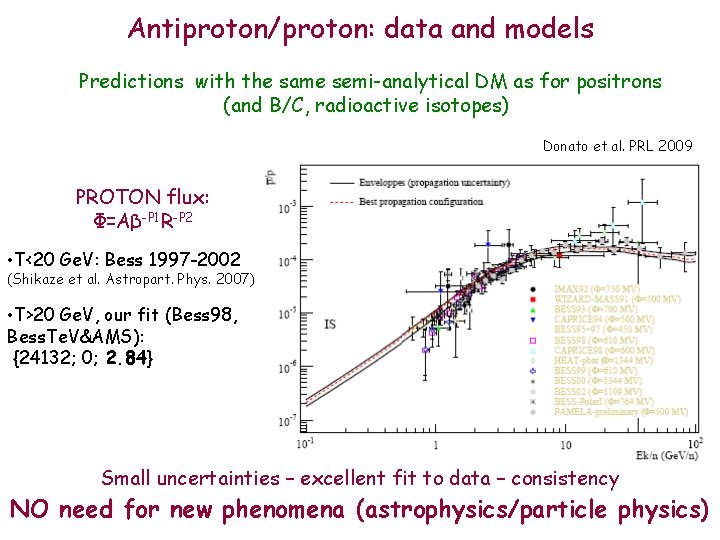
Antiproton/proton: data and models Predictions with the same semi-analytical DM as for positrons (and B/C, radioactive isotopes) Donato et al. PRL 2009 PROTON flux: Φ=Aβ-P 1 R-P 2 • T<20 Ge. V: Bess 1997 -2002 (Shikaze et al. Astropart. Phys. 2007) • T>20 Ge. V, our fit (Bess 98, Bess. Te. V&AMS): {24132; 0; 2. 84} Small uncertainties – excellent fit to data – consistency NO need for new phenomena (astrophysics/particle physics)
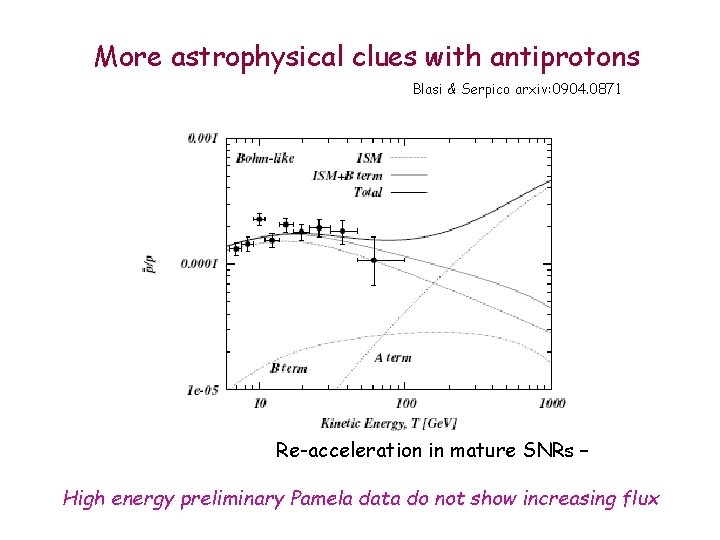
More astrophysical clues with antiprotons Blasi & Serpico arxiv: 0904. 0871 Re-acceleration in mature SNRs – High energy preliminary Pamela data do not show increasing flux
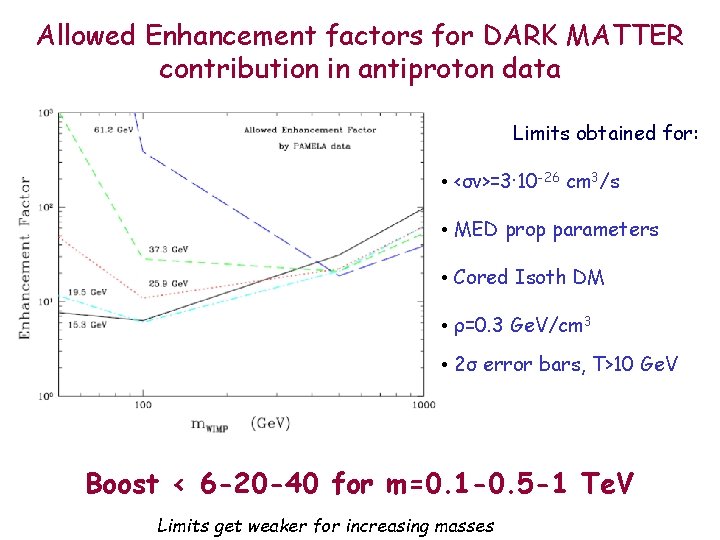
Allowed Enhancement factors for DARK MATTER contribution in antiproton data Limits obtained for: • <σv>=3· 10 -26 cm 3/s • MED prop parameters • Cored Isoth DM • ρ=0. 3 Ge. V/cm 3 • 2σ error bars, T>10 Ge. V Boost < 6 -20 -40 for m=0. 1 -0. 5 -1 Te. V Limits get weaker for increasing masses
Enhancement of the antiproton flux? • Clumpiness in the DM distribution in the Milky Way: energy dependent (Lavalle, Yaun, Maurin, Bi A&A 2008) boost factors may be different for positrons, antiprotons, gamma rays, … (Lavalle, Pochon, Salati, Taillet A&A 2006) a low boost factor (for gamma rays) emerges from most recent N-body simulations (Diemand et al. 2008; Springel et. MNRAS 2008; Brun, Delahaye, Diemand, Profumo, Salati 0904. 0812) • Enhancement of the annihilation cross section (Bergstrom PLB 1989; Hisano et al. PRL 2004) depends on the mass (> Te. V) Compatibility with positron data?
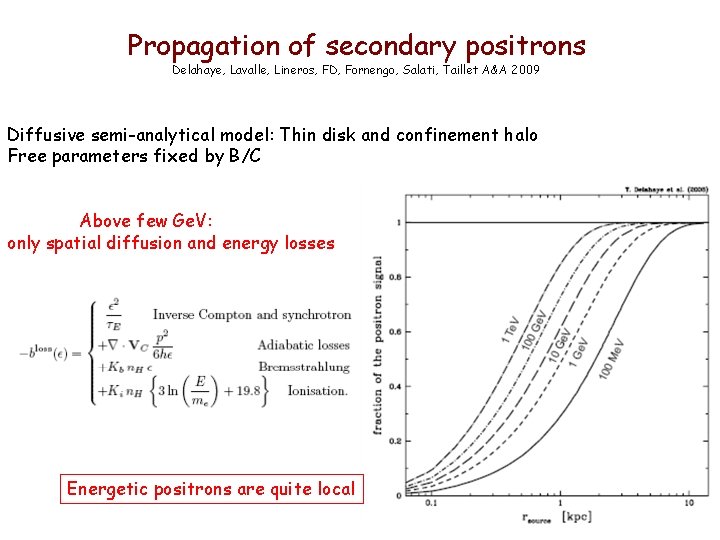
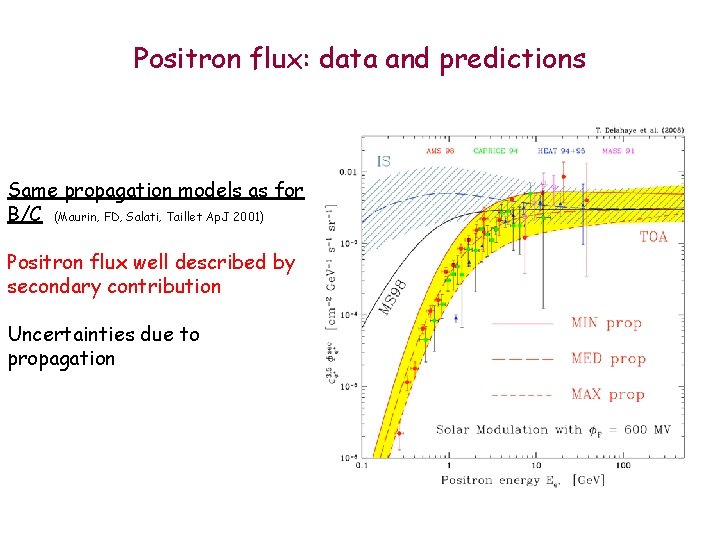
Propagation of secondary positrons Delahaye, Lavalle, Lineros, FD, Fornengo, Salati, Taillet A&A 2009 Diffusive semi-analytical model: Thin disk and confinement halo Free parameters fixed by B/C Above few Ge. V: only spatial diffusion and energy losses Energetic positrons are quite local
Positron flux: data and predictions Same propagation models as for B/C (Maurin, FD, Salati, Taillet Ap. J 2001) Positron flux well described by secondary contribution Uncertainties due to propagation
Positron/electron: data and predictions S Fe tro rm ng i a ly nd dis pr fav el ou im r. P ed am b el y a Delahaye et al. A&A 2009 Yellow band: secondary positrons & propagation uncertainties Hard electrons: γ=3. 34 There is no “standard” flux – dashed is B/C best fit
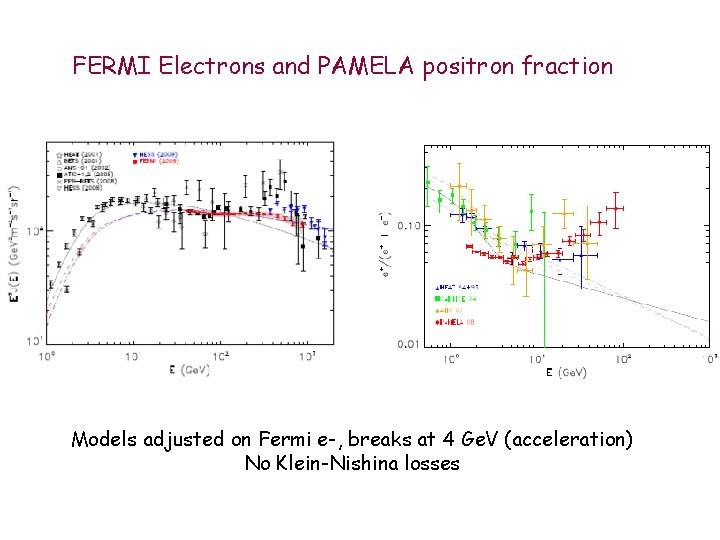
FERMI Electrons and PAMELA positron fraction Models adjusted on Fermi e-, breaks at 4 Ge. V (acceleration) No Klein-Nishina losses
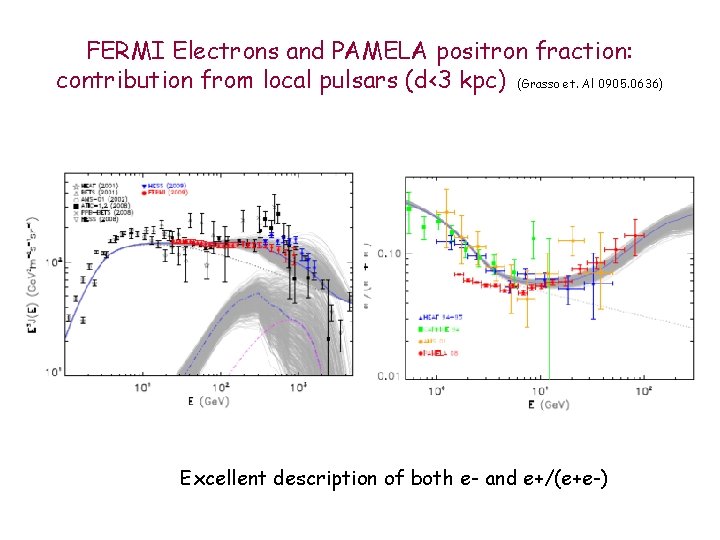
FERMI Electrons and PAMELA positron fraction: contribution from local pulsars (d<3 kpc) (Grasso et. Al 0905. 0636) Excellent description of both e- and e+/(e+e-)
Conclusions and perspectives • Diffusive models with reacceleration/convection reproduce data for many species without too many adjustements • A definite model does not come out – degeneracies and uncertainties • Antimatter in CRs and particle DM in the galaxy: strong connection! Mostly limited by propagation uncertainties, astrophysical backgrounds, data • Data from different species: nuclei, isotopes (rad. , K), electrons and positrons, antiprotons, gamma-rays, on a large energetic range, are needed • Many crucial experimental breakthroughs are just around the corner!