
Cosmic ray anisotropy from Pierre Auger Observatory J
Cosmic ray anisotropy from Pierre Auger Observatory J. R. T. de Mello Neto (for the Auger Collaboration) Universidade Federal do Rio de Janeiro V Nova Física no Espaço Campos do Jordão - SP
Outline • • Open questions Coverage map Previous anisotropy claims Galactic center Prescription results Blind source search Perspectives Ref: Auger contributions in the proceedings of ICRC 05 – Pune, India
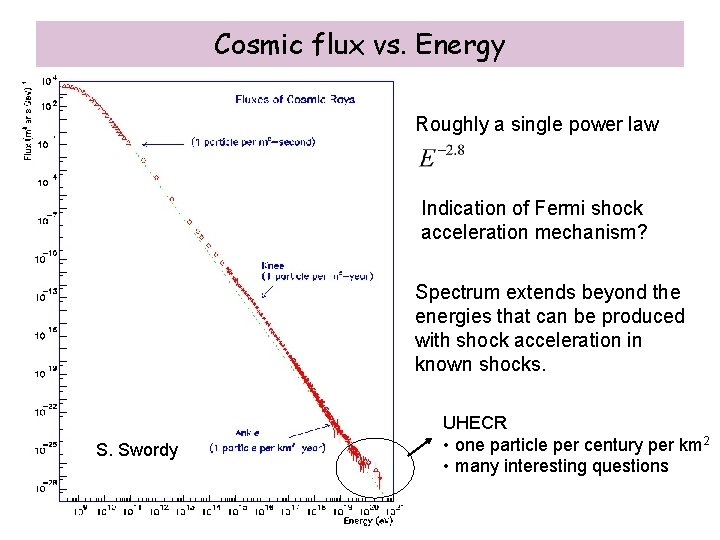
Cosmic flux vs. Energy Roughly a single power law Indication of Fermi shock acceleration mechanism? Spectrum extends beyond the energies that can be produced with shock acceleration in known shocks. S. Swordy UHECR • one particle per century per km 2 • many interesting questions
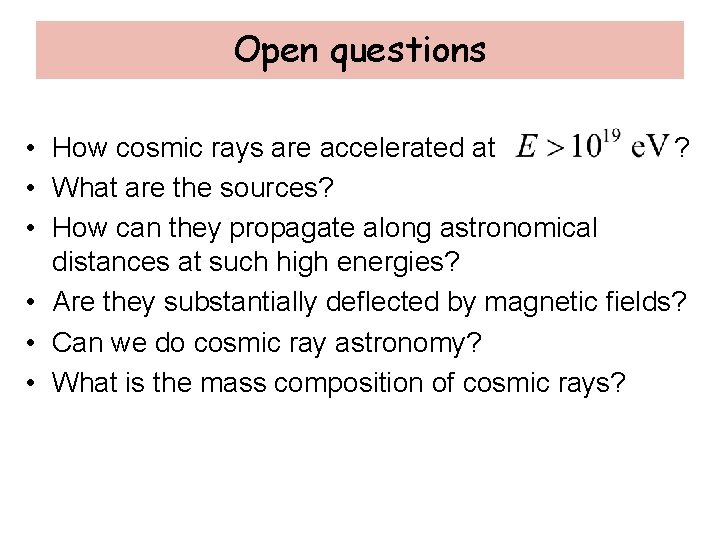
Open questions • How cosmic rays are accelerated at ? • What are the sources? • How can they propagate along astronomical distances at such high energies? • Are they substantially deflected by magnetic fields? • Can we do cosmic ray astronomy? • What is the mass composition of cosmic rays?
Anisotropy UHECR spatial distribution constrains models and sources : point-like for E > 10 Ee. V galactic magnetic diffusion for E < 10 Ee. V If anisotropy/sources are seen • Start “charged particle astronomy” • probe magnetic fields • spectrometry If no anisotropy/sources are seen • indication of top-down origin • re-think propagation • ? ? ?
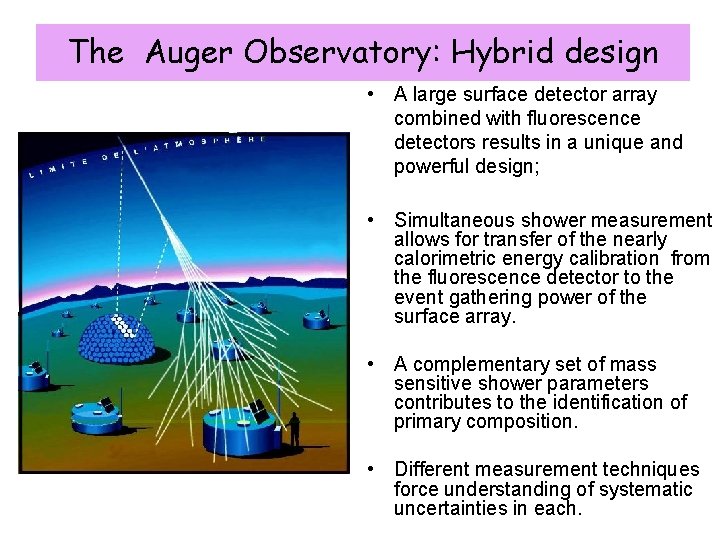
The Auger Observatory: Hybrid design • A large surface detector array combined with fluorescence detectors results in a unique and powerful design; • Simultaneous shower measurement allows for transfer of the nearly calorimetric energy calibration from the fluorescence detector to the event gathering power of the surface array. • A complementary set of mass sensitive shower parameters contributes to the identification of primary composition. • Different measurement techniques force understanding of systematic uncertainties in each.
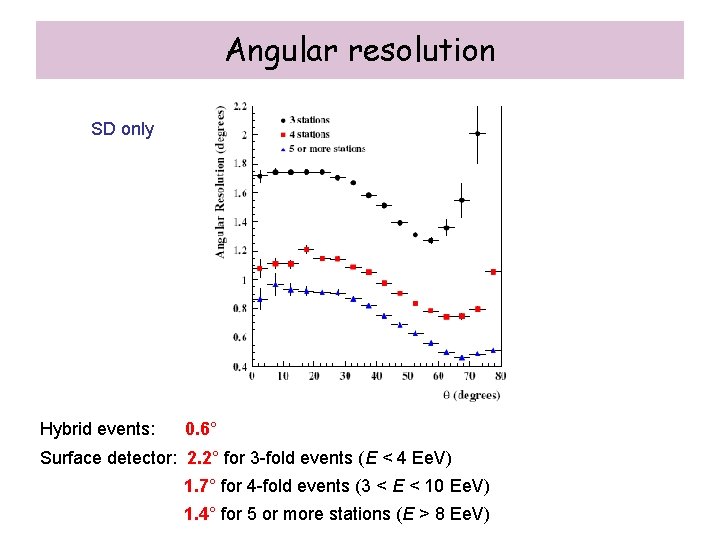
Angular resolution SD only Hybrid events: 0. 6° Surface detector: 2. 2° for 3 -fold events (E < 4 Ee. V) 1. 7° for 4 -fold events (3 < E < 10 Ee. V) 1. 4° for 5 or more stations (E > 8 Ee. V)
Coverage map Check the proposition: what is observed is compatible with what is expected from an isotropic distribution; Need: • isotropic background expectations (coverage map) • statistical estimator of the overdensity Acurate determination of the coverage map is the real issue! • detector growing • weather effects • true large scale anisotropies
Coverage determination Two techniques for coverage map determination: • semi-analytical method • shuffling (two flavours) Acceptance almost independent of sidereal time and azimuth Four independent groups calculated the coverage.
Shuffling method (2 D) • MC based method : • Make N new realisations of the data arrival direction by resampling them : – 5 zenith angle bins – for each event : keep zenith, sample a new arrival time and a new azimuth from data in the same zenith angle bin • Average the N datasets in the window centered around the observed direction • This gives you the expected number of events in that direction
Shuffling method (1 D) • MC based method : • Make N new realisations of the data arrival direction by resampling them : – 5 zenith angle bins – for each event : keep zenith, sample a new day and a new UTC hours from data in the same zenith angle bin and draw phi uniformily • Average the N datasets in the window centered around the observed direction • This gives you the expected number of events in that direction
Semi-analytical coverage map • Start with events zenith angle distribution • Fit it with some smooth functions : splines or polynomials times a Fermi-Dirac. • Convert the fitted zenith angle shape into a declination distribution (analytical) • Assume RA uniformity or use weather data to model RA variation • Integrate through the window • You have the expected number of events in any direction
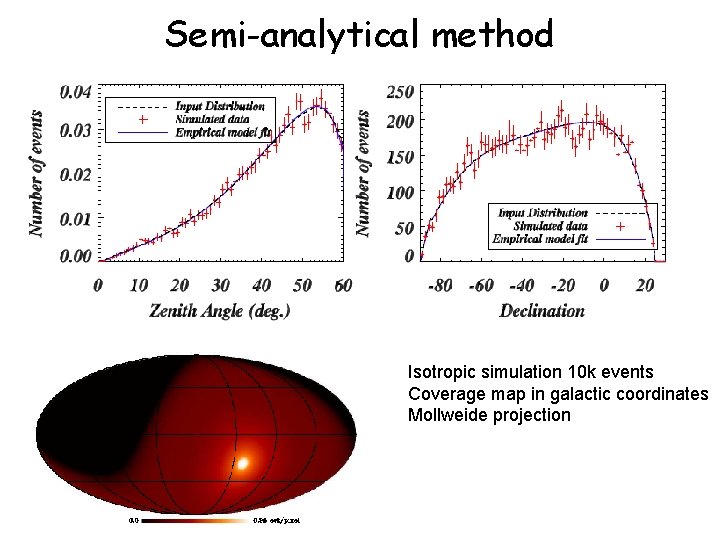
Semi-analytical method Isotropic simulation 10 k events Coverage map in galactic coordinates Mollweide projection
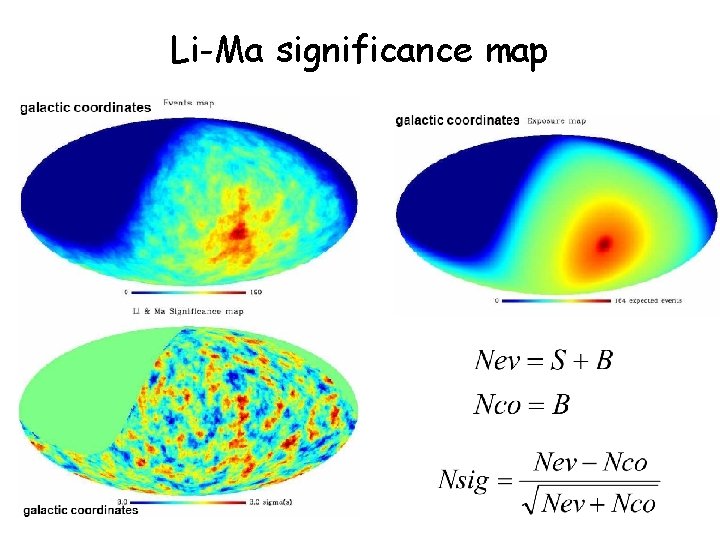
Li-Ma significance map

Galactic center • Galactic Center is a “natural” site for cosmic ray acceleration – Supermassive black hole – Dense clusters of stars – Stellar remnants – SNR (? ) Sgr A East • SUGAR excess is consistent with a point source, indicating neutral primaries • Neutrons would go undeflected, and neutron decay length at 1018 e. V is comparable to the distance to the Galactic center (~8. 5 kpc) Chandra
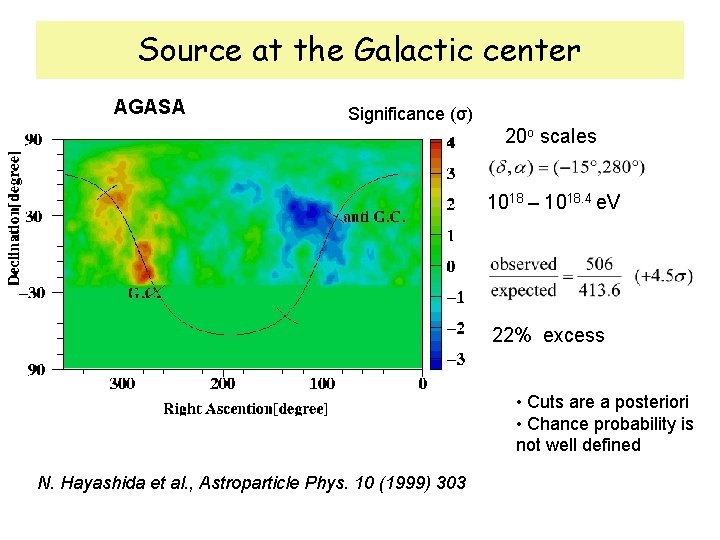
Source at the Galactic center AGASA Significance (σ) 20 o scales 1018 – 1018. 4 e. V 22% excess • Cuts are a posteriori • Chance probability is not well defined N. Hayashida et al. , Astroparticle Phys. 10 (1999) 303
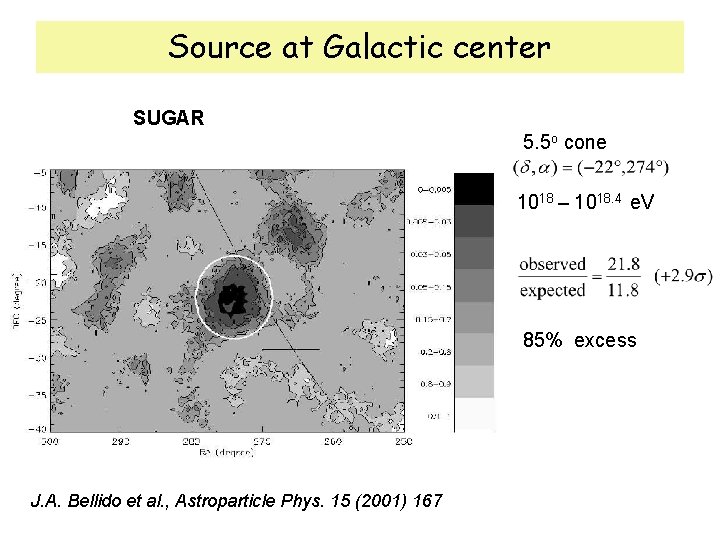
Source at Galactic center SUGAR 5. 5 o cone 1018 – 1018. 4 e. V 85% excess J. A. Bellido et al. , Astroparticle Phys. 15 (2001) 167
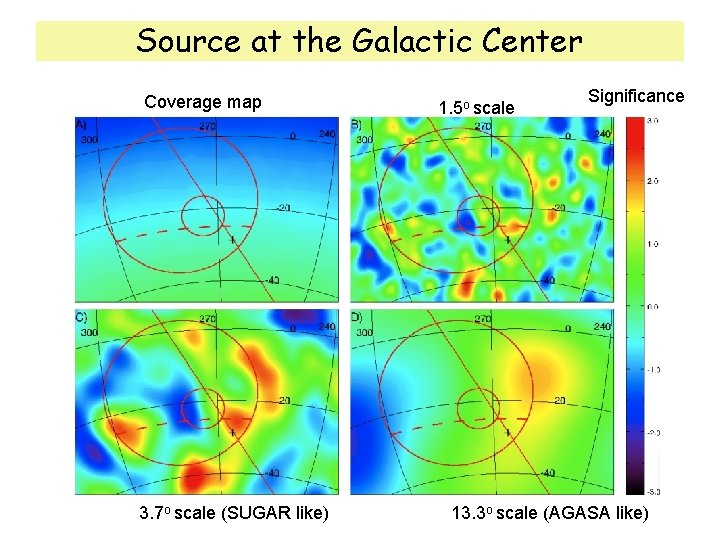
Source at the Galactic Center Coverage map 3. 7 o scale (SUGAR like) 1. 5 o scale Significance 13. 3 o scale (AGASA like)
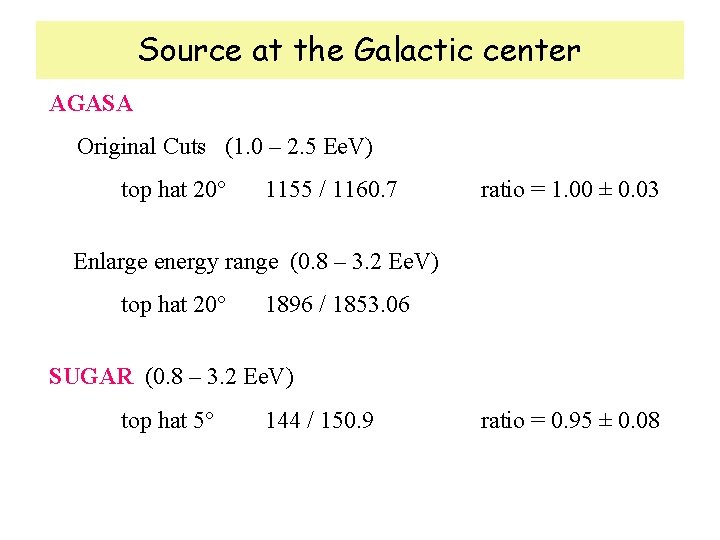
Source at the Galactic center AGASA Original Cuts (1. 0 – 2. 5 Ee. V) top hat 20° 1155 / 1160. 7 ratio = 1. 00 ± 0. 03 Enlarge energy range (0. 8 – 3. 2 Ee. V) top hat 20° 1896 / 1853. 06 SUGAR (0. 8 – 3. 2 Ee. V) top hat 5° 144 / 150. 9 ratio = 0. 95 ± 0. 08
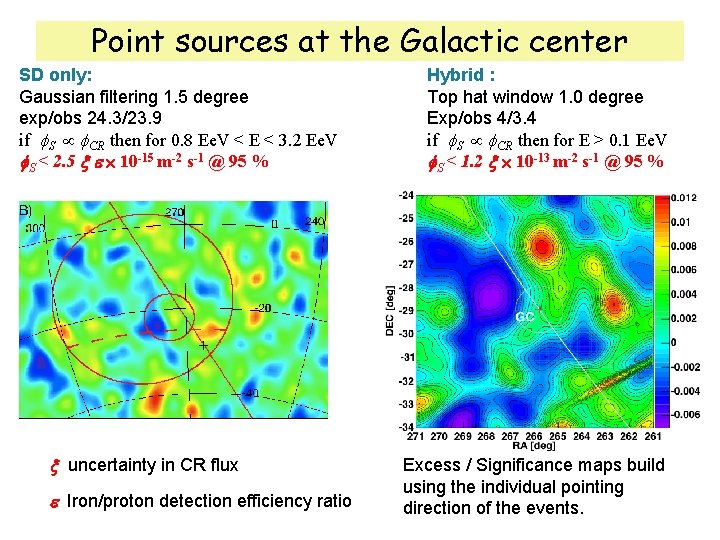
Point sources at the Galactic center SD only: Gaussian filtering 1. 5 degree exp/obs 24. 3/23. 9 if S CR then for 0. 8 Ee. V < E < 3. 2 Ee. V S < 2. 5 10 -15 m-2 s-1 @ 95 % uncertainty in CR flux Iron/proton detection efficiency ratio Hybrid : Top hat window 1. 0 degree Exp/obs 4/3. 4 if S CR then for E > 0. 1 Ee. V S < 1. 2 10 -13 m-2 s-1 @ 95 % Excess / Significance maps build using the individual pointing direction of the events.
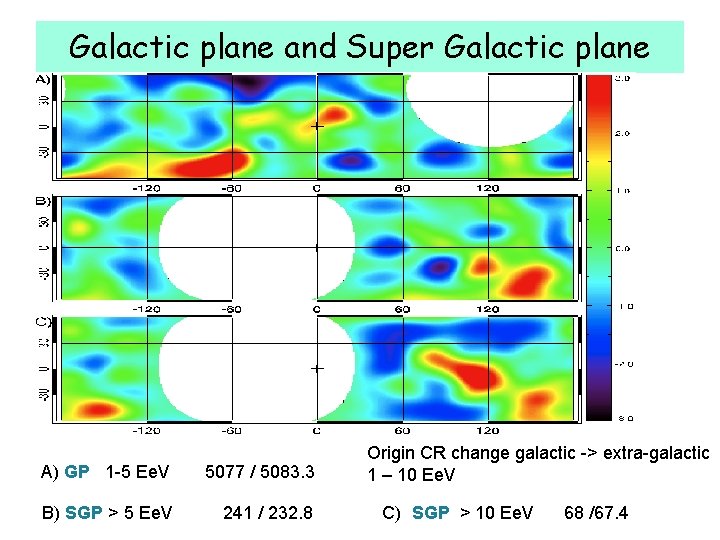
Galactic plane and Super Galactic plane A) GP 1 -5 Ee. V 5077 / 5083. 3 B) SGP > 5 Ee. V 241 / 232. 8 Origin CR change galactic -> extra-galactic 1 – 10 Ee. V C) SGP > 10 Ee. V 68 /67. 4
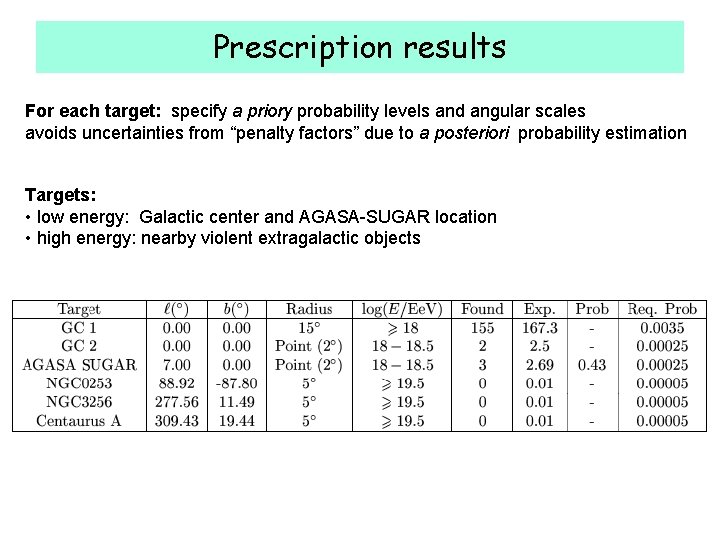
Prescription results For each target: specify a priory probability levels and angular scales avoids uncertainties from “penalty factors” due to a posteriori probability estimation Targets: • low energy: Galactic center and AGASA-SUGAR location • high energy: nearby violent extragalactic objects
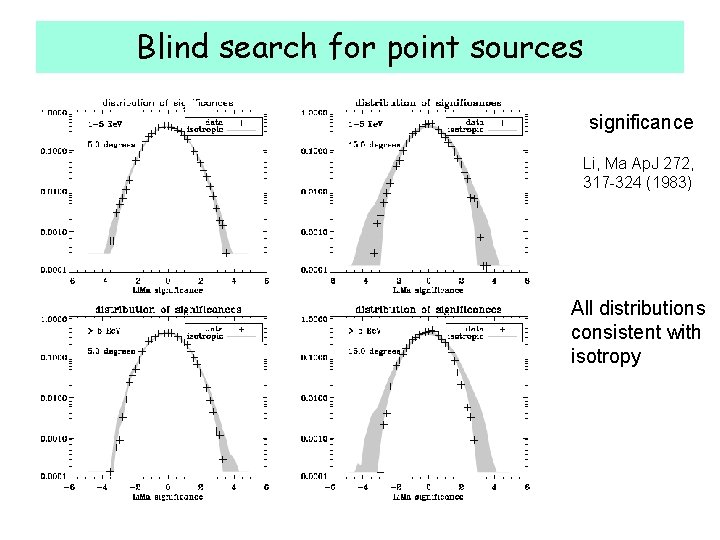
Blind search for point sources significance Li, Ma Ap. J 272, 317 -324 (1983) All distributions consistent with isotropy
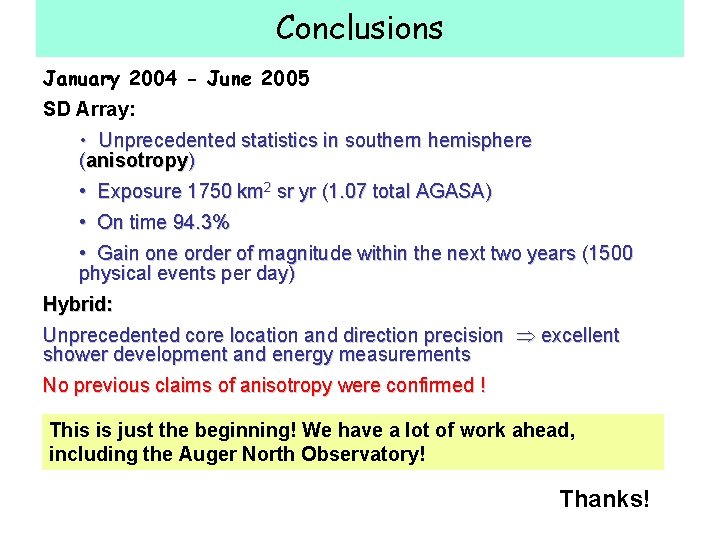
Conclusions January 2004 - June 2005 SD Array: • Unprecedented statistics in southern hemisphere (anisotropy) • Exposure 1750 km 2 sr yr (1. 07 total AGASA) • On time 94. 3% • Gain one order of magnitude within the next two years (1500 physical events per day) Hybrid: Unprecedented core location and direction precision excellent shower development and energy measurements No previous claims of anisotropy were confirmed ! This is just the beginning! We have a lot of work ahead, including the Auger North Observatory! Thanks!
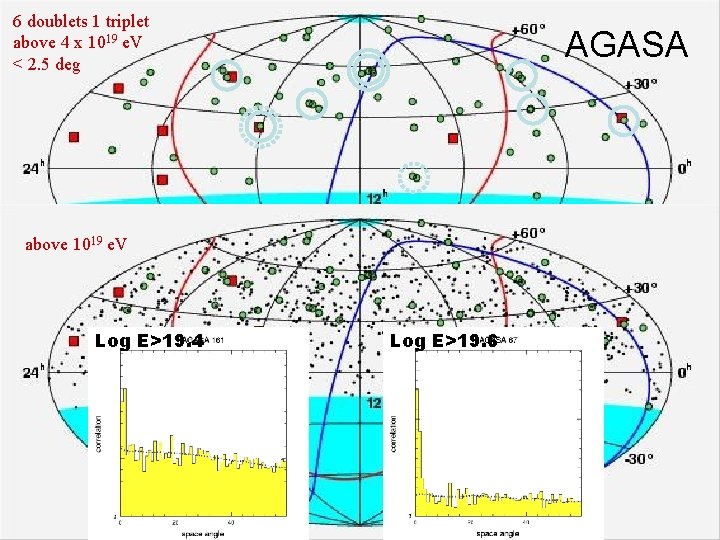
6 doublets 1 triplet above 4 x 10¹⁹ e. V < 2. 5 deg AGASA above 1019 e. V Log E>19. 4 Log E>19. 6
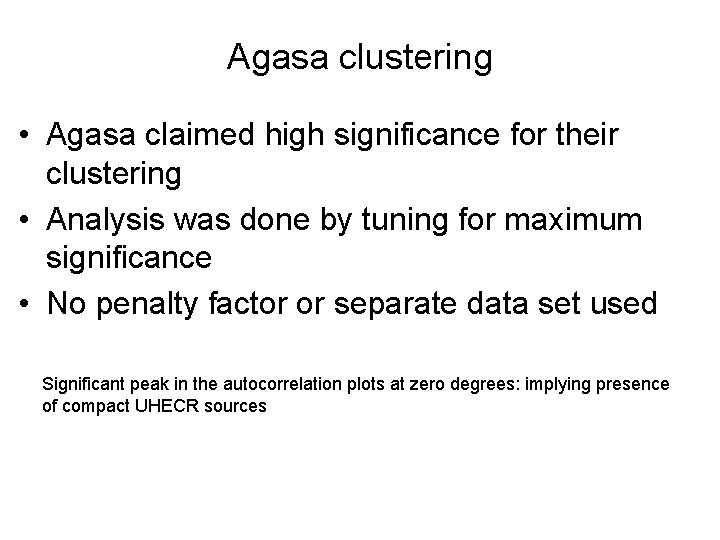
Agasa clustering • Agasa claimed high significance for their clustering • Analysis was done by tuning for maximum significance • No penalty factor or separate data set used Significant peak in the autocorrelation plots at zero degrees: implying presence of compact UHECR sources
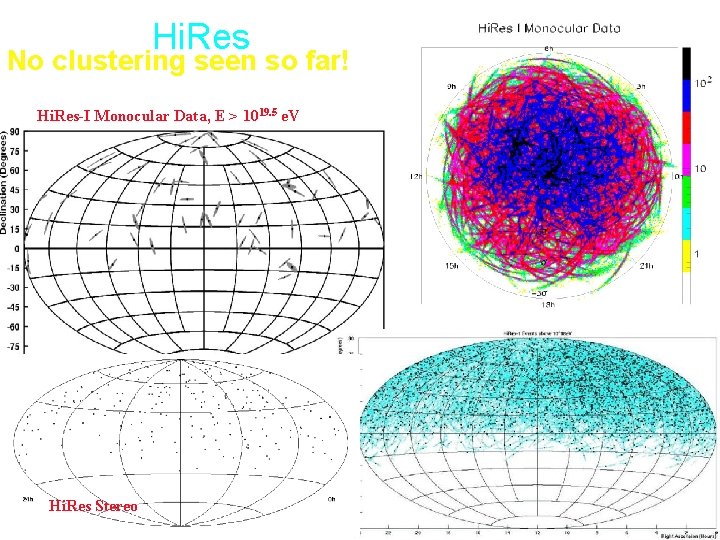
Hi. Res No clustering seen so far! Hi. Res-I Monocular Data, E > 1019. 5 e. V Hi. Res-I Monocular Data, E > 1018. 5 e. V Hi. Res Stereo Upper limit of 4 doublets (90% c. l. ) in Hi. Res-I monocular dataset.
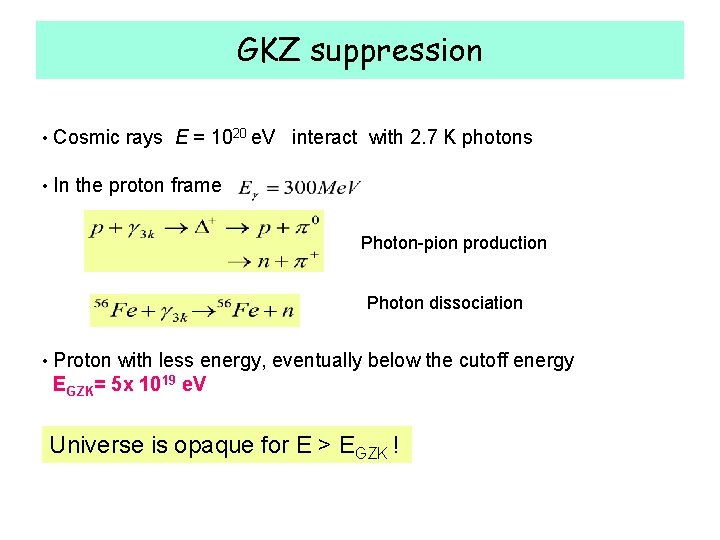
GKZ suppression • Cosmic rays E = 1020 e. V interact with 2. 7 K photons • In the proton frame Photon-pion production Photon dissociation • Proton with less energy, eventually below the cutoff energy EGZK= 5 x 10¹⁹ e. V Universe is opaque for E > EGZK !
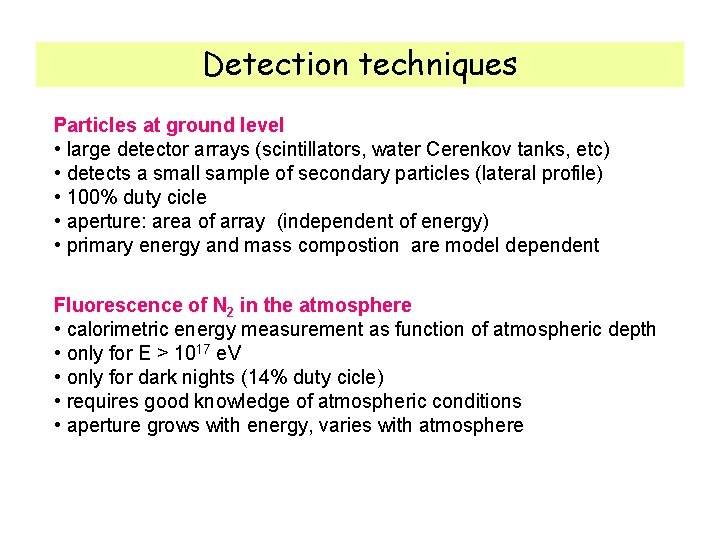
Detection techniques Particles at ground level • large detector arrays (scintillators, water Cerenkov tanks, etc) • detects a small sample of secondary particles (lateral profile) • 100% duty cicle • aperture: area of array (independent of energy) • primary energy and mass compostion are model dependent Fluorescence of N 2 in the atmosphere • calorimetric energy measurement as function of atmospheric depth • only for E > 1017 e. V • only for dark nights (14% duty cicle) • requires good knowledge of atmospheric conditions • aperture grows with energy, varies with atmosphere
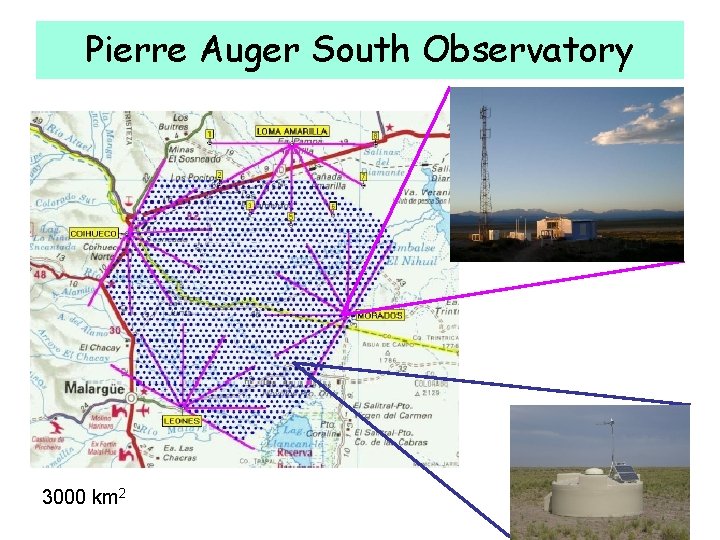
Pierre Auger South Observatory 3000 km 2
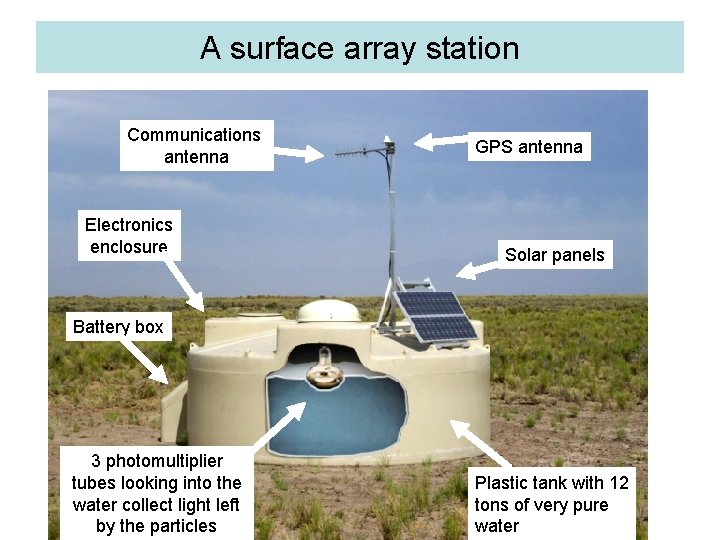
A surface array station Communications antenna Electronics enclosure GPS antenna Solar panels Battery box 3 photomultiplier tubes looking into the water collect light left by the particles Plastic tank with 12 tons of very pure water
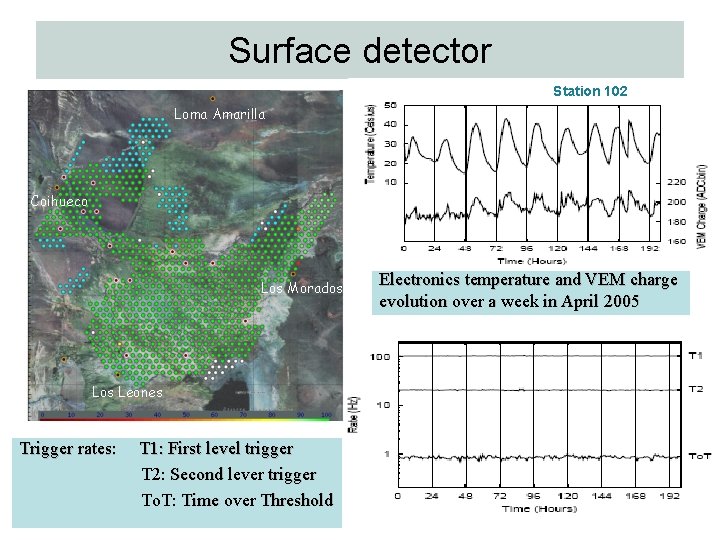
Surface detector Station 102 Loma Amarilla Coihueco Los Morados Leones Trigger rates: T 1: First level trigger T 2: Second lever trigger To. T: Time over Threshold Electronics temperature and VEM charge evolution over a week in April 2005
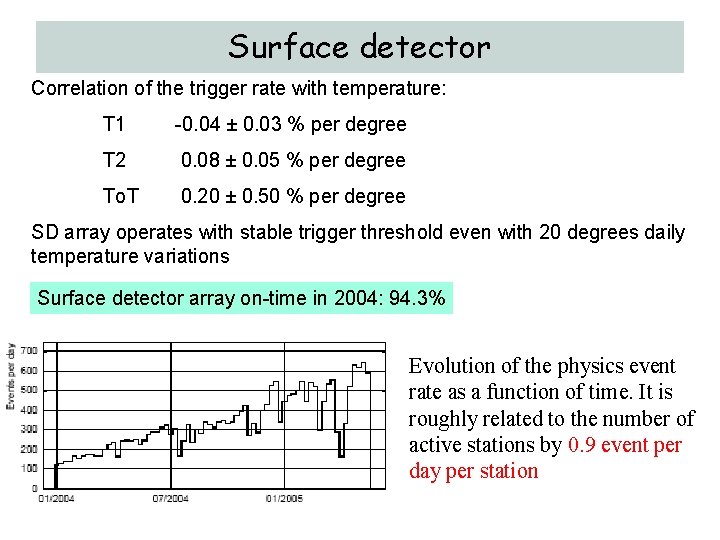
Surface detector Correlation of the trigger rate with temperature: T 1 -0. 04 ± 0. 03 % per degree T 2 0. 08 ± 0. 05 % per degree To. T 0. 20 ± 0. 50 % per degree SD array operates with stable trigger threshold even with 20 degrees daily temperature variations Surface detector array on-time in 2004: 94. 3% Evolution of the physics event rate as a function of time. It is roughly related to the number of active stations by 0. 9 event per day per station
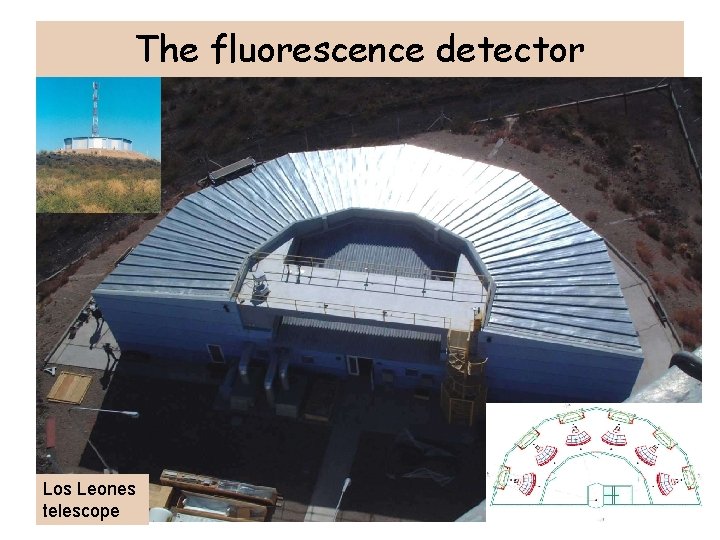
The fluorescence detector Los Leones telescope
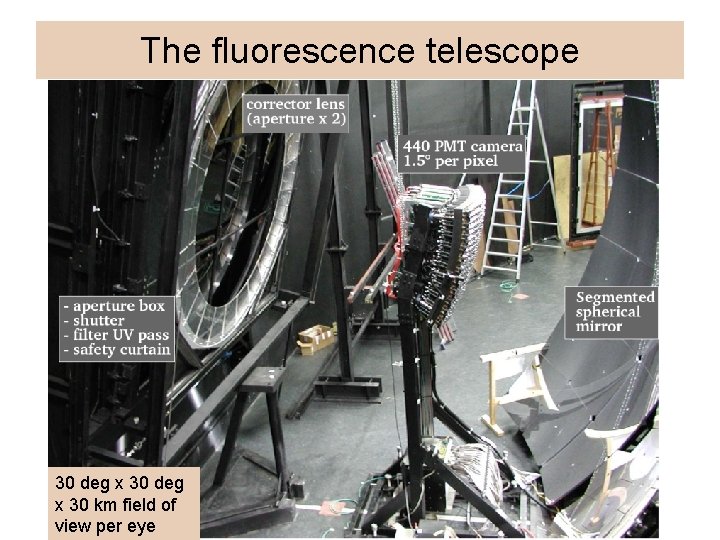
The fluorescence telescope 30 deg x 30 km field of view per eye
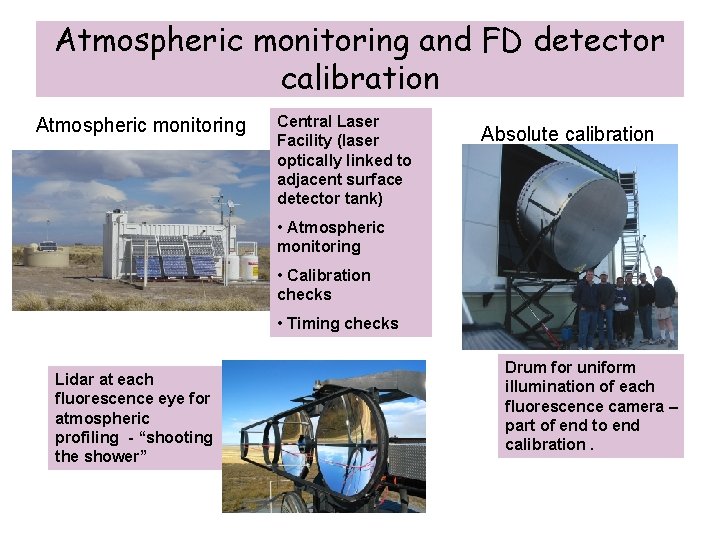
Atmospheric monitoring and FD detector calibration Atmospheric monitoring Central Laser Facility (laser optically linked to adjacent surface detector tank) Absolute calibration • Atmospheric monitoring • Calibration checks • Timing checks Lidar at each fluorescence eye for atmospheric profiling - “shooting the shower” Drum for uniform illumination of each fluorescence camera – part of end to end calibration.
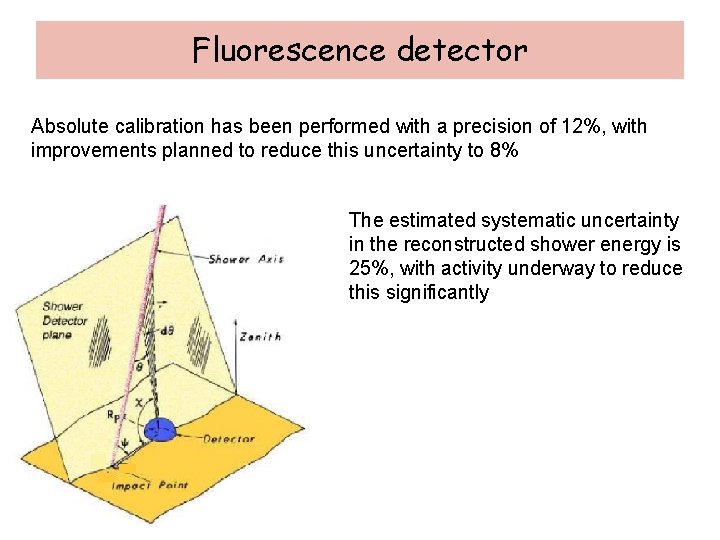
Fluorescence detector Absolute calibration has been performed with a precision of 12%, with improvements planned to reduce this uncertainty to 8% The estimated systematic uncertainty in the reconstructed shower energy is 25%, with activity underway to reduce this significantly
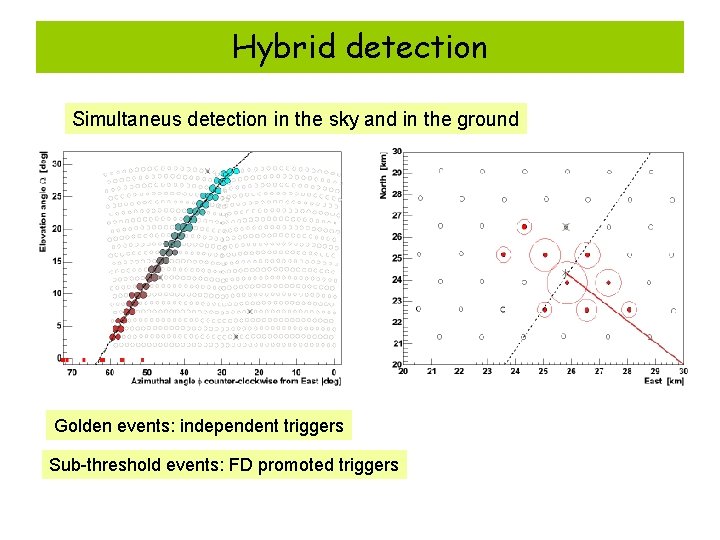
Hybrid detection Simultaneus detection in the sky and in the ground Golden events: independent triggers Sub-threshold events: FD promoted triggers
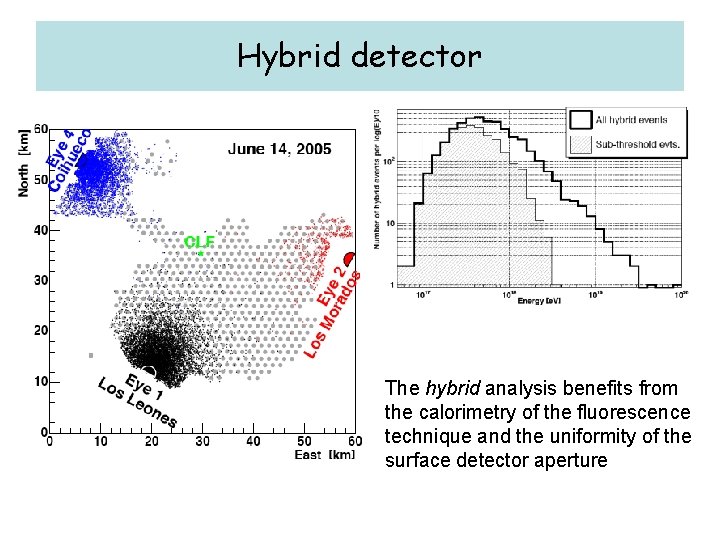
Hybrid detector The hybrid analysis benefits from the calorimetry of the fluorescence technique and the uniformity of the surface detector aperture
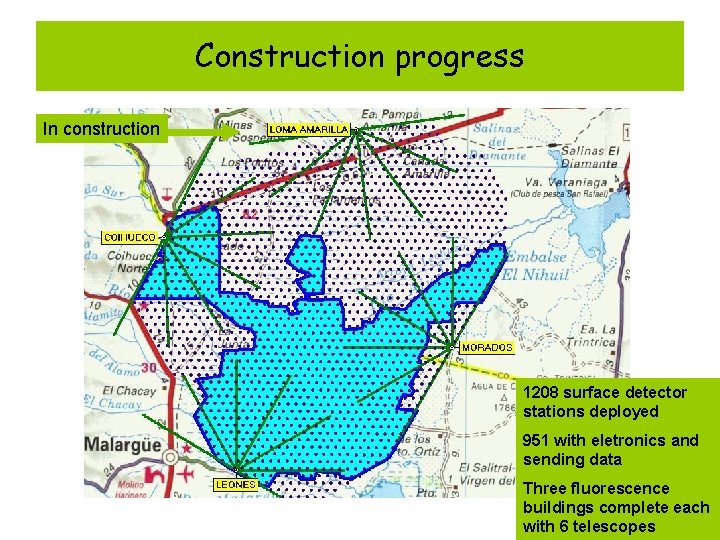
Construction progress In construction 1208 surface detector stations deployed 951 with eletronics and sending data Three fluorescence buildings complete each with 6 telescopes
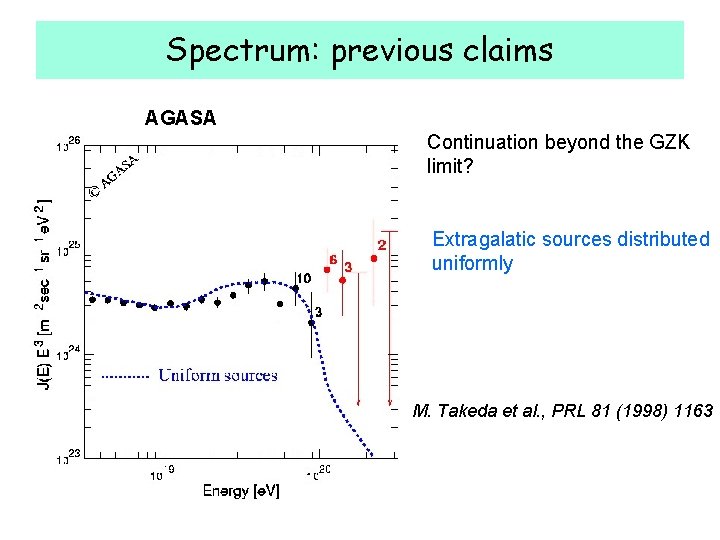
Spectrum: previous claims AGASA Continuation beyond the GZK limit? Extragalatic sources distributed uniformly M. Takeda et al. , PRL 81 (1998) 1163
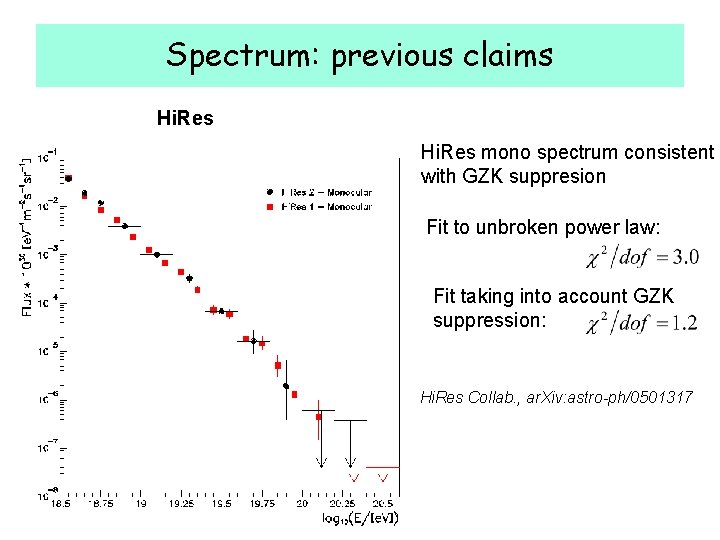
Spectrum: previous claims Hi. Res mono spectrum consistent with GZK suppresion Fit to unbroken power law: Fit taking into account GZK suppression: Hi. Res Collab. , ar. Xiv: astro-ph/0501317
Energy spectrum for Auger Observatory • Based on fluorescence and surface detector data • First model- and mass-independent energy spectrum • Power of the statistics and well-defined exposure of the surface detector • Hybrid data stablishes conection between ground parameter S and shower energy • Hybrid data confirm that SD event trigger is fully efficient above 3 x 10¹⁸ e. V for θ<60 o • Energy scale of the fluorescence detector (nearly calorimetric, model independent energy measurement)
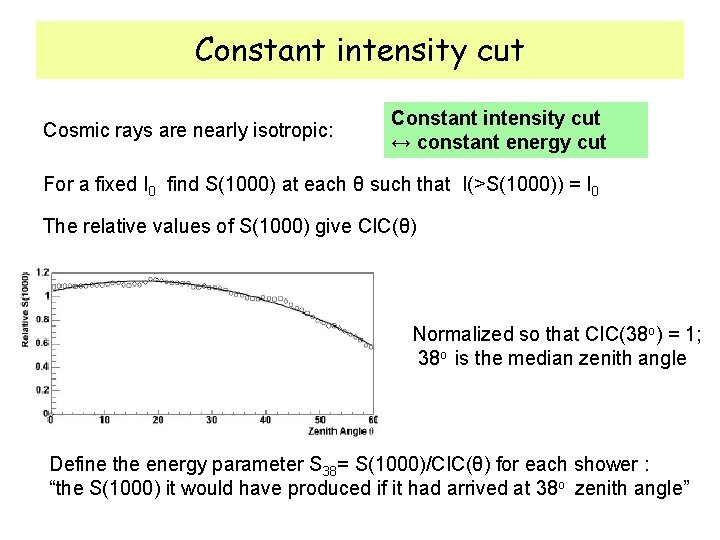
Constant intensity cut Cosmic rays are nearly isotropic: Constant intensity cut ↔ constant energy cut For a fixed I 0 find S(1000) at each θ such that I(>S(1000)) = I 0 The relative values of S(1000) give CIC(θ) Normalized so that CIC(38 o) = 1; 38 o is the median zenith angle Define the energy parameter S 38= S(1000)/CIC(θ) for each shower : “the S(1000) it would have produced if it had arrived at 38 o zenith angle”
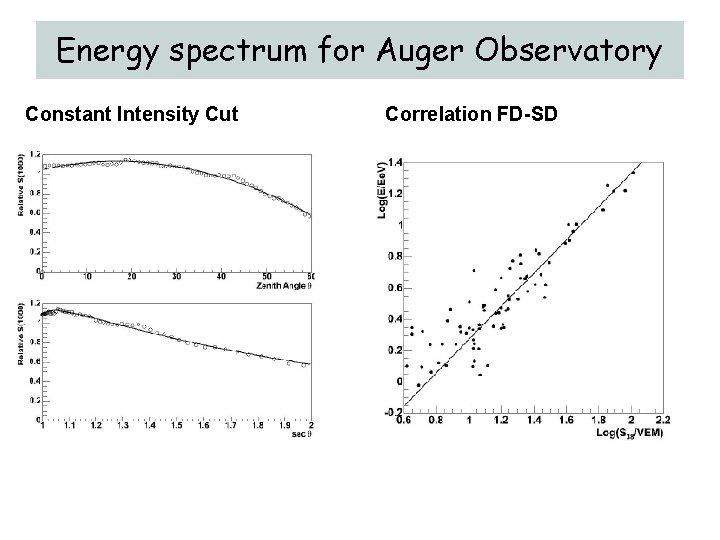
Energy spectrum for Auger Observatory Constant Intensity Cut Correlation FD-SD
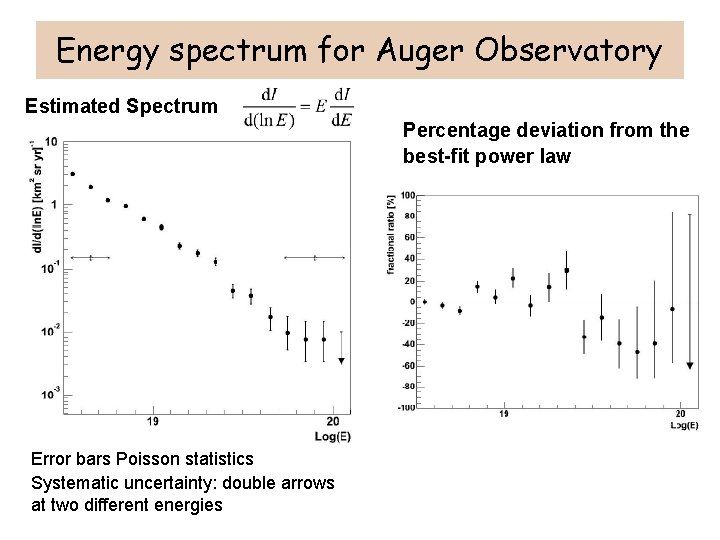
Energy spectrum for Auger Observatory Estimated Spectrum Percentage deviation from the best-fit power law Error bars Poisson statistics Systematic uncertainty: double arrows at two different energies
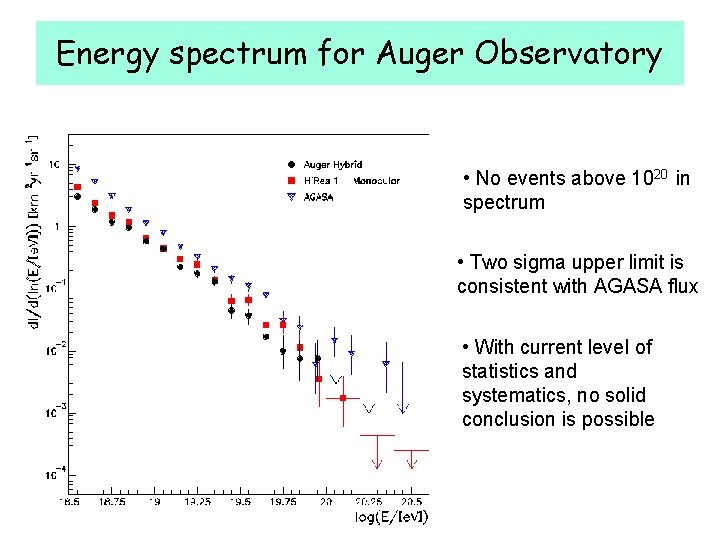
Energy spectrum for Auger Observatory • No events above 1020 in spectrum • Two sigma upper limit is consistent with AGASA flux • With current level of statistics and systematics, no solid conclusion is possible
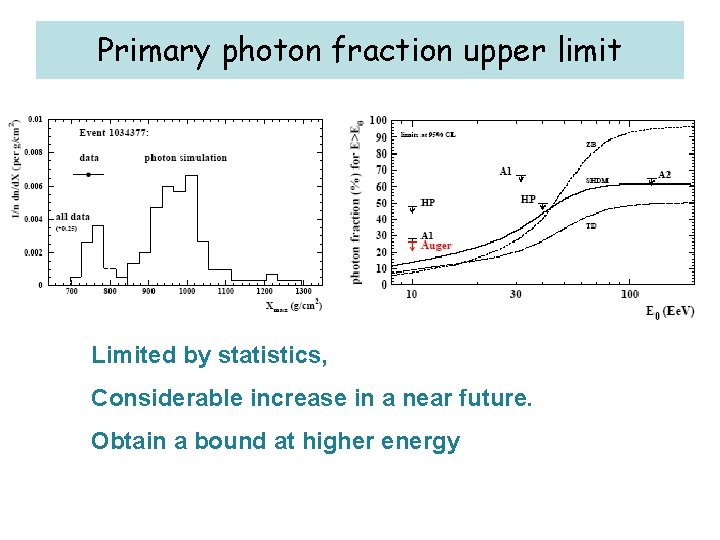
Primary photon fraction upper limit Limited by statistics, Considerable increase in a near future. Obtain a bound at higher energy
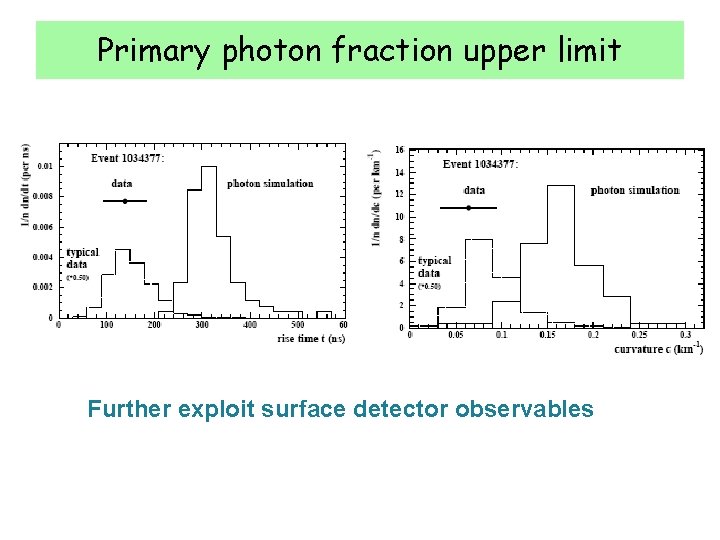
Primary photon fraction upper limit Further exploit surface detector observables
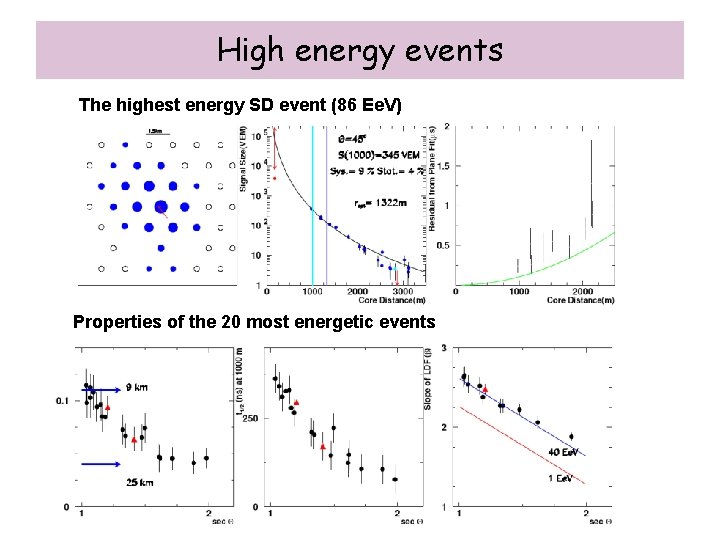
High energy events The highest energy SD event (86 Ee. V) Properties of the 20 most energetic events
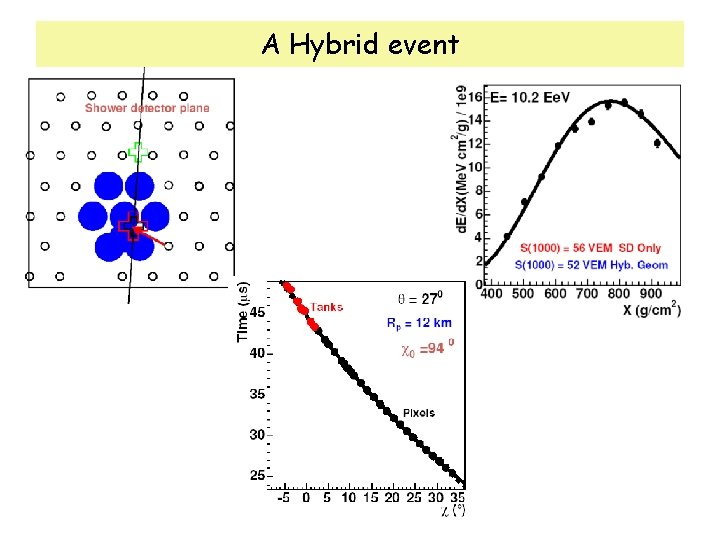
A Hybrid event
- Slides: 51