
Cosmic Microwave Background anisotropies and primordial Gravity waves
Cosmic Microwave Background anisotropies and primordial Gravity waves Radek Stompor (Laboratoire Astro. Particule et Cosmologie) EPS-HEP 2009, Krakow, July, 18, 2009
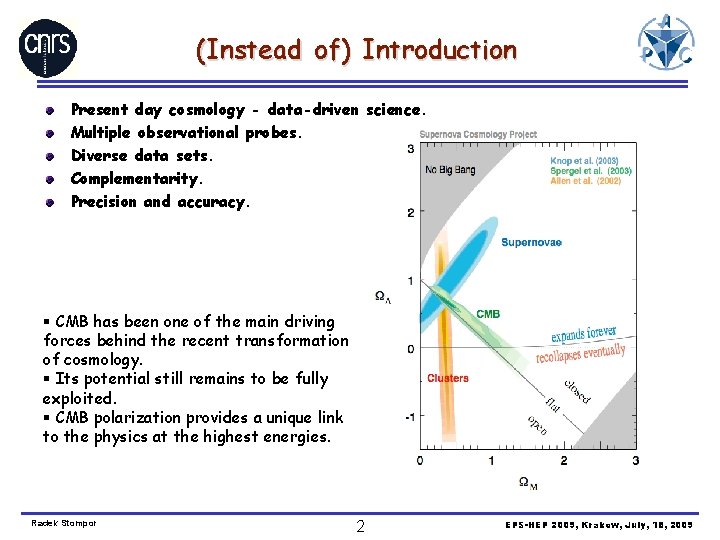
(Instead of) Introduction Present day cosmology - data-driven science. Multiple observational probes. Diverse data sets. Complementarity. Precision and accuracy. § CMB has been one of the main driving forces behind the recent transformation of cosmology. § Its potential still remains to be fully exploited. § CMB polarization provides a unique link to the physics at the highest energies. Radek Stompor 2 EPS-HEP 2009, Krakow, July, 18, 2009
Outline Standard cosmological model: – thermal history; – concordance cosmology. CMB and its anisotropies: – initial fluctuations (inflation); – acoustic oscillations; – CMB observables (power spectra). CMB polarization and primordial gravity waves; – E and B polarization modes; – gravitational lensing. CMB observations: – current status: WMAP, QUAD/BICEP. – future: Planck, etc… Challenges: – foregrounds; – systematics … Concluding remarks. Radek Stompor 3 EPS-HEP 2009, Krakow, July, 18, 2009
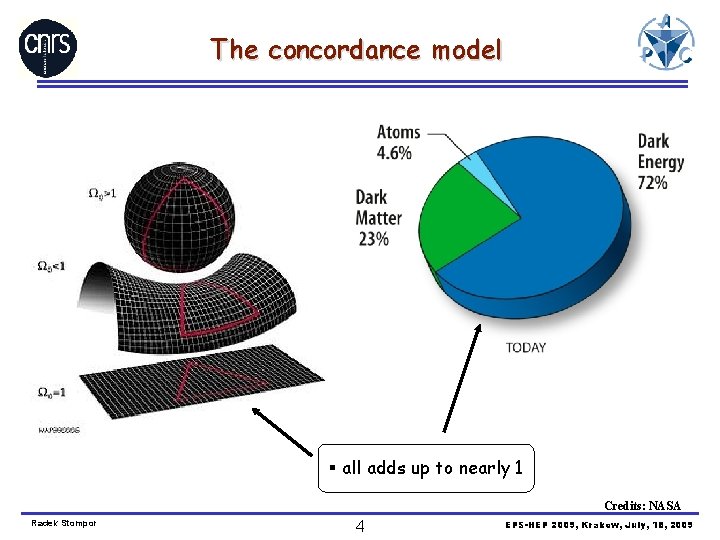
The concordance model Recombination Beginning of the matter domination Beginning of the dark energy § all adds up to nearly 1 domination Credits: NASA Radek Stompor 4 EPS-HEP 2009, Krakow, July, 18, 2009
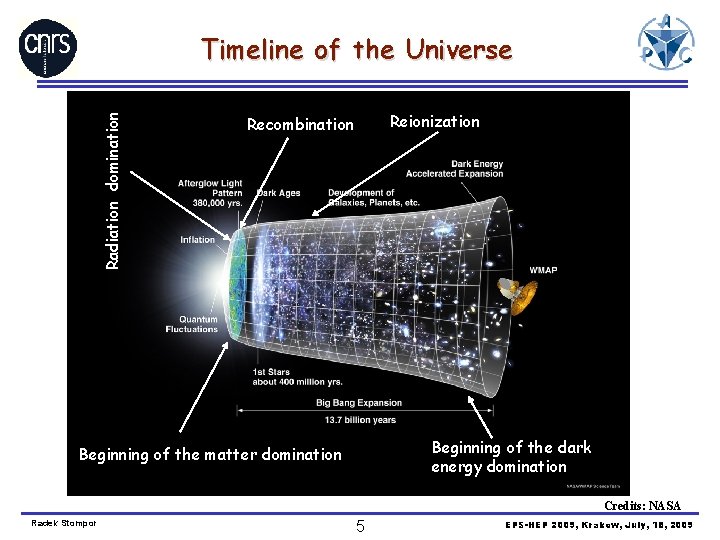
Radiation domination Timeline of the Universe Reionization Recombination Beginning of the dark energy domination Beginning of the matter domination Credits: NASA Radek Stompor 5 EPS-HEP 2009, Krakow, July, 18, 2009
Inflation (1) Inflation seems to provide a successful conceptual framework to understand the early evolution of the Universe. It predicts the presence of primordial fluctuations which could seed the structures observed at the present; It also explains some fine-tuning problems otherwise present in cosmological models, e. g. , (near) spatial-flatness, high level of isotropy. It is is however more like a paradigm than a specific theory - with multiple models available usually with no firm grounding in any fundamental theory. The CMB observations and specifically CMB polarization observations can provide essential confirmation of some the main features of the inflation, therefore, opening up a new, unique perspective at the physics at the energies potentially as high as those of GUT, i. e. , ~1015 Ge. V. Radek Stompor 6 EPS-HEP 2009, Krakow, July, 18, 2009
Inflation (2) It usually postulates presence of one or more scalar fields driving the exponential expansion of the early Universe. Inflationary models generally predicts the scalar (density) perturbations. They are nearly-Gaussian and described by a variance, power spectrum, dependent on the perturbation size as a power law, Pscal (k) kn, n < 1. It also typically predicts gravity waves with a power spectrum again a powerlaw like Pgw (k) km. The tensor-to-scalar ratio, r, can be related directly to the energy scale of inflation. Consistency relations, f(n, m, r) = 0, for some specific classes of the inflationary models, exist. Radek Stompor 7 EPS-HEP 2009, Krakow, July, 18, 2009
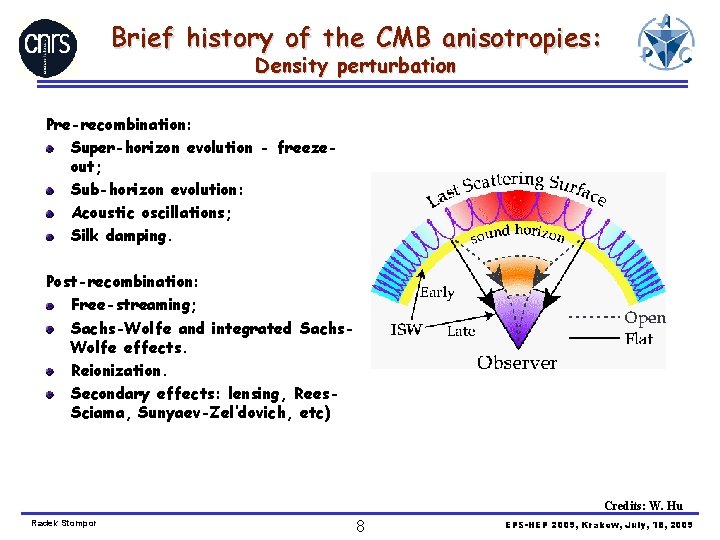
Brief history of the CMB anisotropies: Density perturbation Pre-recombination: Super-horizon evolution - freezeout; Sub-horizon evolution: Acoustic oscillations; Silk damping. Post-recombination: Free-streaming; Sachs-Wolfe and integrated Sachs. Wolfe effects. Reionization. Secondary effects: lensing, Rees. Sciama, Sunyaev-Zel’dovich, etc) Credits: W. Hu Radek Stompor 8 EPS-HEP 2009, Krakow, July, 18, 2009
Acoustic oscillations Sound-waves-like modulo presence of baryons and their gravity as well as non-oscillating gravity of the dark matter component : an oscillator like solution but more with massive spring and in the gravitational field. The oscillations all start when the perturbation enter the horizon Current pattern - a snapshot taken at the recombination. Spatial oscillations project on the 2 d sphere (last scattering surface) observed by us here and now, imprinting on it the characteristic scales corresponding to the acoustic peaks. Radek Stompor 9 EPS-HEP 2009, Krakow, July, 18, 2009
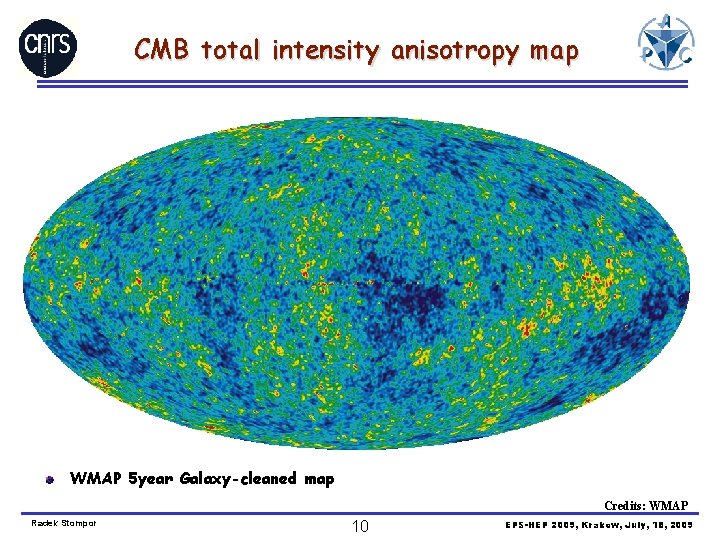
CMB total intensity anisotropy map WMAP 5 year Galaxy-cleaned map Credits: WMAP Radek Stompor 10 EPS-HEP 2009, Krakow, July, 18, 2009
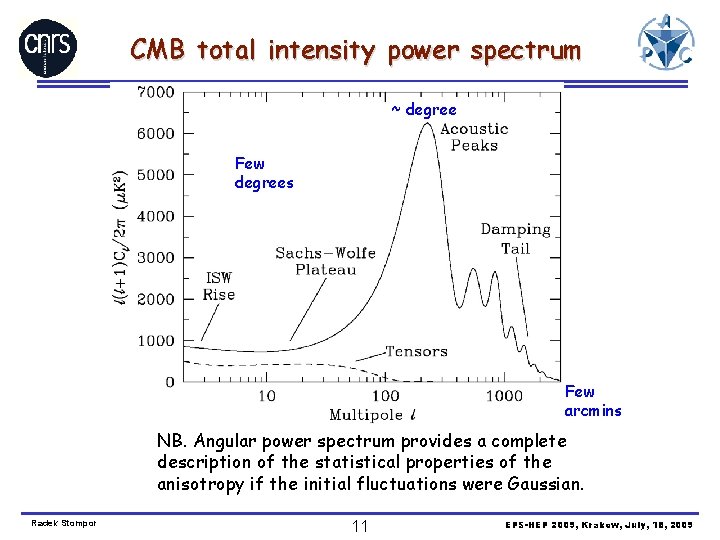
CMB total intensity power spectrum ~ degree Few degrees Few arcmins NB. Angular power spectrum provides a complete description of the statistical properties of the anisotropy if the initial fluctuations were Gaussian. Radek Stompor 11 EPS-HEP 2009, Krakow, July, 18, 2009
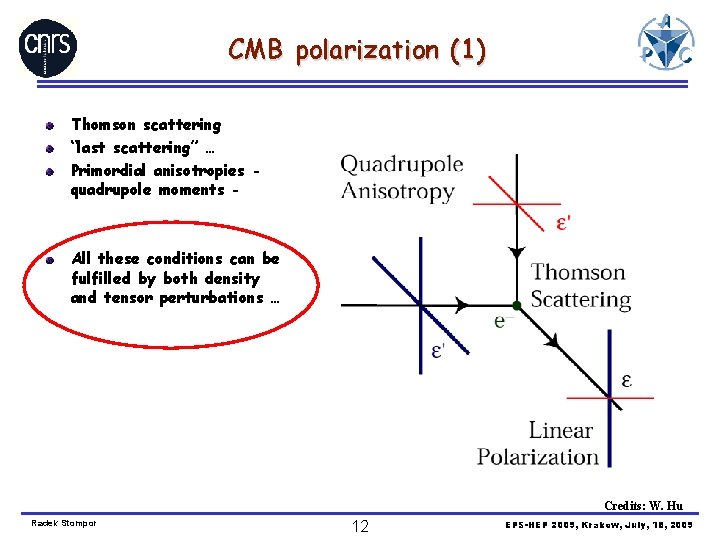
CMB polarization (1) Thomson scattering “last scattering” … Primordial anisotropies quadrupole moments - All these conditions can be fulfilled by both density and tensor perturbations … Credits: W. Hu Radek Stompor 12 EPS-HEP 2009, Krakow, July, 18, 2009
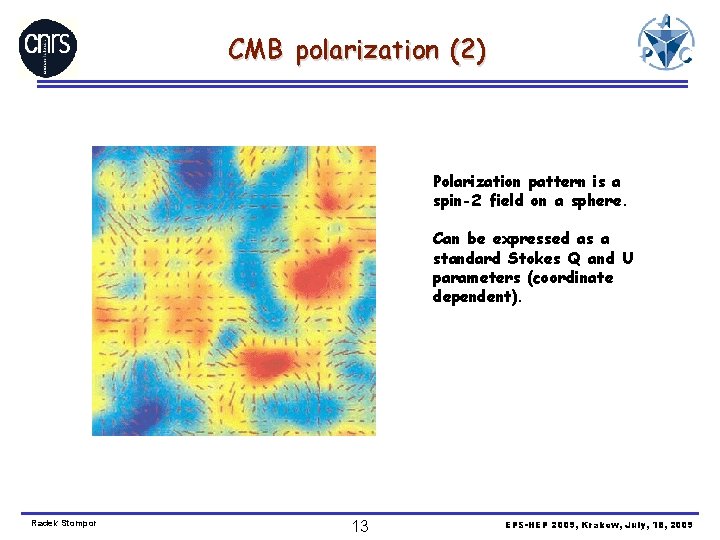
CMB polarization (2) Polarization pattern is a spin-2 field on a sphere. Can be expressed as a standard Stokes Q and U parameters (coordinate dependent). Radek Stompor 13 EPS-HEP 2009, Krakow, July, 18, 2009
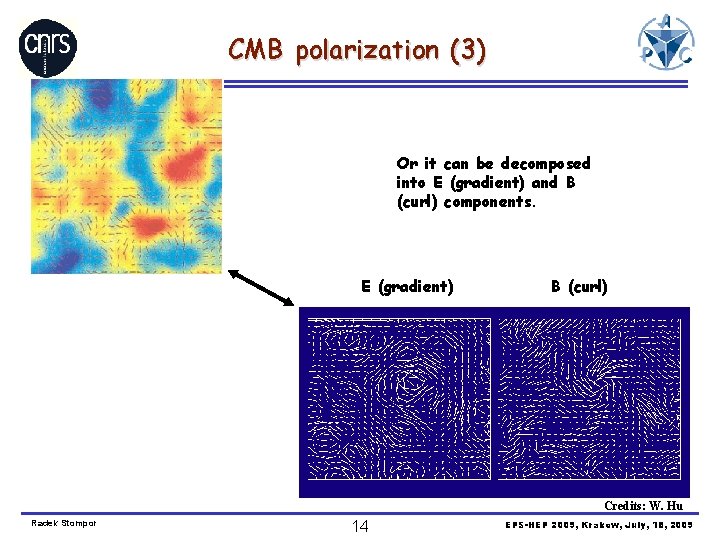
CMB polarization (3) Or it can be decomposed into E (gradient) and B (curl) components. E (gradient) B (curl) Credits: W. Hu Radek Stompor 14 EPS-HEP 2009, Krakow, July, 18, 2009
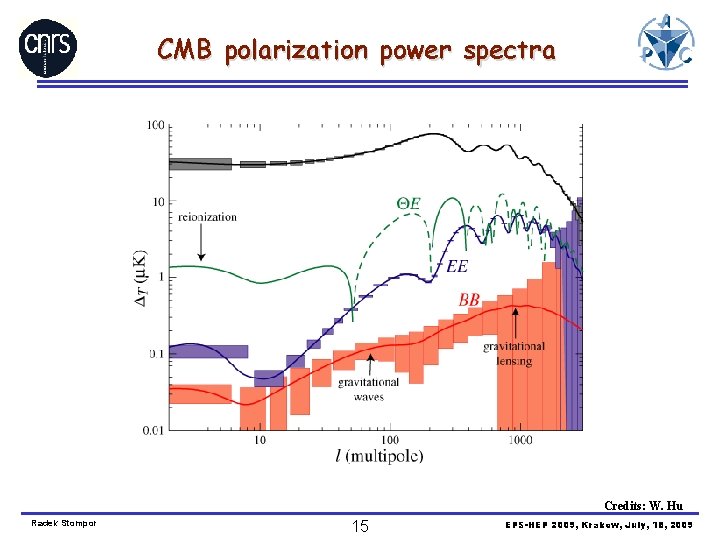
CMB polarization power spectra Credits: W. Hu Radek Stompor 15 EPS-HEP 2009, Krakow, July, 18, 2009
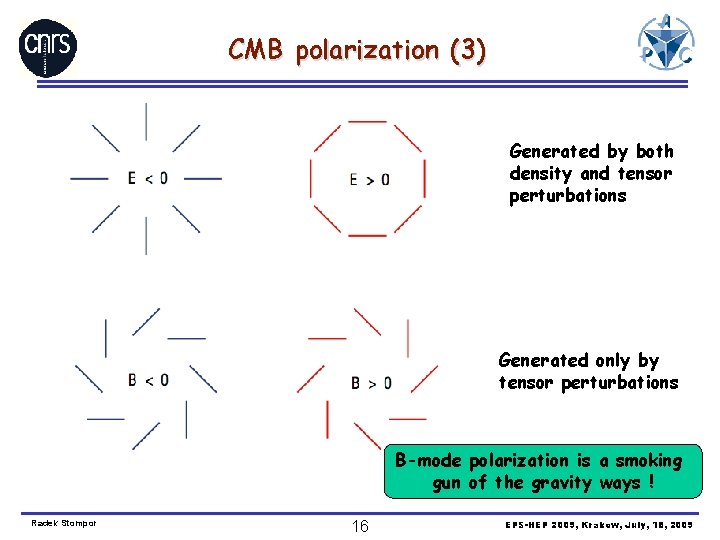
CMB polarization (3) Generated by both density and tensor perturbations Generated only by tensor perturbations B-mode polarization is a smoking gun of the gravity ways ! Radek Stompor 16 EPS-HEP 2009, Krakow, July, 18, 2009
And now the bad news … B-mode signal is miniscule … or may not be there at all … The E and B decomposition is unique only on a full sky … -> « E/B mixing » problem. Gravitational lensing transforms part of the primordial E into B … Astrophysical sources, i. e. , synchrotron radiation or dust emission from our Galaxy, tend to produce similar amounts of the E and B modes and on the levels of the former … -> « component separation » problem … Instrumental systematics … abundant …. Radek Stompor 17 EPS-HEP 2009, Krakow, July, 18, 2009
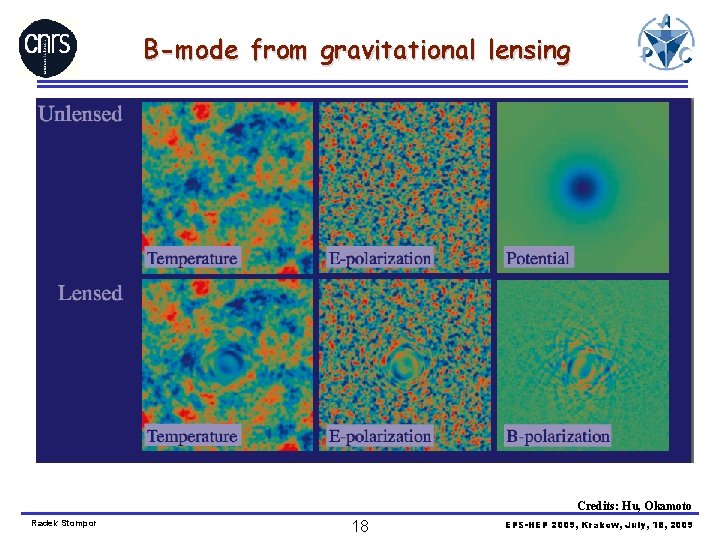
B-mode from gravitational lensing Credits: Hu, Okamoto Radek Stompor 18 EPS-HEP 2009, Krakow, July, 18, 2009
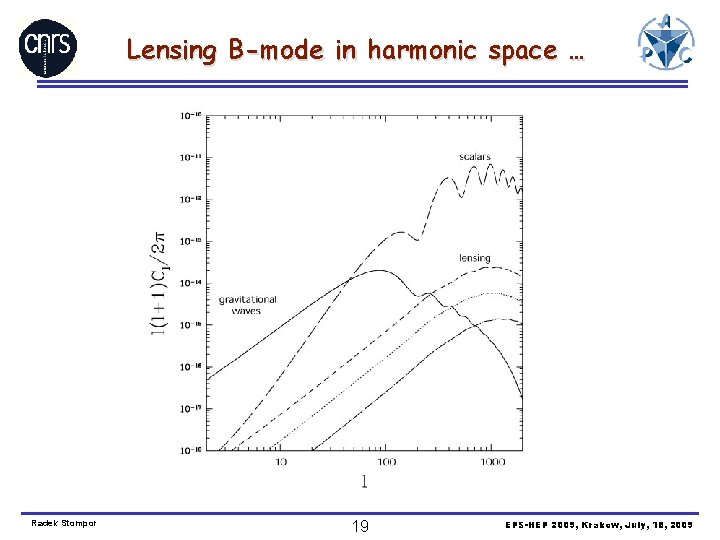
Lensing B-mode in harmonic space … Radek Stompor 19 EPS-HEP 2009, Krakow, July, 18, 2009
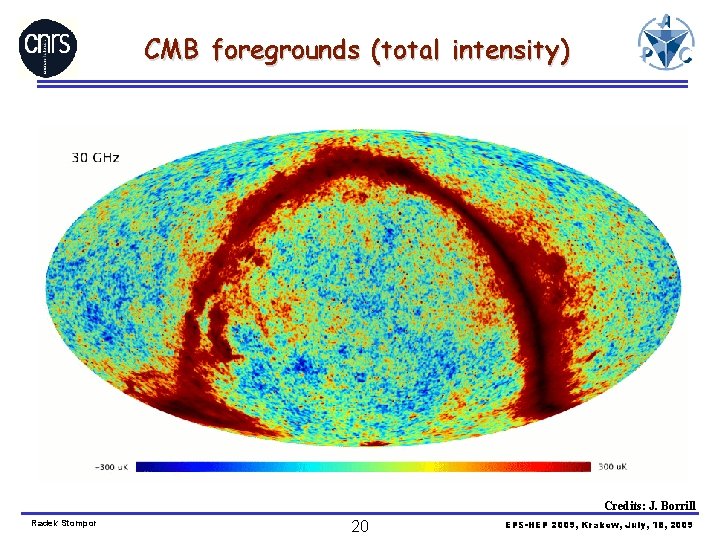
CMB foregrounds (total intensity) Credits: J. Borrill Radek Stompor 20 EPS-HEP 2009, Krakow, July, 18, 2009
The present (1) WMAP (mostly total intensity maps) + other probes: r < 0. 25 (95%) Radek Stompor 21 EPS-HEP 2009, Krakow, July, 18, 2009
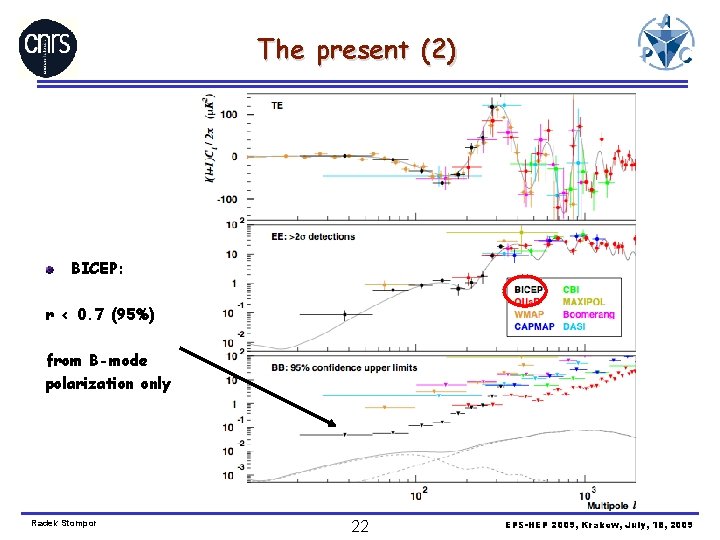
The present (2) BICEP: r < 0. 7 (95%) from B-mode polarization only Radek Stompor 22 EPS-HEP 2009, Krakow, July, 18, 2009
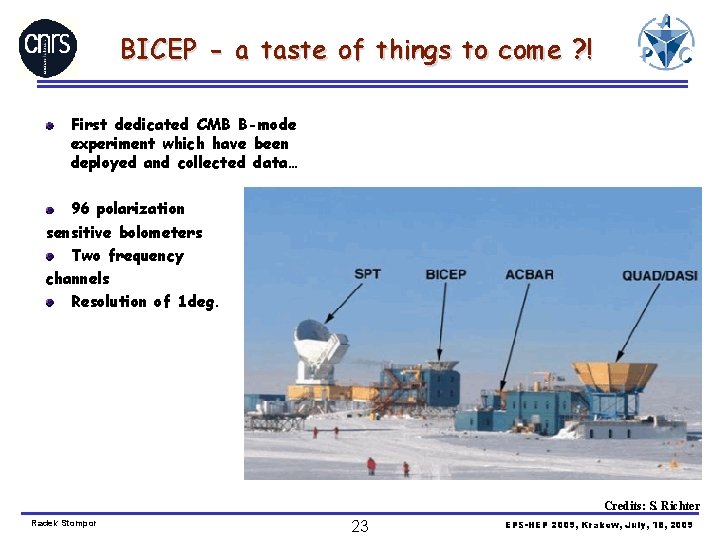
BICEP - a taste of things to come ? ! First dedicated CMB B-mode experiment which have been deployed and collected data… 96 polarization sensitive bolometers Two frequency channels Resolution of 1 deg. Credits: S. Richter Radek Stompor 23 EPS-HEP 2009, Krakow, July, 18, 2009
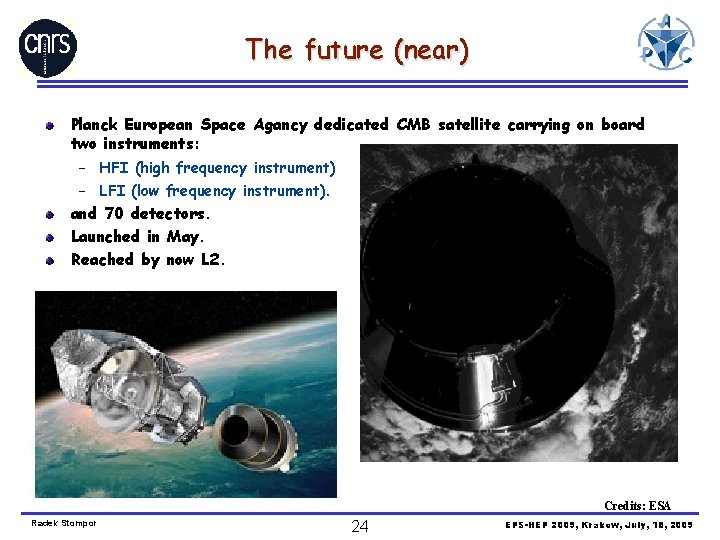
The future (near) Planck European Space Agancy dedicated CMB satellite carrying on board two instruments: – HFI (high frequency instrument) – LFI (low frequency instrument). and 70 detectors. Launched in May. Reached by now L 2. Credits: ESA Radek Stompor 24 EPS-HEP 2009, Krakow, July, 18, 2009
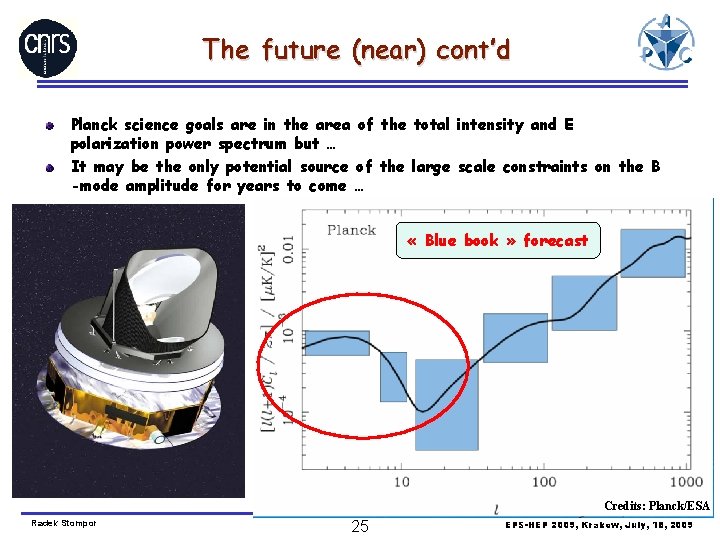
The future (near) cont’d Planck science goals are in the area of the total intensity and E polarization power spectrum but … It may be the only potential source of the large scale constraints on the B -mode amplitude for years to come … « Blue book » forecast Credits: Planck/ESA Radek Stompor 25 EPS-HEP 2009, Krakow, July, 18, 2009
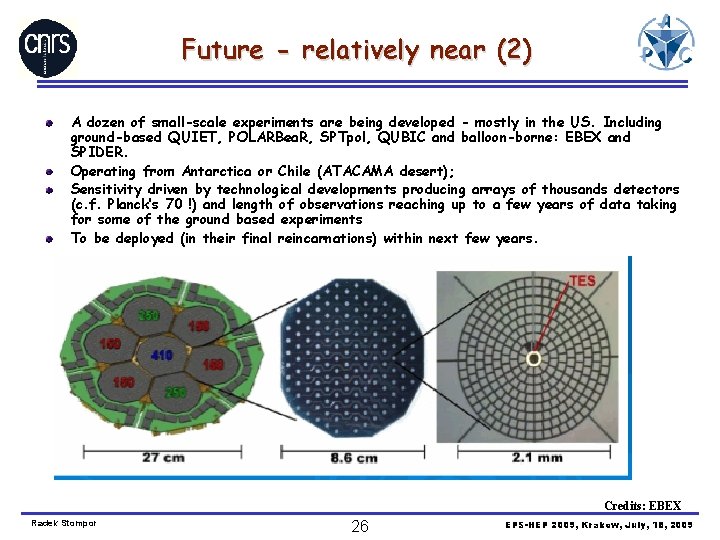
Future - relatively near (2) A dozen of small-scale experiments are being developed - mostly in the US. Including ground-based QUIET, POLARBea. R, SPTpol, QUBIC and balloon-borne: EBEX and SPIDER. Operating from Antarctica or Chile (ATACAMA desert); Sensitivity driven by technological developments producing arrays of thousands detectors (c. f. Planck’s 70 !) and length of observations reaching up to a few years of data taking for some of the ground based experiments To be deployed (in their final reincarnations) within next few years. Credits: EBEX Radek Stompor 26 EPS-HEP 2009, Krakow, July, 18, 2009
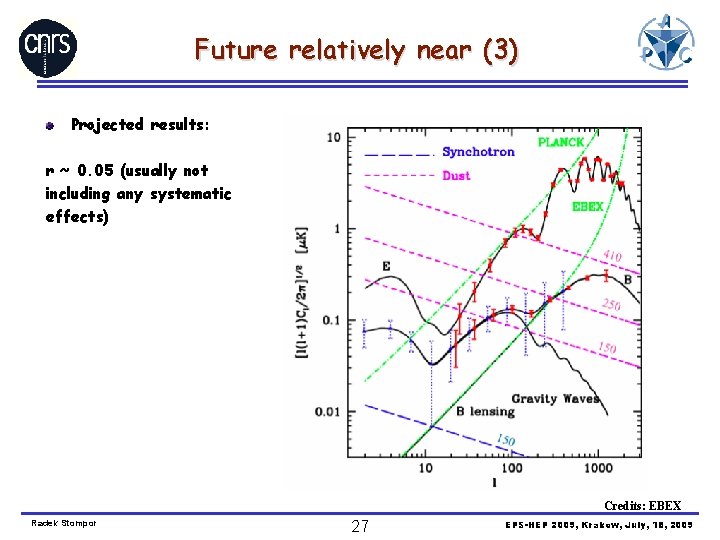
Future relatively near (3) Projected results: r ~ 0. 05 (usually not including any systematic effects) Credits: EBEX Radek Stompor 27 EPS-HEP 2009, Krakow, July, 18, 2009
Future somewhat further … Satellite missions considered, proposed and … rejected both in the US (CMBpol): « unknown astrophysical contaminants » … And Europe (B-pol): « proposed technology not sufficiently mature » … In both cases however the uniqness and scientific value of the proposals has been strongly emphasized giving hope for the future past 2025+ … and lots of work to be done in meantime …. Radek Stompor 28 EPS-HEP 2009, Krakow, July, 18, 2009
Conclusions CMB B-mode polarization provides a clean probe of the presence of the gravitational waves in the earlu Universe. A measurement of the ‘tensor-to-scalar’ ratio could help us constraining the physics of inflation. Significant experimental effort is underway to detect and later characterize B-mode polarization. CMB continues to have an impact on cosmology and holds a unique promise for the fundamental (high energy) physics … Radek Stompor 29 EPS-HEP 2009, Krakow, July, 18, 2009
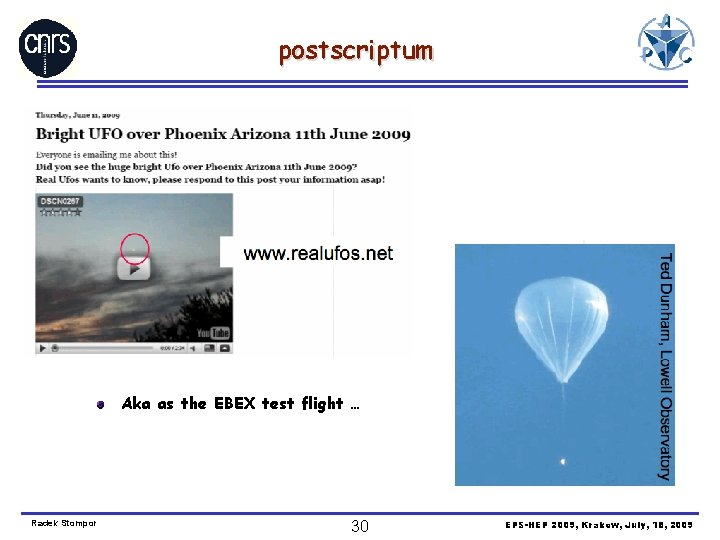
postscriptum Aka as the EBEX test flight … Radek Stompor 30 EPS-HEP 2009, Krakow, July, 18, 2009
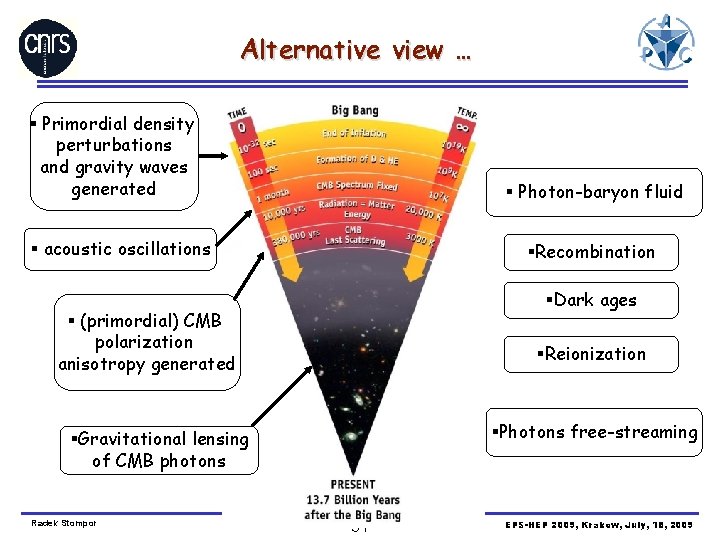
Alternative view … § Primordial density perturbations and gravity waves generated § Photon-baryon fluid § acoustic oscillations §Recombination §Dark ages § (primordial) CMB polarization anisotropy generated §Reionization §Photons free-streaming §Gravitational lensing of CMB photons Radek Stompor 31 EPS-HEP 2009, Krakow, July, 18, 2009
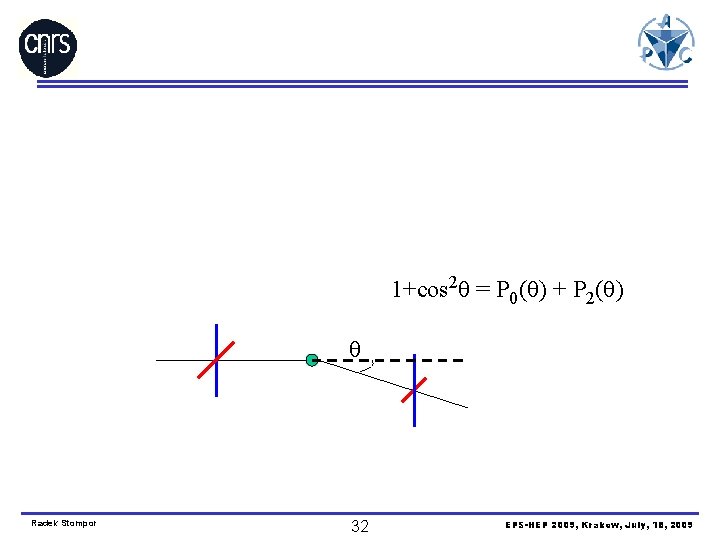
1+cos 2 = P 0( ) + P 2( ) Radek Stompor 32 EPS-HEP 2009, Krakow, July, 18, 2009
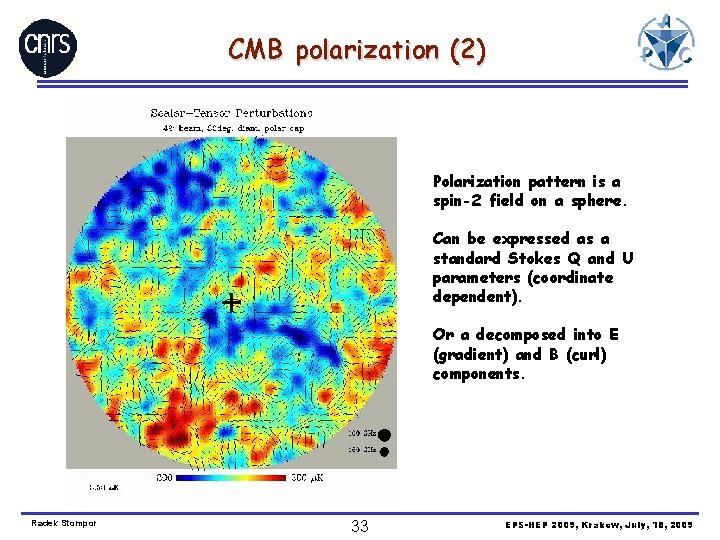
CMB polarization (2) Polarization pattern is a spin-2 field on a sphere. Can be expressed as a standard Stokes Q and U parameters (coordinate dependent). Or a decomposed into E (gradient) and B (curl) components. Radek Stompor 33 EPS-HEP 2009, Krakow, July, 18, 2009
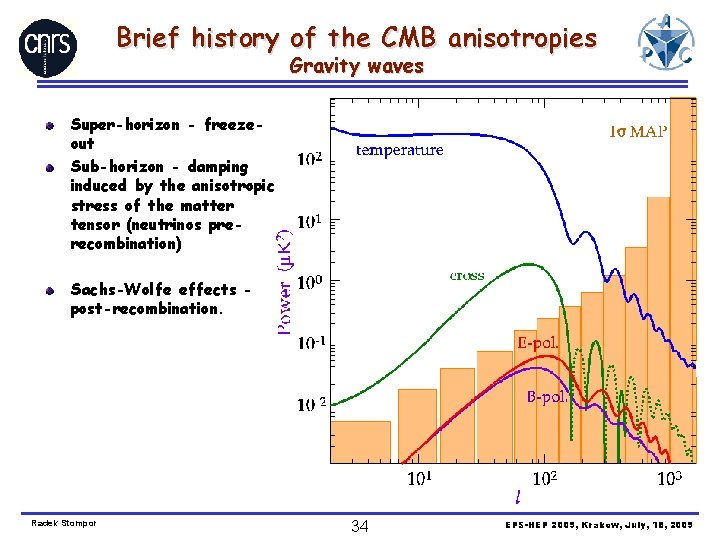
Brief history of the CMB anisotropies Gravity waves Super-horizon - freezeout Sub-horizon - damping induced by the anisotropic stress of the matter tensor (neutrinos prerecombination) Sachs-Wolfe effects post-recombination. Radek Stompor 34 EPS-HEP 2009, Krakow, July, 18, 2009
- Slides: 34