
Cosmic Baryons The IGM UeLi Pen Overview History
Cosmic Baryons: The IGM Ue-Li Pen 彭威禮

Overview • History of Cosmic Baryons: a gas with phase transitions • Missing baryons • simulations • SZ-Power spectrum: direct probe of baryons • Prospects for detection
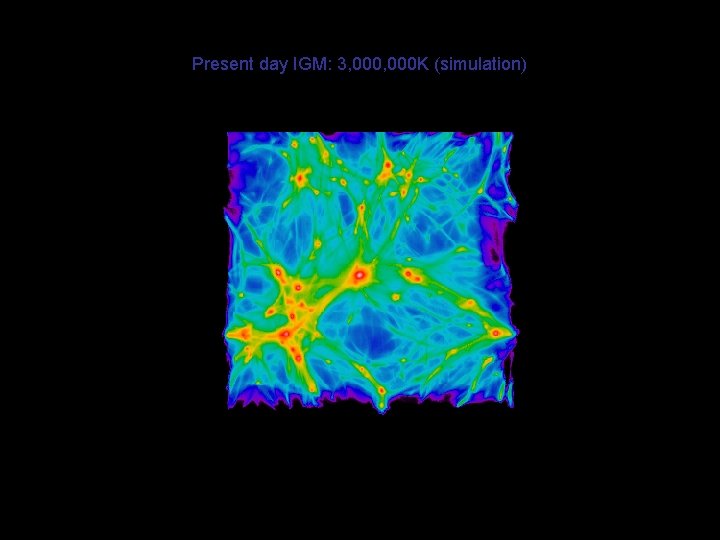
Cosmic Gas • Today, 25% of matter is baryons (ordinary matter), the rest is dark matter (interacts through gravity only). C. f. dark energy. • Thermal state today very poorly known. Probably in warm/hot/diffuse state, filling most of the universe. Only a small fraction in stars, cold (obervable) gas (Fukogita et al 1999). “Missing Baryons” • T range 104 -109 K
Cosmological Context • Critical for understanding global cosmology processes: galaxy formation, cluster formation. • Impacts precision measurement of cosmology: dark energy, dark matter, lensing. • Major efforts underway to map cosmic distribution using SZ (Compton scattering of CMB)
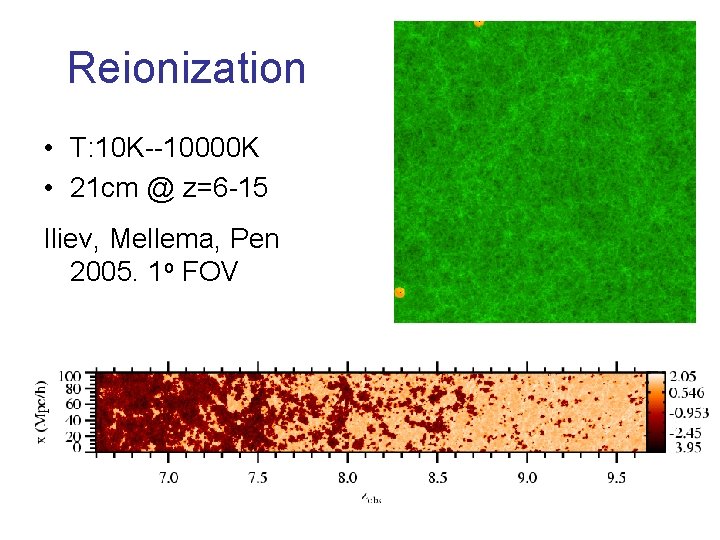
In the beginning • Hot big bang: above z>1000, T>3000 K. Baryons well understood: linear waves in photon-baryon plasma. • Recombination: phase transition to neutral: well understood. • Dark Ages(10<z<1000): non-linear passive evolution: well understood. • Reionization (6<z<20): phase transition • Epoch of Galaxy formation 2<z<6: Lya forest: modestly understood • Present: z<2: poorly understood
WMAP 3 yr Baryons at recombination: T=3000 K, n=102/cm 3
Reionization • T: 10 K--10000 K • 21 cm @ z=6 -15 Iliev, Mellema, Pen 2005. 1 o FOV
Present day IGM: 3, 000 K (simulation)
Where are the missing baryons? • The present day baryons remain undetected. But are not the dark matter • IGM: what is the state/density • Compact objects: Brown/white/other dwarfs. Formed at high-z. Where does gas in clusters come from? • Fukogita et al (1998) speculated baryons to live in poor groups. Violates XRB (Pen 1999).
IGM conundrum • Gas falls into gravitational wells. Why haven’t we seen it? • <k. T>=0. 3 ke. V from cosmic virialization: easily visible by ROSAT extragalactic XRB • Brightness depends on clumping C=ξ(0)<60 • PS prediction: C>200. Need to expel 70% of gas. • Simulations: C>>100 (Pen 1999, Dave et al 2001, Kang&Ryu 2003)
Cosmic Fluid Constraint • If gas follows dark matter (adiabatic evolution), Press-Schechter theory describes dynamics: all matter in gravitationally bound, hydrostatic halos • Missing effects: heating/cooling • Cooling: form stars, denser/colder gas, more easily observed. Calculable. • Heating: expel gas from dark matter halos, harder to observe. Unpredictable.
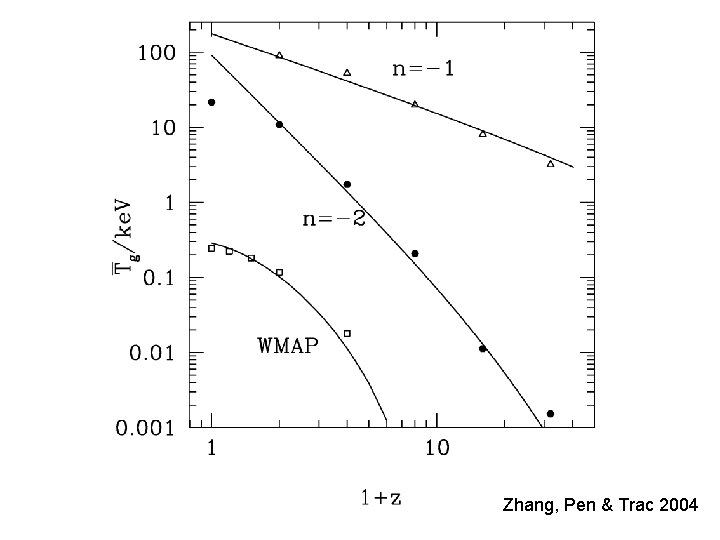
Zhang, Pen & Trac 2004
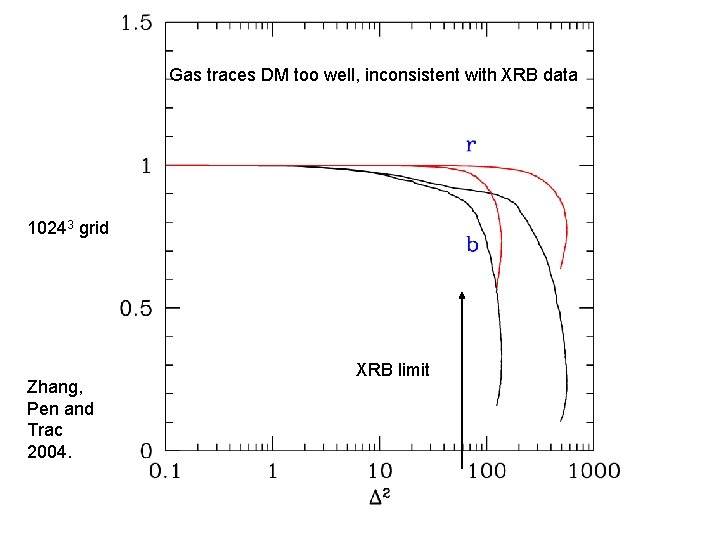
Gas traces DM too well, inconsistent with XRB data 10243 grid Zhang, Pen and Trac 2004. XRB limit
Hiding Baryons • Heat and eject: ΔE of 1 ke. V, maybe less if SN are intergalactic (entropy). • Cool and hide: cooling catastrophe • Problem with simulations? Data interpretation (XRB shadowing)? • How can we find them and show that we found them? How does that affect SZ clusters?
IGM balance • Heating: hydrostatic equilibrium vs free expansion • Gravitational potential determined by dark matter, only weakly affected by baryons • Heating scenarios: 1. halo centers 2. uniform
Central Heating • Initial halo state: isothermal halo, strong entropy stratification • Add heat adiabatically at center, due to winds from SNe, BH outflows, etc. (HII regions are not energetic enough) • Raise central entropy adiabatically at convective stability limit • Final state: central isentropic “core”, isothermal stratified envelope
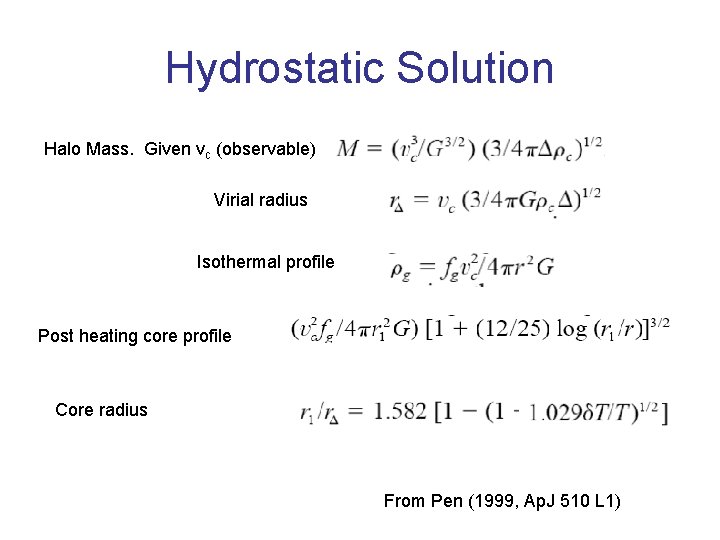
Hydrostatic Solution Halo Mass. Given vc (observable) Virial radius Isothermal profile Post heating core profile Core radius From Pen (1999, Ap. J 510 L 1)
IGM dilemma • Cosmic virial temperature is 3, 000 K • 1 ke. V is uncomfortably hot (107 K) for SNe and feedback scenarios. • What about warm (105 -106 K) phase? Difficult to understand in Press-Schechter picture: hydrostatic equilibrium results in high density, rapid cooling. Warm phase may be numerical artifact.
Hunting Baryons • Baryons (electrons) interact with light (Thomson scattering): SZ & KSZ against CMB. • KSZ is photon Doppler shift from bulk velocity. • TSZ is Compton y =τk. T/(m c 2) ~ 10 -3 • SZ is redshift independent! Where are the baryons?
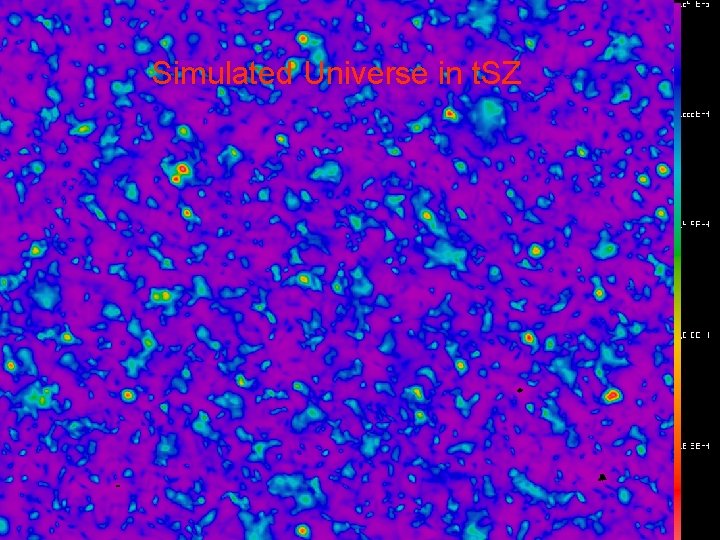
Simulated Universe in t. SZ
• Power spectrum of baryons: thermal and kinetic Zhang, Pen & Trac 2004
Redshift resolution • Equation of state of gas: how hot/dense is the IGM? • Hotter means smoother, less correlated than galaxies • Cross-correlation with photo-z crucial to quantify results
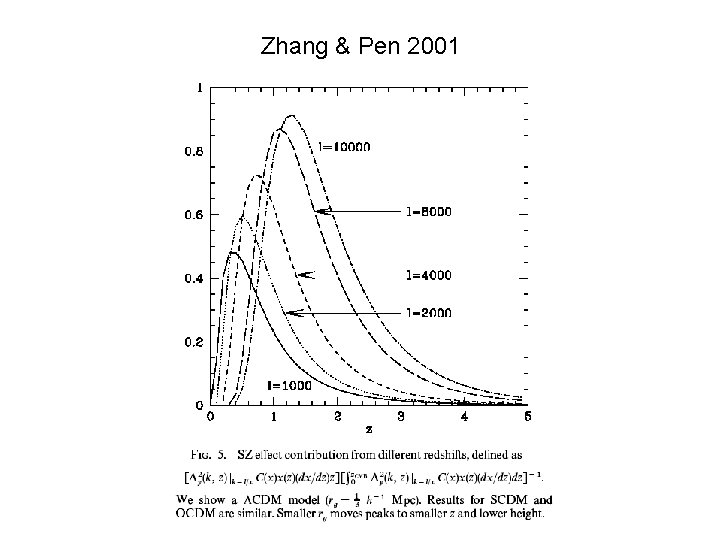
Zhang & Pen 2001
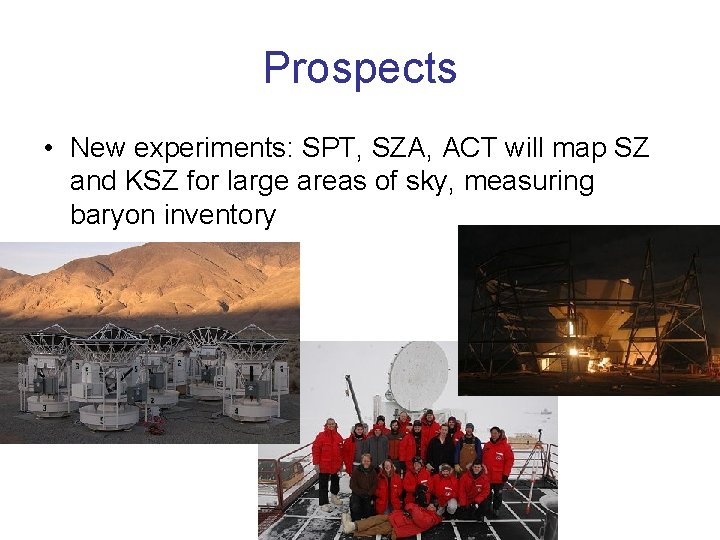
Prospects • New experiments: SPT, SZA, ACT will map SZ and KSZ for large areas of sky, measuring baryon inventory
Conclusions • Baryons poorly understood today. Heating/cooling probably important. • Adiabatic prediction is Evirial = 0. 3 ke. V, inconsistent with observations (groups, XRB) • Feedback requires a lot of energy (>Evirial). 1 ke. V consistent with XRB, LTR (group properties). • Debate on temperature (warm? ), pressure equilibrium, simulations. • SZ a promising physical probe of baryon distribution. This needs to be understood for precision measurement of cosmological parameters, galaxy and cluster formation.
- Slides: 25