
Cosc 2030 binary Heap Binary Heap Binary heap

Cosc 2030 binary Heap.
Binary Heap • Binary heap is with the following properties • it's a complete tree • reminder: all levels are completely filled except for maybe the last one. • Either it’s a • min heap: value of the each node is greater than or equal to the value of its parent with a smallest value at the root • max heap: value of each node is less then or equal to the value of its parent with the max value at the root • Note, some heaps may require the values inserted to be unique.
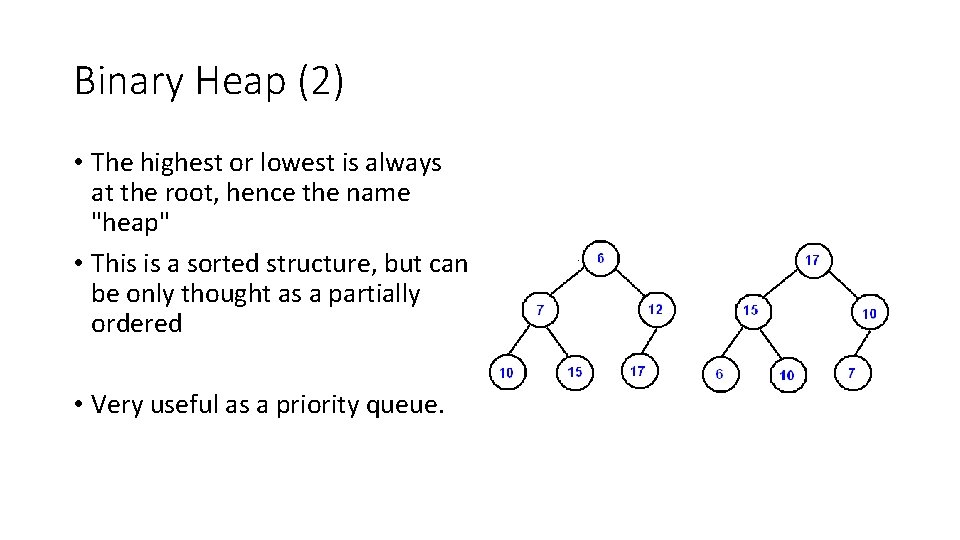
Binary Heap (2) • The highest or lowest is always at the root, hence the name "heap" • This is a sorted structure, but can be only thought as a partially ordered • Very useful as a priority queue.
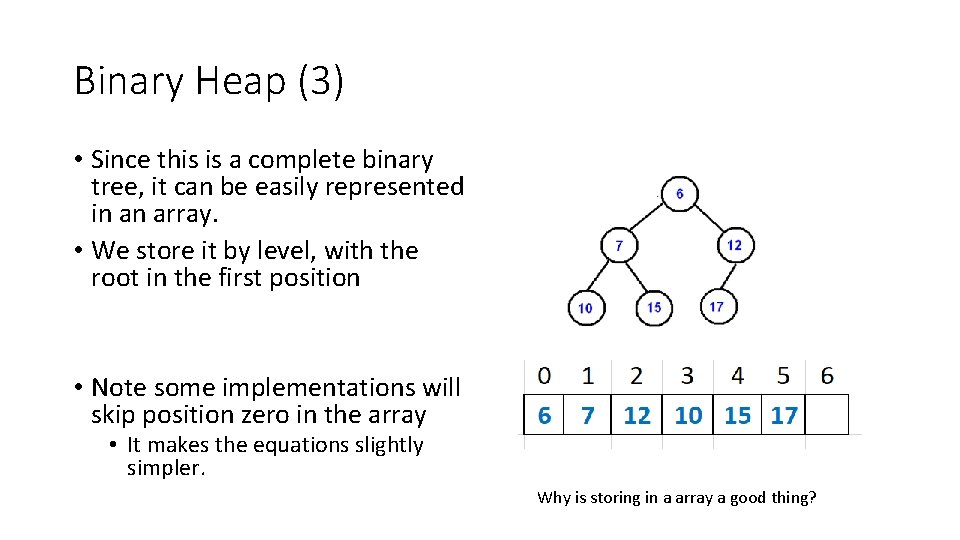
Binary Heap (3) • Since this is a complete binary tree, it can be easily represented in an array. • We store it by level, with the root in the first position • Note some implementations will skip position zero in the array • It makes the equations slightly simpler. Why is storing in a array a good thing?
![Binary Heap (4) • The root is in position zero • arr[0] • For](http://slidetodoc.com/presentation_image_h2/60fdd047ac79cf3667a99eb96235000e/image-5.jpg "Binary Heap (4) • The root is in position zero • arr[0] • For")
Binary Heap (4) • The root is in position zero • arr[0] • For an ith node, we have the following equations. • • parent node is located at (i-1)/2 left child is (2*i) +1 right child is (2*i)+2 with i=0 • left child is 1, right child is 2 • with i=2 • left is child is 5, and right is 6. • Note, will need to the number of nodes.
Binary Heap (5) • A binary heap needs three functions • find • which is the same as other trees • With these two we have to account for min heap or max heap, but the operations. • insert • delete
insert (with arrays) • Insert has two steps 1. add new value to add of the array. 2. "percolation up" • We repair the heap property by comparing the added element with it parent and swapping positions as needed. • min heap, comparison is parent smaller, swap positions. • max heap, comparison is parent larger, swap positions. • repeat from new position until the parent comparison is correct or at root level.
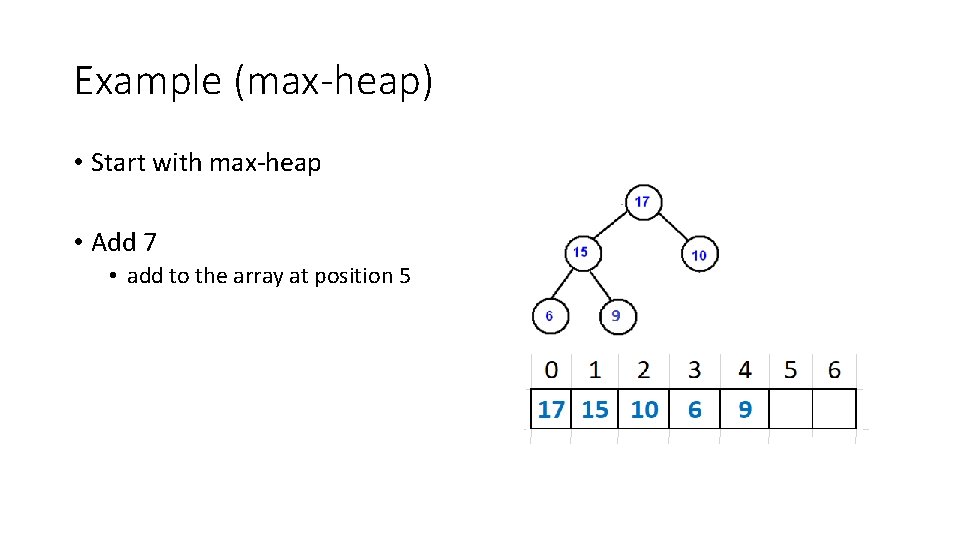
Example (max-heap) • Start with max-heap • Add 7 • add to the array at position 5
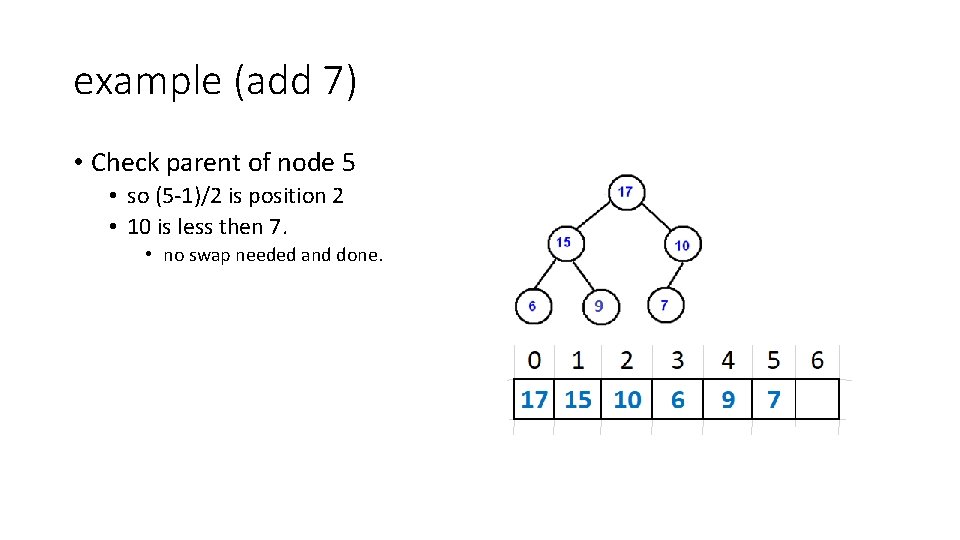
example (add 7) • Check parent of node 5 • so (5 -1)/2 is position 2 • 10 is less then 7. • no swap needed and done.
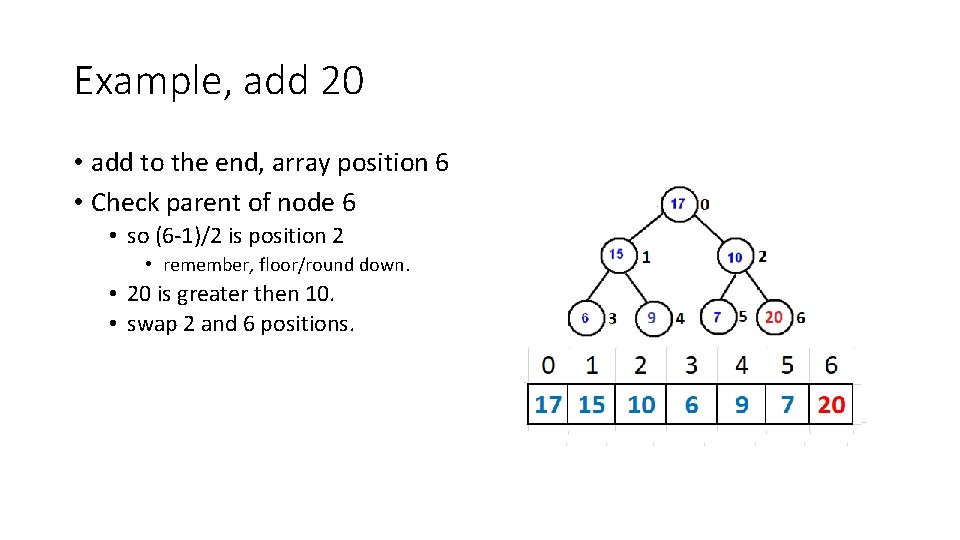
Example, add 20 • add to the end, array position 6 • Check parent of node 6 • so (6 -1)/2 is position 2 • remember, floor/round down. • 20 is greater then 10. • swap 2 and 6 positions.
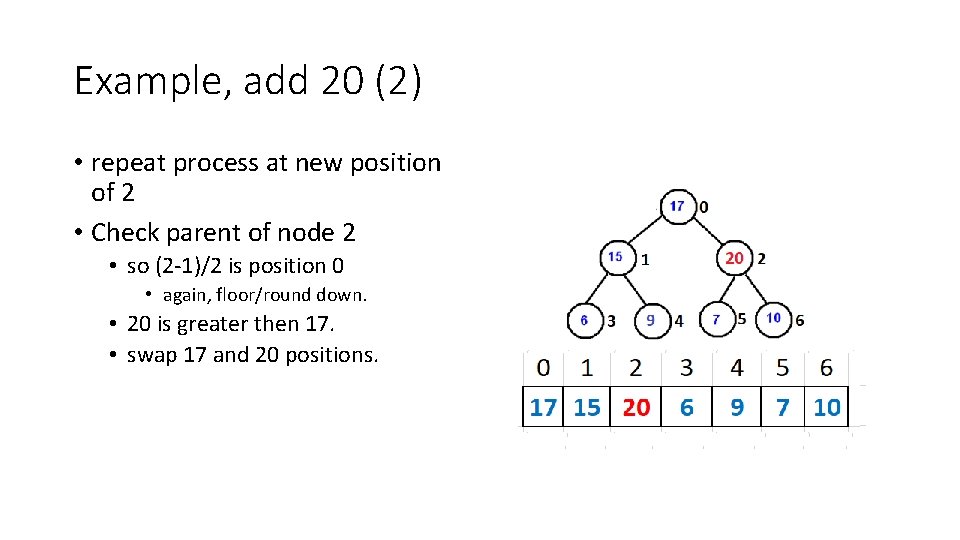
Example, add 20 (2) • repeat process at new position of 2 • Check parent of node 2 • so (2 -1)/2 is position 0 • again, floor/round down. • 20 is greater then 17. • swap 17 and 20 positions.
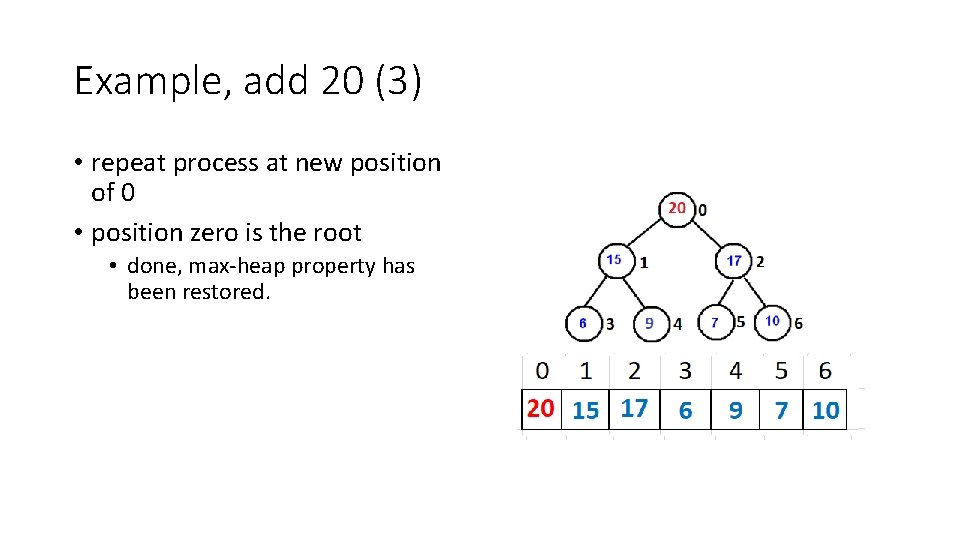
Example, add 20 (3) • repeat process at new position of 0 • position zero is the root • done, max-heap property has been restored.
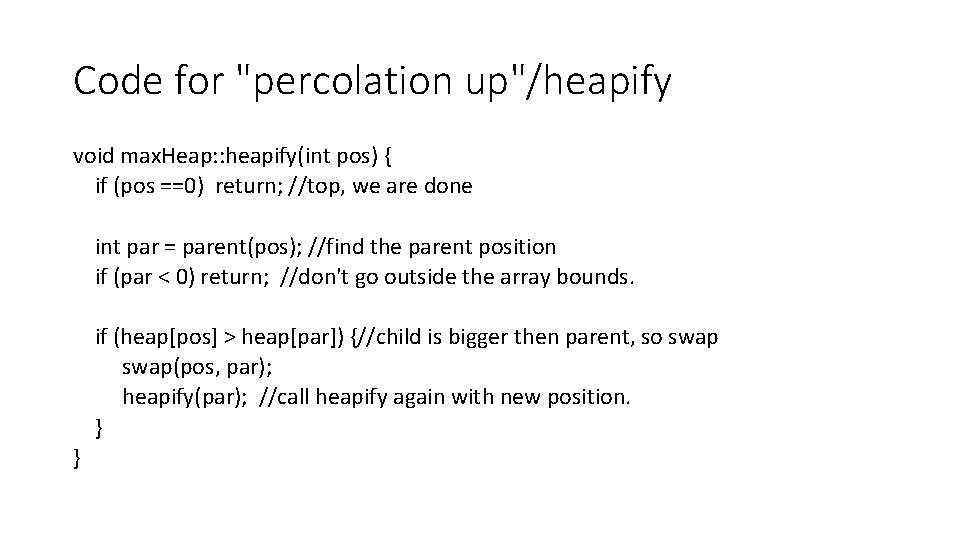
Code for "percolation up"/heapify void max. Heap: : heapify(int pos) { if (pos ==0) return; //top, we are done int par = parent(pos); //find the parent position if (par < 0) return; //don't go outside the array bounds. if (heap[pos] > heap[par]) {//child is bigger then parent, so swap(pos, par); heapify(par); //call heapify again with new position. } }
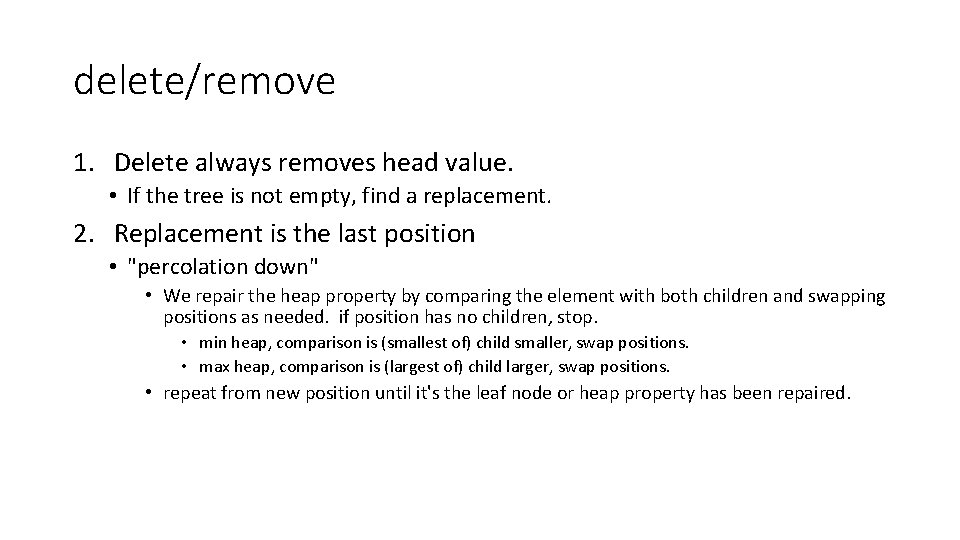
delete/remove 1. Delete always removes head value. • If the tree is not empty, find a replacement. 2. Replacement is the last position • "percolation down" • We repair the heap property by comparing the element with both children and swapping positions as needed. if position has no children, stop. • min heap, comparison is (smallest of) child smaller, swap positions. • max heap, comparison is (largest of) child larger, swap positions. • repeat from new position until it's the leaf node or heap property has been repaired.
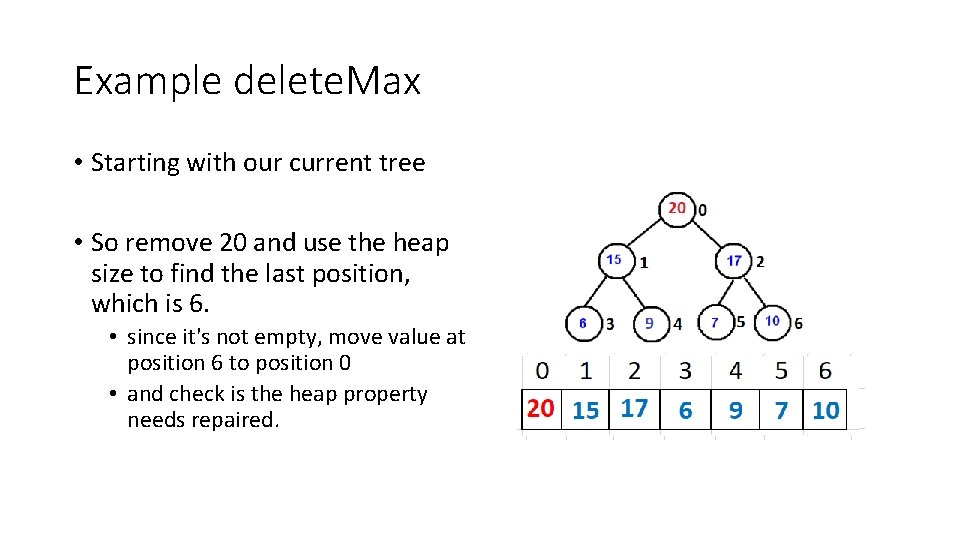
Example delete. Max • Starting with our current tree • So remove 20 and use the heap size to find the last position, which is 6. • since it's not empty, move value at position 6 to position 0 • and check is the heap property needs repaired.
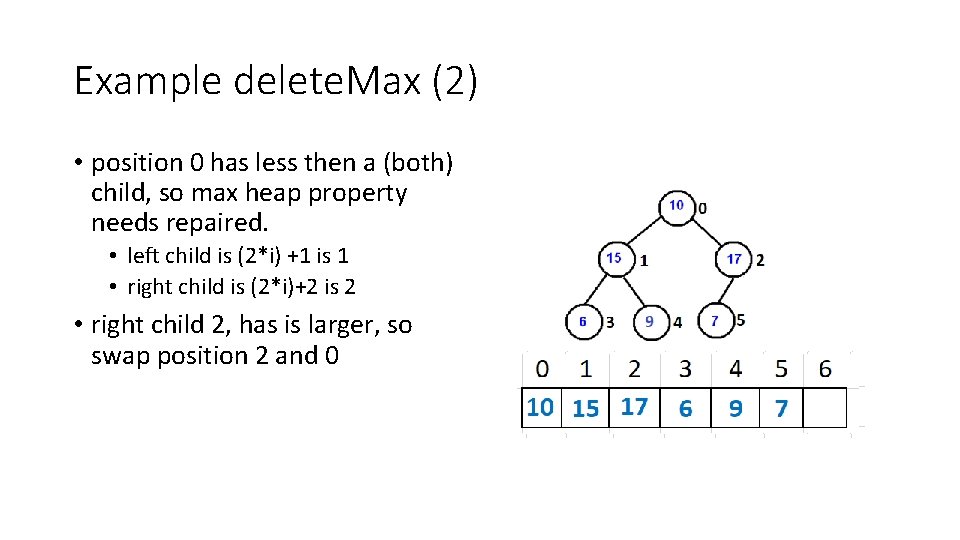
Example delete. Max (2) • position 0 has less then a (both) child, so max heap property needs repaired. • left child is (2*i) +1 is 1 • right child is (2*i)+2 is 2 • right child 2, has is larger, so swap position 2 and 0
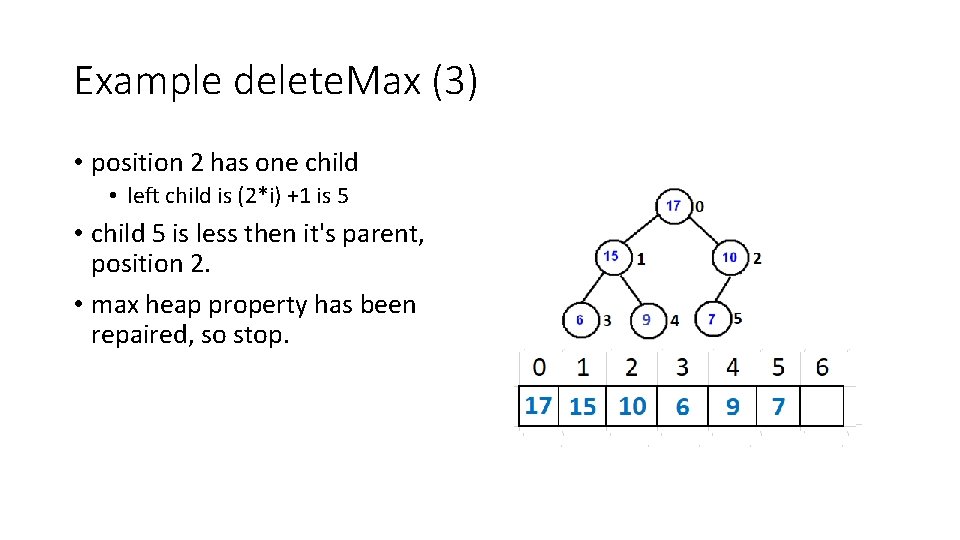
Example delete. Max (3) • position 2 has one child • left child is (2*i) +1 is 5 • child 5 is less then it's parent, position 2. • max heap property has been repaired, so stop.
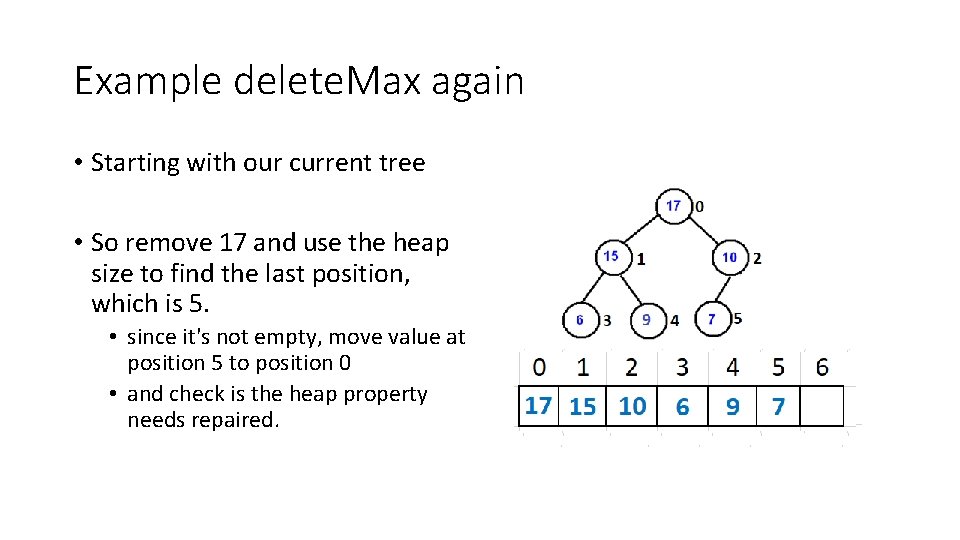
Example delete. Max again • Starting with our current tree • So remove 17 and use the heap size to find the last position, which is 5. • since it's not empty, move value at position 5 to position 0 • and check is the heap property needs repaired.
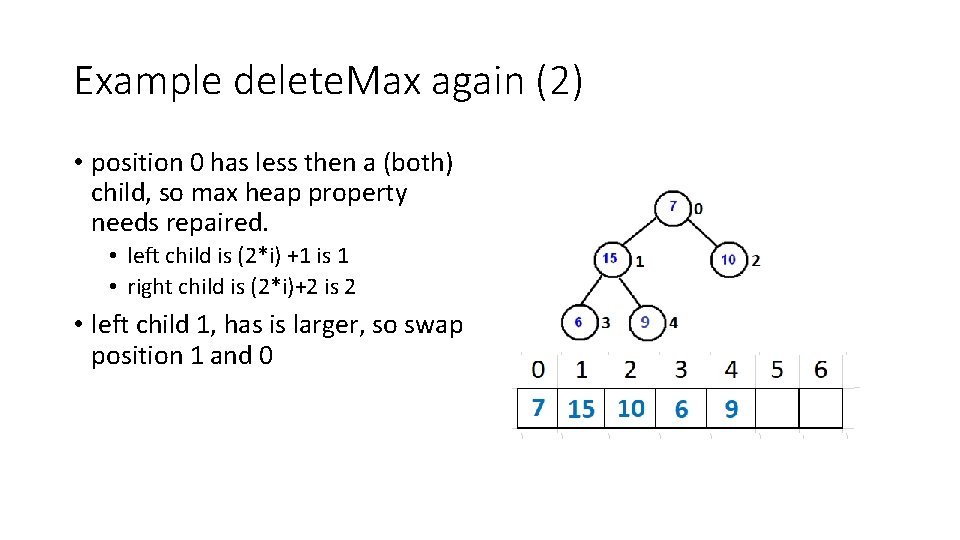
Example delete. Max again (2) • position 0 has less then a (both) child, so max heap property needs repaired. • left child is (2*i) +1 is 1 • right child is (2*i)+2 is 2 • left child 1, has is larger, so swap position 1 and 0
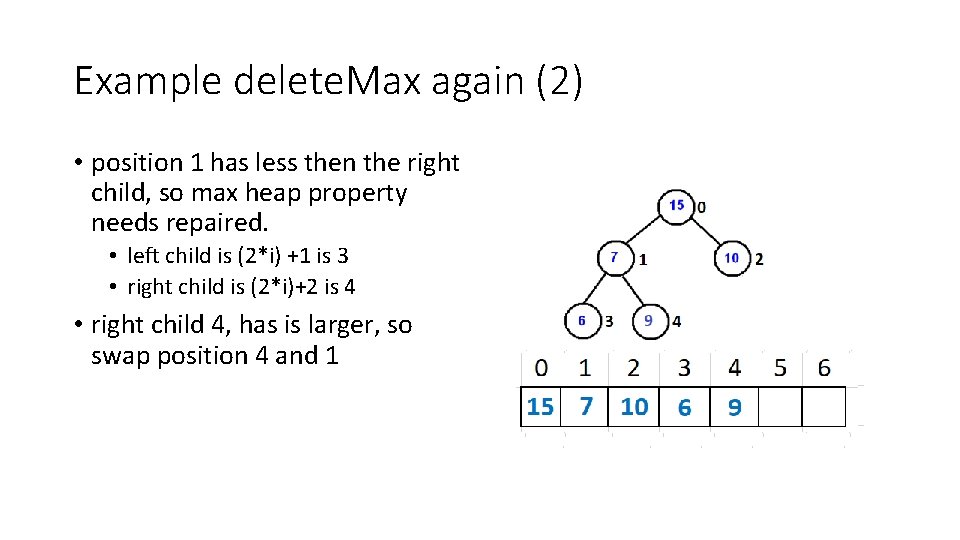
Example delete. Max again (2) • position 1 has less then the right child, so max heap property needs repaired. • left child is (2*i) +1 is 3 • right child is (2*i)+2 is 4 • right child 4, has is larger, so swap position 4 and 1
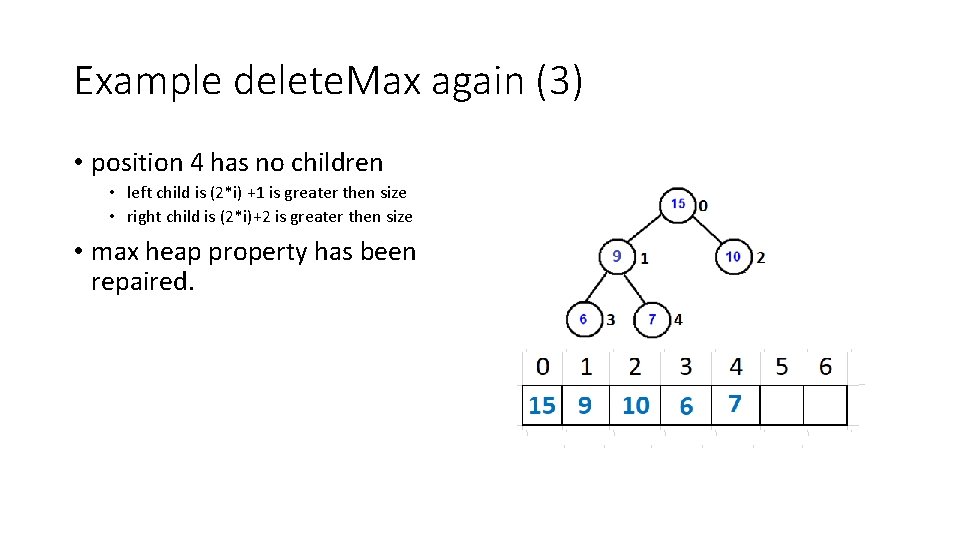
Example delete. Max again (3) • position 4 has no children • left child is (2*i) +1 is greater then size • right child is (2*i)+2 is greater then size • max heap property has been repaired.
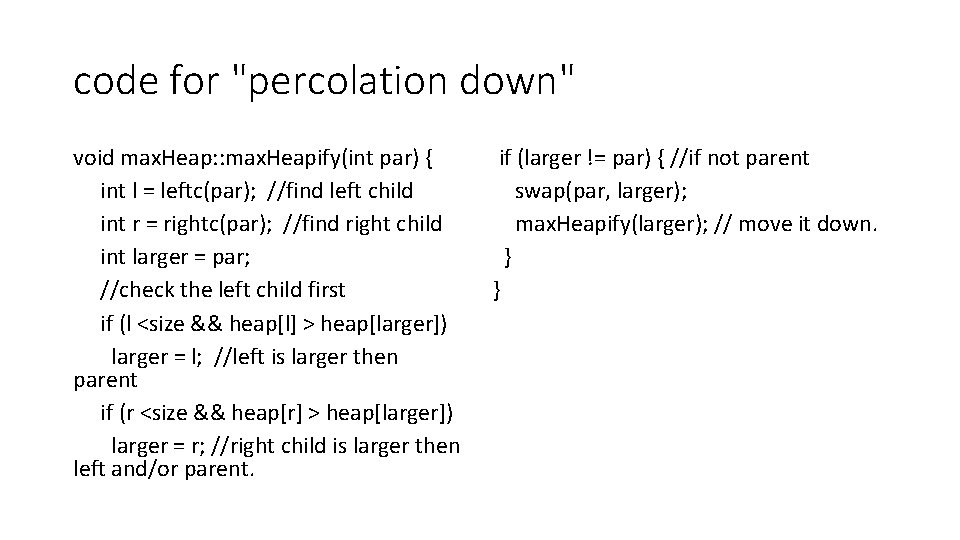
code for "percolation down" void max. Heap: : max. Heapify(int par) { int l = leftc(par); //find left child int r = rightc(par); //find right child int larger = par; //check the left child first if (l <size && heap[l] > heap[larger]) larger = l; //left is larger then parent if (r <size && heap[r] > heap[larger]) larger = r; //right child is larger then left and/or parent. if (larger != par) { //if not parent swap(par, larger); max. Heapify(larger); // move it down. } }
Priority queue • Most priority queues are implemented a binary heap • reminder • binary heap insert and delete are about log 2 n • using a standard list for a priority queue • reminder • insert or search/delete is linear in timing. Why choose a binary heap over a list/queue?
Priority queue note • If the items in the priority queue are unchangeable, then this works great. • If the items can be changed then the changed we need run heap repair on the new node to repair the heap. • Say we enter 'a' with a priority of 2 and then change the priority of 'a' to 4.
is a binary tree a heap? • properties of a heap 1. must be complete. 2. min/max heap property. • min heap: value of the each node is greater than or equal to the value of its parent with a smallest value at the root • max heap: value of each node is less then or equal to the value of its parent with the max value at the root • We can check • With a binary tree, starting a root • If has children and is heap property satisfied? (example max: is greater then both children) • If yes, recursively go down both child. • if no, return "false" • if no children, return true. • This needs be an extra check is this leaf is lower then the left most leaf for complete.
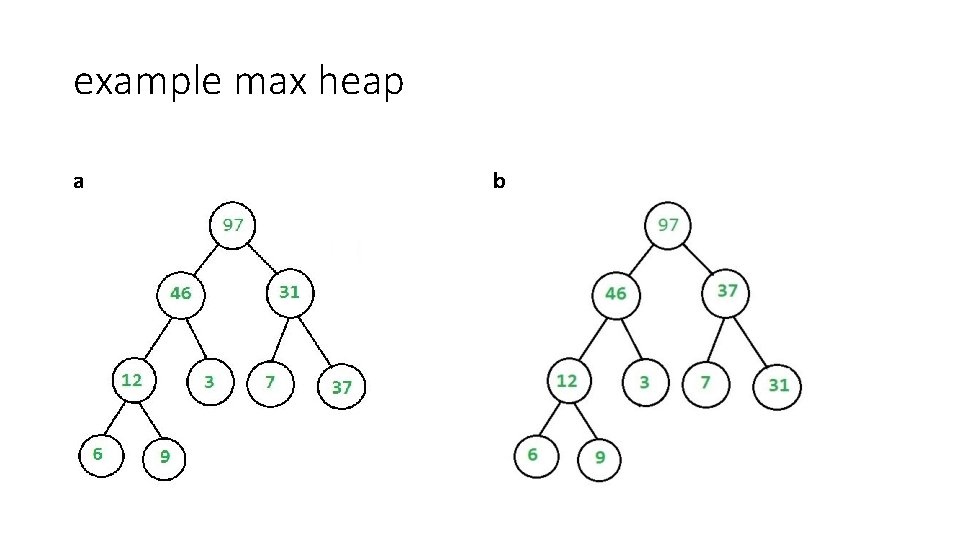
example max heap a b
is a binary tree a heap? (2) • If the tree is an array then is a heap? • The complete check has likely already been done, unless you can leave blanks in the array. • We can loop using this • for (i=0; i<=(n-2)/2) ; i++) • use i to position and check left/right children • return false if property fails • return true if we finish the loop. • If the tree is not stored in an array, much harder • Find out if it is a complete (or nearly complete tree) • Then check the max/min property.
is a binary tree a heap? (3) • recursive function using an array (array bounds check is missing and should be used). bool is. Heap(int arr[], int i, int n) { • If a leaf node if (i > (n - 2)/2) return true; • If an internal node and is greater than its children, and same is recursively true for the children if (arr[i] >= arr[left(i)] && arr[i] >= arr[right(i)] && is. Heap(arr, left(i), n) && is. Heap(arr, right(i), n)) return true; return false; }
Last note • There is a sort, called heap sort based on a binary heap. • we come back to it and look at how it works.

Q&A
- Slides: 30