
Cortland Tree Survey The Cortland Tree Survey project
- Slides: 1
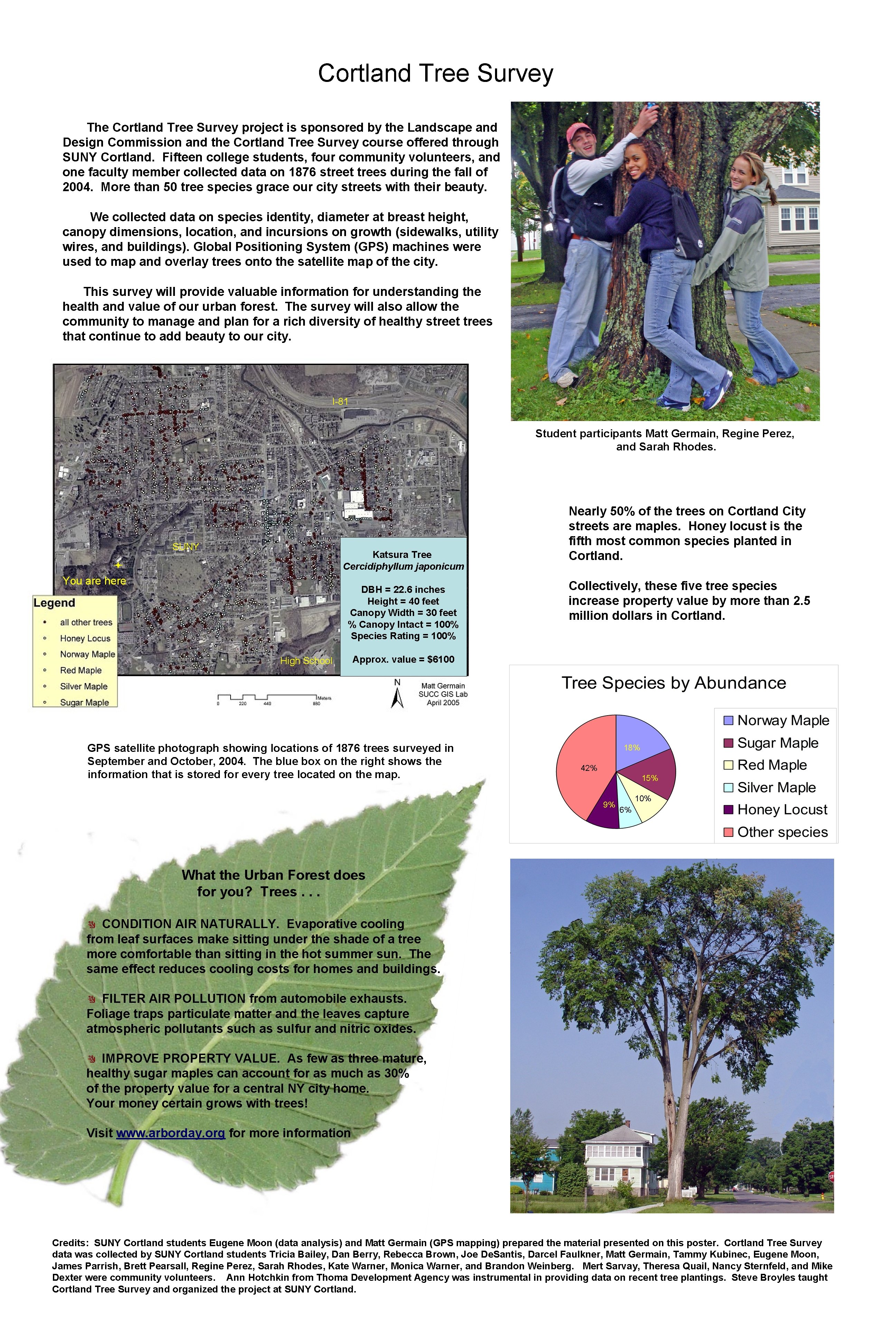
Cortland Tree Survey The Cortland Tree Survey project is sponsored by the Landscape and Design Commission and the Cortland Tree Survey course offered through SUNY Cortland. Fifteen college students, four community volunteers, and one faculty member collected data on 1876 street trees during the fall of 2004. More than 50 tree species grace our city streets with their beauty. We collected data on species identity, diameter at breast height, canopy dimensions, location, and incursions on growth (sidewalks, utility wires, and buildings). Global Positioning System (GPS) machines were used to map and overlay trees onto the satellite map of the city. This survey will provide valuable information for understanding the health and value of our urban forest. The survey will also allow the community to manage and plan for a rich diversity of healthy street trees that continue to add beauty to our city. I-81 Student participants Matt Germain, Regine Perez, and Sarah Rhodes. SUNY Katsura Tree Cercidiphyllum japonicum You are here DBH = 22. 6 inches Height = 40 feet Canopy Width = 30 feet % Canopy Intact = 100% Species Rating = 100% High School Nearly 50% of the trees on Cortland City streets are maples. Honey locust is the fifth most common species planted in Cortland. Collectively, these five tree species increase property value by more than 2. 5 million dollars in Cortland. Approx. value = $6100 GPS satellite photograph showing locations of 1876 trees surveyed in September and October, 2004. The blue box on the right shows the information that is stored for every tree located on the map. 18% 42% 15% 9% 10% 6% What the Urban Forest does for you? Trees. . . CONDITION AIR NATURALLY. Evaporative cooling from leaf surfaces make sitting under the shade of a tree more comfortable than sitting in the hot summer sun. The same effect reduces cooling costs for homes and buildings. FILTER AIR POLLUTION from automobile exhausts. Foliage traps particulate matter and the leaves capture atmospheric pollutants such as sulfur and nitric oxides. IMPROVE PROPERTY VALUE. As few as three mature, healthy sugar maples can account for as much as 30% of the property value for a central NY city home. Your money certain grows with trees! Visit www. arborday. org for more information Credits: SUNY Cortland students Eugene Moon (data analysis) and Matt Germain (GPS mapping) prepared the material presented on this poster. Cortland Tree Survey data was collected by SUNY Cortland students Tricia Bailey, Dan Berry, Rebecca Brown, Joe De. Santis, Darcel Faulkner, Matt Germain, Tammy Kubinec, Eugene Moon, James Parrish, Brett Pearsall, Regine Perez, Sarah Rhodes, Kate Warner, Monica Warner, and Brandon Weinberg. Mert Sarvay, Theresa Quail, Nancy Sternfeld, and Mike Dexter were community volunteers. Ann Hotchkin from Thoma Development Agency was instrumental in providing data on recent tree plantings. Steve Broyles taught Cortland Tree Survey and organized the project at SUNY Cortland.