
Corso di Modellazione e Simulazione di Sistemi Fisiologici


- Slides: 36
Corso di Modellazione e Simulazione di Sistemi Fisiologici Medical Image Processing Federica Caselli Department of Civil Engineering University of Rome Tor Vergata
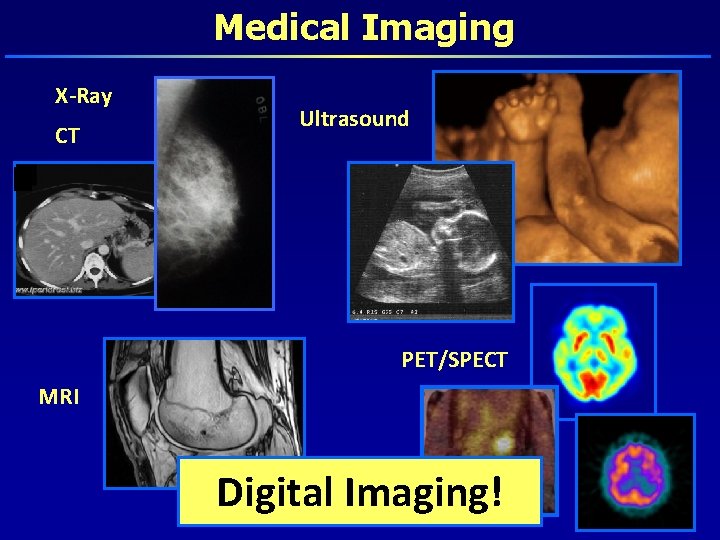
Medical Imaging X-Ray CT Ultrasound PET/SPECT MRI Digital Imaging!
Medical Image Processing What kind? • Image compression • Image denoising • Image enhancement • Image segmentation • Image registration • Image fusion What for? • Image storage, retrieval, transmission • Telemedicine • Quantitative analysis • Computer aided diagnosis, surgery, treatment and follow up To name but a few! Image analysis software becoming an essential component of the medical instrumentation
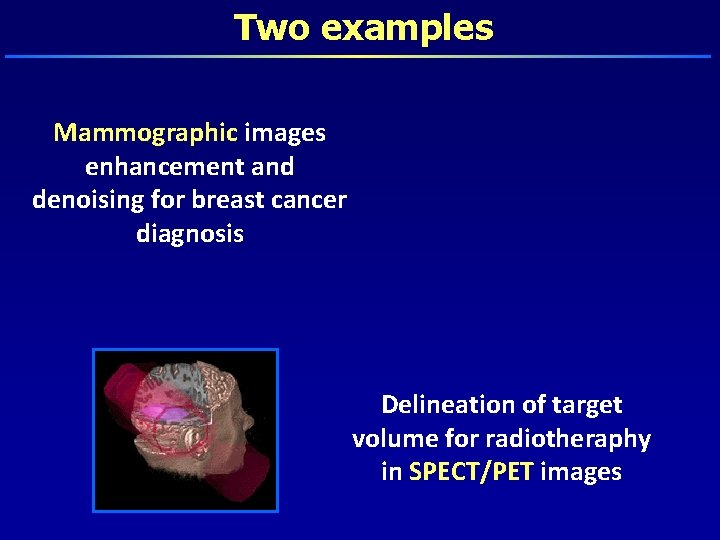
Two examples Mammographic images enhancement and denoising for breast cancer diagnosis Delineation of target volume for radiotheraphy in SPECT/PET images
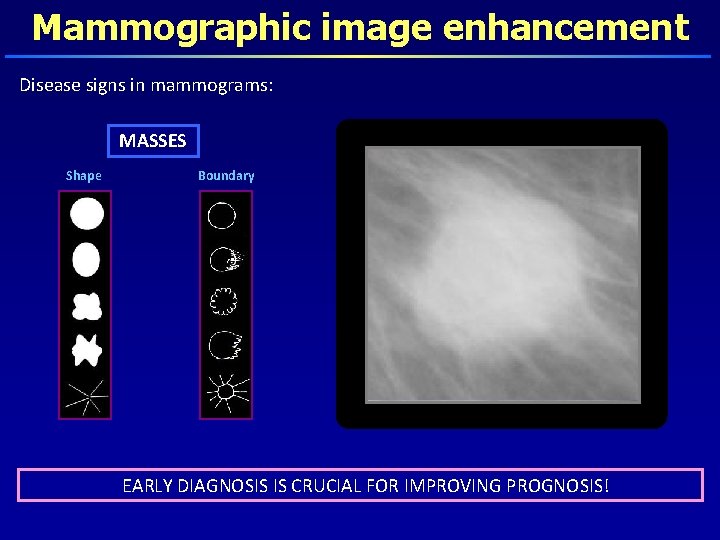
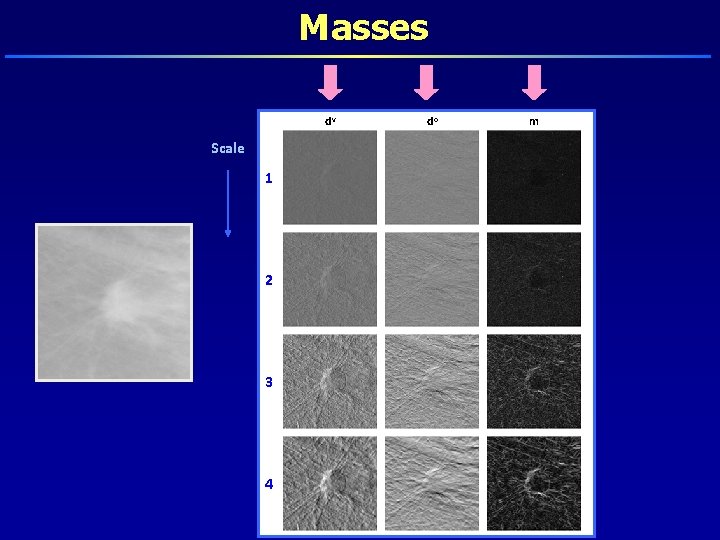
Mammographic image enhancement Disease signs in mammograms: MASSES Shape Boundary EARLY DIAGNOSIS IS CRUCIAL FOR IMPROVING PROGNOSIS!
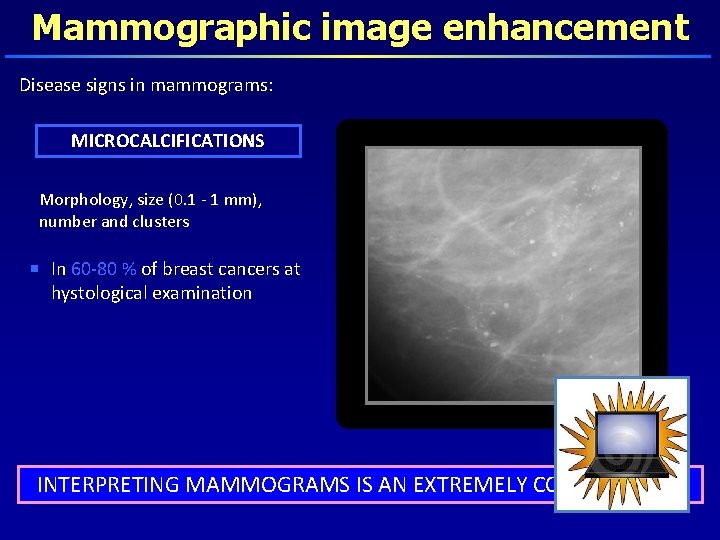
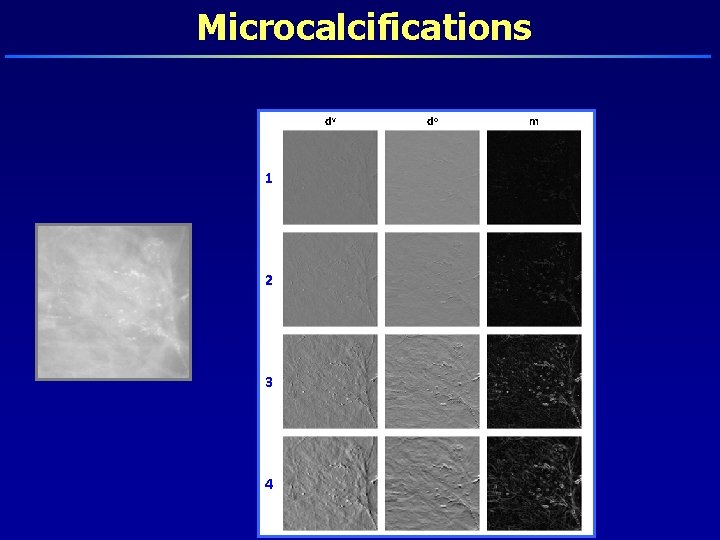
Mammographic image enhancement Disease signs in mammograms: MICROCALCIFICATIONS Morphology, size (0. 1 - 1 mm), number and clusters In 60 -80 % of breast cancers at hystological examination EARLY DIAGNOSIS IS CRUCIALISFOR PROGNOSIS! INTERPRETING MAMMOGRAMS ANIMPROVING EXTREMELY COMPLEX TASK
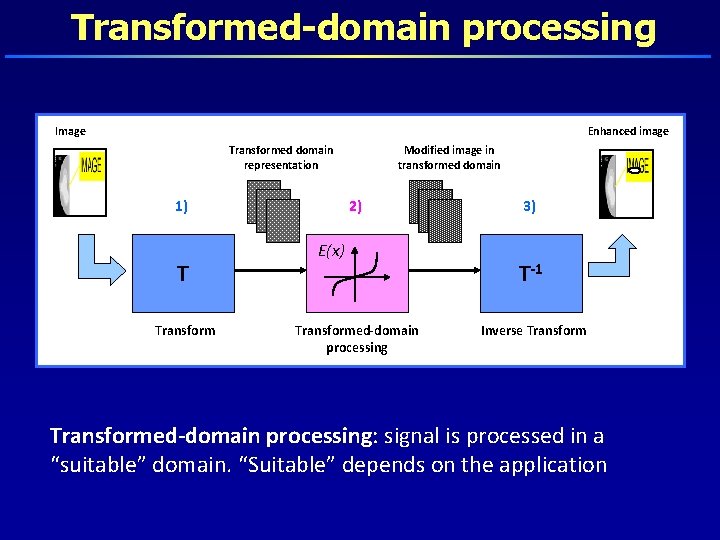
Transformed-domain processing Image Enhanced image Transformed domain representation 1) T Transform Modified image in transformed domain 2) E(x) Transformed-domain processing 3) T-1 Inverse Transformed-domain processing: signal is processed in a “suitable” domain. “Suitable” depends on the application
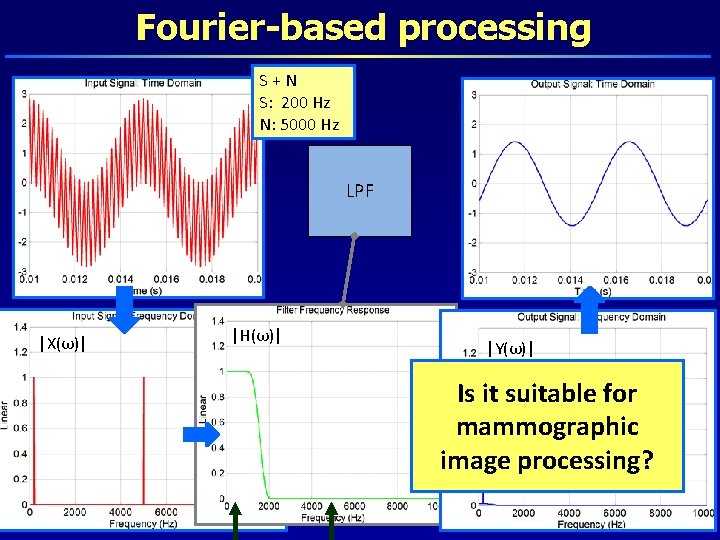
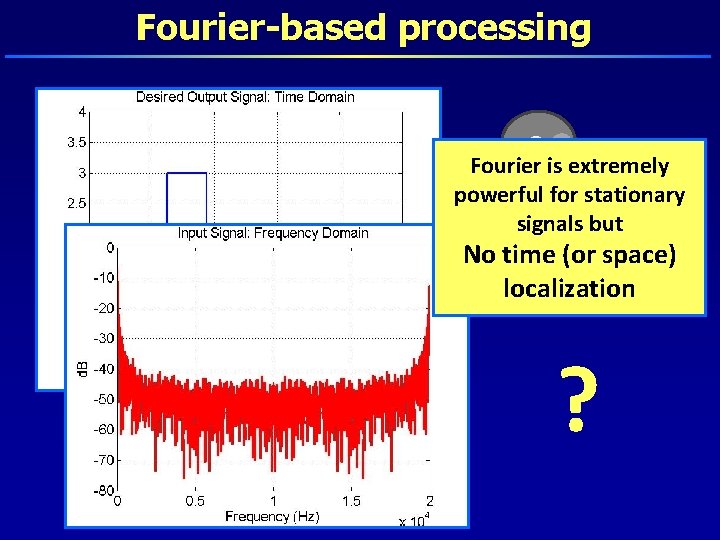
Fourier-based processing S+N S: 200 Hz N: 5000 Hz LPF |X(ω)| |H(ω)| |Y(ω)| Is it suitable for mammographic image processing?
Fourier-based processing Fourier is extremely powerful for stationary signals but No time (or space) localization ?
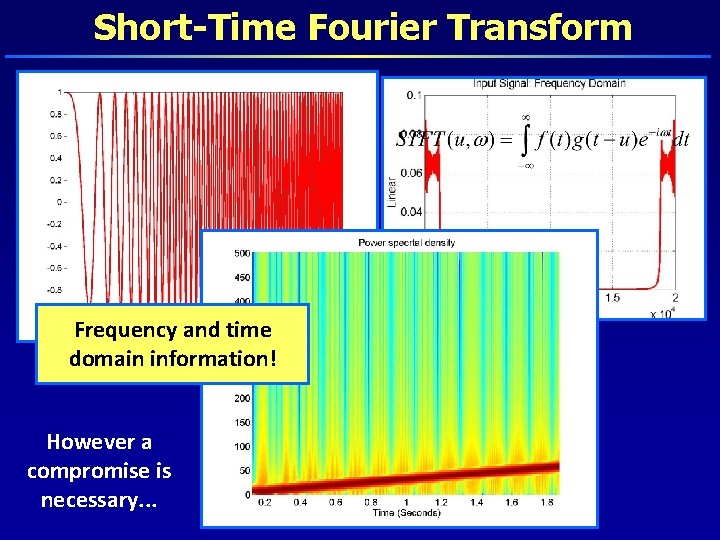
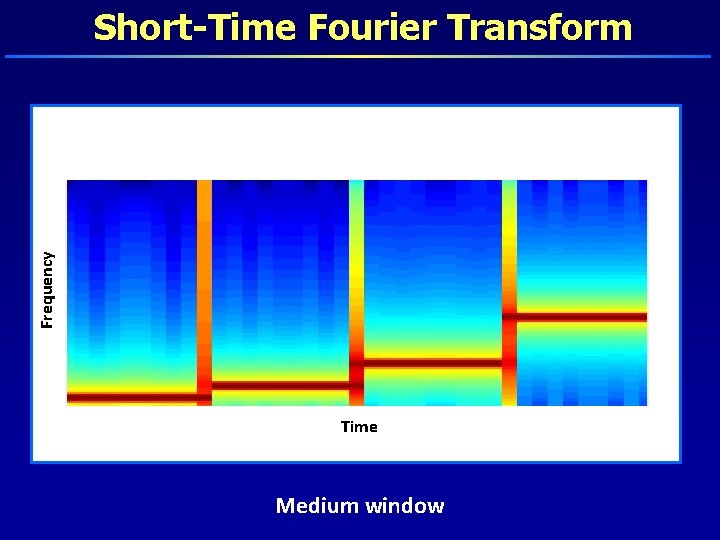
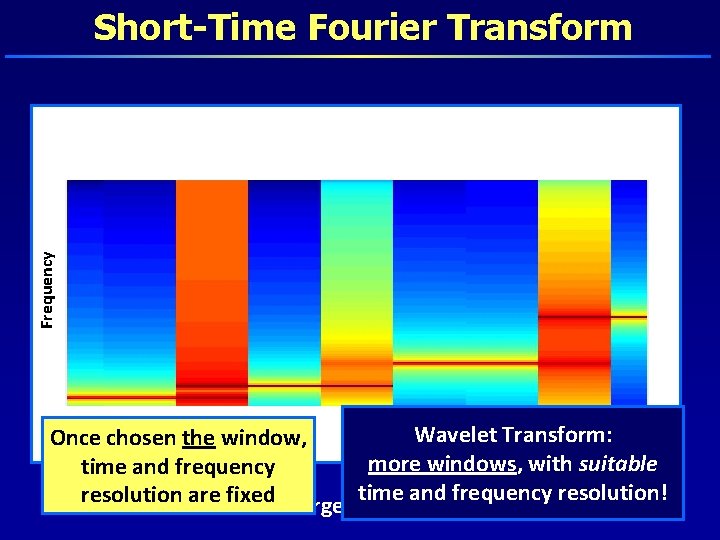
Short-Time Fourier Transform Frequency and time domain information! However a compromise is necessary. . .
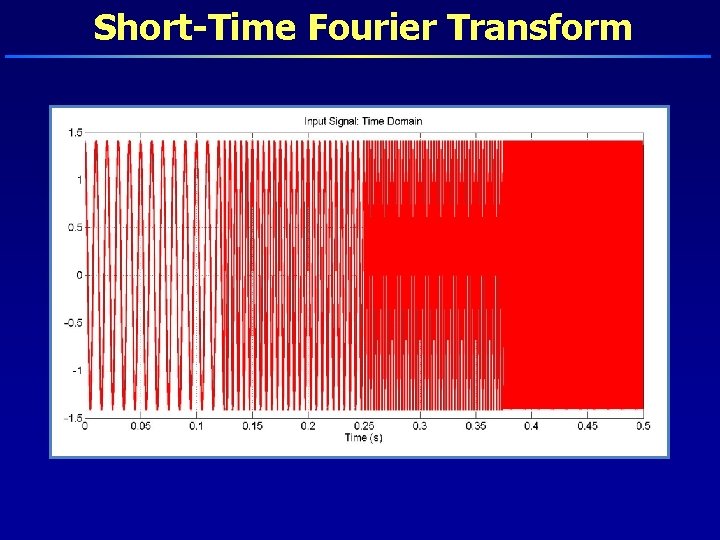
Short-Time Fourier Transform
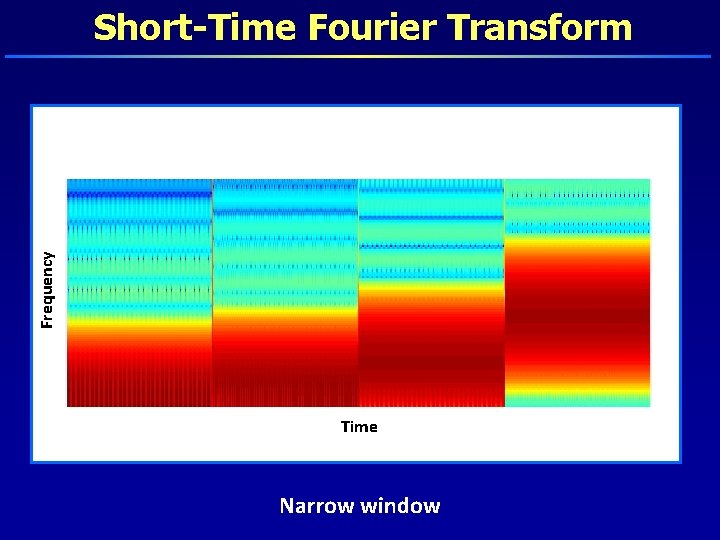
Frequency Short-Time Fourier Transform Time Narrow window
Frequency Short-Time Fourier Transform Time Medium window
Frequency Short-Time Fourier Transform Time Wavelet Transform: Once chosen the window, more windows, with suitable time and frequency resolution! resolution are fixed Large window
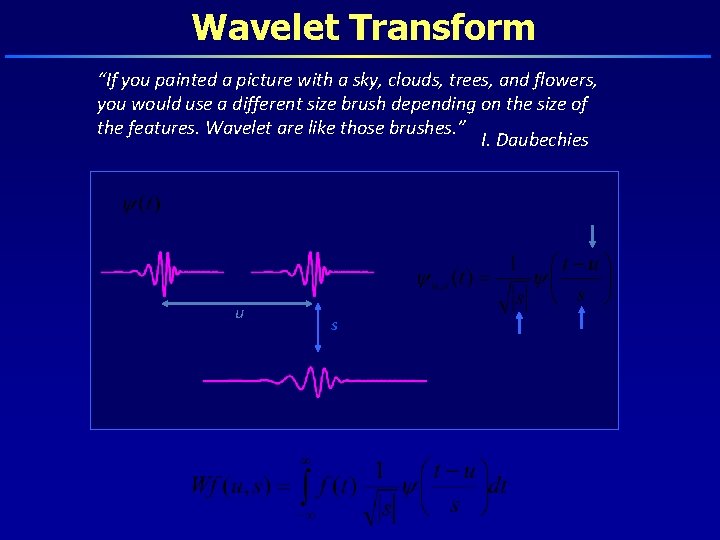
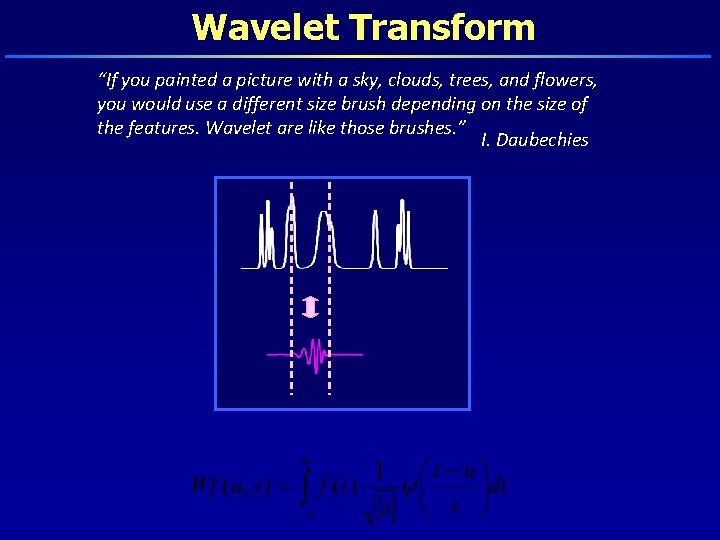
Wavelet Transform “If you painted a picture with a sky, clouds, trees, and flowers, you would use a different size brush depending on the size of the features. Wavelet are like those brushes. ” I. Daubechies u s
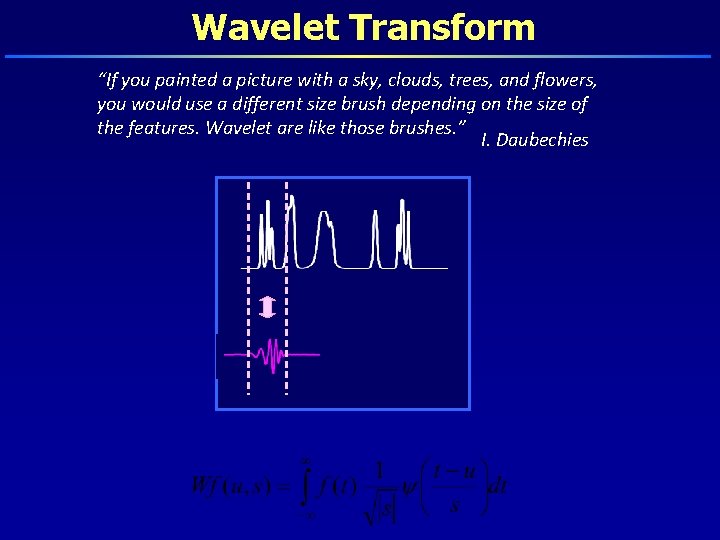
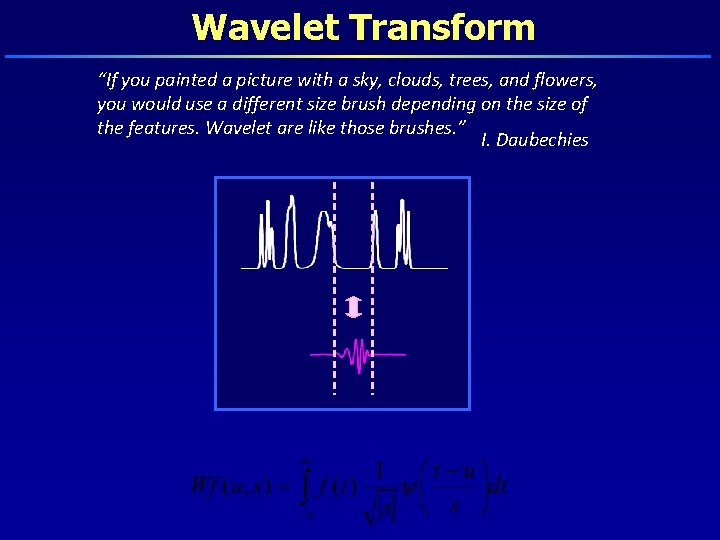
Wavelet Transform “If you painted a picture with a sky, clouds, trees, and flowers, you would use a different size brush depending on the size of the features. Wavelet are like those brushes. ” I. Daubechies
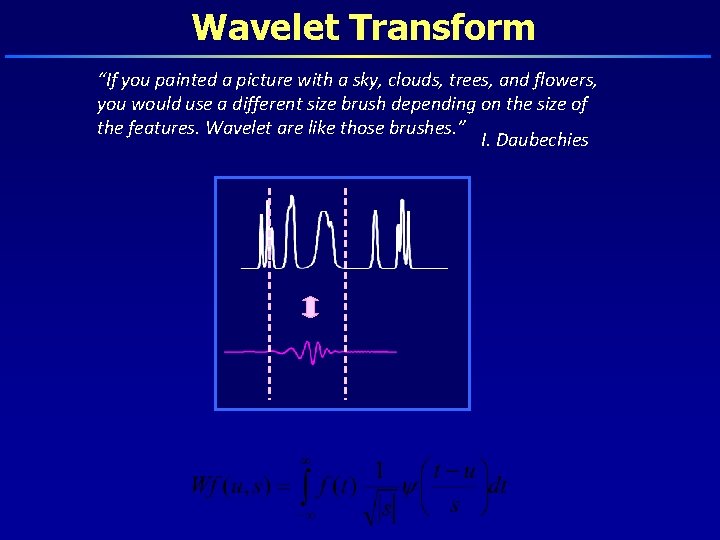
Wavelet Transform “If you painted a picture with a sky, clouds, trees, and flowers, you would use a different size brush depending on the size of the features. Wavelet are like those brushes. ” I. Daubechies
Wavelet Transform “If you painted a picture with a sky, clouds, trees, and flowers, you would use a different size brush depending on the size of the features. Wavelet are like those brushes. ” I. Daubechies
Wavelet Transform “If you painted a picture with a sky, clouds, trees, and flowers, you would use a different size brush depending on the size of the features. Wavelet are like those brushes. ” I. Daubechies
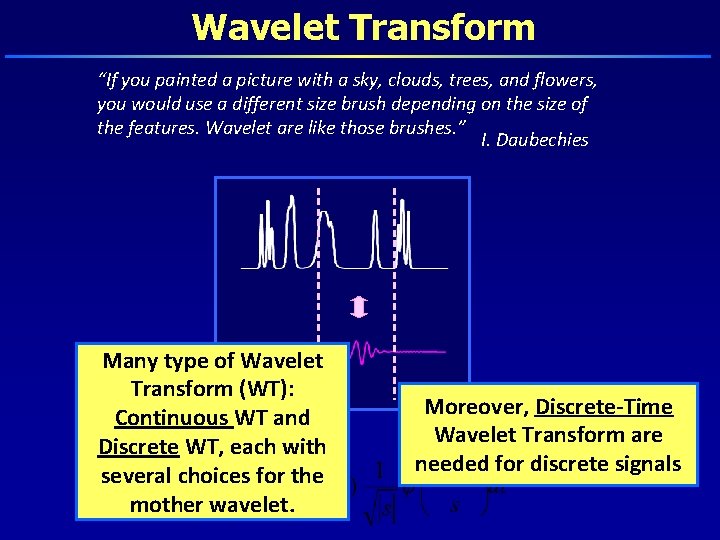
Wavelet Transform “If you painted a picture with a sky, clouds, trees, and flowers, you would use a different size brush depending on the size of the features. Wavelet are like those brushes. ” I. Daubechies Many type of Wavelet Transform (WT): Continuous WT and Discrete WT, each with several choices for the mother wavelet. Moreover, Discrete-Time Wavelet Transform are needed for discrete signals
Dyadic Wavelet Transform S. Mallat and S. Zhong, “Characterization of signals from multiscale edge”, IEEE Transactions on Pattern Analysis and Machine Intelligence, Vol. 14, No. 7, 1992.
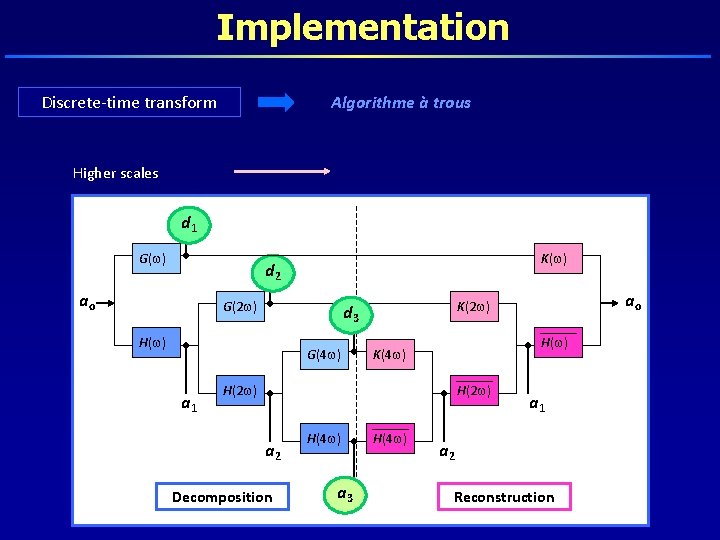
Implementation Algorithme à trous Discrete-time transform Higher scales d 1 G( ) d 2 ao G(2 ) d 3 H( ) G(4 ) a 1 H(2 ) a 2 Decomposition H(4 ) a 3
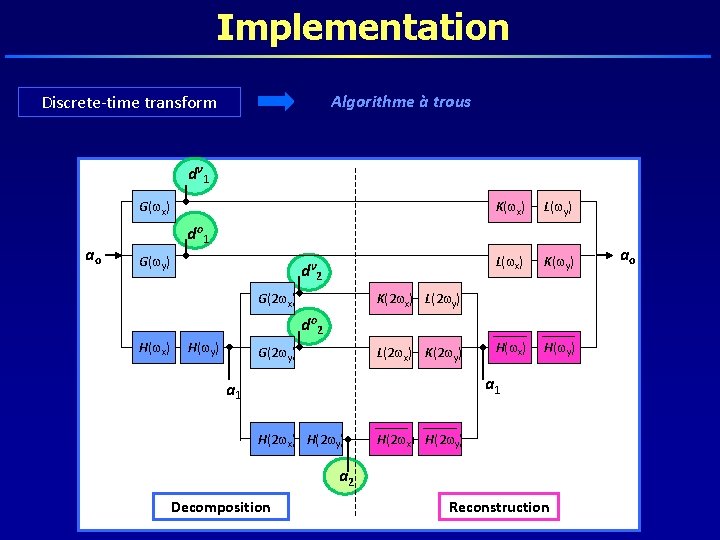
Implementation Algorithme à trous Discrete-time transform Higher scales d 1 G( ) K( ) d 2 ao G(2 ) H( ) G(4 ) a 1 H( ) K(4 ) H(2 ) a 2 Decomposition H(4 ) a 3 ao K(2 ) d 3 H(4 ) a 1 a 2 Reconstruction
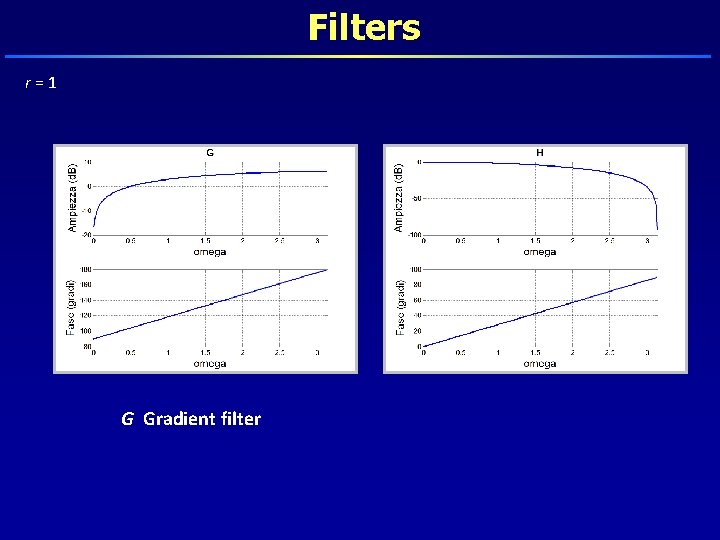
Filters r=1 G Gradient filter
Filters r=2 G Laplacian filter
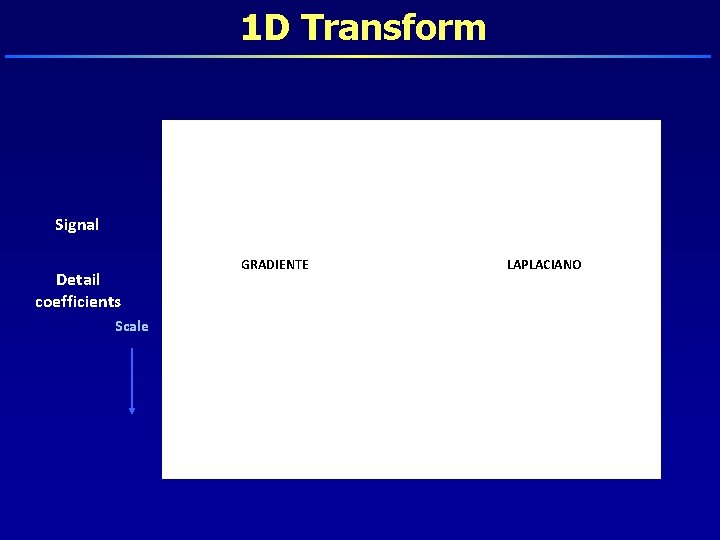
1 D Transform Signal Detail coefficients Scale GRADIENTE LAPLACIANO
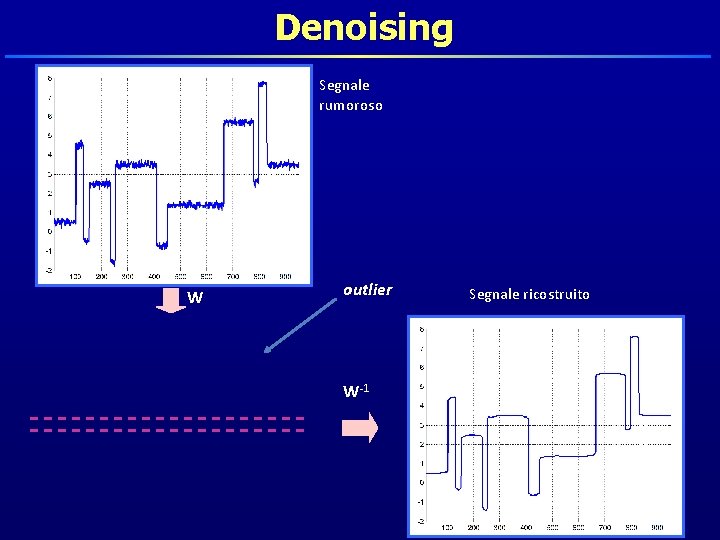
Denoising Segnale rumoroso W outlier W-1 Segnale ricostruito
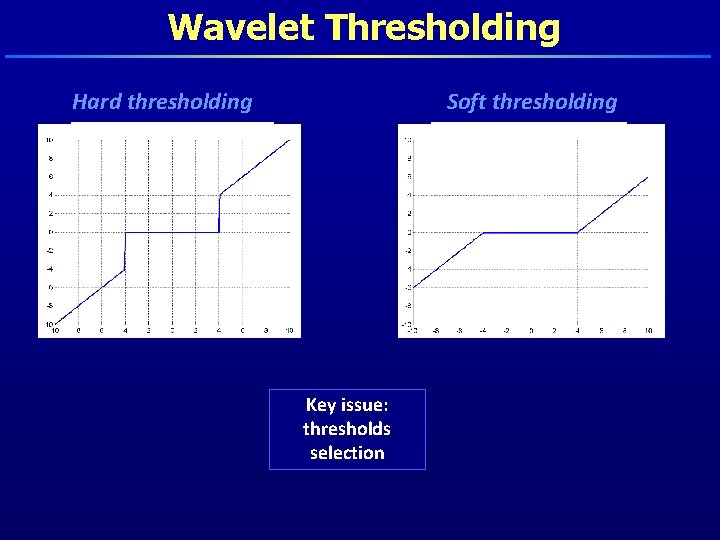
Wavelet Thresholding Hard thresholding Soft thresholding Key issue: thresholds selection
Implementation Algorithme à trous Discrete-time transform dv 1 G( x) ao K( x) L( y) L( x) K( y) H( x) H( y) do 1 G( y) dv 2 G(2 x) K(2 x) L(2 y) do 2 H( x) H( y) G(2 y) L(2 x) K(2 y) a 1 H(2 x) H(2 y) a 2 Decomposition Reconstruction ao
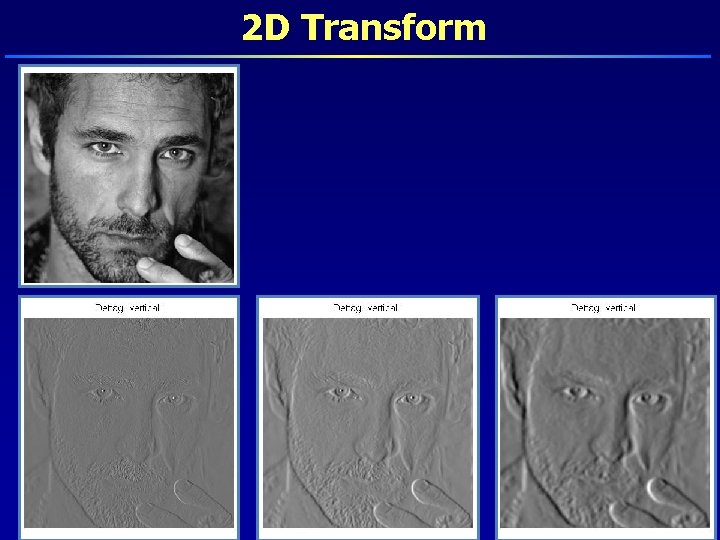
2 D Transform
2 D Transform
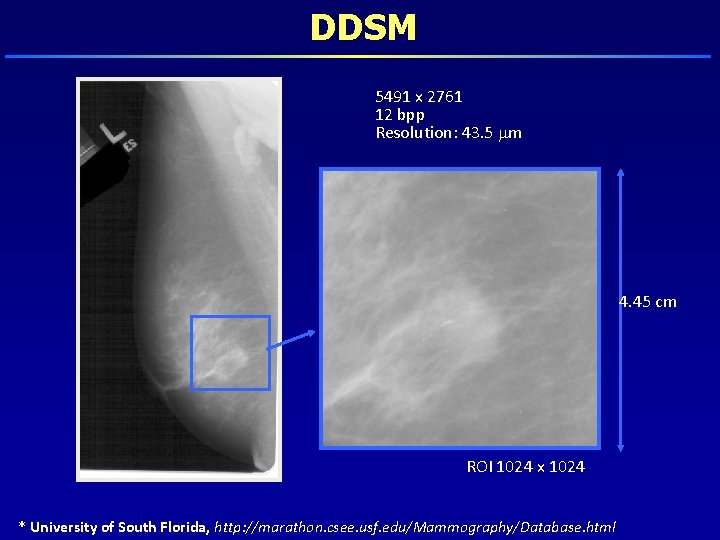
DDSM 5491 x 2761 12 bpp Resolution: 43. 5 m 4. 45 cm ROI 1024 x 1024 * University of South Florida, http: //marathon. csee. usf. edu/Mammography/Database. html
Masses dv Scale 1 2 3 4 do m
Microcalcifications dv 1 2 3 4 do m
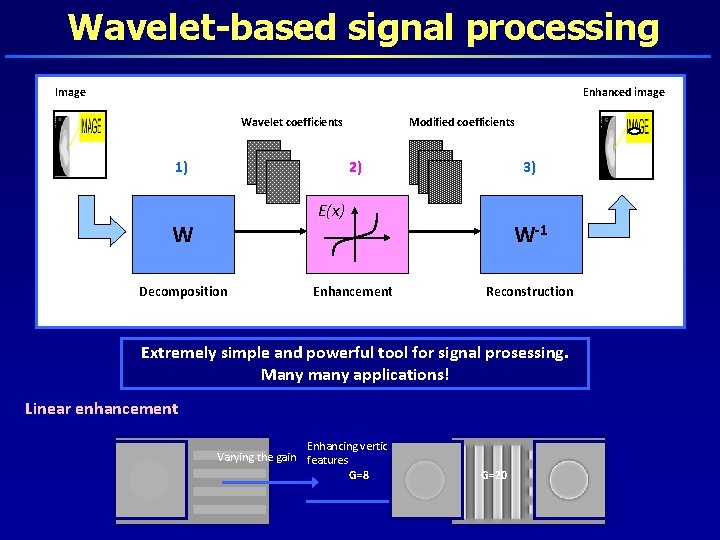
Wavelet-based signal processing Image Enhanced image Wavelet coefficients 1) Modified coefficients 2) 3) E(x) W Decomposition Enhancement W-1 Reconstruction Extremely simple and powerful tool for signal prosessing. Many many applications! Linear enhancement Enhancing vertical Varying the gain features G=8 G=20
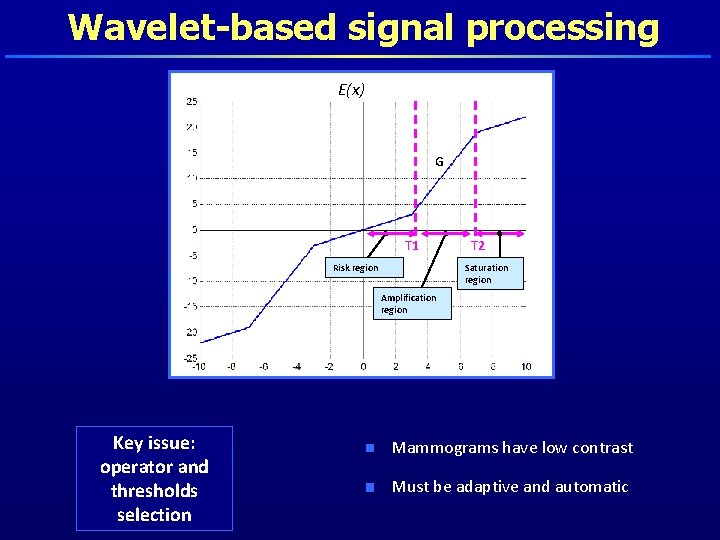
Wavelet-based signal processing E(x) G T 1 Risk region T 2 Saturation region Amplification region Key issue: operator and thresholds selection Mammograms have low contrast Must be adaptive and automatic