
Corsica simulation of ITER hybrid mode operation scenario
Corsica simulation of ITER hybrid mode operation scenario S. H. Kim and T. A. Casper ITER Organization, St Paul lez Durance, France Acknowledgement : LLNL, ITER/Monaco R. H. Bulmer, L. Lo. Destro, W. Meyer and D. Pearlstein (LLNL) – Corsica collaboration J. Garcia (CEA), M. Henderson (ITER), C. E Kessel (PPPL) and T. Oikawa (ITER) – useful discussions Sun Hee KIM, Plasma Operations/POP Page
Outline 1. Introduction 2. Source modules for Corsica simulation 3. Backing out simulation of ITER hybrid mode operation 1. Reference hybrid mode simulation (33 MW NB & 20 MW EC) 2. Varying simulation conditions 3. Pre-magnetization 4. Various HCD schemes 5. Ramp-down shape evolution 4. Forward simulation of ITER hybrid mode operation 5. Summary and perspectives Sun Hee KIM, Plasma Operations/POP Page 2
Introduction 1. Simulations of ITER hybrid and steady-state mode operations are requested to support several tasks for resolving ITER physics and engineering issues. 1. Feasibility of achieving physics goals, such as Q and plasma burn duration 2. Heating and current drive requirements, and profile tailoring 3. Plasma control system, coils and power supplies 2. Corsica provides a self-consistent free-boundary plasma evolution with transport and sources, using a fully implicit coupling scheme. 3. Realistic source modules (NB/EC/LH/IC) are recently either upgraded or added, and their operating parameters are determined reflecting recent ITER design changes. 4. Corsica is ready to support ITER PCS (as a practical tool for validating PCS concepts) and IM (as a candidate for plasma simulator) projects. Sun Hee KIM, Plasma Operations/POP Page 3
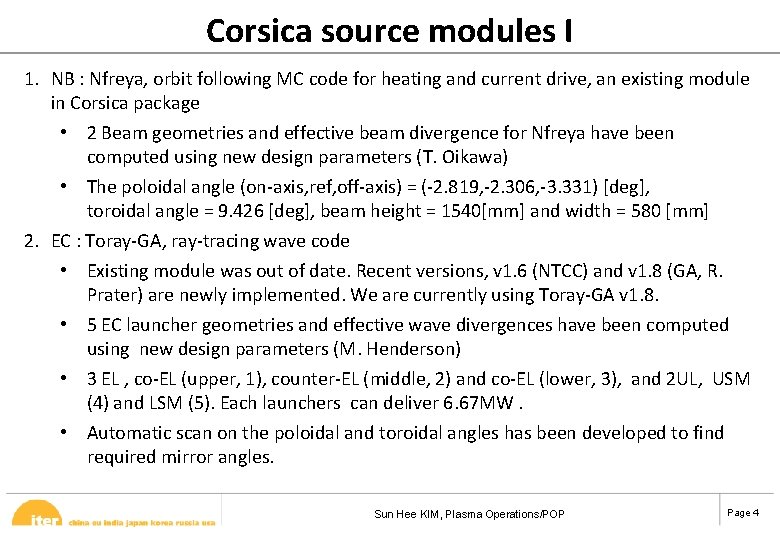
Corsica source modules I 1. NB : Nfreya, orbit following MC code for heating and current drive, an existing module in Corsica package • 2 Beam geometries and effective beam divergence for Nfreya have been computed using new design parameters (T. Oikawa) • The poloidal angle (on-axis, ref, off-axis) = (-2. 819, -2. 306, -3. 331) [deg], toroidal angle = 9. 426 [deg], beam height = 1540[mm] and width = 580 [mm] 2. EC : Toray-GA, ray-tracing wave code • Existing module was out of date. Recent versions, v 1. 6 (NTCC) and v 1. 8 (GA, R. Prater) are newly implemented. We are currently using Toray-GA v 1. 8. • 5 EC launcher geometries and effective wave divergences have been computed using new design parameters (M. Henderson) • 3 EL , co-EL (upper, 1), counter-EL (middle, 2) and co-EL (lower, 3), and 2 UL, USM (4) and LSM (5). Each launchers can deliver 6. 67 MW. • Automatic scan on the poloidal and toroidal angles has been developed to find required mirror angles. Sun Hee KIM, Plasma Operations/POP Page 4
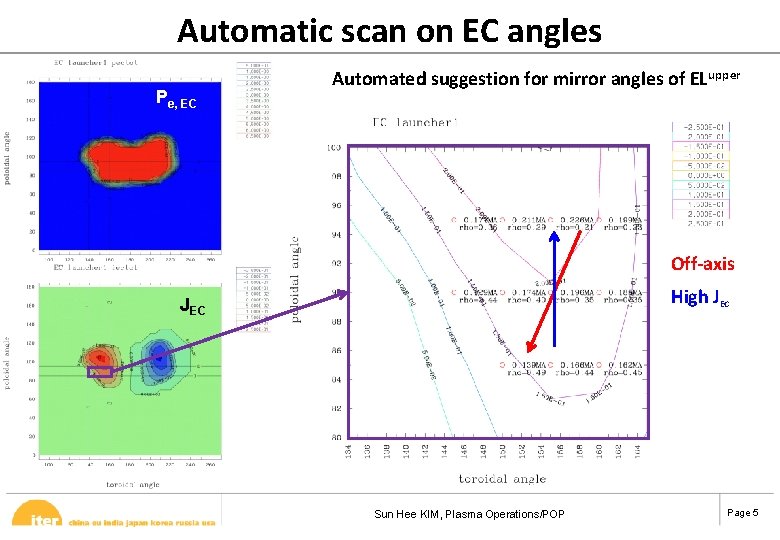
Automatic scan on EC angles Pe, EC Automated suggestion for mirror angles of ELupper Off-axis High JEC Sun Hee KIM, Plasma Operations/POP Page 5
Corsica source modules II 1. LH : LSC, ray-tracing wave code, NTCC library, newly added • ‘n_parallel’ and ‘tilt angle of the launcher’ have been obtained from TSC ITER simulation setting (C. Kessel). • Graphical outputs are suppressed and output values less than 1 e-100 are set to zeros. 2. ICRF : Toric, Full wave code, in preparation • A version originally used for developing interface is working, but prescribed heat deposition profiles are used in this work. • No IC driven current is assumed. • ITER will have an official version soon from IPP (discussed with R. Bialto and J. Rice) Sun Hee KIM, Plasma Operations/POP Page 6
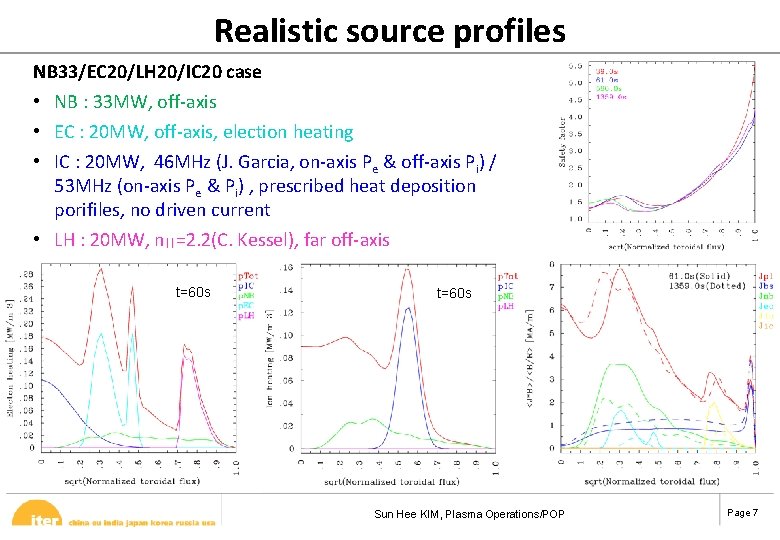
Realistic source profiles NB 33/EC 20/LH 20/IC 20 case • NB : 33 MW, off-axis • EC : 20 MW, off-axis, election heating • IC : 20 MW, 46 MHz (J. Garcia, on-axis Pe & off-axis Pi) / 53 MHz (on-axis Pe & Pi) , prescribed heat deposition porifiles, no driven current • LH : 20 MW, n||=2. 2(C. Kessel), far off-axis t=60 s Sun Hee KIM, Plasma Operations/POP Page 7
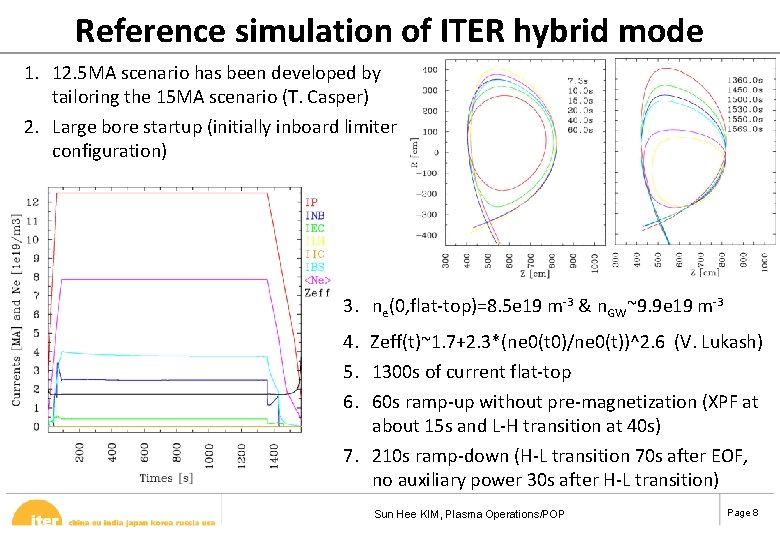
Reference simulation of ITER hybrid mode 1. 12. 5 MA scenario has been developed by tailoring the 15 MA scenario (T. Casper) 2. Large bore startup (initially inboard limiter configuration) 3. ne(0, flat-top)=8. 5 e 19 m-3 & n. GW~9. 9 e 19 m-3 4. Zeff(t)~1. 7+2. 3*(ne 0(t 0)/ne 0(t))^2. 6 (V. Lukash) 5. 1300 s of current flat-top 6. 60 s ramp-up without pre-magnetization (XPF at about 15 s and L-H transition at 40 s) 7. 210 s ramp-down (H-L transition 70 s after EOF, no auxiliary power 30 s after H-L transition) Sun Hee KIM, Plasma Operations/POP Page 8
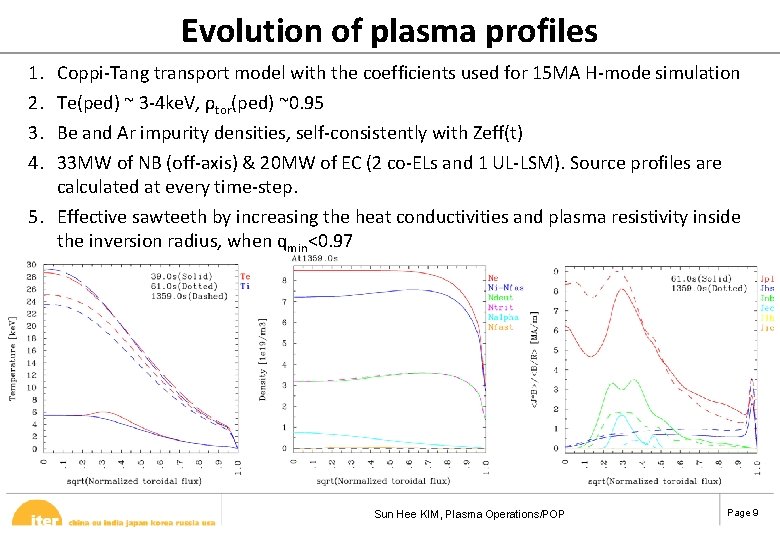
Evolution of plasma profiles 1. 2. 3. 4. Coppi-Tang transport model with the coefficients used for 15 MA H-mode simulation Te(ped) ~ 3 -4 ke. V, ρtor(ped) ~0. 95 Be and Ar impurity densities, self-consistently with Zeff(t) 33 MW of NB (off-axis) & 20 MW of EC (2 co-ELs and 1 UL-LSM). Source profiles are calculated at every time-step. 5. Effective sawteeth by increasing the heat conductivities and plasma resistivity inside the inversion radius, when qmin<0. 97 Sun Hee KIM, Plasma Operations/POP Page 9
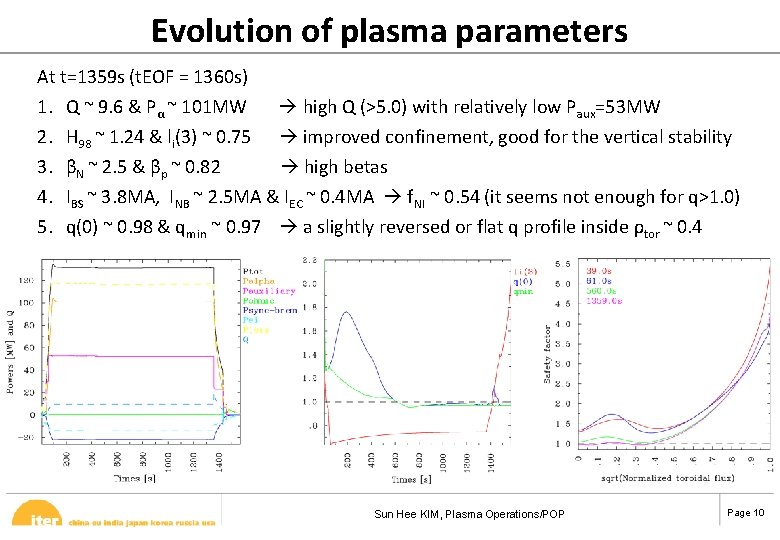
Evolution of plasma parameters At t=1359 s (t. EOF = 1360 s) 1. 2. 3. 4. 5. Q ~ 9. 6 & Pα ~ 101 MW high Q (>5. 0) with relatively low Paux=53 MW H 98 ~ 1. 24 & li(3) ~ 0. 75 improved confinement, good for the vertical stability βN ~ 2. 5 & βp ~ 0. 82 high betas IBS ~ 3. 8 MA, INB ~ 2. 5 MA & IEC ~ 0. 4 MA f. NI ~ 0. 54 (it seems not enough for q>1. 0) q(0) ~ 0. 98 & qmin ~ 0. 97 a slightly reversed or flat q profile inside ρtor ~ 0. 4 Sun Hee KIM, Plasma Operations/POP Page 10
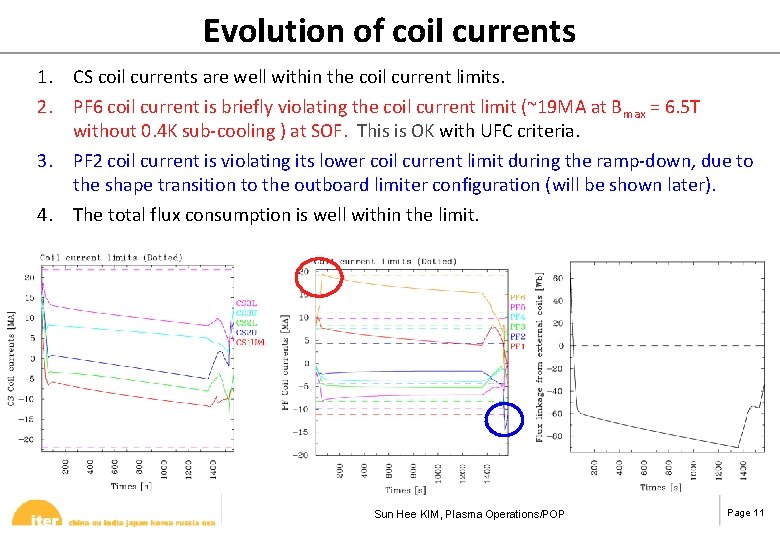
Evolution of coil currents 1. CS coil currents are well within the coil current limits. 2. PF 6 coil current is briefly violating the coil current limit (~19 MA at B max = 6. 5 T without 0. 4 K sub-cooling ) at SOF. This is OK with UFC criteria. 3. PF 2 coil current is violating its lower coil current limit during the ramp-down, due to the shape transition to the outboard limiter configuration (will be shown later). 4. The total flux consumption is well within the limit. Sun Hee KIM, Plasma Operations/POP Page 11
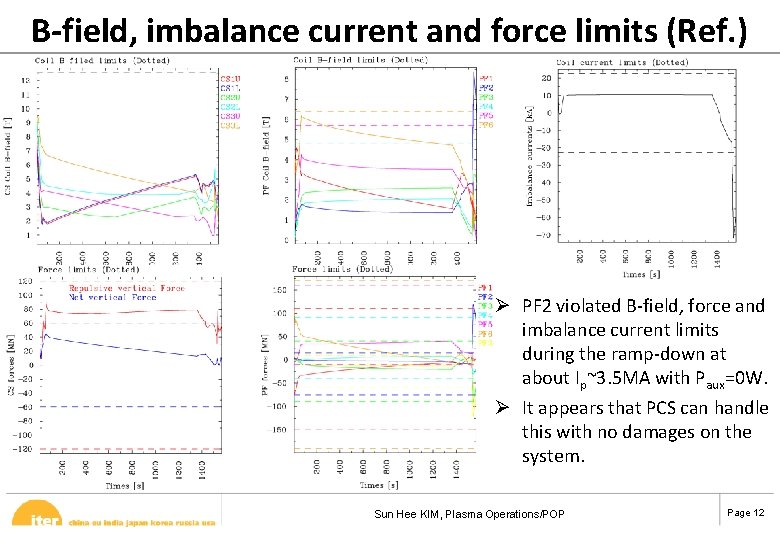
B-field, imbalance current and force limits (Ref. ) Ø PF 2 violated B-field, force and imbalance current limits during the ramp-down at about Ip~3. 5 MA with Paux=0 W. Ø It appears that PCS can handle this with no damages on the system. Sun Hee KIM, Plasma Operations/POP Page 12
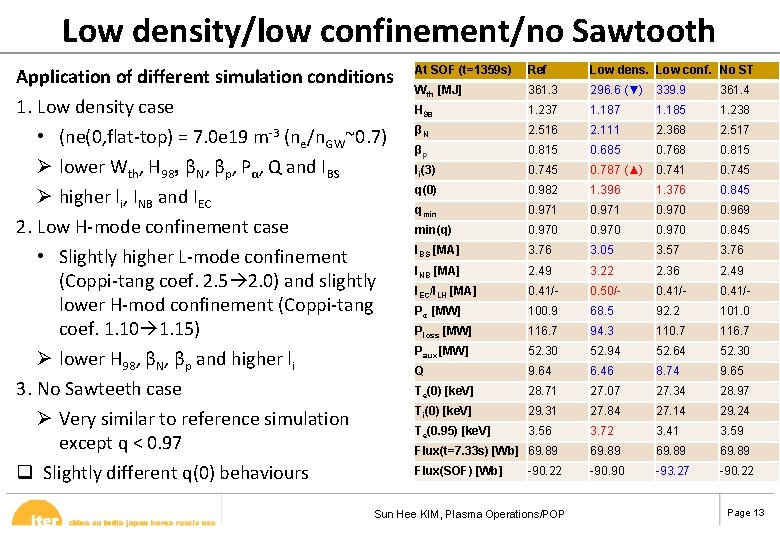
Low density/low confinement/no Sawtooth Application of different simulation conditions 1. Low density case • (ne(0, flat-top) = 7. 0 e 19 m-3 (ne/n. GW~0. 7) Ø lower Wth, H 98, βN, βp, Pα, Q and IBS Ø higher li, INB and IEC 2. Low H-mode confinement case • Slightly higher L-mode confinement (Coppi-tang coef. 2. 5 2. 0) and slightly lower H-mod confinement (Coppi-tang coef. 1. 10 1. 15) Ø lower H 98, βN, βp and higher li 3. No Sawteeth case Ø Very similar to reference simulation except q < 0. 97 q Slightly different q(0) behaviours At SOF (t=1359 s) Ref Low dens. Low conf. No ST Wth [MJ] 361. 3 296. 6 (▼) 339. 9 361. 4 H 98 1. 237 1. 185 1. 238 βN 2. 516 2. 111 2. 368 2. 517 βp 0. 815 0. 685 0. 768 0. 815 li(3) 0. 745 0. 787 (▲) 0. 741 0. 745 q(0) 0. 982 1. 396 1. 376 0. 845 qmin 0. 971 0. 970 0. 969 min(q) 0. 970 0. 845 IBS [MA] 3. 76 3. 05 3. 57 3. 76 INB [MA] 2. 49 3. 22 2. 36 2. 49 IEC/ILH [MA] 0. 41/- 0. 50/- 0. 41/- Pα [MW] 100. 9 68. 5 92. 2 101. 0 Ploss [MW] 116. 7 94. 3 110. 7 116. 7 Paux [MW] 52. 30 52. 94 52. 64 52. 30 Q 9. 64 6. 46 8. 74 9. 65 Te(0) [ke. V] 28. 71 27. 07 27. 34 28. 97 Ti(0) [ke. V] 29. 31 27. 84 27. 14 29. 24 Te(0. 95) [ke. V] 3. 56 3. 72 3. 41 3. 59 Flux(t=7. 33 s) [Wb] 69. 89 Flux(SOF) [Wb] -90. 90 -93. 27 -90. 22 Sun Hee KIM, Plasma Operations/POP Page 13
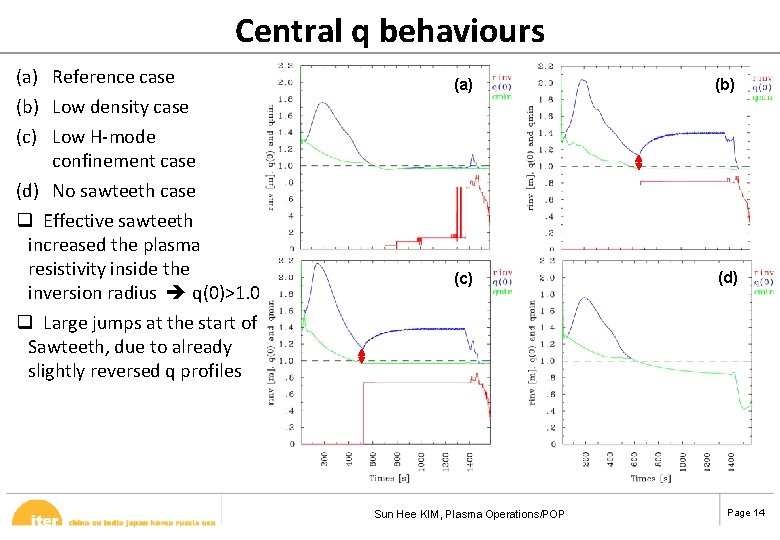
Central q behaviours (a) Reference case (b) Low density case (c) Low H-mode confinement case (d) No sawteeth case q Effective sawteeth increased the plasma resistivity inside the inversion radius q(0)>1. 0 q Large jumps at the start of Sawteeth, due to already slightly reversed q profiles (a) (b) (c) (d) Sun Hee KIM, Plasma Operations/POP Page 14
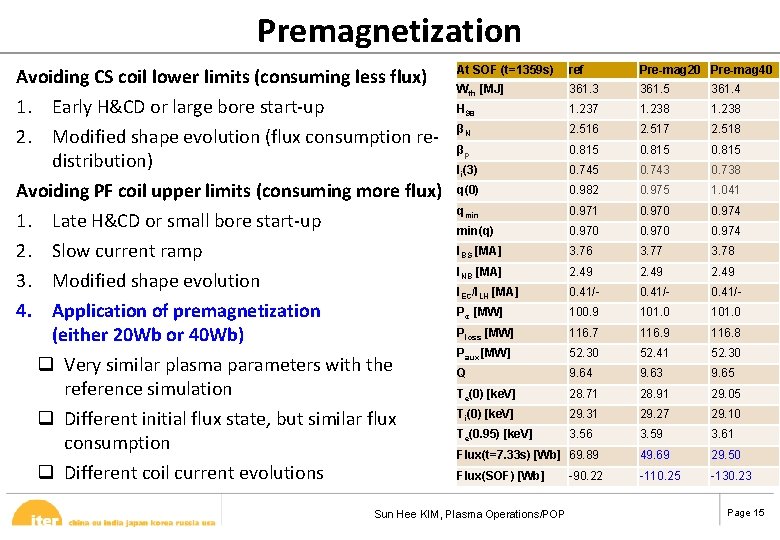
Premagnetization Avoiding CS coil lower limits (consuming less flux) 1. Early H&CD or large bore start-up 2. Modified shape evolution (flux consumption redistribution) Avoiding PF coil upper limits (consuming more flux) 1. Late H&CD or small bore start-up 2. Slow current ramp 3. Modified shape evolution 4. Application of premagnetization (either 20 Wb or 40 Wb) q Very similar plasma parameters with the reference simulation q Different initial flux state, but similar flux consumption q Different coil current evolutions At SOF (t=1359 s) ref Pre-mag 20 Pre-mag 40 Wth [MJ] 361. 3 361. 5 361. 4 H 98 1. 237 1. 238 βN 2. 516 2. 517 2. 518 βp 0. 815 li(3) 0. 745 0. 743 0. 738 q(0) 0. 982 0. 975 1. 041 qmin 0. 971 0. 970 0. 974 min(q) 0. 970 0. 974 IBS [MA] 3. 76 3. 77 3. 78 INB [MA] 2. 49 IEC/ILH [MA] 0. 41/- Pα [MW] 100. 9 101. 0 Ploss [MW] 116. 7 116. 9 116. 8 Paux [MW] 52. 30 52. 41 52. 30 Q 9. 64 9. 63 9. 65 Te(0) [ke. V] 28. 71 28. 91 29. 05 Ti(0) [ke. V] 29. 31 29. 27 29. 10 Te(0. 95) [ke. V] 3. 56 3. 59 3. 61 Flux(t=7. 33 s) [Wb] 69. 89 49. 69 29. 50 Flux(SOF) [Wb] -110. 25 -130. 23 Sun Hee KIM, Plasma Operations/POP -90. 22 Page 15
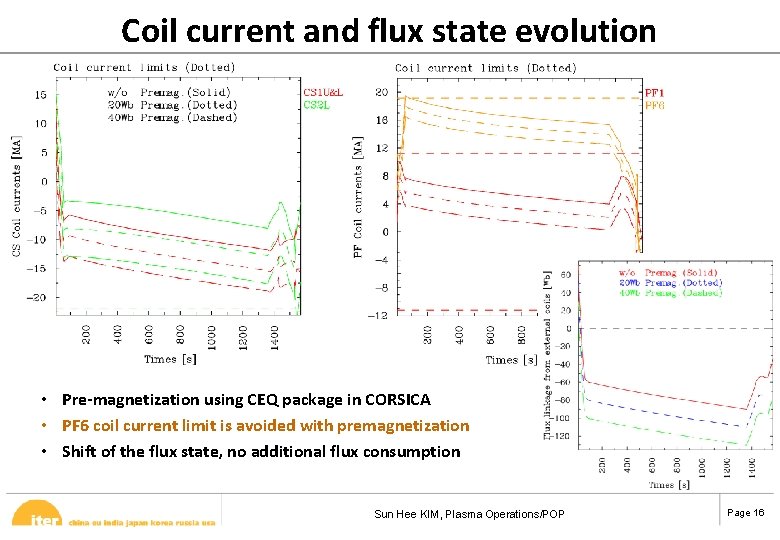
Coil current and flux state evolution • Pre-magnetization using CEQ package in CORSICA • PF 6 coil current limit is avoided with premagnetization • Shift of the flux state, no additional flux consumption Sun Hee KIM, Plasma Operations/POP Page 16
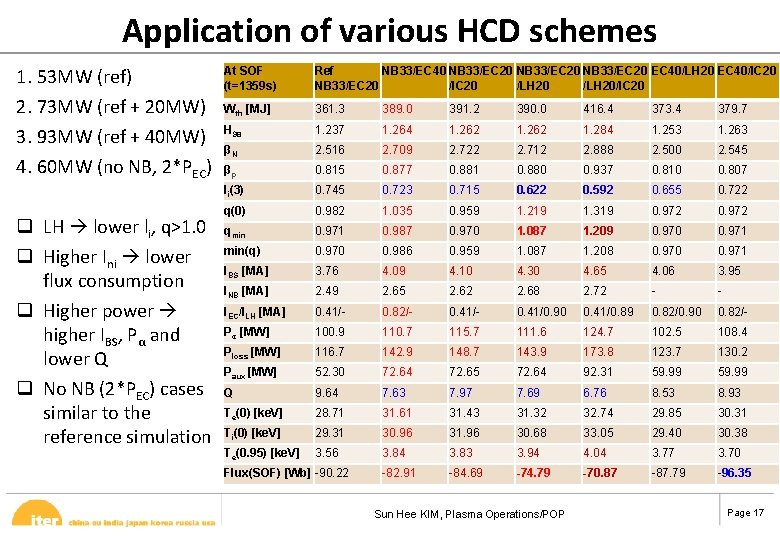
Application of various HCD schemes 1. 53 MW (ref) 2. 73 MW (ref + 20 MW) 3. 93 MW (ref + 40 MW) 4. 60 MW (no NB, 2*PEC) q LH lower li, q>1. 0 q Higher Ini lower flux consumption q Higher power higher IBS, Pα and lower Q q No NB (2*PEC) cases similar to the reference simulation At SOF (t=1359 s) Ref NB 33/EC 40 NB 33/EC 20 EC 40/LH 20 EC 40/IC 20 NB 33/EC 20 /IC 20 /LH 20/IC 20 Wth [MJ] 361. 3 389. 0 391. 2 390. 0 416. 4 373. 4 379. 7 H 98 1. 237 1. 264 1. 262 1. 284 1. 253 1. 263 βN 2. 516 2. 709 2. 722 2. 712 2. 888 2. 500 2. 545 βp 0. 815 0. 877 0. 881 0. 880 0. 937 0. 810 0. 807 li(3) 0. 745 0. 723 0. 715 0. 622 0. 592 0. 655 0. 722 q(0) 0. 982 1. 035 0. 959 1. 219 1. 319 0. 972 qmin 0. 971 0. 987 0. 970 1. 087 1. 209 0. 970 0. 971 min(q) 0. 970 0. 986 0. 959 1. 087 1. 208 0. 970 0. 971 IBS [MA] 3. 76 4. 09 4. 10 4. 30 4. 65 4. 06 3. 95 INB [MA] 2. 49 2. 65 2. 62 2. 68 2. 72 - - IEC/ILH [MA] 0. 41/- 0. 82/- 0. 41/0. 90 0. 41/0. 89 0. 82/0. 90 0. 82/- Pα [MW] 100. 9 110. 7 115. 7 111. 6 124. 7 102. 5 108. 4 Ploss [MW] 116. 7 142. 9 148. 7 143. 9 173. 8 123. 7 130. 2 Paux [MW] 52. 30 72. 64 72. 65 72. 64 92. 31 59. 99 Q 9. 64 7. 63 7. 97 7. 69 6. 76 8. 53 8. 93 Te(0) [ke. V] 28. 71 31. 61 31. 43 31. 32 32. 74 29. 85 30. 31 Ti(0) [ke. V] 29. 31 30. 96 31. 96 30. 68 33. 05 29. 40 30. 38 Te(0. 95) [ke. V] 3. 56 3. 84 3. 83 3. 94 4. 04 3. 77 3. 70 -82. 91 -84. 69 -74. 79 -70. 87 -87. 79 -96. 35 Flux(SOF) [Wb] -90. 22 Sun Hee KIM, Plasma Operations/POP Page 17
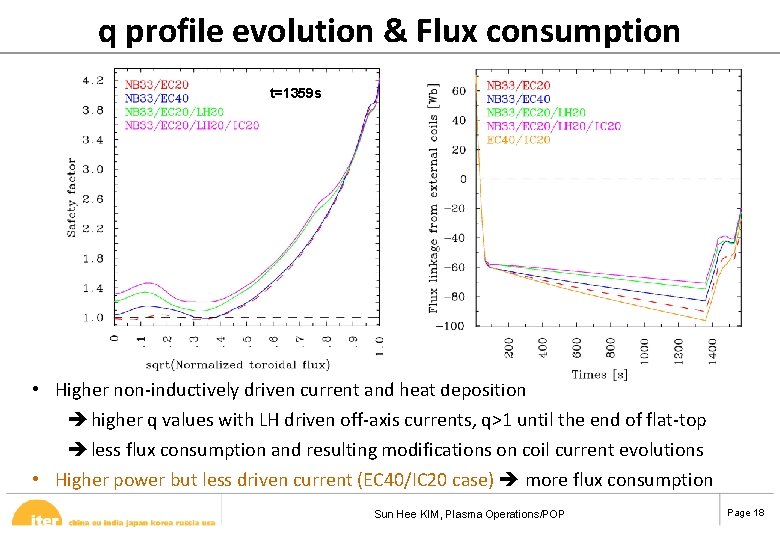
q profile evolution & Flux consumption t=1359 s • Higher non-inductively driven current and heat deposition higher q values with LH driven off-axis currents, q>1 until the end of flat-top less flux consumption and resulting modifications on coil current evolutions • Higher power but less driven current (EC 40/IC 20 case) more flux consumption Sun Hee KIM, Plasma Operations/POP Page 18
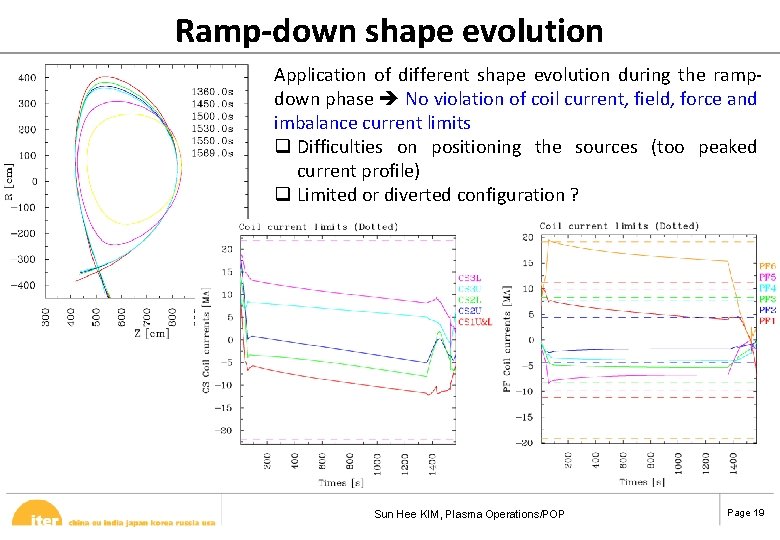
Ramp-down shape evolution Application of different shape evolution during the rampdown phase No violation of coil current, field, force and imbalance current limits q Difficulties on positioning the sources (too peaked current profile) q Limited or diverted configuration ? Sun Hee KIM, Plasma Operations/POP Page 19
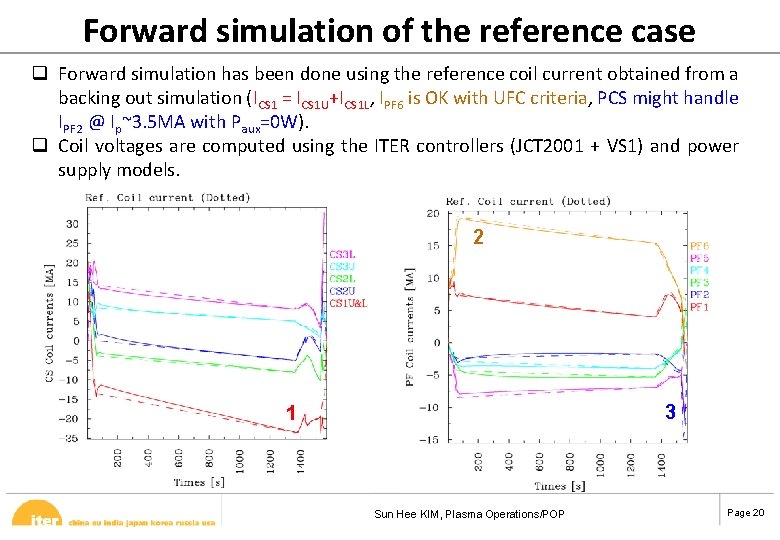
Forward simulation of the reference case q Forward simulation has been done using the reference coil current obtained from a backing out simulation (ICS 1 = ICS 1 U+ICS 1 L, IPF 6 is OK with UFC criteria, PCS might handle IPF 2 @ Ip~3. 5 MA with Paux=0 W). q Coil voltages are computed using the ITER controllers (JCT 2001 + VS 1) and power supply models. 2 3 1 Sun Hee KIM, Plasma Operations/POP Page 20
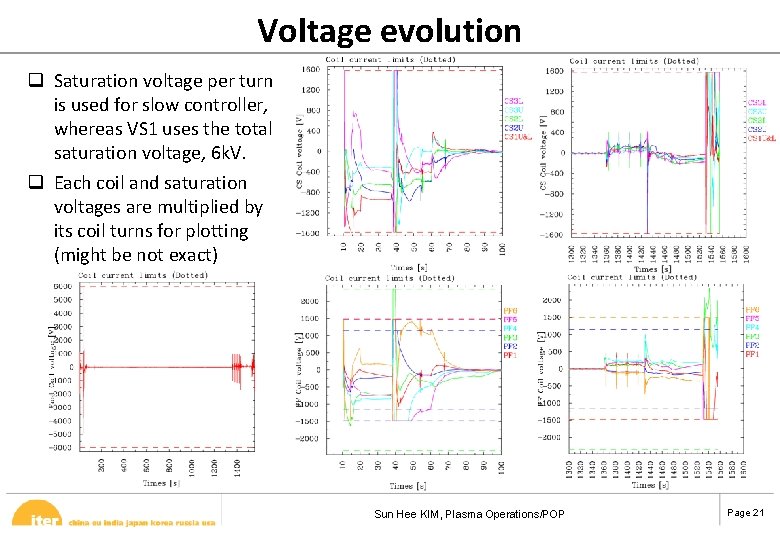
Voltage evolution q Saturation voltage per turn is used for slow controller, whereas VS 1 uses the total saturation voltage, 6 k. V. q Each coil and saturation voltages are multiplied by its coil turns for plotting (might be not exact) Sun Hee KIM, Plasma Operations/POP Page 21
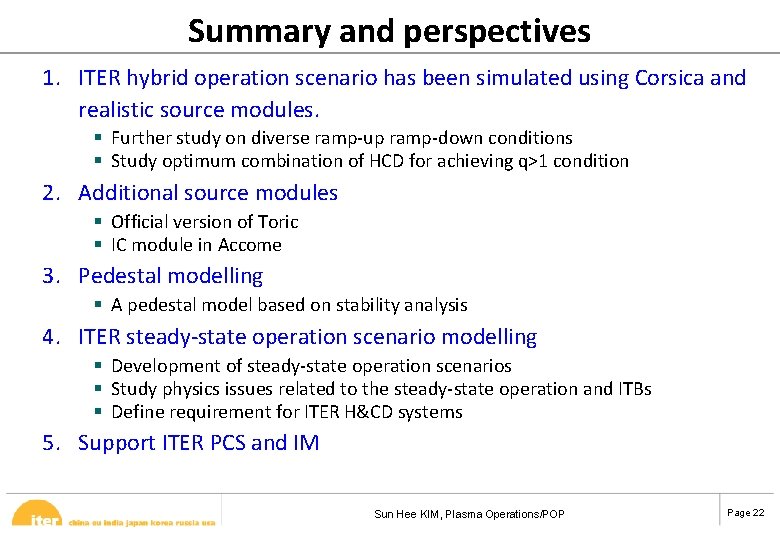
Summary and perspectives 1. ITER hybrid operation scenario has been simulated using Corsica and realistic source modules. § Further study on diverse ramp-up ramp-down conditions § Study optimum combination of HCD for achieving q>1 condition 2. Additional source modules § Official version of Toric § IC module in Accome 3. Pedestal modelling § A pedestal model based on stability analysis 4. ITER steady-state operation scenario modelling § Development of steady-state operation scenarios § Study physics issues related to the steady-state operation and ITBs § Define requirement for ITER H&CD systems 5. Support ITER PCS and IM Sun Hee KIM, Plasma Operations/POP Page 22
Additional slides Sun Hee KIM, Plasma Operations/POP Page 23
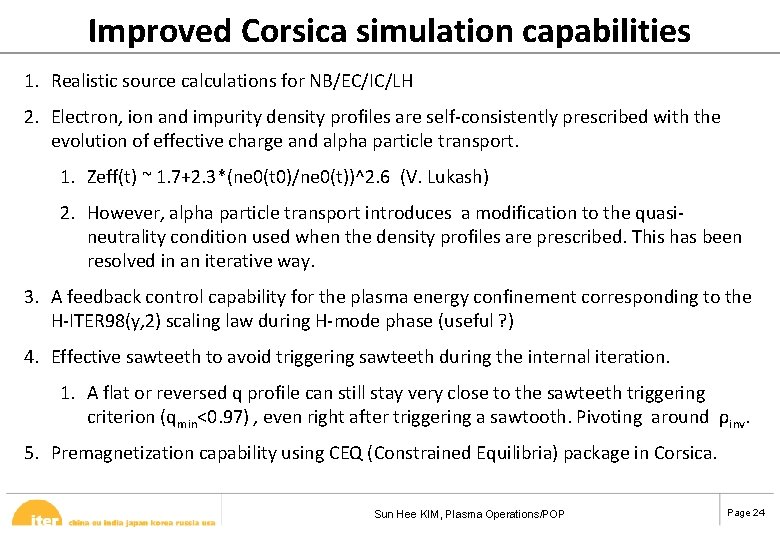
Improved Corsica simulation capabilities 1. Realistic source calculations for NB/EC/IC/LH 2. Electron, ion and impurity density profiles are self-consistently prescribed with the evolution of effective charge and alpha particle transport. 1. Zeff(t) ~ 1. 7+2. 3*(ne 0(t 0)/ne 0(t))^2. 6 (V. Lukash) 2. However, alpha particle transport introduces a modification to the quasineutrality condition used when the density profiles are prescribed. This has been resolved in an iterative way. 3. A feedback control capability for the plasma energy confinement corresponding to the H-ITER 98(y, 2) scaling law during H-mode phase (useful ? ) 4. Effective sawteeth to avoid triggering sawteeth during the internal iteration. 1. A flat or reversed q profile can still stay very close to the sawteeth triggering criterion (qmin<0. 97) , even right after triggering a sawtooth. Pivoting around ρinv. 5. Premagnetization capability using CEQ (Constrained Equilibria) package in Corsica. Sun Hee KIM, Plasma Operations/POP Page 24
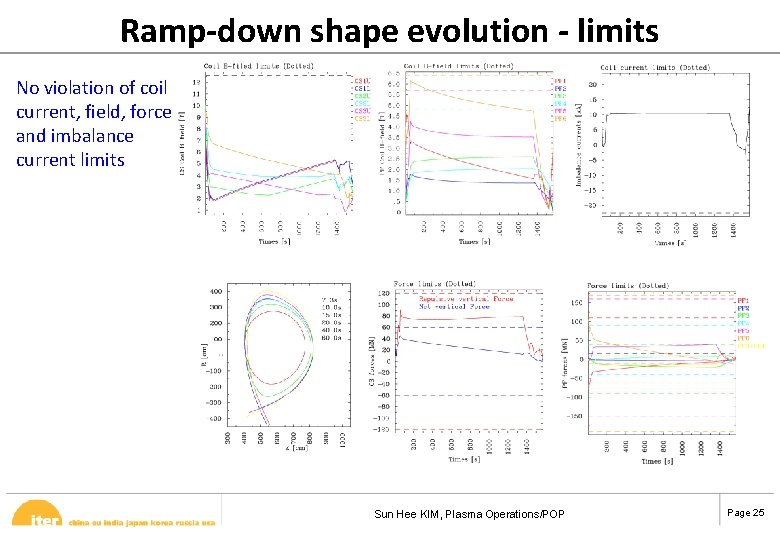
Ramp-down shape evolution - limits No violation of coil current, field, force and imbalance current limits Sun Hee KIM, Plasma Operations/POP Page 25
- Slides: 25