
CORROSION TYPES CHAPTER 4 7INTERGRANULER CORROSION Ass Professor

- Slides: 8
CORROSION TYPES CHAPTER 4 7)INTERGRANULER CORROSION Ass. Professor SAHEB M. MAHDI
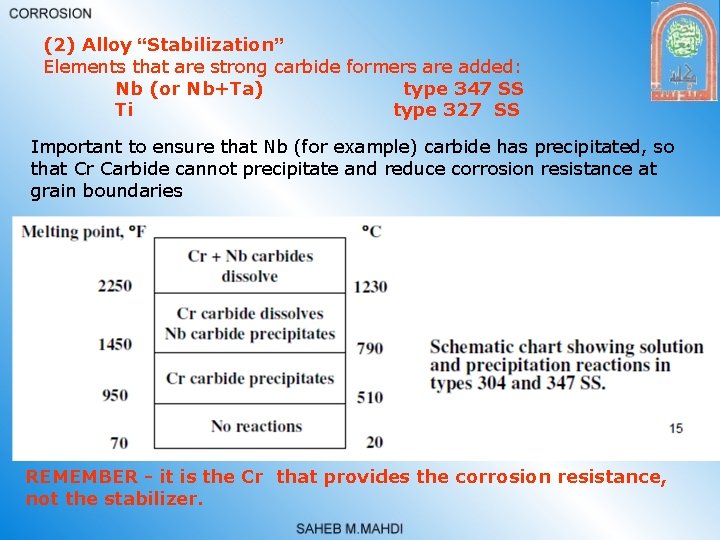
7 ) Intergranular Corrosion Or Sensitization Intergranular corrosion , can be caused by impurities at the grain boundaries, enrichment of one of alloying elements, or depletion of one of these elements in grain boundary areas. Small amounts of iron in aluminum , wherein the solubility of iron is low , have been shown to segregate in grain boundaries and cause Intergranular corrosion. Depletion of chromium in grain boundary regions results in Intergranular corrosion of stainless steels. Cr is added to steels to make them “stainless”. Th elements in grain boundary Cr-rich oxide film (based on Cr 2 O 3) is thin, adherent and very protective. BUT if heated into range 510 -790 C, the steels “sensitize” and become prone to IGA.
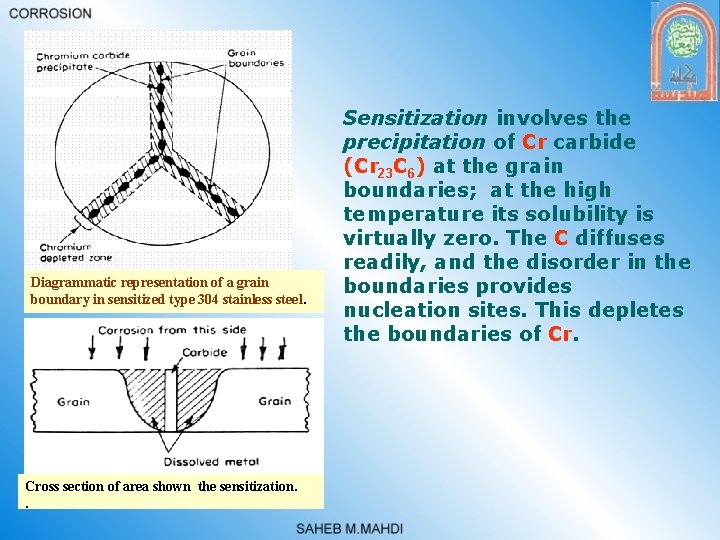
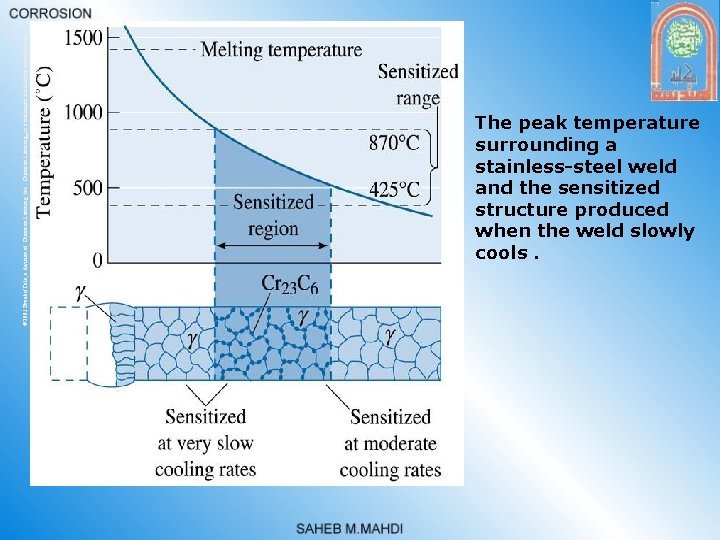
Diagrammatic representation of a grain boundary in sensitized type 304 stainless steel. Cross section of area shown the sensitization. . Sensitization involves the precipitation of Cr carbide (Cr 23 C 6) at the grain boundaries; at the high temperature its solubility is virtually zero. The C diffuses readily, and the disorder in the boundaries provides nucleation sites. This depletes the boundaries of Cr.
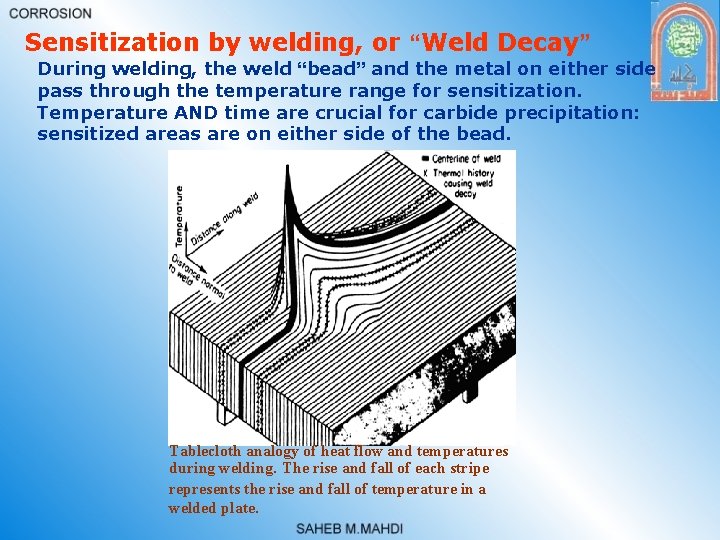
Sensitization by welding, or “Weld Decay” During welding, the weld “bead” and the metal on either side pass through the temperature range for sensitization. Temperature AND time are crucial for carbide precipitation: sensitized areas are on either side of the bead. Tablecloth analogy of heat flow and temperatures during welding. The rise and fall of each stripe represents the rise and fall of temperature in a welded plate.
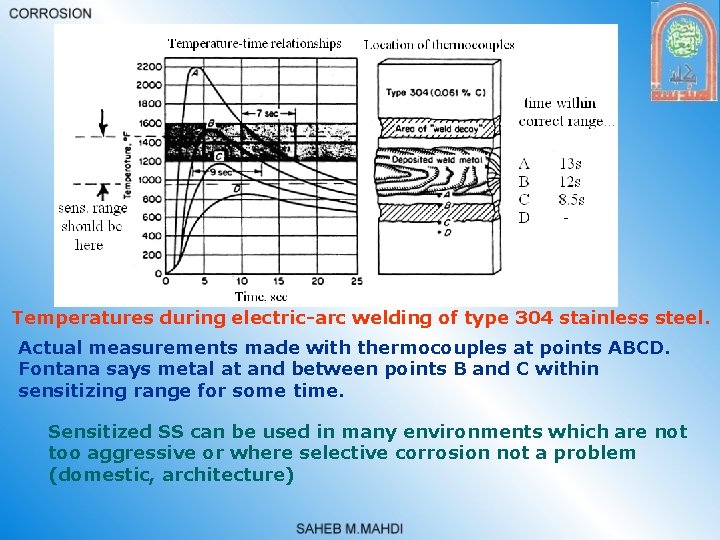
Temperatures during electric-arc welding of type 304 stainless steel. Actual measurements made with thermocouples at points ABCD. Fontana says metal at and between points B and C within sensitizing range for some time. Sensitized SS can be used in many environments which are not too aggressive or where selective corrosion not a problem (domestic, architecture)
© 2003 Brooks/Cole, a division of Thomson Learning, Inc. Thomson Learning™ is a trademark used herein under license. The peak temperature surrounding a stainless-steel weld and the sensitized structure produced when the weld slowly cools.
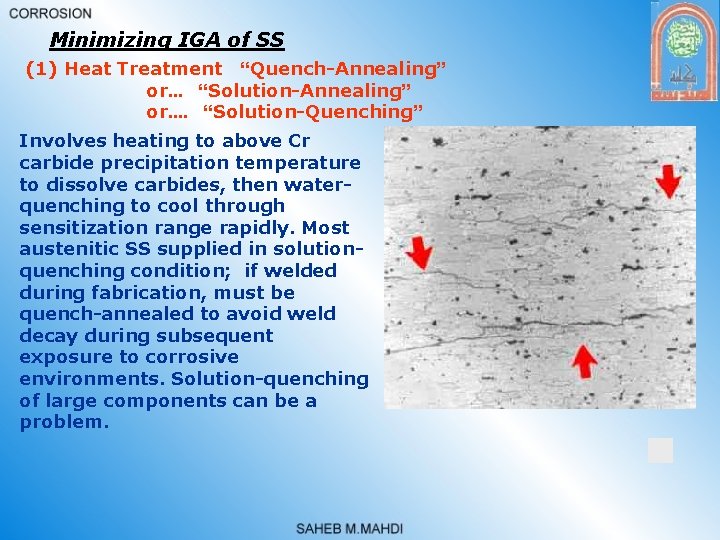
Minimizing IGA of SS (1) Heat Treatment “Quench-Annealing” or. . . “Solution-Annealing” or. . “Solution-Quenching” Involves heating to above Cr carbide precipitation temperature to dissolve carbides, then waterquenching to cool through sensitization range rapidly. Most austenitic SS supplied in solutionquenching condition; if welded during fabrication, must be quench-annealed to avoid weld decay during subsequent exposure to corrosive environments. Solution-quenching of large components can be a problem.
(2) Alloy “Stabilization” Elements that are strong carbide formers are added: Nb (or Nb+Ta) type 347 SS Ti type 327 SS Important to ensure that Nb (for example) carbide has precipitated, so that Cr Carbide cannot precipitate and reduce corrosion resistance at grain boundaries REMEMBER - it is the Cr that provides the corrosion resistance, not the stabilizer.