
Corrosion Training CP Designed Part 1 Galvanic Anodes


- Slides: 89
Corrosion Training CP Designed – Part 1 Galvanic Anodes (current requirement testing), Insulators, Test stations, Coatings
Learning Over View l Part One – l l l l Part Two – l l Current requirement design Galvanic anode design Insulators Coatings Test stations Coupons Rectified Systems, Solar panels Part Three – l AC Design
Objective of Class l Understanding of design for COH and CKY with Corrosion Anodes (Galvanic) l Insulators (types) l Coatings (types) l Test stations l IR Coupons l
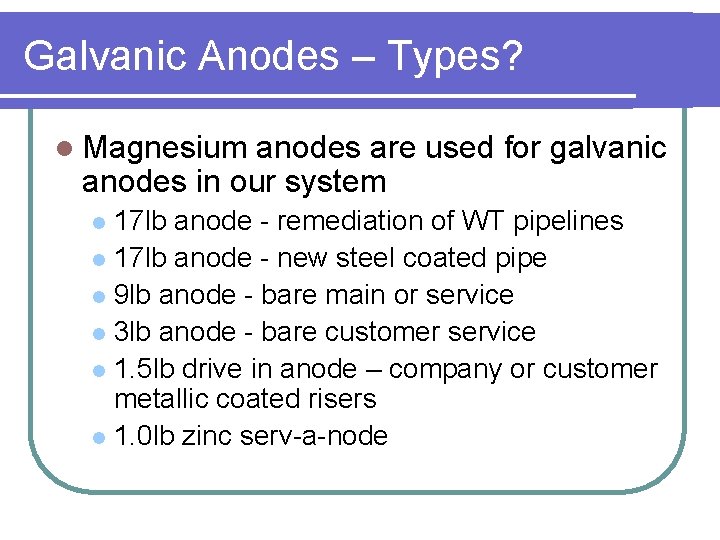
Galvanic Anodes – Types? l Magnesium anodes are used for galvanic anodes in our system 17 lb anode - remediation of WT pipelines l 17 lb anode - new steel coated pipe l 9 lb anode - bare main or service l 3 lb anode - bare customer service l 1. 5 lb drive in anode – company or customer metallic coated risers l 1. 0 lb zinc serv-a-node l
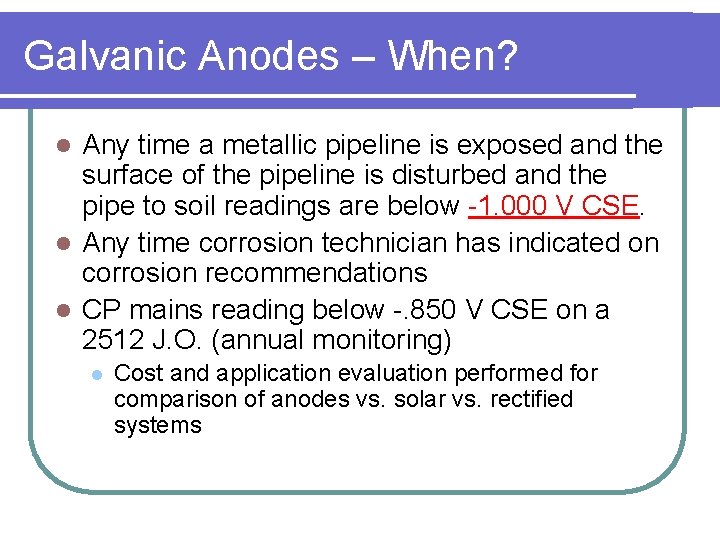
Galvanic Anodes – When? Any time a metallic pipeline is exposed and the surface of the pipeline is disturbed and the pipe to soil readings are below -1. 000 V CSE. l Any time corrosion technician has indicated on corrosion recommendations l CP mains reading below -. 850 V CSE on a 2512 J. O. (annual monitoring) l l Cost and application evaluation performed for comparison of anodes vs. solar vs. rectified systems
Galvanic Anodes – Connected? l Thermite welded to the pipeline Thermite welds shall be 4” apart from each other l Thermite welds shall be 6” away from an adjacent weld l l At any test station locations, connected by mechanical means by junction of the test station terminal
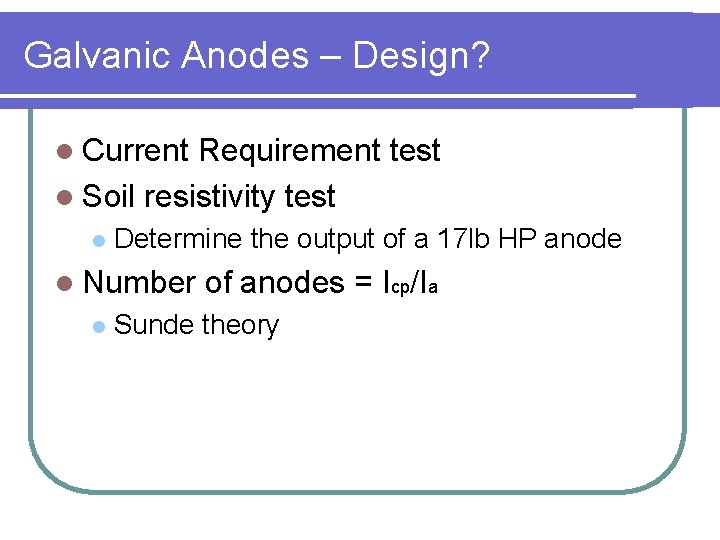
Galvanic Anodes – Design? l Current Requirement test l Soil resistivity test l Determine the output of a 17 lb HP anode l Number l of anodes = Icp/Ia Sunde theory
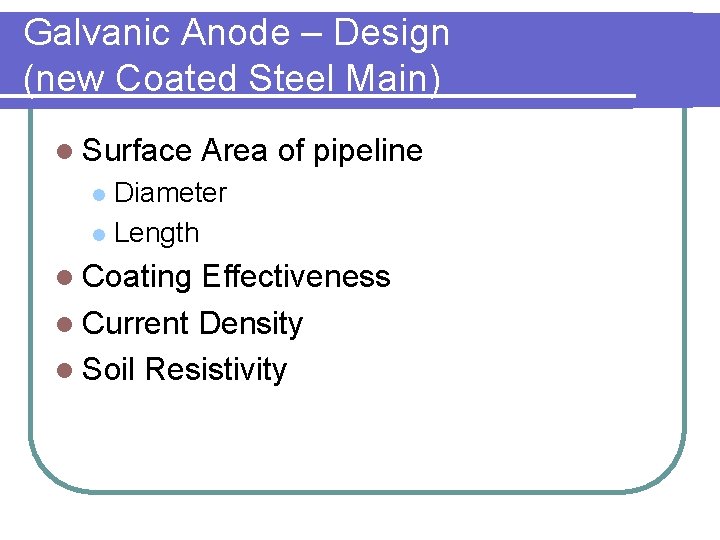
Galvanic Anode – Design (new Coated Steel Main) l Surface Area of pipeline Diameter l Length l l Coating Effectiveness l Current Density l Soil Resistivity
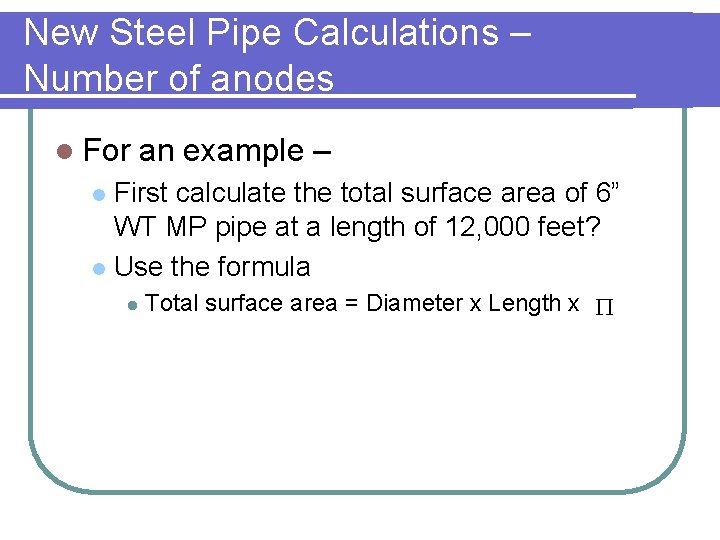
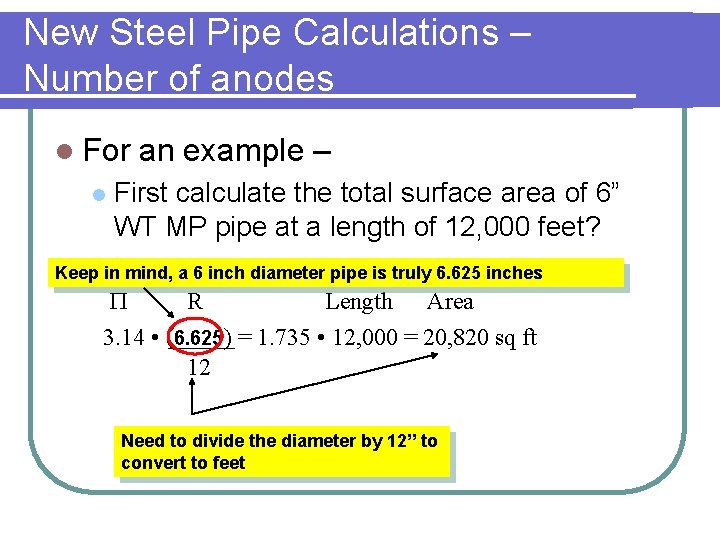
New Steel Pipe Calculations – Number of anodes l For an example – First calculate the total surface area of 6” WT MP pipe at a length of 12, 000 feet? l Use the formula l l Total surface area = Diameter x Length x
New Steel Pipe Calculations – Number of anodes l For l an example – First calculate the total surface area of 6” WT MP pipe at a length of 12, 000 feet? Keep in mind, a 6 inch diameter pipe is truly 6. 625 inches R Length Area 3. 14 • (6. 625) = 1. 735 • 12, 000 = 20, 820 sq ft 12 Need to divide the diameter by 12” to convert to feet
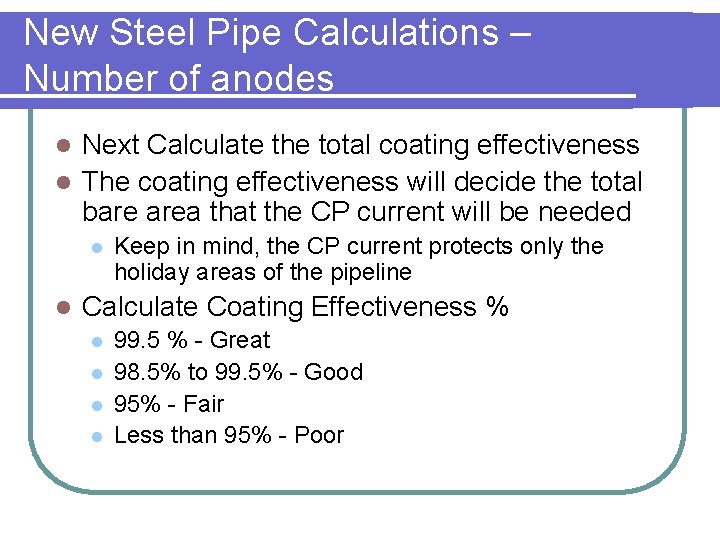
New Steel Pipe Calculations – Number of anodes Next Calculate the total coating effectiveness l The coating effectiveness will decide the total bare area that the CP current will be needed l l l Keep in mind, the CP current protects only the holiday areas of the pipeline Calculate Coating Effectiveness % l l 99. 5 % - Great 98. 5% to 99. 5% - Good 95% - Fair Less than 95% - Poor
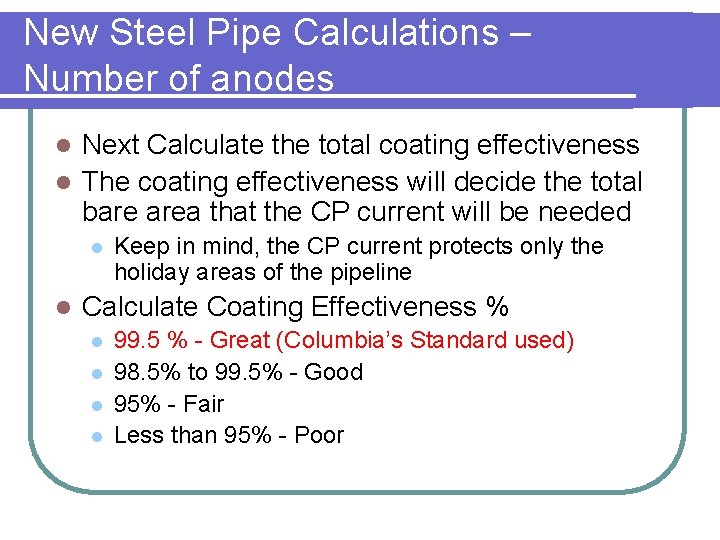
New Steel Pipe Calculations – Number of anodes Next Calculate the total coating effectiveness l The coating effectiveness will decide the total bare area that the CP current will be needed l l l Keep in mind, the CP current protects only the holiday areas of the pipeline Calculate Coating Effectiveness % l l 99. 5 % - Great (Columbia’s Standard used) 98. 5% to 99. 5% - Good 95% - Fair Less than 95% - Poor
New Steel Pipe Calculations – Number of anodes l What is the total surface area?
New Steel Pipe Calculations – Number of anodes l What l is the total surface area? 20, 820 sq ft l What is the total bare area of the pipeline?
New Steel Pipe Calculations – Number of anodes l What l is the total surface area? 20, 820 sq ft l What is the total bare area of the pipeline? l 104. 1 sq ft
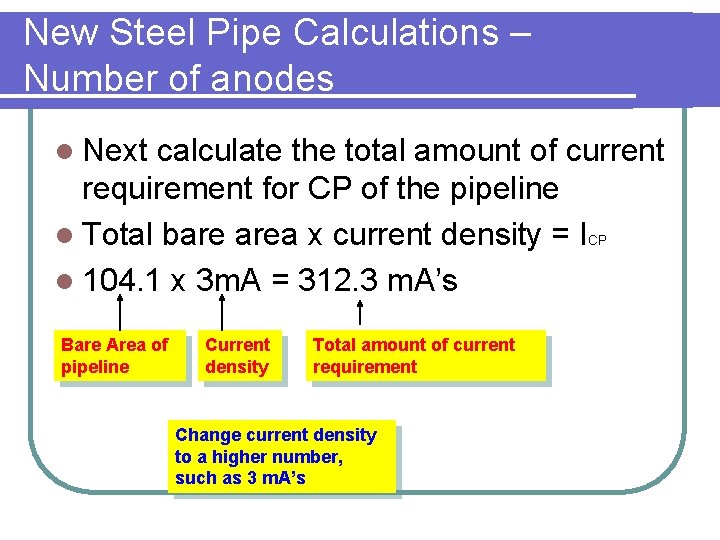
New Steel Pipe Calculations – Number of anodes l Next calculate the total amount of current requirement for CP of the pipeline l Total bare area x current density = ICP l What is the bare area? l 104. 1 sqft l What is the current density?
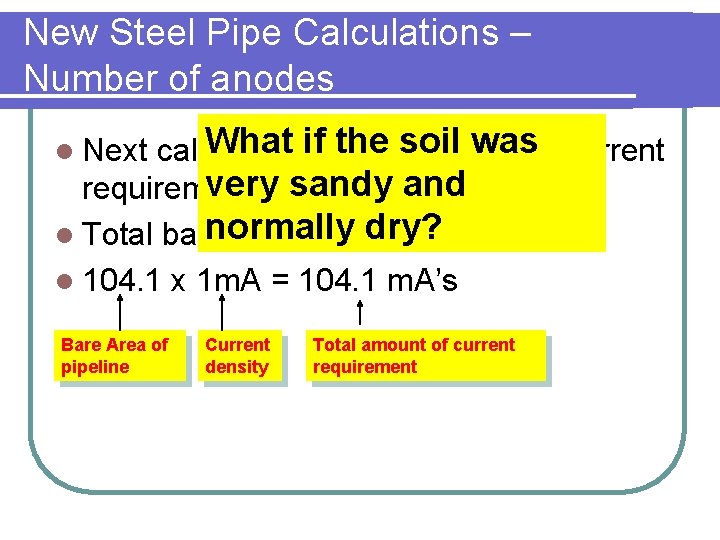
New Steel Pipe Calculations – Number of anodes l Current Density l l Is considered the square of the pipeline in which will conduct current Normally in the range 1 to 3 m. A l l Sandy or Dry soil – 3 m. A Semi-dry soil – 2 m. A Wet soil – 1 m. A For current requirement calculations, we use a higher number for higher soil resistivity for the purpose of designing a higher amount of current requirement.
New Steel Pipe Calculations – Number of anodes Whatthe if the wasof current calculate totalsoil amount veryforsandy andpipeline requirement CP of the normally dry? density = ICP l Total bare area x current l 104. 1 x 1 m. A = 104. 1 m. A’s l Next Bare Area of pipeline Current density Total amount of current requirement
New Steel Pipe Calculations – Number of anodes l Next calculate the total amount of current requirement for CP of the pipeline l Total bare area x current density = ICP l 104. 1 x 3 m. A = 312. 3 m. A’s Bare Area of pipeline Current density Total amount of current requirement Change current density to a higher number, such as 3 m. A’s
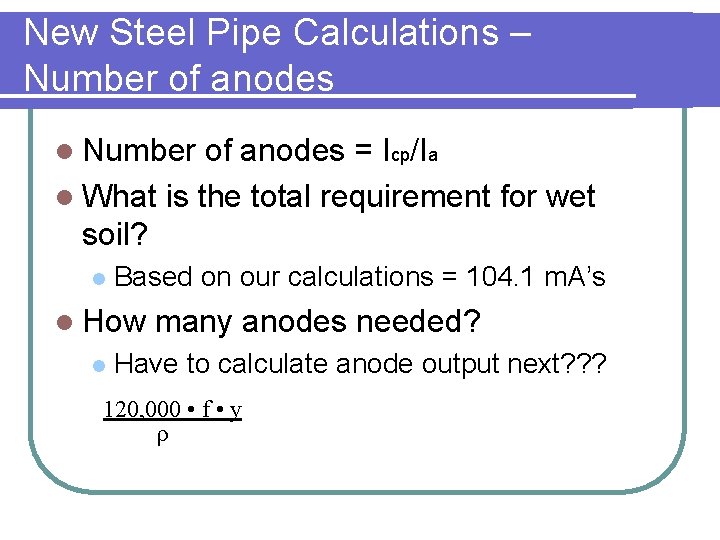
New Steel Pipe Calculations – Number of anodes l Number of anodes = Icp/Ia l What is the total requirement for wet soil? l Based on our calculations = 104. 1 m. A’s l How l many anodes needed? Have to calculate anode output next? ? ? 120, 000 • f • y ρ
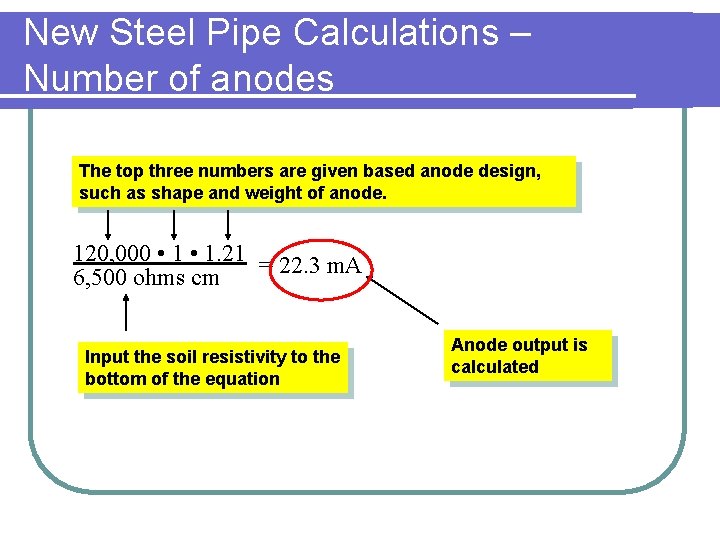
New Steel Pipe Calculations – Number of anodes The top three numbers are given based anode design, such as shape and weight of anode. 120, 000 • 1. 21 = 22. 3 m. A 6, 500 ohms cm Input the soil resistivity to the bottom of the equation Anode output is calculated
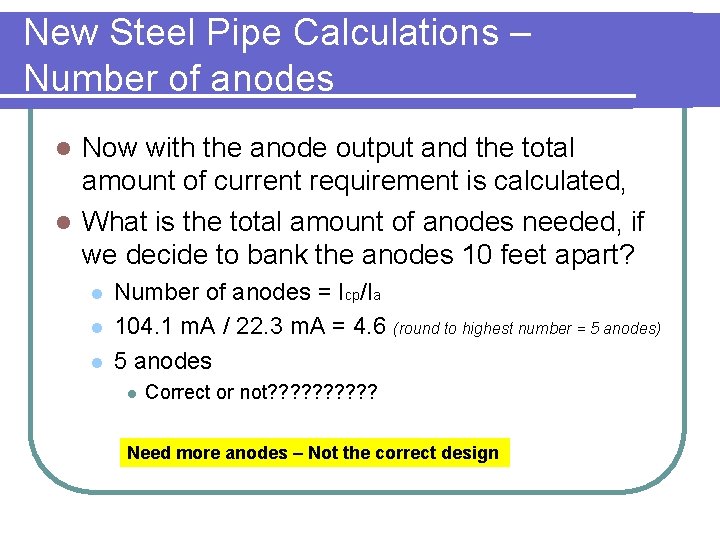
New Steel Pipe Calculations – Number of anodes Now with the anode output and the total amount of current requirement is calculated, l What is the total amount of anodes needed, if we decide to bank the anodes 10 feet apart? l l Number of anodes = Icp/Ia 104. 1 m. A / 22. 3 m. A = 4. 6 (round to highest number = 5 anodes) 5 anodes l Correct or not? ? ? ? ? Need more anodes – Not the correct design
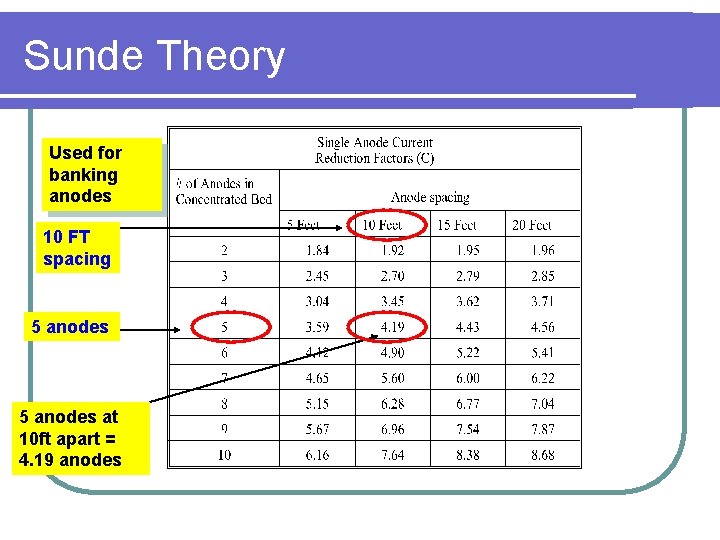
Sunde Theory Used for banking anodes 10 FT spacing 5 anodes at 10 ft apart = 4. 19 anodes
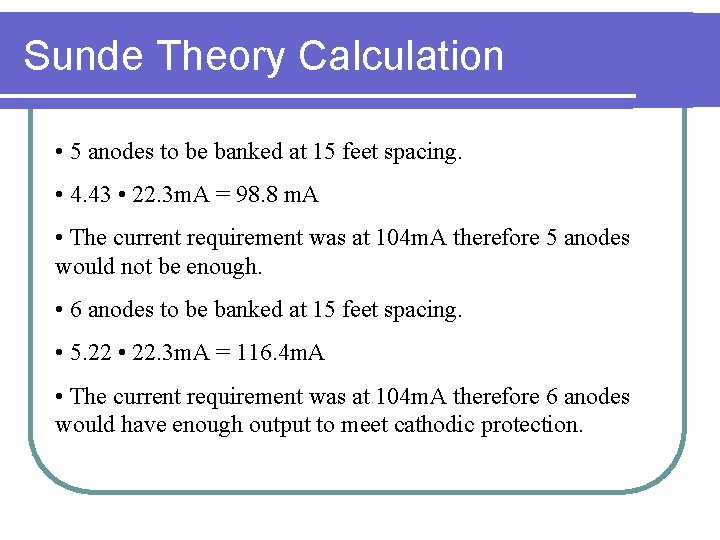
Sunde Theory Calculation • 5 anodes to be banked at 15 feet spacing. • 4. 43 • 22. 3 m. A = 98. 8 m. A • The current requirement was at 104 m. A therefore 5 anodes would not be enough. • 6 anodes to be banked at 15 feet spacing. • 5. 22 • 22. 3 m. A = 116. 4 m. A • The current requirement was at 104 m. A therefore 6 anodes would have enough output to meet cathodic protection.
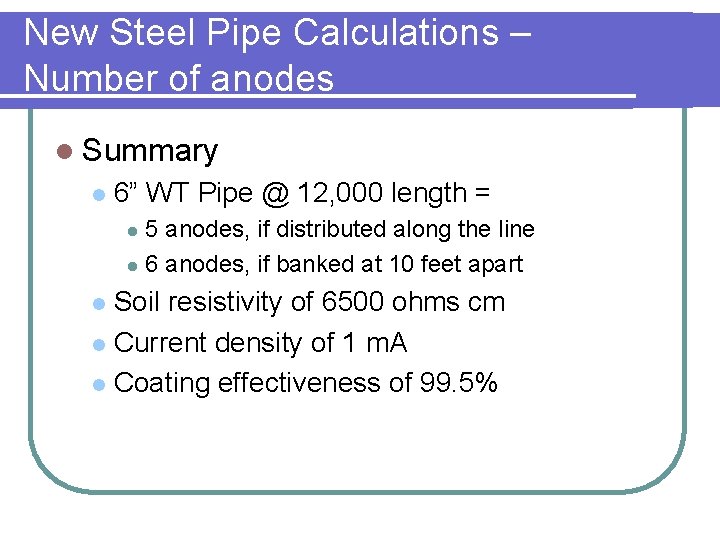
New Steel Pipe Calculations – Number of anodes l Summary l 6” WT Pipe @ 12, 000 length = 5 anodes, if distributed along the line l 6 anodes, if banked at 10 feet apart l Soil resistivity of 6500 ohms cm l Current density of 1 m. A l Coating effectiveness of 99. 5% l
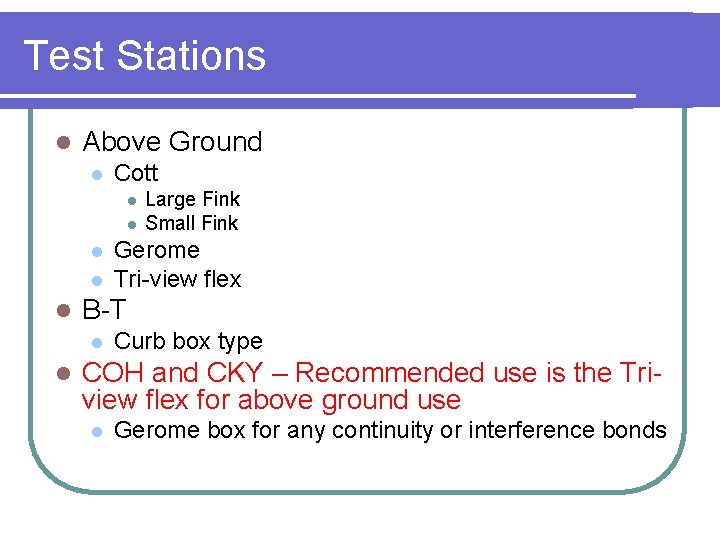
Test Stations l Above Ground l Cott l l l Gerome Tri-view flex B-T l l Large Fink Small Fink Curb box type COH and CKY – Recommended use is the Triview flex for above ground use l Gerome box for any continuity or interference bonds
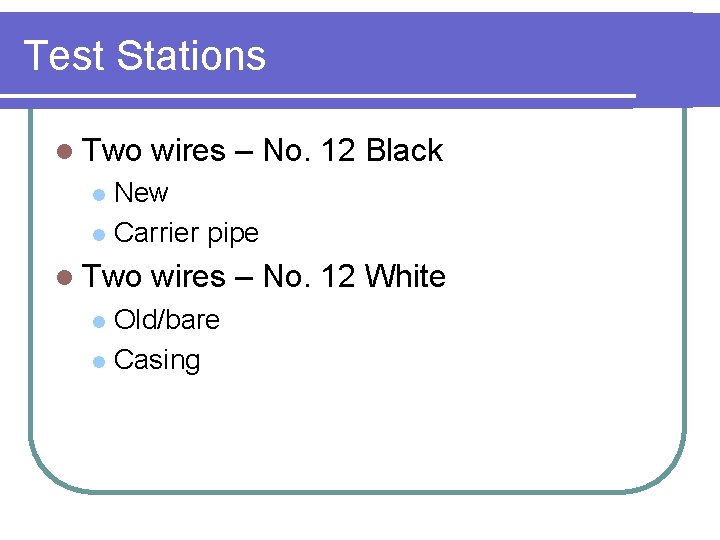
Test Stations l Two wires – No. 12 Black New l Carrier pipe l l Two wires – No. 12 White Old/bare l Casing l
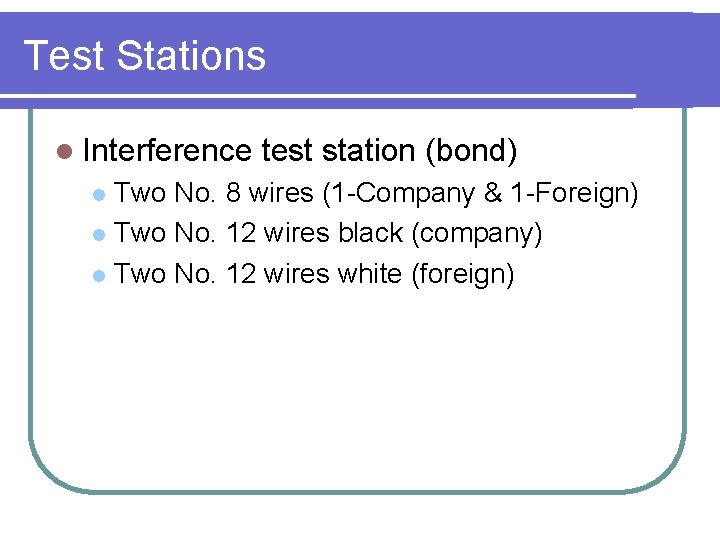
Test Stations l Interference test station (bond) Two No. 8 wires (1 -Company & 1 -Foreign) l Two No. 12 wires black (company) l Two No. 12 wires white (foreign) l
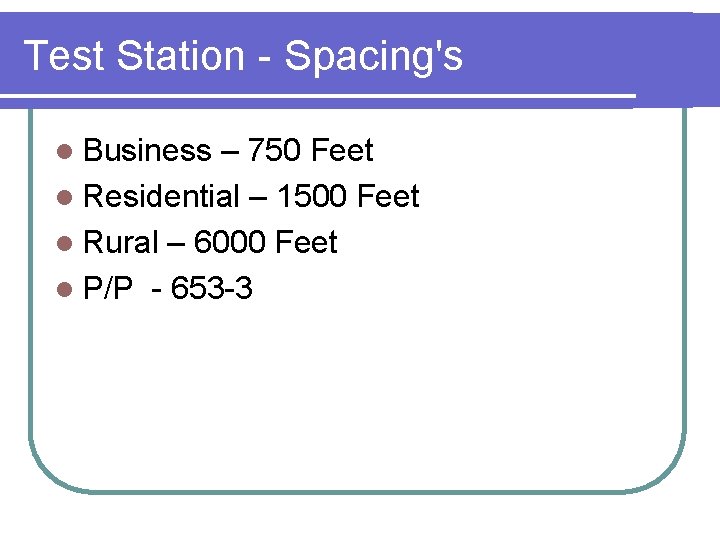
Test Station - Spacing's l Business – 750 Feet l Residential – 1500 Feet l Rural – 6000 Feet l P/P - 653 -3
Coatings are our first line of defense against corrosion. l Coatings are a high resistance barrier between the metallic structure and the surrounding electrolyte. l A quality dielectric coating material can reduce costs in additional corrosion control materials such as sacrificial anodes or impressed current type cathodic protection systems. l
Coatings l Cathodic protection system design is based upon protecting the bare surface area of the buried/submerged metallic structure. l Typically a well coated pipeline will be protected over 90% of its surface. l In this case, only 10% of the pipeline surface will require cathodic protection current.
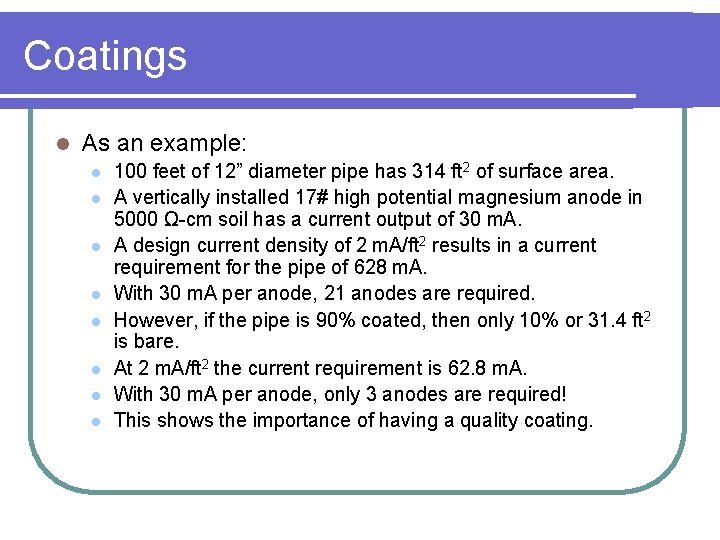
Coatings l As an example: l l l l 100 feet of 12” diameter pipe has 314 ft 2 of surface area. A vertically installed 17# high potential magnesium anode in 5000 Ω-cm soil has a current output of 30 m. A. A design current density of 2 m. A/ft 2 results in a current requirement for the pipe of 628 m. A. With 30 m. A per anode, 21 anodes are required. However, if the pipe is 90% coated, then only 10% or 31. 4 ft 2 is bare. At 2 m. A/ft 2 the current requirement is 62. 8 m. A. With 30 m. A per anode, only 3 anodes are required! This shows the importance of having a quality coating.
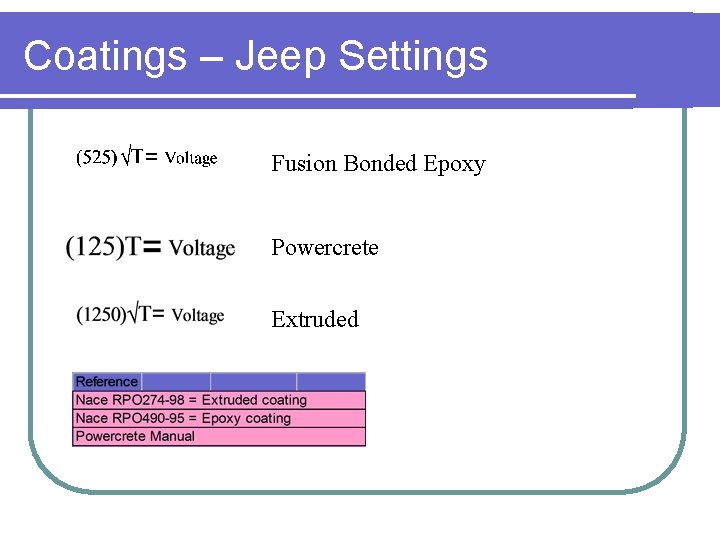
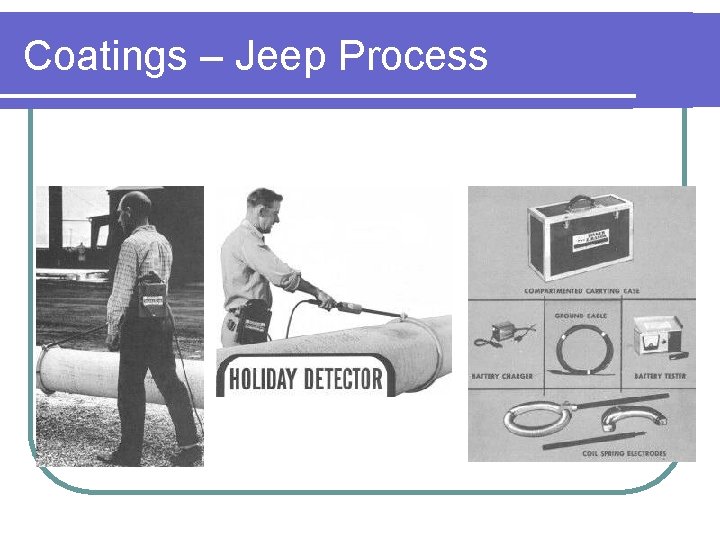
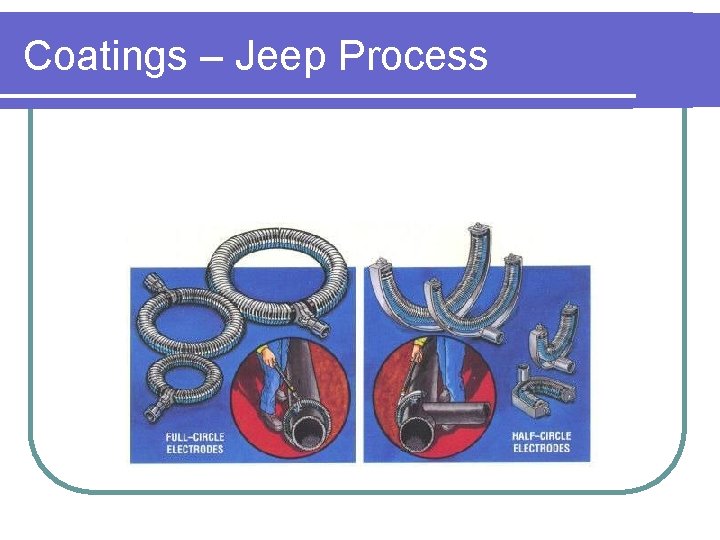
Coatings l Holiday Testing (Jeeping) l l Test process which the operator can identify holidays (imperfections) in the coating Involves a high voltage power source l Instruments can be adjusted to apply the proper voltage across the coating l l l Different thickness’ of coating requires different settings Electrode is passed over the coating surface If the coating resistance is low or a holiday is present, an audio signal is heard due to an electrical discharge from the electrode onto the pipe surface l Repair of the coating is made
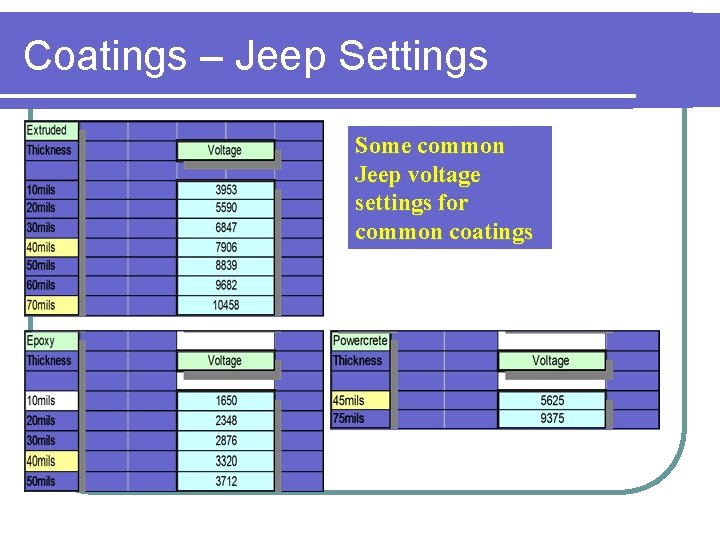
Coatings – Jeep Settings Fusion Bonded Epoxy Powercrete Extruded
Coatings – Jeep Settings Some common Jeep voltage settings for common coatings
Coatings – Jeep settings l You maybe asked to QA or verify the coating thickness base on the jeep process l Check the coating thickness l DFT Check the voltage setting of the Jeep l Verify, the contractor or crew is creating a holiday to verify the setting l
Coatings – Jeep Process
Coatings – Jeep Process
Coatings l Three common types mostly used in the gas industry Extruded l Fusion bonded epoxy (FBE) l Powercrete l
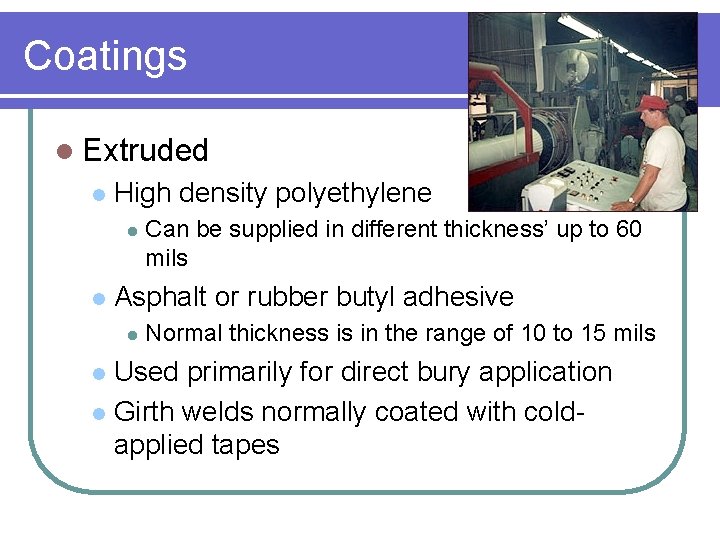
Coatings l Extruded l High density polyethylene l l Can be supplied in different thickness’ up to 60 mils Asphalt or rubber butyl adhesive l Normal thickness is in the range of 10 to 15 mils Used primarily for direct bury application l Girth welds normally coated with coldapplied tapes l
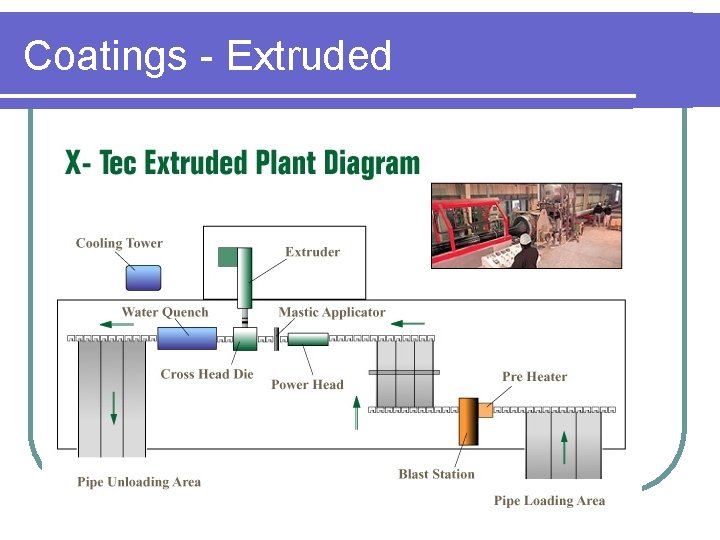
Coatings - Extruded
Coatings - Extruded l Direct l Bury - X-Tech II – COH & CKY practice for direct bury design, 1 st choice 70 mill application l Two layers of 30 mills of polyethylene coating l 10 mills of butyl rubber mastic l
Coatings - Extruded l Design for AC and/or DC interference currents l Use only Extruded – X-TECH II coating systems
Coatings - FBE l Fusion Bonded Epoxy l Surface preparation includes sand blasting l l l l To clean the surface and form anchor patterns for the coating to adhere or bond to the pipe surface Surface is acid washed to remove salt deposits Surface is washed with dionized water Pipe surface is heated to 500 degrees or hotter Epoxy powders are electro statically charged and sprayed onto the hot surface The powders melt to a liquid form and fuse to the pipe surface forming a hard shell The applied coating normally cures within 90 seconds and then is blasted with cool water in order to facilitate handling
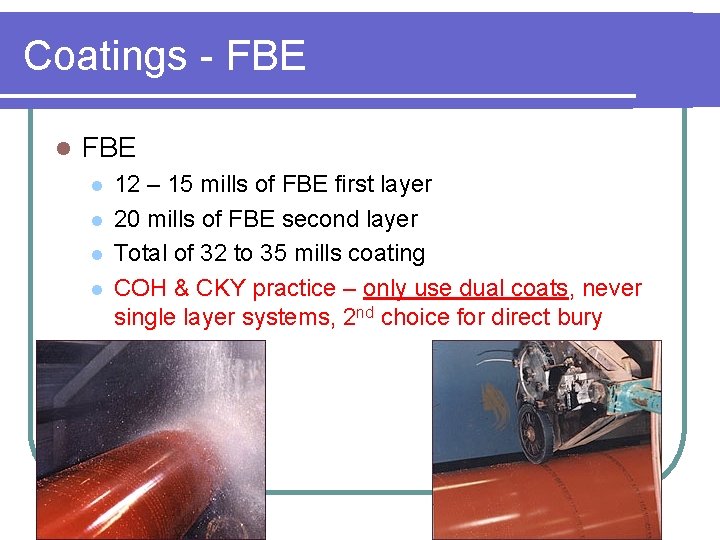
Coatings - FBE l l l l 12 – 15 mills of FBE first layer 20 mills of FBE second layer Total of 32 to 35 mills coating COH & CKY practice – only use dual coats, never single layer systems, 2 nd choice for direct bury
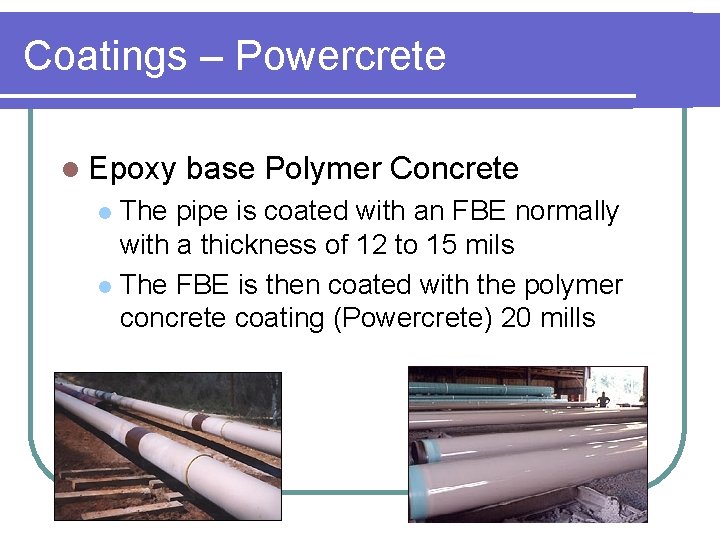
Coatings – Powercrete l Epoxy base Polymer Concrete The pipe is coated with an FBE normally with a thickness of 12 to 15 mils l The FBE is then coated with the polymer concrete coating (Powercrete) 20 mills l
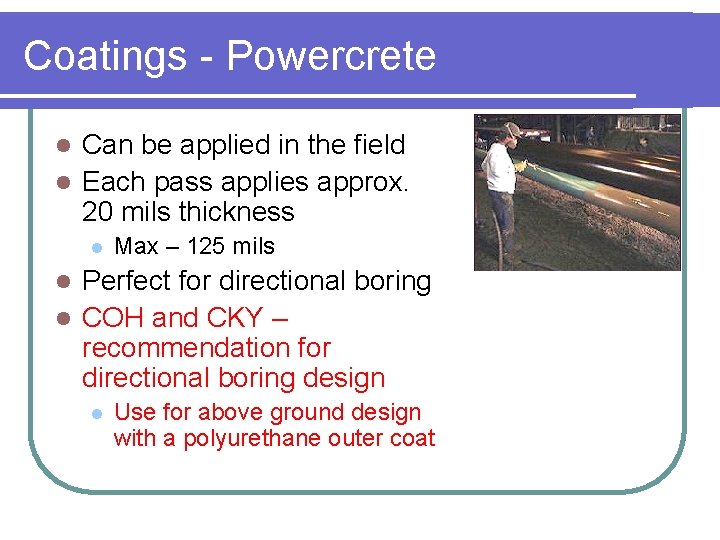
Coatings - Powercrete Can be applied in the field l Each pass applies approx. 20 mils thickness l l Max – 125 mils Perfect for directional boring l COH and CKY – recommendation for directional boring design l l Use for above ground design with a polyurethane outer coat
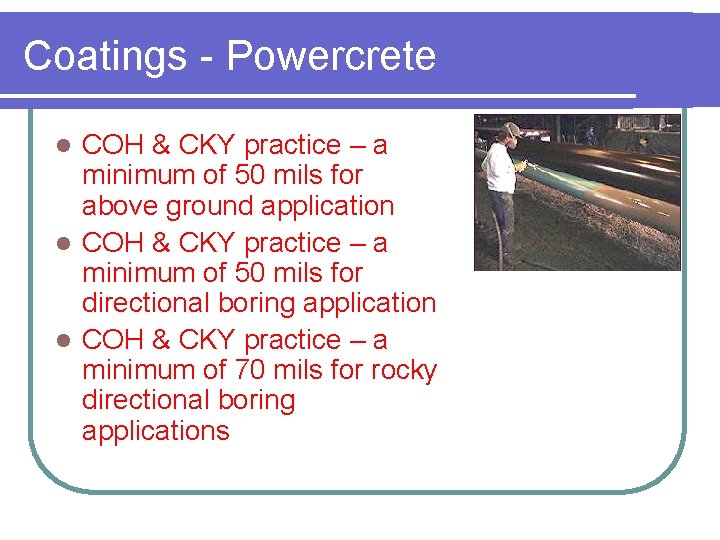
Coatings - Powercrete COH & CKY practice – a minimum of 50 mils for above ground application l COH & CKY practice – a minimum of 50 mils for directional boring application l COH & CKY practice – a minimum of 70 mils for rocky directional boring applications l
Coatings – Girth Welds l FBE and Powercrete coating applications l COH & CKY practice – two part liquid epoxy system l l l Surface will need to be sand blasted to a Nace 1 anchor pattern The two parts are mixed l l Protal 7200 – temp’s at or above 50 degrees Protal 7125 – temp’s below 50 degrees R 95 – temp’s at or above 50 degrees – back up coating Epoxy resin Epoxy hardener Coat the surface of the girth weld according to manufacture’s recommended wet film thickness Use the same material on the holiday areas as well
Coatings – Girth Welds l Girth l Welds Extruded Coatings – X-Tech II l Acceptable methods – l l l Polyken 936 Tape coat H 35 Petrolatum Tape l Utility tape (PVC) on new steel applications to be used l S 105 paste recommended, especially in cold climates
Coatings – Thermite welds No mastic…. . l Preference – especially for vacuum systems l l Acceptable methods – l Petrolatum products l l l Protal 7200 cartridge l l Profile mastic petrolatum – Denso product (bird seed) Top coat with the Denso Color Tape – petrolatum – Denso product Mix product on cardboard Dip brush and paint onto surface Cover with Trenton wax paper to prevent any damage due to debri of dirt Trenton patch kits (watch cost – higher dollar)
Coatings – Transmission and/or Directional boring Applications l Corrosion FLL shall be contacted l Corrosion department will inspect the pipeline at the coating Mill using the recommended “Hold points”
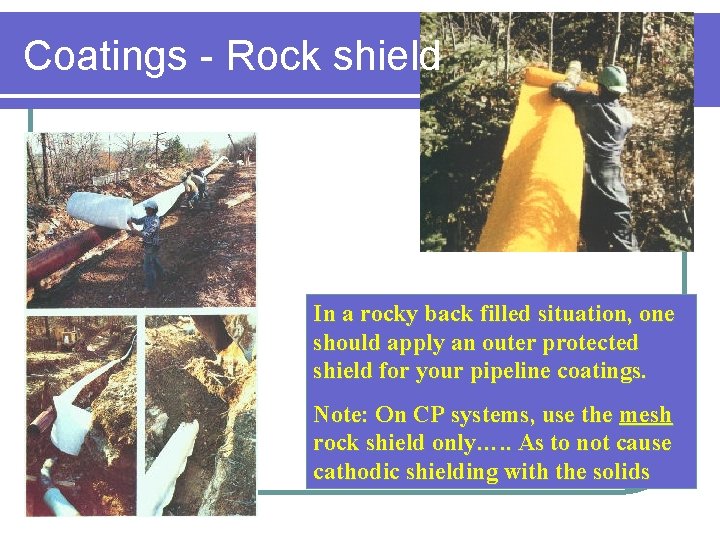
Coatings - Rock shield In a rocky back filled situation, one should apply an outer protected shield for your pipeline coatings. Note: On CP systems, use the mesh rock shield only…. . As to not cause cathodic shielding with the solids
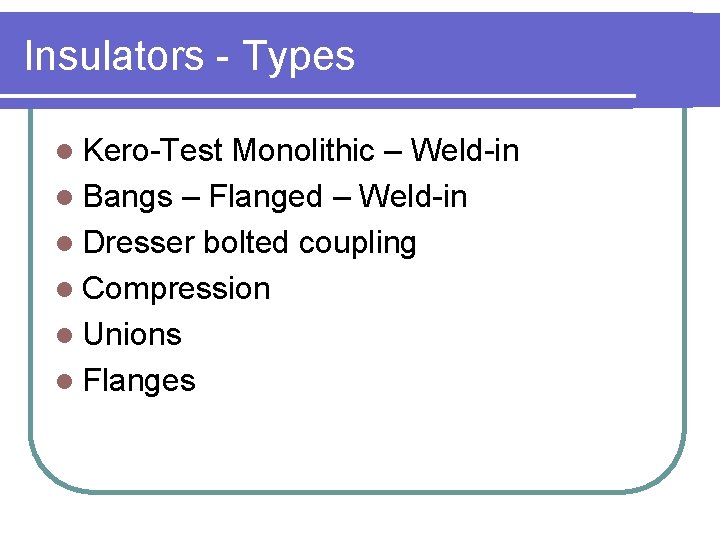
Insulators - Types l Kero-Test Monolithic – Weld-in l Bangs – Flanged – Weld-in l Dresser bolted coupling l Compression l Unions l Flanges
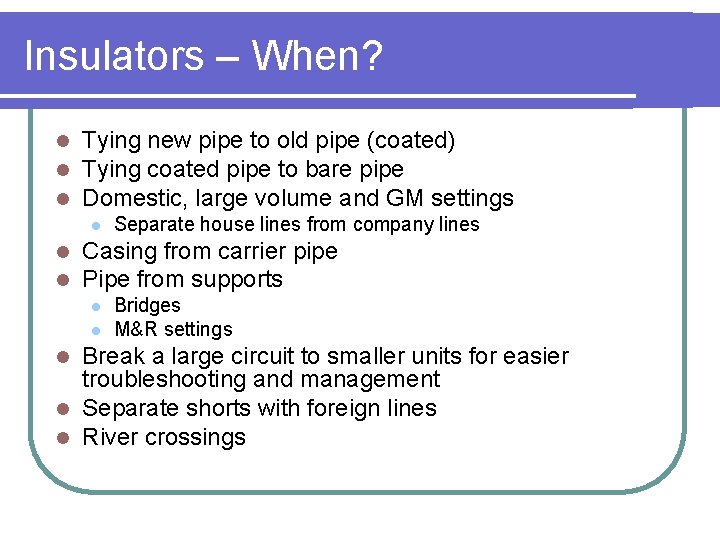
Insulators – When? l l l Tying new pipe to old pipe (coated) Tying coated pipe to bare pipe Domestic, large volume and GM settings l l l Separate house lines from company lines Casing from carrier pipe Pipe from supports l l Bridges M&R settings Break a large circuit to smaller units for easier troubleshooting and management l Separate shorts with foreign lines l River crossings l
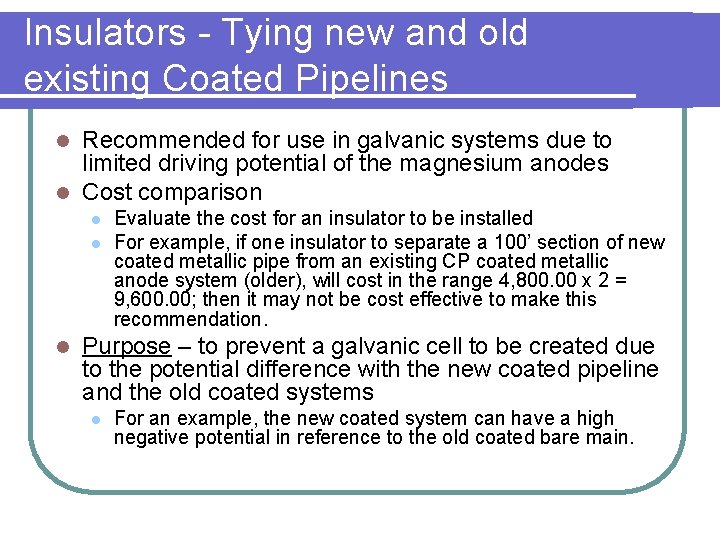
Insulators - Tying new and old existing Coated Pipelines Recommended for use in galvanic systems due to limited driving potential of the magnesium anodes l Cost comparison l l Evaluate the cost for an insulator to be installed For example, if one insulator to separate a 100’ section of new coated metallic pipe from an existing CP coated metallic anode system (older), will cost in the range 4, 800. 00 x 2 = 9, 600. 00; then it may not be cost effective to make this recommendation. Purpose – to prevent a galvanic cell to be created due to the potential difference with the new coated pipeline and the old coated systems l For an example, the new coated system can have a high negative potential in reference to the old coated bare main.
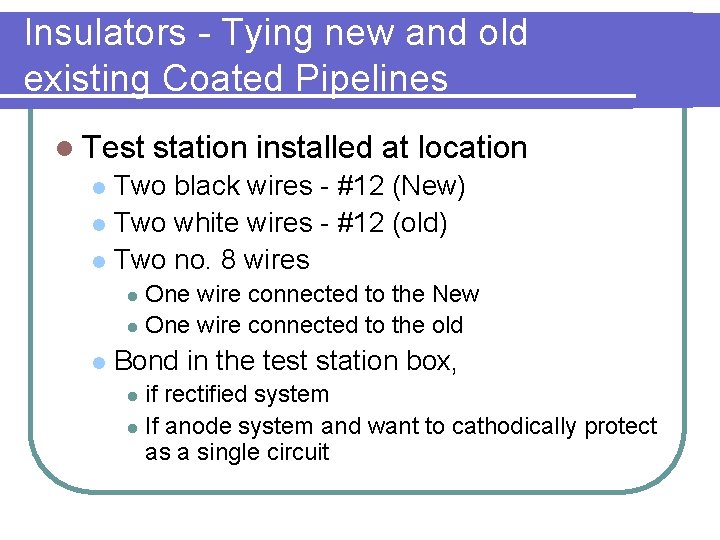
Insulators - Tying new and old existing Coated Pipelines l Test station installed at location Two black wires - #12 (New) l Two white wires - #12 (old) l Two no. 8 wires l One wire connected to the New l One wire connected to the old l l Bond in the test station box, if rectified system l If anode system and want to cathodically protect as a single circuit l
Insulators - Tying new and old existing Coated Pipelines l If not bonded in the test station box, then create two facilities on WMS and two test point sheets
Insulators - Tying new and old existing Coated Pipelines l Recommended spacing's of insulators Business – 1500 feet l Residential – 3000 feet l Rural – 12000 feet l
Insulators - Tying to Bare Pipe l All coated systems tying to bare systems are to be insulated off l Test station installed at location Verification to be made on annual monitoring l Trouble shooting purpose l Two white wires on the bare pipe l Two black wires on the coated pipe l
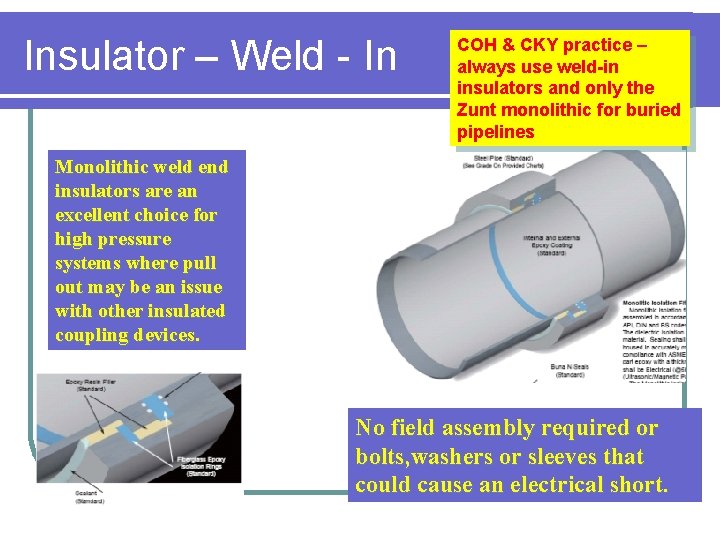
Insulator – Weld - In COH & CKY practice – always use weld-in insulators and only the Zunt monolithic for buried pipelines Monolithic weld end insulators are an excellent choice for high pressure systems where pull out may be an issue with other insulated coupling devices. No field assembly required or bolts, washers or sleeves that could cause an electrical short.
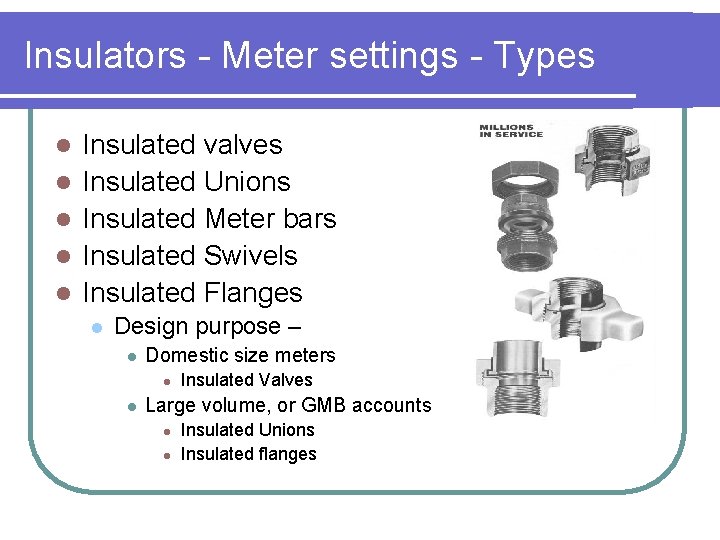
Insulators - Meter settings - Types l l l Insulated valves Insulated Unions Insulated Meter bars Insulated Swivels Insulated Flanges l Design purpose – l Domestic size meters l l Insulated Valves Large volume, or GMB accounts l l Insulated Unions Insulated flanges
Insulators – M&R Station l Insulated in a structure l l Must have a zinc grounding cell installed (DOT and procedure requirement) Insulated at flange @ outlet of valves l Outlet valve l l l If need to replace flange insulators, on lower pressure end Bypass valve All control lines need to have insulated unions
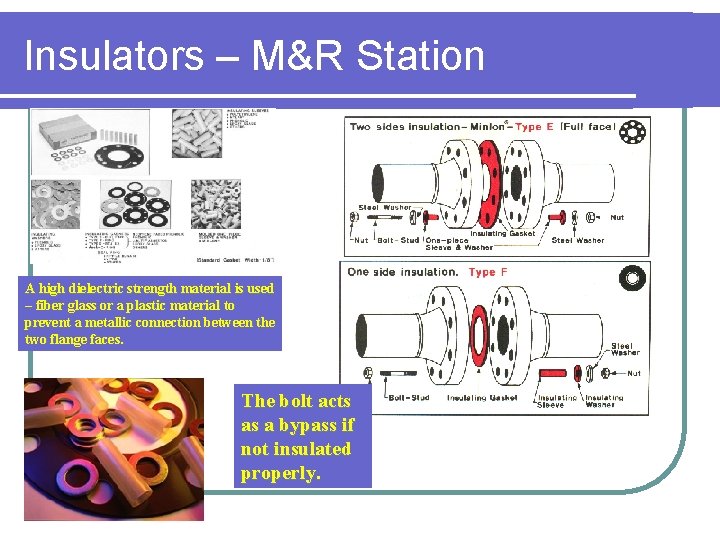
Insulators – M&R Station A high dielectric strength material is used – fiber glass or a plastic material to prevent a metallic connection between the two flange faces. The bolt acts as a bypass if not insulated properly.
Insulator – Casing and Carrier Pipe l Casing isolation – two primary functions Prevent an electrolyte from entering the casing and creating a galvanic corrosion cell. l Prevent metallic contact between the carrier pipe and casing pipe. l Casing isolation may remove up to two of the four parts of a corrosion cell. l
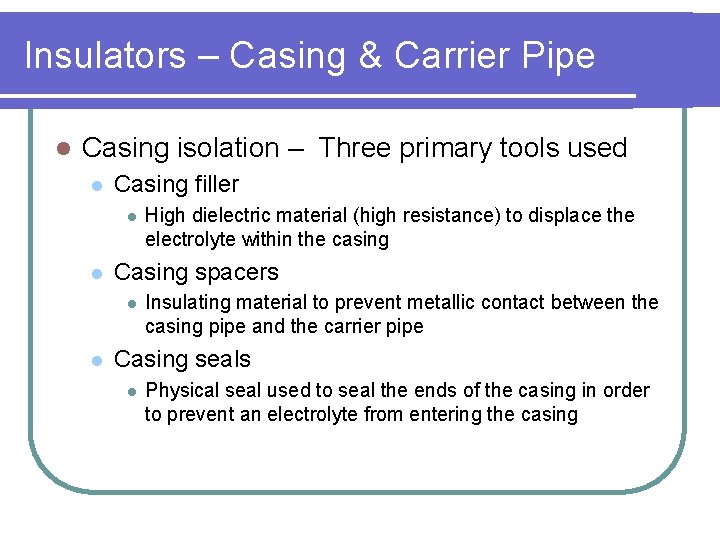
Insulators – Casing & Carrier Pipe l Casing isolation – Three primary tools used l Casing filler l l Casing spacers l l High dielectric material (high resistance) to displace the electrolyte within the casing Insulating material to prevent metallic contact between the casing pipe and the carrier pipe Casing seals l Physical seal used to seal the ends of the casing in order to prevent an electrolyte from entering the casing
Insulator – Casing & Carrier Pipe – Casing Filling l Petrolatum based material that has a high dielectric strength. l Displaces the surrounding electrolyte in the casing around the carrier pipe. l Prevents water from entering the casing and displaces the existing water. l Environmentally safe – non-hazardous.
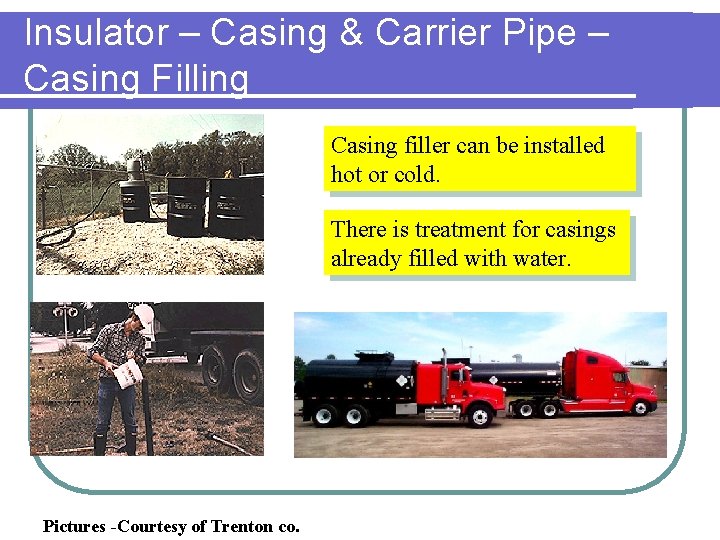
Insulator – Casing & Carrier Pipe – Casing Filling Casing filler can be installed hot or cold. There is treatment for casings already filled with water. Pictures -Courtesy of Trenton co.
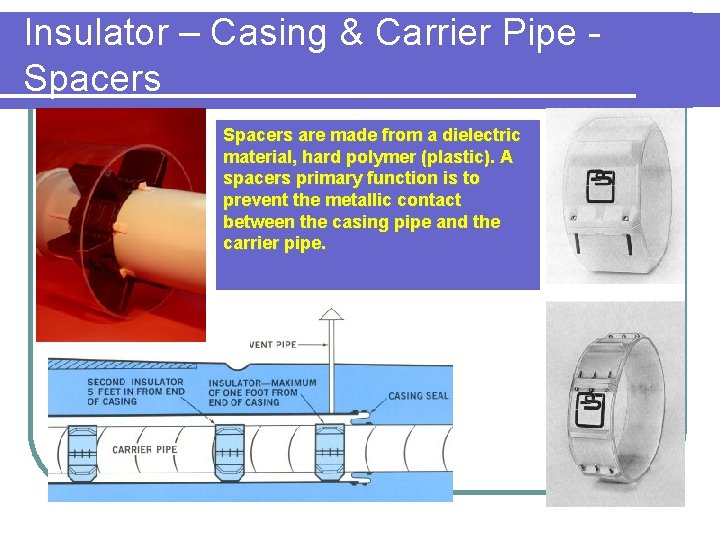
Insulator – Casing & Carrier Pipe Spacers are made from a dielectric material, hard polymer (plastic). A spacers primary function is to prevent the metallic contact between the casing pipe and the carrier pipe.
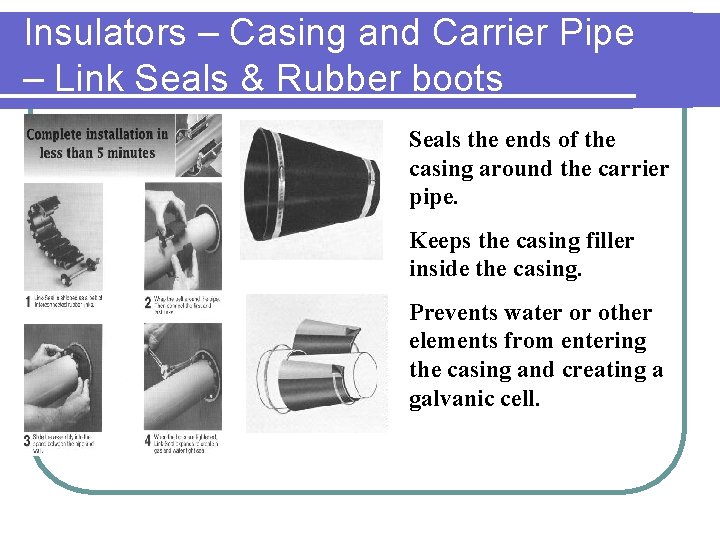
Insulators – Casing and Carrier Pipe – Link Seals & Rubber boots Seals the ends of the casing around the carrier pipe. Keeps the casing filler inside the casing. Prevents water or other elements from entering the casing and creating a galvanic cell.
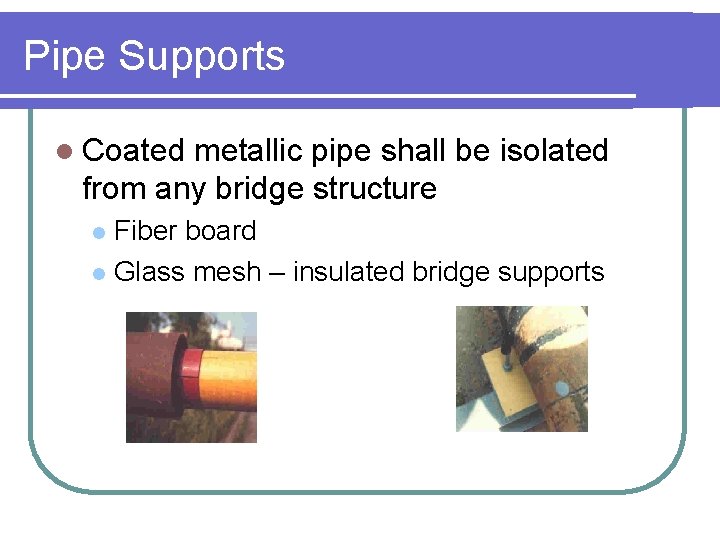
Pipe Supports l Coated metallic pipe shall be isolated from any bridge structure Fiber board l Glass mesh – insulated bridge supports l
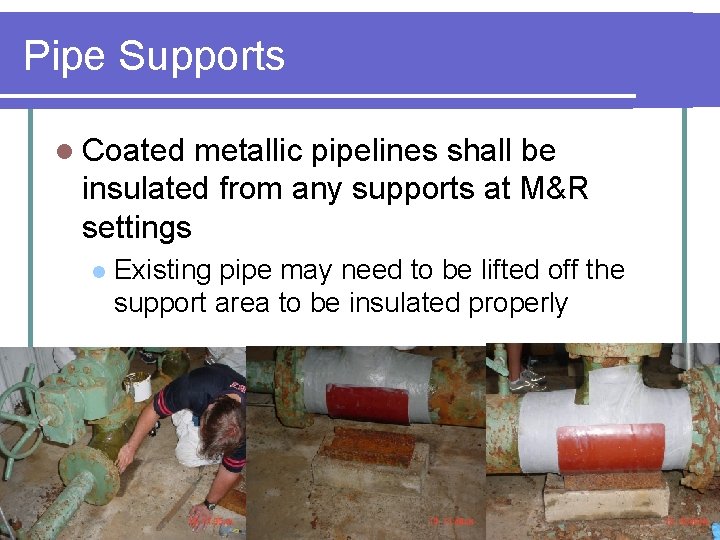
Pipe Supports l Coated metallic pipelines shall be insulated from any supports at M&R settings l Existing pipe may need to be lifted off the support area to be insulated properly
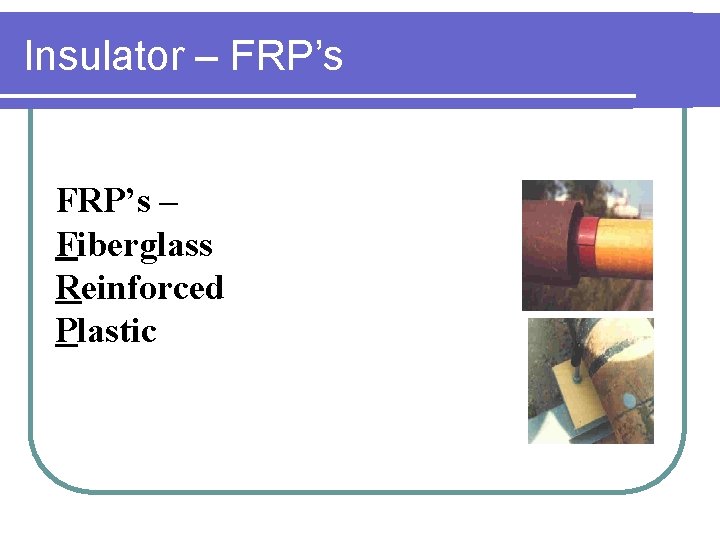
Insulator – FRP’s – Fiberglass Reinforced Plastic
Insulator – FRP’s l Primary function of FRP’s To prevent an electrical connection between the structure intended for cathodic protection and foreign metallic structures. l Separates the anode from the cathode by electrically isolating the two structures. l Reduces the required amount of corrosion materials to be used. l
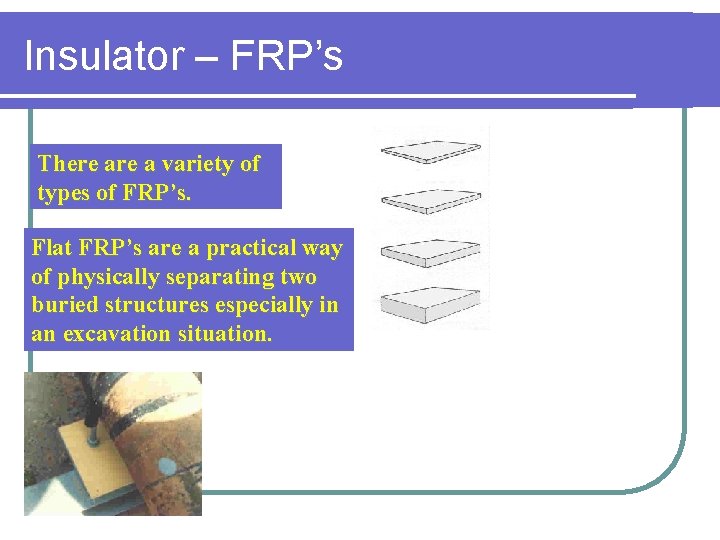
Insulator – FRP’s There a variety of types of FRP’s. Flat FRP’s are a practical way of physically separating two buried structures especially in an excavation situation.
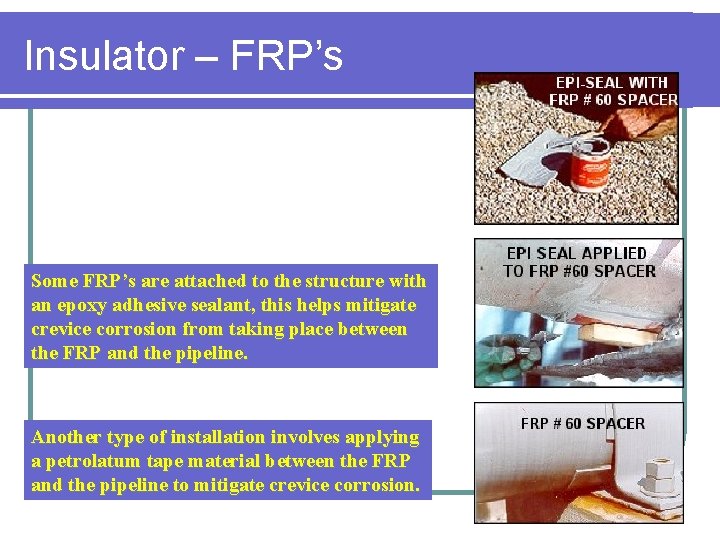
Insulator – FRP’s Some FRP’s are attached to the structure with an epoxy adhesive sealant, this helps mitigate crevice corrosion from taking place between the FRP and the pipeline. Another type of installation involves applying a petrolatum tape material between the FRP and the pipeline to mitigate crevice corrosion.
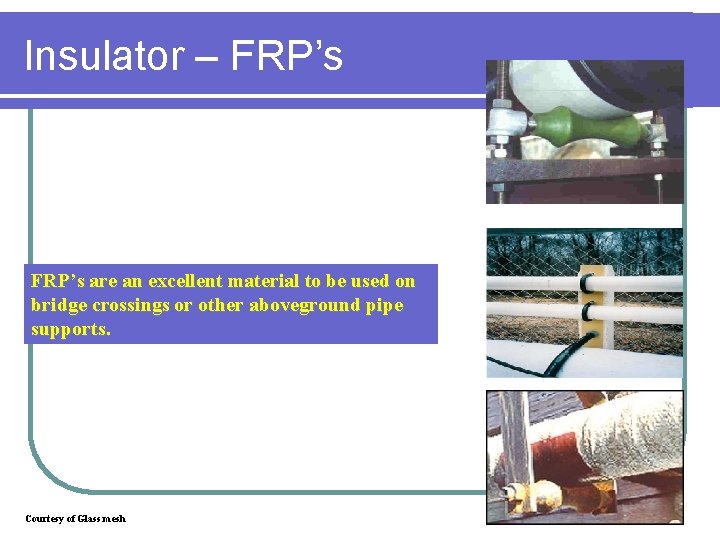
Insulator – FRP’s are an excellent material to be used on bridge crossings or other aboveground pipe supports. Courtesy of Glass mesh
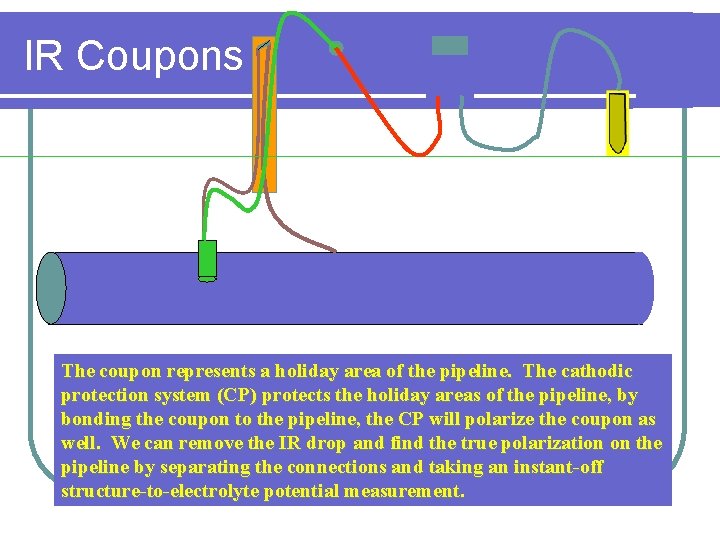
IR Coupons Two no. 12 stranded wires. l Benefits l Obtain IR drop free potentials l l of using coupons Especially on systems that the current source can not be interrupted. AC measurements such as AC current density calculations. Surface area = 1. 34 in 2
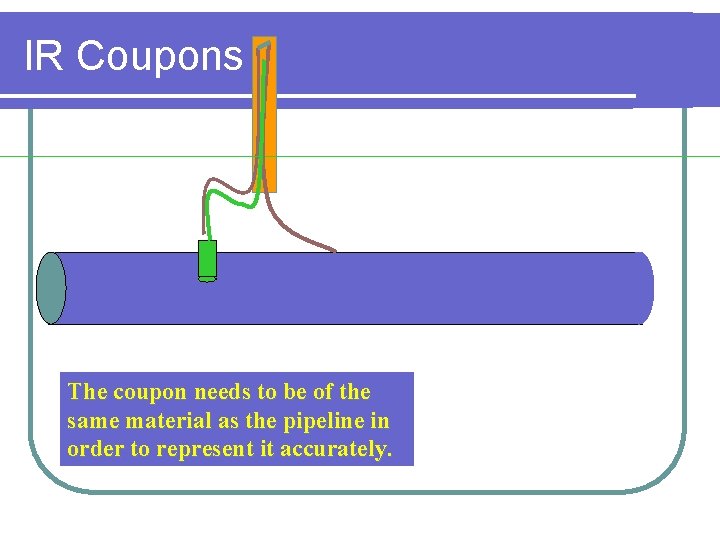
IR Coupons The coupon needs to be of the same material as the pipeline in order to represent it accurately.
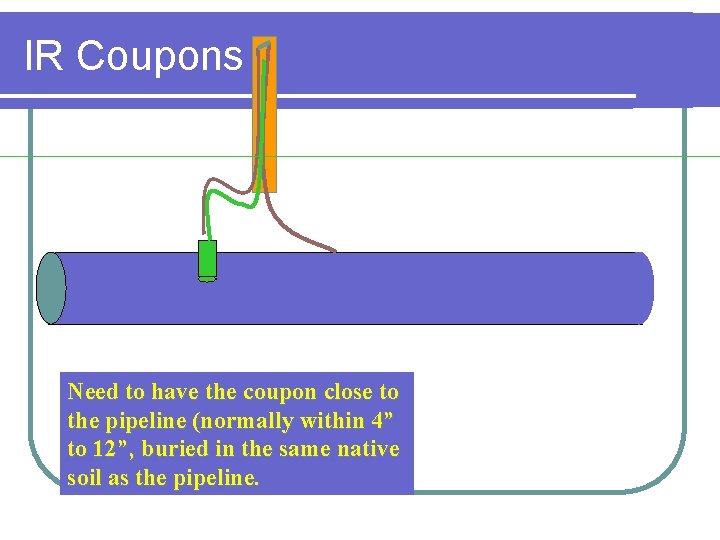
IR Coupons Need to have the coupon close to the pipeline (normally within 4” to 12”, buried in the same native soil as the pipeline.
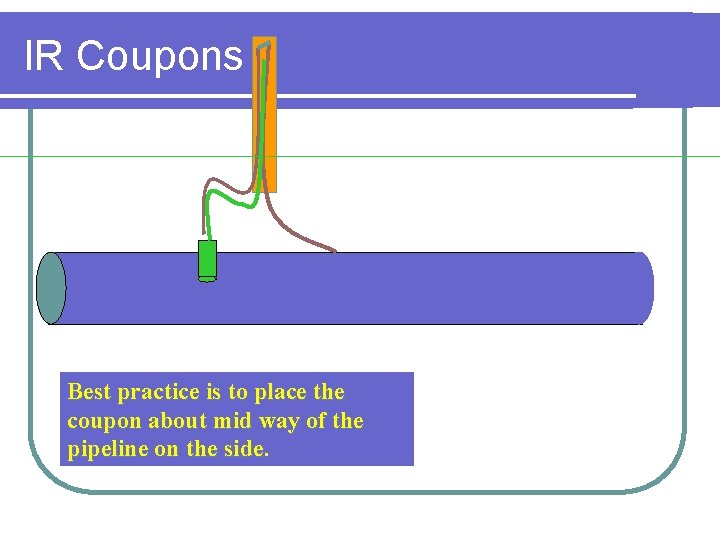
IR Coupons Best practice is to place the coupon about mid way of the pipeline on the side.
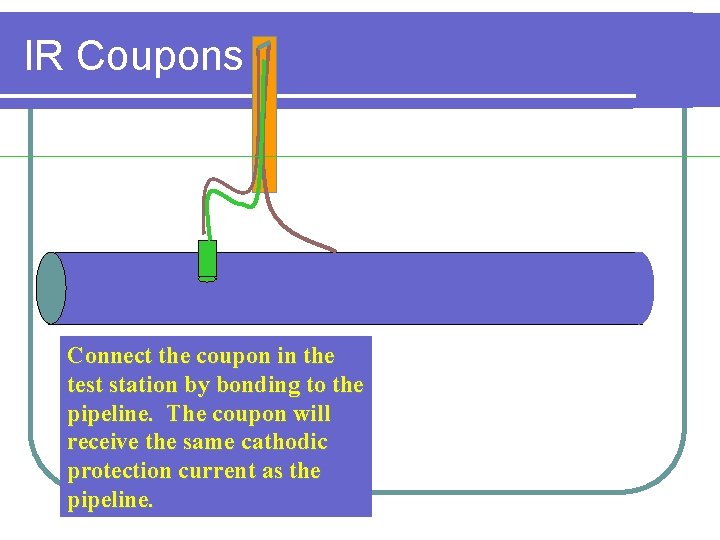
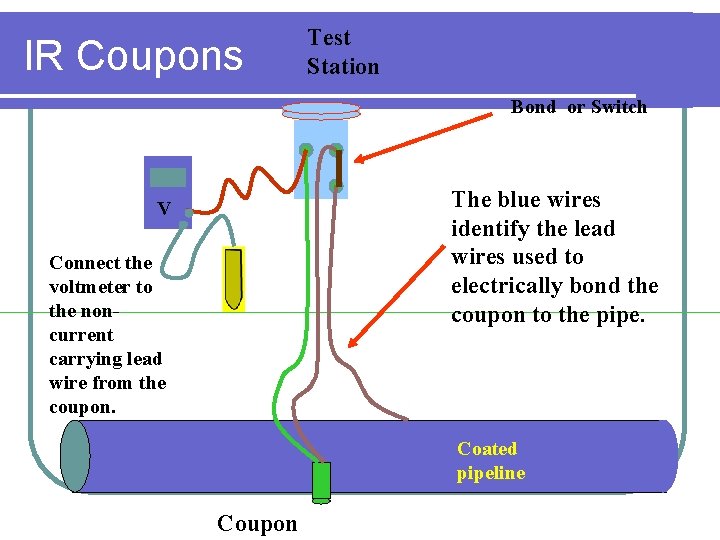
IR Coupons Connect the coupon in the test station by bonding to the pipeline. The coupon will receive the same cathodic protection current as the pipeline.
IR Coupons The coupon represents a holiday area of the pipeline. The cathodic protection system (CP) protects the holiday areas of the pipeline, by bonding the coupon to the pipeline, the CP will polarize the coupon as well. We can remove the IR drop and find the true polarization on the pipeline by separating the connections and taking an instant-off structure-to-electrolyte potential measurement.
IR Coupons Test Station Bond or Switch The blue wires identify the lead wires used to electrically bond the coupon to the pipe. V Connect the voltmeter to the noncurrent carrying lead wire from the coupon. Coated pipeline Coupon
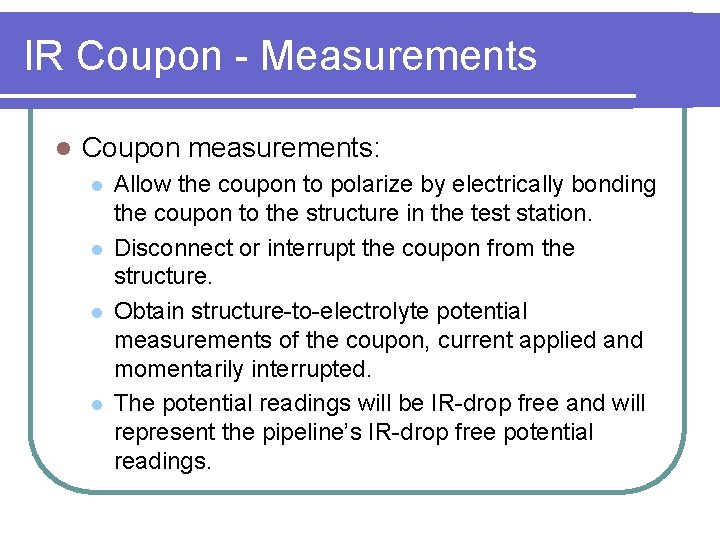
IR Coupon - Measurements l Coupon measurements: l l Allow the coupon to polarize by electrically bonding the coupon to the structure in the test station. Disconnect or interrupt the coupon from the structure. Obtain structure-to-electrolyte potential measurements of the coupon, current applied and momentarily interrupted. The potential readings will be IR-drop free and will represent the pipeline’s IR-drop free potential readings.
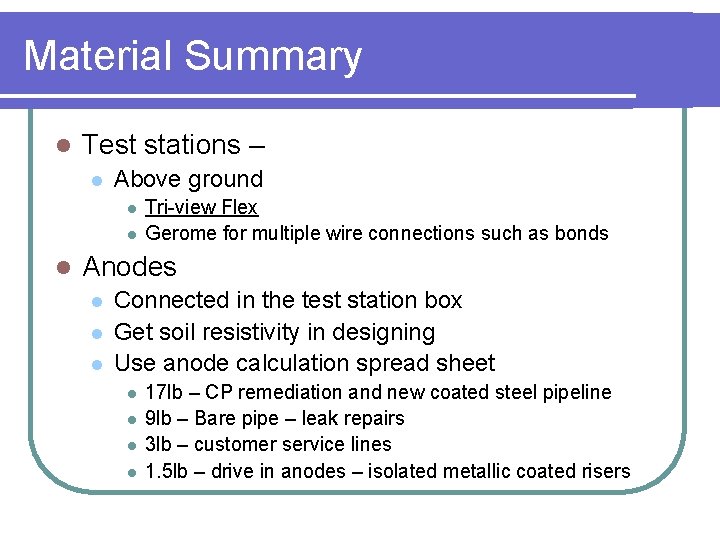
Material Summary l Test stations – l Above ground l l l Tri-view Flex Gerome for multiple wire connections such as bonds Anodes l l l Connected in the test station box Get soil resistivity in designing Use anode calculation spread sheet l l 17 lb – CP remediation and new coated steel pipeline 9 lb – Bare pipe – leak repairs 3 lb – customer service lines 1. 5 lb – drive in anodes – isolated metallic coated risers
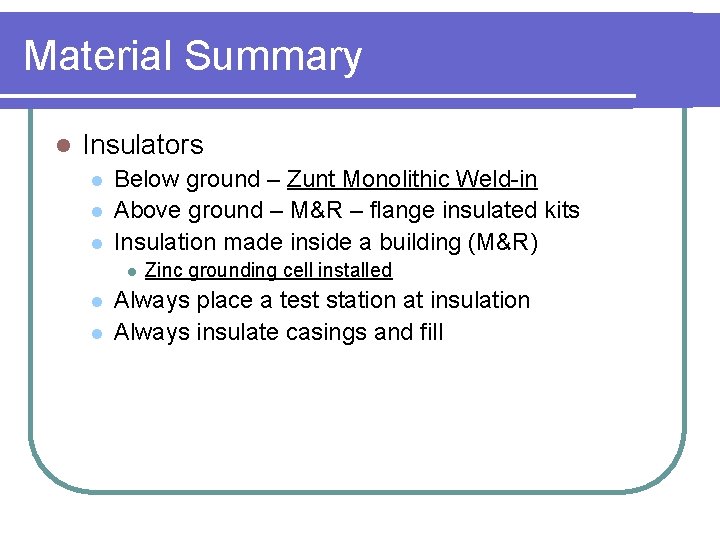
Material Summary l Insulators l l l Below ground – Zunt Monolithic Weld-in Above ground – M&R – flange insulated kits Insulation made inside a building (M&R) l l l Zinc grounding cell installed Always place a test station at insulation Always insulate casings and fill
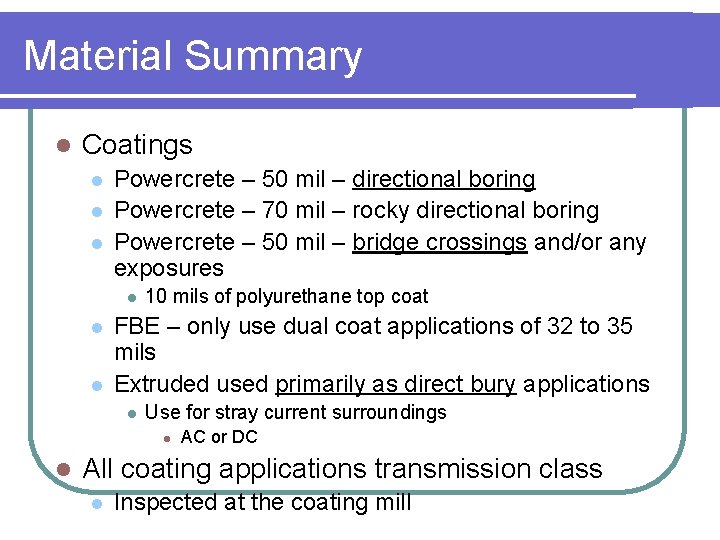
Material Summary l Coatings l l l Powercrete – 50 mil – directional boring Powercrete – 70 mil – rocky directional boring Powercrete – 50 mil – bridge crossings and/or any exposures l l l 10 mils of polyurethane top coat FBE – only use dual coat applications of 32 to 35 mils Extruded used primarily as direct bury applications l Use for stray current surroundings l l AC or DC All coating applications transmission class l Inspected at the coating mill