
Corrosion Modeling Using Multiphysics Computational Fluid Dynamics From

- Slides: 18
Corrosion Modeling Using Multiphysics Computational Fluid Dynamics – From Ideal to Real Conditions Julio Mendez Ph. D. , Siva Palani Ph. D. , Alan Rose Ph. D. and Keith Legg Ph. D. nafems. org/caase 20 The Conference on Advancing Analysis & Simulation in Engineering | CAASE 20 June 16 th – 18 th | Virtual Conference
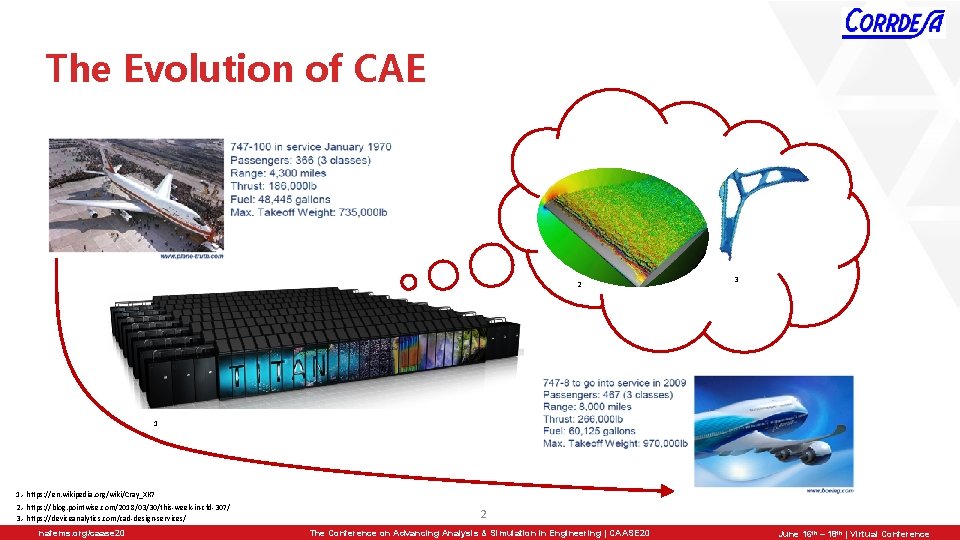
The Evolution of CAE 2 3 1 1. - https: //en. wikipedia. org/wiki/Cray_XK 7 2. - https: //blog. pointwise. com/2018/03/30/this-week-in-cfd-307/ 3. - https: //deviceanalytics. com/cad-design-services/ nafems. org/caase 20 2 The Conference on Advancing Analysis & Simulation in Engineering | CAASE 20 June 16 th – 18 th | Virtual Conference
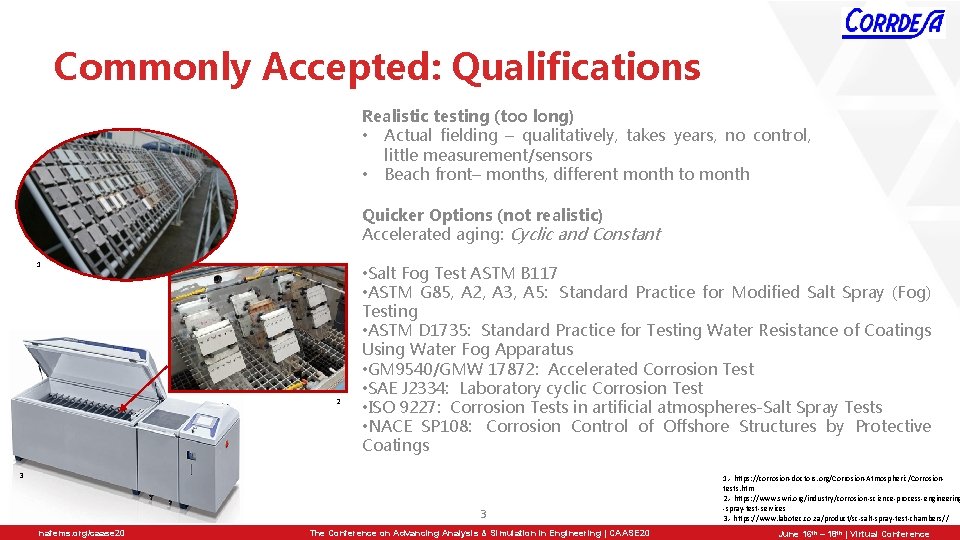
Commonly Accepted: Qualifications Realistic testing (too long) • Actual fielding – qualitatively, takes years, no control, little measurement/sensors • Beach front– months, different month to month Quicker Options (not realistic) Accelerated aging: Cyclic and Constant 1 2 • Salt Fog Test ASTM B 117 • ASTM G 85, A 2, A 3, A 5: Standard Practice for Modified Salt Spray (Fog) Testing • ASTM D 1735: Standard Practice for Testing Water Resistance of Coatings Using Water Fog Apparatus • GM 9540/GMW 17872: Accelerated Corrosion Test • SAE J 2334: Laboratory cyclic Corrosion Test • ISO 9227: Corrosion Tests in artificial atmospheres-Salt Spray Tests • NACE SP 108: Corrosion Control of Offshore Structures by Protective Coatings 3 3 nafems. org/caase 20 The Conference on Advancing Analysis & Simulation in Engineering | CAASE 20 1. - https: //corrosion-doctors. org/Corrosion-Atmospheric/Corrosiontests. htm 2. - https: //www. swri. org/industry/corrosion-science-process-engineering -spray-test-services 3. - https: //www. labotec. co. za/product/sc-salt-spray-test-chambers/ / June 16 th – 18 th | Virtual Conference
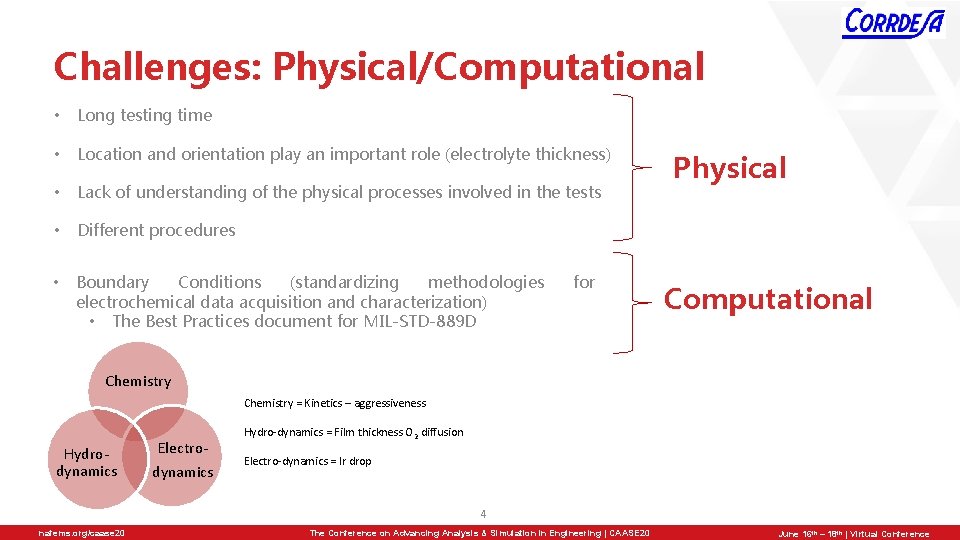
Challenges: Physical/Computational • Long testing time • Location and orientation play an important role (electrolyte thickness) • Lack of understanding of the physical processes involved in the tests • Different procedures • Boundary Conditions (standardizing methodologies electrochemical data acquisition and characterization) • The Best Practices document for MIL-STD-889 D for Physical Computational Chemistry = Kinetics – aggressiveness Hydrodynamics Electrodynamics Hydro-dynamics = Film thickness O 2 diffusion Electro-dynamics = Ir drop 4 nafems. org/caase 20 The Conference on Advancing Analysis & Simulation in Engineering | CAASE 20 June 16 th – 18 th | Virtual Conference
Challenges: Physical/Computational 1. Can we reproduce the Accelerated Corrosion Test (ACT) numerically ? 2. Is there anything we can do in between to accelerate and guide the selection of materials and coatings down selection process to filter the N different possibilities? 3. How can we provide accurate, representative, and robust data to CFD Multiphysics solvers? 5 nafems. org/caase 20 The Conference on Advancing Analysis & Simulation in Engineering | CAASE 20 June 16 th – 18 th | Virtual Conference
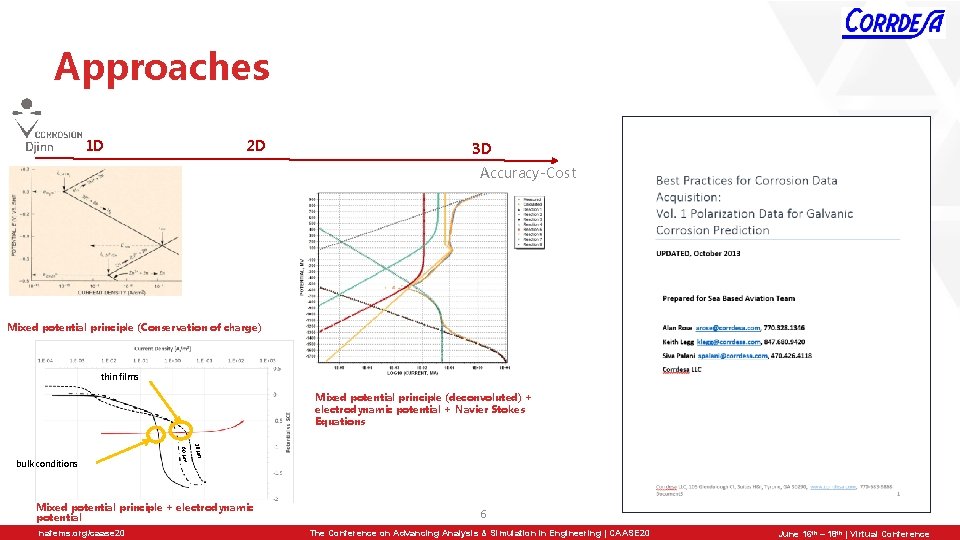
Approaches 1 D 2 D 3 D Accuracy-Cost Mixed potential principle (Conservation of charge) thin films Mixed potential principle (deconvoluted) + electrodynamic potential + Navier Stokes Equations 60 µm 20 µm bulk conditions Mixed potential principle + electrodynamic potential nafems. org/caase 20 6 The Conference on Advancing Analysis & Simulation in Engineering | CAASE 20 June 16 th – 18 th | Virtual Conference
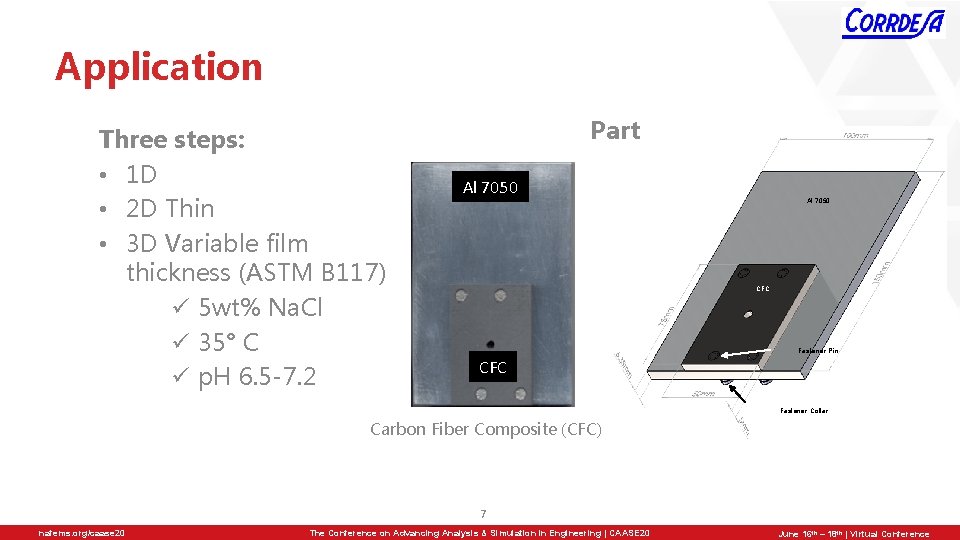
Application Three steps: • 1 D • 2 D Thin • 3 D Variable film thickness (ASTM B 117) ü 5 wt% Na. Cl ü 35° C ü p. H 6. 5 -7. 2 Part Al 7050 CFC Fastener Pin CFC Fastener Collar Carbon Fiber Composite (CFC) 7 nafems. org/caase 20 The Conference on Advancing Analysis & Simulation in Engineering | CAASE 20 June 16 th – 18 th | Virtual Conference
Objectives: 1. Quantify the impact of time and surface preparation on the electrochemical properties of materials. 2. Identify the regions with the strongest galvanic interaction based on the materials provided. 3. Perform a realistic CFD prediction of the ACT ASTM B 117 and measure the impact of constant and variable film thickness. 8 nafems. org/caase 20 The Conference on Advancing Analysis & Simulation in Engineering | CAASE 20 June 16 th – 18 th | Virtual Conference
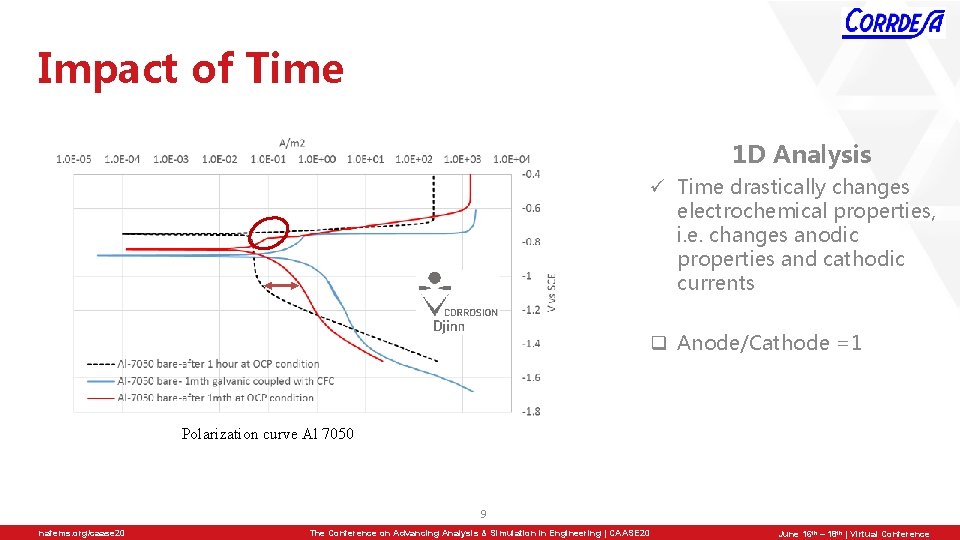
Impact of Time 1 D Analysis ü Time drastically changes electrochemical properties, i. e. changes anodic properties and cathodic currents q Anode/Cathode =1 Polarization curve Al 7050 9 nafems. org/caase 20 The Conference on Advancing Analysis & Simulation in Engineering | CAASE 20 June 16 th – 18 th | Virtual Conference
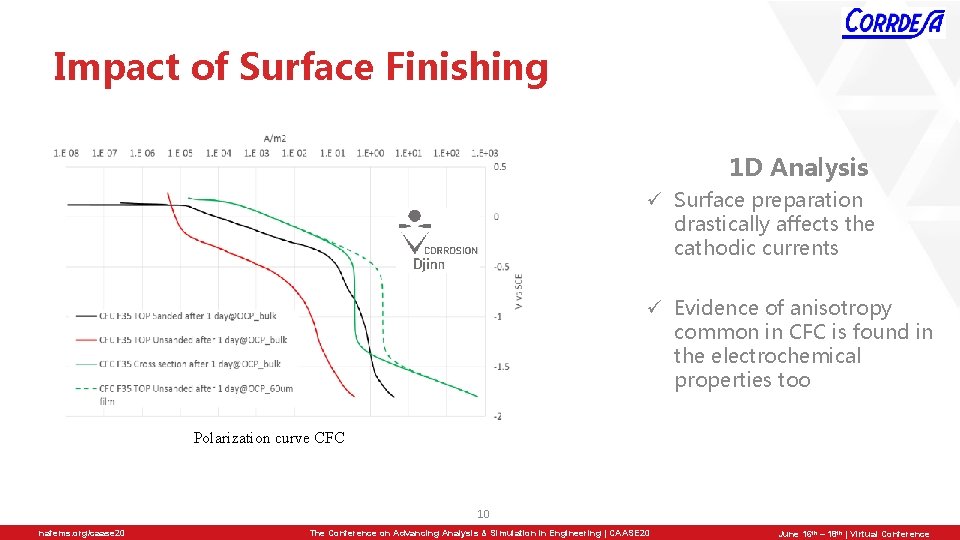
Impact of Surface Finishing 1 D Analysis ü Surface preparation drastically affects the cathodic currents ü Evidence of anisotropy common in CFC is found in the electrochemical properties too Polarization curve CFC 10 nafems. org/caase 20 The Conference on Advancing Analysis & Simulation in Engineering | CAASE 20 June 16 th – 18 th | Virtual Conference
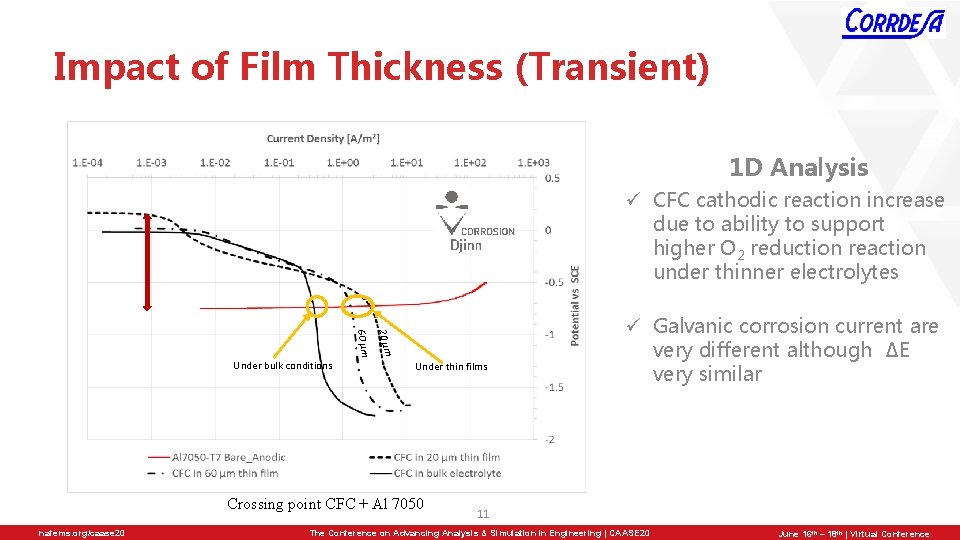
Impact of Film Thickness (Transient) 1 D Analysis ü CFC cathodic reaction increase due to ability to support higher O 2 reduction reaction under thinner electrolytes 20 µm 60 µm Under bulk conditions Under thin films Crossing point CFC + Al 7050 nafems. org/caase 20 ü Galvanic corrosion current are very different although ΔE very similar 11 The Conference on Advancing Analysis & Simulation in Engineering | CAASE 20 June 16 th – 18 th | Virtual Conference
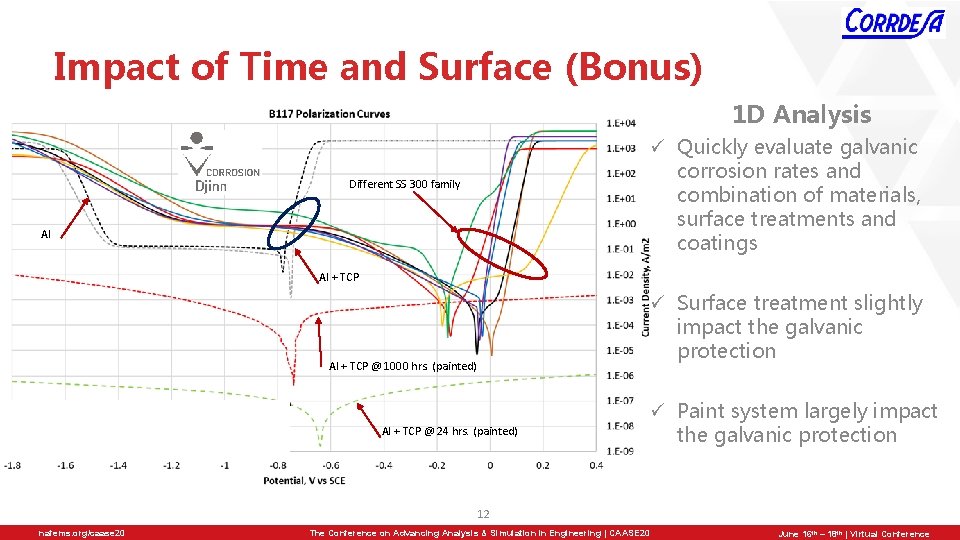
Impact of Time and Surface (Bonus) 1 D Analysis ü Quickly evaluate galvanic corrosion rates and combination of materials, surface treatments and coatings Different SS 300 family Al Al + TCP ü Surface treatment slightly impact the galvanic protection Al + TCP @ 1000 hrs. (painted) Al + TCP @ 24 hrs. (painted) ü Paint system largely impact the galvanic protection 12 nafems. org/caase 20 The Conference on Advancing Analysis & Simulation in Engineering | CAASE 20 June 16 th – 18 th | Virtual Conference
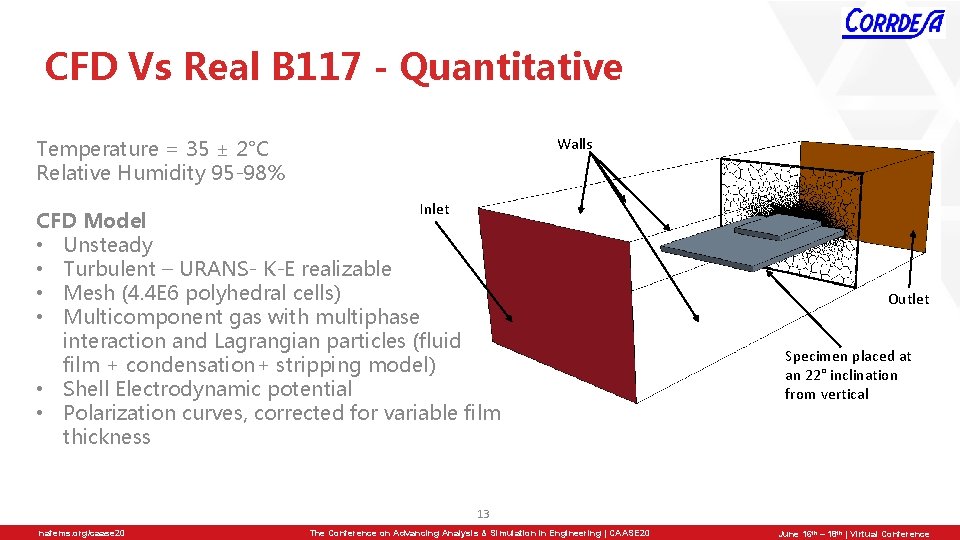
CFD Vs Real B 117 - Quantitative Walls Temperature = 35 ± 2°C Relative Humidity 95 -98% Inlet CFD Model • Unsteady • Turbulent – URANS- K-E realizable • Mesh (4. 4 E 6 polyhedral cells) • Multicomponent gas with multiphase interaction and Lagrangian particles (fluid film + condensation+ stripping model) • Shell Electrodynamic potential • Polarization curves, corrected for variable film thickness Outlet Specimen placed at an 22° inclination from vertical 13 nafems. org/caase 20 The Conference on Advancing Analysis & Simulation in Engineering | CAASE 20 June 16 th – 18 th | Virtual Conference
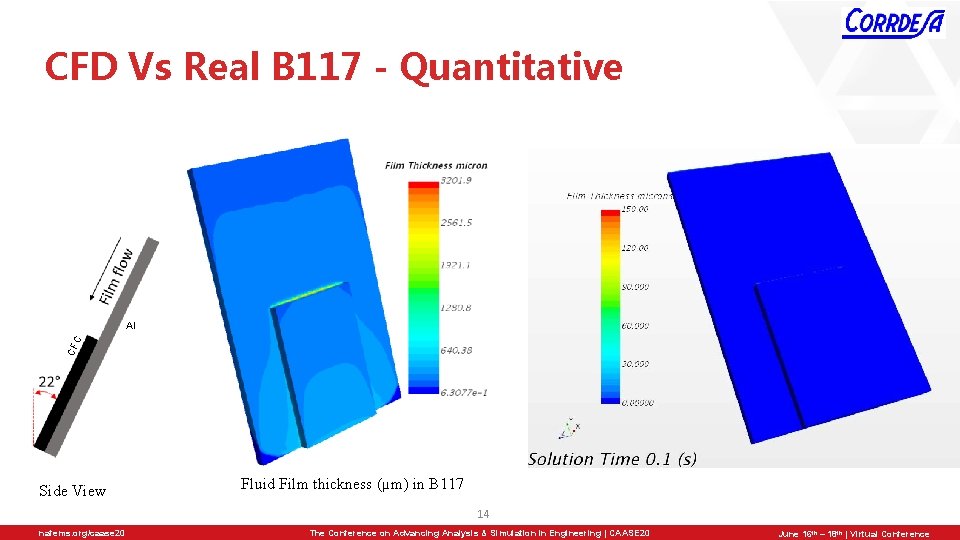
CFD Vs Real B 117 - Quantitative CF C Al Side View Fluid Film thickness (µm) in B 117 14 nafems. org/caase 20 The Conference on Advancing Analysis & Simulation in Engineering | CAASE 20 June 16 th – 18 th | Virtual Conference
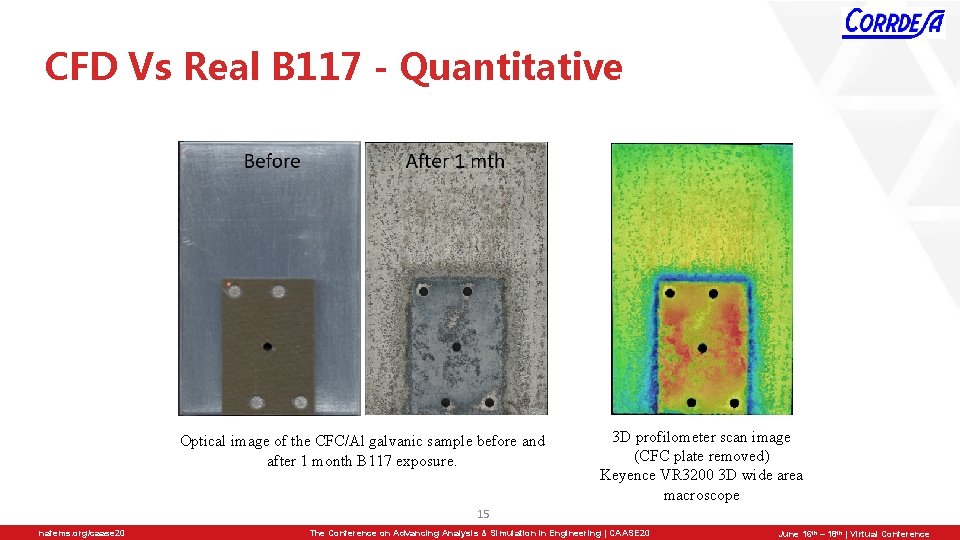
CFD Vs Real B 117 - Quantitative Optical image of the CFC/Al galvanic sample before and after 1 month B 117 exposure. 3 D profilometer scan image (CFC plate removed) Keyence VR 3200 3 D wide area macroscope 15 nafems. org/caase 20 The Conference on Advancing Analysis & Simulation in Engineering | CAASE 20 June 16 th – 18 th | Virtual Conference
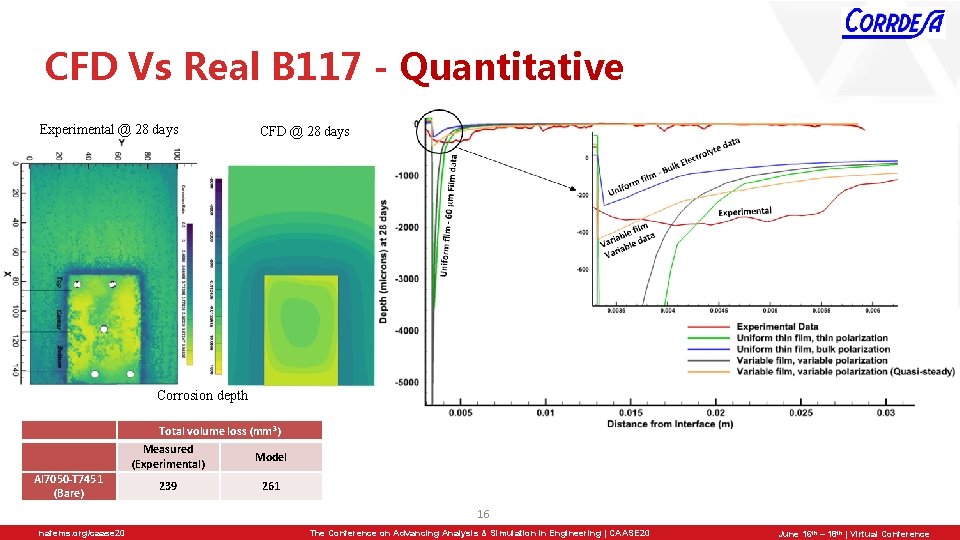
CFD Vs Real B 117 - Quantitative 2527 µm/yr Experimental @ 28 days CFD @ 28 days Corrosion depth Total volume loss (mm 3) Al 7050 -T 7451 (Bare) Measured (Experimental) Model 239 261 16 nafems. org/caase 20 The Conference on Advancing Analysis & Simulation in Engineering | CAASE 20 June 16 th – 18 th | Virtual Conference
Conclusions ü We demonstrated that the 1 D – 2 D and the 3 D approach are all capable of quantitatively measuring the impact of paint systems and surface protection. ü The 1 D provides an accurate and quick means to test and study dozens to hundreds of materials and coatings – simple and fast. ü 2 D demonstrates the importance of considering the actual Anode/Cathode ratio, still, it can underpredict the true corrosion rates. ü The CFD solution captured the regions with the strongest galvanic interaction and its prediction closely matched B 117 corrosion measurements. ü Numerical simulations (2 D and 3 D) are as good as the boundary conditions. The upcoming MIL-STD 889 D provides the standard procedures to get the polarization curves. ü We successfully replicated the B 117 test using Multiphysics CFD tool. While the volume loss matched very well the spatial distribution of the corrosion depth showed important discrepancies. To alleviate these, we plan: ü Consider the change in the profile of the electrolyte using morphing mesh. 17 nafems. org/caase 20 The Conference on Advancing Analysis & Simulation in Engineering | CAASE 20 June 16 th – 18 th | Virtual Conference
Thank You! Dr. Alan Rose: arose@corrdesa. com 1346 +1 770 -328 - 18 nafems. org/caase 20 The Conference on Advancing Analysis & Simulation in Engineering | CAASE 20 June 16 th – 18 th | Virtual Conference