
Corridors and Superelevations Trimble Business Center v 5
Corridors and Superelevations Trimble Business Center v 5. 0 Training Last Updated – November 2018
Superelevation Terms § § – – Normal Cross Slope – The standard cross slope for a road in a straight section i. e. no curvature e. g. -2% – The cross slope at the peak of superelevation in the curve e. g. 6% – – The distance over which the normal cross slope e. g. -2% changes to a 0% cross slope Is normally taken out in the straight or tangent section preceding or succeeding the curve section – – – The distance over which the cross slope changes from 0% to the maximum superelevation Normally occurs through the spiral section leading into the Arc section of the road Where no spiral exists i. e. in a straight – arc – straight combination, user will define how much of the runoff length will occur in the Arc or Curve section as a percentage of the total runoff. i. e. for a 0% to 6% superelevation change, if user enters 50% in the curve, then -2 to +3% will be in the straight section and +3 to +6% will be in the Arc or Curve section Maximum Superelevation Runout and Runout Distance Runoff and Runoff Distance Compound Maximum – The distance between superelevation elements on adjacent curves in the same direction (right or left) beneath which the current super will merge into a single compound superelevation with the previous super (stops the road repeatedly changing cross slope) (basically maintains the super elevation over a longer distance filling the gap between supers) (Note: Looks back to previous curve). Note measured from End of Super to start of Super Reverse Maximum – The distance between superelevation elements on adjacent curves which reverse direction (right to left etc. ) beneath which the current super will merge into a single transition to the previous super (basically reduces the rate of change of slope through the area between curves) (Note: Looks back to previous curve)

Superelevation With Spirals Max Superelevation Runoff 5 Runoff Runout Normal Cross Slope 4 3 2 1 4 2 5 3 1

Superelevations With Arcs Only Max Superelevation Runoff 5 Runoff Runout Normal Cross Slope 4 4 2 3 3 5 1 2 1 Note: Runout is always in Straight Section Note: Runoff is 50% in Straight and 50% in Curve Section Note: The Percentage of Runoff in the Curve Varies
Notes on Superelevations In Arcs § For superelevations through Arc only sections – All runout (e. g. -2% to 0%) will be in the straight or tangent section. – Additionally a % of the runoff (e. g. 0% to 6%) will also be in the straight section § Typically 66% of the superelevation will be in the straight or tangent section and 33% in the arc itself. In this scenario -2% to +4% would be in tangent and +4% to +6% in the arc. § Different Designers / Regions use different split ratios so it does vary from locale to locale how this is managed
Notes on Superelevations § In Divided Highways the pivot point is typically the inner (i. e. median) edge of pavement on both highway sections

Pivot Location Options § Centerline § Inside edge of pavement on divided highways § Outside edge of pavement on inside of curve (Right Curve Shown) § Outside edge of pavement on outside of curve (Right Curve Shown)
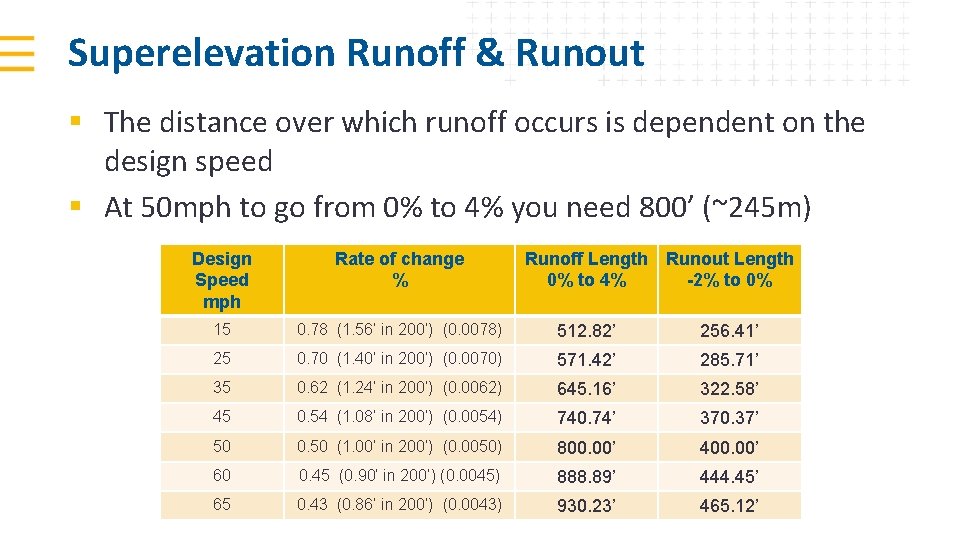
Superelevation Runoff & Runout § The distance over which runoff occurs is dependent on the design speed § At 50 mph to go from 0% to 4% you need 800’ (~245 m) Design Speed mph Rate of change % Runoff Length 0% to 4% Runout Length -2% to 0% 15 0. 78 (1. 56’ in 200’) (0. 0078) 512. 82’ 256. 41’ 25 0. 70 (1. 40’ in 200’) (0. 0070) 571. 42’ 285. 71’ 35 0. 62 (1. 24’ in 200’) (0. 0062) 645. 16’ 322. 58’ 45 0. 54 (1. 08’ in 200’) (0. 0054) 740. 74’ 370. 37’ 50 0. 50 (1. 00’ in 200’) (0. 0050) 800. 00’ 400. 00’ 60 0. 45 (0. 90’ in 200’) (0. 0045) 888. 89’ 444. 45’ 65 0. 43 (0. 86’ in 200’) (0. 0043) 930. 23’ 465. 12’
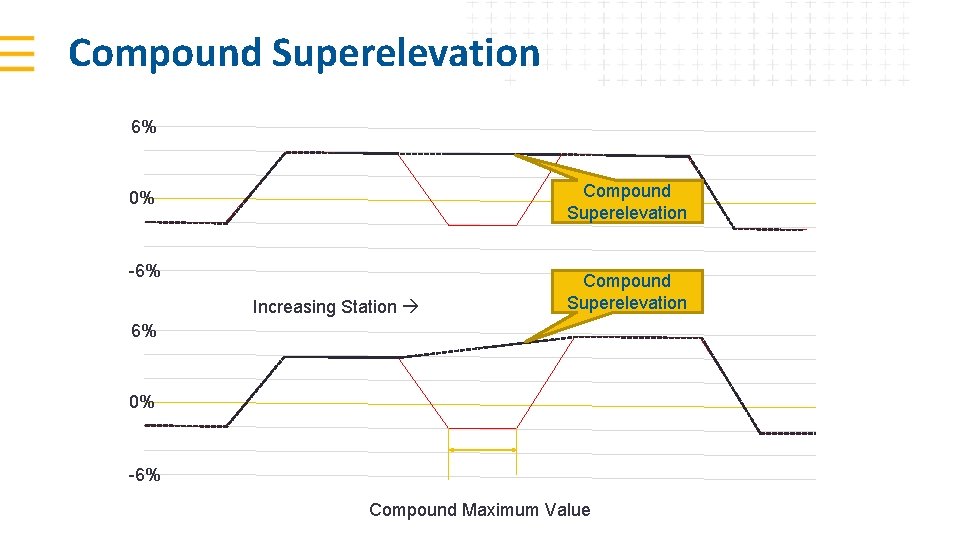
Compound Superelevation 6% Compound Superelevation 0% -6% Increasing Station Compound Superelevation 6% 0% -6% Compound Maximum Value

Reverse Superelevations Reverse Superelevation 6% 0% -6% Reverse Value Increasing Station
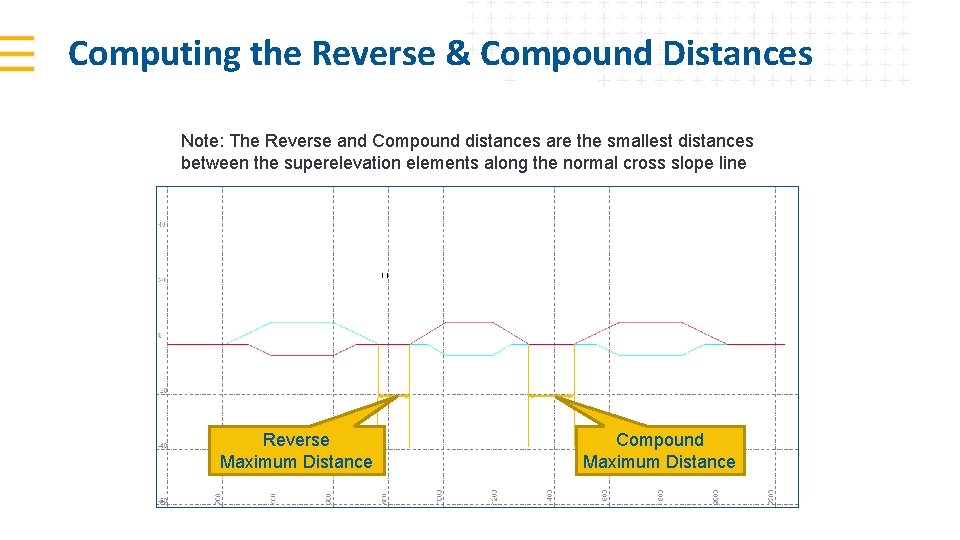
Computing the Reverse & Compound Distances Note: The Reverse and Compound distances are the smallest distances between the superelevation elements along the normal cross slope line Reverse Maximum Distance Compound Maximum Distance
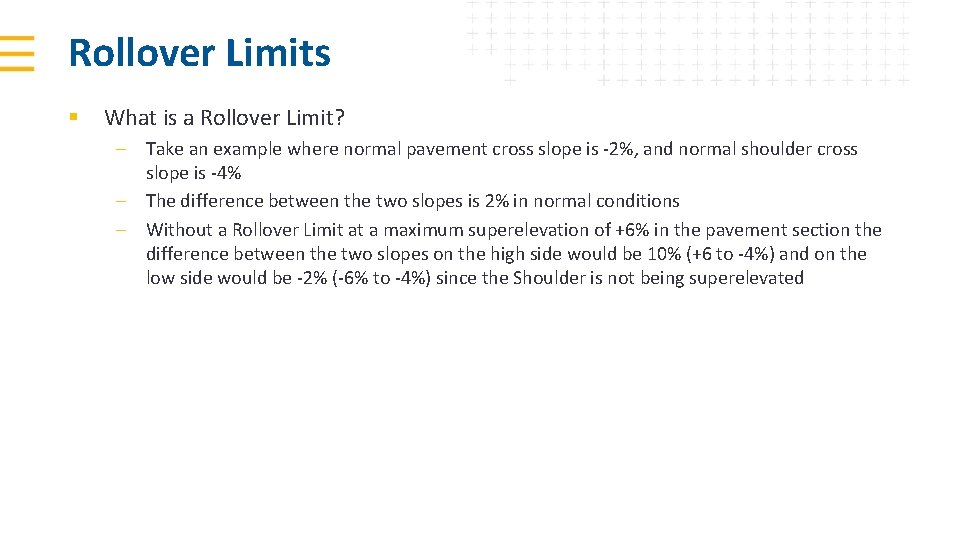
Rollover Limits § What is a Rollover Limit? – Take an example where normal pavement cross slope is -2%, and normal shoulder cross slope is -4% – The difference between the two slopes is 2% in normal conditions – Without a Rollover Limit at a maximum superelevation of +6% in the pavement section the difference between the two slopes on the high side would be 10% (+6 to -4%) and on the low side would be -2% (-6% to -4%) since the Shoulder is not being superelevated
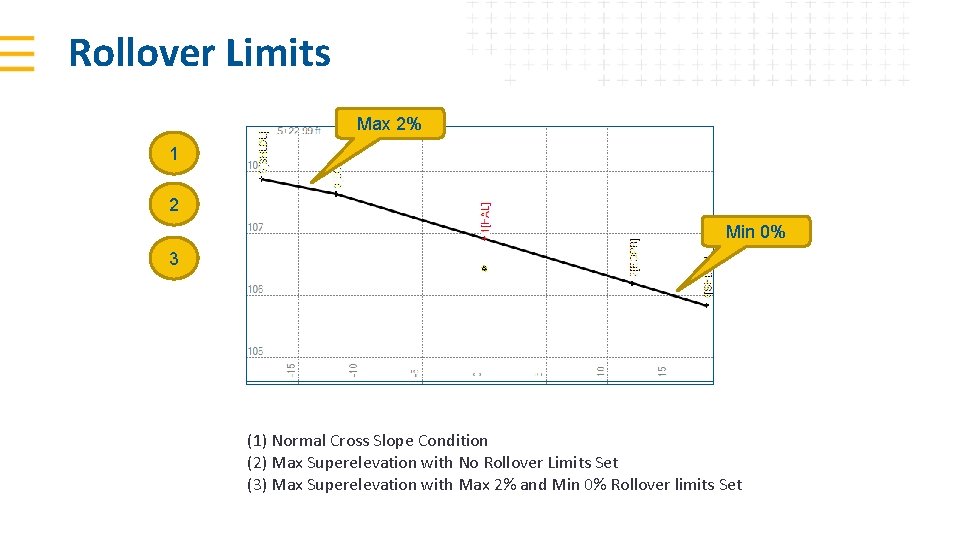
Rollover Limits Max 2% 1 2 Min 0% 3 (1) Normal Cross Slope Condition (2) Max Superelevation with No Rollover Limits Set (3) Max Superelevation with Max 2% and Min 0% Rollover limits Set
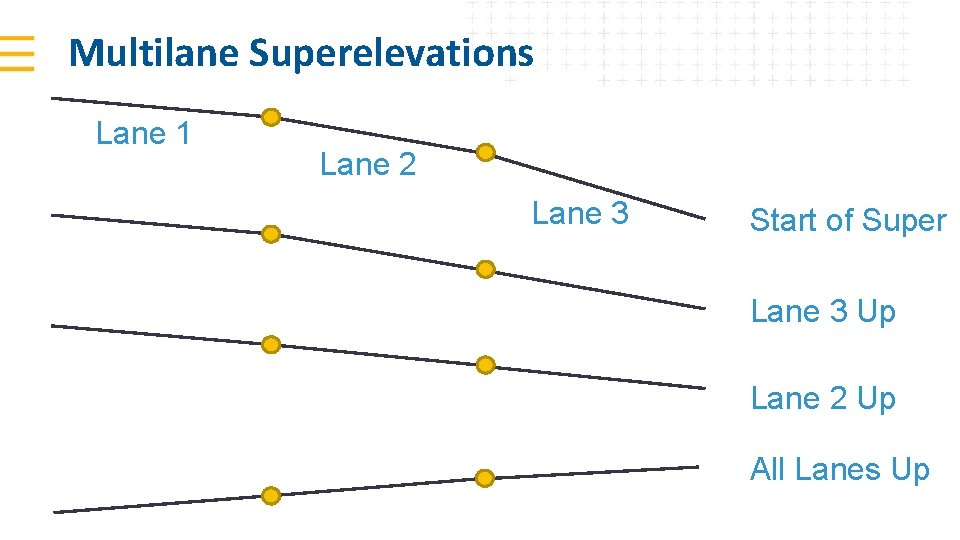
Multilane Superelevations Lane 1 Lane 2 Lane 3 Start of Super Lane 3 Up Lane 2 Up All Lanes Up

Managing Superelevations in TBC v 5. 0 § § § § Create the Alignment – HAL and VAL Create the Superelevation on the Alignment (this defines the parameters of the superelevation. In itself it does nothing to the corridor model Create the Corridor Model and define the first Template Create the Pavement Instructions first – those elements on Left and Right side that are affected by Superelevation Create a Superelevation instruction for the Left and Right combined or one for the Left and one for the Right if separate controls required. Define the Pivot Node (from the nodes above the super instruction). Define the Affected Nodes (from the nodes above the super instruction). Define The Shoulder Element instructions Left and Right and at center if a Median Island is present On the Shoulder Element instructions define the Rollover Parameters to manage the maximum rollovers through a Superelevation
Superelevation vs Slope Tables § Many Superelevations can be managed using instruction slope tables or shareable slope tables – sometimes the data provided makes this an easier approach § Superelevations where the pivot node is on the outside or Inside of the Curve cannot be handled using Slope Tables because through the Super, the centerline pivots higher than the vertical alignment

Helping Yourself Going Forwards § Questions, Answers and Learning Tools – Trimble Community Forum – Civil Construction – BC-HCE Community – https: //community. trimble. com/community/find-answers/civilengineering-and-construction § Training Classes on Video (PC & Mobile Device) – Trimble Library – https: //trimble. retrieve. com/#/ – Some free classes – some paid for classes
Thank You To Contact Me alan_sharp@trimble. com Use The Forum To Ask Questions On Line – We Will Answer As Fast As Possible – This develops the entire TBC User Community
- Slides: 18