
Correspondence Matching feature points We know how to

![Rotation Invariance by Orientation [Lowe, SIFT, 1999] Normalization • Compute orientation histogram • Select](https://slidetodoc.com/presentation_image_h2/e0fc436574ce9d4327ac9eb15a1609f9/image-29.jpg "Rotation Invariance by Orientation [Lowe, SIFT, 1999] Normalization • Compute orientation histogram • Select")
- Slides: 57
Correspondence
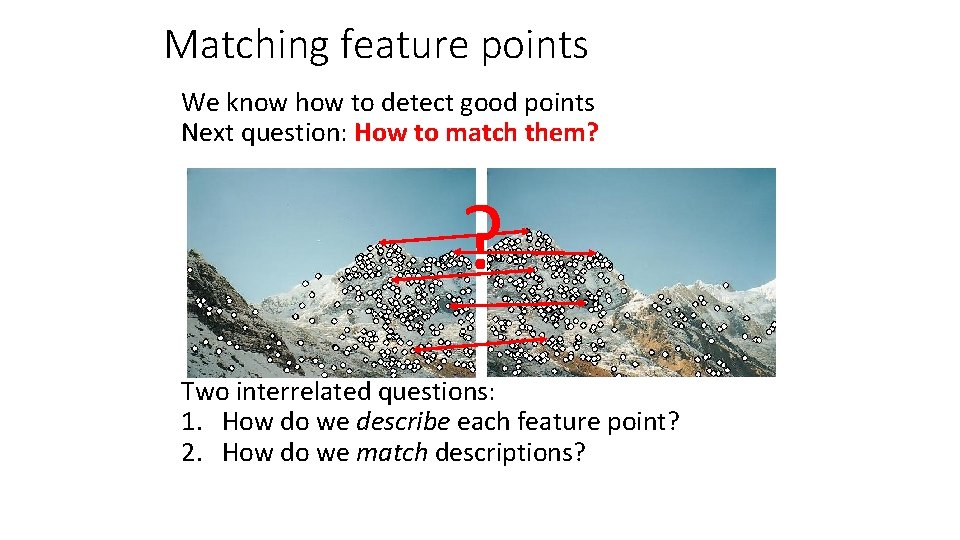
Matching feature points We know how to detect good points Next question: How to match them? ? Two interrelated questions: 1. How do we describe each feature point? 2. How do we match descriptions?
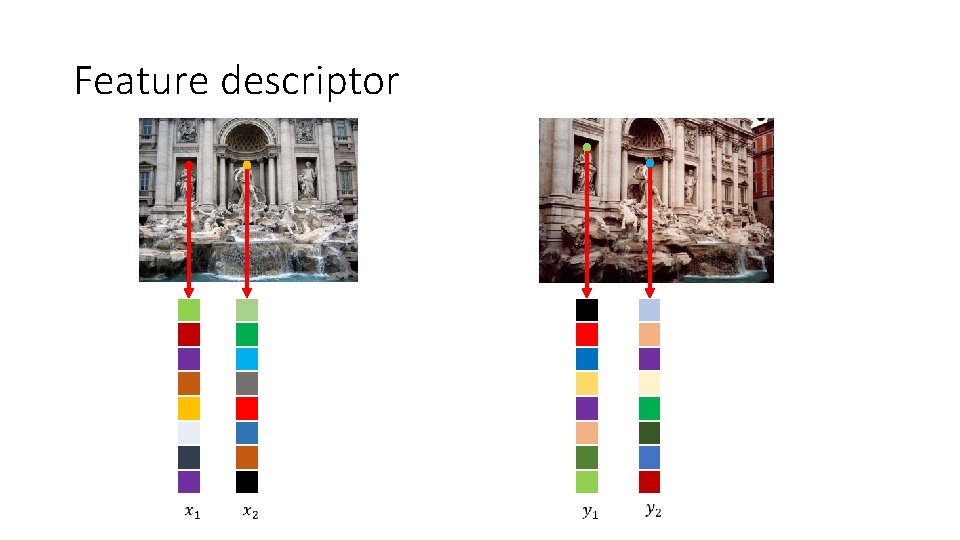
Feature descriptor
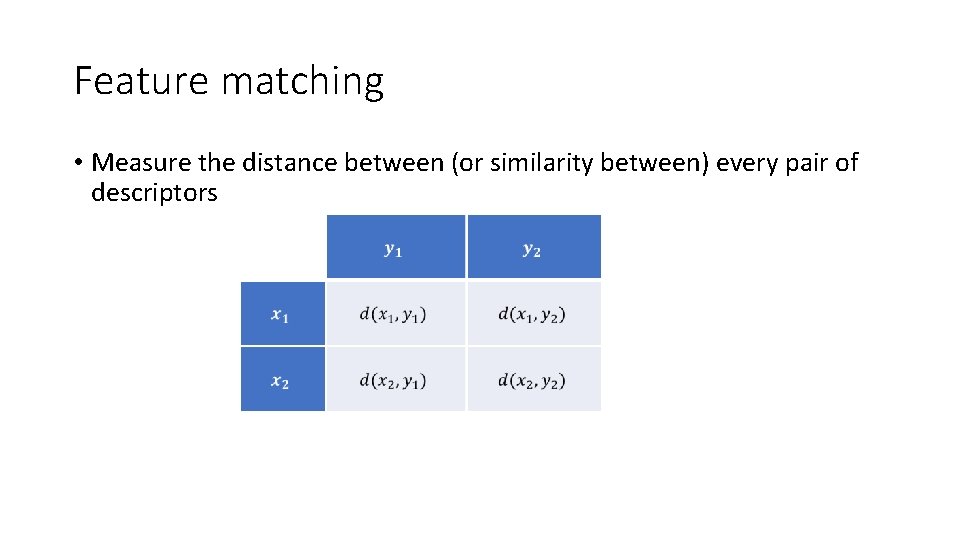
Feature matching • Measure the distance between (or similarity between) every pair of descriptors
Invariance vs. discriminability • Invariance: • Distance between descriptors should be small even if image is transformed • Discriminability: • Descriptor should be highly unique for each point (far away from other points in the image)
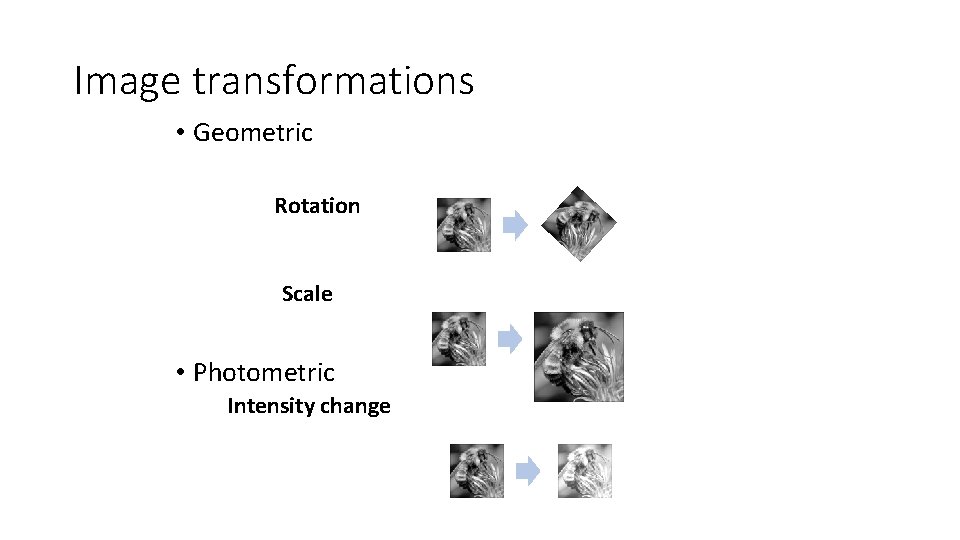
Image transformations • Geometric Rotation Scale • Photometric Intensity change
Invariance • Most feature descriptors are designed to be invariant to • Translation, 2 D rotation, scale • They can usually also handle • Limited 3 D rotations (SIFT works up to about 60 degrees) • Limited affine transformations (some are fully affine invariant) • Limited illumination/contrast changes
How to achieve invariance Design an invariant feature descriptor • Simplest descriptor: a single 0 • What’s this invariant to? • Is this discriminative? • Next simplest descriptor: a single pixel • What’s this invariant to? • Is this discriminative?
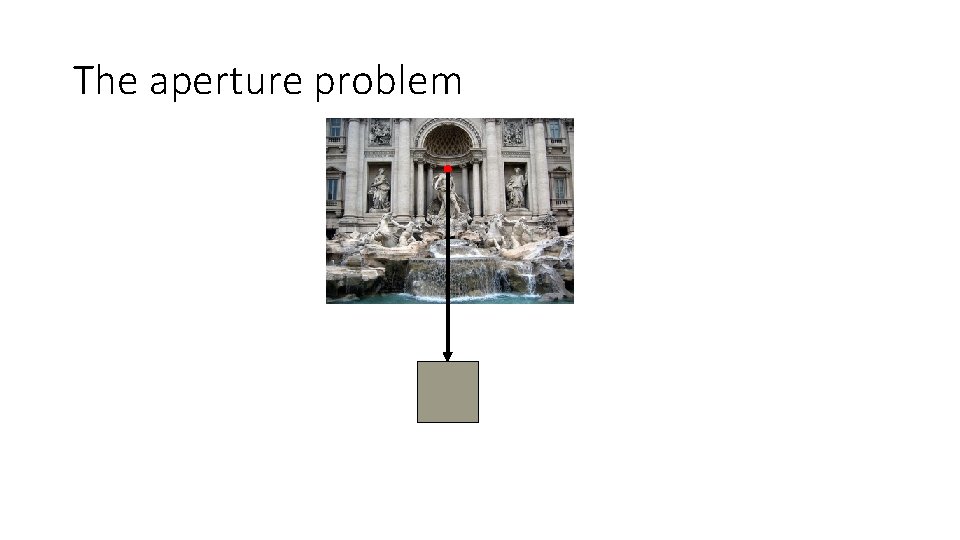
The aperture problem
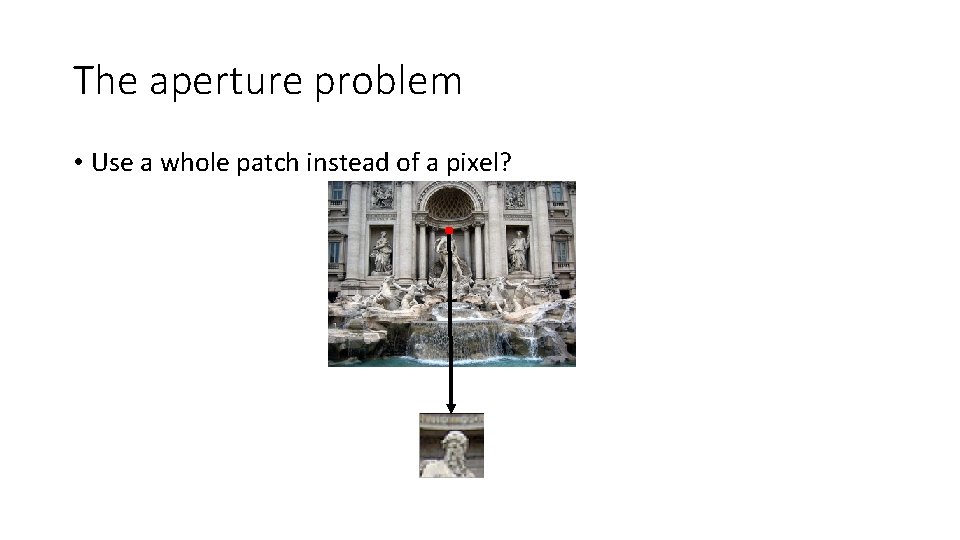
The aperture problem • Use a whole patch instead of a pixel?
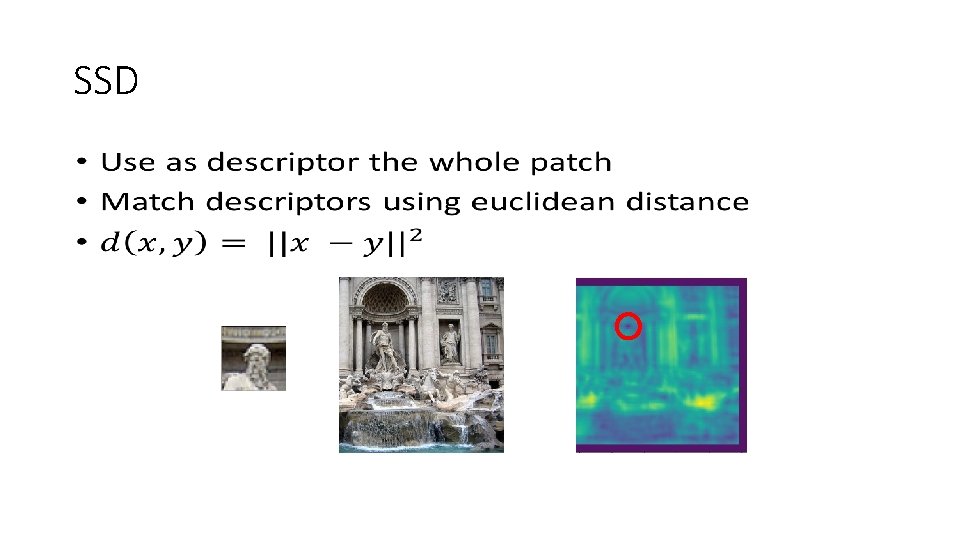
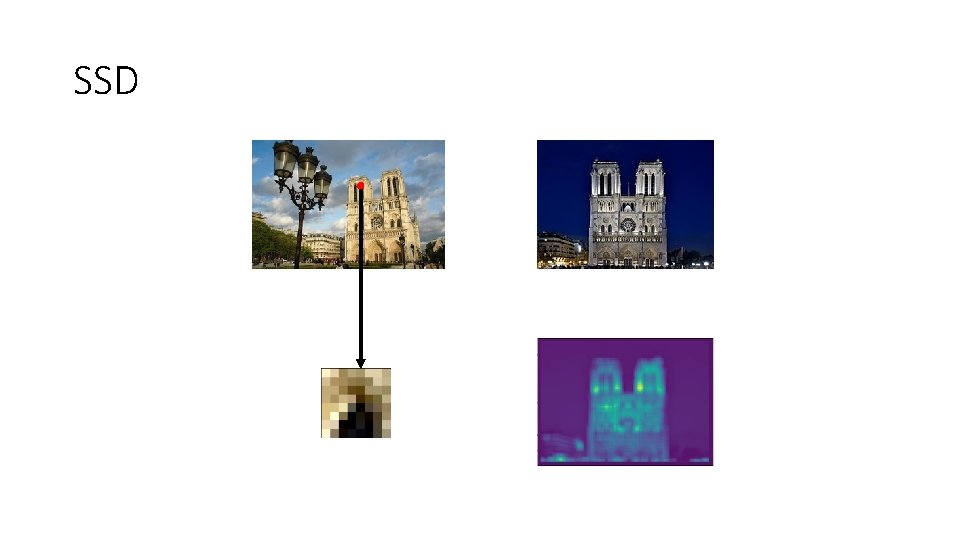
SSD •
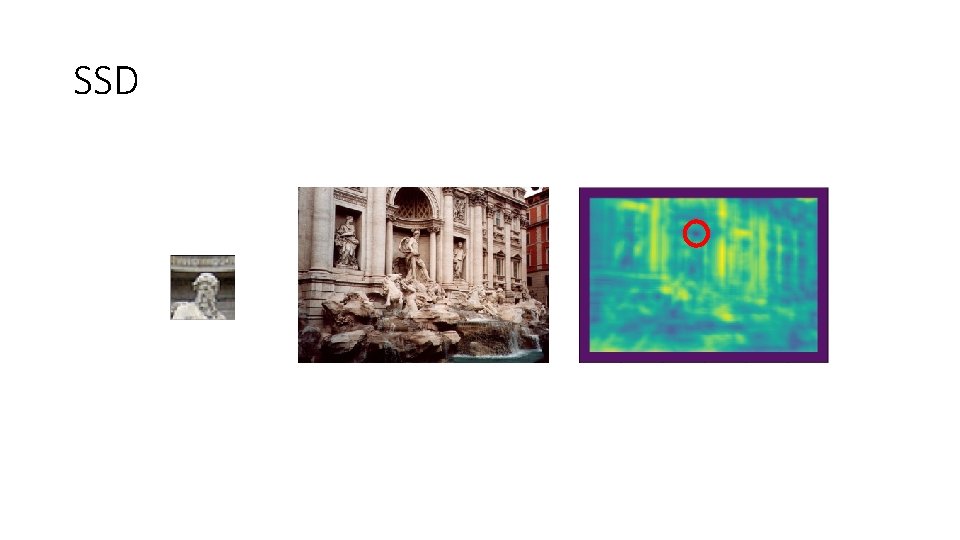
SSD
SSD
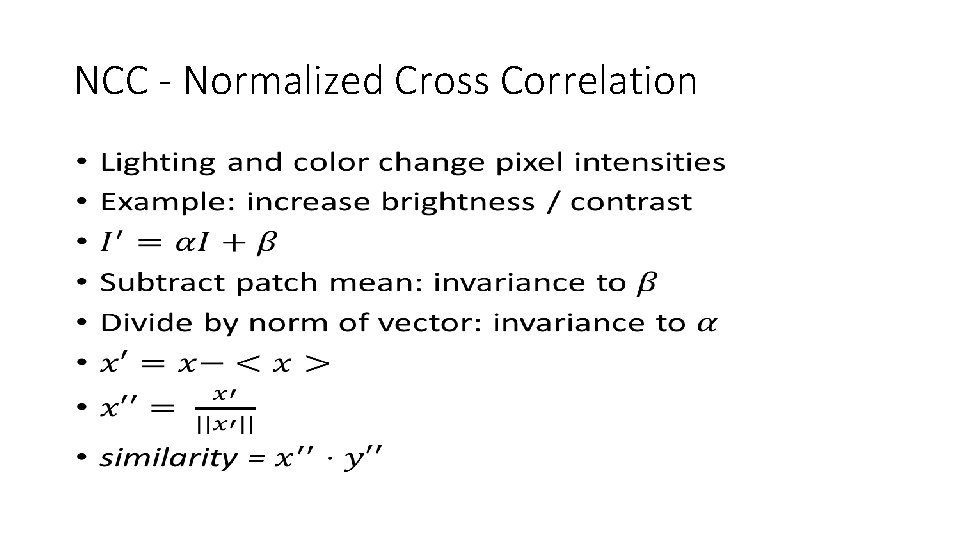
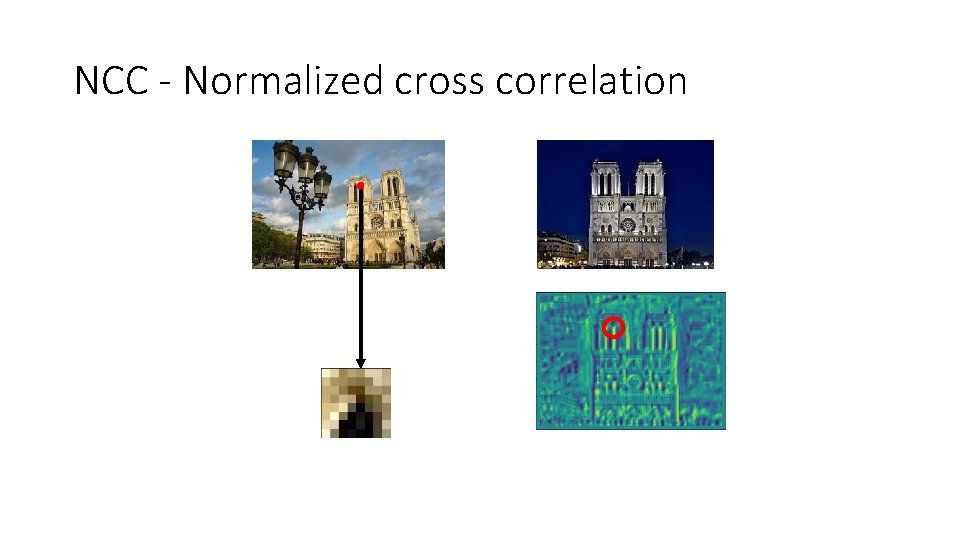
NCC - Normalized Cross Correlation •
NCC - Normalized cross correlation
Basic correspondence • Image patch as descriptor, NCC as similarity • Invariant to? • Photometric transformations? • Translation? • Rotation?
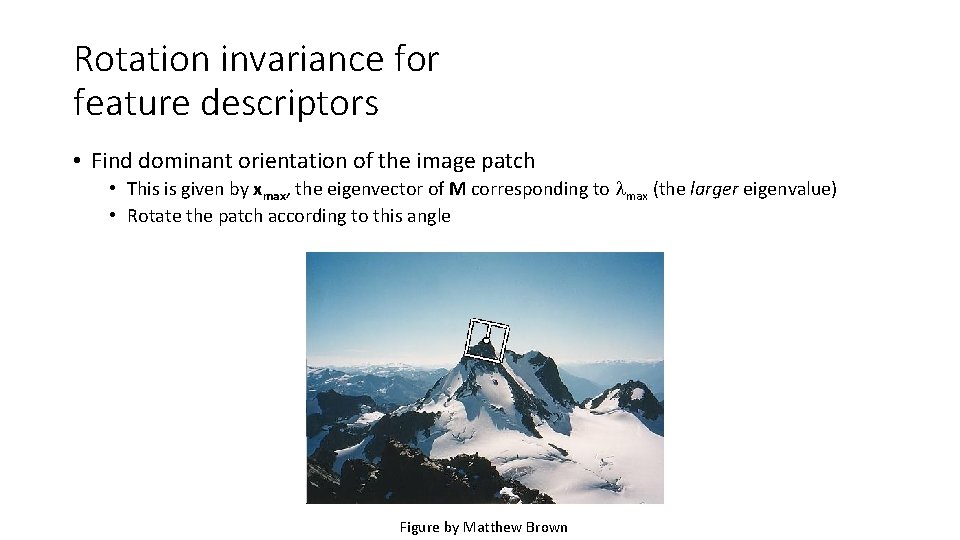
Rotation invariance for feature descriptors • Find dominant orientation of the image patch • This is given by xmax, the eigenvector of M corresponding to max (the larger eigenvalue) • Rotate the patch according to this angle Figure by Matthew Brown
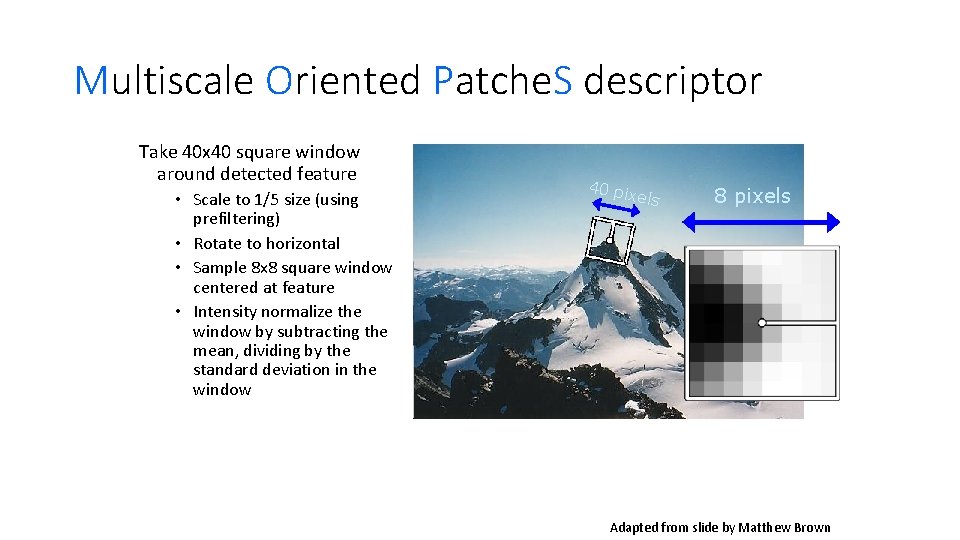
Multiscale Oriented Patche. S descriptor Take 40 x 40 square window around detected feature • Scale to 1/5 size (using prefiltering) • Rotate to horizontal • Sample 8 x 8 square window centered at feature • Intensity normalize the window by subtracting the mean, dividing by the standard deviation in the window 40 pi xels 8 pixels CSE 576: Computer Vision Adapted from slide by Matthew Brown
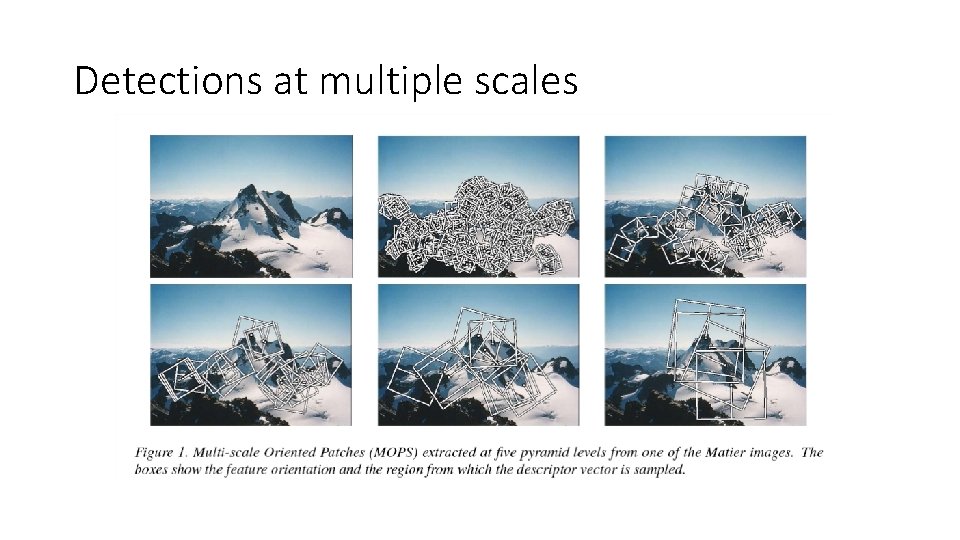
Detections at multiple scales
Invariance of MOPS • Intensity • Scale • Rotation
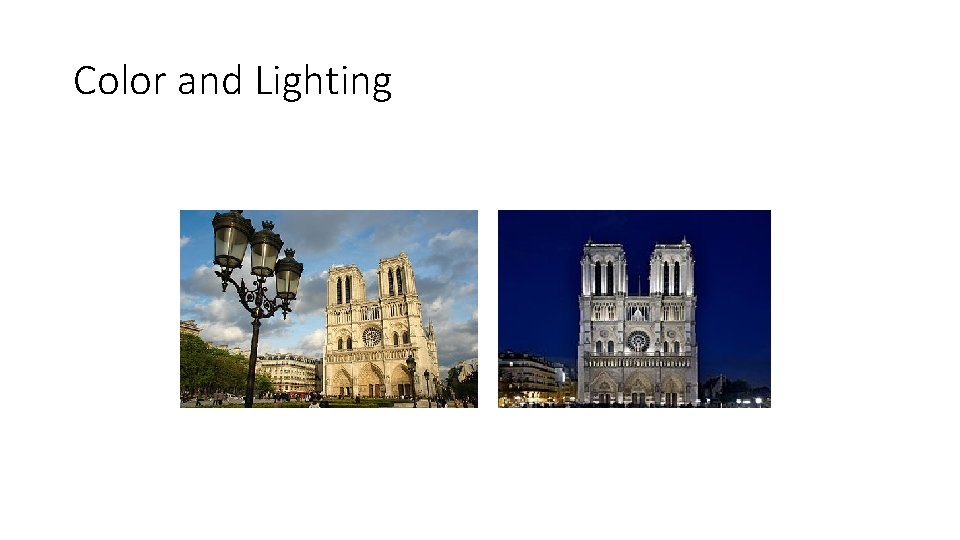
Color and Lighting
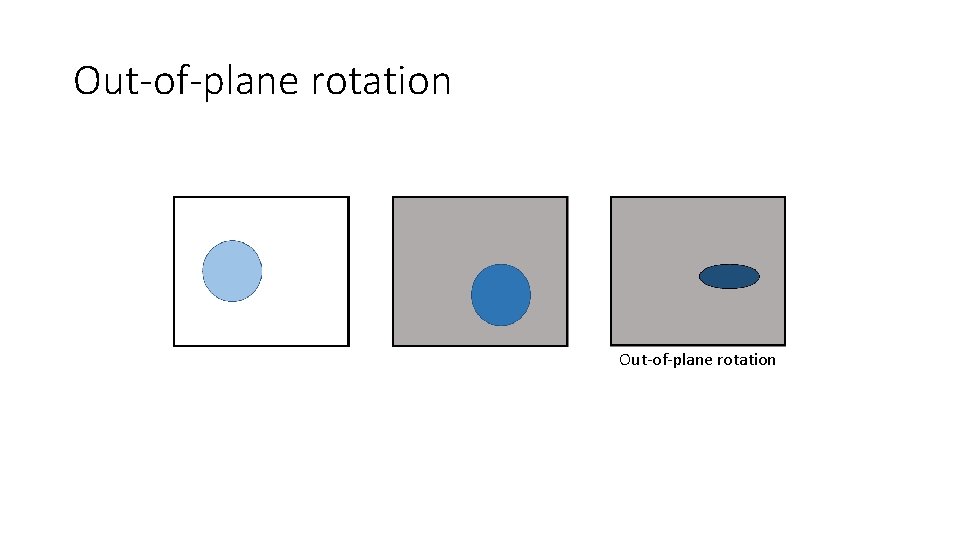
Out-of-plane rotation
Discussion
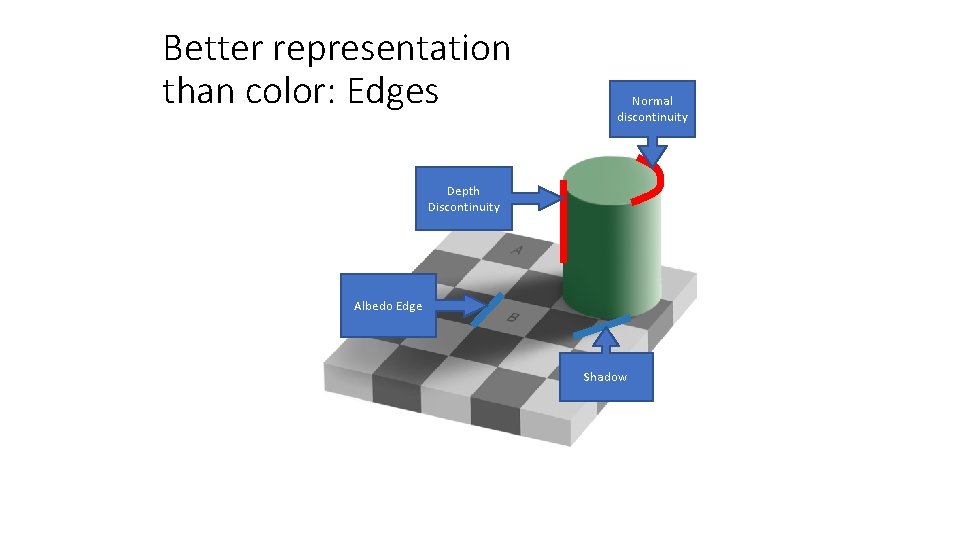
Better representation than color: Edges Normal discontinuity Depth Discontinuity Albedo Edge Shadow
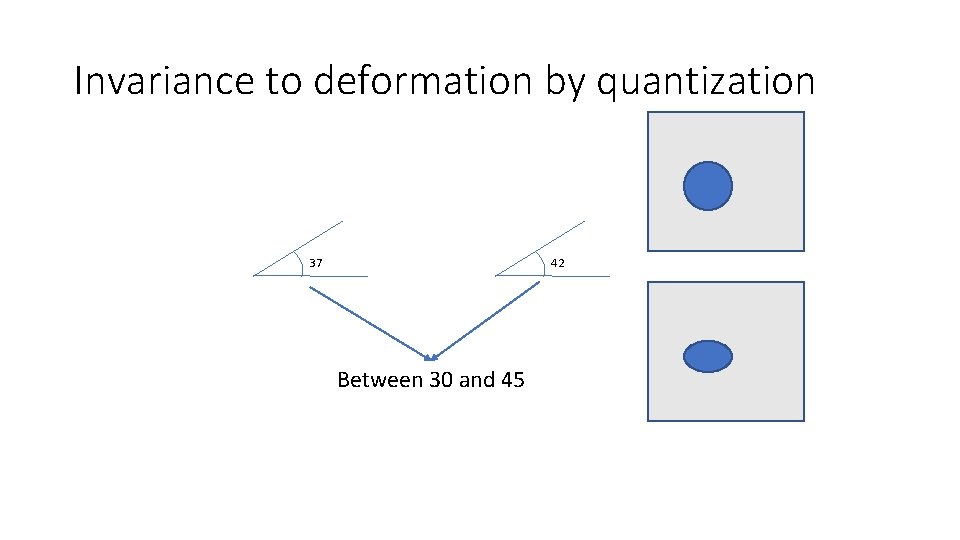
Towards a better feature descriptor • Match pattern of edges • Edge orientation – clue to shape • Be resilient to small deformations • Deformations might move pixels around, but slightly • Deformations might change edge orientations, but slightly
Invariance to deformation by quantization 37 42 Between 30 and 45
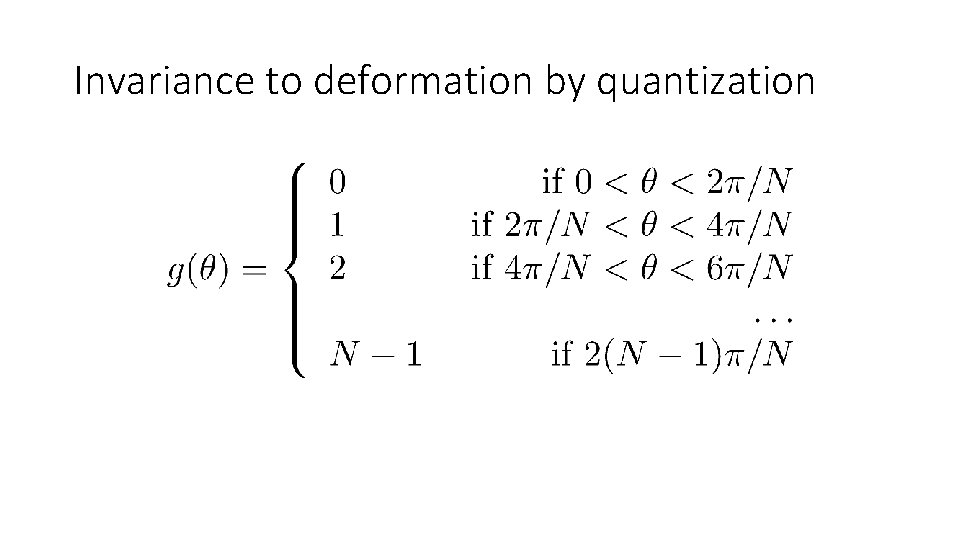
Invariance to deformation by quantization
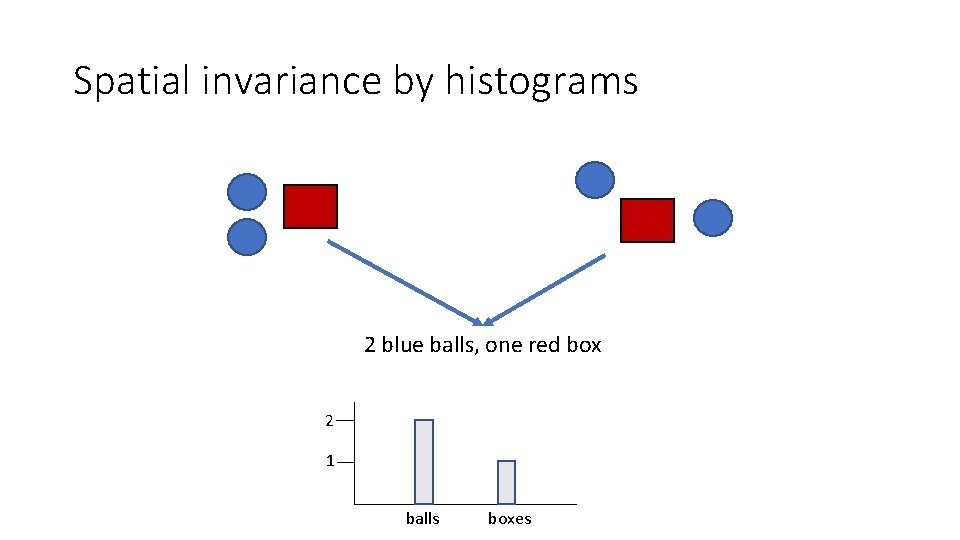
Spatial invariance by histograms 2 blue balls, one red box 2 1 balls boxes
Rotation Invariance by Orientation [Lowe, SIFT, 1999] Normalization • Compute orientation histogram • Select dominant orientation • Normalize: rotate to fixed orientation 0 T. Tuytelaars, B. Leibe 2
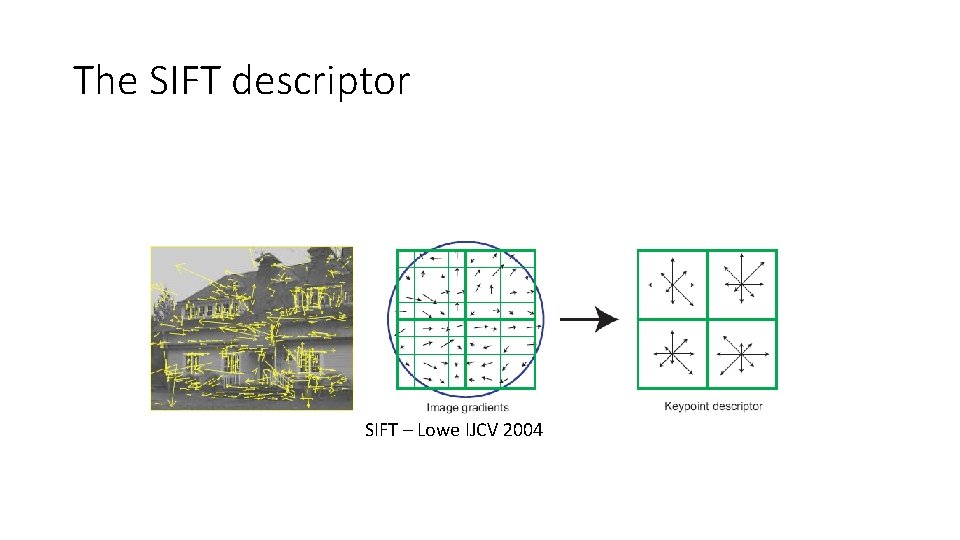
The SIFT descriptor SIFT – Lowe IJCV 2004
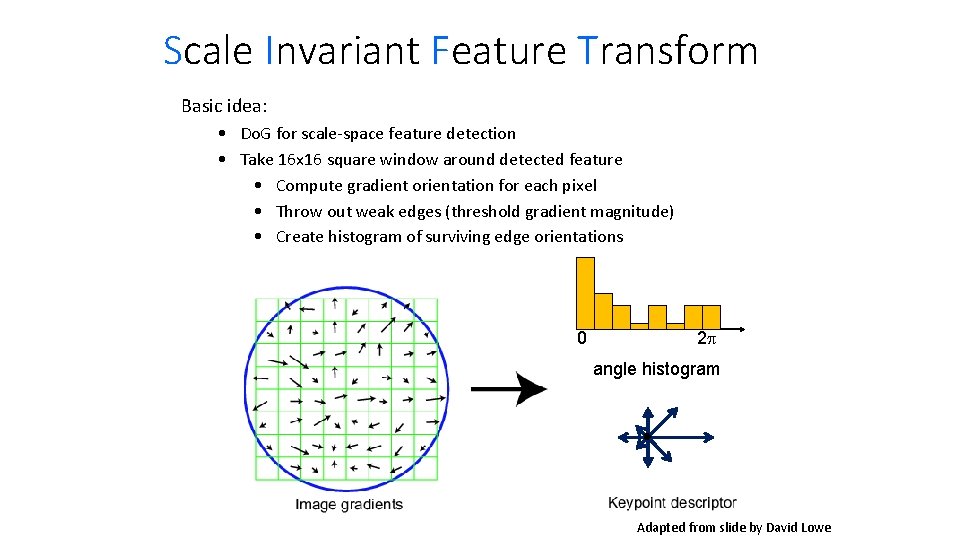
Scale Invariant Feature Transform Basic idea: • Do. G for scale-space feature detection • Take 16 x 16 square window around detected feature • Compute gradient orientation for each pixel • Throw out weak edges (threshold gradient magnitude) • Create histogram of surviving edge orientations 0 2 angle histogram Adapted from slide by David Lowe
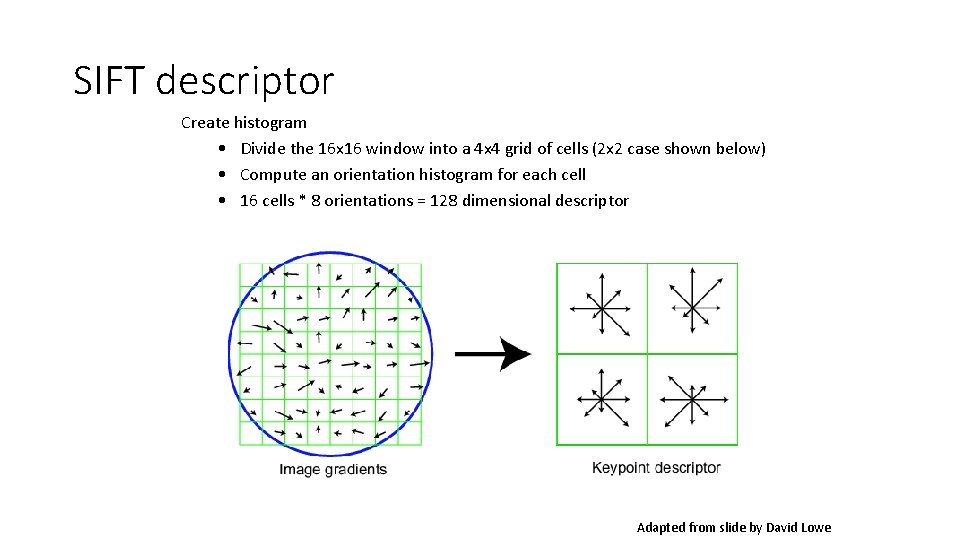
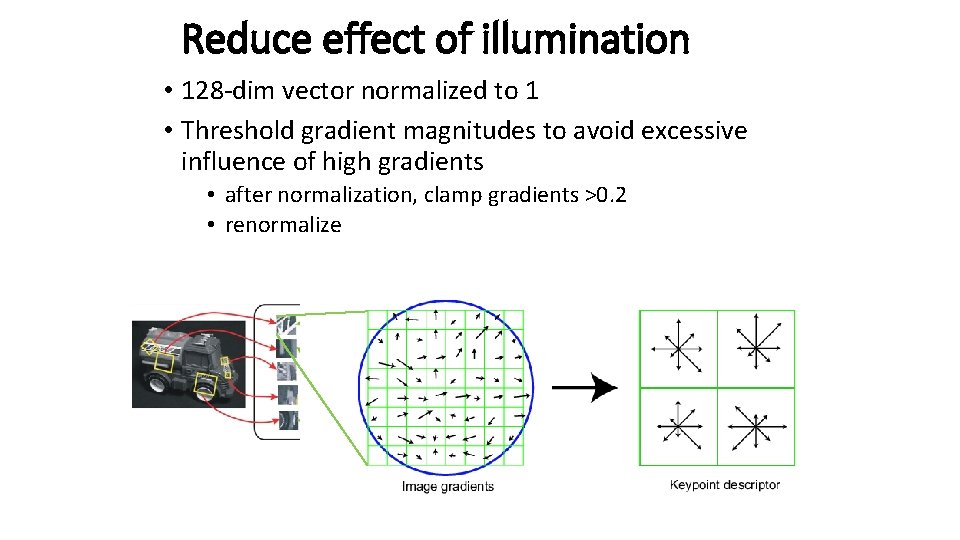
SIFT descriptor Create histogram • Divide the 16 x 16 window into a 4 x 4 grid of cells (2 x 2 case shown below) • Compute an orientation histogram for each cell • 16 cells * 8 orientations = 128 dimensional descriptor Adapted from slide by David Lowe
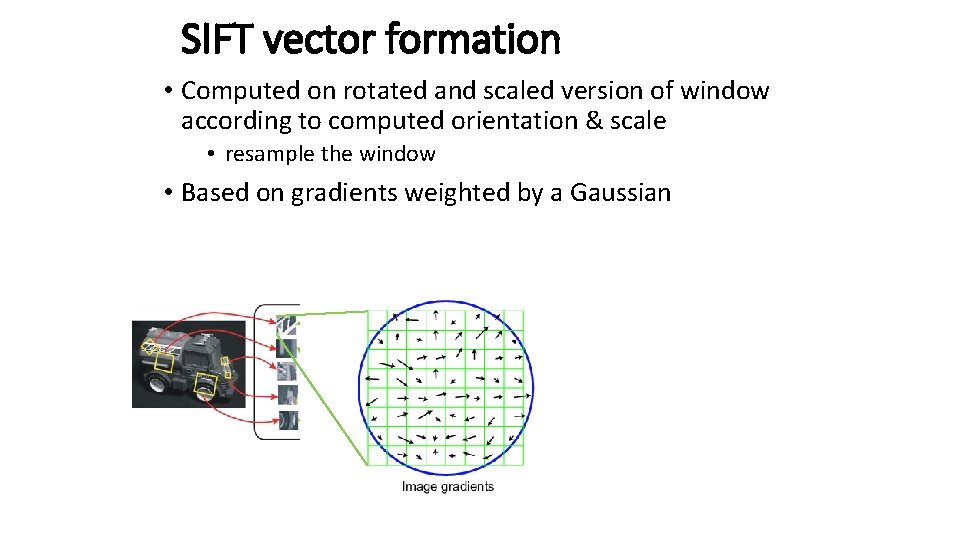
SIFT vector formation • Computed on rotated and scaled version of window according to computed orientation & scale • resample the window • Based on gradients weighted by a Gaussian
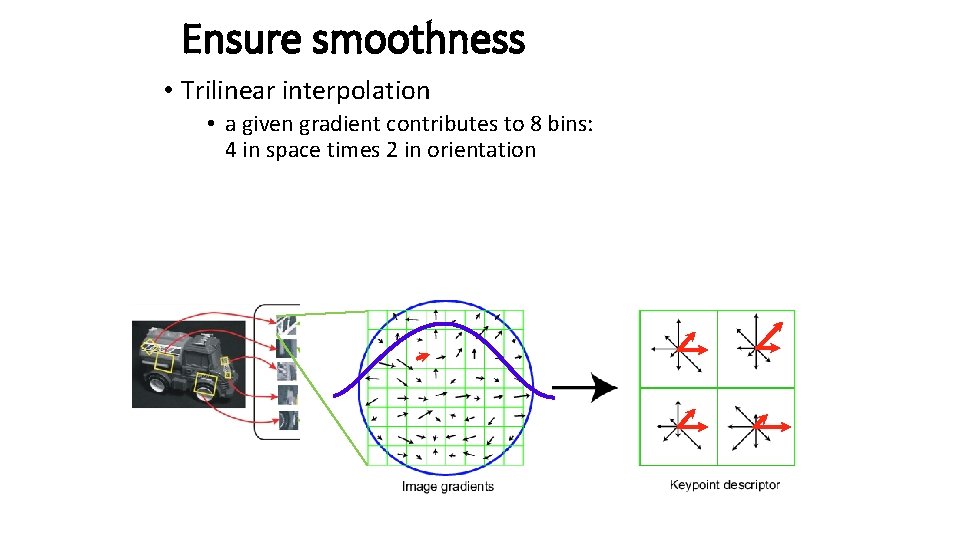
Ensure smoothness • Trilinear interpolation • a given gradient contributes to 8 bins: 4 in space times 2 in orientation
Reduce effect of illumination • 128 -dim vector normalized to 1 • Threshold gradient magnitudes to avoid excessive influence of high gradients • after normalization, clamp gradients >0. 2 • renormalize
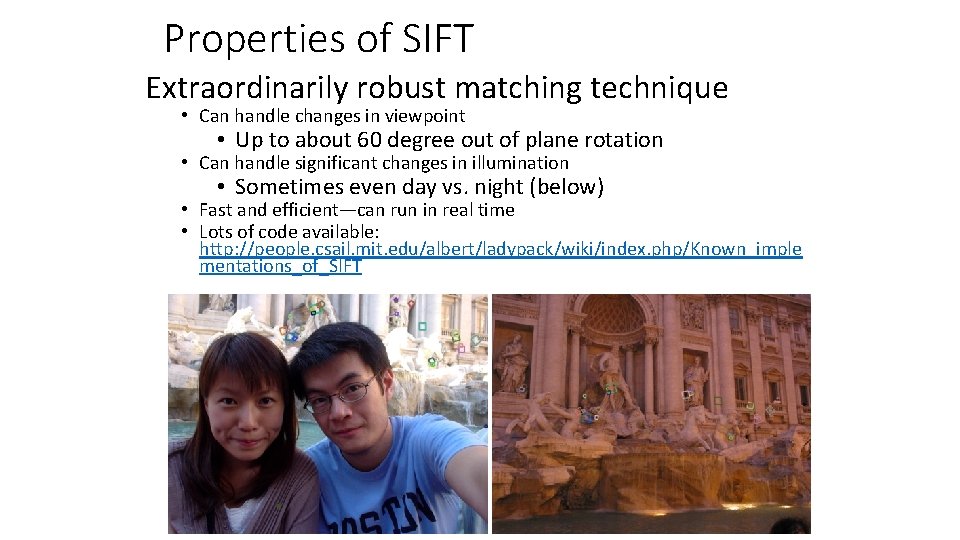
Properties of SIFT Extraordinarily robust matching technique • Can handle changes in viewpoint • Up to about 60 degree out of plane rotation • Can handle significant changes in illumination • Sometimes even day vs. night (below) • Fast and efficient—can run in real time • Lots of code available: http: //people. csail. mit. edu/albert/ladypack/wiki/index. php/Known_imple mentations_of_SIFT
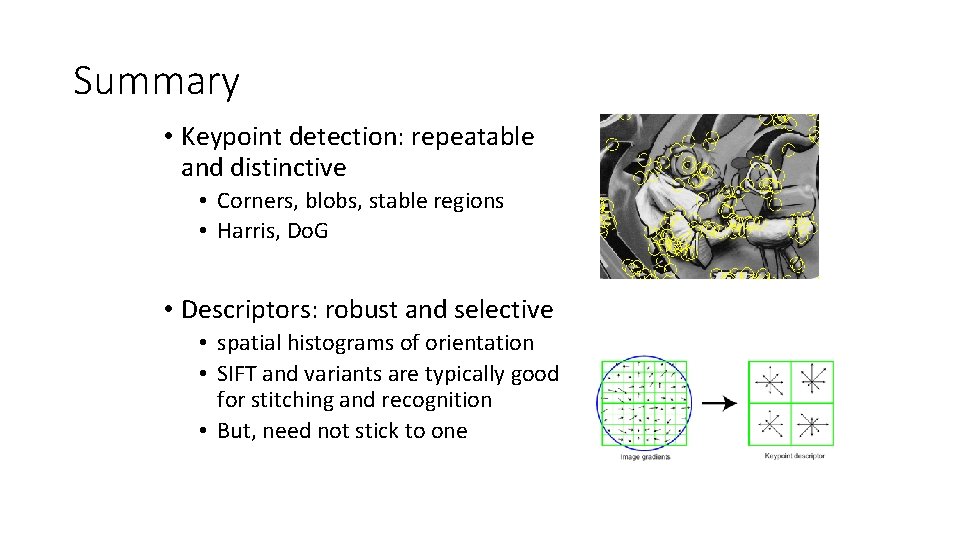
Summary • Keypoint detection: repeatable and distinctive • Corners, blobs, stable regions • Harris, Do. G • Descriptors: robust and selective • spatial histograms of orientation • SIFT and variants are typically good for stitching and recognition • But, need not stick to one
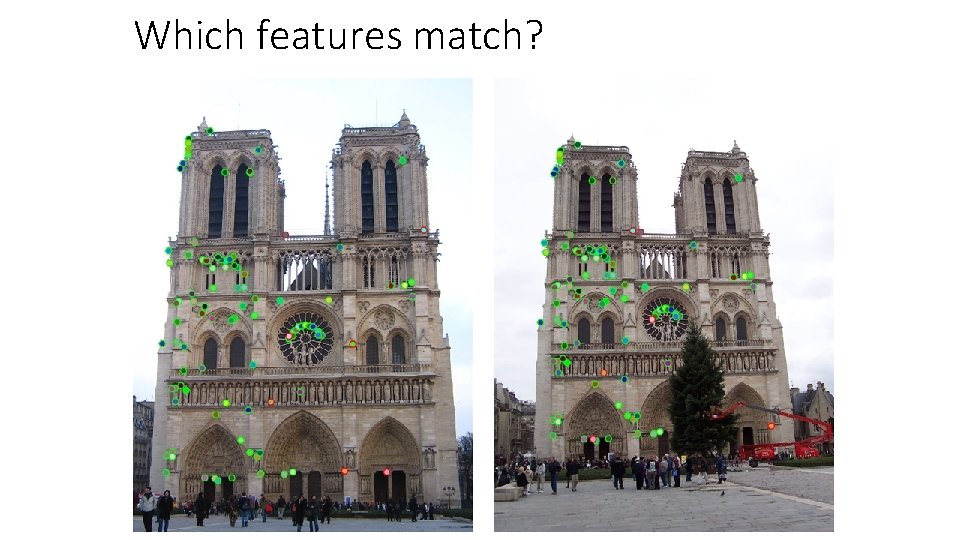
Which features match?
Feature matching Given a feature in I 1, how to find the best match in I 2? 1. Define distance function that compares two descriptors 2. Test all the features in I 2, find the one with min distance
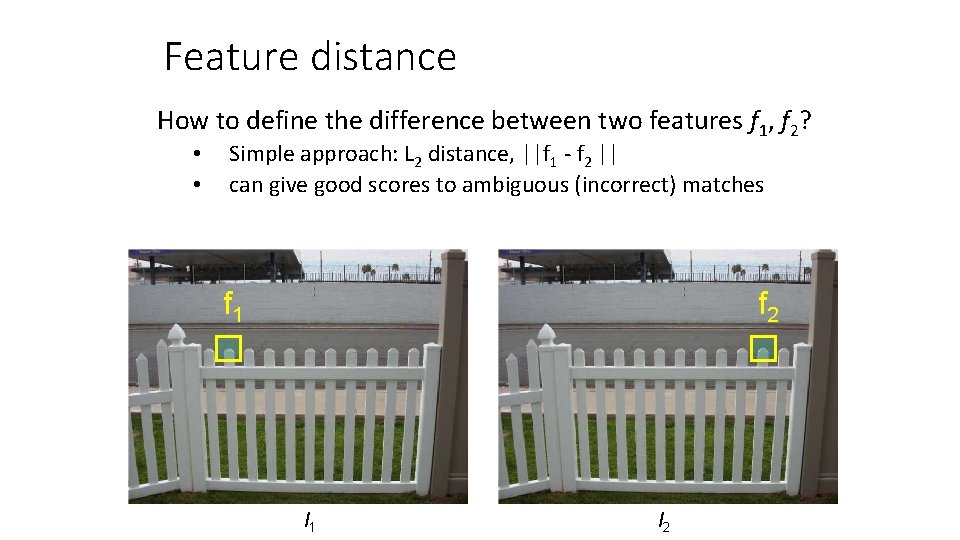
Feature distance How to define the difference between two features f 1, f 2? • • Simple approach: L 2 distance, ||f 1 - f 2 || can give good scores to ambiguous (incorrect) matches f 1 f 2 I 1 I 2
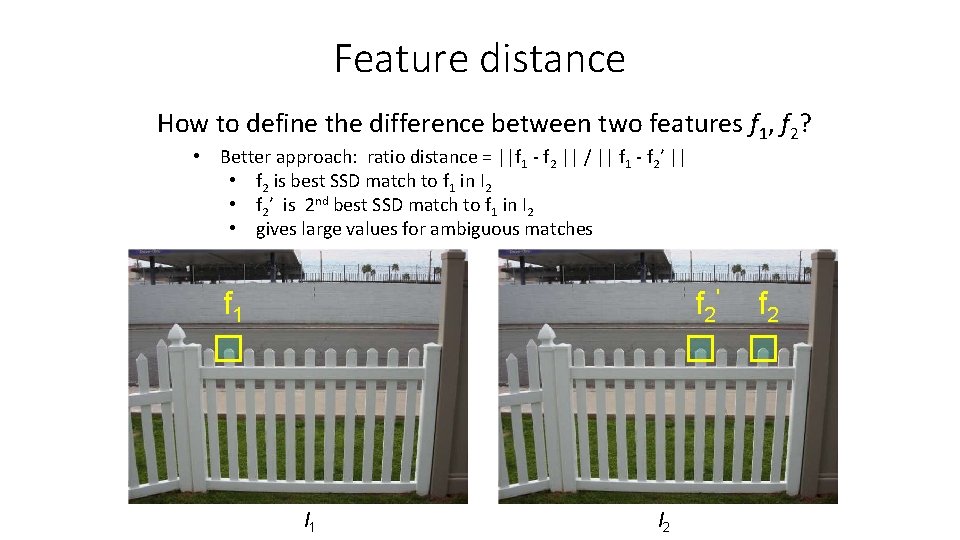
Feature distance How to define the difference between two features f 1, f 2? • Better approach: ratio distance = ||f 1 - f 2 || / || f 1 - f 2’ || • f 2 is best SSD match to f 1 in I 2 • f 2’ is 2 nd best SSD match to f 1 in I 2 • gives large values for ambiguous matches f 1 f 2' I 1 I 2 f 2
Dense correspondence
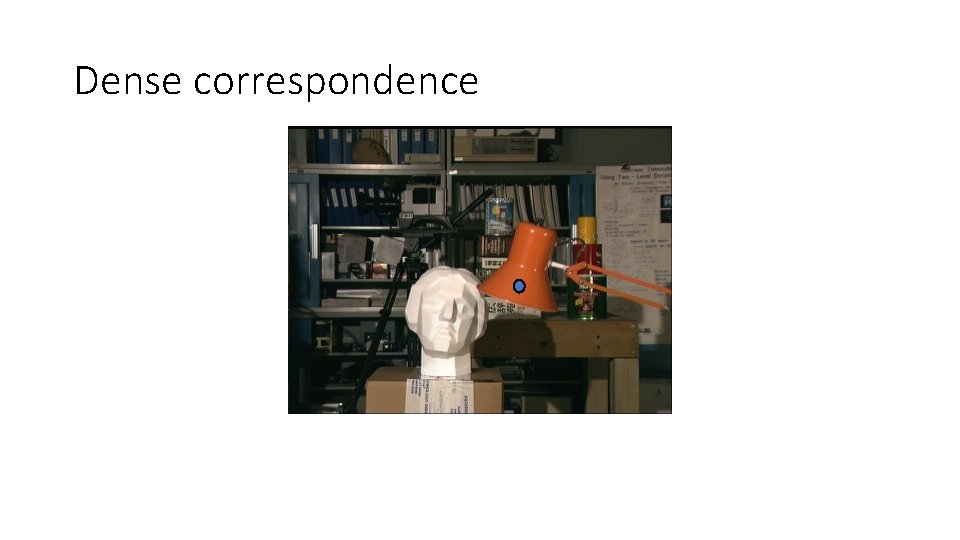
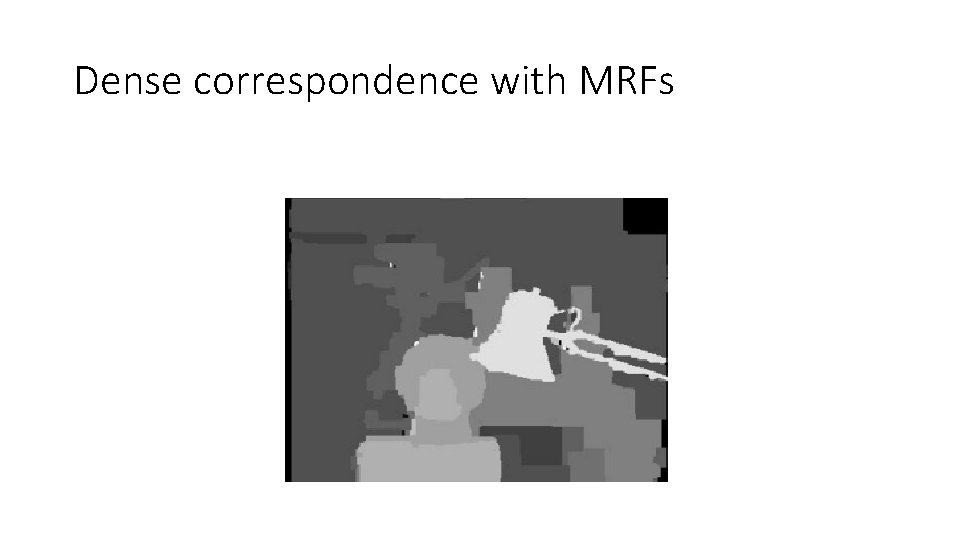
Dense correspondence • Goal: Assign disparity value to each pixel • Problem: most pixels will be ambiguous • Solution: propagate from unambiguous to ambiguous pixels • Basic idea: nearby pixels likely to have same disparity (smoothness)
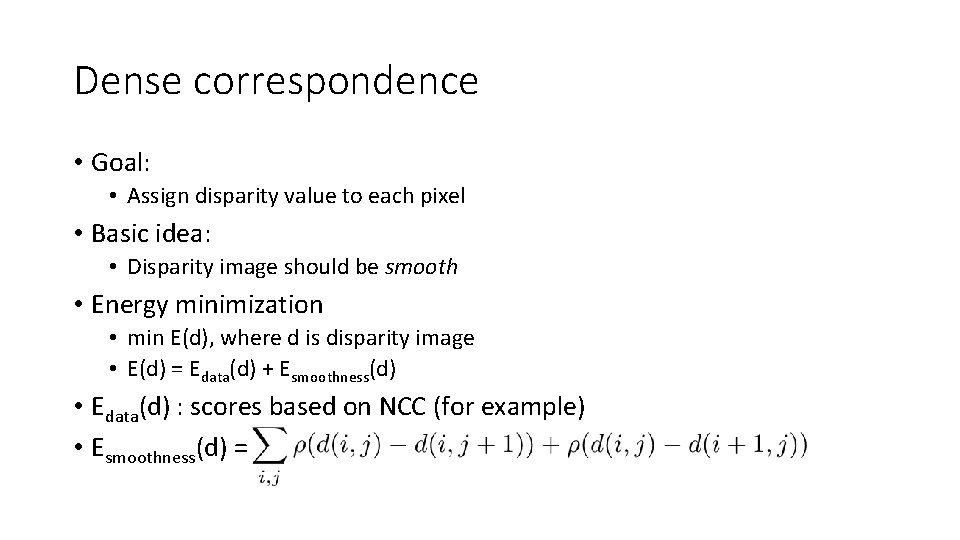
Dense correspondence • Goal: • Assign disparity value to each pixel • Basic idea: • Disparity image should be smooth • Energy minimization • min E(d), where d is disparity image • E(d) = Edata(d) + Esmoothness(d) • Edata(d) : scores based on NCC (for example) • Esmoothness(d) =
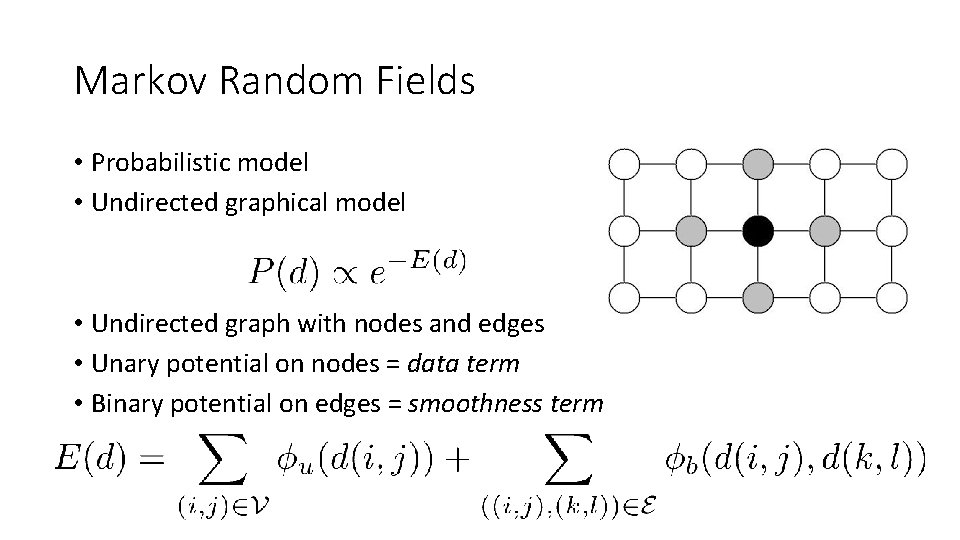
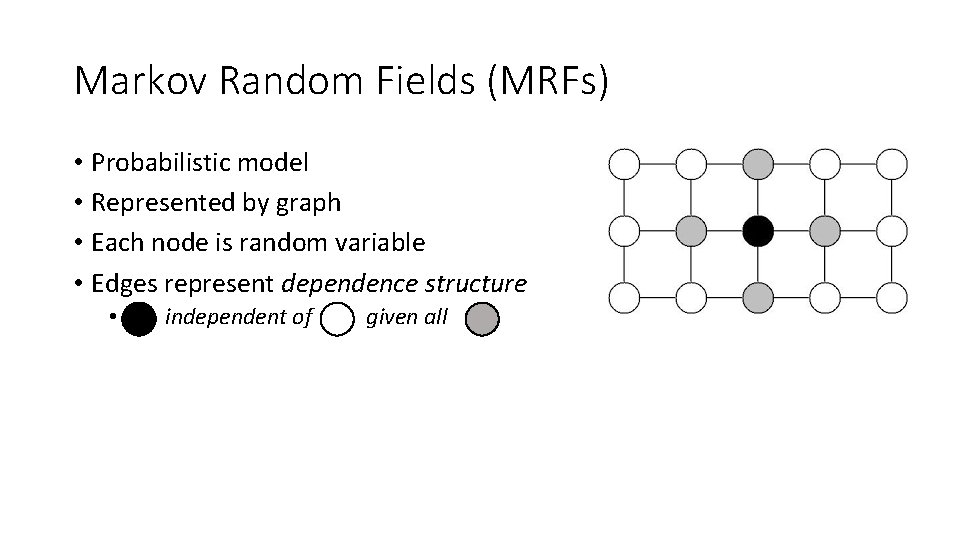
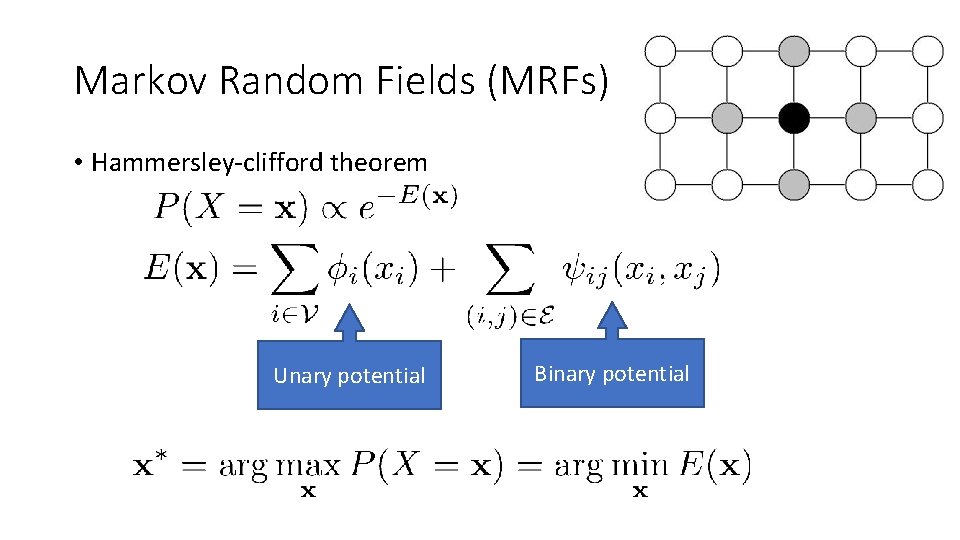
Markov Random Fields • Probabilistic model • Undirected graphical model • Undirected graph with nodes and edges • Unary potential on nodes = data term • Binary potential on edges = smoothness term
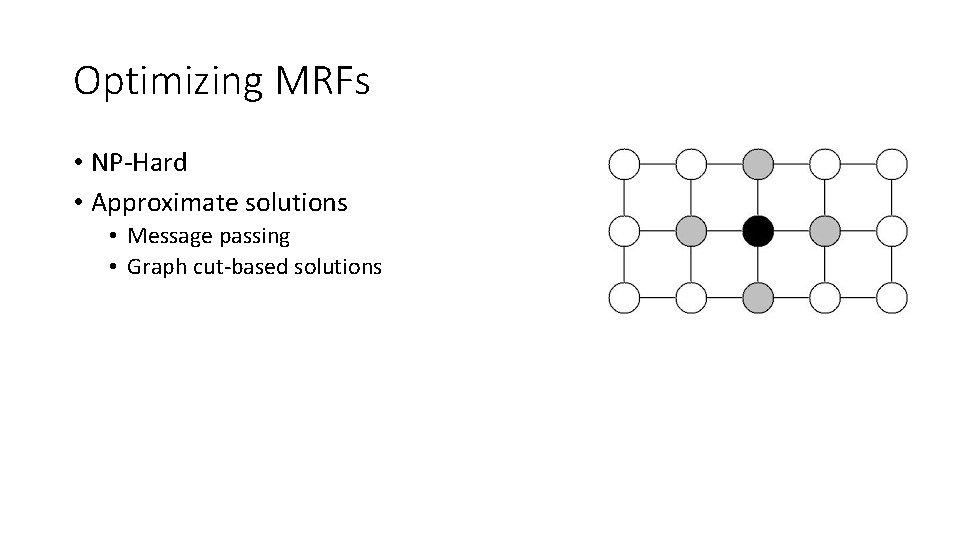
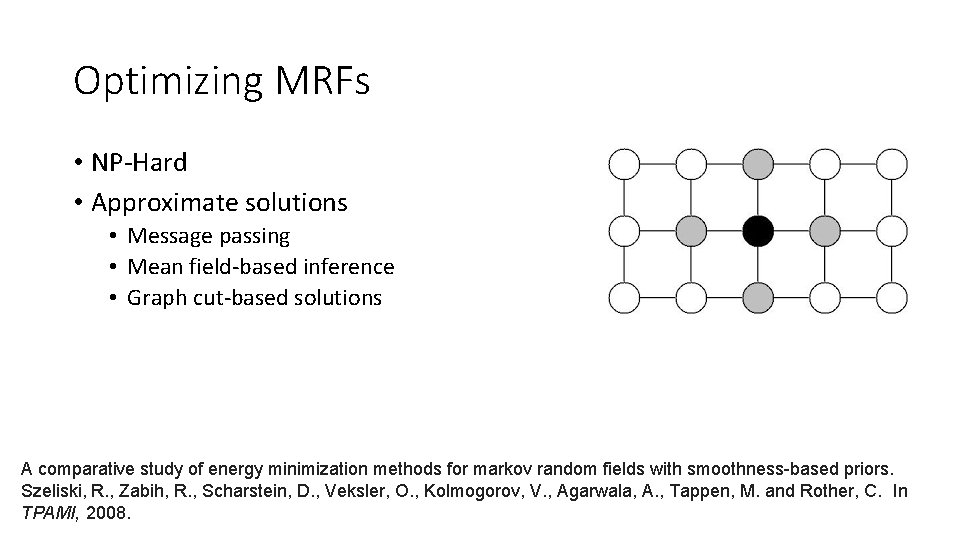
Optimizing MRFs • NP-Hard • Approximate solutions • Message passing • Graph cut-based solutions
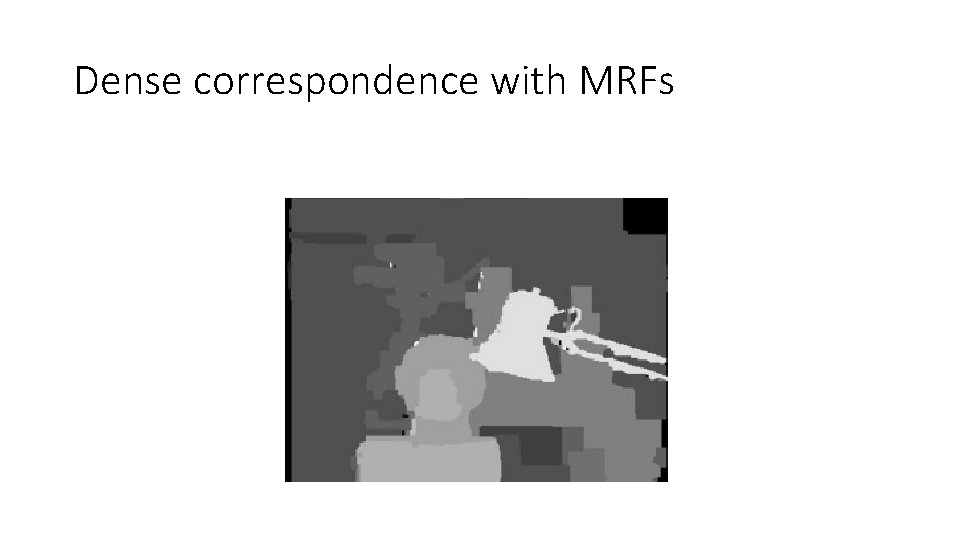
Dense correspondence with MRFs
Dense correspondence • Goal: Assign disparity value to each pixel • Problem: most pixels will be ambiguous • Solution: propagate from unambiguous to ambiguous pixels • Basic idea: nearby pixels likely to have same disparity (smoothness)
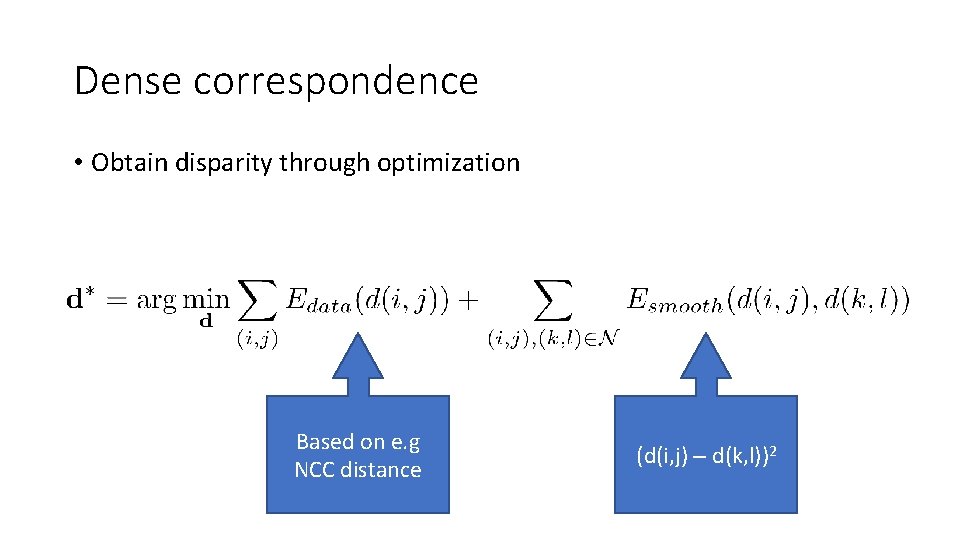
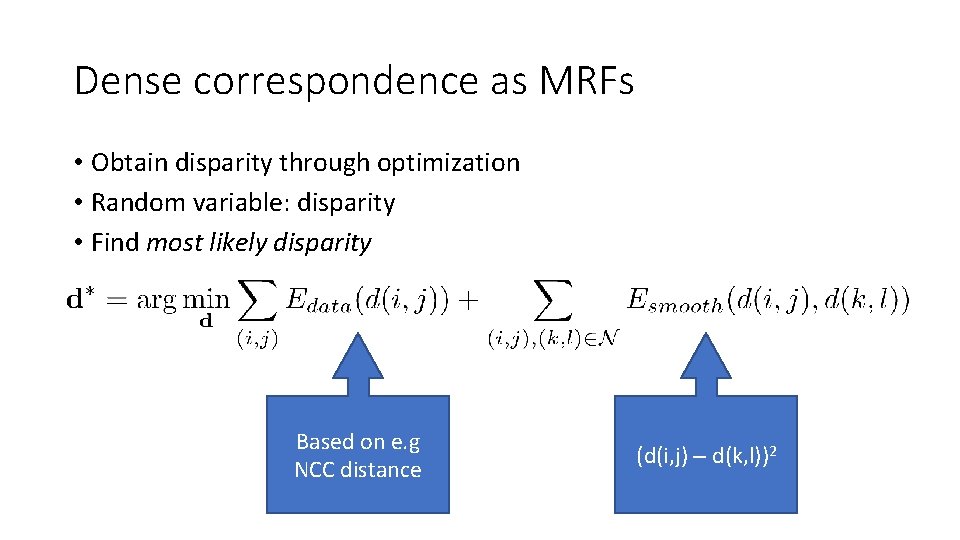
Dense correspondence • Obtain disparity through optimization Based on e. g NCC distance (d(i, j) – d(k, l))2
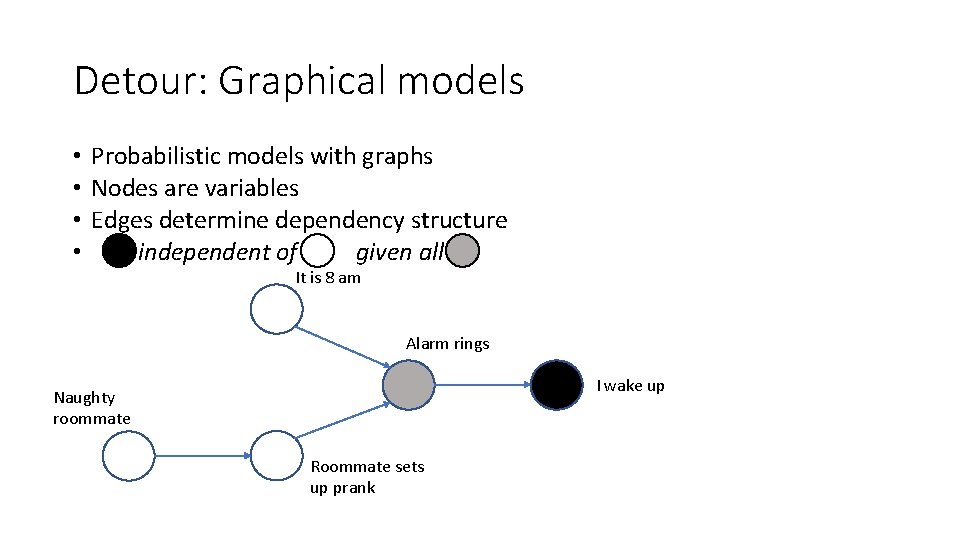
Detour: Graphical models • Probabilistic models with graphs • Nodes are variables • Edges determine dependency structure • independent of given all It is 8 am Alarm rings I wake up Naughty roommate Roommate sets up prank
Markov Random Fields (MRFs) • Probabilistic model • Represented by graph • Each node is random variable • Edges represent dependence structure • independent of given all
Markov Random Fields (MRFs) • Hammersley-clifford theorem Unary potential Binary potential
Dense correspondence as MRFs • Obtain disparity through optimization • Random variable: disparity • Find most likely disparity Based on e. g NCC distance (d(i, j) – d(k, l))2
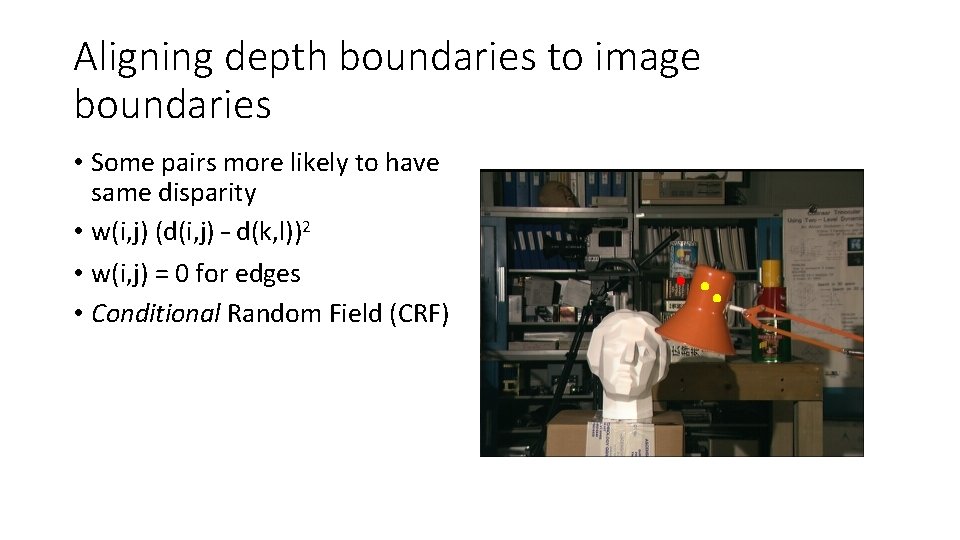
Aligning depth boundaries to image boundaries • Some pairs more likely to have same disparity • w(i, j) (d(i, j) – d(k, l))2 • w(i, j) = 0 for edges • Conditional Random Field (CRF)
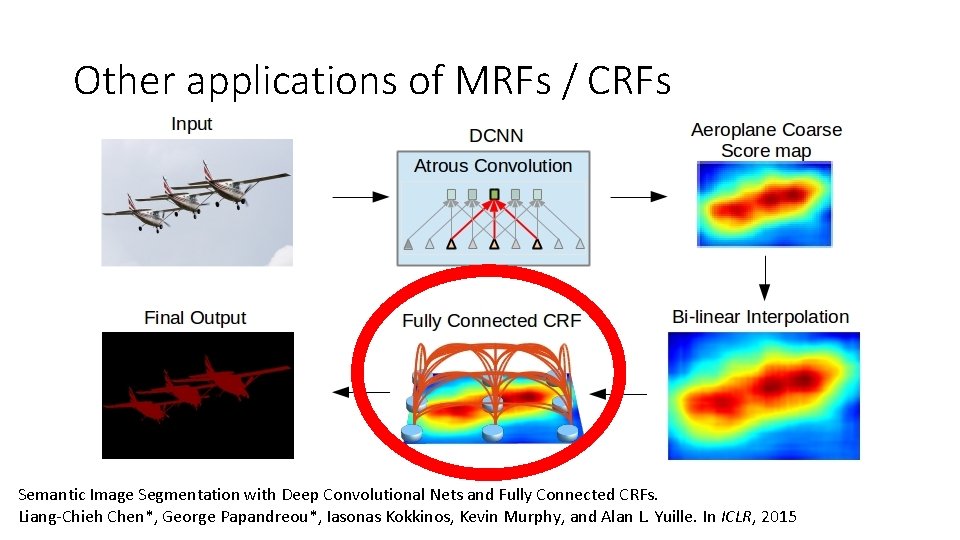
Other applications of MRFs / CRFs Semantic Image Segmentation with Deep Convolutional Nets and Fully Connected CRFs. Liang-Chieh Chen*, George Papandreou*, Iasonas Kokkinos, Kevin Murphy, and Alan L. Yuille. In ICLR, 2015
Optimizing MRFs • NP-Hard • Approximate solutions • Message passing • Mean field-based inference • Graph cut-based solutions A comparative study of energy minimization methods for markov random fields with smoothness-based priors. Szeliski, R. , Zabih, R. , Scharstein, D. , Veksler, O. , Kolmogorov, V. , Agarwala, A. , Tappen, M. and Rother, C. In TPAMI, 2008.
Dense correspondence with MRFs