
Correlation does not equal causation necessary but not
-Correlation does not equal causation -necessary but not sufficient -Where there’s smoke there may be fire Experimental approach attempts to create conditions where third variable effects and issues of directionality can be eliminated.
But what conditions would define a causal relationship?
Mills’ Canons of Causality conditions that must be met if a relationship is causal • Where “A” is presumed cause and “B” is presumed effect. • Method of agreement • Method of disagreement • Method of concomitant variation • Method of multiple causality
Method of Agreement • If “A” is present then so should be “B”
Method of Disagreement • If “A” is not present then neither should be “B. ”

Method of concomitant Variation • If “A” is varied in intensity then “B” should show corresponding variation
How do we set up experimental conditions to test Mills assumptions
The Experimental approach • Systematic manipulation (variation) of the presumed causal variable • Systematic measurement of the presumed affected variable • Under controlled conditions
Terminology • The presumed causal variable = the independent variable (IV) – The manipulated variable – The administered variable The presumed affected variable = the dependent variable (DV) – The measured variable
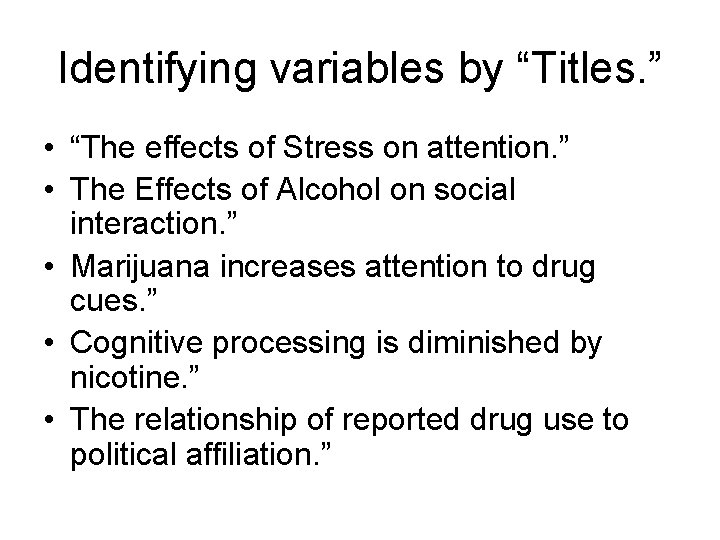
Identifying variables by “Titles. ” • “The effects of Stress on attention. ” • The Effects of Alcohol on social interaction. ” • Marijuana increases attention to drug cues. ” • Cognitive processing is diminished by nicotine. ” • The relationship of reported drug use to political affiliation. ”

Identifying Correlational studies vs Experimental studies. There should be clear inference of cause or effect in Experimental studies • • The effects of peanut butter on… Peanut butter increases… Brain size is increased… Typing speed is related to….

Manipulation of IV to test Mills assumptions • Minimally, the IV must have two Levels or conditions • Present/absent or High vs low • IV may have more than two levels– Concomitant variation

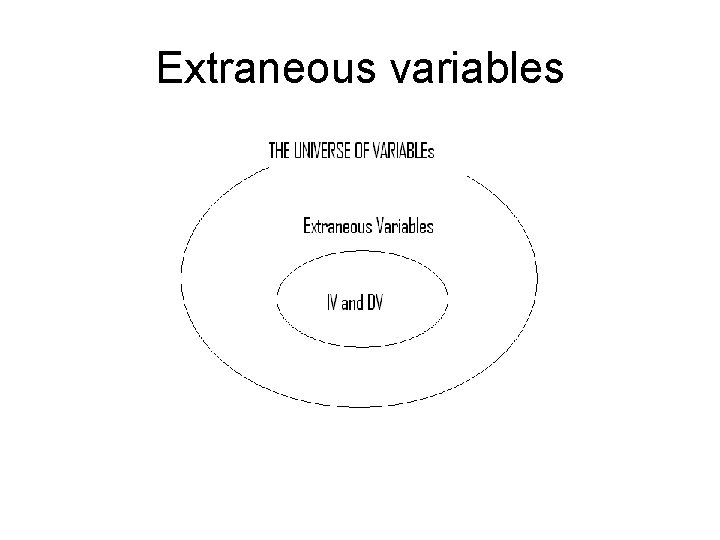
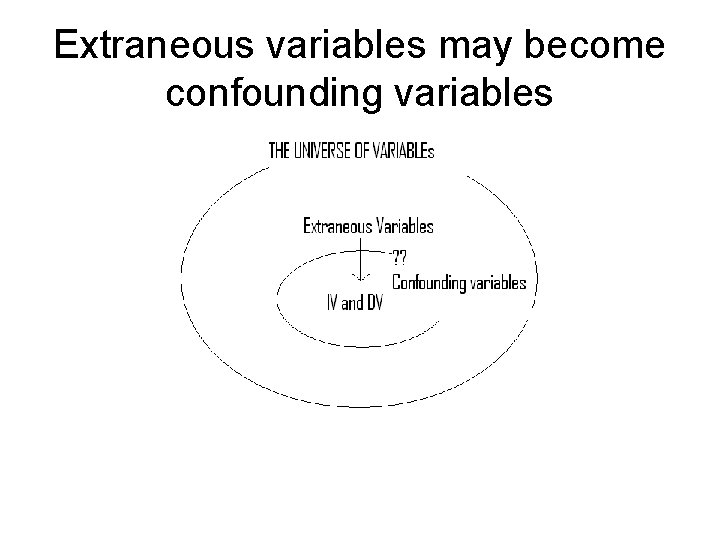
The Experimental and Control Conditions • The control condition is both a point of comparison and • Helps control for possible unwanted effects of extraneous (confounding) variables.
BASIC EXPERIMENTAL DESIGNS • Between group designs • Within group designs
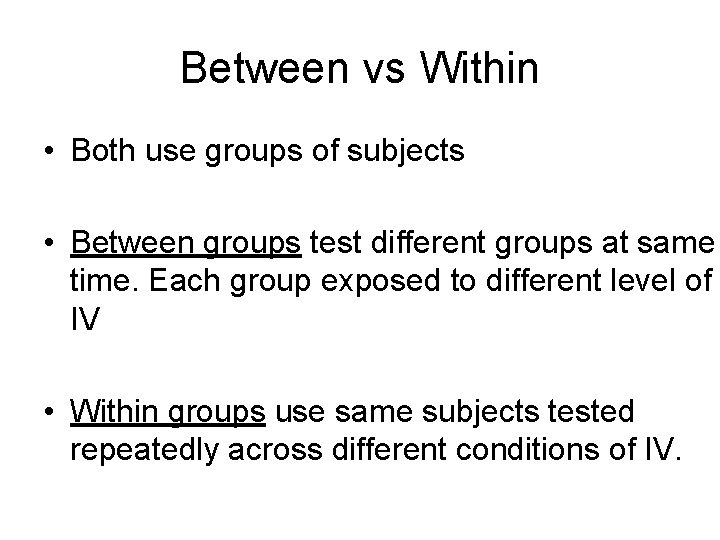
Between vs Within • Both use groups of subjects • Between groups test different groups at same time. Each group exposed to different level of IV • Within groups use same subjects tested repeatedly across different conditions of IV.
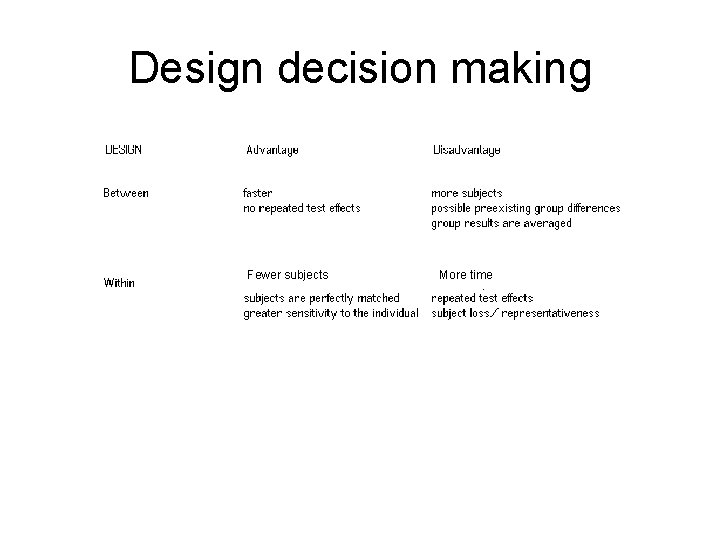
Design decision making Fewer subjects More time
The Experimental approach • Systematic manipulation (variation) of the presumed causal variable • Systematic measurement of the presumed affected variable • Under controlled conditions
Extraneous variables
Extraneous variables may become confounding variables
Confounding variables: An extraneous variable that varies with the IV.

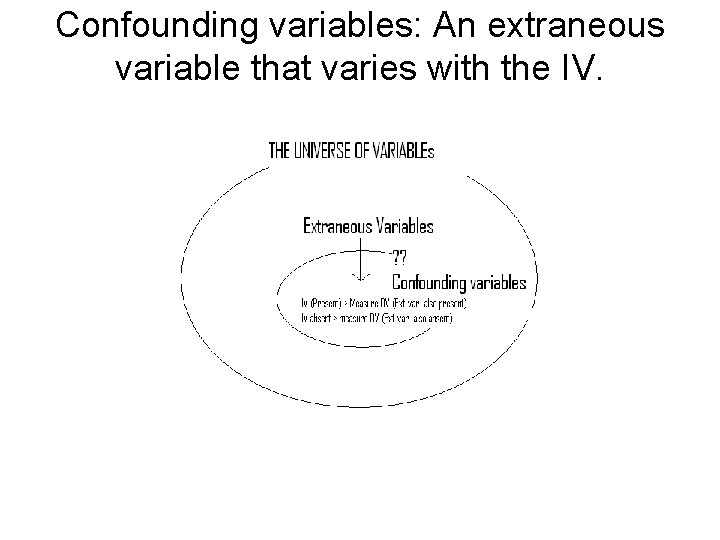
Confounding variables • “ a variable that should be extraneous, but becomes systematically varied along with the IV. • Eg…”Effects of marijuana on memory. ” • MJ accidentally administered only to experienced users but not to naïve users.
Experimental Control • Procedures to minimize CVs • By elimination, constancy or specific testing of suspected confounds • The Control group or condition • = point of comparison and. . • A fundamental control procedure
- Slides: 22