
Correlation Convolution Mohammad Nayeem Teli CrossCorrelation Mathematically Crosscorrelation
![The discrete gradient How can we differentiate a digital image f[x, y]? � Option](https://slidetodoc.com/presentation_image_h2/39b8eff17eb44e2e13b9a82ff73325c0/image-33.jpg "The discrete gradient How can we differentiate a digital image f[x, y]? � Option")
- Slides: 38
Correlation & Convolution Mohammad Nayeem Teli
Cross-Correlation Mathematically
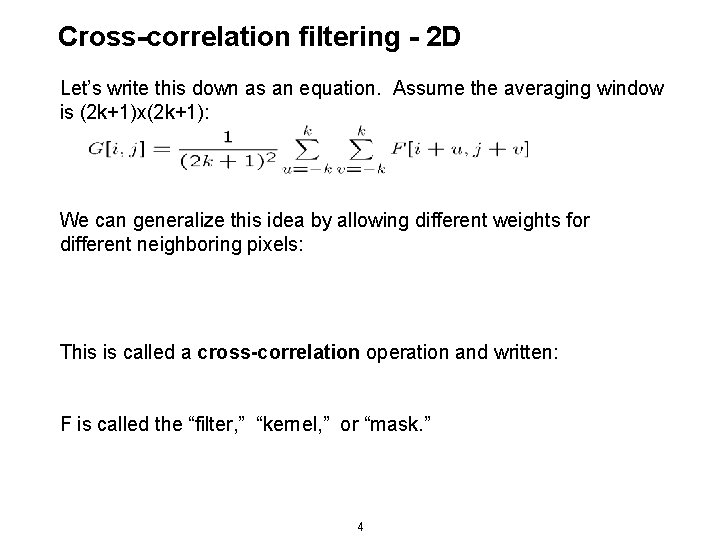
Cross-correlation filtering - 2 D Let’s write this down as an equation. Assume the averaging window is (2 k+1)x(2 k+1): We can generalize this idea by allowing different weights for different neighboring pixels: This is called a cross-correlation operation and written: F is called the “filter, ” “kernel, ” or “mask. ” 4
Convolution
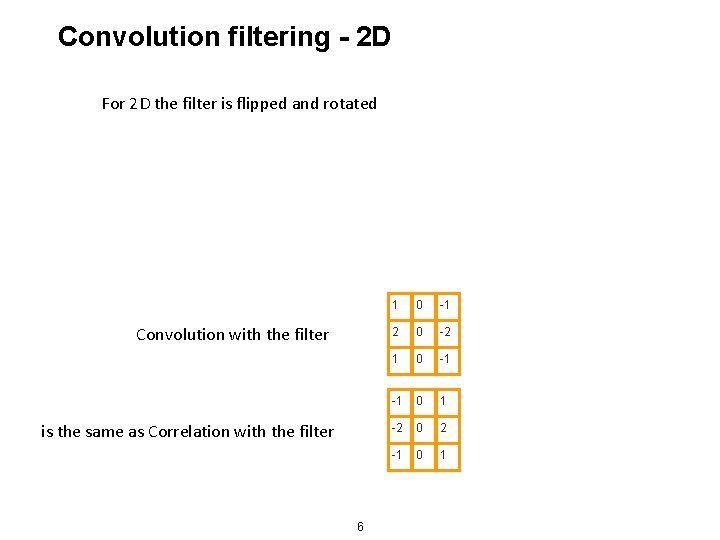
Convolution filtering - 2 D For 2 D the filter is flipped and rotated Convolution with the filter is the same as Correlation with the filter 6 1 0 -1 2 0 -2 1 0 -1 -1 0 1 -2 0 2 -1 0 1
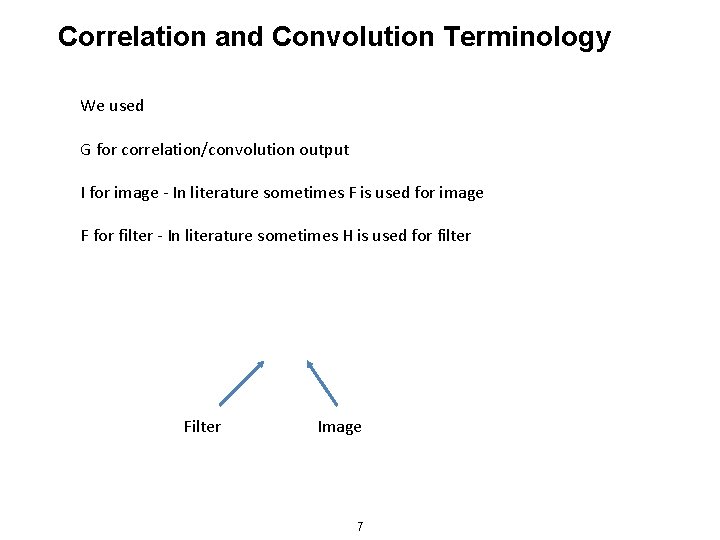
Correlation and Convolution Terminology We used G for correlation/convolution output I for image - In literature sometimes F is used for image F for filter - In literature sometimes H is used for filter Filter Image 7
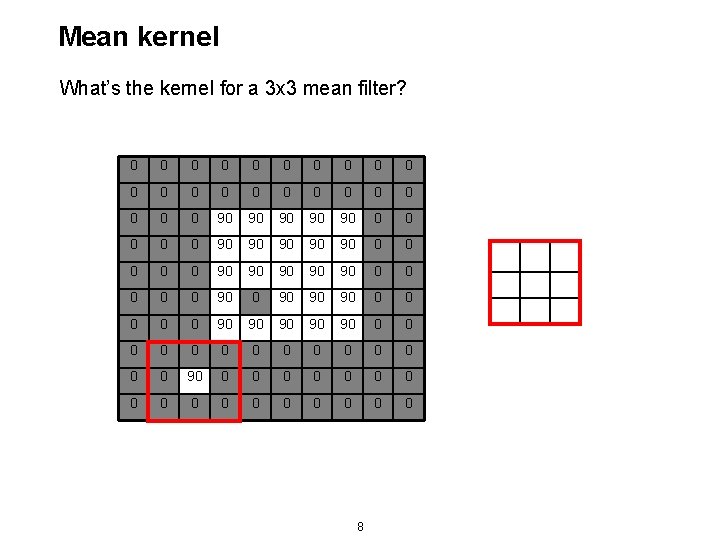
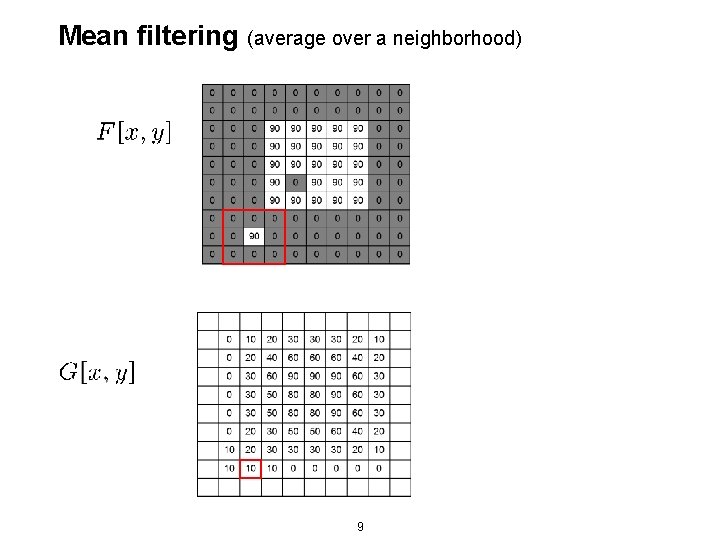
Mean kernel What’s the kernel for a 3 x 3 mean filter? 0 0 0 0 0 0 90 90 90 0 0 90 90 90 0 90 90 90 0 0 0 0 0 0 0 0 0 0 8
Mean filtering (average over a neighborhood) 9
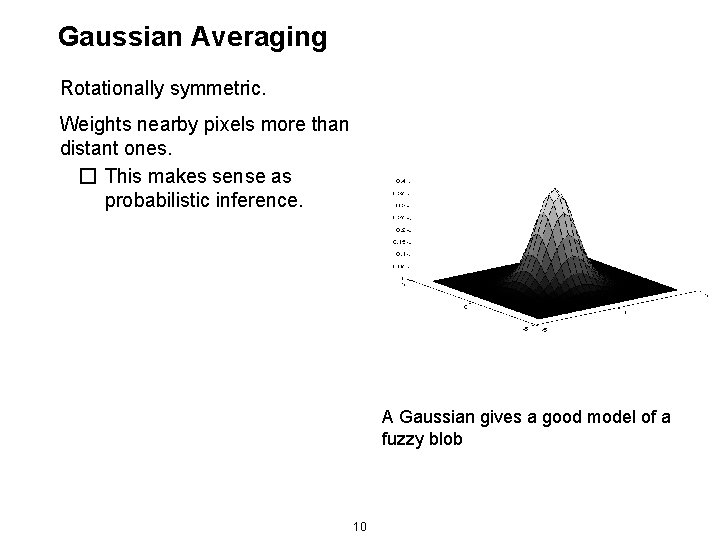
Gaussian Averaging Rotationally symmetric. Weights nearby pixels more than distant ones. � This makes sense as probabilistic inference. A Gaussian gives a good model of a fuzzy blob 10
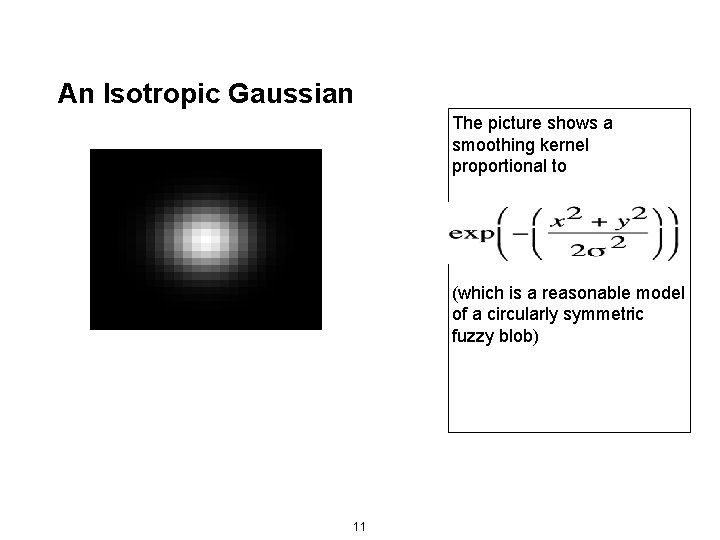
An Isotropic Gaussian The picture shows a smoothing kernel proportional to (which is a reasonable model of a circularly symmetric fuzzy blob) 11
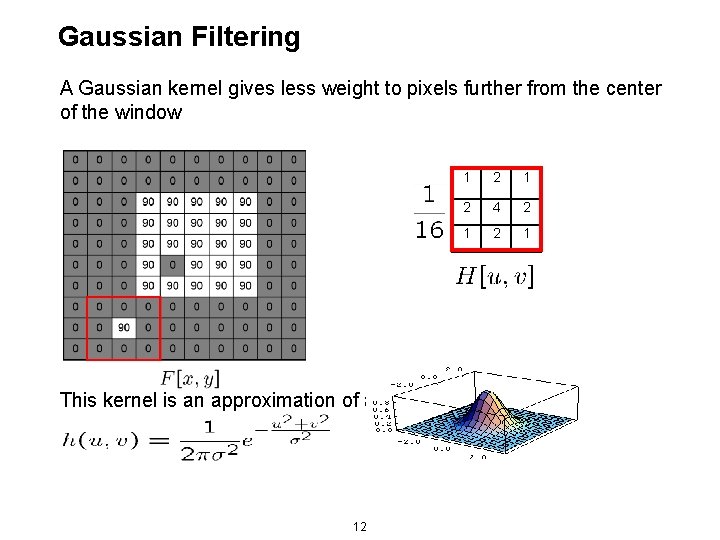
Gaussian Filtering A Gaussian kernel gives less weight to pixels further from the center of the window 1 2 4 2 1 This kernel is an approximation of a Gaussian function: 12
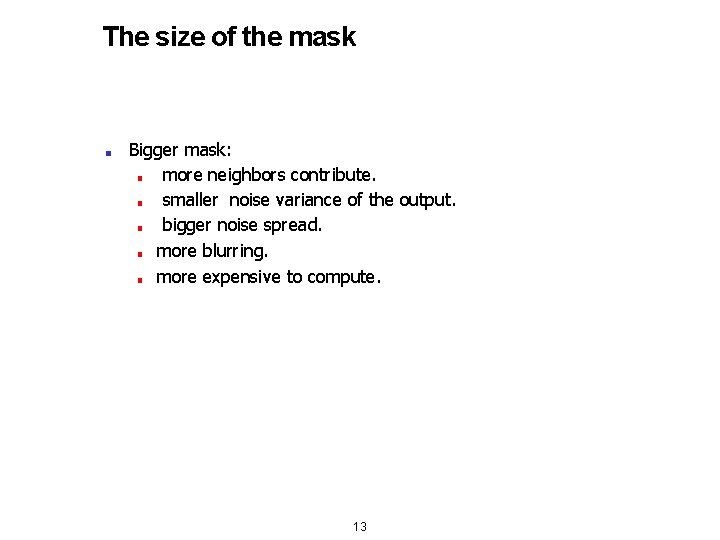
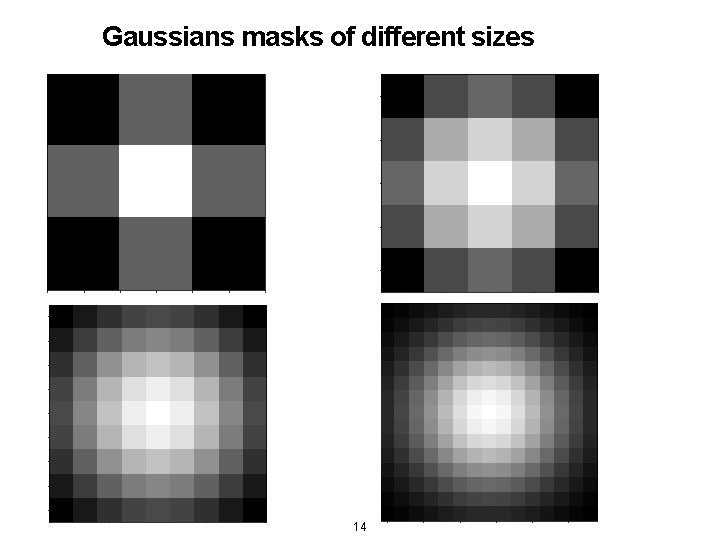
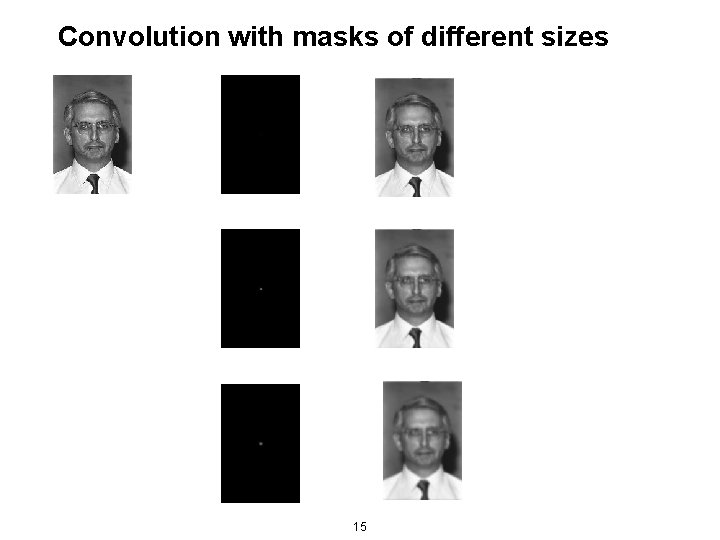
The size of the mask ■ Bigger mask: ■ more neighbors contribute. ■ smaller noise variance of the output. ■ bigger noise spread. ■ more blurring. ■ more expensive to compute. 13
Gaussians masks of different sizes 14
Convolution with masks of different sizes 15
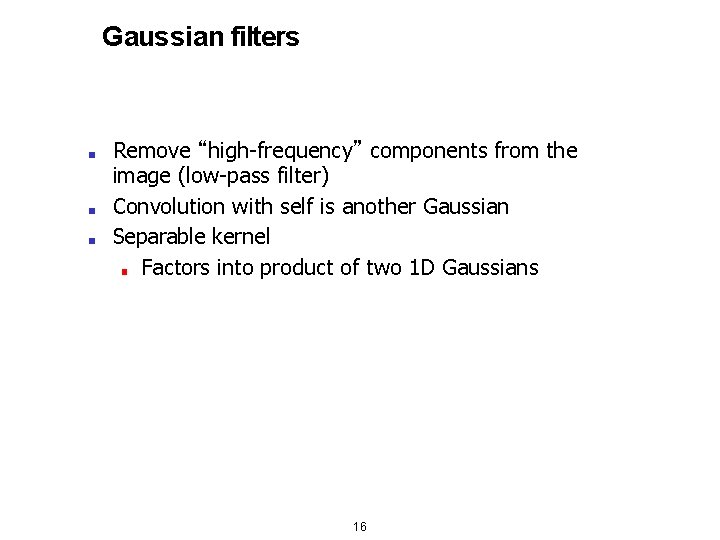
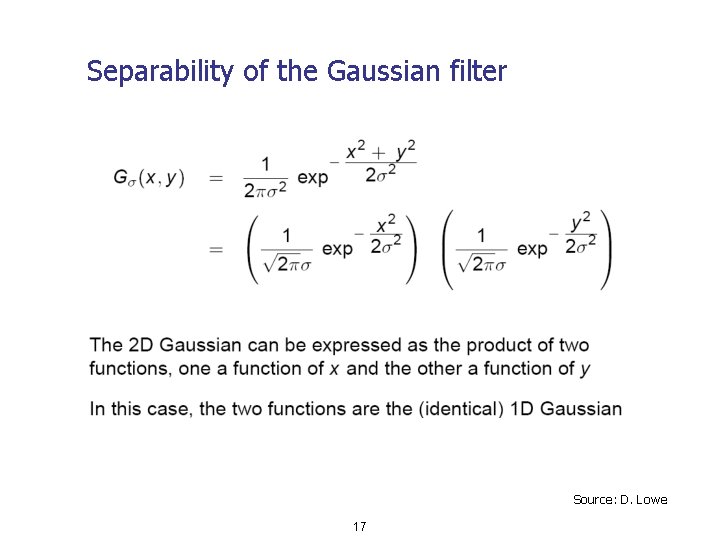
Gaussian filters ■ ■ ■ Remove “high-frequency” components from the image (low-pass filter) Convolution with self is another Gaussian Separable kernel ■ Factors into product of two 1 D Gaussians 16
Separability of the Gaussian filter Source: D. Lowe 17
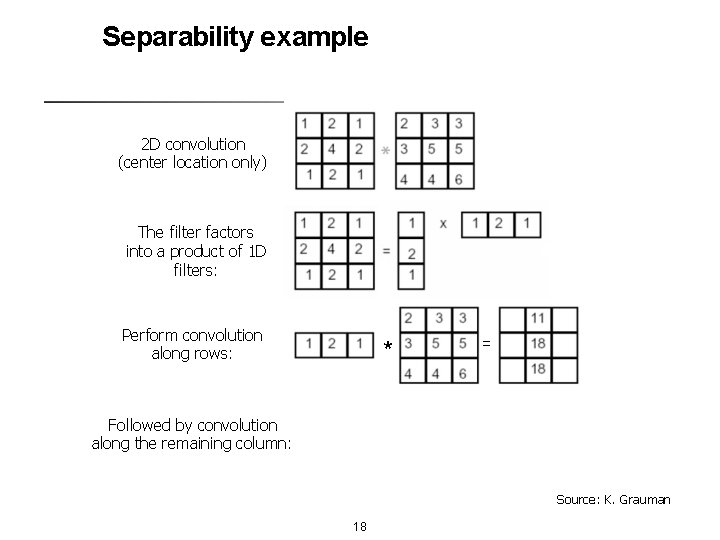
Separability example 2 D convolution (center location only) The filter factors into a product of 1 D filters: Perform convolution along rows: Followed by convolution along the remaining column: * = Source: K. Grauman 18
Efficient Implementation Both, the BOX filter and the Gaussian filter are separable: � First convolve each row with a 1 D filter � Then convolve each column with a 1 D filter. 19
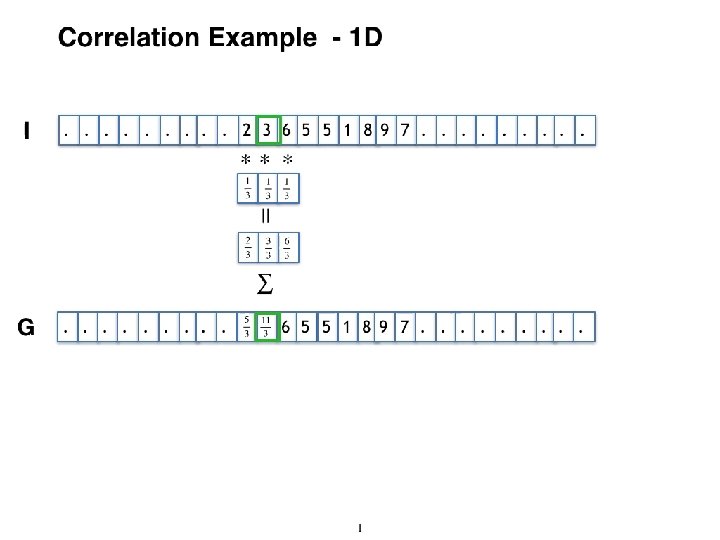
Correlation & Convolution • Basic operation to extract information from an image. • These operations have two key features: • shift invariant • linear • Applicable to 1 -D and multi dimensional images. 20
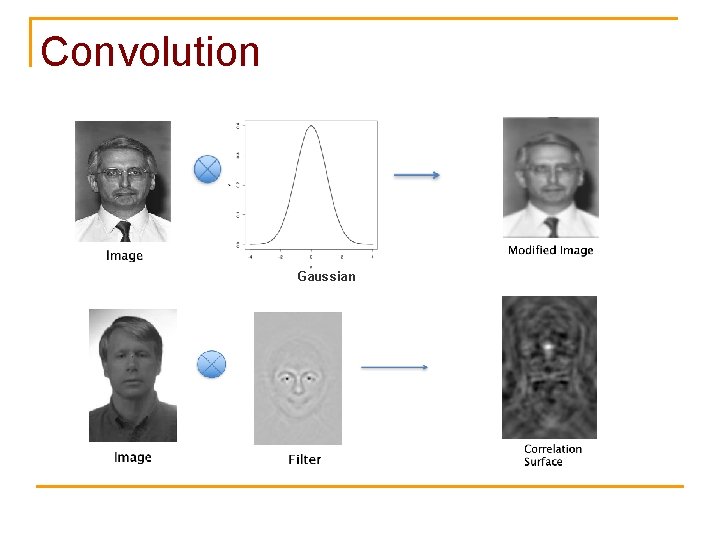
Convolution Gaussian
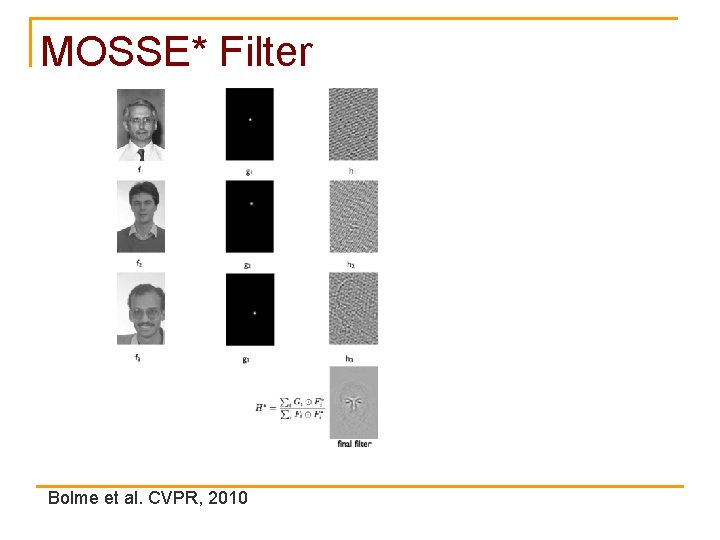
MOSSE* Filter Bolme et al. CVPR, 2010
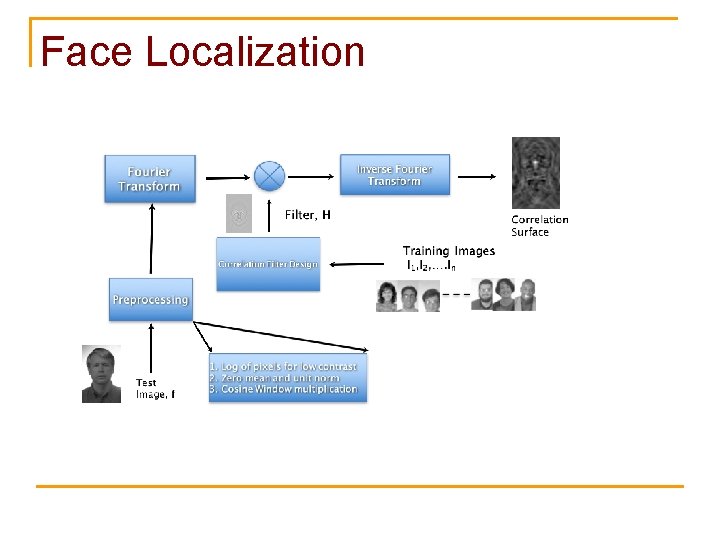
Face Localization
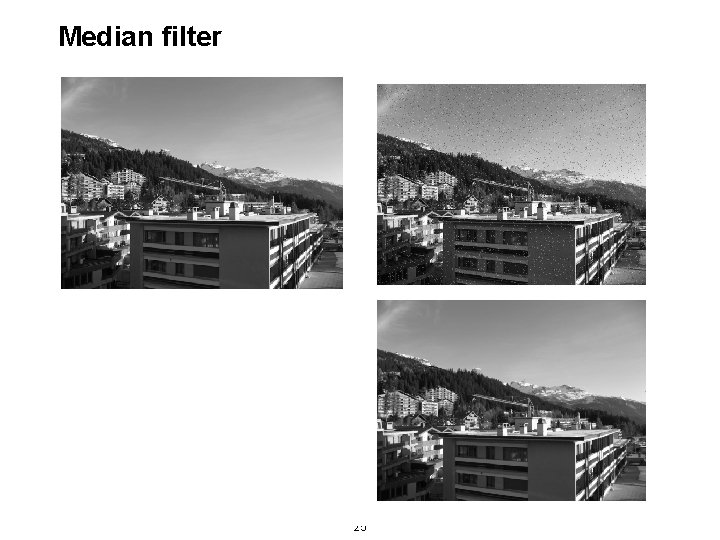
Median filters A Median Filter operates over a window by selecting the median intensity in the window. What advantage does a median filter have over a mean filter? Is a median filter a kind of convolution? Median filter is non linear 24
Median filter 25
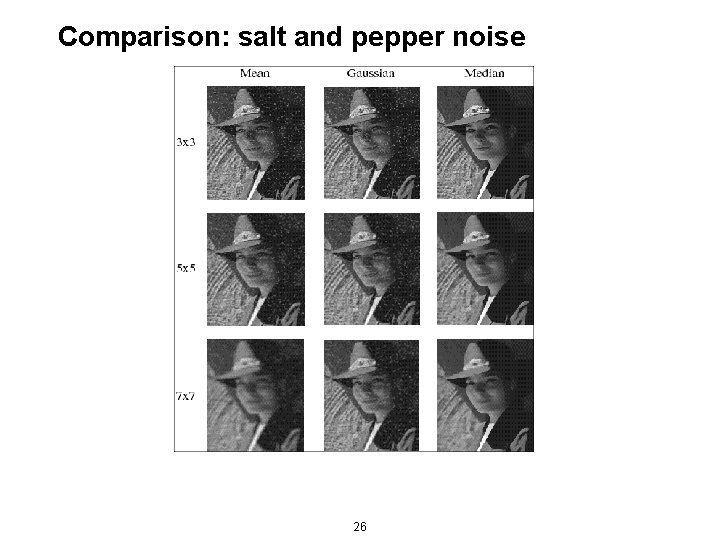
Comparison: salt and pepper noise 26
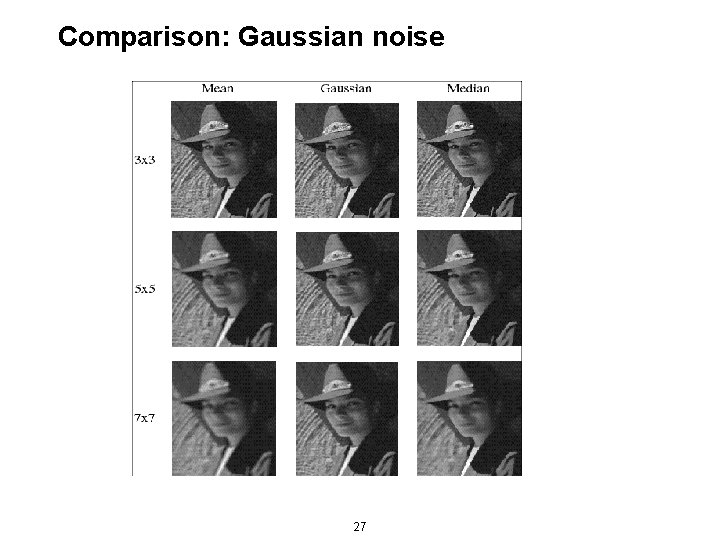
Comparison: Gaussian noise 27
Edge Detection
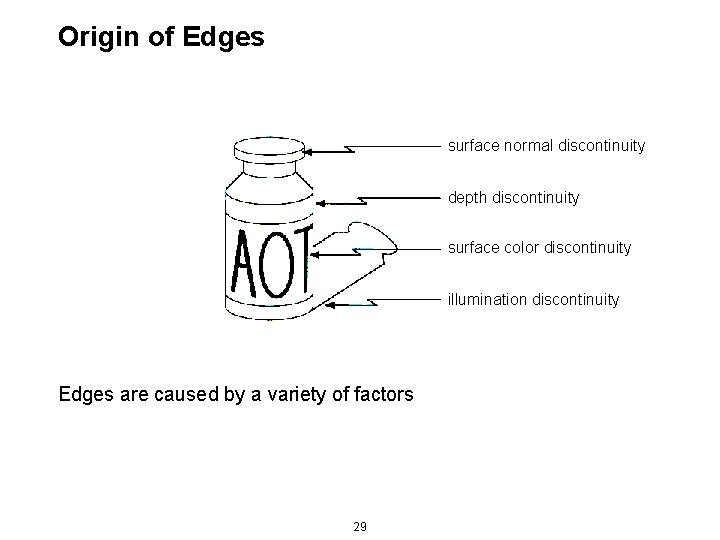
Origin of Edges surface normal discontinuity depth discontinuity surface color discontinuity illumination discontinuity Edges are caused by a variety of factors 29
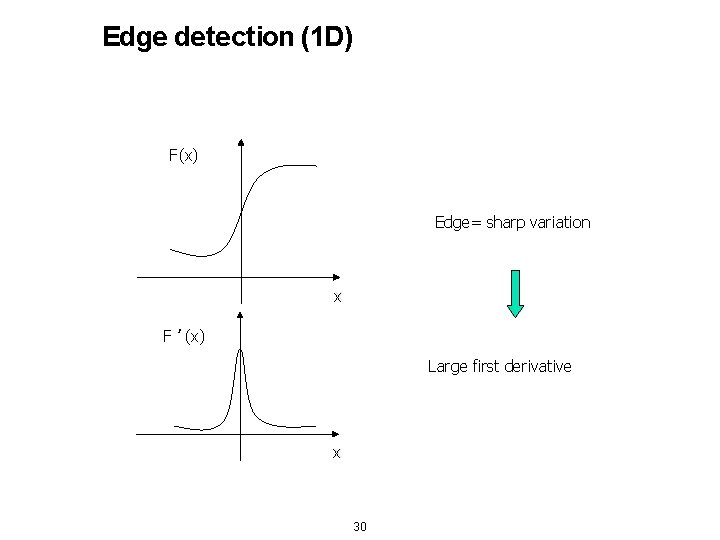
Edge detection (1 D) F(x) Edge= sharp variation x F ’(x) Large first derivative x 30
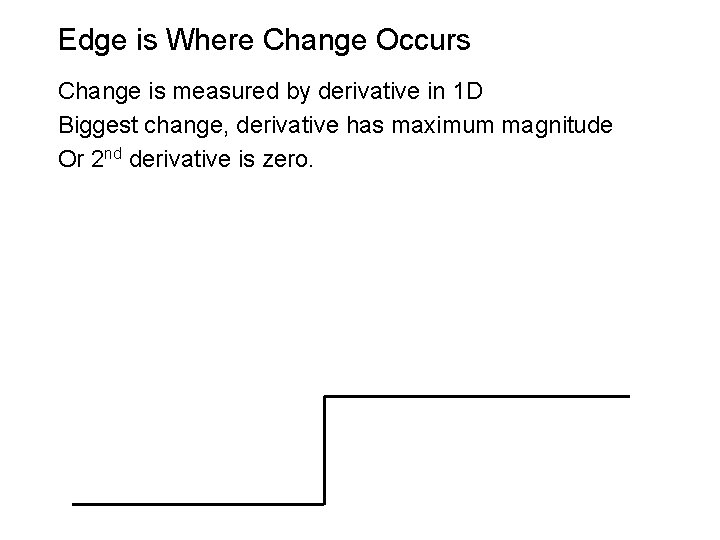
Edge is Where Change Occurs Change is measured by derivative in 1 D Biggest change, derivative has maximum magnitude Or 2 nd derivative is zero.
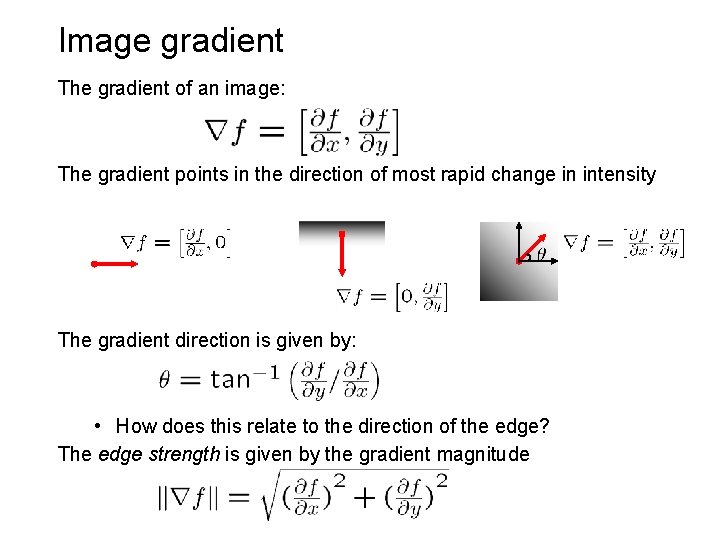
Image gradient The gradient of an image: The gradient points in the direction of most rapid change in intensity The gradient direction is given by: • How does this relate to the direction of the edge? The edge strength is given by the gradient magnitude
The discrete gradient How can we differentiate a digital image f[x, y]? � Option 1: reconstruct a continuous image, then take gradient � Option 2: take discrete derivative (finite difference) How would you implement this as a cross-correlation? 33
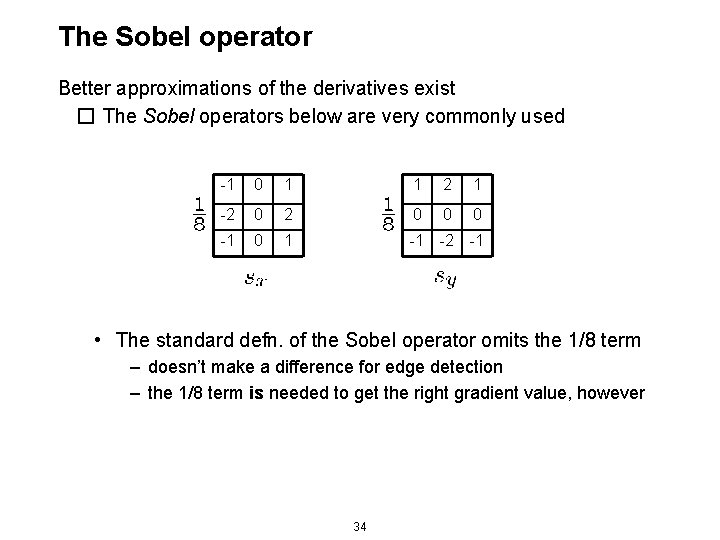
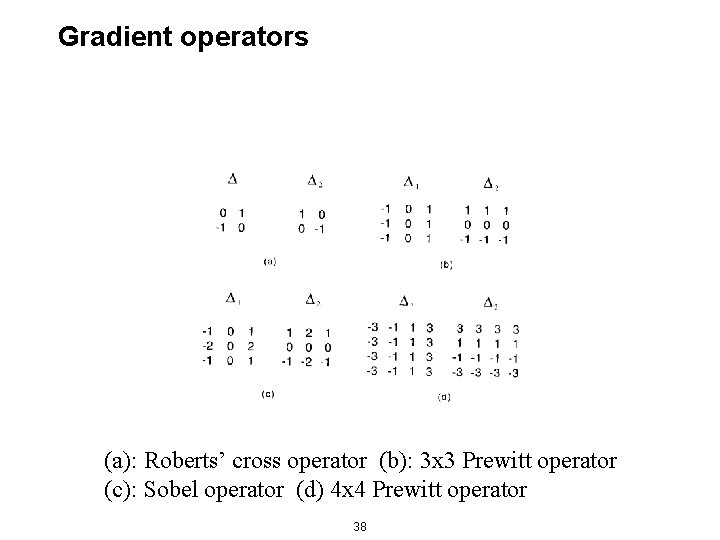
The Sobel operator Better approximations of the derivatives exist � The Sobel operators below are very commonly used -1 0 1 1 2 1 -2 0 0 0 -1 0 1 -1 -2 -1 • The standard defn. of the Sobel operator omits the 1/8 term – doesn’t make a difference for edge detection – the 1/8 term is needed to get the right gradient value, however 34
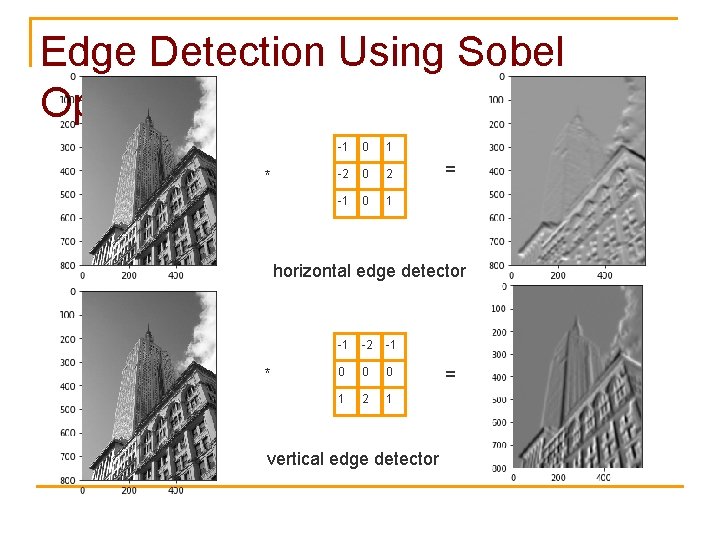
Edge Detection Using Sobel Operator * -1 0 1 -2 0 2 -1 0 1 = horizontal edge detector * -1 -2 -1 0 0 0 1 2 1 vertical edge detector =
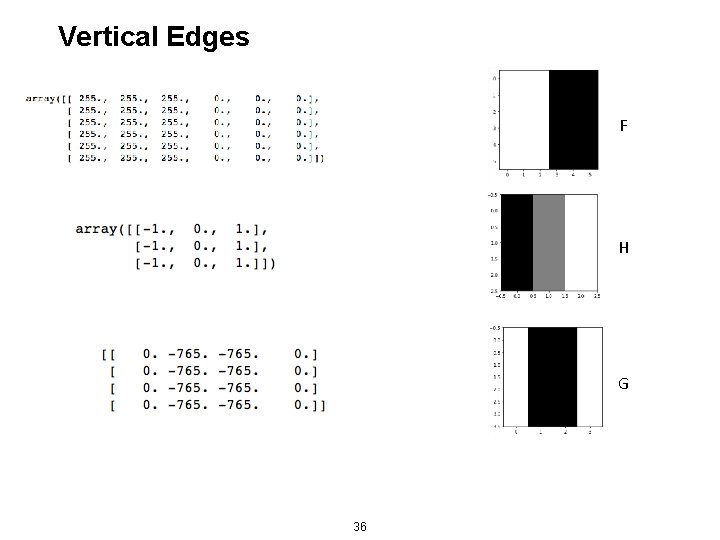
Vertical Edges F H G 36
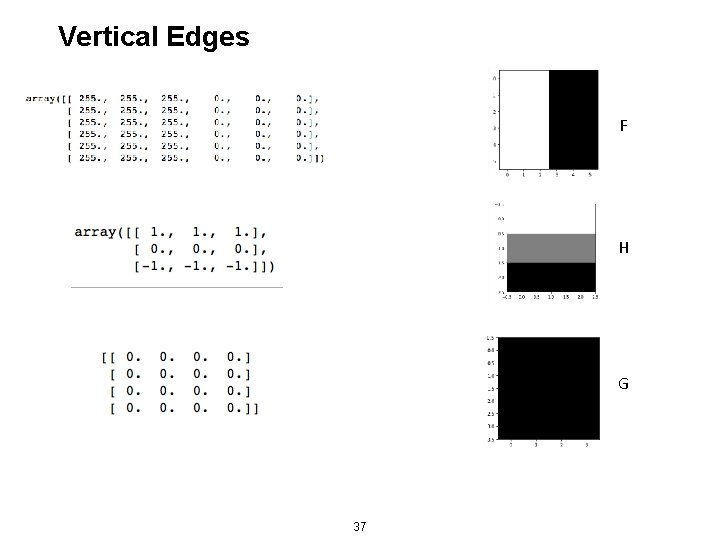
Vertical Edges F H G 37
Gradient operators (a): Roberts’ cross operator (b): 3 x 3 Prewitt operator (c): Sobel operator (d) 4 x 4 Prewitt operator 38