
Correlation between the elbow ulnar collateral ligament and
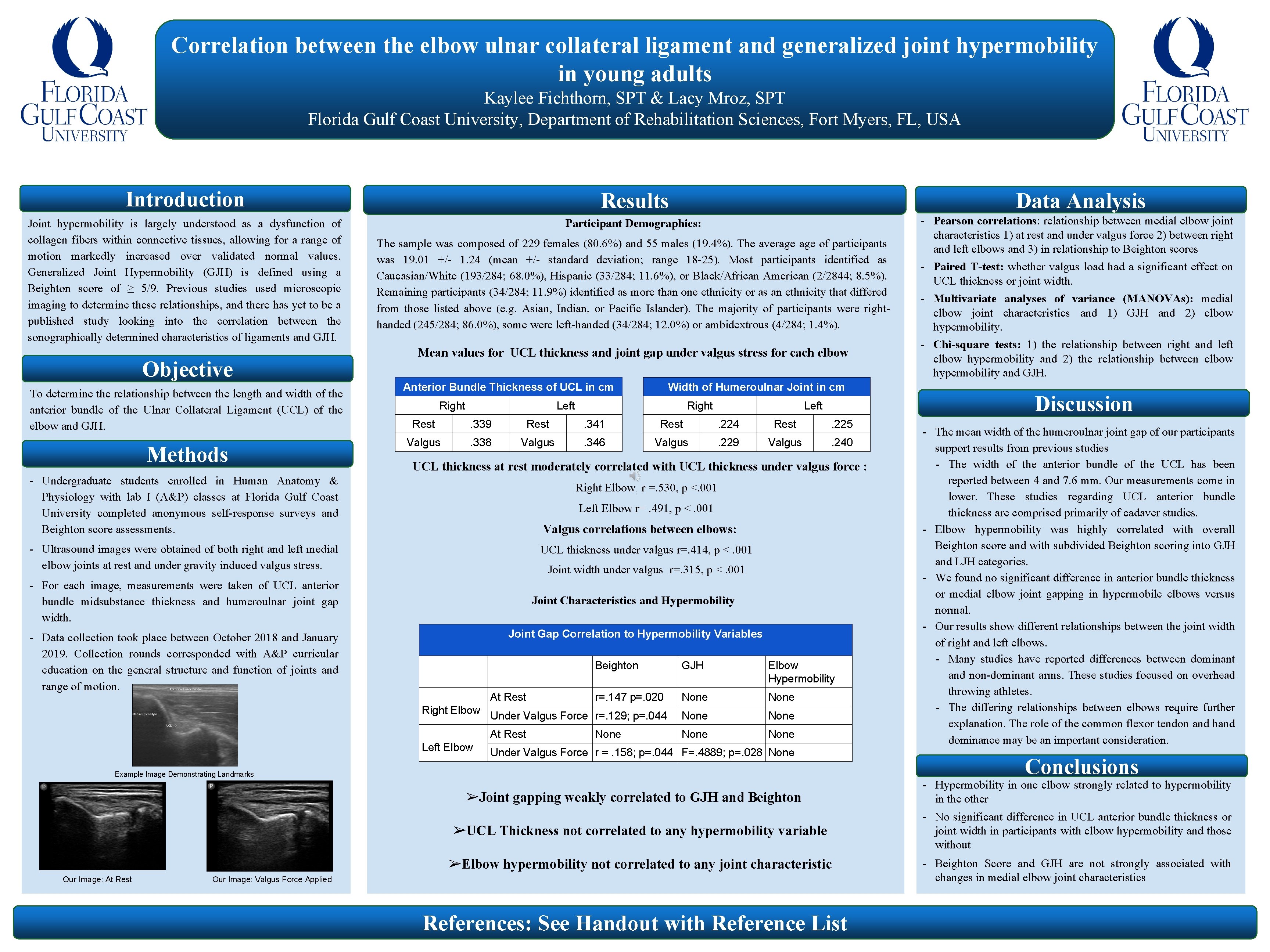
Correlation between the elbow ulnar collateral ligament and generalized joint hypermobility in young adults Kaylee Fichthorn, SPT & Lacy Mroz, SPT Florida Gulf Coast University, Department of Rehabilitation Sciences, Fort Myers, FL, USA Introduction Results Joint hypermobility is largely understood as a dysfunction of collagen fibers within connective tissues, allowing for a range of motion markedly increased over validated normal values. Generalized Joint Hypermobility (GJH) is defined using a Beighton score of ≥ 5/9. Previous studies used microscopic imaging to determine these relationships, and there has yet to be a published study looking into the correlation between the sonographically determined characteristics of ligaments and GJH. Participant Demographics: Objective To determine the relationship between the length and width of the anterior bundle of the Ulnar Collateral Ligament (UCL) of the elbow and GJH. Methods Data Analysis The sample was composed of 229 females (80. 6%) and 55 males (19. 4%). The average of participants was 19. 01 +/- 1. 24 (mean +/- standard deviation; range 18 -25). Most participants identified as Caucasian/White (193/284; 68. 0%), Hispanic (33/284; 11. 6%), or Black/African American (2/2844; 8. 5%). Remaining participants (34/284; 11. 9%) identified as more than one ethnicity or as an ethnicity that differed from those listed above (e. g. Asian, Indian, or Pacific Islander). The majority of participants were righthanded (245/284; 86. 0%), some were left-handed (34/284; 12. 0%) or ambidextrous (4/284; 1. 4%). Mean values for UCL thickness and joint gap under valgus stress for each elbow Anterior Bundle Thickness of UCL in cm Right Width of Humeroulnar Joint in cm Left Right Left Rest . 339 Rest . 341 Rest . 224 Rest . 225 Valgus . 338 Valgus . 346 Valgus . 229 Valgus . 240 UCL thickness at rest moderately correlated with UCL thickness under valgus force : - Undergraduate students enrolled in Human Anatomy & Physiology with lab I (A&P) classes at Florida Gulf Coast University completed anonymous self-response surveys and Beighton score assessments. Right Elbow: r =. 530, p <. 001 Left Elbow r=. 491, p <. 001 Valgus correlations between elbows: - Ultrasound images were obtained of both right and left medial elbow joints at rest and under gravity induced valgus stress. UCL thickness under valgus r=. 414, p <. 001 Joint width under valgus r=. 315, p <. 001 - For each image, measurements were taken of UCL anterior bundle midsubstance thickness and humeroulnar joint gap width. Joint Characteristics and Hypermobility Joint Gap Correlation to Hypermobility Variables - Data collection took place between October 2018 and January 2019. Collection rounds corresponded with A&P curricular education on the general structure and function of joints and range of motion. Beighton GJH Elbow Hypermobility r=. 147 p=. 020 None Right Elbow Under Valgus Force r=. 129; p=. 044 None At Rest Left Elbow None Under Valgus Force r =. 158; p=. 044 F=. 4889; p=. 028 None Example Image Demonstrating Landmarks ➢Joint gapping weakly correlated to GJH and Beighton ➢UCL Thickness not correlated to any hypermobility variable ➢Elbow hypermobility not correlated to any joint characteristic Our Image: At Rest Our Image: Valgus Force Applied References: See Handout with Reference List - Pearson correlations: relationship between medial elbow joint characteristics 1) at rest and under valgus force 2) between right and left elbows and 3) in relationship to Beighton scores - Paired T-test: whether valgus load had a significant effect on UCL thickness or joint width. - Multivariate analyses of variance (MANOVAs): medial elbow joint characteristics and 1) GJH and 2) elbow hypermobility. - Chi-square tests: 1) the relationship between right and left elbow hypermobility and 2) the relationship between elbow hypermobility and GJH. Discussion - The mean width of the humeroulnar joint gap of our participants support results from previous studies - The width of the anterior bundle of the UCL has been reported between 4 and 7. 6 mm. Our measurements come in lower. These studies regarding UCL anterior bundle thickness are comprised primarily of cadaver studies. - Elbow hypermobility was highly correlated with overall Beighton score and with subdivided Beighton scoring into GJH and LJH categories. - We found no significant difference in anterior bundle thickness or medial elbow joint gapping in hypermobile elbows versus normal. - Our results show different relationships between the joint width of right and left elbows. - Many studies have reported differences between dominant and non-dominant arms. These studies focused on overhead throwing athletes. - The differing relationships between elbows require further explanation. The role of the common flexor tendon and hand dominance may be an important consideration. Conclusions - Hypermobility in one elbow strongly related to hypermobility in the other - No significant difference in UCL anterior bundle thickness or joint width in participants with elbow hypermobility and those without - Beighton Score and GJH are not strongly associated with changes in medial elbow joint characteristics
Introduction Joint hypermobility is largely understood as a dysfunction of collagen fibers within connective tissues, allowing for a range of motion markedly increased over validated normal values. – Generalized Joint Hypermobility (GJH) is defined using a Beighton score of ≥ 5/9. – Previous studies used microscopic imaging to determine these relationships, and there has yet to be a published study looking into the correlation between the sonographically determined characteristics of ligaments and GJH. –
Objective To determine the relationship between the length and width of the anterior bundle of the Ulnar Collateral Ligament (UCL) of the elbow and GJH.
Methods - Undergraduate students enrolled in Human Anatomy & Physiology with lab I (A&P) classes at Florida Gulf Coast University completed anonymous self-response surveys and Beighton score assessments. - Ultrasound images were obtained of both right and left medial elbow joints at rest and under gravity induced valgus stress. - For each image, measurements were taken of UCL anterior bundle midsubstance thickness and humeroulnar joint gap width. - Data collection took place between October 2018 and January 2019. Collection rounds corresponded with A&P curricular education on the general structure and function of joints and range of motion.
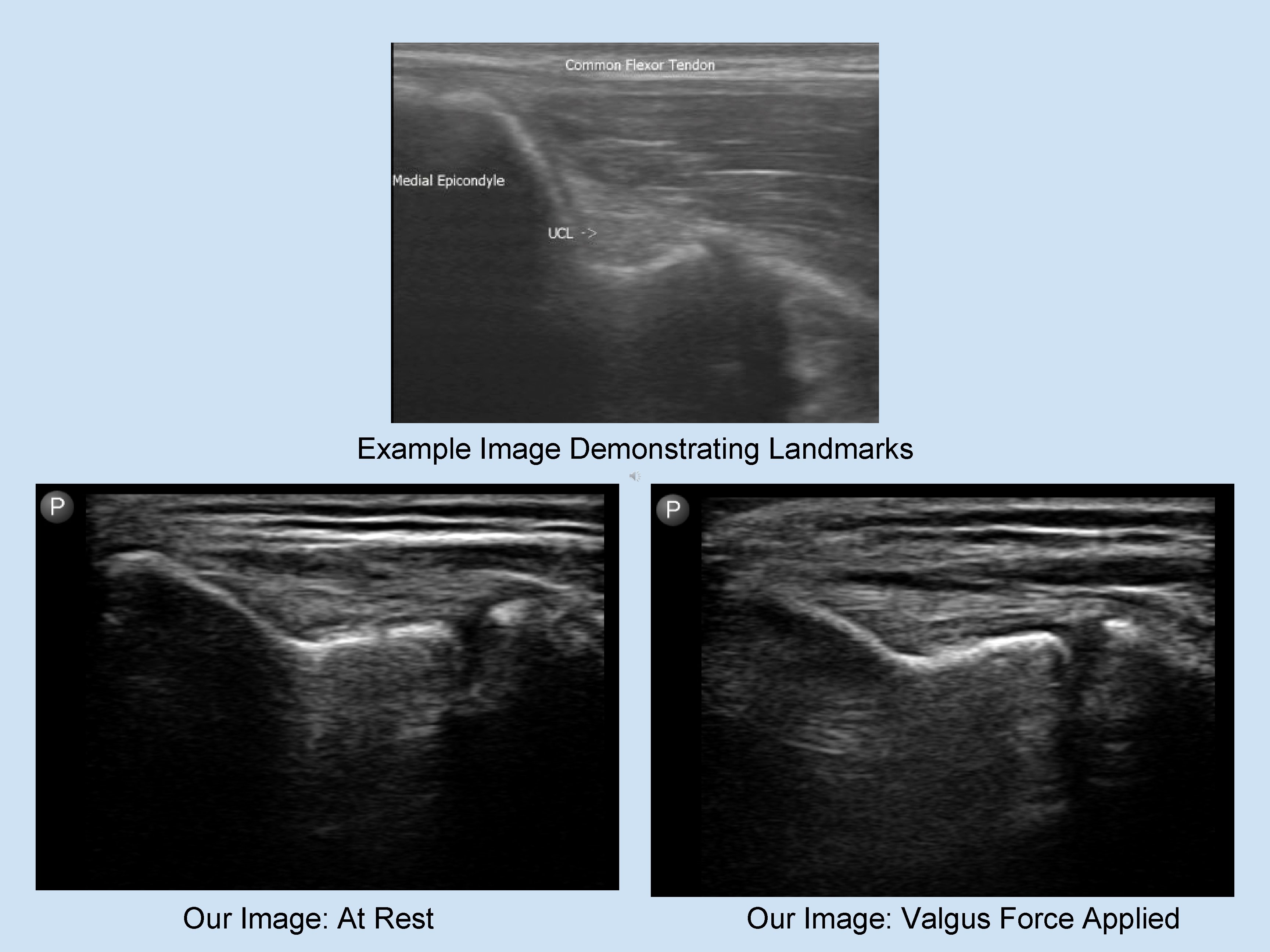
Example Image Demonstrating Landmarks Our Image: At Rest Our Image: Valgus Force Applied
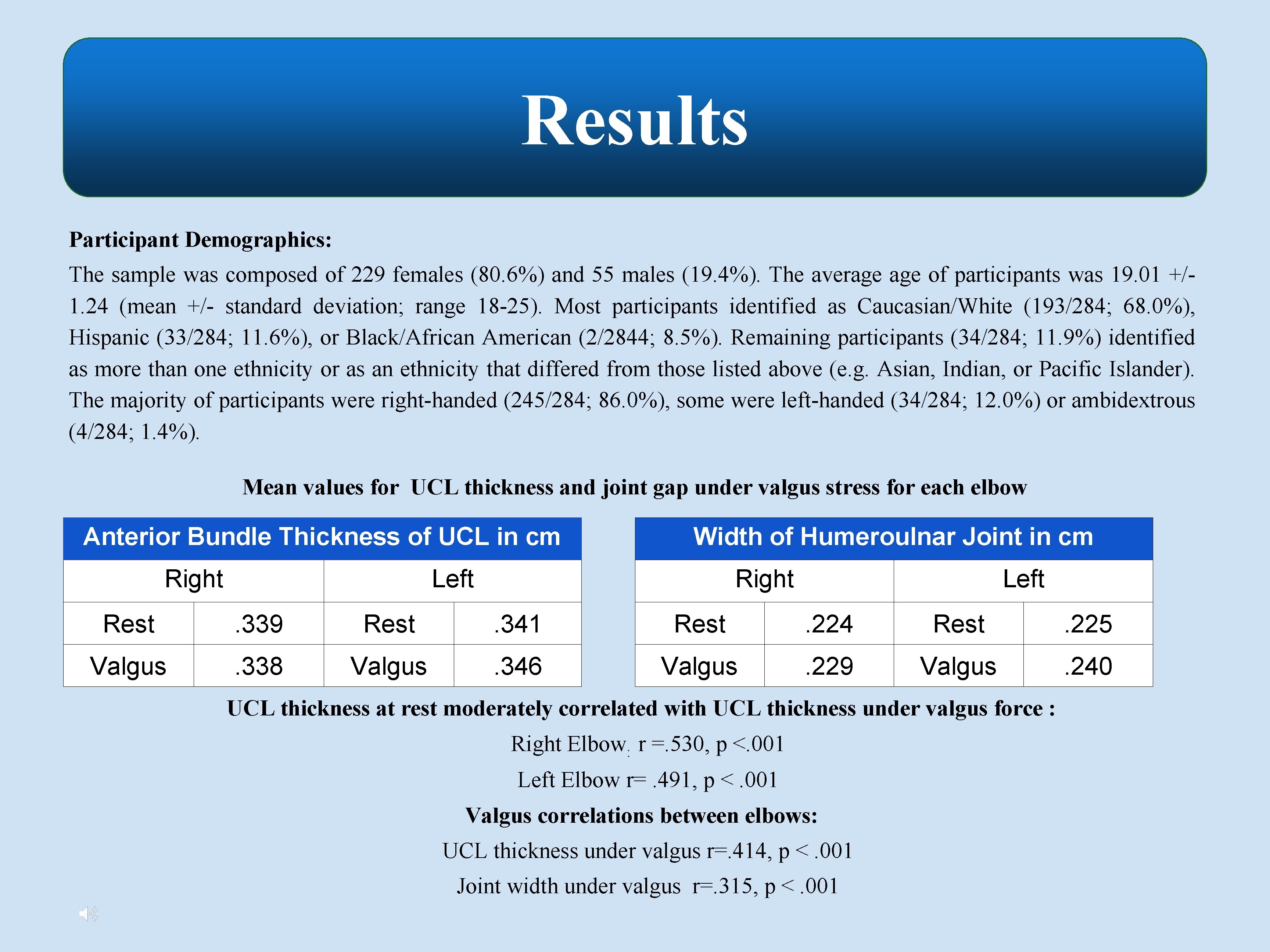
Results Participant Demographics: The sample was composed of 229 females (80. 6%) and 55 males (19. 4%). The average of participants was 19. 01 +/1. 24 (mean +/- standard deviation; range 18 -25). Most participants identified as Caucasian/White (193/284; 68. 0%), Hispanic (33/284; 11. 6%), or Black/African American (2/2844; 8. 5%). Remaining participants (34/284; 11. 9%) identified as more than one ethnicity or as an ethnicity that differed from those listed above (e. g. Asian, Indian, or Pacific Islander). The majority of participants were right-handed (245/284; 86. 0%), some were left-handed (34/284; 12. 0%) or ambidextrous (4/284; 1. 4%). Mean values for UCL thickness and joint gap under valgus stress for each elbow Anterior Bundle Thickness of UCL in cm Right Width of Humeroulnar Joint in cm Left Right Left Rest . 339 Rest . 341 Rest . 224 Rest . 225 Valgus . 338 Valgus . 346 Valgus . 229 Valgus . 240 UCL thickness at rest moderately correlated with UCL thickness under valgus force : Right Elbow: r =. 530, p <. 001 Left Elbow r=. 491, p <. 001 Valgus correlations between elbows: UCL thickness under valgus r=. 414, p <. 001 Joint width under valgus r=. 315, p <. 001
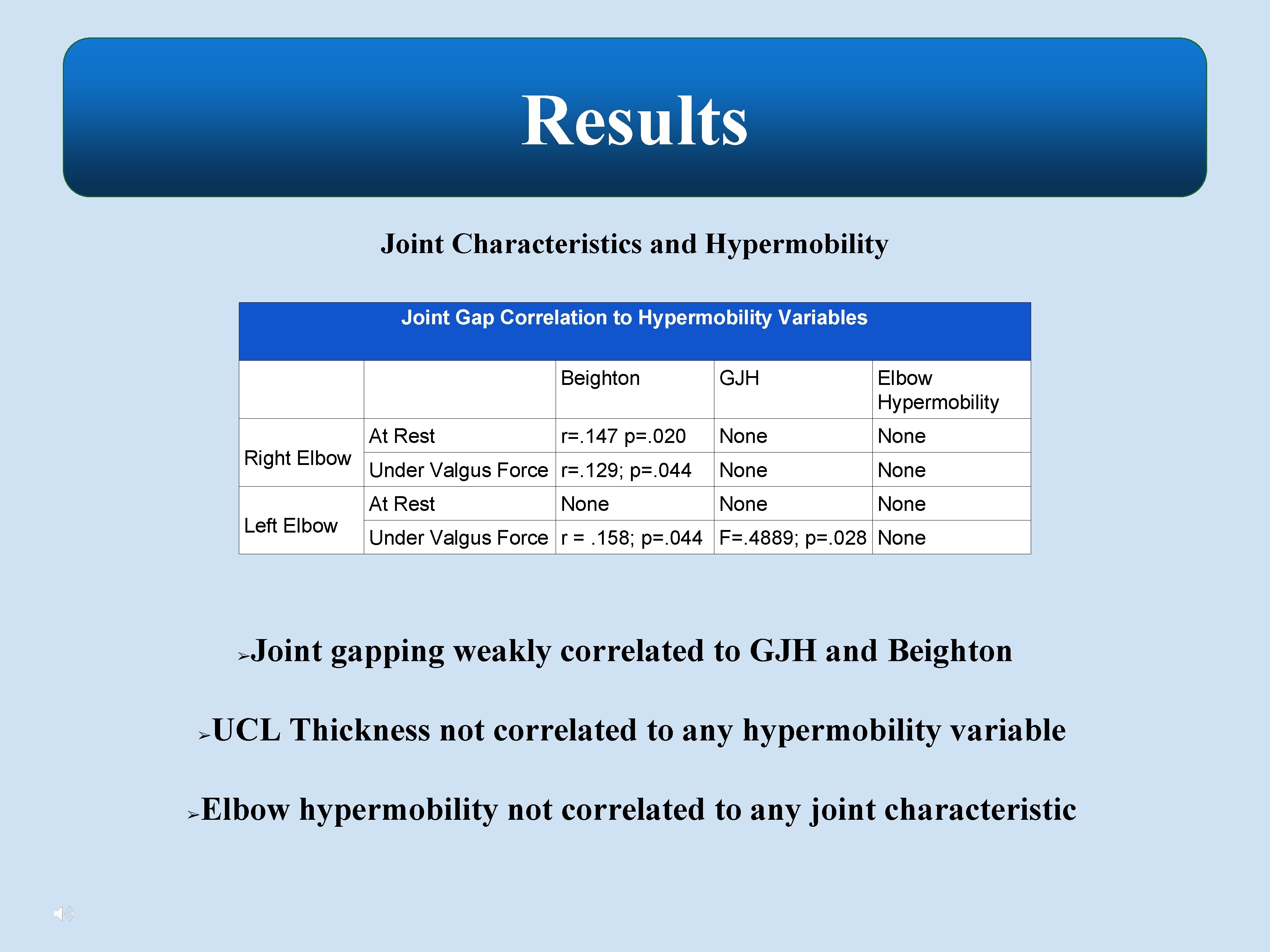
Results Joint Characteristics and Hypermobility Joint Gap Correlation to Hypermobility Variables Right Elbow Left Elbow Beighton GJH Elbow Hypermobility r=. 147 p=. 020 None Under Valgus Force r=. 129; p=. 044 None At Rest None Under Valgus Force r =. 158; p=. 044 F=. 4889; p=. 028 None Joint gapping weakly correlated to GJH and Beighton ➢ UCL Thickness not correlated to any hypermobility variable ➢ Elbow hypermobility not correlated to any joint characteristic ➢
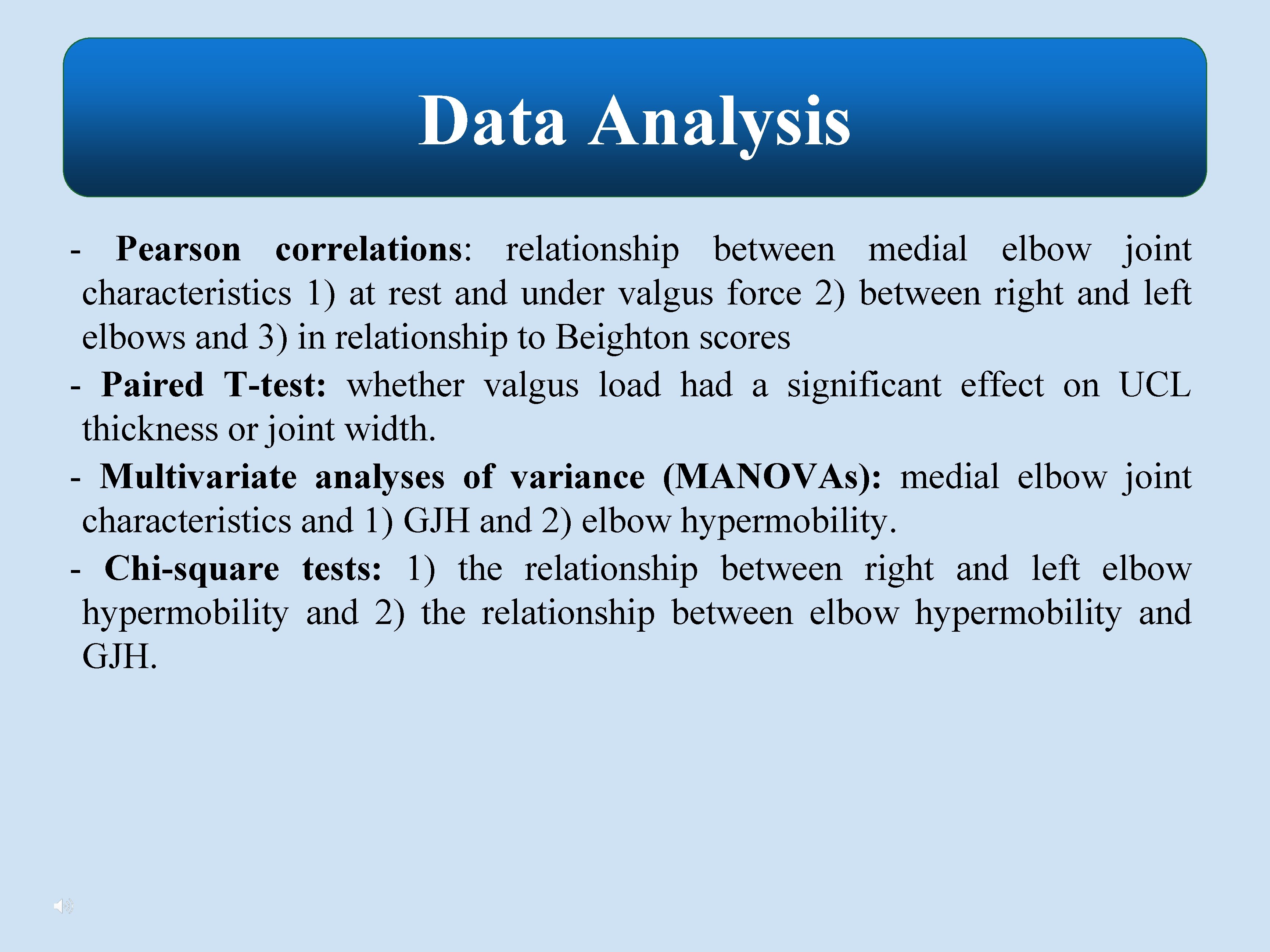
Data Analysis - Pearson correlations: relationship between medial elbow joint characteristics 1) at rest and under valgus force 2) between right and left elbows and 3) in relationship to Beighton scores - Paired T-test: whether valgus load had a significant effect on UCL thickness or joint width. - Multivariate analyses of variance (MANOVAs): medial elbow joint characteristics and 1) GJH and 2) elbow hypermobility. - Chi-square tests: 1) the relationship between right and left elbow hypermobility and 2) the relationship between elbow hypermobility and GJH.
Discussion - The mean width of the humeroulnar joint gap of our participants support results from previous studies - The width of the anterior bundle of the UCL has been reported between 4 and 7. 6 mm. Our measurements come in lower. These studies regarding UCL anterior bundle thickness are comprised primarily of cadaver studies. - Elbow hypermobility was highly correlated with overall Beighton score and with subdivided Beighton scoring into GJH and LJH categories. - We found no significant difference in anterior bundle thickness or medial elbow joint gapping in hypermobile elbows versus normal. - Our results show different relationships between the joint width of right and left elbows. - Many studies have reported differences between dominant and non-dominant arms. These studies focused on overhead throwing athletes. - The differing relationships between elbows require further explanation. The role of the common flexor tendon and hand dominance may be an important consideration.
Conclusions - Hypermobility in one elbow strongly related to hypermobility in the other - No significant difference in UCL anterior bundle thickness or joint width in participants with elbow hypermobility and those without - Beighton Score and GJH are not strongly associated with changes in medial elbow joint characteristics
References 1. Collinge R, Jane V. Hypermobility, injury rate and rehabilitation in a professional football squad – A preliminary study. Phys Ther Sport. 2009; 10(3): 91 -96. 2. Morris SL, O'Sullivan PB, Murray KJ, Bear NM, Hands B, Smith AJ. Hypermobility and musculoskeletal pain in adolescents. J Pediatr. 2016; 181(1): 213 -221. 3. Thijs KM, Blokland D, Backx FJG, Goedhart EA, Huisstede BMA. No effect of generalized joint hypermobility on injury risk in elite female soccer players: Response. Am Journal Sport Med. 2018; 46(7): 286 -293. 4. Beighton P, Solomon L, Soskolne CL. Articular mobility in an African population. Ann Rheum Dis. 1973; 32(5): 413 -418 5. Beighton, P, Horan, F. Orthopaedic aspects of the ehlers-danlos syndrome. The J Bone Joint Surg. British Volume. 1969; 51(3): 444 -453. 6. Junge T, Jespersen E, Wedderkopp N, Juul-Kristensen B. Inter-tester reproducibility and inter-method agreement of two variations of the Beighton test for determining generalised joint hypermobility in primary school children. BMC Pediatr. 2013; 13(1): 214 7. Malfait F, Francomano C, Byers P, et al. The 2017 international classification of the ehlers-danlos syndromes. Am J Med Genet C Semin Med Genet. 2017; 175(1): 8 -26. 8. Castori M, Tinkle B, Levy H, Grahame R, Malfait F, Hakim A. A framework for the classification of joint hypermobility and related conditions. Am J Med Genet C Semin Med Genet. 2017; 175(1): 148– 157 9. Wolf JM, Cameron JL, Owens BD. Impact of joint laxity and hypermobility on the musculoskeletal system. J AAOS. 2011; 19(8): 463 -471. 10. Wang H, Shultz SJ, Schmitz RJ. Association of anterior cruciate ligament width with anterior knee laxity. J Athl Train. 2016; 51(6): 460 -465. 11. Wolf JM, Schreier S, Tomsic, S, Williams A, Petersen B. Radiographic laxity of the trapeziometacarpal joint is correlated with generalized joint hypermobility. J Hand Surg. 2011; 36(7): 11651169. 12. Labott JR, Aibinder WR, Dines JS, Camp CL. Understanding the medial ulnar collateral ligament of the elbow: Review of native ligament anatomy and function. World J Orthop. 2018; 9(6): 7884. 13. Atanda A, Buckley PS, Hammoud S, Cohen SB, Nazarian, LN, Ciccotti MG. Early anatomic changes of the ulnar collateral ligament identified by stress ultrasound of the elbow in young professional baseball pitchers. The Am J Sport Med. 2015; 43(12): 2943 -2949. 14. Nazarian LN, Mc. Shane JM, Ciccotti MG, O'Kane PL, Harwood MI. Dynamic US of the anterior band of the ulnar collateral ligament of the elbow in asymptomatic major league baseball pitchers. Radiology. 2003; 227(1): 149 -154. 15. Labott JR, Aibinder WR, Dines JS, Camp CL. Understanding the medial ulnar collateral ligament of the elbow: Review of native ligament anatomy and function. World J Orthop. 2018; 9(6): 78– 84. 16. Slane L, Slane J, Scheys L. The measurement of medial knee gap width using ultrasound. Arch Orthop Trauma Surg. 2017; 137(8): 1121 -1128. 17. Wood N, Konin JG, Nofsinger C. Diagnosis of an ulnar collateral ligament tear using musculoskeletal ultrasound in a collegiate baseball pitcher: A case report. N Am J Sports Phys Ther. 2010; 5(4): 227 -233.

References 18. Smith B. The use of ultrasound imaging in assessing UCL width for college baseball pitchers. Pro. Quest Dissertations Publishing; 2016. 19. Reuter PR, Fichthorn KR. Prevalence of generalized joint hypermobility, musculoskeletal injuries, and chronic musculoskeletal pain among American university students. Peer. J. 2019; 7: e 7625. 20. FGCU fast facts. https: //www. fgcu. edu/about/fastfacts. aspx Web site. https: //www. fgcu. edu/about/fastfacts. aspx. Updated 2018. Accessed 7/16/, 2018. 21. United States Census Bureau (2018) United States census bureau quickfacts United States. 2018. https: //www. census. gov/quickfacts/fact/table/US/PST 045217 22. Alexander M, Berg JG, Bienemy C, et al. The 2017 national nursing workforce survey. J Nurs Reg. 2018; 9(3): S 1 -S 88 23. Ciccotti MC, Ciccotti MG, Cohen SB, Dodson CC, Hammoud S, Nazarian LN. Stress ultrasound evaluation of medial elbow instability in a cadaveric model. Am J Sports Med. 2014; 42(10). 2463 -2469 24. Lynch KP. Ultrasound imaging to evaluate acute adaptations of the medial elbow joint complex in college baseball pitchers. Pro. Quest Dissertations Publishing. 2018 25. Yoshida M, Goto H, Takenaga T, et al. Anterior and posterior bands of the anterior bundle in the elbow ulnar collateral ligament: ultrasound anatomy. J Shoulder Elbow Surg. 2017; 26(10): 1803 -1809 26. Dugas JR, Ostrander RV, Cain EL, Kingsley D, Andrews JR. Anatomy of the anterior bundle of the ulnar collateral ligament. J Shoulder Elbow Surg. 2007; 16(5): 657 -660. 27. Russek LN, Errico DM. Prevalence, injury rate and, symptom frequency in generalized joint laxity and joint hypermobility syndrome in a “healthy” college population. J Clin Rheumatol. 2016; 35(4): 1029– 1039. 38. Shanley E. , Smith M. , Mayer B. et al. Using stress ultrasonography to understand the risk of UCL injury among professional baseball pitchers based on ligament morphology and dynamic abnormalities. Orthop J Sports Med. 2018; 6(8). 29. Tajika T, Yamamoto A, Oya N, et al. The morphologic change of the ulnar collateral ligament of elbow in high school baseball pitchers, with and without symptoms, by sonography. J Shoulder Elbow Surg. 2016; 25(8): 1223 -1228. 30. Iurassich S, Rocco D, Aurilia A. Type III Ehlers–Danlos syndrome: correlations among clinical signs, ultrasound, and histologic findings in a study of 35 cases. Int J Dermatol. 2001; 40(3): 175178. 31. Frangiamore S, Moatshe G, Kruckeber B, et al. Qualitative and quantitative analyses of the dynamic and static stabilizers of the medial elbow: an anatomic study. Am J Sports Med. 2018; 46(3): 687 -694. 32. Myers JB, Pexa BS, Ryan ED. Medial elbow joint space increases with valgus stress and decreases when cued to perform a maximal grip contraction. Am J Sports Med. 2018; 46(5): 11141119. 33. Hsu J, Koh J, Li-Qun Zhang, Peng Q, Schafer D. Mechanical actions of individual muscles at the human elbow joint and their roles in protecting/unloading the ulnar collateral ligament. Conf Proc IEEE Eng Med Biol Soc. 2004; 2004: 4704 -4705 34. Cho M, Choi K, Kim J, et al. Evaluation of subjective perceived rating for grip strength depending on handedness for various target force levels. Work. 2019; 62(1): 21 -26
- Slides: 12