
CorrelatedGroups and SingleSubject Designs Graziano and Raulin Research
Correlated-Groups and Single-Subject Designs Graziano and Raulin Research Methods: Chapter 11 This multimedia product and its contents are protected under copyright law. The following are prohibited by law: (1) Any public performance or display, including transmission of any image over a network; (2) Preparation of any derivative work, including the extraction, in whole or in part, of any images; (3) Any rental, lease, or lending of the program. Copyright © Allyn & Bacon (2007)
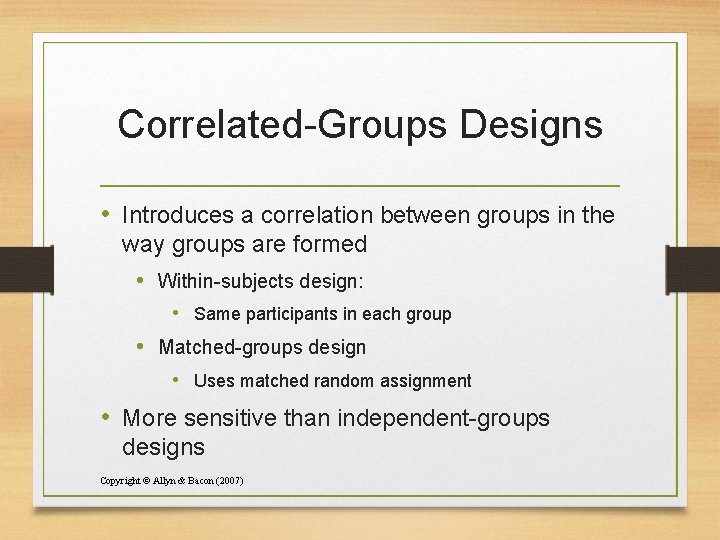
Correlated-Groups Designs • Introduces a correlation between groups in the way groups are formed • Within-subjects design: • Same participants in each group • Matched-groups design • Uses matched random assignment • More sensitive than independent-groups designs Copyright © Allyn & Bacon (2007)
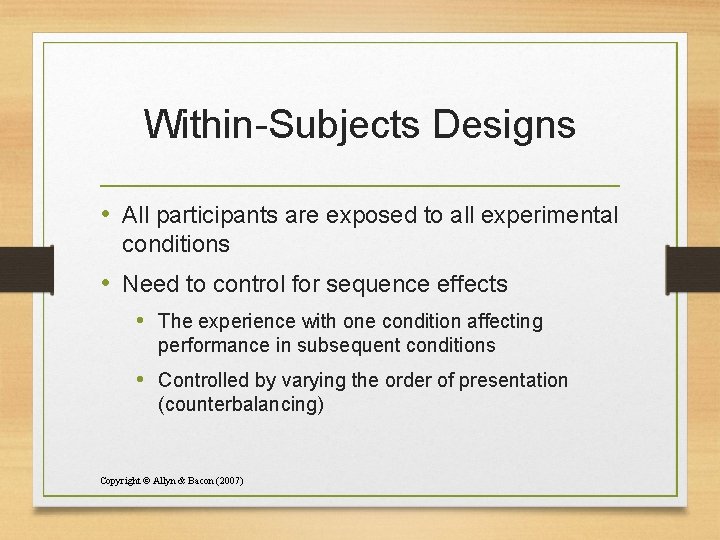
Within-Subjects Designs • All participants are exposed to all experimental conditions • Need to control for sequence effects • The experience with one condition affecting performance in subsequent conditions • Controlled by varying the order of presentation (counterbalancing) Copyright © Allyn & Bacon (2007)
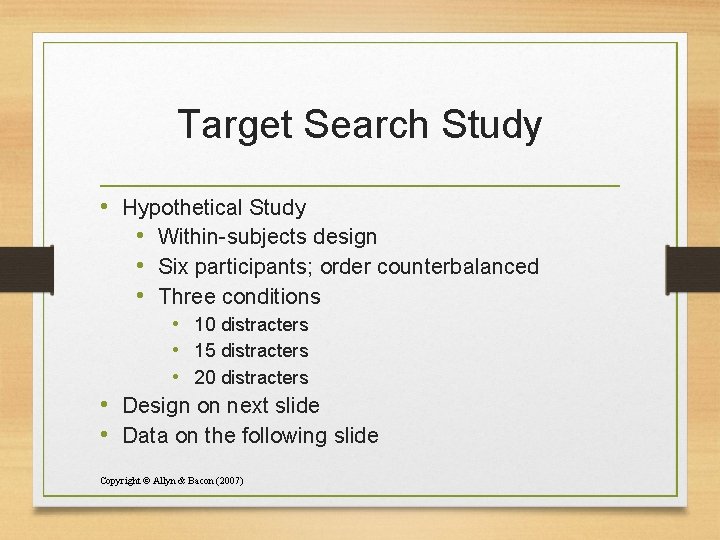
Target Search Study • Hypothetical Study • Within-subjects design • Six participants; order counterbalanced • Three conditions • 10 distracters • 15 distracters • 20 distracters • Design on next slide • Data on the following slide Copyright © Allyn & Bacon (2007)

Within-Subjects Design Example Copyright © Allyn & Bacon (2007)
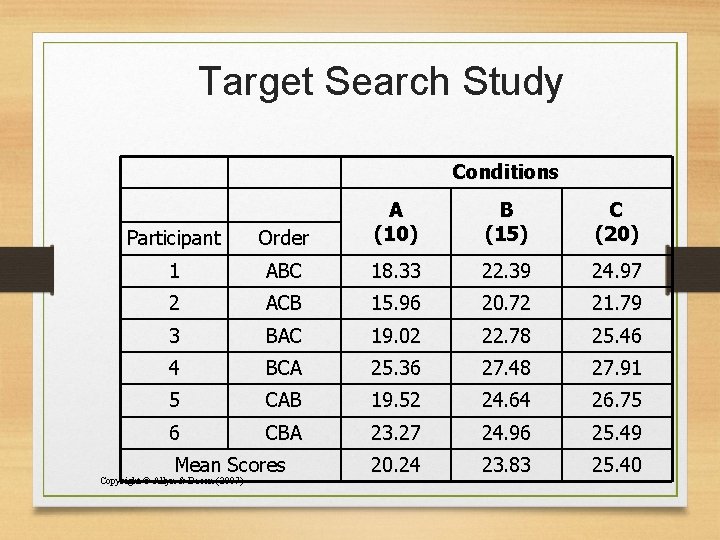
Target Search Study Conditions Participant Order A (10) 1 ABC 18. 33 22. 39 24. 97 2 ACB 15. 96 20. 72 21. 79 3 BAC 19. 02 22. 78 25. 46 4 BCA 25. 36 27. 48 27. 91 5 CAB 19. 52 24. 64 26. 75 6 CBA 23. 27 24. 96 25. 49 20. 24 23. 83 25. 40 Mean Scores Copyright © Allyn & Bacon (2007) B (15) C (20)
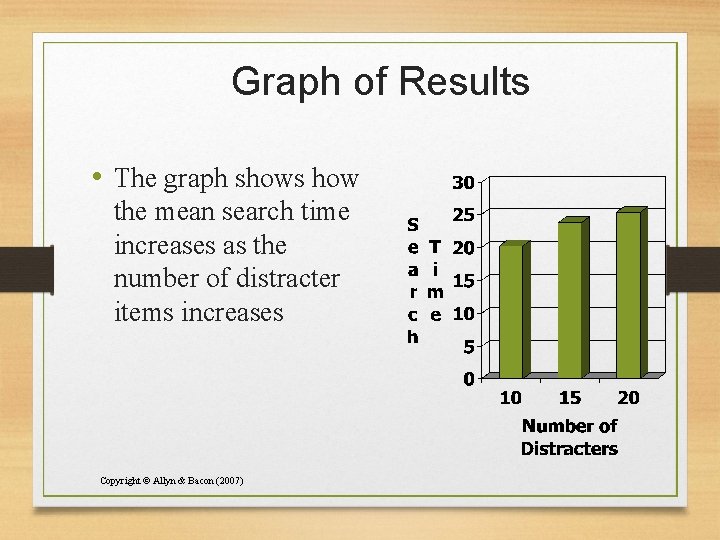
Graph of Results • The graph shows how the mean search time increases as the number of distracter items increases Copyright © Allyn & Bacon (2007)
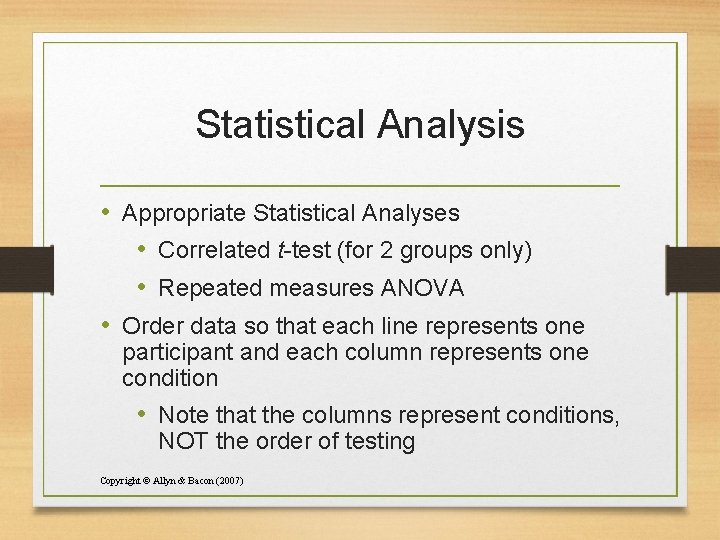
Statistical Analysis • Appropriate Statistical Analyses • Correlated t-test (for 2 groups only) • Repeated measures ANOVA • Order data so that each line represents one participant and each column represents one condition • Note that the columns represent conditions, NOT the order of testing Copyright © Allyn & Bacon (2007)
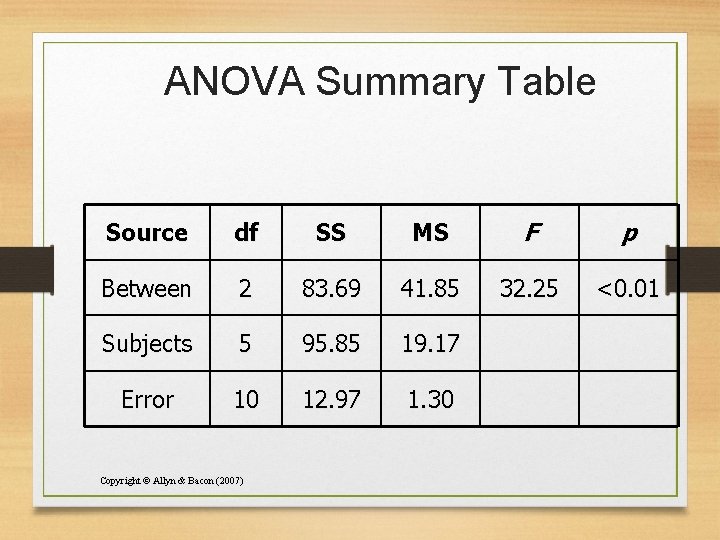
ANOVA Summary Table Source df SS MS F p Between 2 83. 69 41. 85 32. 25 <0. 01 Subjects 5 95. 85 19. 17 Error 10 12. 97 1. 30 Copyright © Allyn & Bacon (2007)
Within-Subjects Strengths • More sensitive to small group differences • The variability due to individual differences is statistically eliminated • Fewer participants are needed • Each participant appears in each condition • Instructions may take less time • Participants were already instructed on the task in previous conditions Copyright © Allyn & Bacon (2007)
Within-Subjects Weaknesses • Because participants experience all conditions, they may figure out the hypothesis (potential subject effects) • Major issue is sequence effects • Practice and carry-over effects • Controlled by varying the order of presentation • Counterbalancing • Random order of presentation • Latin square design Copyright © Allyn & Bacon (2007)
Matched-Subjects Designs • Introduces correlation through matched random assignment • Should match on “relevant” variables • Variables that affect the dependent variable • Variables that show considerable natural variation in the population sampled Copyright © Allyn & Bacon (2007)
Matching Participants • Match participants in sets • Set size is equal to the number of conditions • Matching gets more difficult as: • The number of matching variables increases • Matching is done on continuous variables • The number of conditions increase • Once sets are matched, randomly assign participants in the set to the conditions Copyright © Allyn & Bacon (2007)
Statistical Analysis • Analyze as if it were a within-subjects study • Data from matched participants are organized as if the data came from a single participant • Act as if the number of participants was equal to the actual number of participants divided by the number of conditions Copyright © Allyn & Bacon (2007) (e. g. , for 40 participants and 4 conditions, tell the program that you had 10 participants and 4 conditions in
Strengths and Weaknesses • Strengths • Increased sensitivity to group differences • No sequence effects • Weaknesses • Extra work of matching participants • Participants without appropriate matches cannot be used in the study Copyright © Allyn & Bacon (2007)
Single-Subject Designs • Extensions of within-subjects designs • Single participant tested under all conditions, with the researcher actively manipulating the independent variable • Variation on time-series designs, with repeated measurement of the dependent variable Copyright © Allyn & Bacon (2007)
History of these Designs • Intensive studies of individuals was common before R. A. Fisher • Fisher’s development of ANOVA changed the focus of psychology to comparing groups of individuals • Skinner was one of the few psychologists who advocated the intensive study of individuals Copyright © Allyn & Bacon (2007)
Logic of these Designs • Includes independent variable manipulation • Expect dependent variable response • Note that the response must occur shortly after the manipulation unless there is a theoretical reason to expect a delay • Multiple measures before and after the manipulation to identify normal variation and rule out regression to the mean Copyright © Allyn & Bacon (2007)
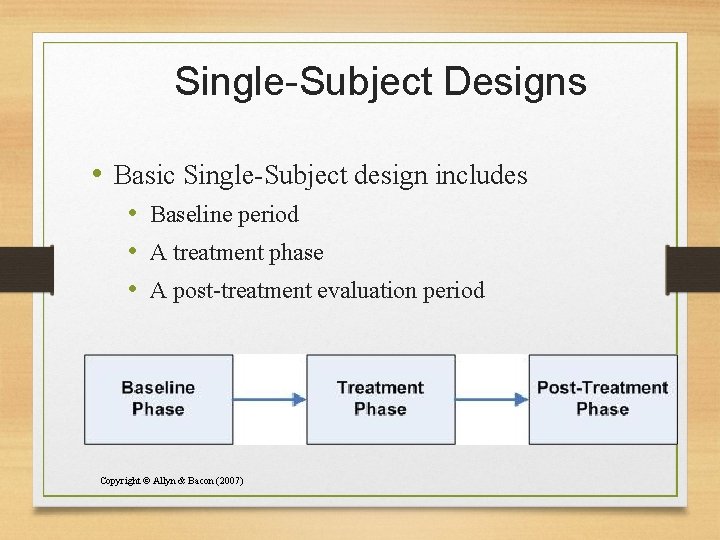
Single-Subject Designs • Basic Single-Subject design includes • Baseline period • A treatment phase • A post-treatment evaluation period Copyright © Allyn & Bacon (2007)
Types of Designs • ABA Reversal Design • Multiple Baseline Design • Single-Subject, Randomized, Time-Series Design Copyright © Allyn & Bacon (2007)
Reversal Design • LOGIC • Apply, then remove, independent variable manipulation • If change occurs at both application and removal, it suggests a causal connection • PROCEDURES • Baseline measures (Condition A) • Treatment application (Condition B) • Return to baseline (Condition A again) • Additional reversals can be included Copyright © Allyn & Bacon (2007)
Reversal Design Example • Reversal conditions • Condition A: attending to self-stimulation • Condition B: withdrawing attention when selfstimulation occurs • Hypothetical results (next slide) suggests that attention does influence self-stimulation • Ethics requires return to Condition B Copyright © Allyn & Bacon (2007)
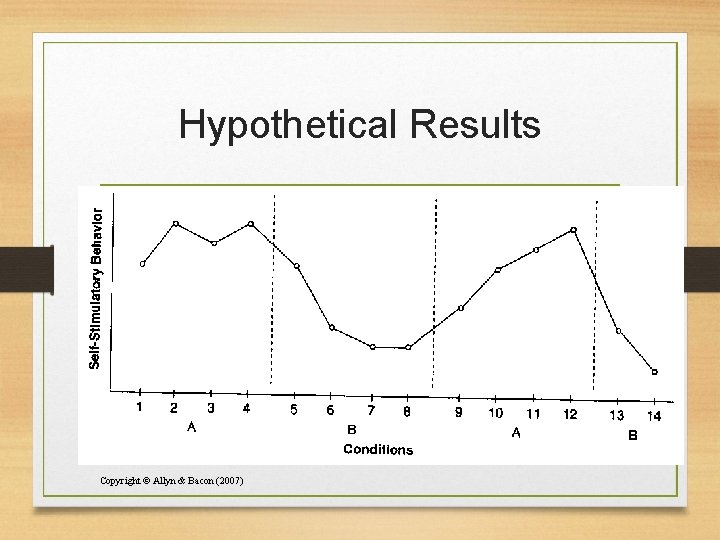
Hypothetical Results Copyright © Allyn & Bacon (2007)
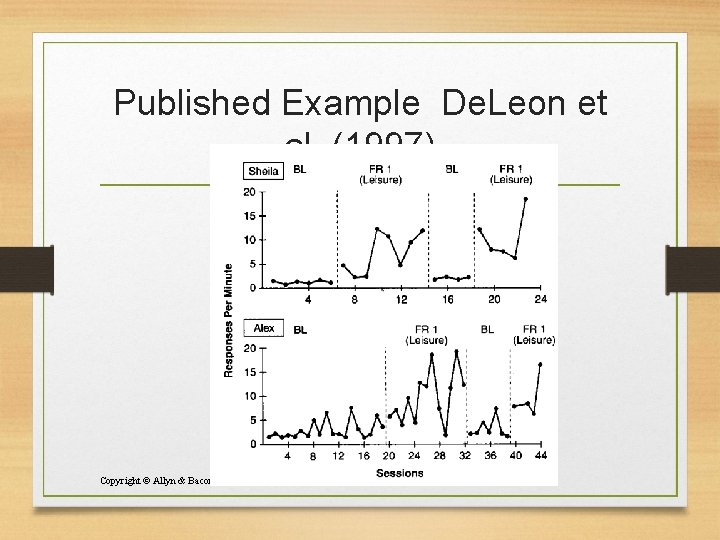
Published Example De. Leon et al. (1997) Copyright © Allyn & Bacon (2007)
Multiple Baseline Design • LOGIC • Show the effect of the independent variable on several dependent variables • Use when • Reversals are undesirable • Behavioral changes would not reverse Copyright © Allyn & Bacon (2007) • PROCEDURES • Baseline • Manipulation focused on first dependent variable • Manipulation focused on second dependent variable • …and so on
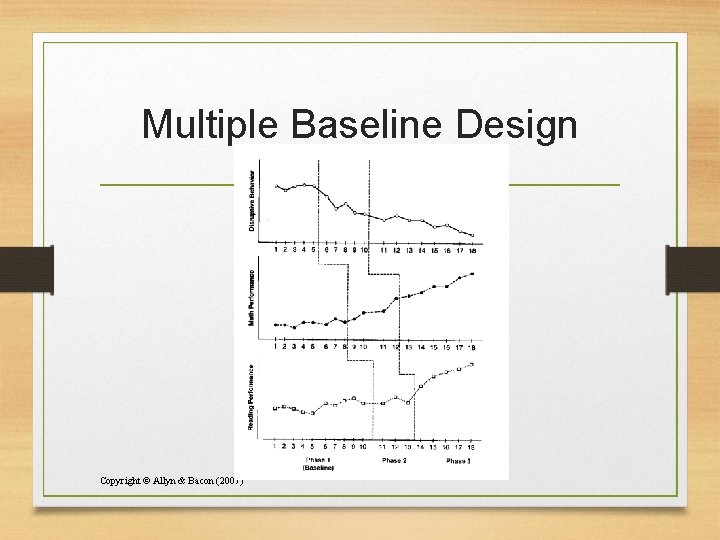
Multiple Baseline Design Copyright © Allyn & Bacon (2007)
Variations on Multiple Baseline Design • Across Behaviors • Testing effects on different behaviors • Across Individuals • Testing effects on different people • Across Settings and Time • Testing effects in different settings or at different times Copyright © Allyn & Bacon (2007)
Single-Subject, Randomized Time-Series Design • LOGIC • Repeated measures of the dependent variable interrupted by a randomly placed intervention • If change occurs at the point of intervention, it suggests a causal connection Copyright © Allyn & Bacon (2007) • PROCEDURES • Select minimum baseline and follow-up periods • Randomly select the point of intervention • Compare pattern of scores before and after the intervention
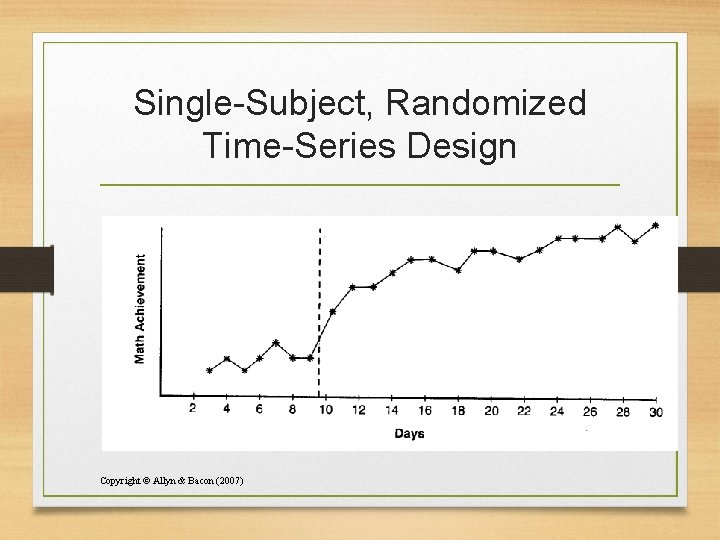
Single-Subject, Randomized Time-Series Design Copyright © Allyn & Bacon (2007)
Replicating Single-Subject Experiments • Direct replication • Repeating study on the same target behavior • Systematic replication • Evaluate procedures across subjects, settings, and/or target behaviors • Clinical replication • Combining procedures into a treatment “package” Copyright © Allyn & Bacon (2007)
Summary • Can introduce a correlation in two ways • Within-subjects and matched-subjects designs • These designs are more sensitive to small differences between groups • The costs for the greater sensitivity are: • Sequence effects (within-subjects design) • Matching difficulties (matched-subjects design) • Single-subject designs allow the experimental manipulation of variables Copyright © Allyn & Bacon (2007)
- Slides: 31