
Correctness Until now Weve seen how to define
- Slides: 45
Correctness
Until now • We’ve seen how to define dataflow analyses • How do we know our analyses are correct? • We could reason about each individual analysis one a time • However, a unified framework would make proofs easier to develop and understand
Abstract interpretation • Abstract interpretation is such a framework • Life in analysis-land is all about two things: – fixed points – and approximations • In most general terms, abstract interpretation is a theory of fixed point approximation • Abstract interpretation is very flexible, and it has been applied to many domains
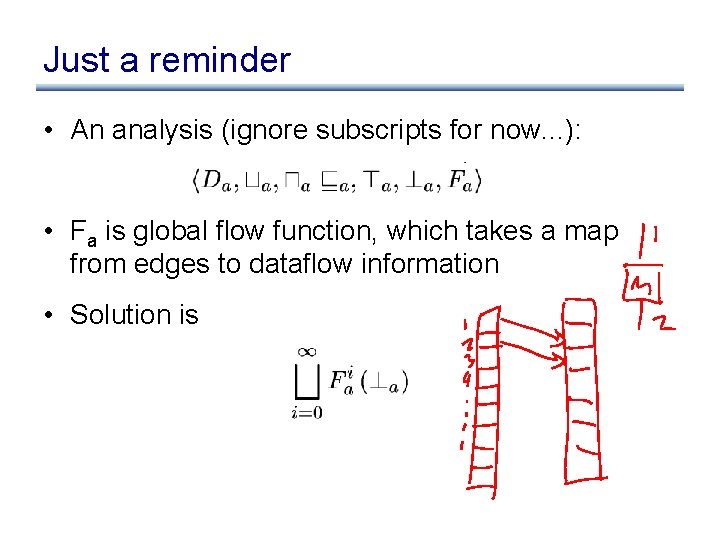
Just a reminder • An analysis (ignore subscripts for now. . . ): • Fa is global flow function, which takes a map from edges to dataflow information • Solution is
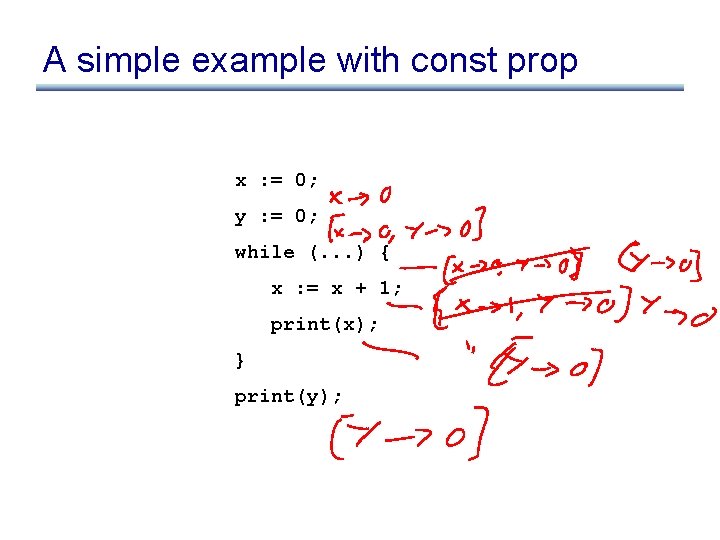
A simple example with const prop x : = 0; y : = 0; while (. . . ) { x : = x + 1; print(x); } print(y);
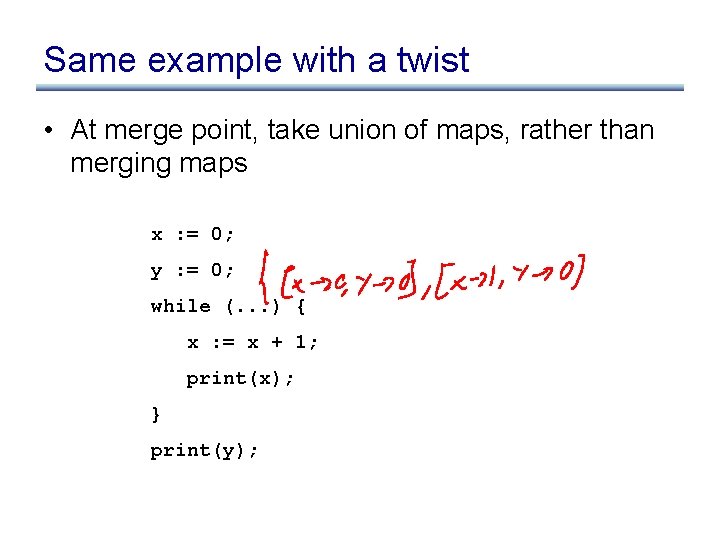
Same example with a twist • At merge point, take union of maps, rather than merging maps x : = 0; y : = 0; while (. . . ) { x : = x + 1; print(x); } print(y);
What exactly is going on? (discussion)
What exactly is going on? • Well, to begin with, our analysis doesn’t terminate anymore. . . • We are keeping much more information around • In fact, we are. . . • . . . running the program
Excursion into semantics land • Semantics of a programming language – captures how instructions of a programming language operate • vs. semantics of a program – captures how a given program runs
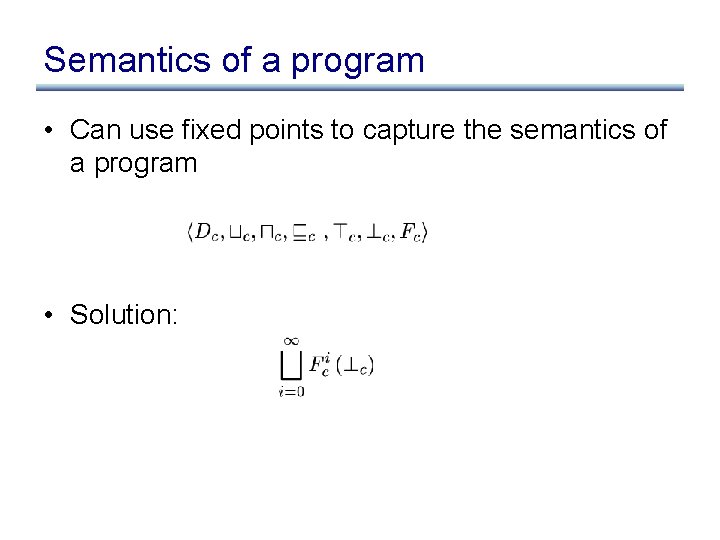
Semantics of a program • Can use fixed points to capture the semantics of a program • Solution:
Semantics of a program • Back to our const prop example • What were we computing?
Semantics of a program • Back to our const prop example • What were we computing? • Set of all program states at a given CFG edge • This fixed point is not computable, but we never compute it. We only reason about it.
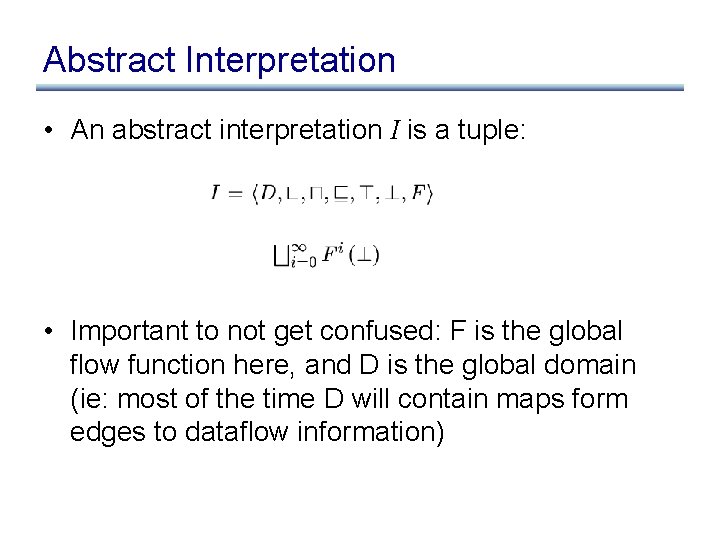
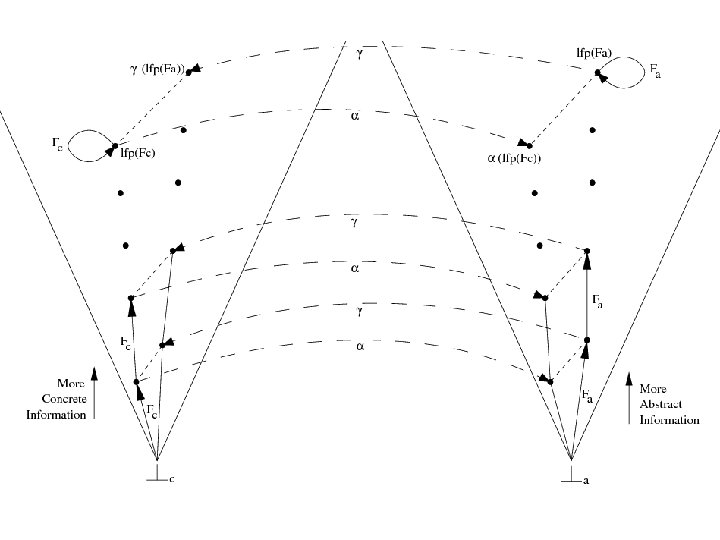
Abstract Interpretation • An abstract interpretation I is a tuple: • Important to not get confused: F is the global flow function here, and D is the global domain (ie: most of the time D will contain maps form edges to dataflow information)
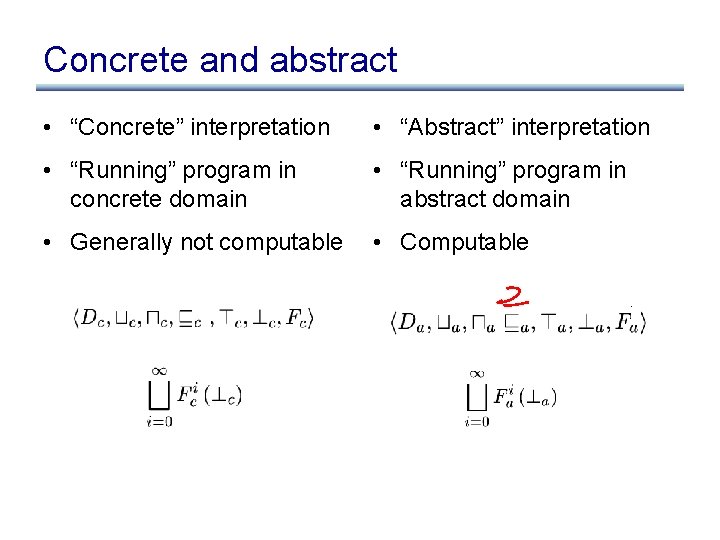
Concrete and abstract • “Concrete” interpretation • “Abstract” interpretation • “Running” program in concrete domain • “Running” program in abstract domain • Generally not computable • Computable
Concrete and abstract • Recall I is an abstract interpretation • So we should really be saying “concrete” abstract interpretation, and “abstract” abstract interpretation. • So even the concrete interpretation is called abstract. . . • Anyone confused yet?
Concrete and abstract • Ok, so why is the “concrete” interpretation a “concrete” abstract interpretation • Because all interpretations are in some way or another abstractions of the program • In fact, even our so-called “concrete” interpretation can be seen as “abstract” when compared to other interpretation
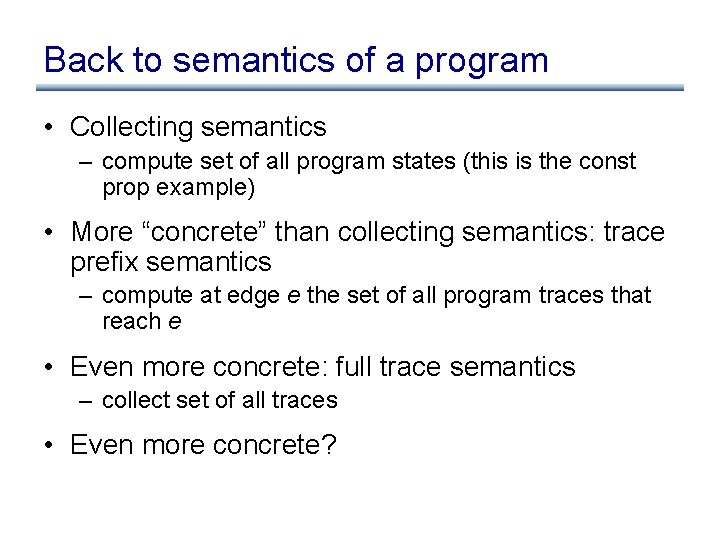
Back to semantics of a program • Collecting semantics – compute set of all program states (this is the const prop example) • More “concrete” than collecting semantics: trace prefix semantics – compute at edge e the set of all program traces that reach e • Even more concrete: full trace semantics – collect set of all traces • Even more concrete?
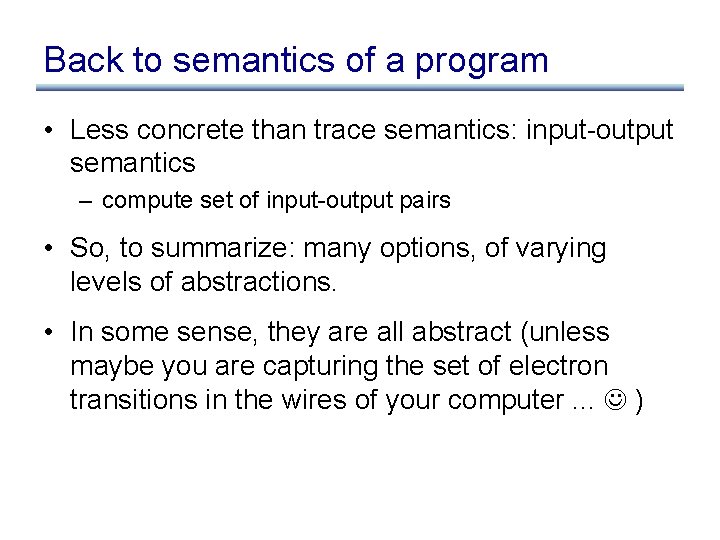
Back to semantics of a program • Less concrete than trace semantics: input-output semantics – compute set of input-output pairs • So, to summarize: many options, of varying levels of abstractions. • In some sense, they are all abstract (unless maybe you are capturing the set of electron transitions in the wires of your computer. . . )
Back to semantics of a program • Choosing the right concrete semantics is actually important: it affects what you are proving about the program • But the key is that all can be expressed as a fixed point computation
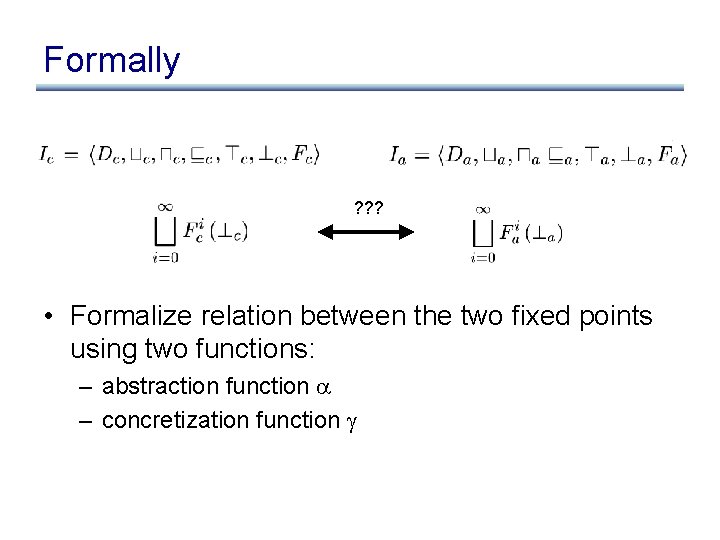
Correctness • Ok, so now we have two fixed point computations Ic and Ia. • Ic is the precise semantics of our program, but it’s not computable. So we compute Ia instead. Ia is computable, but. . . is it meaningfull? • In other words does Ia in fact tell us something about Ic? • We now want to show that the abstract fixed point is in fact meaningful, in that it approximates the concrete one.
Formally ? ? ? • Formalize relation between the two fixed points using two functions: – abstraction function – concretization function
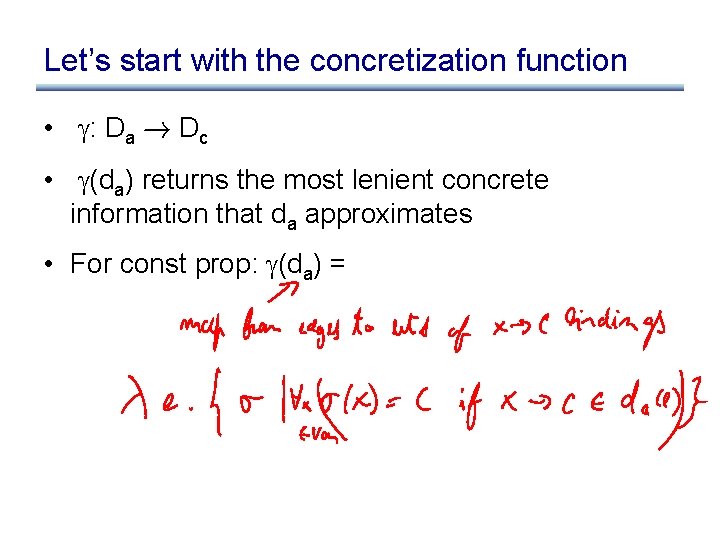
Let’s start with the concretization function • : Da ! Dc • (da) returns the most lenient concrete information that da approximates • For const prop: (da) =
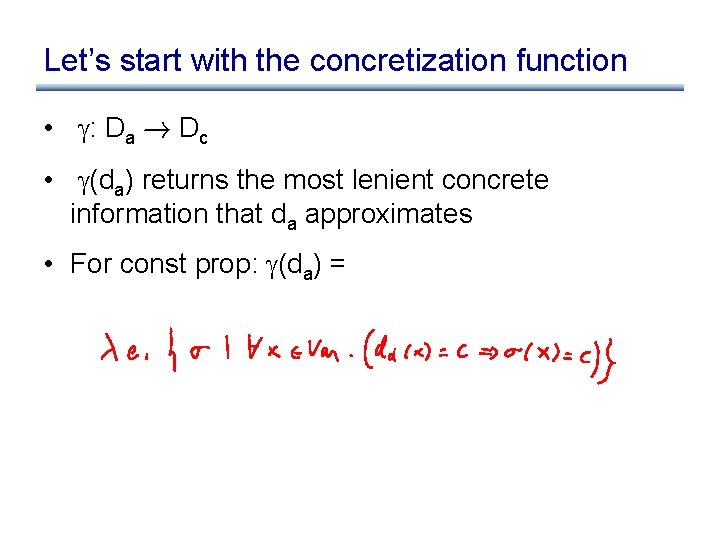
Let’s start with the concretization function • : Da ! Dc • (da) returns the most lenient concrete information that da approximates • For const prop: (da) =
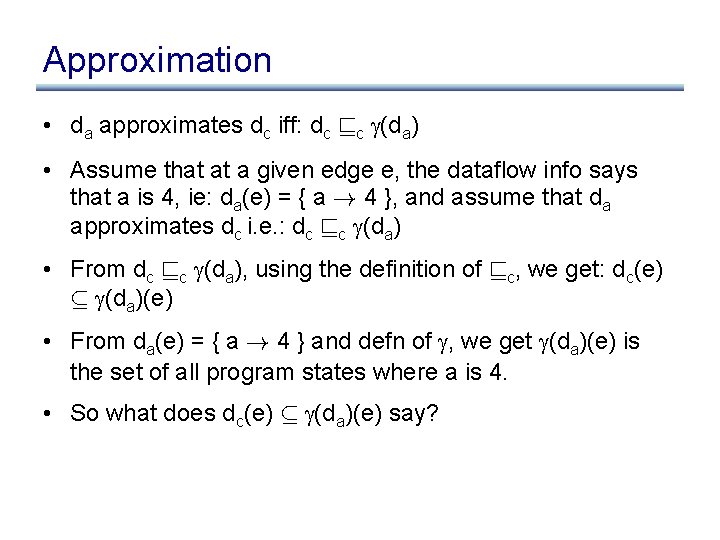
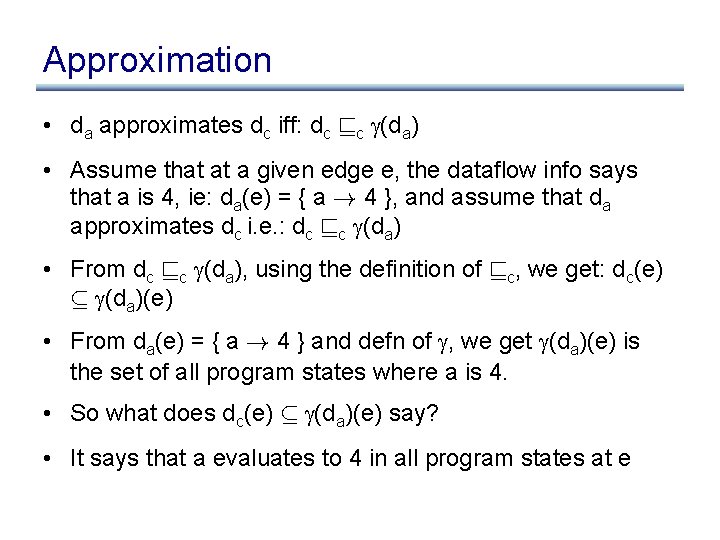
Approximation • da approximates dc iff: dc vc (da) • Assume that at a given edge e, the dataflow info says that a is 4, ie: da(e) = { a ! 4 }, and assume that da approximates dc i. e. : dc vc (da) • From dc vc (da), using the definition of vc, we get: dc(e) µ (da)(e) • From da(e) = { a ! 4 } and defn of , we get (da)(e) is the set of all program states where a is 4. • So what does dc(e) µ (da)(e) say?
Approximation • da approximates dc iff: dc vc (da) • Assume that at a given edge e, the dataflow info says that a is 4, ie: da(e) = { a ! 4 }, and assume that da approximates dc i. e. : dc vc (da) • From dc vc (da), using the definition of vc, we get: dc(e) µ (da)(e) • From da(e) = { a ! 4 } and defn of , we get (da)(e) is the set of all program states where a is 4. • So what does dc(e) µ (da)(e) say? • It says that a evaluates to 4 in all program states at e
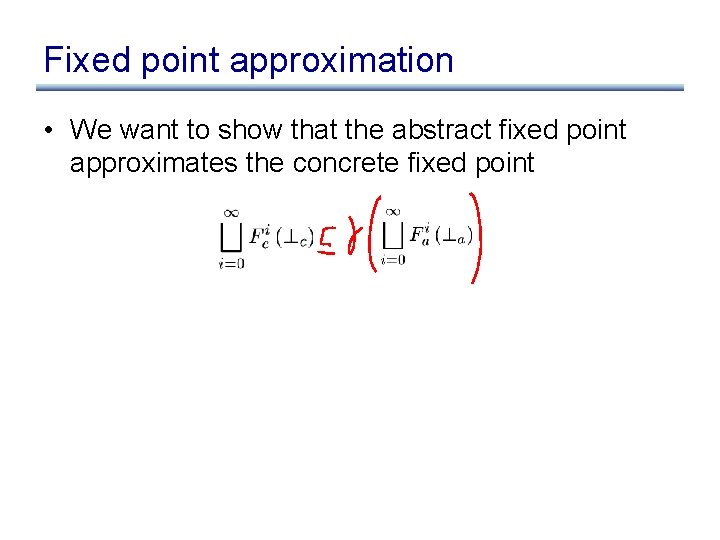
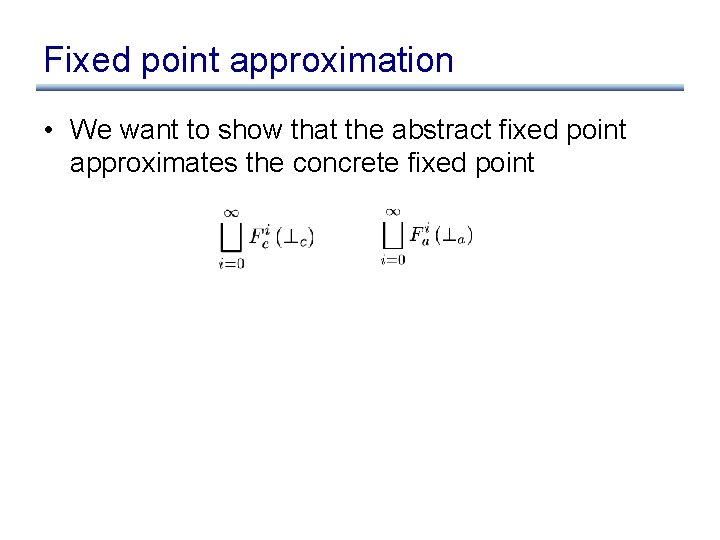
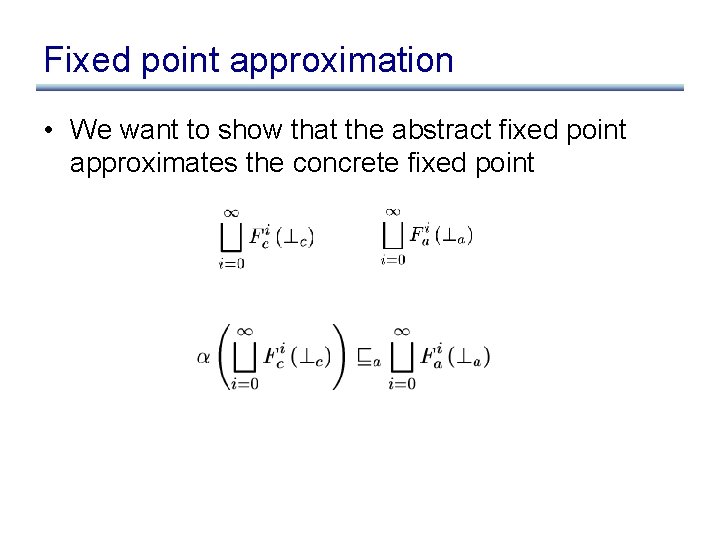
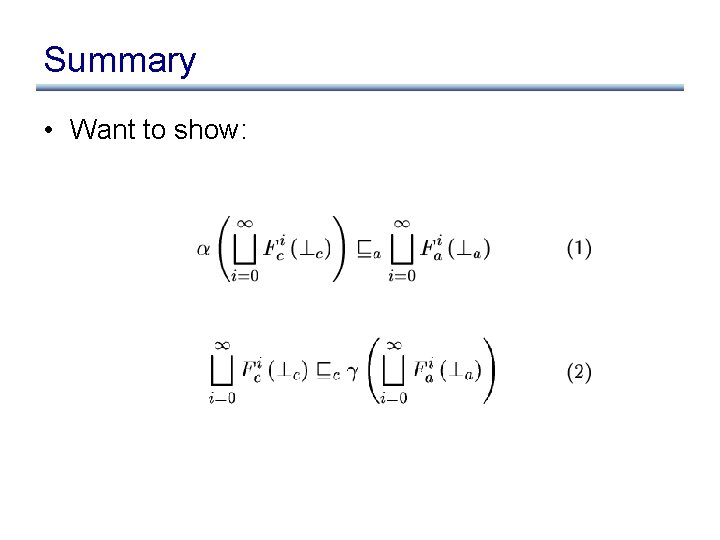
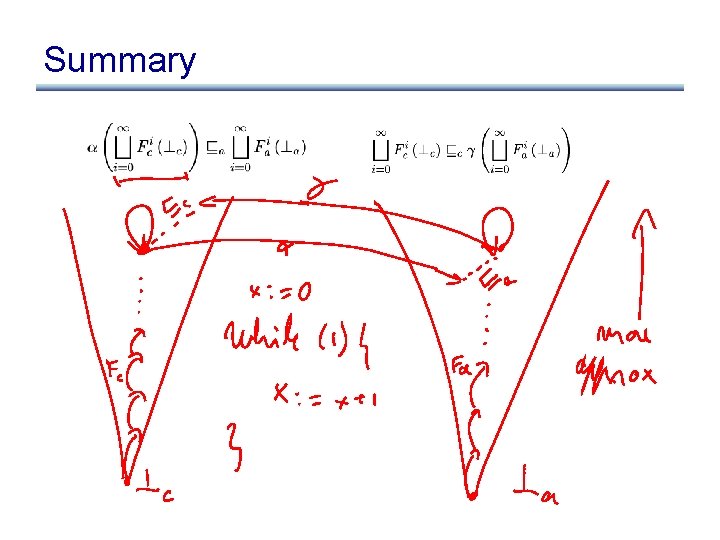
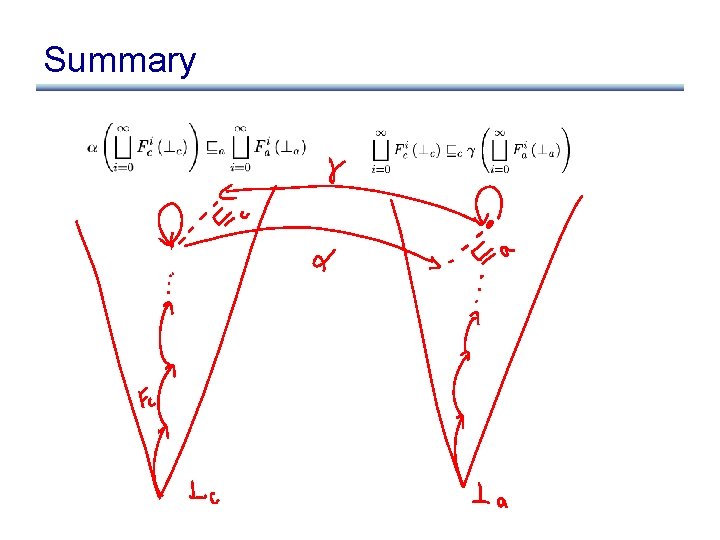
Fixed point approximation • We want to show that the abstract fixed point approximates the concrete fixed point
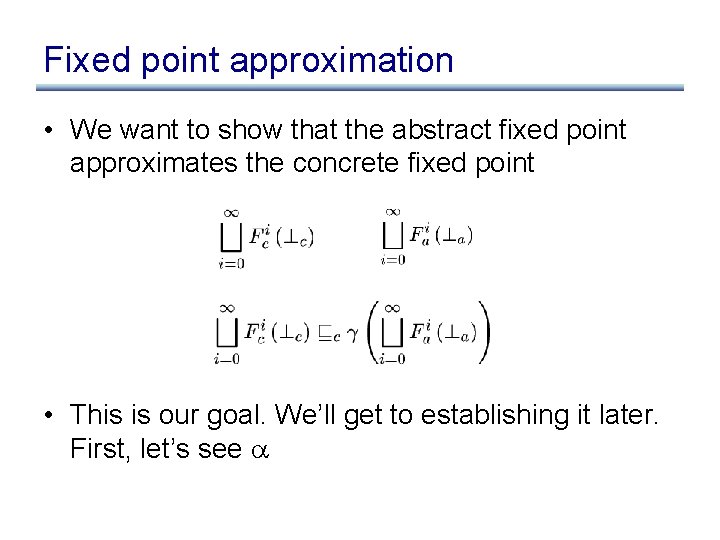
Fixed point approximation • We want to show that the abstract fixed point approximates the concrete fixed point • This is our goal. We’ll get to establishing it later. First, let’s see
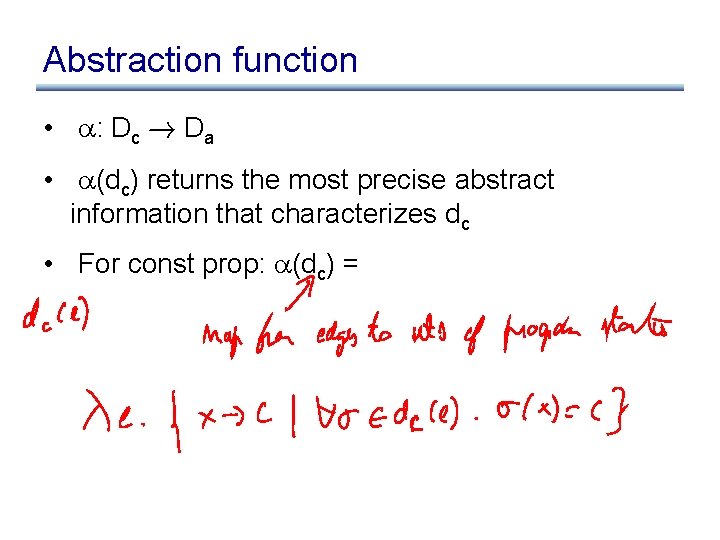
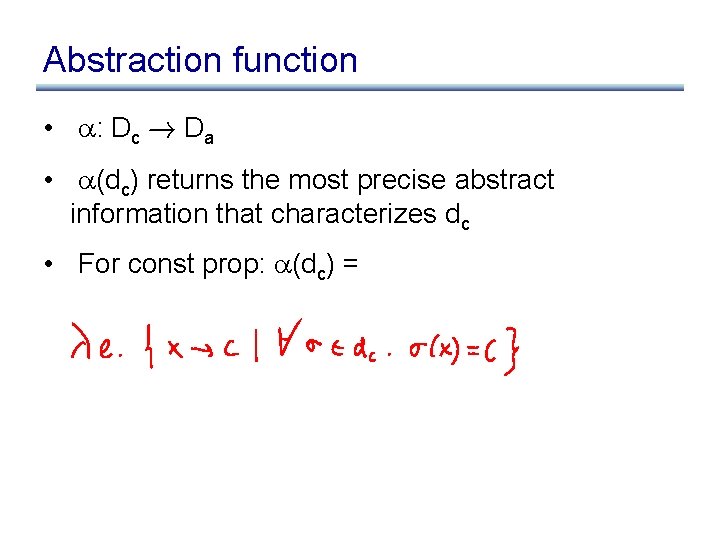
Abstraction function • : Dc ! Da • (dc) returns the most precise abstract information that characterizes dc • For const prop: (dc) =
Abstraction function • : Dc ! Da • (dc) returns the most precise abstract information that characterizes dc • For const prop: (dc) =
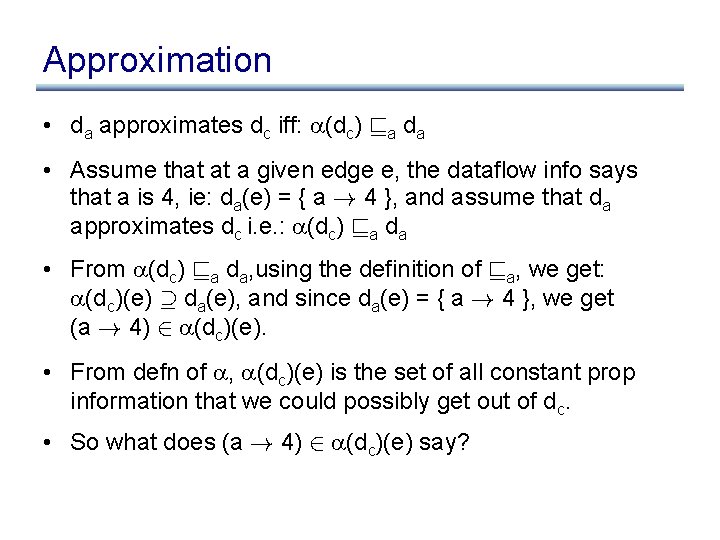
Approximation • da approximates dc iff: (dc) va da • Assume that at a given edge e, the dataflow info says that a is 4, ie: da(e) = { a ! 4 }, and assume that da approximates dc i. e. : (dc) va da • From (dc) va da, using the definition of va, we get: (dc)(e) ¶ da(e), and since da(e) = { a ! 4 }, we get (a ! 4) 2 (dc)(e). • From defn of , (dc)(e) is the set of all constant prop information that we could possibly get out of dc. • So what does (a ! 4) 2 (dc)(e) say?
Fixed point approximation • We want to show that the abstract fixed point approximates the concrete fixed point
Fixed point approximation • We want to show that the abstract fixed point approximates the concrete fixed point
Summary • Want to show:
Summary
Summary
Problem • The above conditions are global: they talk about the fixed point computation • We want some local conditions on Fa and Fc
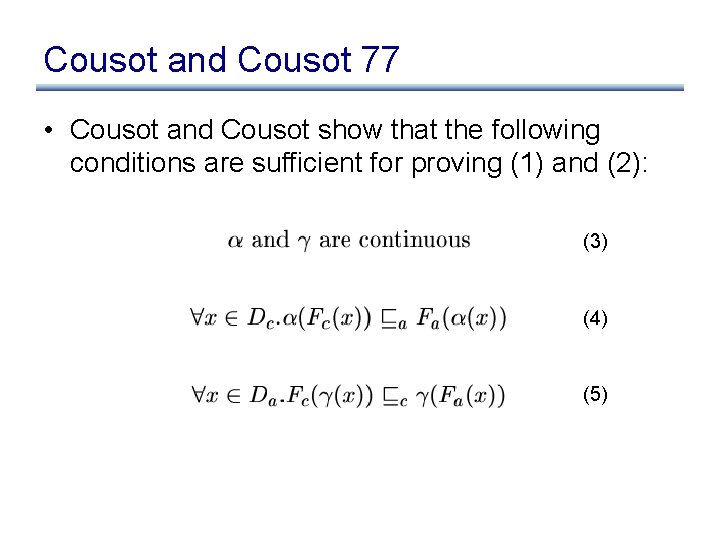
Cousot and Cousot 77 • Cousot and Cousot show that the following conditions are sufficient for proving (1) and (2): (3) (4) (5)
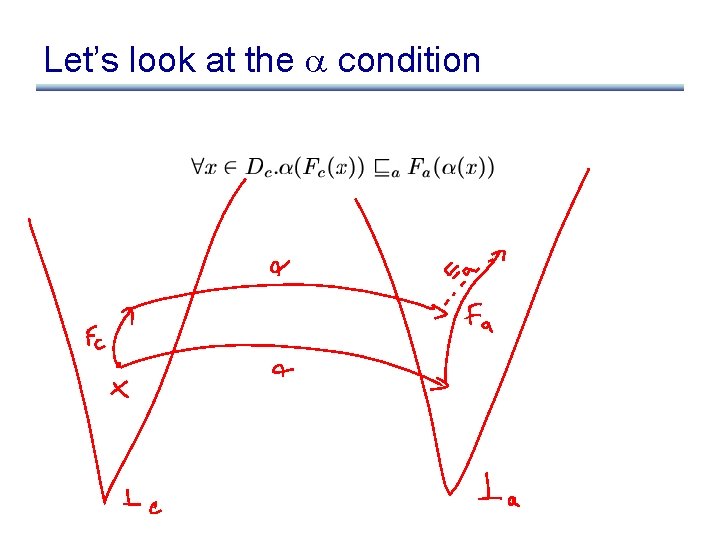
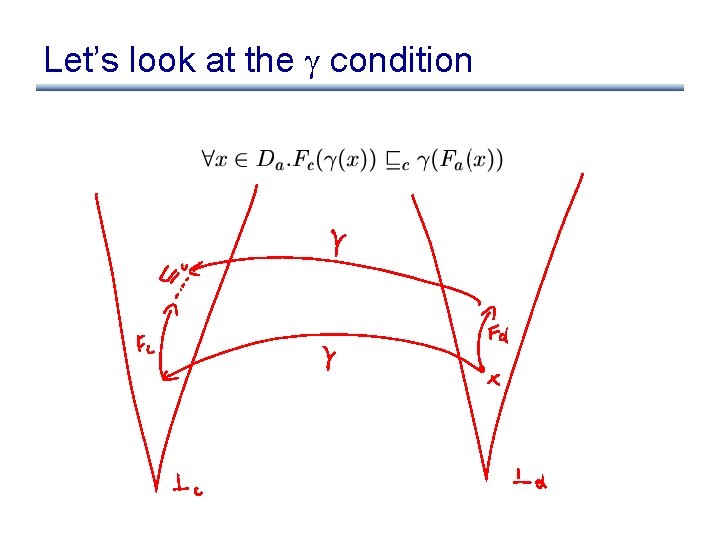
Let’s look at the condition
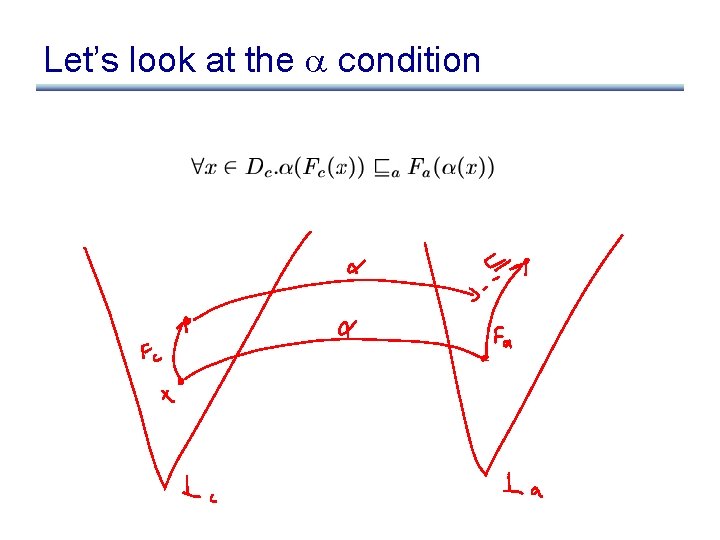
Let’s look at the condition
Let’s look at the condition
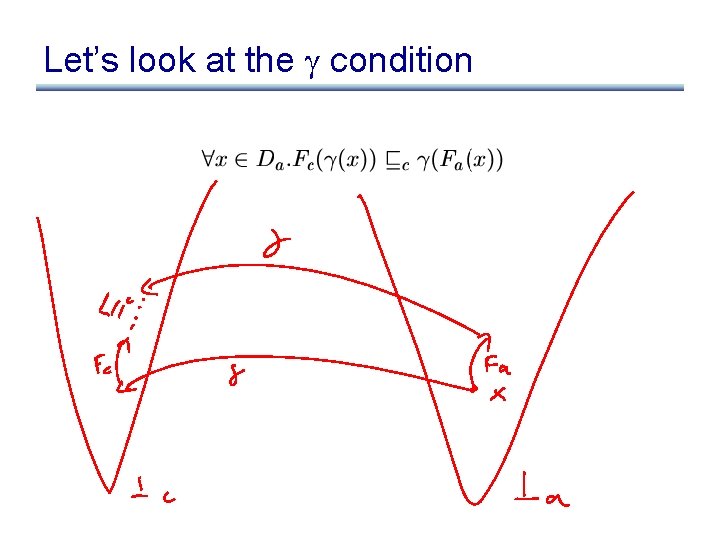
Let’s look at the condition
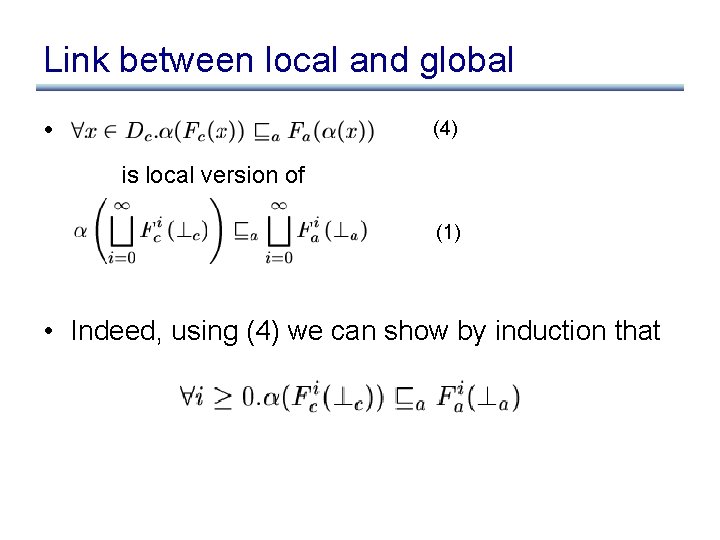
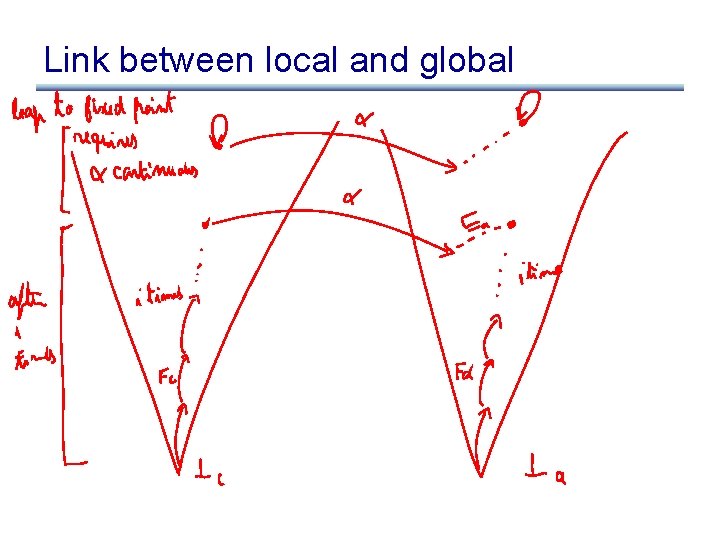
Link between local and global • (4) is local version of (1) • Indeed, using (4) we can show by induction that
Link between local and global
Link between local and global