
Corrections to H deflection and time of flight

- Slides: 31
Corrections to H+ deflection and time of flight for an ideal parallel plate deflector using a real deflector simulated with SIMION By Bret Polopolus Thanks to Itzik Ben-Itzhak and Bishwanath Gaire J. R. Macdonald Laboratory, Physics Department, Kansas State University, Manhattan, Kansas 66506 This work was partially funded under NSF grant number PHY-0851599 Supported by the Chemical Sciences, Geosciences, and Biosciences Division, Office of Basic Energy Sciences, Office of Science, U. S. Department of Energy
Overview �A molecular ion beam is sent toward a detector �The laser interacts with the ion beam dissociating H 2+ → H + �The particles move through a parallel plate deflector to separate their detection
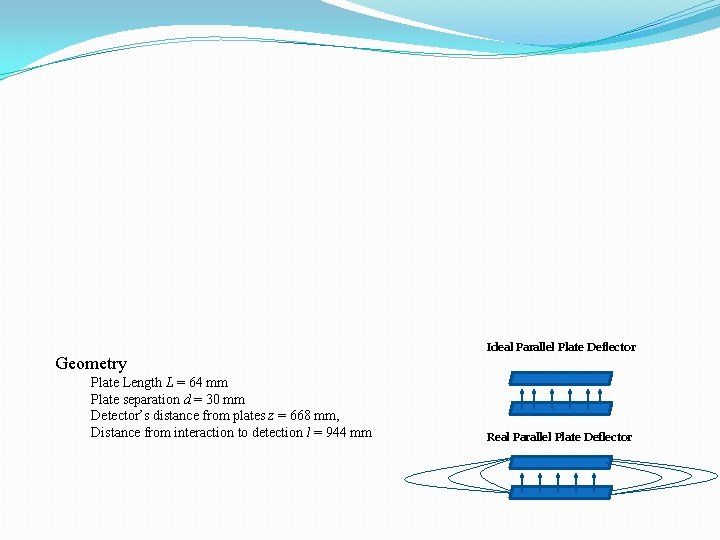
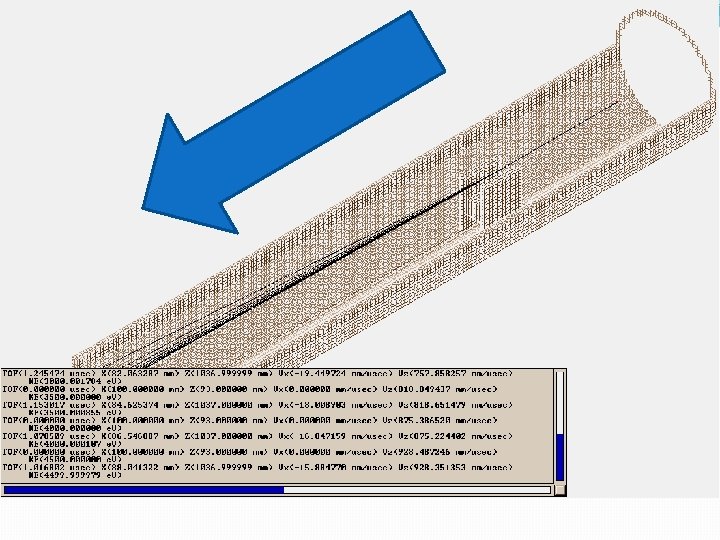
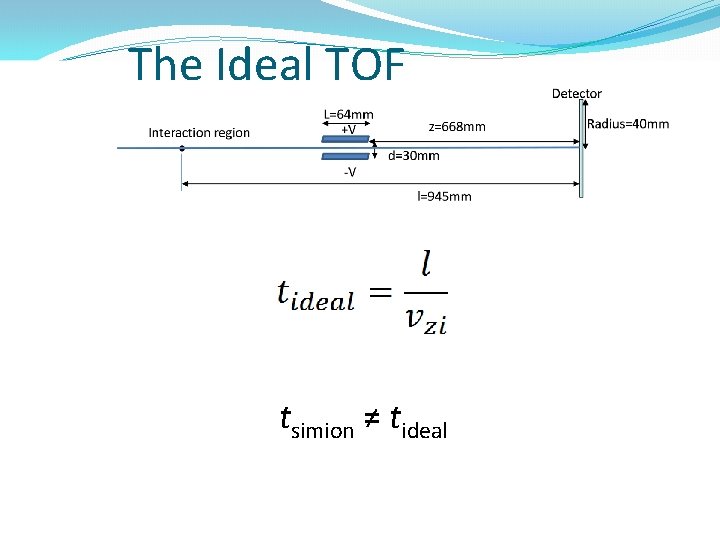
Geometry Plate Length L = 64 mm Plate separation d = 30 mm Detector’s distance from plates z = 668 mm, Distance from interaction to detection l = 944 mm Ideal Parallel Plate Deflector Real Parallel Plate Deflector
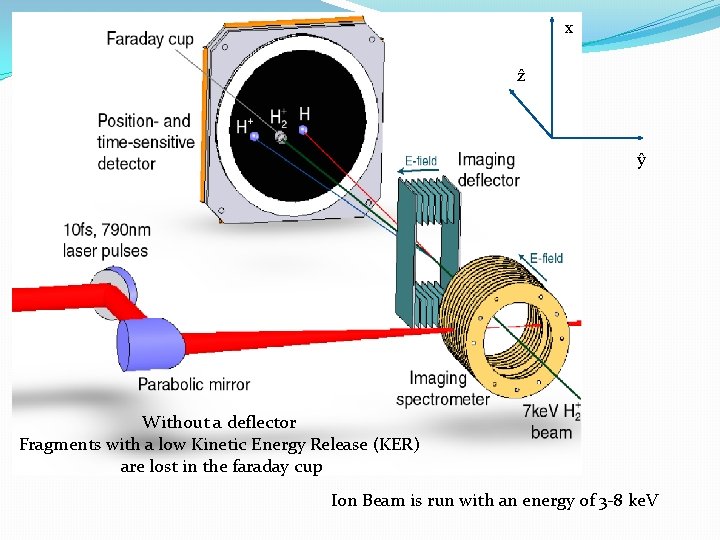
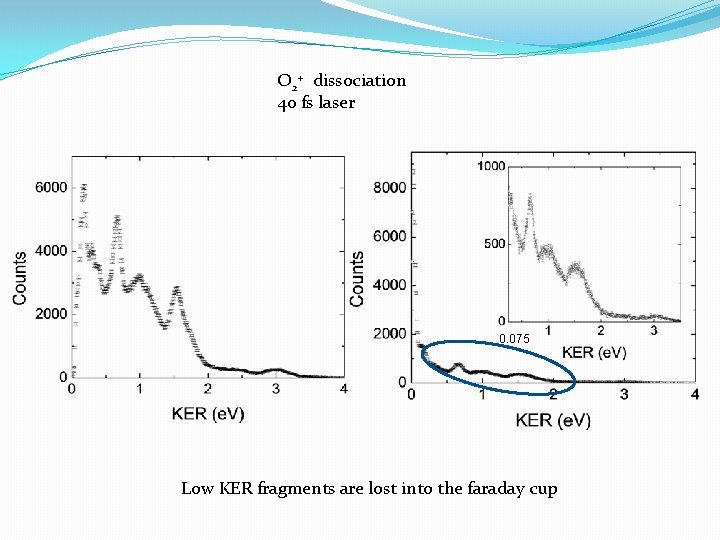
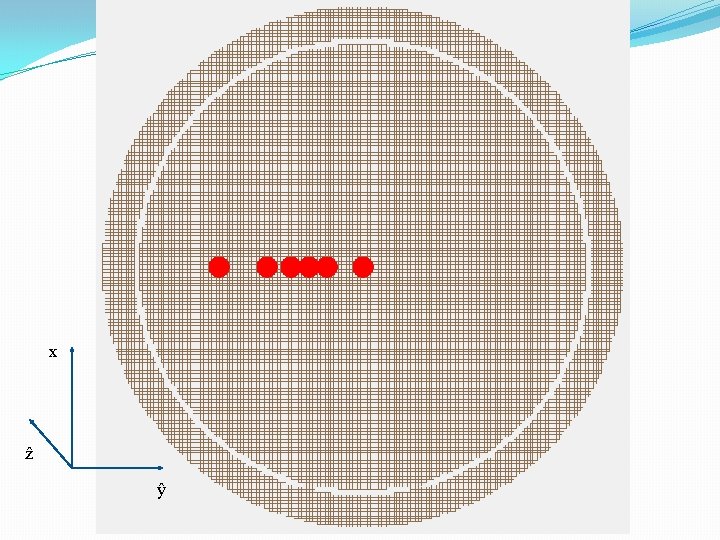
x ẑ ŷ Without a deflector Fragments with a low Kinetic Energy Release (KER) are lost in the faraday cup Ion Beam is run with an energy of 3 -8 ke. V
O 2+ dissociation 40 fs laser 0. 075 Low KER fragments are lost into the faraday cup
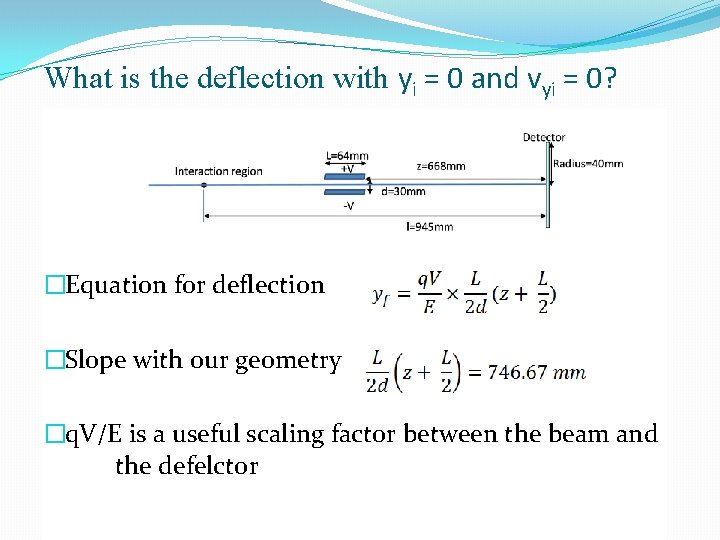
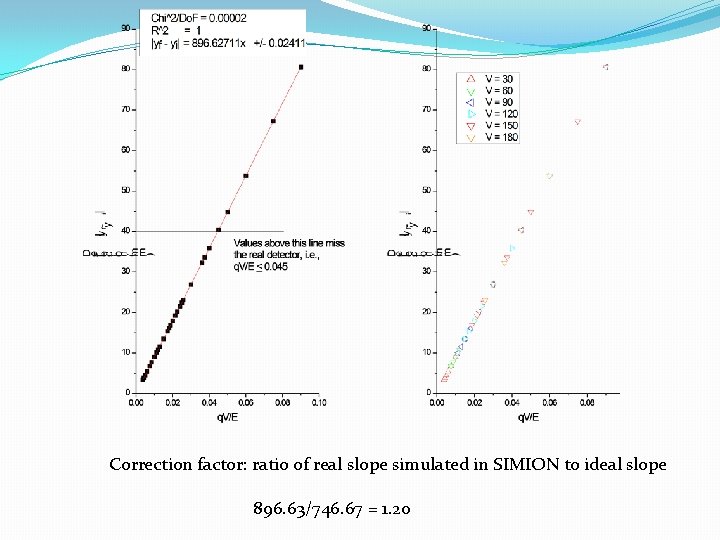
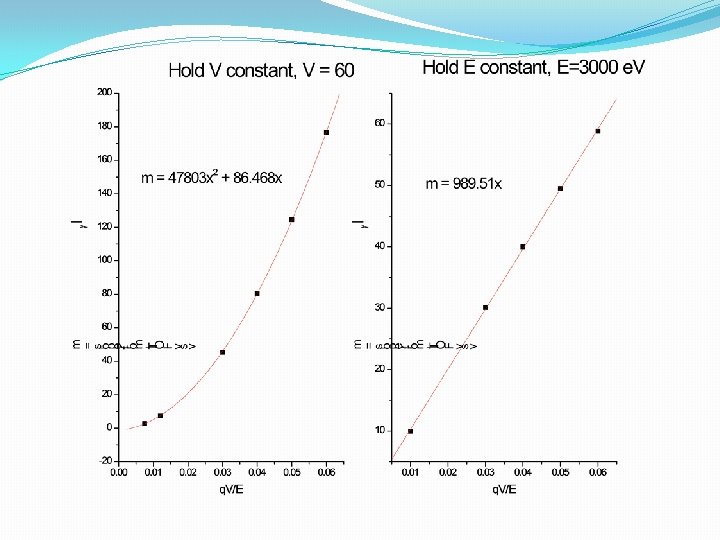
What is the deflection with yi = 0 and vyi = 0? �Equation for deflection �Slope with our geometry �q. V/E is a useful scaling factor between the beam and the defelctor
Correction factor: ratio of real slope simulated in SIMION to ideal slope 896. 63/746. 67 = 1. 20
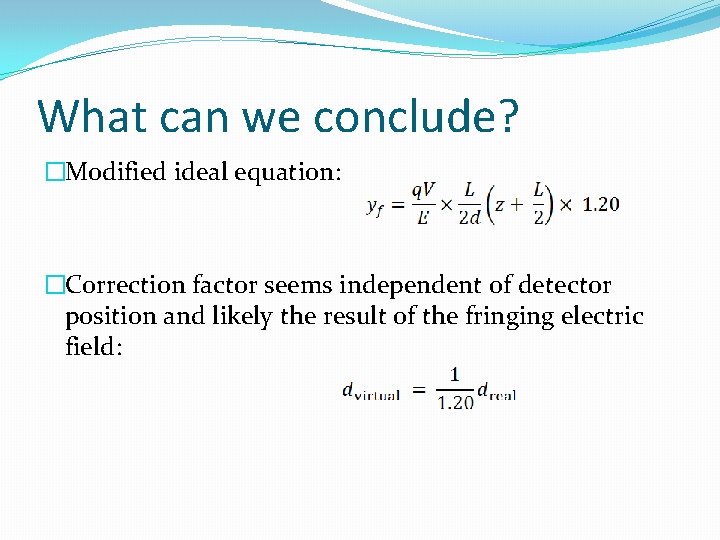
What can we conclude? �Modified ideal equation: �Correction factor seems independent of detector position and likely the result of the fringing electric field:
Effect of varying initial position
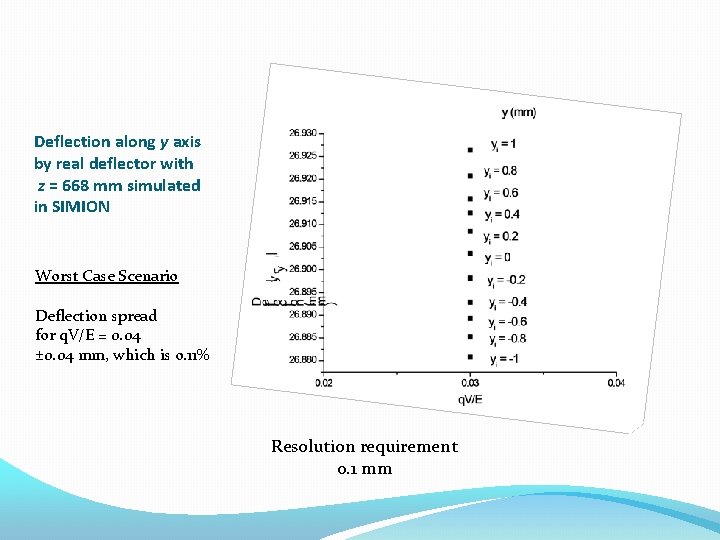
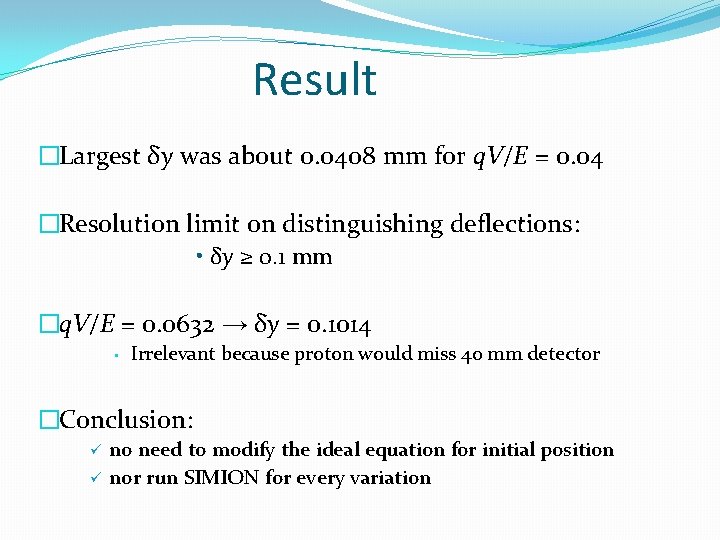
Deflection along y axis by real deflector with z = 668 mm simulated in SIMION Worst Case Scenario Deflection spread for q. V/E = 0. 04 ± 0. 04 mm, which is o. 11% Resolution requirement 0. 1 mm
Result �Largest δy was about 0. 0408 mm for q. V/E = 0. 04 �Resolution limit on distinguishing deflections: • δy ≥ 0. 1 mm �q. V/E = 0. 0632 → δy = 0. 1014 • Irrelevant because proton would miss 40 mm detector �Conclusion: ü ü no need to modify the ideal equation for initial position nor run SIMION for every variation
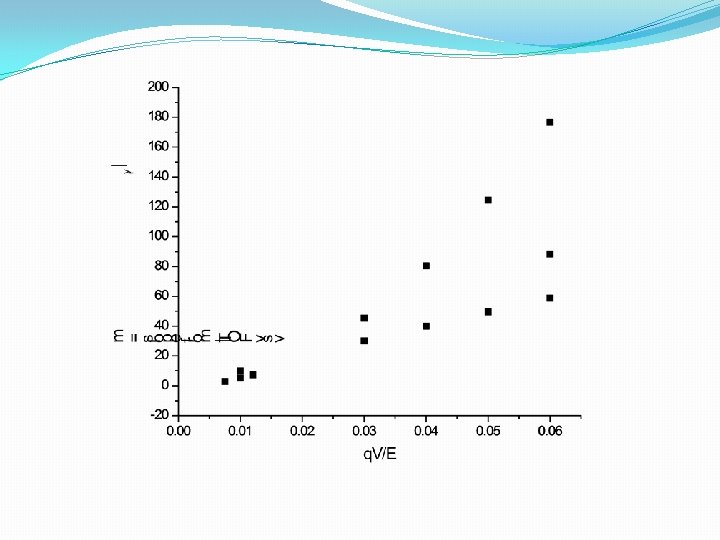
Effect of varying initial transverse velocity, vyi
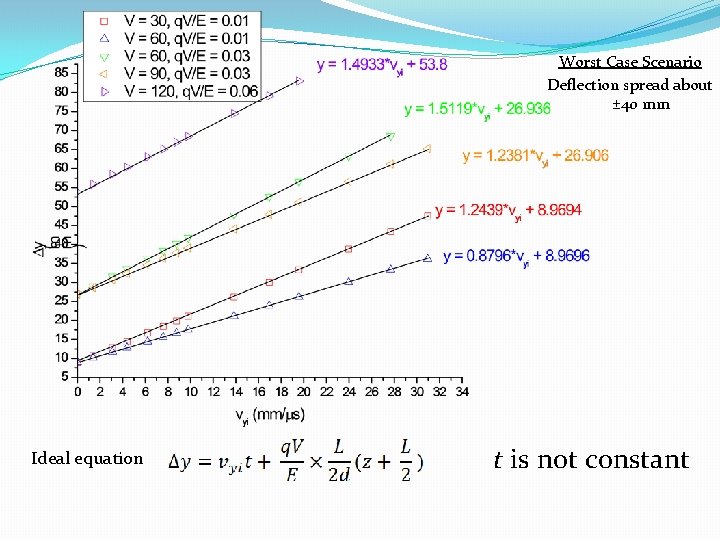
Worst Case Scenario Deflection spread about ± 40 mm Ideal equation t is not constant
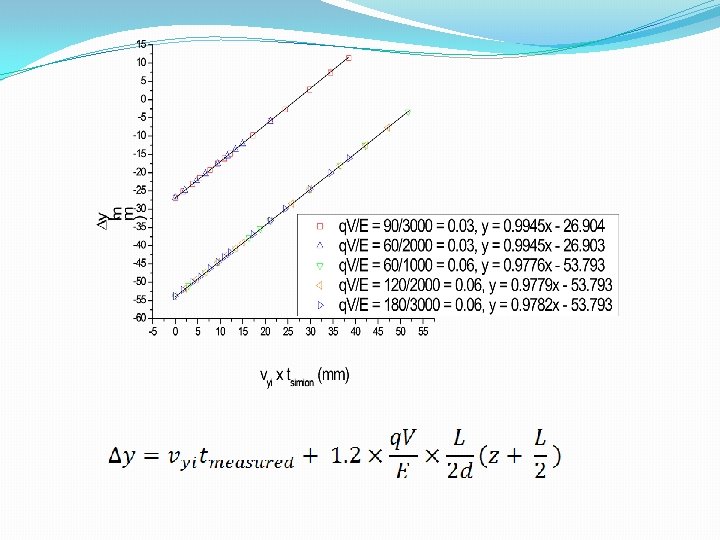
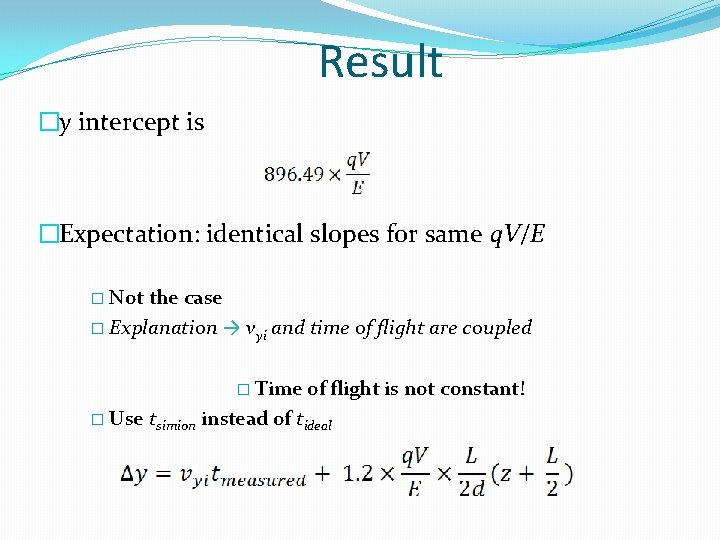
Result �y intercept is �Expectation: identical slopes for same q. V/E � Not the case � Explanation → vyi and time of flight are coupled � Time � Use tsimion of flight is not constant! instead of tideal
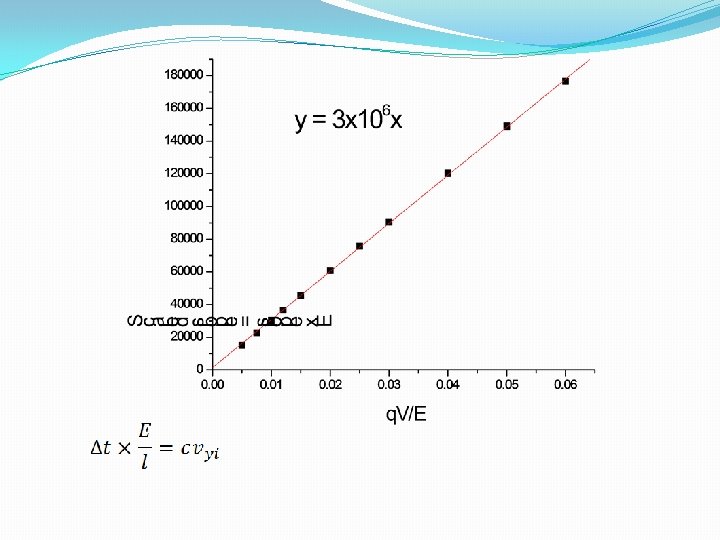
Time of Flight (TOF) yi = 0 and vyi = 0
The Ideal TOF tsimion ≠ tideal
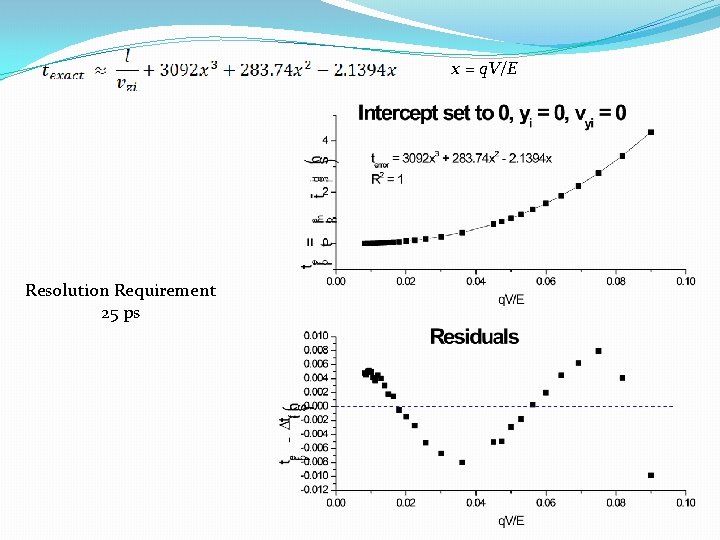
x = q. V/E Resolution Requirement 25 ps
TOF dependence on initial position along y-axis, yi
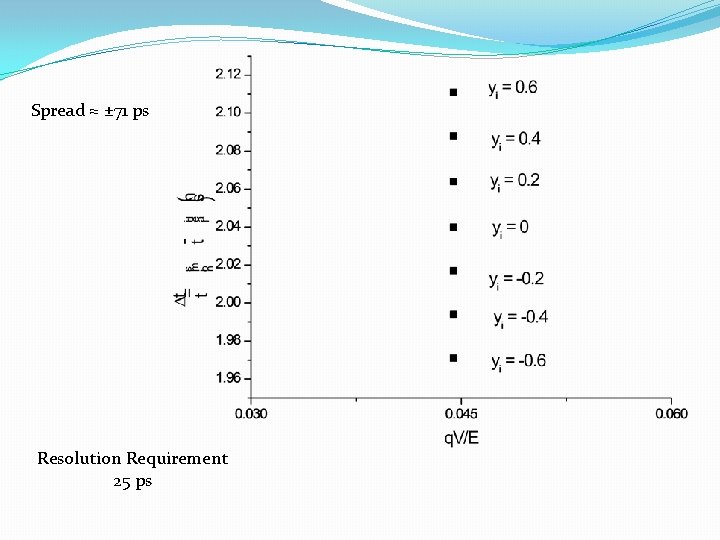
Spread ≈ ± 71 ps Resolution Requirement 25 ps
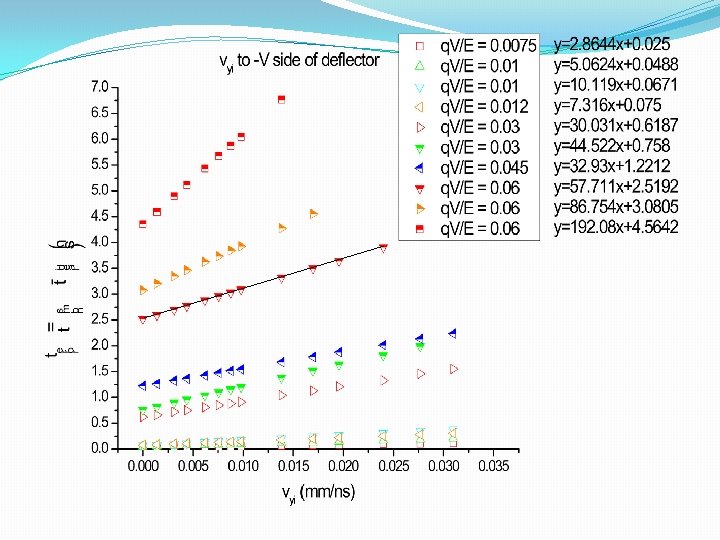
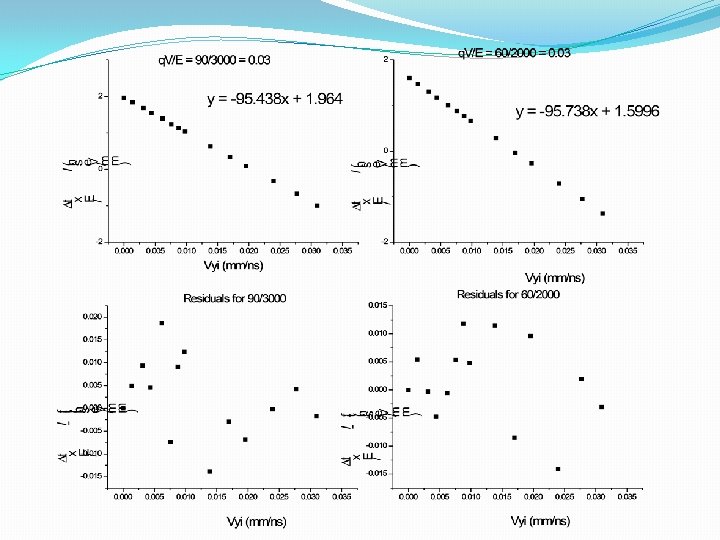
TOF dependence on initial y-velocity, vyi
Summary
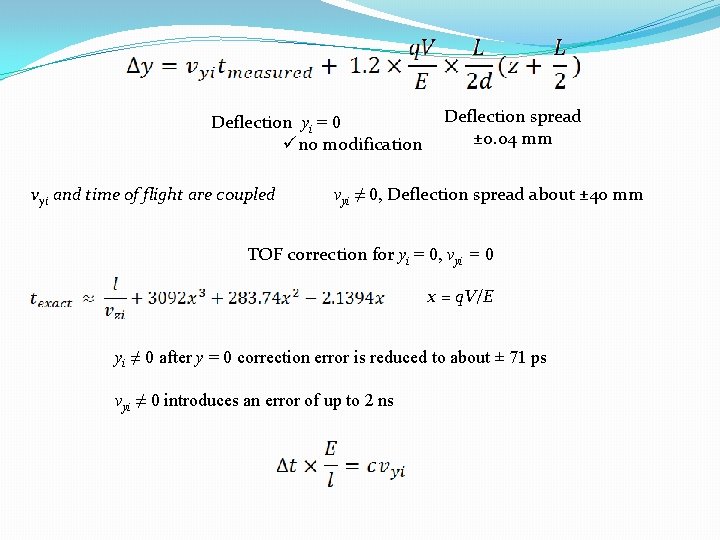
Deflection yi = 0 üno modification vyi and time of flight are coupled Deflection spread ± 0. 04 mm vyi ≠ 0, Deflection spread about ± 40 mm TOF correction for yi = 0, vyi = 0 x = q. V/E yi ≠ 0 after y = 0 correction error is reduced to about ± 71 ps vyi ≠ 0 introduces an error of up to 2 ns
Future Directions Simulations of vyi directed away from the detector should be run Imaging Rewrite equations to reconstruct vyi