
Correcting the beam optics Orbit Response Matrix analysis
Correcting the beam optics: Orbit Response Matrix analysis for the FAIR storage rings Oleksandr Kovalenko Orbit Response Matrix Analysis 1
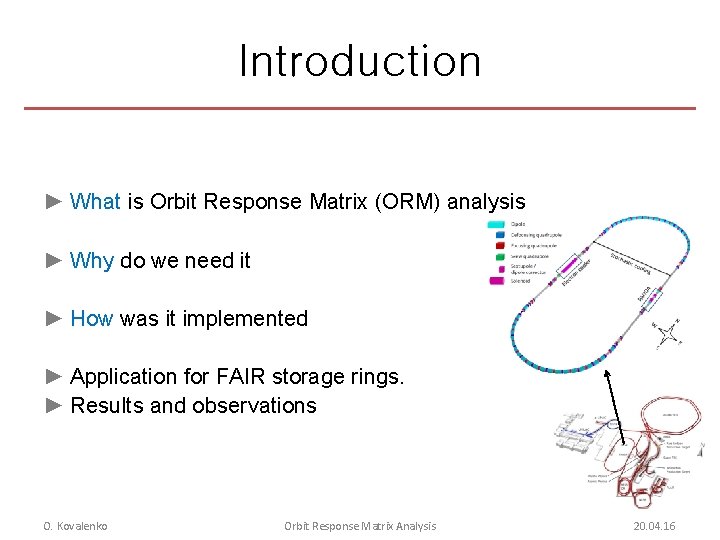
Introduction ► What is Orbit Response Matrix (ORM) analysis ► Why do we need it ► How was it implemented ► Application for FAIR storage rings. ► Results and observations O. Kovalenko Orbit Response Matrix Analysis 20. 04. 16

Why we need ORM analysis ► Real magnetic lattice has errors in comparison to the model: – – Magnet rolls Magnet misalignments Wrong quadrupole settings Calibration errors in dipole correctors and Beam Position Monitors ► When not corrected it causes: – Breaking the lattice periodicity – Increasing the harmful effects of the nonlinear resonances – Reducing the beam lifetime ► ORM analysis: search for the errors locations and values. Restore the optics. Model Lattice + Errors = Real lattice ORM Model Lattice without errors!
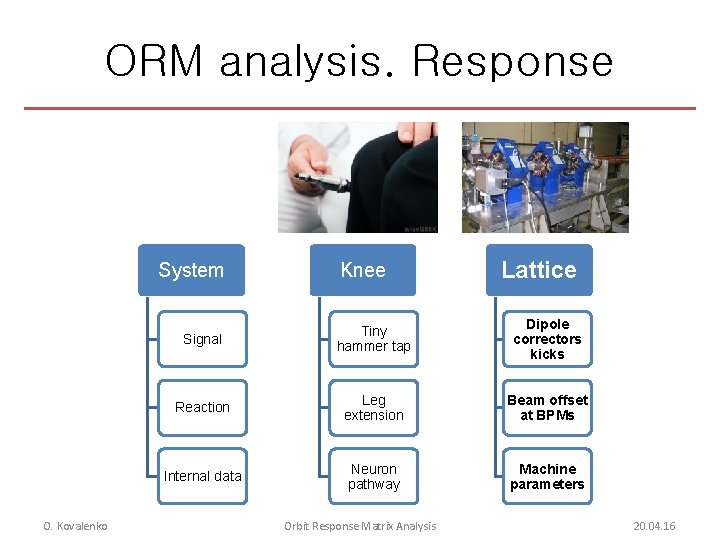
ORM analysis. Response System O. Kovalenko Knee Lattice Signal Tiny hammer tap Dipole correctors kicks Reaction Leg extension Beam offset at BPMs Internal data Neuron pathway Machine parameters Orbit Response Matrix Analysis 20. 04. 16
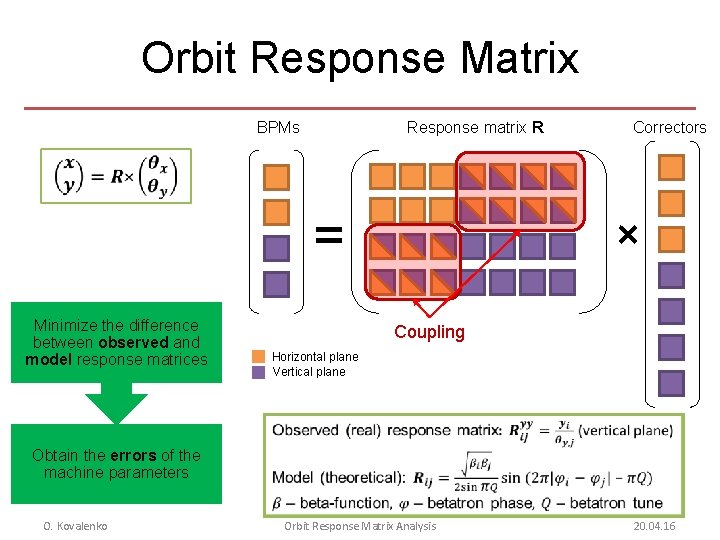
Orbit Response Matrix BPMs Response matrix R Correctors = Minimize the difference between observed and model response matrices × Coupling Horizontal plane Vertical plane Obtain the errors of the machine parameters O. Kovalenko Orbit Response Matrix Analysis 20. 04. 16
Tools ► CERN MAD-X accelerator code – Twiss parameters computation – Beam orbit computation – Nonlinear beam dynamics ► Python programming language + Py. Qt + linear algebra libraries – – – General algorithm Testing Graphical User Interface Lattice parser Plotting Singular Value Decomposition O. Kovalenko Orbit Response Matrix Analysis 20. 04. 16
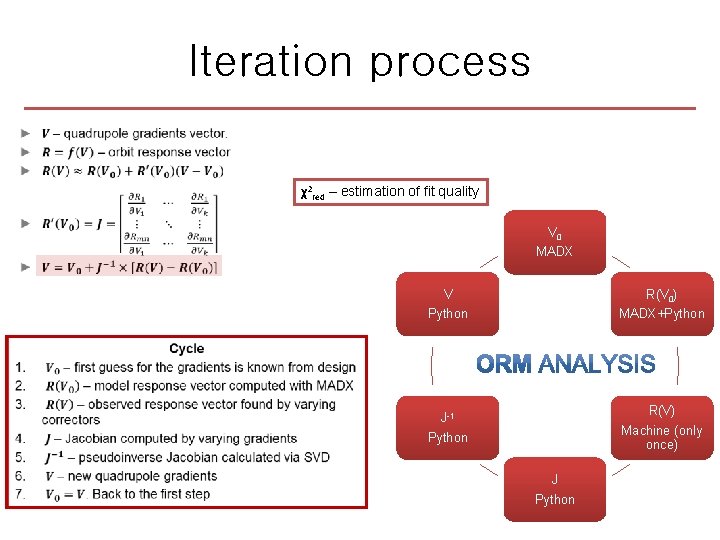
Iteration process χ2 red – estimation of fit quality V 0 MADX V Python R(V 0) MADX+Python J-1 Python R(V) Machine (only once) J Python
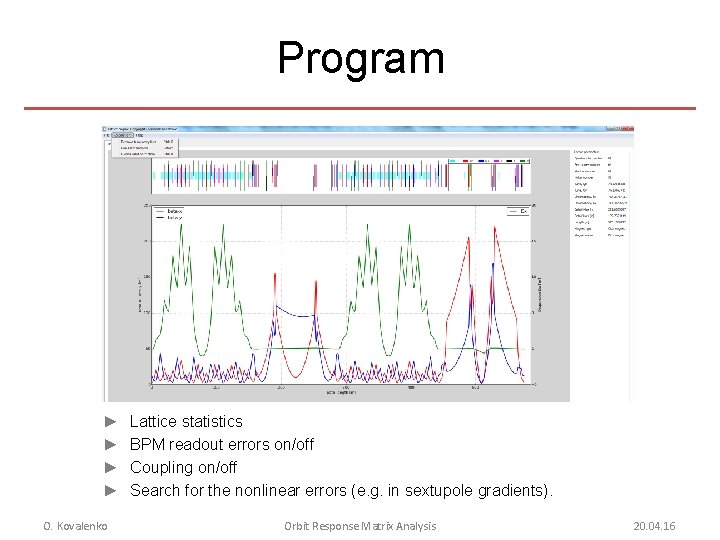
Program ► ► O. Kovalenko Lattice statistics BPM readout errors on/off Coupling on/off Search for the nonlinear errors (e. g. in sextupole gradients). Orbit Response Matrix Analysis 20. 04. 16

Results O. Kovalenko Orbit Response Matrix Analysis 9
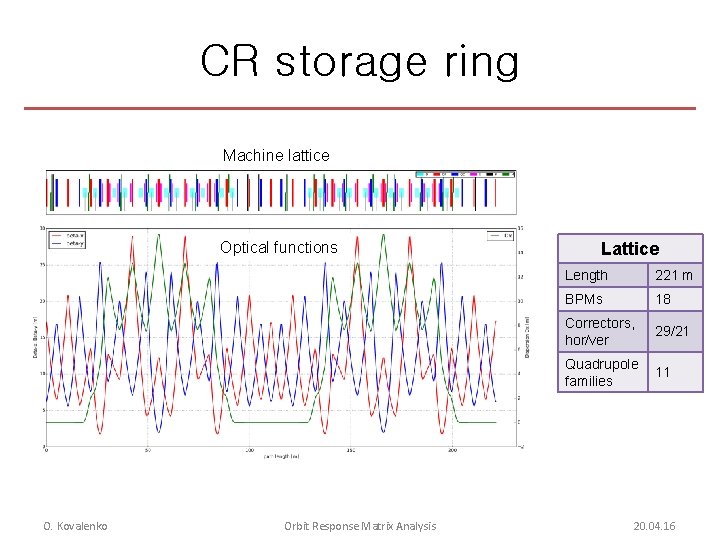
CR storage ring Machine lattice Optical functions O. Kovalenko Orbit Response Matrix Analysis Lattice Length 221 m BPMs 18 Correctors, hor/ver 29/21 Quadrupole families 11 20. 04. 16
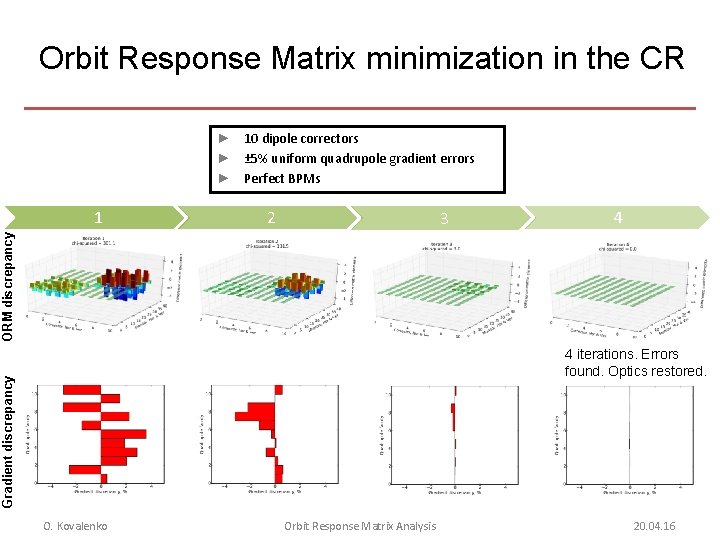
Orbit Response Matrix minimization in the CR ► 10 dipole correctors ► ± 5% uniform quadrupole gradient errors ► Perfect BPMs 2 3 4 ORM discrepancy 1 Gradient discrepancy 4 iterations. Errors found. Optics restored. O. Kovalenko Orbit Response Matrix Analysis 20. 04. 16

ORM analysis. Orbit fit. CR Orbit shift excited by one corrector ► 50 dipole correctors. Random quadrupole gradient errors in the range ± 5%. ► The distortion of the orbit before the fit is up to 3 mm. ► Three iterations, about one minute of computation time ► All the errors of the quadrupole gradients were found almost exactly! ► The rms difference between the model and the measured orbit (green cirlces) after the fit is less than 1 μm. O. Kovalenko Orbit Response Matrix Analysis 20. 04. 16
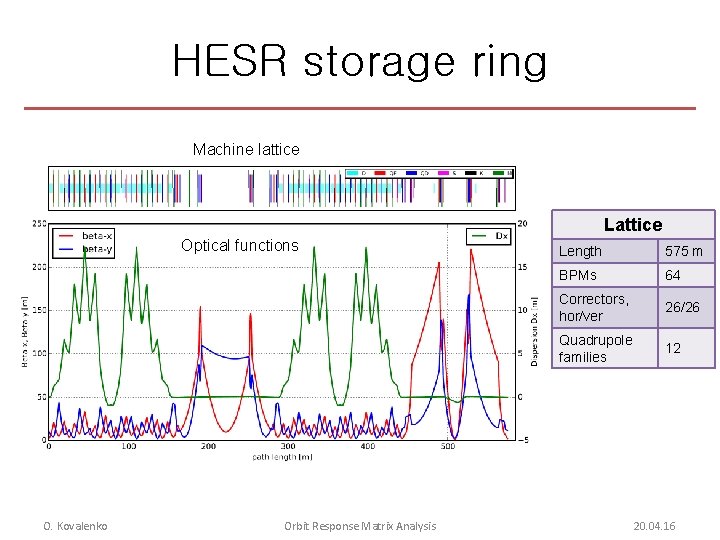
HESR storage ring Machine lattice Lattice Optical functions O. Kovalenko Orbit Response Matrix Analysis Length 575 m BPMs 64 Correctors, hor/ver 26/26 Quadrupole families 12 20. 04. 16
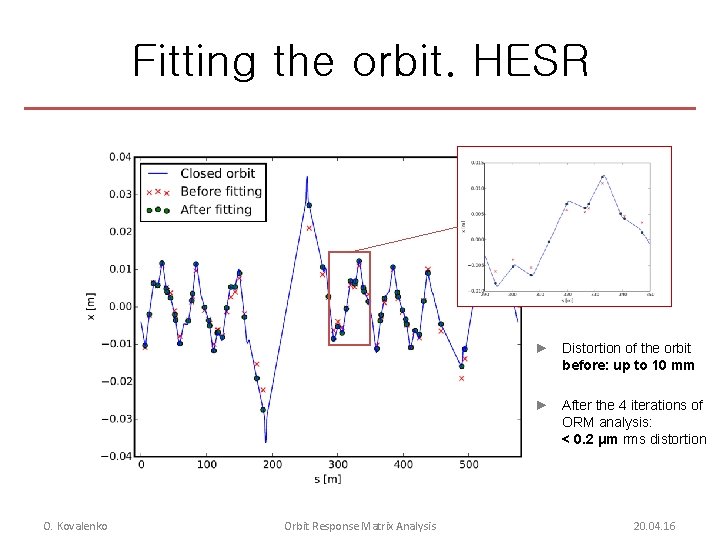
Fitting the orbit. HESR ► Distortion of the orbit before: up to 10 mm ► After the 4 iterations of ORM analysis: < 0. 2 μm rms distortion O. Kovalenko Orbit Response Matrix Analysis 20. 04. 16
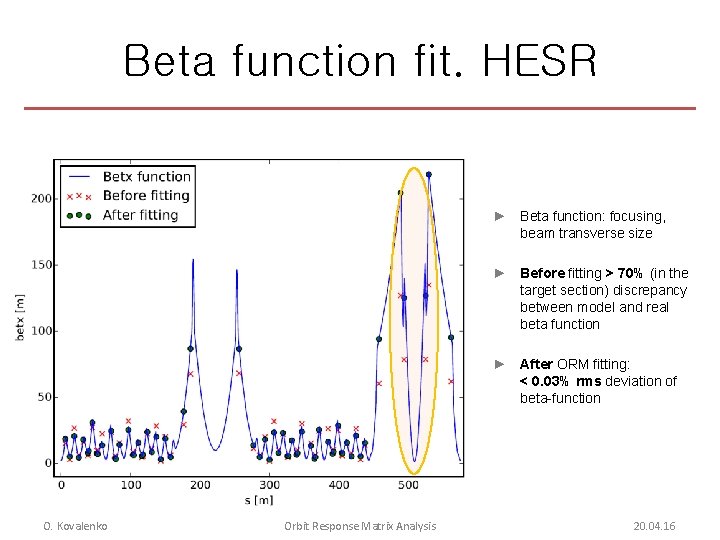
Beta function fit. HESR ► Beta function: focusing, beam transverse size ► Before fitting > 70% (in the target section) discrepancy between model and real beta function ► After ORM fitting: < 0. 03% rms deviation of beta-function O. Kovalenko Orbit Response Matrix Analysis 20. 04. 16
Observations ► Sensitivity. BPM readout errors. – uniformly distributed BPM readout error in the range ± 1 mm. After 3 -4 iterations the ORM code converged with χ2 = 0. 99 for the CR and χ2 = 0. 97 for the HESR. The quadrupole gradients were found with an rms error ≈0. 5% (BPM noise level). ► Singal-to-noise ratio. Use the maximum possible corrector kicks. – CR: the orbit offsets at BPMs were limited by the maximum strength of the dipole correctors. – HESR: the limiting factor was the magnet aperture (full aperture in most of the magnets is only 89 mm) – This approach might however fail when there are strong nonlinearities in the BPMs leading to large readout errors for large orbits offsets (at the edges of BPMs). ► Data for the response matrix. Use any type of data you can obtain. – Dispersion: varying frequency in the RF accelerating cavity, measure beam offsets. – Phase advances – Tunes etc. O. Kovalenko Orbit Response Matrix Analysis 20. 04. 16
Conclusions ► Response matrix analysis is a powerful technique to track down the errors in the lattice. ► Can be used during beam commissioning as well as during routine machine operation ► Type of magnetic elements, the errors of which can be corrected: – normal and skew quadrupole gradients – calibration factors of BPMs and correctors – sextupole gradients ► Successful proof of concept for CR and HESR FAIR storage rings. Faulty optics was completely restored. Next steps ► Applying the ORM analysis for SIS 100 ► Test of the ORM analysis for the existing machines – CRYRING (GSI), COSY (FZ Jülich), CSR (Lanzhou) ► ORM analysis into Java O. Kovalenko Orbit Response Matrix Analysis 20. 04. 16
- Slides: 17