
CORRECTING ERRORS Learning Objectives 1 Identify types of
CORRECTING ERRORS �Learning Objectives 1. Identify types of errors 2. Detect the errors and do the correcting journal entry 3. Function of Suspense Account 4. Prepare Statement of Adjusted Net Profit and Adjusted Balance Sheet
Why A Balanced Trial Balance maybe not free from errors ? Errors Tangible Errors Intangible Errors
Intangible Errors �Errors of Omission �Errors of Posting �Errors of Original Entry �Compensating Errors �Errors of Reversal
Errors of Omission – �Transaction not yet recorded in any record �Eg: A payment of RM 1, 000 was made to creditor Ar Ltd by cheque. This transaction was not recorded yet. Correcting Journal Entry : Dr Creditor – Ar Ltd 1, 000 CR Bank 1, 000
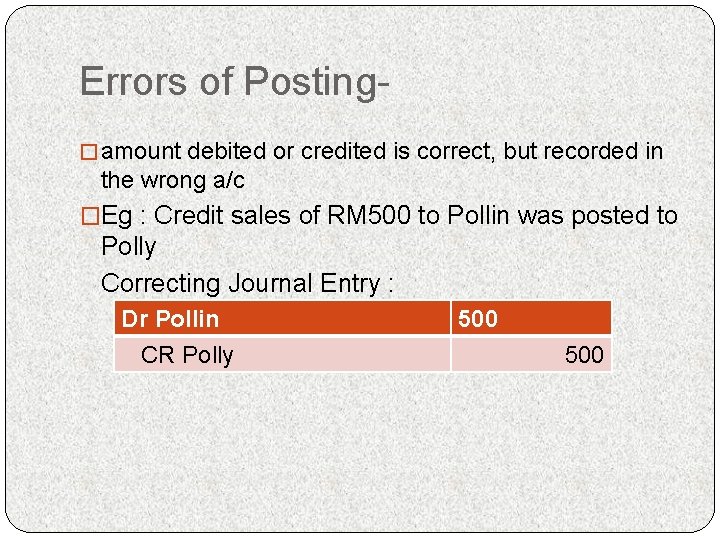
Errors of Posting� amount debited or credited is correct, but recorded in the wrong a/c �Eg : Credit sales of RM 500 to Pollin was posted to Polly Correcting Journal Entry : Dr Pollin CR Polly 500
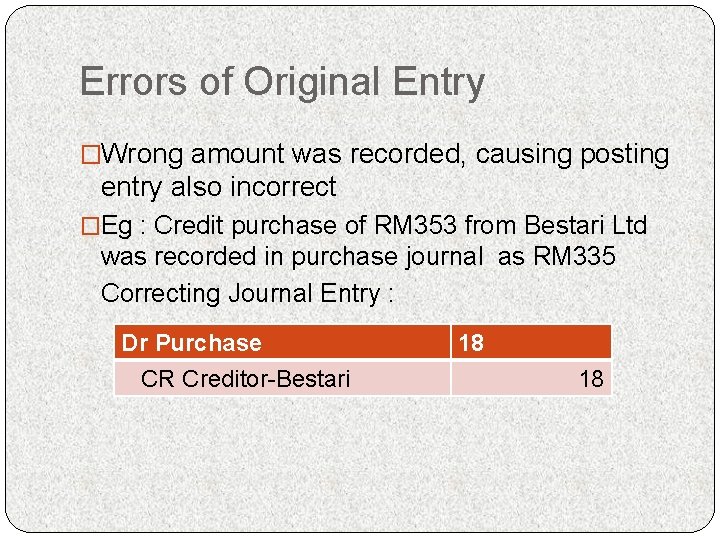
Errors of Original Entry �Wrong amount was recorded, causing posting entry also incorrect �Eg : Credit purchase of RM 353 from Bestari Ltd was recorded in purchase journal as RM 335 Correcting Journal Entry : Dr Purchase CR Creditor-Bestari 18 18
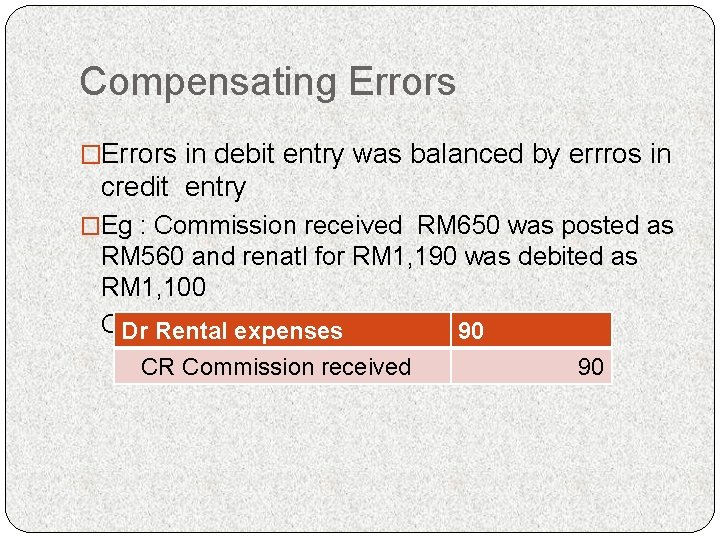
Compensating Errors �Errors in debit entry was balanced by errros in credit entry �Eg : Commission received RM 650 was posted as RM 560 and renatl for RM 1, 190 was debited as RM 1, 100 Correcting Entry : Dr Rental. Journal expenses 90 CR Commission received 90
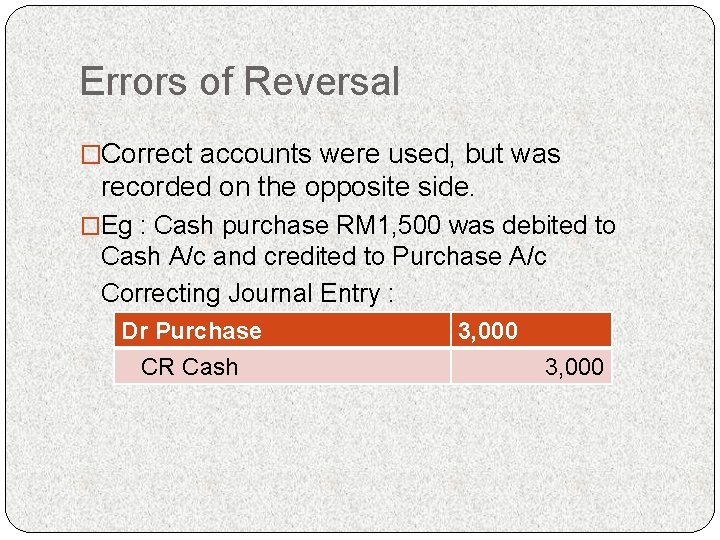
Errors of Reversal �Correct accounts were used, but was recorded on the opposite side. �Eg : Cash purchase RM 1, 500 was debited to Cash A/c and credited to Purchase A/c Correcting Journal Entry : Dr Purchase CR Cash 3, 000
Tangible Errors * When does tangible errors happened ? * A suspense a/c will be created temporarily * Suspense A/c – debit side ( Balance Sheet – Asset) * Suspense A/c – credit side ( Balance Sheet – Liab. )
Types of Tangible Errors * Incomplete Double Entry *Wrong Posting *Different amount were debited and credited * Transaction recorded by two debit entries or vice versa
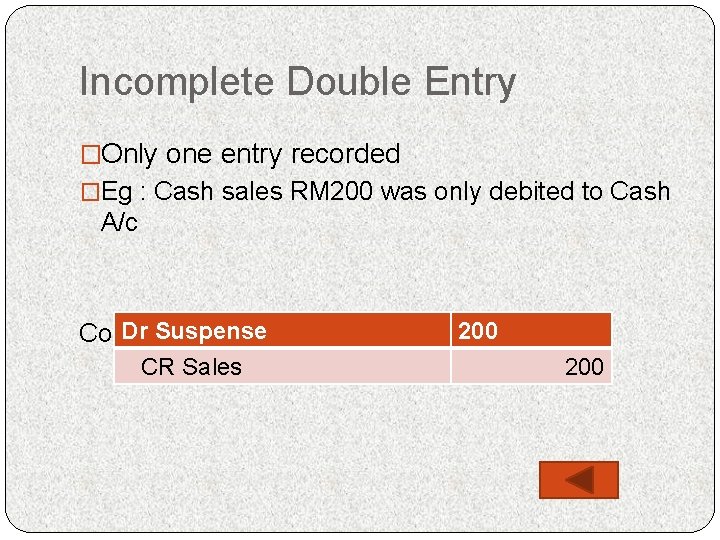
Incomplete Double Entry �Only one entry recorded �Eg : Cash sales RM 200 was only debited to Cash A/c Dr Suspense Correcting Journal Entry : CR Sales 200
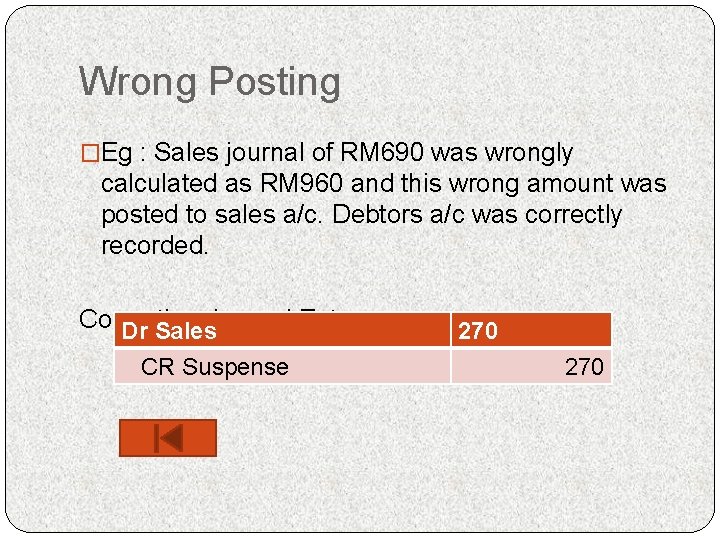
Wrong Posting �Eg : Sales journal of RM 690 was wrongly calculated as RM 960 and this wrong amount was posted to sales a/c. Debtors a/c was correctly recorded. Correcting Dr Sales. Journal Entry : CR Suspense 270
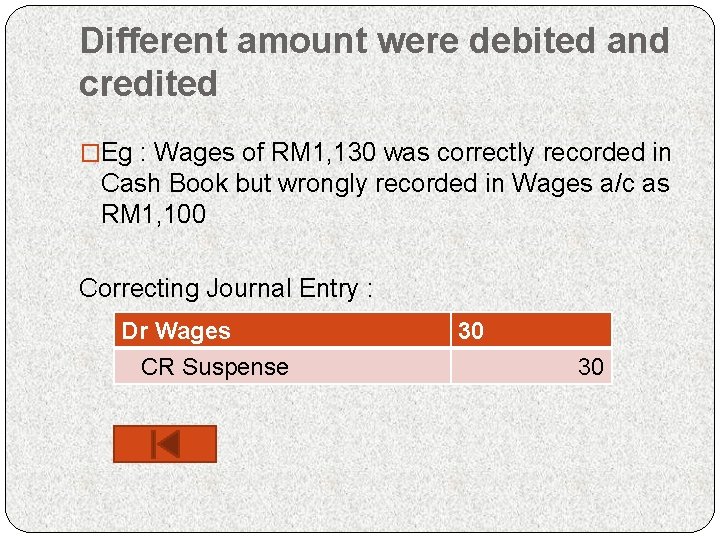
Different amount were debited and credited �Eg : Wages of RM 1, 130 was correctly recorded in Cash Book but wrongly recorded in Wages a/c as RM 1, 100 Correcting Journal Entry : Dr Wages CR Suspense 30 30
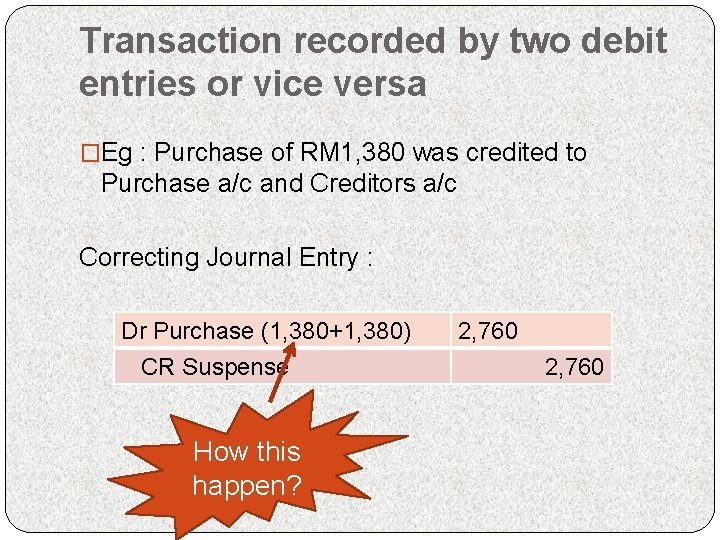
Transaction recorded by two debit entries or vice versa �Eg : Purchase of RM 1, 380 was credited to Purchase a/c and Creditors a/c Correcting Journal Entry : Dr Purchase (1, 380+1, 380) CR Suspense How this happen? 2, 760
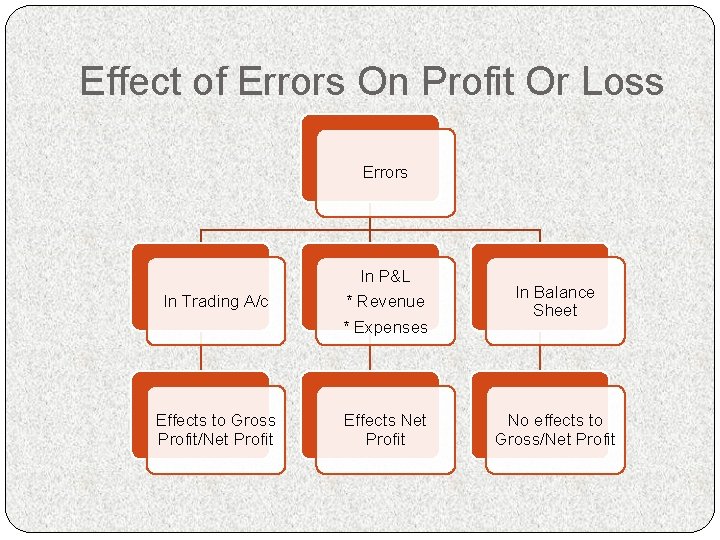
Effect of Errors On Profit Or Loss Errors In Trading A/c In P&L * Revenue * Expenses In Balance Sheet Effects to Gross Profit/Net Profit Effects Net Profit No effects to Gross/Net Profit
REFER TO EXAMPLE 9. 12 PAGE 248
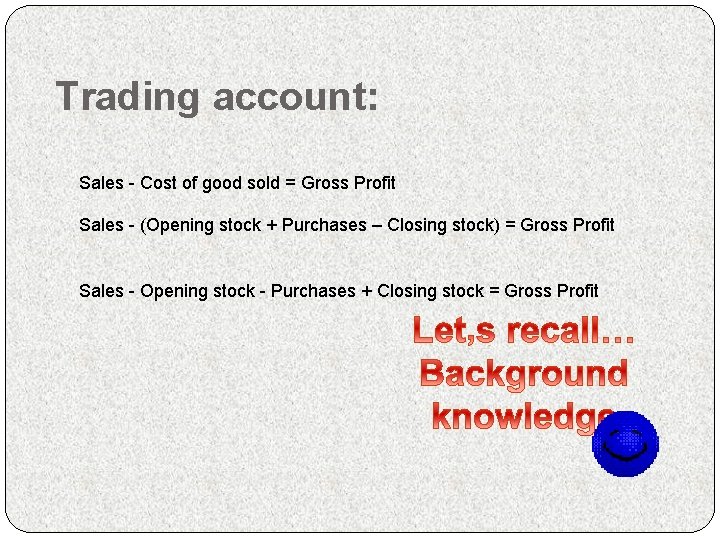
Trading account: Sales - Cost of good sold = Gross Profit Sales - (Opening stock + Purchases – Closing stock) = Gross Profit Sales - Opening stock - Purchases + Closing stock = Gross Profit
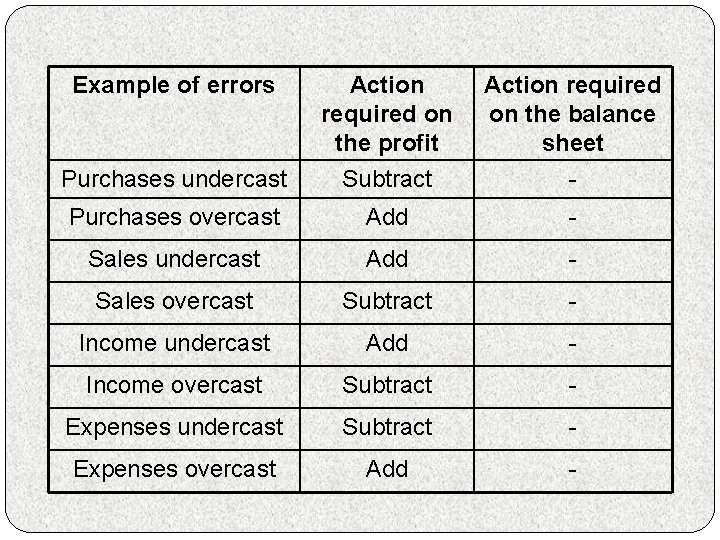
Example of errors Purchases undercast Action required on the profit Subtract Action required on the balance sheet - Purchases overcast Add - Sales undercast Add - Sales overcast Subtract - Income undercast Add - Income overcast Subtract - Expenses undercast Subtract - Expenses overcast Add -
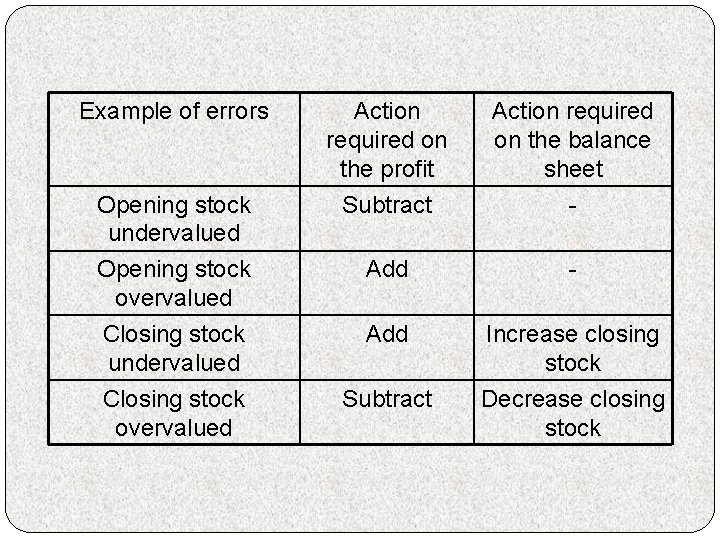
Example of errors Action required on the profit Subtract Action required on the balance sheet - Opening stock overvalued Closing stock undervalued Add - Add Increase closing stock Closing stock overvalued Subtract Decrease closing stock Opening stock undervalued
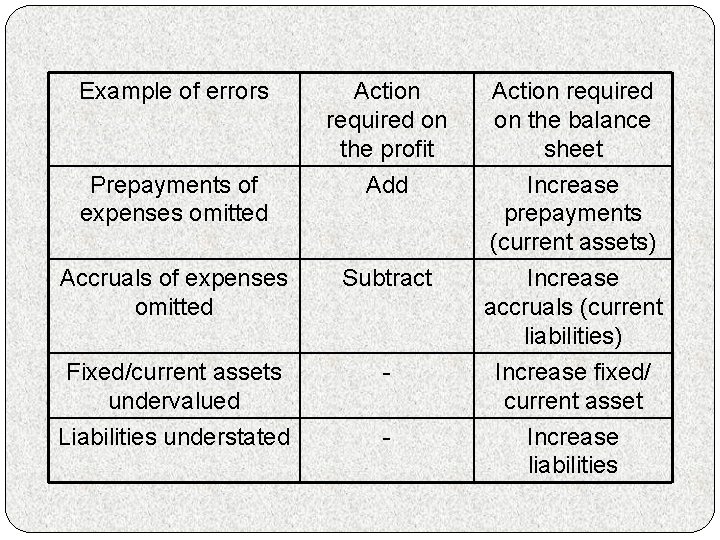
Example of errors Prepayments of expenses omitted Action required on the profit Add Accruals of expenses omitted Subtract Fixed/current assets undervalued Liabilities understated - Action required on the balance sheet Increase prepayments (current assets) Increase accruals (current liabilities) Increase fixed/ current asset Increase liabilities

- Slides: 21