
Correct the spelling punctuation and grammar errors in



- Slides: 22
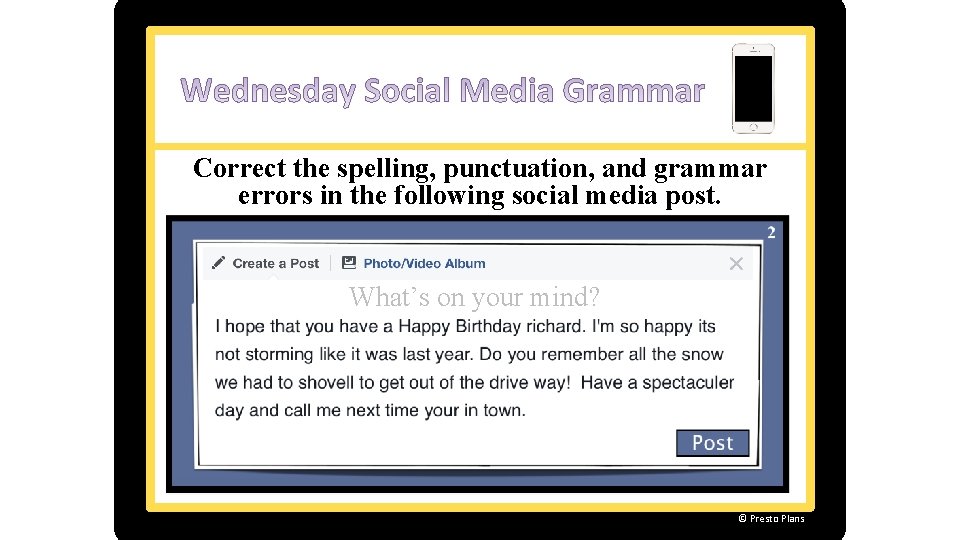
Correct the spelling, punctuation, and grammar errors in the following social media post. What’s on your mind? © Presto Plans
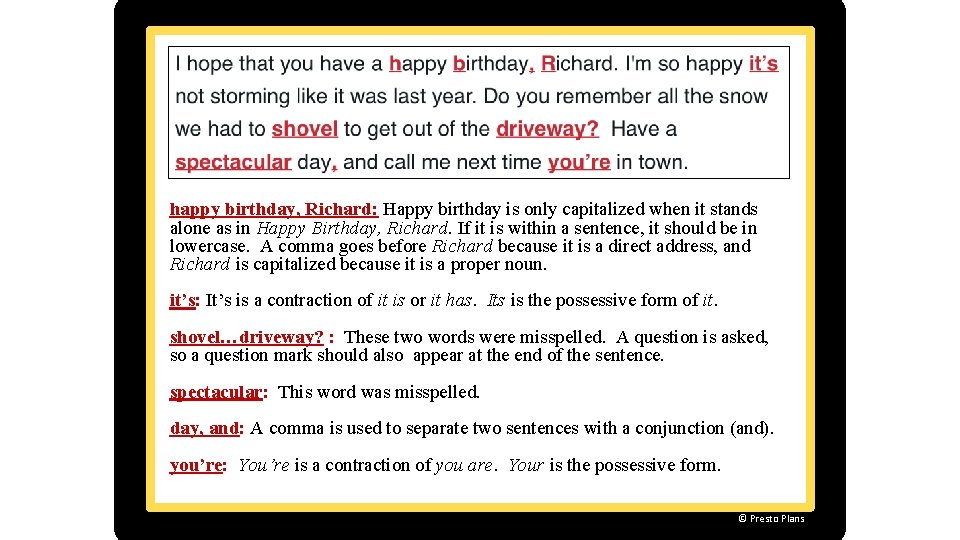
happy birthday, Richard: Happy birthday is only capitalized when it stands alone as in Happy Birthday, Richard. If it is within a sentence, it should be in lowercase. A comma goes before Richard because it is a direct address, and Richard is capitalized because it is a proper noun. it’s: It’s is a contraction of it is or it has. Its is the possessive form of it. shovel…driveway? : These two words were misspelled. A question is asked, so a question mark should also appear at the end of the sentence. spectacular: This word was misspelled. day, and: A comma is used to separate two sentences with a conjunction (and). you’re: You’re is a contraction of you are. Your is the possessive form. © Presto Plans
NATIVE AMERICAN LITERATURE Pre-Colonization
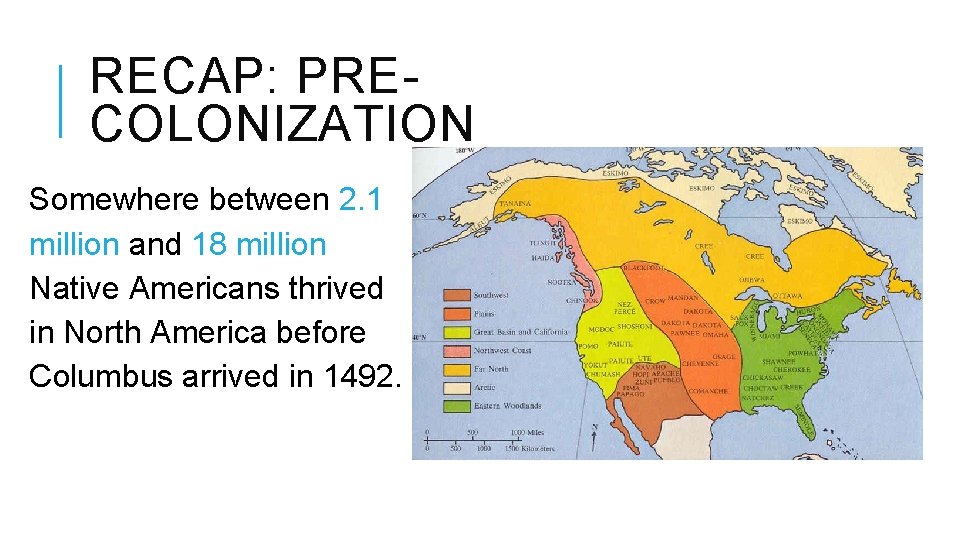
RECAP: PRECOLONIZATION Somewhere between 2. 1 million and 18 million Native Americans thrived in North America before Columbus arrived in 1492.
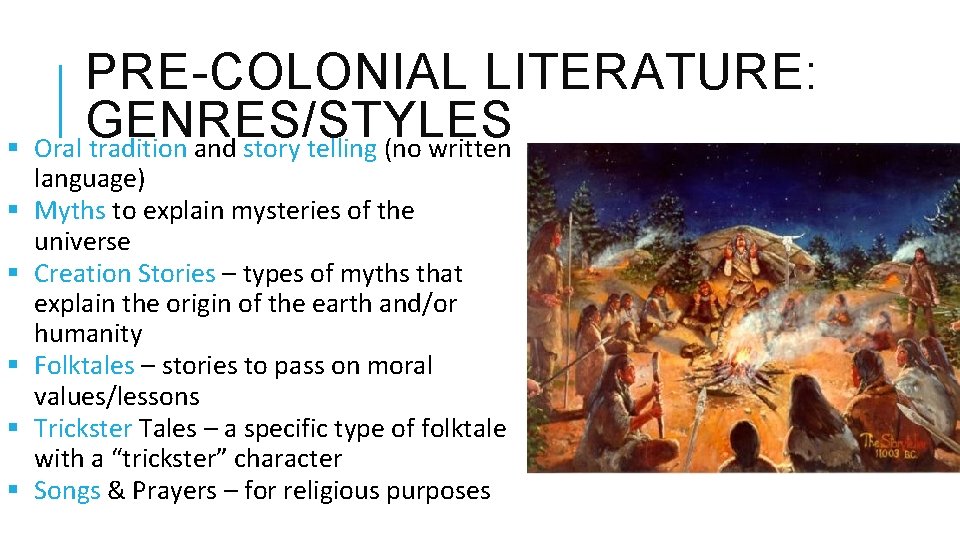
§ § § PRE-COLONIAL LITERATURE: GENRES/STYLES Oral tradition and story telling (no written language) Myths to explain mysteries of the universe Creation Stories – types of myths that explain the origin of the earth and/or humanity Folktales – stories to pass on moral values/lessons Trickster Tales – a specific type of folktale with a “trickster” character Songs & Prayers – for religious purposes
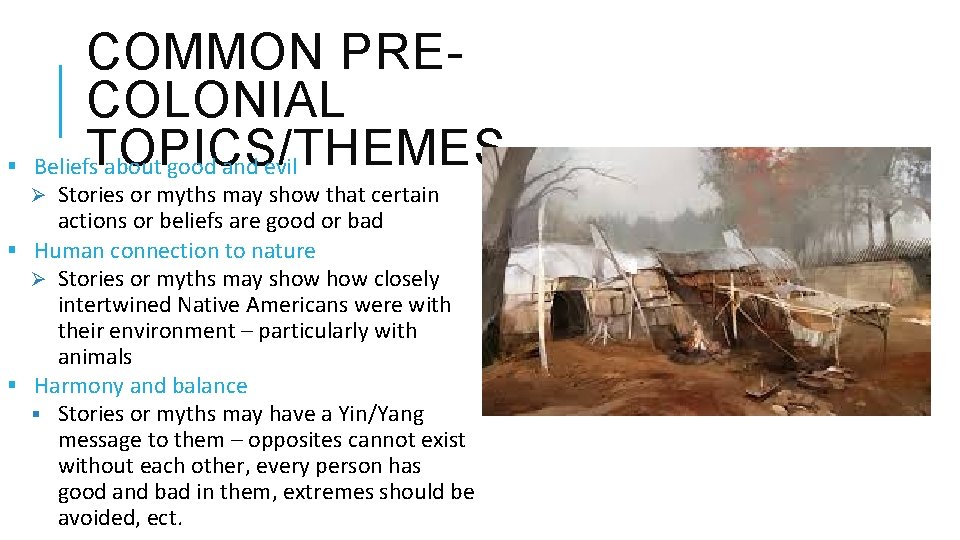
§ COMMON PRECOLONIAL TOPICS/THEMES Beliefs about good and evil Ø Stories or myths may show that certain actions or beliefs are good or bad § Human connection to nature Ø Stories or myths may show closely intertwined Native Americans were with their environment – particularly with animals § Harmony and balance § Stories or myths may have a Yin/Yang message to them – opposites cannot exist without each other, every person has good and bad in them, extremes should be avoided, ect.
NATIVE AMERICAN LITERATURE Post. Colonization
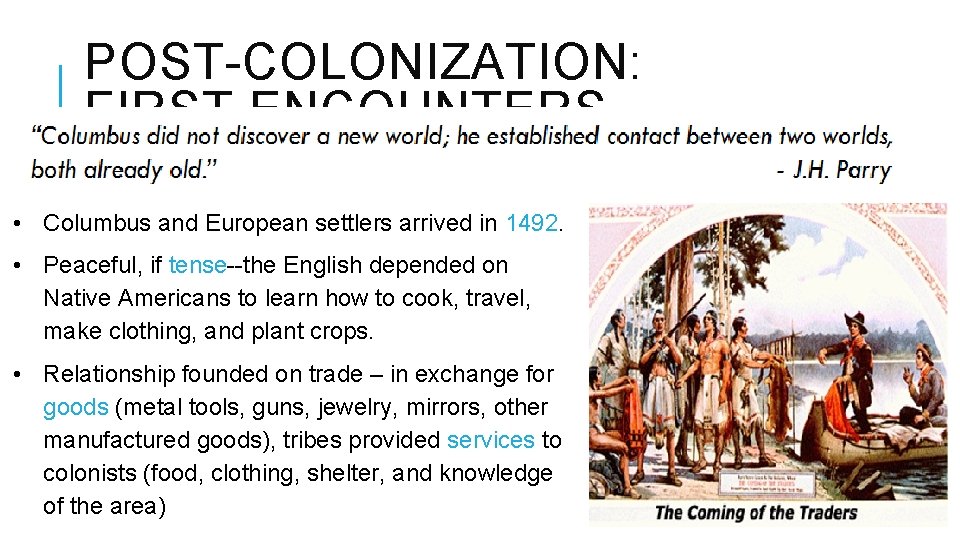
POST-COLONIZATION: FIRST ENCOUNTERS • Columbus and European settlers arrived in 1492. • Peaceful, if tense--the English depended on Native Americans to learn how to cook, travel, make clothing, and plant crops. • Relationship founded on trade – in exchange for goods (metal tools, guns, jewelry, mirrors, other manufactured goods), tribes provided services to colonists (food, clothing, shelter, and knowledge of the area)
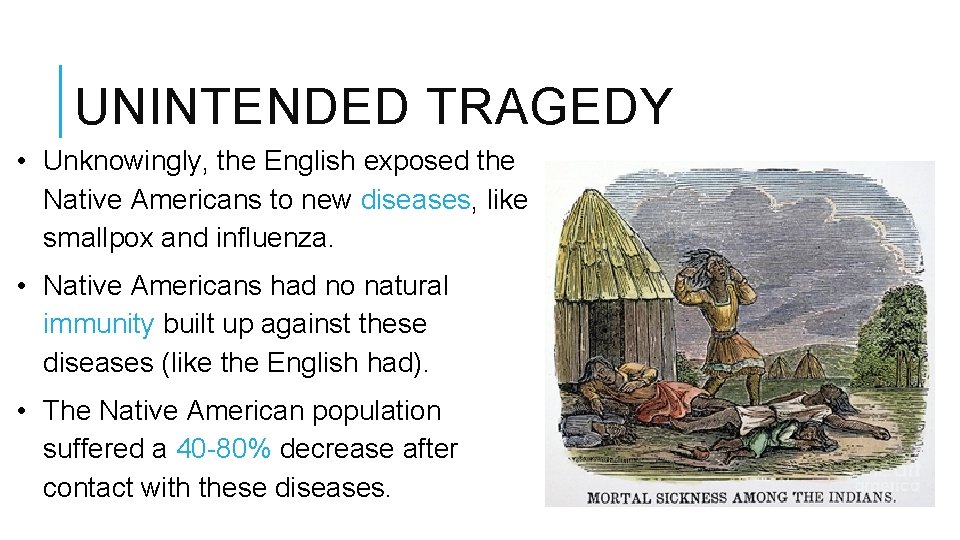
UNINTENDED TRAGEDY • Unknowingly, the English exposed the Native Americans to new diseases, like smallpox and influenza. • Native Americans had no natural immunity built up against these diseases (like the English had). • The Native American population suffered a 40 -80% decrease after contact with these diseases.
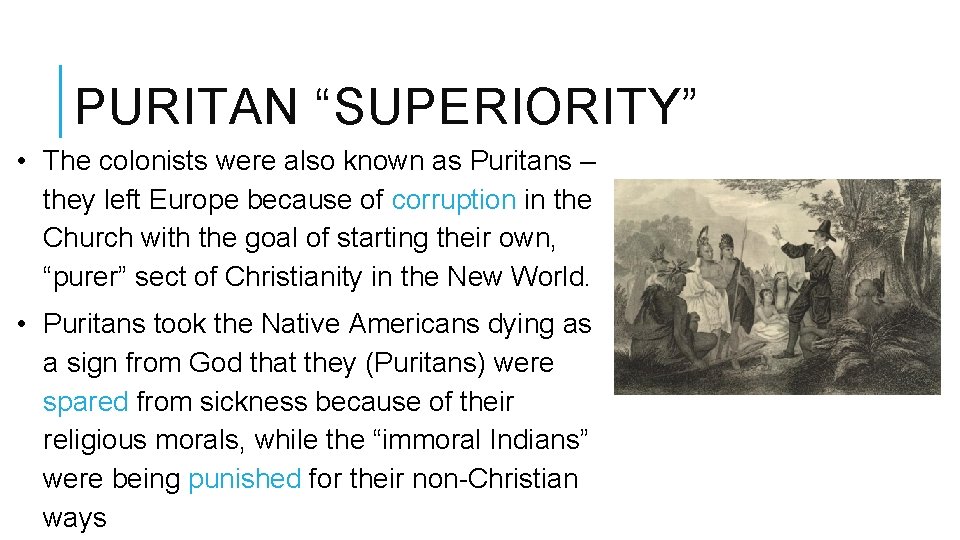
PURITAN “SUPERIORITY” • The colonists were also known as Puritans – they left Europe because of corruption in the Church with the goal of starting their own, “purer” sect of Christianity in the New World. • Puritans took the Native Americans dying as a sign from God that they (Puritans) were spared from sickness because of their religious morals, while the “immoral Indians” were being punished for their non-Christian ways
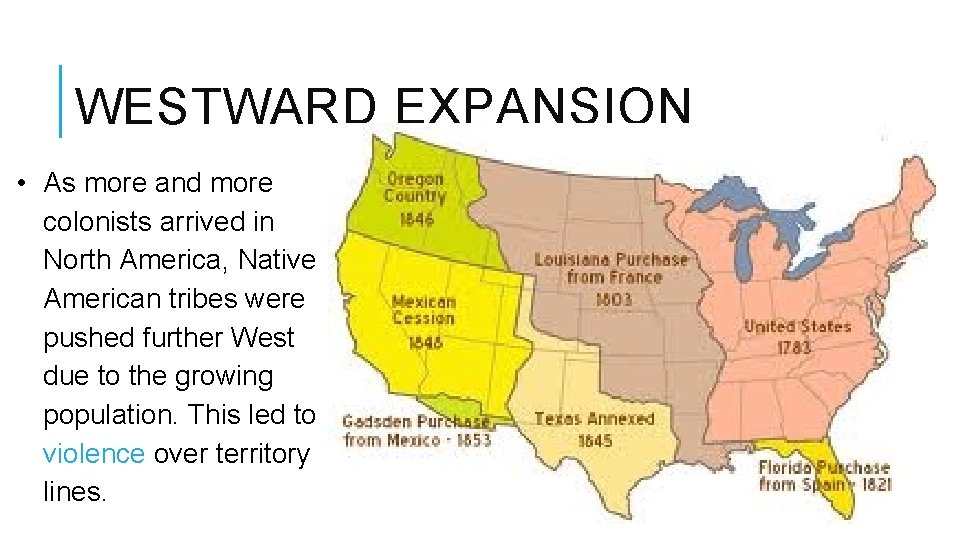
WESTWARD EXPANSION • As more and more colonists arrived in North America, Native American tribes were pushed further West due to the growing population. This led to violence over territory lines.
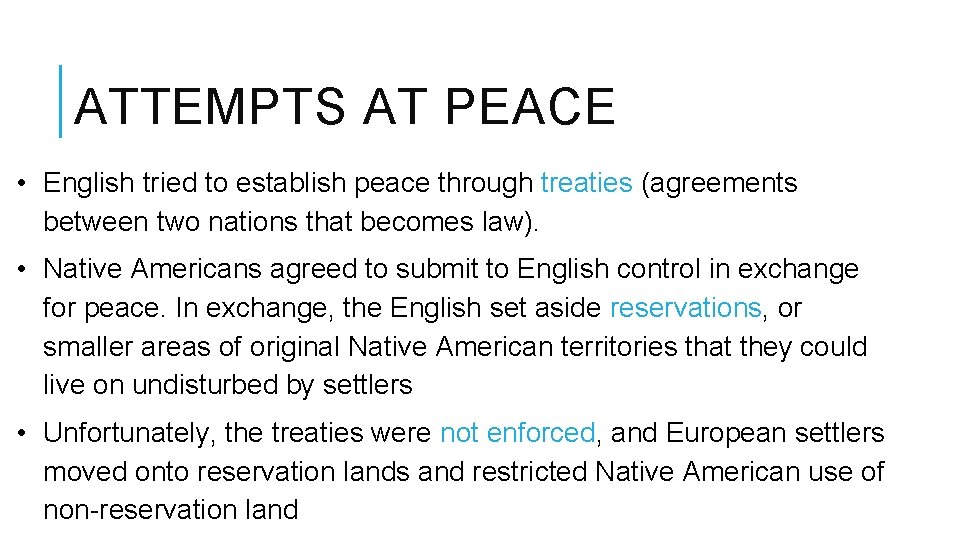
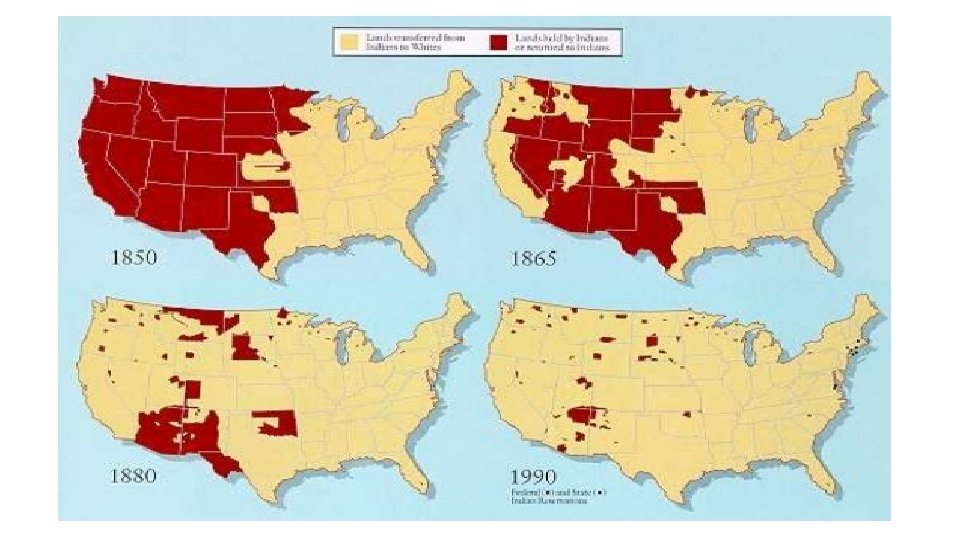
ATTEMPTS AT PEACE • English tried to establish peace through treaties (agreements between two nations that becomes law). • Native Americans agreed to submit to English control in exchange for peace. In exchange, the English set aside reservations, or smaller areas of original Native American territories that they could live on undisturbed by settlers • Unfortunately, the treaties were not enforced, and European settlers moved onto reservation lands and restricted Native American use of non-reservation land
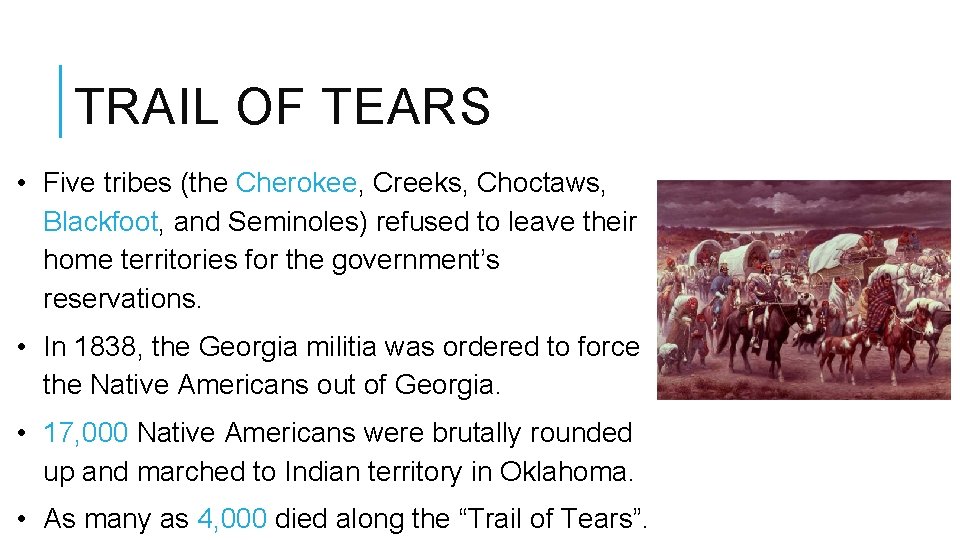
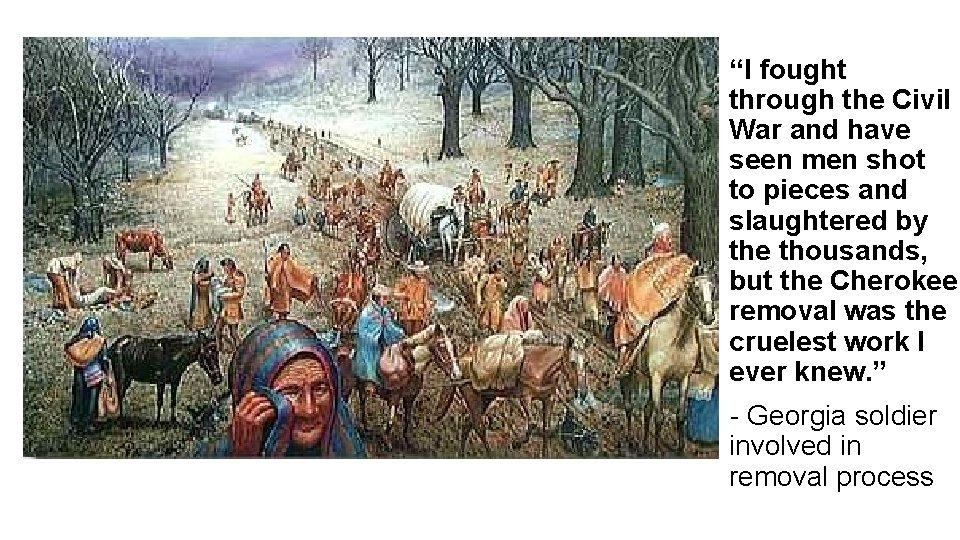
TRAIL OF TEARS • Five tribes (the Cherokee, Creeks, Choctaws, Blackfoot, and Seminoles) refused to leave their home territories for the government’s reservations. • In 1838, the Georgia militia was ordered to force the Native Americans out of Georgia. • 17, 000 Native Americans were brutally rounded up and marched to Indian territory in Oklahoma. • As many as 4, 000 died along the “Trail of Tears”.
“I fought through the Civil War and have seen men shot to pieces and slaughtered by the thousands, but the Cherokee removal was the cruelest work I ever knew. ” - Georgia soldier involved in removal process
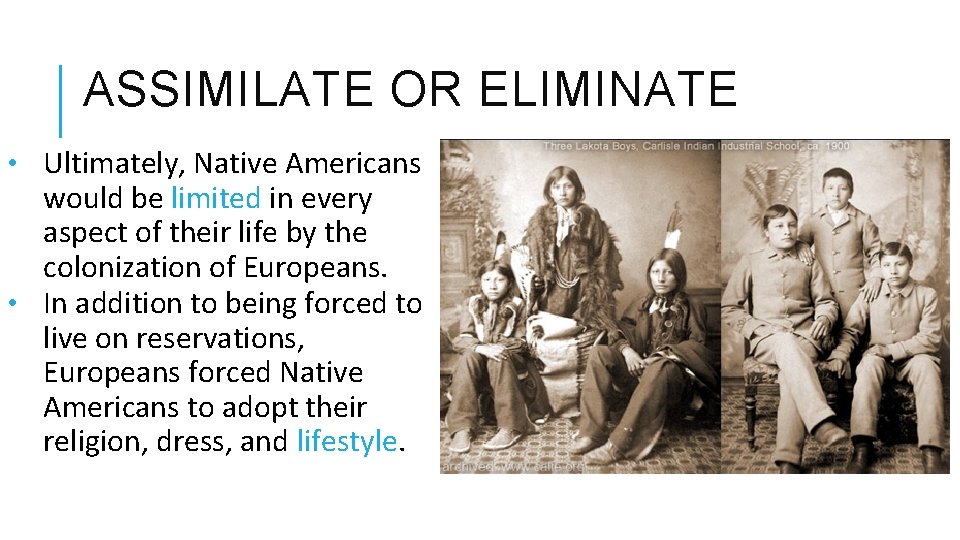
ASSIMILATE OR ELIMINATE • Ultimately, Native Americans would be limited in every aspect of their life by the colonization of Europeans. • In addition to being forced to live on reservations, Europeans forced Native Americans to adopt their religion, dress, and lifestyle.
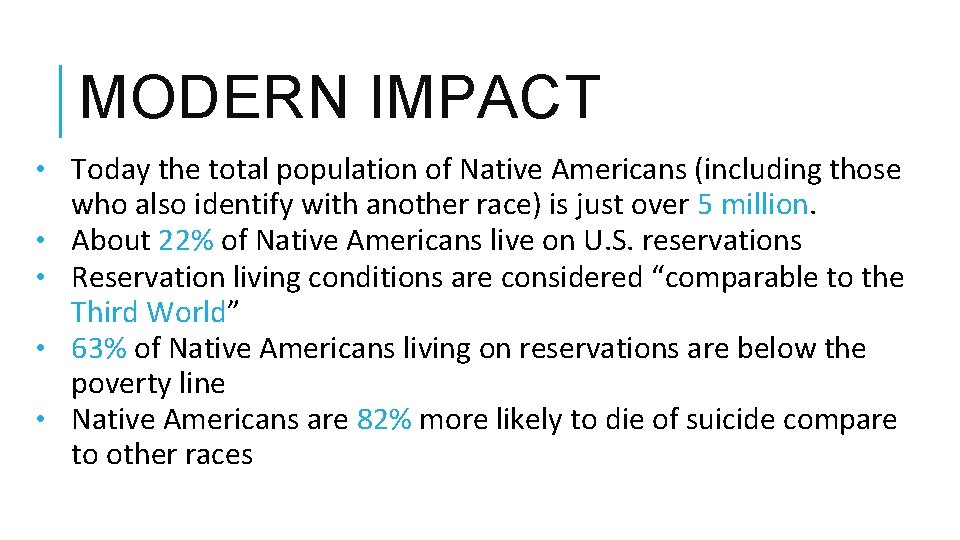
MODERN IMPACT • Today the total population of Native Americans (including those • • who also identify with another race) is just over 5 million. About 22% of Native Americans live on U. S. reservations Reservation living conditions are considered “comparable to the Third World” 63% of Native Americans living on reservations are below the poverty line Native Americans are 82% more likely to die of suicide compare to other races
POST-COLONIAL STYLES/GENRES OF LITERATURE • Oral tradition – folktales, myths, histories, maps, ect. – transposed to written tradition. • Adoption of European literature writings/styles – including poems, short stories, and novels
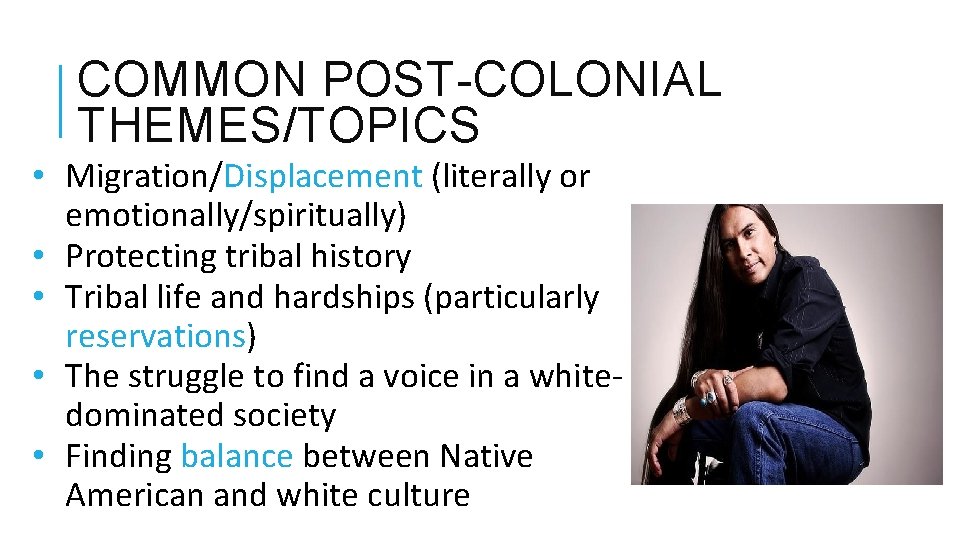
COMMON POST-COLONIAL THEMES/TOPICS • Migration/Displacement (literally or emotionally/spiritually) • Protecting tribal history • Tribal life and hardships (particularly reservations) • The struggle to find a voice in a whitedominated society • Finding balance between Native American and white culture
“DON’T DRINK THE WATER” BY THE DAVE MATTHEWS BAND 1. Read through the lyrics of “Don’t Drink the Water. ” Who is the speaker? How do you know? 2. Who is the “you” the speaker is supposed to be talking to? How do you know? 3. What is the artist’s purpose? What’s the point/message/theme of this song? Please back up your answer using evidence from the text. 4. If you were directing the music video to this song, what types of images/video clips would you include to enhance the song’s meaning?
“DON’T DRINK THE WATER” BY THE DAVE MATTHEWS BAND 5. Watch the real https: //www. youtube. com/watch? v=ps. Iuidkk. Lj. I music video! Did you predict anything in the music video in your answer to #4? Did anything surprise you?
HOMEWORK - IXL For homework, you have one IXL to complete by Friday. For full points, you need at a score of at least 80% on A. 3 in the eleventh grade skills Language Arts section. Good luck!