
Correct MDS 3 0 coding for UTIs By
Correct MDS 3. 0 coding for UTIs By Cil Bullard RN, CPC, RAC-CT State RAI/OASIS Coordinator, Virginia
CMS focus includes UTIs in all settings �CMS has been penalizing hospitals for avoidable complications- one of the CMS ‘Never events’ is developing a UTI while an inpatient �MDS 3. 0 coding does not match ‘typical’ assignment of a UTI diagnosis under current infection control standards
From S&C: 17 -06 -NH Across the scope and severity levels, there were 56 different deficiencies (F-tags) cited. The more frequently cited deficiencies are listed below. �F 278 – MDS Accuracy �F 356 – Posted Nursing Staffing Information �F 279 – Develop Comprehensive Care Plans �F 329 – Free from Unnecessary Drugs �F 314 – Treatment/Services to Prevent/Heal PUs �F 315 – No catheter/Prevent UTI/Restore Bladder �F 274 – Comprehensive Assessment after
Common citations under F 278 �Antipsychotics, Restraints, Falls �Urinary Tract Infections (UTI) Incorrect coding based on UTI criteria in RAI Manual �Continence/Catheters: Coding inconsistent with residents with and w/o a catheter, residents coded as having a catheter with no diagnosis, continence coding �Pressure Ulcers: Coding inconsistent with residents with and w/o pressure ulcers �MDS Quarterly, Comprehensive (annual), and Significant Change in Status Assessment (SCSA): not done timely

MDS Section I, Active diagnoses Two Look‐back periods for Section I • Diagnosis identification physician documentation of diagnosis in last 60 days • Determination if diagnosis is active in 7‐day window (except UTI) 6
Do not include conditions that have been resolved, do not affect the resident’s current status or do not drive the plan of care during the last 7 days Special criteria for UTI: • Physician Dx of UTI in last 30 days and • Signs and symptoms attributed to UTI, and • Positive test, study or procedure, and • Current medication or treatment for UTI in last 30 days 7
Item I 2300 Urinary tract infection (UTI) page I-8 Code only if all the following are met: 1. Physician, nurse practitioner, physician assistant, or clinical nurse specialist or other authorized licensed staff as permitted by state law assign diagnosis of a UTI in last 30 days,
Code only if all the following are met: (continued) 2. Sign or symptom attributed to UTI, which may or may not include but not be limited to: fever, urinary symptoms (e. g. , peri-urethral site burning sensation, frequent urination of small amounts), pain or tenderness in flank, confusion or change in mental status, change in character of urine (e. g. , pyuria),
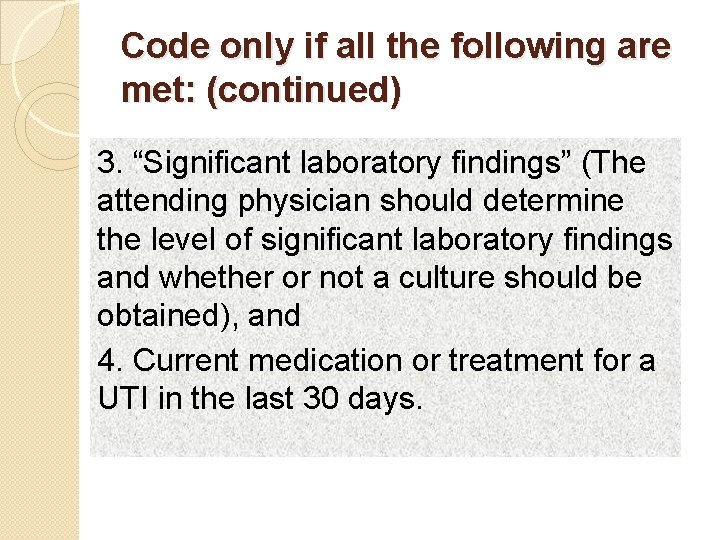
Code only if all the following are met: (continued) 3. “Significant laboratory findings” (The attending physician should determine the level of significant laboratory findings and whether or not a culture should be obtained), and 4. Current medication or treatment for a UTI in the last 30 days.
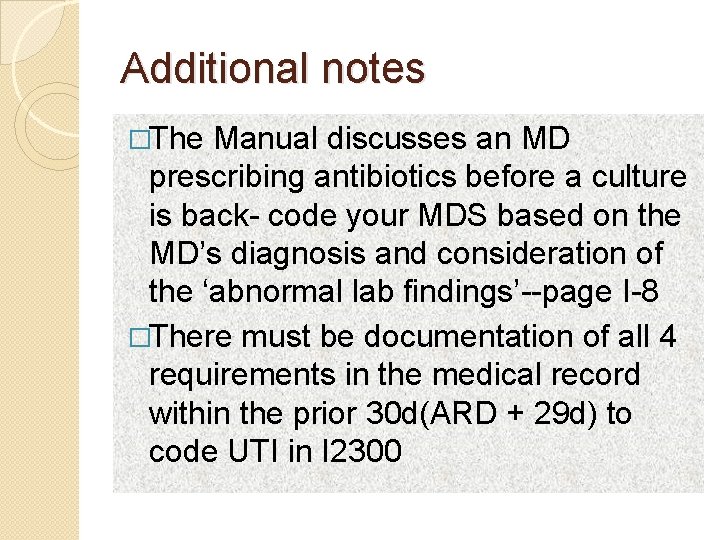
Additional notes �The Manual discusses an MD prescribing antibiotics before a culture is back- code your MDS based on the MD’s diagnosis and consideration of the ‘abnormal lab findings’--page I-8 �There must be documentation of all 4 requirements in the medical record within the prior 30 d(ARD + 29 d) to code UTI in I 2300

�The UTI QM applies to your 5 -star rating �There are expanded requirements for infection control and Quality Assurance in the revisions to the Final Rule �Your Quality Assurance program is a good place to start- review your UTI QM, review MDS accuracy, do a rootcause analysis for any residents with a UTI, implement corrective actions

For questions about UTI coding on the MDS…. . �In Maryland, contact Mark Paugh at mark. Paugh@maryland. gov �In Virginia, contact Cil Bullard at Priscilla. bullard@vdh. virginia. gov
- Slides: 13