
Correct Addressing Business Letter Services Introduction Correctly addressing
Correct Addressing Business Letter Services
Introduction Correctly addressing articles allows Australia Post’s mail sorting equipment to sort mail accurately and quickly and lets the postie know where to deliver it. In this module This module explains the importance of Correct Addressing and provides a detailed review of Australia Post’s requirements for correctly addressing each of the Bulk Mail services. Learning outcomes By completing this module, you will be able to: • list the background and benefits of Correct Addressing • identify Australia Post’s Correct Addressing standards and conditions for each Business Letter service • locate current information about Correct Addressing

Correct addressing at a glance What is a ‘Correct Address’ The address on every mail article is a direction to Australia Post. It directs the article through the mail delivery process, from street post box or Mail Centre to people’s letter boxes. It should be complete, concise, and clearly written or printed so that Australia Post can process and deliver the article accurately and speedily. Correct addressing conditions ensure Australia Post delivery systems can recognise and interpret the delivery address.

Correct addressing at a glance Components of a correct address The address on any postal article must be left justified and contain the following components: • name of addressee • “Attention of: ” or other reference details • street address: house or box number, street name and type or Locked Bag number • locality name or the name of the office of delivery • State or Territory abbreviation Australia Post • postcode Attention of: Mr A. Sample Punctuation must be avoided in the last line of the address, 321 Exhibition Street including full stops and commas. No part of the address should be underlined. Specific standards relate to each line of the address. These standards are covered on the following pages. MELBOURNE VIC 3000
Advanced: Correct addressing standards Introduction The advanced letter sorting equipment used by Australia Post can read not only the place name, State, postcode (essentially the last line of the address) - it is able to read the full address information. This enables letters to be sorted to a finer level. The following 10 address presentation standards outline the correct format • Building/Property name • Building/Complex Sub Unit • Floor/Level • House/Property Number • Lot/Section Number • Street Name and Type • Postal Delivery Type • Placename/Suburb/Locality • State/Territory • Postcode Each standard is covered in more detail on the following pages.

Advanced: Correct addressing standards Introduction All abbreviations used by Australia Post are based on Australian Standards AS 45901999. The Address Presentation Standards does not contain a complete list of abbreviations, only those commonly used. Whilst these standards have been specifically developed for the machine addressing of Small letters, it is recommended they be used for all categories of mail, including hand addressed mail articles.
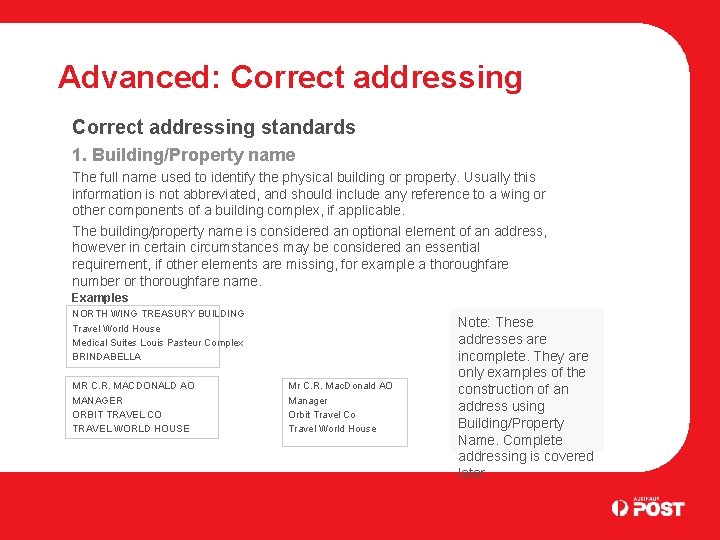
Advanced: Correct addressing standards 1. Building/Property name The full name used to identify the physical building or property. Usually this information is not abbreviated, and should include any reference to a wing or other components of a building complex, if applicable. The building/property name is considered an optional element of an address, however in certain circumstances may be considered an essential requirement, if other elements are missing, for example a thoroughfare number or thoroughfare name. Examples NORTH WING TREASURY BUILDING Travel World House Medical Suites Louis Pasteur Complex BRINDABELLA MR C. R. MACDONALD AO MANAGER ORBIT TRAVEL CO TRAVEL WORLD HOUSE Mr C. R. Mac. Donald AO Manager Orbit Travel Co Travel World House Note: These addresses are incomplete. They are only examples of the construction of an address using Building/Property Name. Complete addressing is covered later.

Advanced: Correct addressing Correct Addressing standards 2. Building/Complex Sub. Unit If applicable, specifying the type of a separately identifiable portion within a building complex or marina with its associated number or identifier to clearly distinguish it from another, is an essential element of an address. Abbreviations can be used, however they are not essential. If abbreviations are used they should be structured in accordance with the table below.
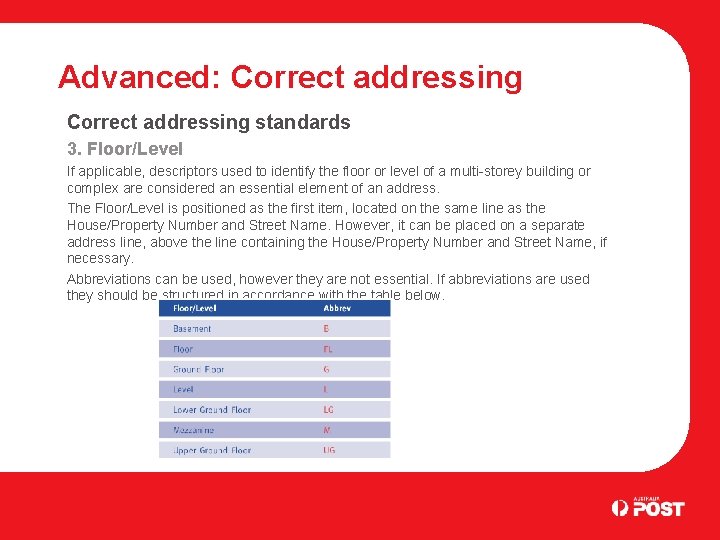
Advanced: Correct addressing standards 3. Floor/Level If applicable, descriptors used to identify the floor or level of a multi-storey building or complex are considered an essential element of an address. The Floor/Level is positioned as the first item, located on the same line as the House/Property Number and Street Name. However, it can be placed on a separate address line, above the line containing the House/Property Number and Street Name, if necessary. Abbreviations can be used, however they are not essential. If abbreviations are used they should be structured in accordance with the table below.

Advanced: Correct addressing standards 4. House/Property number To record the numeric or numeric/alpha reference number of a house or property (also referred to as a street number) is an essential element of an address. The House/Property Number is positioned before the Street Name and Type, located in the same line containing the Street Name. Generally, only one house/property number is used. However, if the house/property number includes a number range, the range of applicable numbers should be included, separated by a hyphen (-), with no spaces between numerals, i. e. 17 -19. Ideally, the alpha characters should be printed in upper case, with no spaces between numerals, for example 11 B. Examples 11 B Waterman Ave 101 -105 WENTWORTH RD 17 Jones St MR C. R. MACDONALD AO MANAGER ORBIT TRAVEL CO TRAVEL WORLD HOUSE SUITE 3 LEVEL 7 17 JONES ST Mr C. R. Mac. Donald AO Manager Orbit Travel Co Travel World House Suite 3 Level 7 17 Jones St
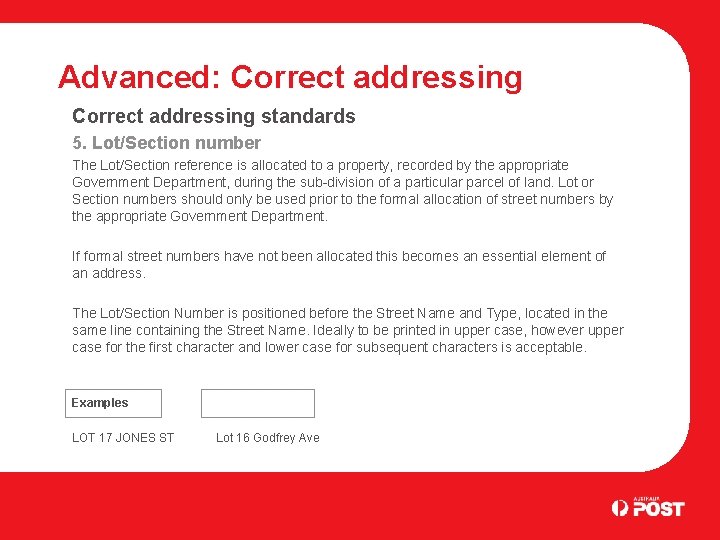
Advanced: Correct addressing standards 5. Lot/Section number The Lot/Section reference is allocated to a property, recorded by the appropriate Government Department, during the sub-division of a particular parcel of land. Lot or Section numbers should only be used prior to the formal allocation of street numbers by the appropriate Government Department. If formal street numbers have not been allocated this becomes an essential element of an address. The Lot/Section Number is positioned before the Street Name and Type, located in the same line containing the Street Name. Ideally to be printed in upper case, however upper case for the first character and lower case for subsequent characters is acceptable. Examples LOT 17 JONES ST Lot 16 Godfrey Ave
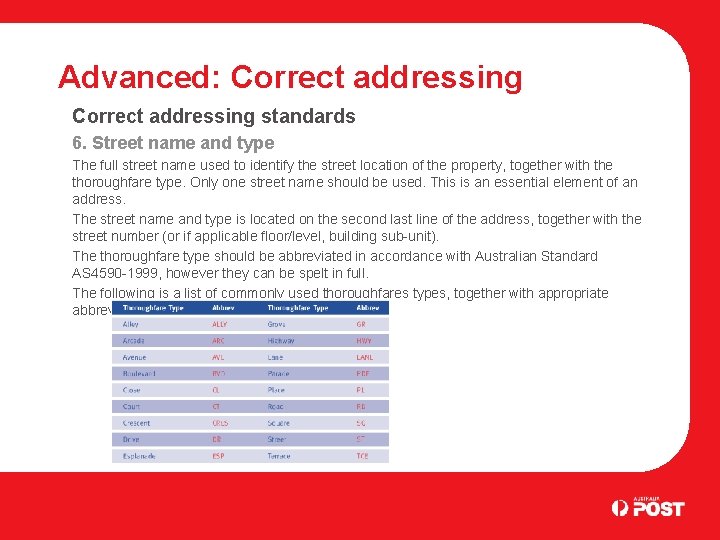
Advanced: Correct addressing standards 6. Street name and type The full street name used to identify the street location of the property, together with the thoroughfare type. Only one street name should be used. This is an essential element of an address. The street name and type is located on the second last line of the address, together with the street number (or if applicable floor/level, building sub-unit). The thoroughfare type should be abbreviated in accordance with Australian Standard AS 4590 -1999, however they can be spelt in full. The following is a list of commonly used thoroughfares types, together with appropriate abbreviations.
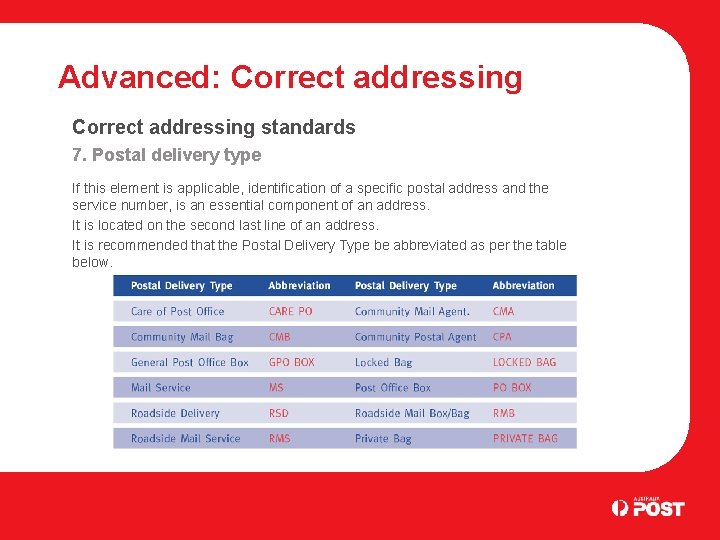
Advanced: Correct addressing standards 7. Postal delivery type If this element is applicable, identification of a specific postal address and the service number, is an essential component of an address. It is located on the second last line of an address. It is recommended that the Postal Delivery Type be abbreviated as per the table below.
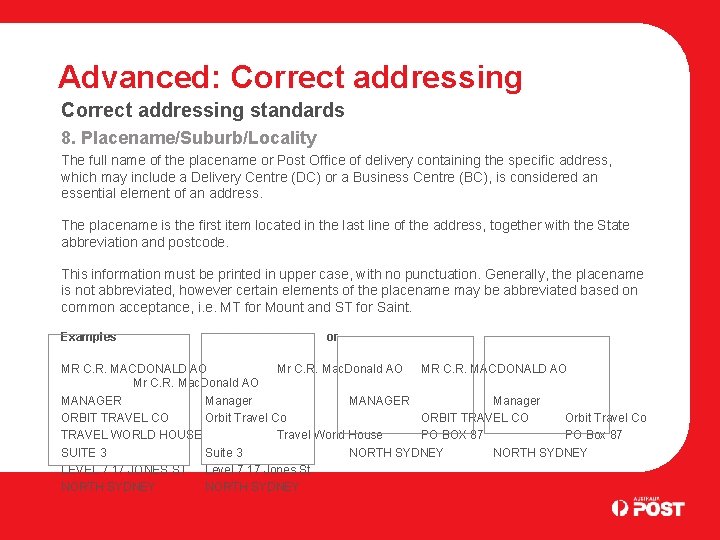
Advanced: Correct addressing standards 8. Placename/Suburb/Locality The full name of the placename or Post Office of delivery containing the specific address, which may include a Delivery Centre (DC) or a Business Centre (BC), is considered an essential element of an address. The placename is the first item located in the last line of the address, together with the State abbreviation and postcode. This information must be printed in upper case, with no punctuation. Generally, the placename is not abbreviated, however certain elements of the placename may be abbreviated based on common acceptance, i. e. MT for Mount and ST for Saint. Examples or MR C. R. MACDONALD AO Mr C. R. Mac. Donald AO MANAGER Manager ORBIT TRAVEL CO Orbit Travel Co TRAVEL WORLD HOUSE Travel World House PO BOX 87 PO Box 87 SUITE 3 Suite 3 NORTH SYDNEY LEVEL 7 17 JONES ST Level 7 17 Jones St NORTH SYDNEY

Advanced: Correct addressing standards 9. State/Territory The defined State or Territory in Australia (in abbreviated format) that the specific placename/address is located is considered an essential element of an address. The State or Territory abbreviation is located in the last line of the address, one or two spaces after the Suburb/Place/Locality. Two spaces are preferred. It must be printed in upper case, with no punctuation. The State or Territory must always appear in an approved abbreviated form, as indicated below.
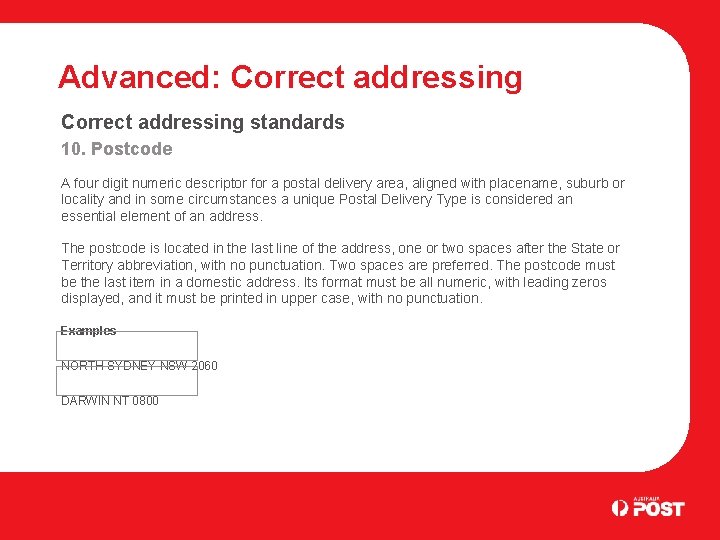
Advanced: Correct addressing standards 10. Postcode A four digit numeric descriptor for a postal delivery area, aligned with placename, suburb or locality and in some circumstances a unique Postal Delivery Type is considered an essential element of an address. The postcode is located in the last line of the address, one or two spaces after the State or Territory abbreviation, with no punctuation. Two spaces are preferred. The postcode must be the last item in a domestic address. Its format must be all numeric, with leading zeros displayed, and it must be printed in upper case, with no punctuation. Examples NORTH SYDNEY NSW 2060 DARWIN NT 0800
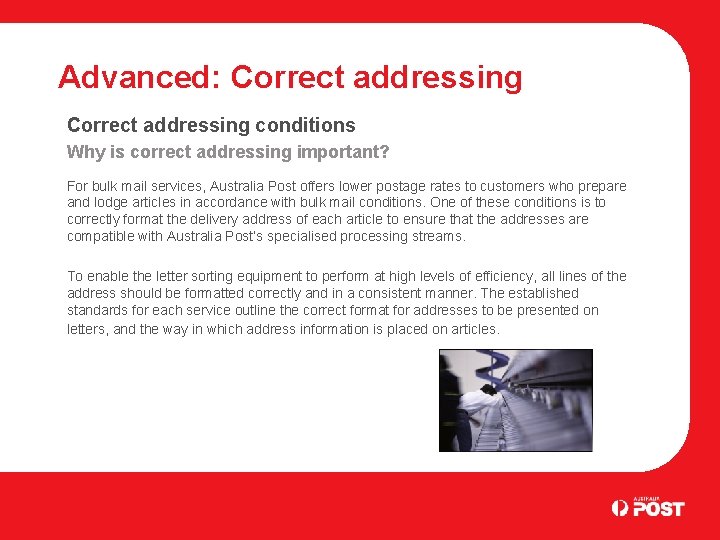
Advanced: Correct addressing conditions Why is correct addressing important? For bulk mail services, Australia Post offers lower postage rates to customers who prepare and lodge articles in accordance with bulk mail conditions. One of these conditions is to correctly format the delivery address of each article to ensure that the addresses are compatible with Australia Post’s specialised processing streams. To enable the letter sorting equipment to perform at high levels of efficiency, all lines of the address should be formatted correctly and in a consistent manner. The established standards for each service outline the correct format for addresses to be presented on letters, and the way in which address information is placed on articles.
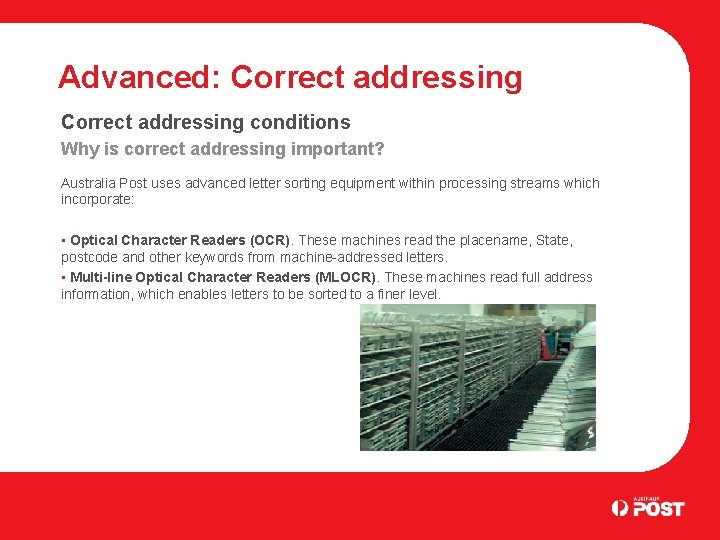
Advanced: Correct addressing conditions Why is correct addressing important? Australia Post uses advanced letter sorting equipment within processing streams which incorporate: • Optical Character Readers (OCR). These machines read the placename, State, postcode and other keywords from machine-addressed letters. • Multi-line Optical Character Readers (MLOCR). These machines read full address information, which enables letters to be sorted to a finer level.
Advanced: Correct addressing conditions When is correct addressing mandatory? Correct Addressing is a condition of acceptance for: • Charity Mail • Clean Mail • Impact Mail • Acquisition Mail • Pre. Sort Letters • Print Post • Reply Paid Specific requirements for each service are covered on the following pages. The address structure on Reply Paid responses is different to the others, so it is covered separately later in this module.
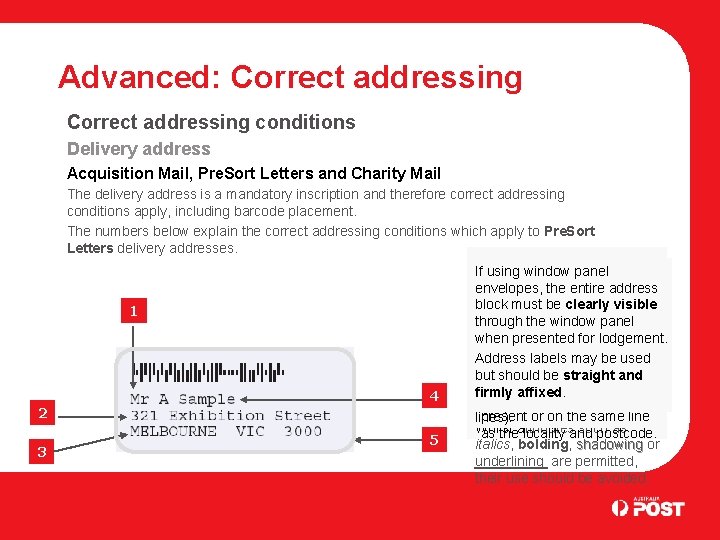
Advanced: Correct addressing conditions Delivery address Acquisition Mail, Pre. Sort Letters and Charity Mail 2 3 The delivery address is a mandatory inscription and therefore correct addressing conditions apply, including barcode placement. The numbers below explain the correct addressing conditions which apply to Pre. Sort Letters delivery addresses. Address lines Bottom line must contain If using window panel (excluding barcode the localitythe andentire postcode. It envelopes, address placement) should be left is recommended that visible the Additional address block must. Any be clearly justified. font can be 1 State abbreviation printed information such as is a through the window panel used forsame the address as long on the line after the business or person’s name, Second last line must when presented for lodgement. as it isbeclearly readable, locality and that CAPITALS must placed above the contain the delivery address Address labels may besize used preferably in 12 point are used. Customers last two lines of the can information. but should be straight and it is strongly access Pre. Sort prices if the address (not below, firmly affixed. recommended that print 4 State abbreviation is not alongside or within these characters do not overlap. present or on the same lines). Whilst such as as theattributes locality and postcode. 5 italics, bolding, shadowing or underlining are permitted, their use should be avoided.
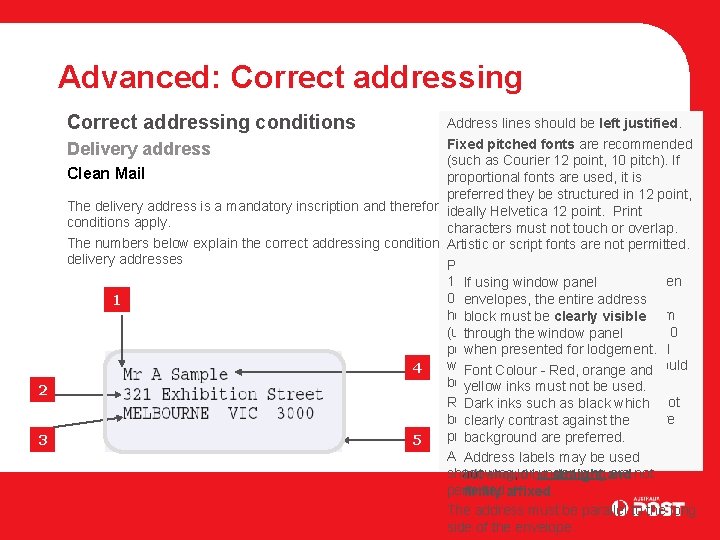
Advanced: Correct addressing conditions 2 3 Address lines should be left justified. Fixed pitched fonts are recommended Delivery address (such as Courier 12 point, 10 pitch). If Clean Mail proportional fonts are used, it is preferred they be structured in 12 point, The delivery address is a mandatory inscription and thereforeideally correct. Helvetica addressing 12 point. Print conditions apply. characters must not touch or overlap. The numbers below explain the correct addressing conditions. Artistic which apply to Clean Mail or script fonts are not permitted. delivery addresses Print characters mustcontain be between Bottom line must in Additional address information 1. 8 mm and 7. 0 mm high, and between If using window panel the following order: locality, Second last linethe must such as a business or 0. 3 mm and 7. 0 mm wide. The ideal envelopes, the entire address 1 State abbreviation andbe finally contain the number and person’s name, must height is must between 2. 0 mm and 4. 0 mm block be This clearly visible the postcode. line is to be placed above the last two name ofthe streetpanel ornominal (upper case characters of 10 through window printed inthe CAPITALS with no lines of address (not thoroughfare orfor PO Box or fall point andpresented 12 point generally when lodgement. punctuation andtype no underlining. below, alongside or within this. Line spacing Bag number. 4 Font Colour Red, orange andshould Leave 1 range) or 2 -spaces between lines). be these between 1. 0 mm andbe 2. 5 mm. yellow inks must not the locality, the State or used. Red, orange and yellow inks must not Dark inks such as black which territory abbreviation and the be clearly used. Dark inksagainst such asthe black are contrast postcode. preferred. background are preferred. 5 Attributes as may italics, Addresssuch labels bebolding, used shadowing, underlining are not but shouldorbe straight and permitted. firmly affixed. The address must be parallel to the long side of the envelope.
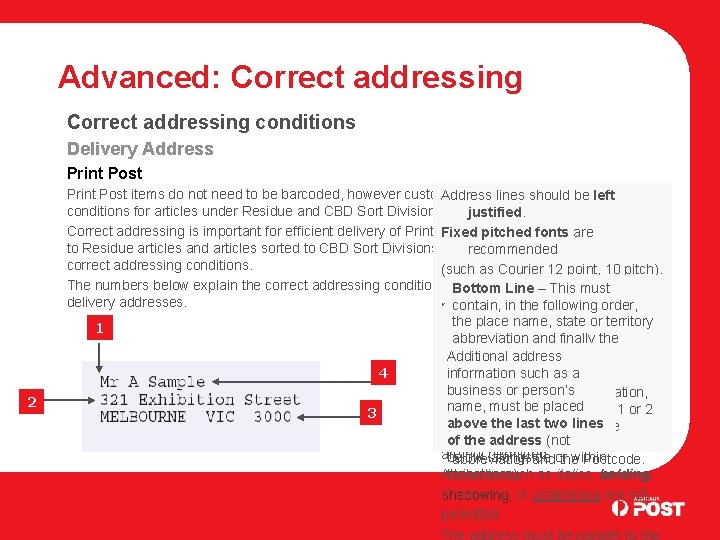
Advanced: Correct addressing conditions Delivery Address Print Post 2 Print Post items do not need to be barcoded, however customers can lines avoidshould correctbeaddressing Address left conditions for articles under Residue and CBD Sort Divisions if they apply barcodes. justified. Correct addressing is important for efficient delivery of Print Post articles. surcharge Fixed pitched. Afonts are applies to Residue articles and articles sorted to CBD Sort Divisions which do not meet the following recommended correct addressing conditions. (such as Courier 12 point, 10 pitch). The numbers below explain the correct addressing conditions which If apply Bottom Lineto–Print This Post must delivery addresses. contain, in fonts the following order, proportional are used, it is Second Last Linestate – This thepreferred place name, or territory 1 must contain the abbreviation anddelivery finally they be structured in 12 point, address information. postcode. Additional ideally address information a Red, yellow 4 This orange line 12 is such toand beas printed in Helvetica point. Print characters business or person’s inks must not be used. Dark CAPITALS with no punctuation, must name, must be placed inks such as black which and no underlining. Leave 1 or 2 3 not touch or overlap. Artistic above last two lines clearly contrast against the or spacesthe only between place script fonts (not of the address background preferred. name, stateare or territory are not permitted. below, alongside within abbreviation andor the Postcode. these lines). Attributes such as italics, bolding, shadowing, or underlining are not permitted. The address must be parallel to the
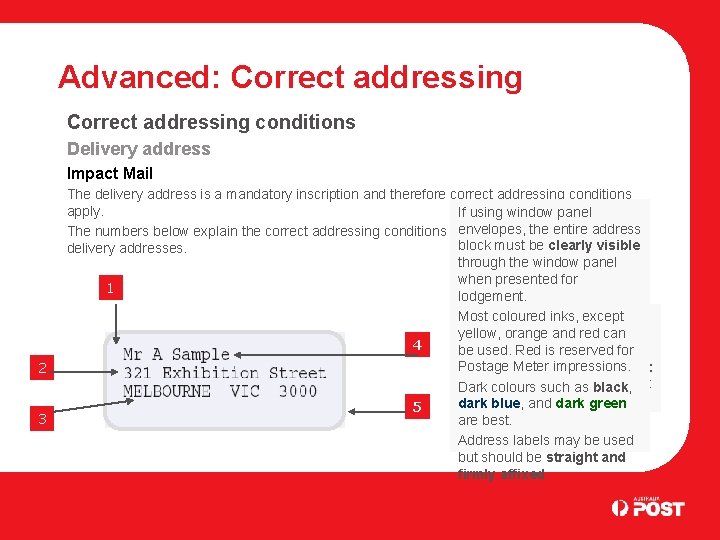
Advanced: Correct addressing conditions Delivery address Impact Mail 2 3 The delivery address is a mandatory inscription and therefore correct addressing conditions apply. If using window panel envelopes, the. Impact entire address The numbers below explain the correct addressing conditions which apply to Mail block must be clearly visible delivery addresses. through the window panel when presented for 1 lodgement. 1. linesline should be 2. Address Second last must Most coloured inks, except left 4. address contain the delivery 3. Additional Itjustified. is recommended that yellow, orange and red can information such as a Any fontinformation. can be used address the place name, state for 4 be used. Red islong reserved business oras person’s the address asname, it isfor abbreviation and postcode Postage Meter impressions. must be placed above clearly readable, preferably be printed on the samethe linelast lines of the address Dark colours such as are black, (not intwo 12 that point size. and CAPITALS below, alongside or within dark and dark green used. blue, This information 5 these lines). are best. be on the bottom should line. Address labels may be used but should be straight and firmly affixed.
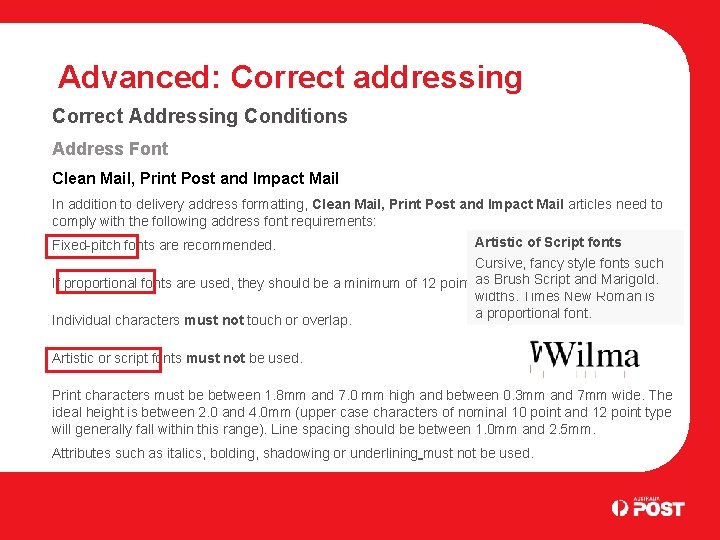
Advanced: Correct addressing Correct Addressing Conditions Address Font Clean Mail, Print Post and Impact Mail In addition to delivery address formatting, Clean Mail, Print Post and Impact Mail articles need to comply with the following address font requirements: Artistic Fixed Proportional pitch of Script (or fonts nonfonts proportional) In Cursive, proportional fancy fonts style fonts; fonts different such In size. characters as fixed-pitch Brush Script have fonts; and different every Marigold. If proportional fonts are used, they should be a minimum of 12 point in character widths. Times has the Newsame Roman width is. Courier a proportional is a fixed font. pitch font. Individual characters must not touch or overlap. Fixed-pitch fonts are recommended. Artistic or script fonts must not be used. Print characters must be between 1. 8 mm and 7. 0 mm high and between 0. 3 mm and 7 mm wide. The ideal height is between 2. 0 and 4. 0 mm (upper case characters of nominal 10 point and 12 point type will generally fall within this range). Line spacing should be between 1. 0 mm and 2. 5 mm. Attributes such as italics, bolding, shadowing or underlining must not be used.
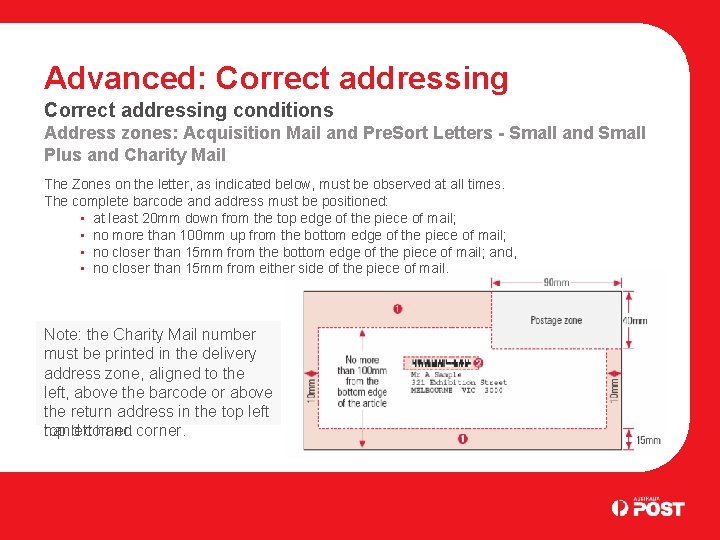
Advanced: Correct addressing conditions Address zones: Acquisition Mail and Pre. Sort Letters - Small and Small Plus and Charity Mail The Zones on the letter, as indicated below, must be observed at all times. The complete barcode and address must be positioned: • at least 20 mm down from the top edge of the piece of mail; • no more than 100 mm up from the bottom edge of the piece of mail; • no closer than 15 mm from the bottom edge of the piece of mail; and, • no closer than 15 mm from either side of the piece of mail. Note: the Charity Acquisition Mail number job ID number must be must printed beinprinted the delivery in the delivery address zone, aligned zone, to aligned the to the left, above the barcode or above the return the address return address in the top in the left top leftcorner. hand corner.
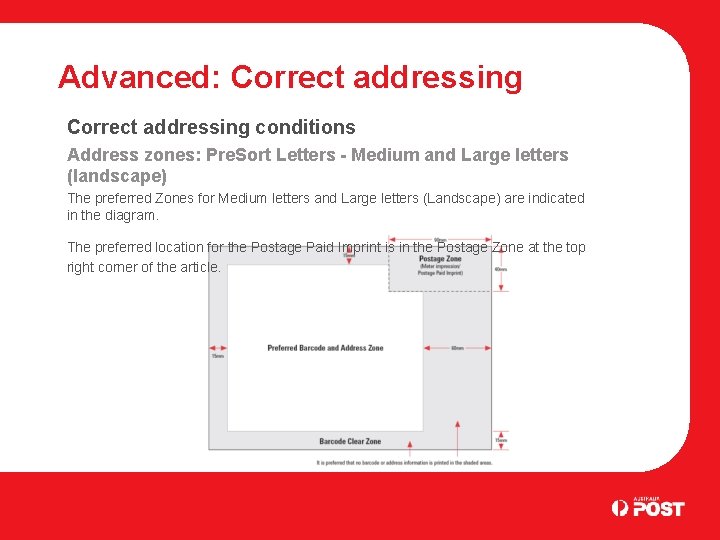
Advanced: Correct addressing conditions Address zones: Pre. Sort Letters - Medium and Large letters (landscape) The preferred Zones for Medium letters and Large letters (Landscape) are indicated in the diagram. The preferred location for the Postage Paid Imprint is in the Postage Zone at the top right corner of the article.
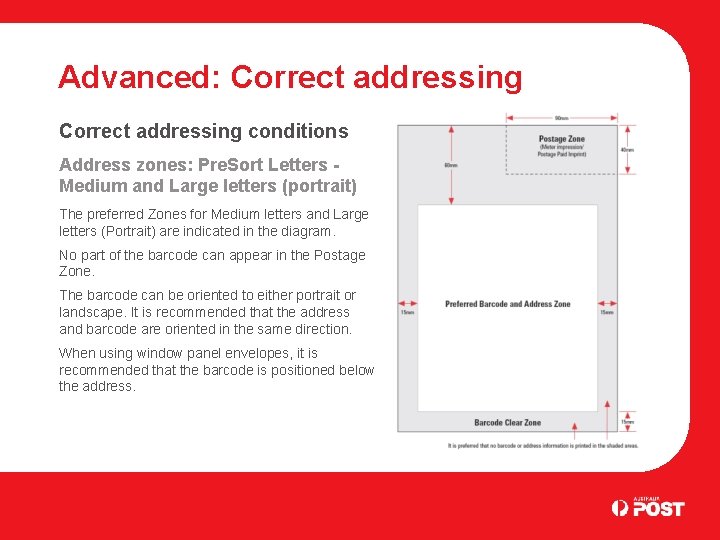
Advanced: Correct addressing conditions Address zones: Pre. Sort Letters Medium and Large letters (portrait) The preferred Zones for Medium letters and Large letters (Portrait) are indicated in the diagram. No part of the barcode can appear in the Postage Zone. The barcode can be oriented to either portrait or landscape. It is recommended that the address and barcode are oriented in the same direction. When using window panel envelopes, it is recommended that the barcode is positioned below the address.
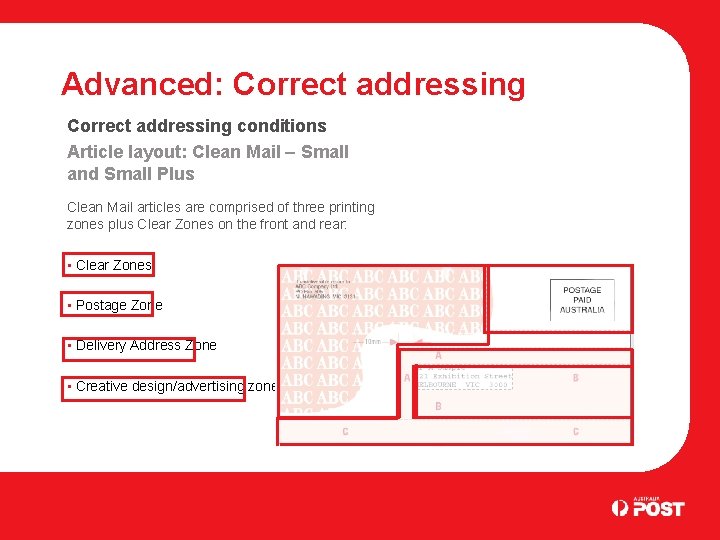
Advanced: Correct addressing conditions Article layout: Clean Mail – Small and Small Plus Clean Mail articles are comprised of three printing zones plus Clear Zones on the front and rear: • Clear Zones • Postage Zone • Delivery Address Zone • Creative design/advertising zone
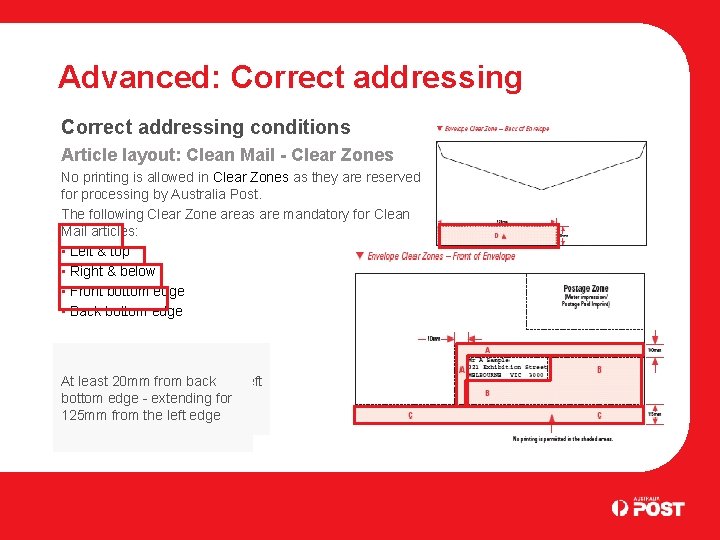
Advanced: Correct addressing conditions Article layout: Clean Mail - Clear Zones No printing is allowed in Clear Zones as they are reserved for processing by Australia Post. The following Clear Zone areas are mandatory for Clean Mail articles: • Left & top • Right & below • Front bottom edge • Back bottom edge The whole of the area 10 mm clear from the left At least 20 mm from back 15 mm below and to the right of the side top of edge address block bottom edge - extending for front & bottom of the address blockthe left edge 125 mm envelopefrom
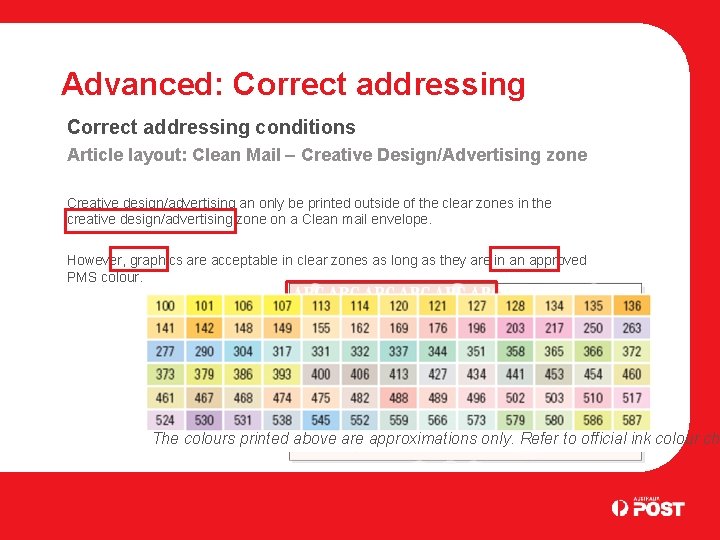
Advanced: Correct addressing conditions Article layout: Clean Mail – Creative Design/Advertising zone Creative design/advertising an only be printed outside of the clear zones in the creative design/advertising zone on a Clean mail envelope. However, graphics are acceptable in clear zones as long as they are in an approved PMS colour. The colours printed above are approximations only. Refer to official ink colour ch
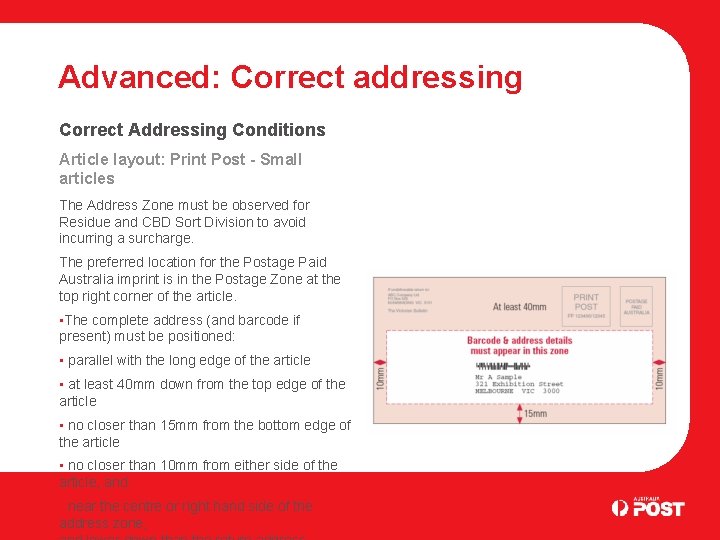
Advanced: Correct addressing Correct Addressing Conditions Article layout: Print Post - Small articles The Address Zone must be observed for Residue and CBD Sort Division to avoid incurring a surcharge. The preferred location for the Postage Paid Australia imprint is in the Postage Zone at the top right corner of the article. • The complete address (and barcode if present) must be positioned: • parallel with the long edge of the article • at least 40 mm down from the top edge of the article • no closer than 15 mm from the bottom edge of the article • no closer than 10 mm from either side of the article, and • near the centre or right hand side of the address zone,
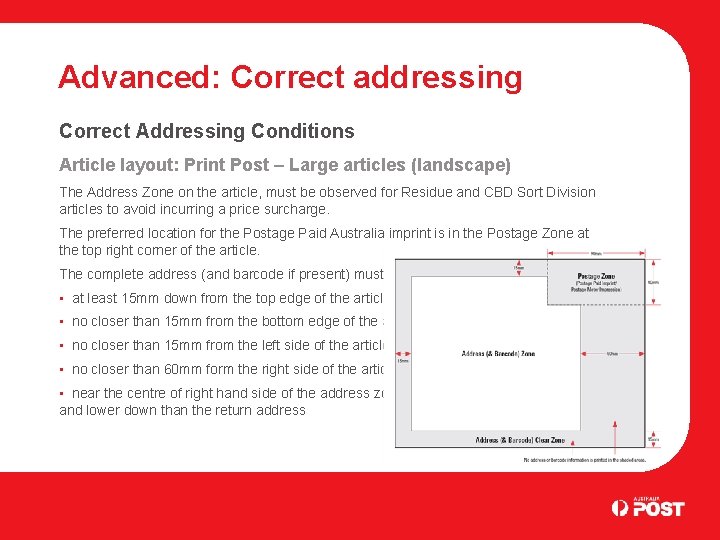
Advanced: Correct addressing Correct Addressing Conditions Article layout: Print Post – Large articles (landscape) The Address Zone on the article, must be observed for Residue and CBD Sort Division articles to avoid incurring a price surcharge. The preferred location for the Postage Paid Australia imprint is in the Postage Zone at the top right corner of the article. The complete address (and barcode if present) must be positioned: • at least 15 mm down from the top edge of the article • no closer than 15 mm from the bottom edge of the article • no closer than 15 mm from the left side of the article • no closer than 60 mm form the right side of the article • near the centre of right hand side of the address zone, and lower down than the return address
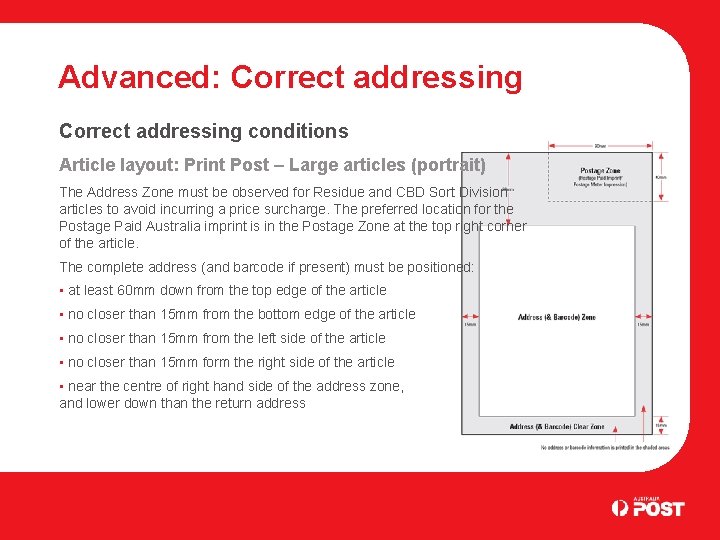
Advanced: Correct addressing conditions Article layout: Print Post – Large articles (portrait) The Address Zone must be observed for Residue and CBD Sort Division articles to avoid incurring a price surcharge. The preferred location for the Postage Paid Australia imprint is in the Postage Zone at the top right corner of the article. The complete address (and barcode if present) must be positioned: • at least 60 mm down from the top edge of the article • no closer than 15 mm from the bottom edge of the article • no closer than 15 mm from the left side of the article • no closer than 15 mm form the right side of the article • near the centre of right hand side of the address zone, and lower down than the return address
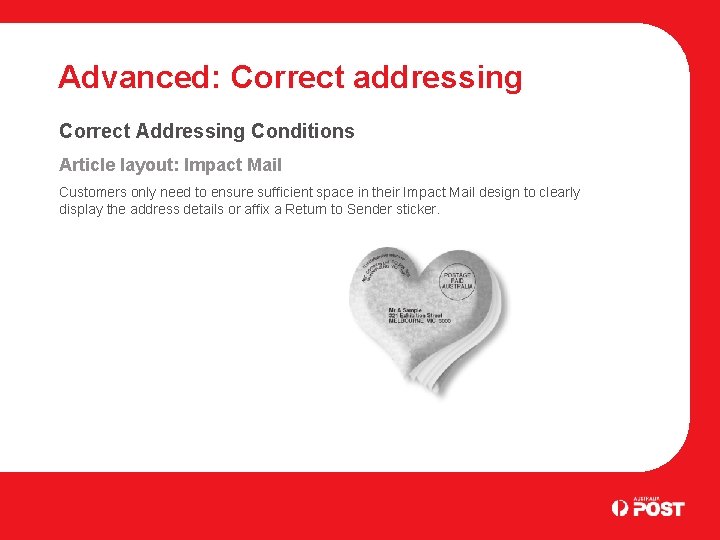
Advanced: Correct addressing Correct Addressing Conditions Article layout: Impact Mail Customers only need to ensure sufficient space in their Impact Mail design to clearly display the address details or affix a Return to Sender sticker.
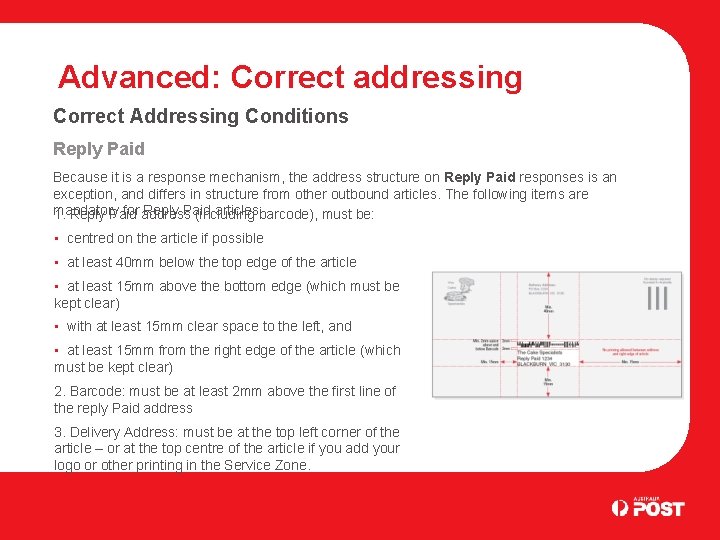
Advanced: Correct addressing Correct Addressing Conditions Reply Paid Because it is a response mechanism, the address structure on Reply Paid responses is an exception, and differs in structure from other outbound articles. The following items are mandatory for address Reply Paid articles: barcode), must be: 1. Reply Paid (including • centred on the article if possible • at least 40 mm below the top edge of the article • at least 15 mm above the bottom edge (which must be kept clear) • with at least 15 mm clear space to the left, and • at least 15 mm from the right edge of the article (which must be kept clear) 2. Barcode: must be at least 2 mm above the first line of the reply Paid address 3. Delivery Address: must be at the top left corner of the article – or at the top centre of the article if you add your logo or other printing in the Service Zone.
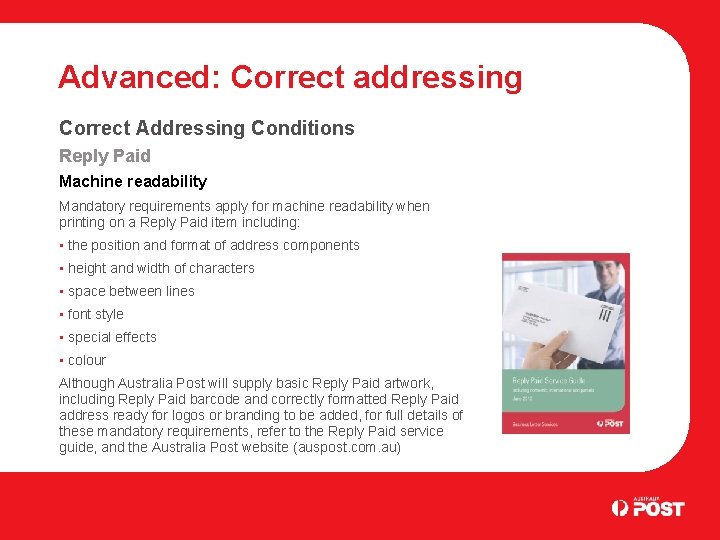
Advanced: Correct addressing Correct Addressing Conditions Reply Paid Machine readability Mandatory requirements apply for machine readability when printing on a Reply Paid item including: • the position and format of address components • height and width of characters • space between lines • font style • special effects • colour Although Australia Post will supply basic Reply Paid artwork, including Reply Paid barcode and correctly formatted Reply Paid address ready for logos or branding to be added, for full details of these mandatory requirements, refer to the Reply Paid service guide, and the Australia Post website (auspost. com. au)
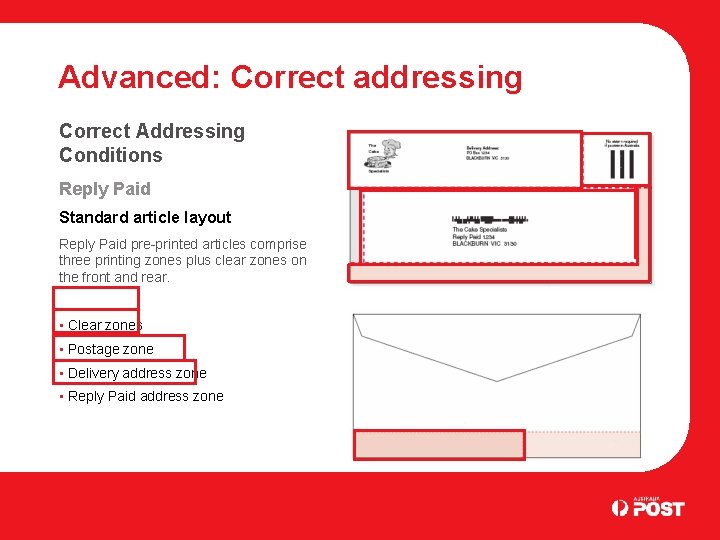
Advanced: Correct addressing Correct Addressing Conditions Reply Paid Standard article layout Reply Paid pre-printed articles comprise three printing zones plus clear zones on the front and rear. • Clear zones • Postage zone • Delivery address zone • Reply Paid address zone
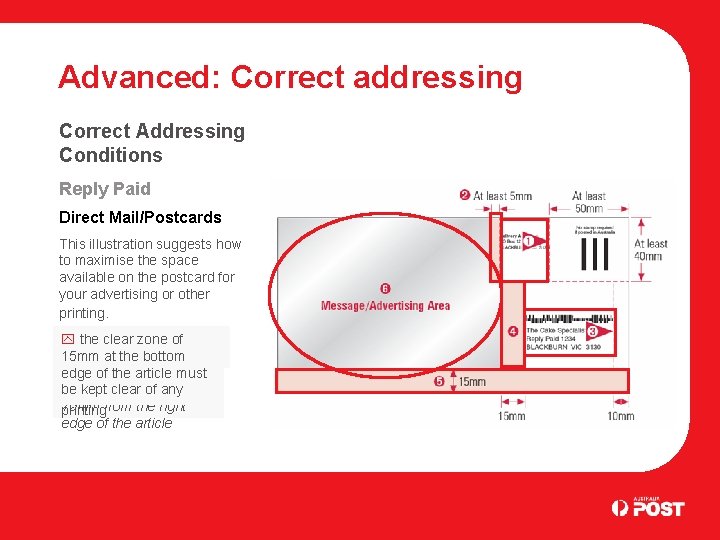
Advanced: Correct addressing Correct Addressing Conditions Reply Paid Direct Mail/Postcards This illustration suggests how to maximise the space available on the postcard for your advertising or other printing. move keep the move remaining clear 5 mm 15 mm thezone Reply delivery clear space of. Paid totothe address left on barcode the 15 mm the of leftthe left at ofto and the delivery the side the bottom address Reply right of theedge Paid as of the address article far barcode edge to of the delivery may the and right be article address as address used must for zone the possible be kept advertising – no clear – closer no of closer or any than 50 mm 10 mm from the right other printing edge of the article
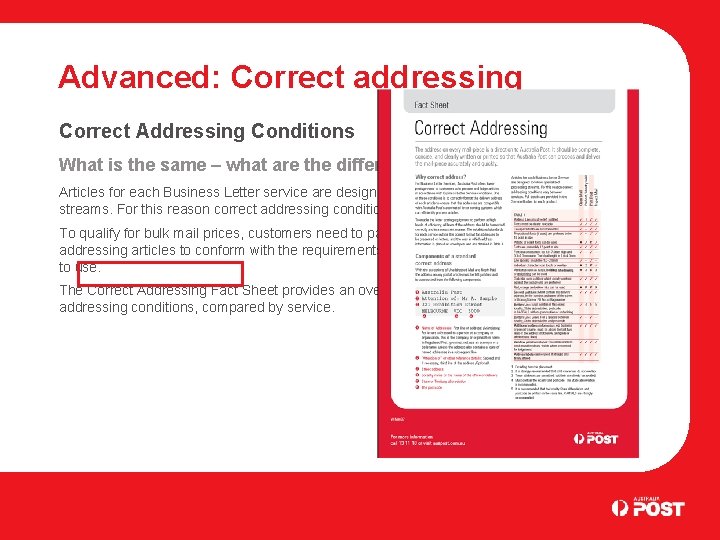
Advanced: Correct addressing Correct Addressing Conditions What is the same – what are the differences? Articles for each Business Letter service are designed to follow specialised processing streams. For this reason correct addressing conditions vary between services. To qualify for bulk mail prices, customers need to pay particular attention to correctly addressing articles to conform with the requirements of the service they have elected to use. The Correct Addressing Fact Sheet provides an overview of the different correct addressing conditions, compared by service.
Advanced: Correct addressing Summary You have now completed this module. The key points covered were: • The address on every mail article is a direction to Australia Post. • The address should be complete, concise, and clear so that Australia Post can process and deliver the article accurately and speedily. • Address presentation standards apply to each line of the address. • The name of the addressee is a mandatory condition. • The Street address, Box number or Locked Bag number is a mandatory condition. • The bottom line must always contain the locality name, and usually the State or territory and the postcode. • Correct Addressing is a condition of access to Business letter services discounts. • Correct Addressing is a condition of acceptance for Acquisition Mail, Pre. Sort Letters, Charity Mail, Clean Mail, Print Post, Impact Mail and Reply Paid. • Correct Addressing Conditions include article layout for these services. • Because it is a response mechanism, the address structure on Reply Paid responses is an exception, and differs from other outbound articles.
Assessment You now need to complete a short assessment to check your understanding of the information covered in this module. This assessment consists of 10 multiple-choice questions and should take you approximately 10 minutes to complete. To pass the assessment, you need to answer at least eight of these questions correctly. Attempt this assessment as many times as you need to. If you do not pass, it is recommended that you review this module again.
Assessment 1 True or false? Each article must contain a correctly written address to ensure Australia Post is able to deliver it. a. True b. False Correct answer = A Correct Addressing conditions ensure Australia Post delivery systems can recognise and interpret the delivery address.
Assessment 2 Select the correct address alignment (justification) for any postal article… a. Right justified b. Centred c. Left justified Correct answer = C The address on any postal article must be left justified.
Assessment 3 True or false? Australia Post letter sorting equipment can only read the Suburb, State and Postcode. a. True b. False Correct answer = B The advanced letter sorting equipment used by Australia Post can read not only the placename, State, postcode (essentially the last line of the address), they are able to read full address information, which allows letters to be sorted to a finer level.
Assessment 4 Correct Addressing is a condition of access to Bulk Mail services prices. This is because: a. It makes it easier to identify the chosen service b. Articles can follow their specialised processing streams c. You need to do something different to earn a different rate Correct answer = B For each Business Letter Service, articles are designed to follow specialised processing streams. For this reason, and to qualify for bulk mail prices, customers need to pay particular attention to addressing. .
Assessment 5 To which of the following Bulk Mail services do Correct Addressing conditions not apply? a. Pre. Sort Letters/Charity Mail/Acquisition Mail b. Print Post c. Reply Paid d. Unaddressed Mail e. Impact Mail Correct answer = D Because it has no address, Unaddressed Mail does not require correct addressing conditions
Assessment 6 True or false? Acquisition Mail and Pre. Sort Letters must contain the Locality, the State abbreviation and the Postcode. a. True b. False Correct answer = B The bottom line of Acquisition Mail and Pre. Sort Letters must contain the locality and postcode. It is recommended that the State abbreviation is printed on the same line after the locality and that CAPITALS are used. Customers can access Pre. Sort prices if the State abbreviation is not present or on the same line as the locality and postcode. .
Assessment 7 True or false? Print Post articles must contain the locality, the State abbreviation and the postcode. a. True b. False Correct answer = A Correct. The bottom line of Print Post articles must contain, in the following order, the place name (locality), state or territory abbreviation and finally the postcode.
Assessment 8 True or false? Impact Mail articles must contain the locality, the State abbreviation and the postcode. . a. True b. False Correct answer = A For Impact Mail items it is recommended that the place name (locality), state abbreviation and postcode be printed on the same line and that CAPITALS are used. This information should be on the bottom line.
Assessment 9 Which service does not require Clear Zones adhered to in its article layout? a. Pre. Sort Letters/Charity Mail/Acquisition Mail b. Print Post c. Reply Paid d. Impact Mail e. Clean Mail Correct answer = D Impact Mail customers only need to ensure sufficient space in their design to clearly display the address details or affix a Return to Sender sticker.
Assessment 10 Because it is a response mechanism, the address structure on Reply Paid responses is an exception, and differs in structure from outbound articles and has mandatory requirements for: a. Clear Zones, Return Address and Postage Paid imprint b. Postage Meter imprint, Surface Mail indicator and Print Post number c. Reply Paid address, Barcode and Delivery address Correct answer = C Because it is a response mechanism, the address structure on Reply Paid responses is an exception, and differs in structure from outbound articles and has mandatory requirements for the Reply Paid address, the Barcode and the Delivery address.
- Slides: 51