
Corporate Strategy 2015 Robert M Grant Judith Jordan
Corporate Strategy © 2015 Robert M. Grant & Judith Jordan www. foundationsofstrategy. com 1

Learning Objectives By the time you have completed this topic you will be able to: • be familiar with the concepts of economies of scope, transaction costs and the costs of managing complexity, and understand how these ideas help to explain firm boundaries and the shifts in firm boundaries over time • understand the rationale behind multi-business activity and the potential benefits and costs of extending the horizontal or vertical scope of a firm • be able to evaluate the advantages and disadvantages of changing a firm’s scope and the different ways of exploiting opportunities for value creation • appreciate the trends in diversification and vertical integration over time • be familiar with the techniques of portfolio analysis and be able to apply them to corporate strategic decisions © 2015 Robert M. Grant & Judith Jordan www. foundationsofstrategy. com 2

The Scope of the Firm • Product scope - How wide a range of products does the firm supply? • Vertical scope - What range of vertically linked activities does the firm encompass? • Geographical scope - What is the geographical spread of the firm’s activities? Does it compete locally or globally? © 2015 Robert M. Grant & Judith Jordan www. foundationsofstrategy. com 3
Key Concepts for Analyzing Firm Scope • Economics of scope – are the cost economies that arise from increasing the output of multiple products. • Transaction costs – are the costs of market transactions. When the costs of administering transactions within the firm are lower than the costs of market transactions, the firm grows in size and scope. • The costs of corporate complexity – impose limits to the firm’s growth in size and scope © 2015 Robert M. Grant & Judith Jordan www. foundationsofstrategy. com 4
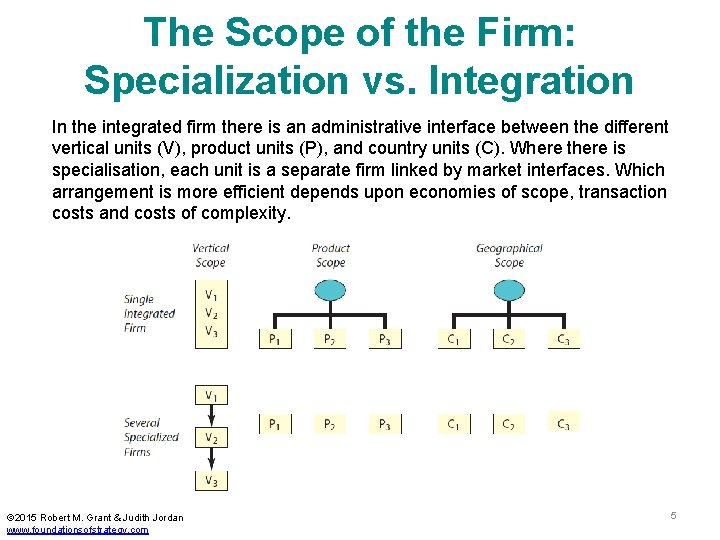
The Scope of the Firm: Specialization vs. Integration In the integrated firm there is an administrative interface between the different vertical units (V), product units (P), and country units (C). Where there is specialisation, each unit is a separate firm linked by market interfaces. Which arrangement is more efficient depends upon economies of scope, transaction costs and costs of complexity. © 2015 Robert M. Grant & Judith Jordan www. foundationsofstrategy. com 5
Diversification: Motives • Growth – A powerful motive for managers—but growth without profitability does not create value for shareholders. Growth through acquisition a major destroyer of shareholder value. • Risk spreading – Diversification tends to reduce fluctuations in profits; but this does not necessarily create value for shareholders. • Value creation – For diversification to create shareholder value it must exploit some linkage (“ create synergy”) between the different businesses, e. g. by: o exploiting economies of scope o operating an efficient internal capital market o operating an internal labour market © 2015 Robert M. Grant & Judith Jordan www. foundationsofstrategy. com 6
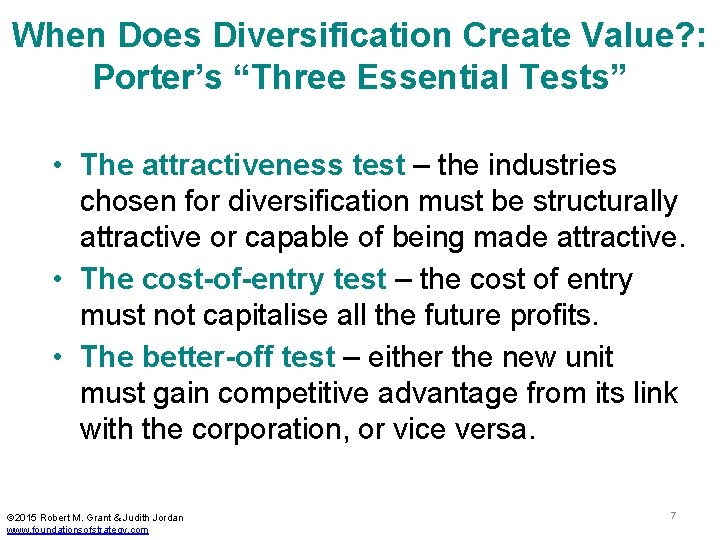
When Does Diversification Create Value? : Porter’s “Three Essential Tests” • The attractiveness test – the industries chosen for diversification must be structurally attractive or capable of being made attractive. • The cost-of-entry test – the cost of entry must not capitalise all the future profits. • The better-off test – either the new unit must gain competitive advantage from its link with the corporation, or vice versa. © 2015 Robert M. Grant & Judith Jordan www. foundationsofstrategy. com 7
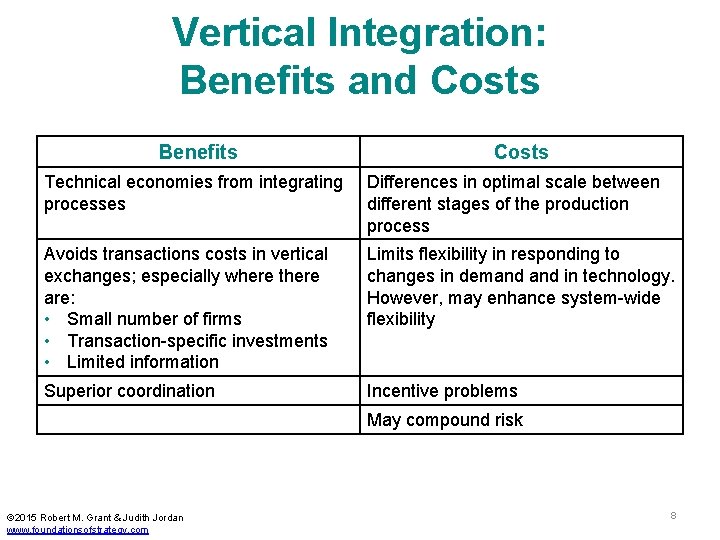
Vertical Integration: Benefits and Costs Benefits Costs Technical economies from integrating processes Differences in optimal scale between different stages of the production process Avoids transactions costs in vertical exchanges; especially where there are: • Small number of firms • Transaction-specific investments • Limited information Limits flexibility in responding to changes in demand in technology. However, may enhance system-wide flexibility Superior coordination Incentive problems May compound risk © 2015 Robert M. Grant & Judith Jordan www. foundationsofstrategy. com 8
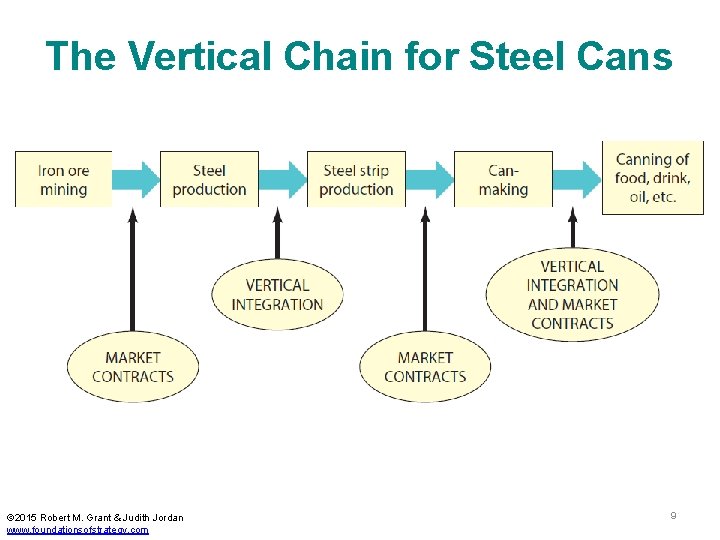
The Vertical Chain for Steel Cans © 2015 Robert M. Grant & Judith Jordan www. foundationsofstrategy. com 9
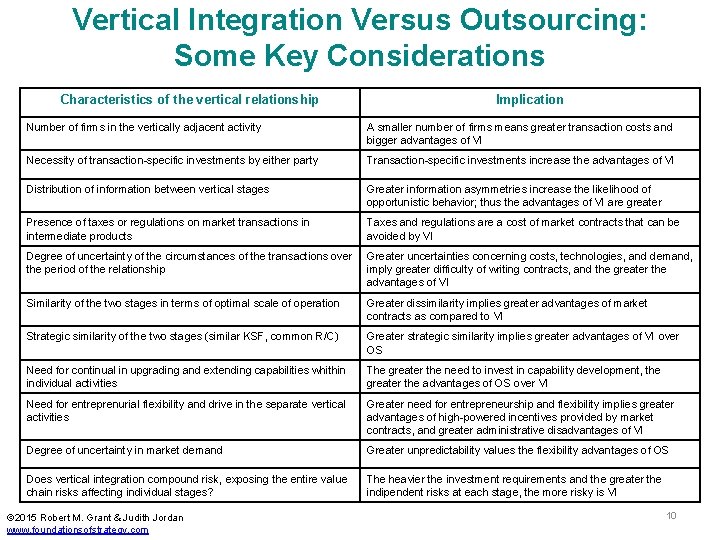
Vertical Integration Versus Outsourcing: Some Key Considerations Characteristics of the vertical relationship Implication Number of firms in the vertically adjacent activity A smaller number of firms means greater transaction costs and bigger advantages of VI Necessity of transaction-specific investments by either party Transaction-specific investments increase the advantages of VI Distribution of information between vertical stages Greater information asymmetries increase the likelihood of opportunistic behavior; thus the advantages of VI are greater Presence of taxes or regulations on market transactions in intermediate products Taxes and regulations are a cost of market contracts that can be avoided by VI Degree of uncertainty of the circumstances of the transactions over the period of the relationship Greater uncertainties concerning costs, technologies, and demand, imply greater difficulty of writing contracts, and the greater the advantages of VI Similarity of the two stages in terms of optimal scale of operation Greater dissimilarity implies greater advantages of market contracts as compared to VI Strategic similarity of the two stages (similar KSF, common R/C) Greater strategic similarity implies greater advantages of VI over OS Need for continual in upgrading and extending capabilities whithin individual activities The greater the need to invest in capability development, the greater the advantages of OS over VI Need for entreprenurial flexibility and drive in the separate vertical activities Greater need for entrepreneurship and flexibility implies greater advantages of high-powered incentives provided by market contracts, and greater administrative disadvantages of VI Degree of uncertainty in market demand Greater unpredictability values the flexibility advantages of OS Does vertical integration compound risk, exposing the entire value chain risks affecting individual stages? The heavier the investment requirements and the greater the indipendent risks at each stage, the more risky is VI © 2015 Robert M. Grant & Judith Jordan www. foundationsofstrategy. com 10

Different Types of Vertical Relationship © 2015 Robert M. Grant & Judith Jordan www. foundationsofstrategy. com 11
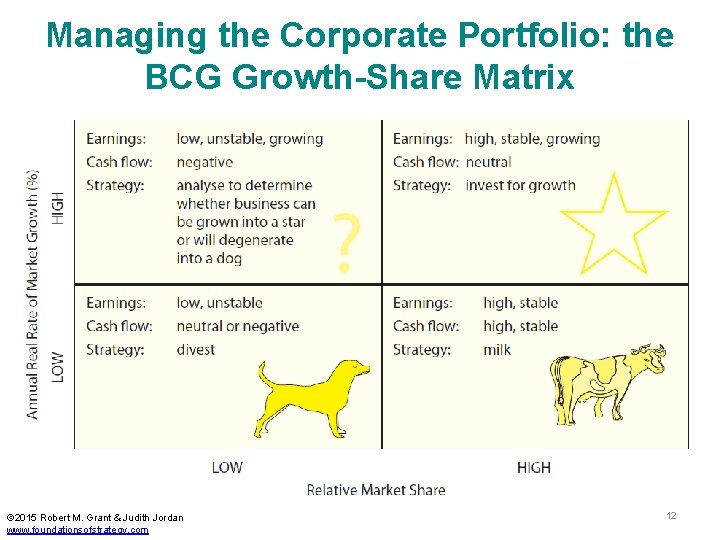
Managing the Corporate Portfolio: the BCG Growth-Share Matrix © 2015 Robert M. Grant & Judith Jordan www. foundationsofstrategy. com 12

The GE/Mc. Kinsey Portfolio Planning Matrix © 2015 Robert M. Grant & Judith Jordan www. foundationsofstrategy. com 13
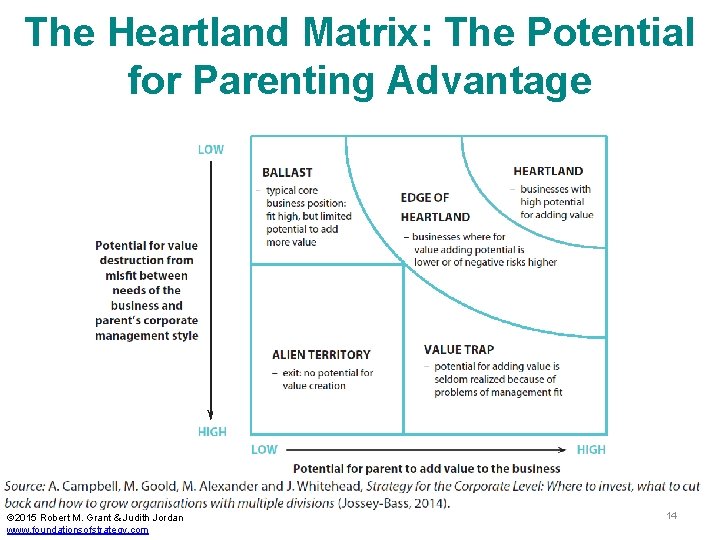
The Heartland Matrix: The Potential for Parenting Advantage © 2015 Robert M. Grant & Judith Jordan www. foundationsofstrategy. com 14
- Slides: 14