
Corporate Social Responsibility LECTURE 7 Corporate Social Responsibility
Corporate Social Responsibility LECTURE 7: Corporate Social Responsibility MGT 610 1
Corporate Social Responsibility Chapter 2 Evolution of Company and CSR 2

Corporate Social Responsibility After Studying this chapter, you will be able to: • Understand the concept of corporation • Trace a brief history of corporations • Understand how modern corporations come in to existence • Provide a brief outline of corporate governance • Analyze the importance of CSR in governance 3
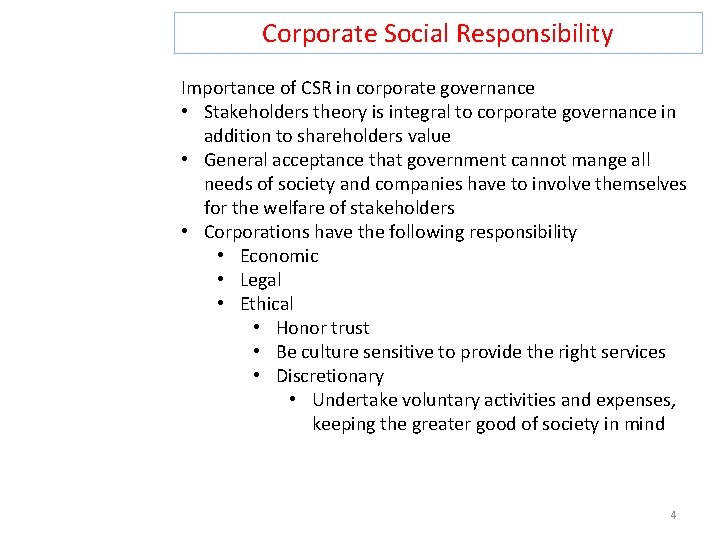
Corporate Social Responsibility Importance of CSR in corporate governance • Stakeholders theory is integral to corporate governance in addition to shareholders value • General acceptance that government cannot mange all needs of society and companies have to involve themselves for the welfare of stakeholders • Corporations have the following responsibility • Economic • Legal • Ethical • Honor trust • Be culture sensitive to provide the right services • Discretionary • Undertake voluntary activities and expenses, keeping the greater good of society in mind 4
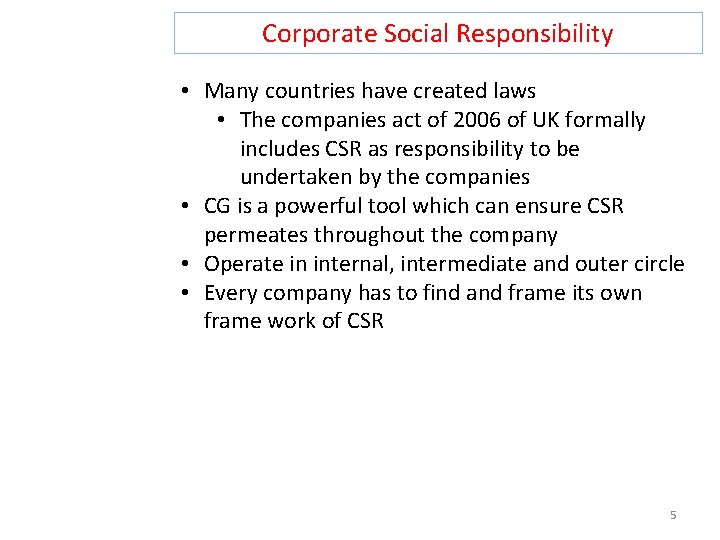
Corporate Social Responsibility • Many countries have created laws • The companies act of 2006 of UK formally includes CSR as responsibility to be undertaken by the companies • CG is a powerful tool which can ensure CSR permeates throughout the company • Operate in internal, intermediate and outer circle • Every company has to find and frame its own frame work of CSR 5
Corporate Social Responsibility Leadership Crisis • The obligations of a corporations can be discharged if leaders believe in them • Human aspect ensure success or failure as they are the process creator, process owners and process deliverers • Organizations need a team that can identify with the mission statement • If the organization is defined by economic terms …. The management fails to realize the deeper values that the organization offers to employees in term of security, personal growth, purpose in life • Organization cannot have a two set of moral • Organizations have to realize that making money is essential but it is certainly not its purpose • Businesses do not operate outside society therefore it has a responsibility towards society • This can be fulfilled by the value orientation of the people within the business 6
Corporate Social Responsibility Relations between Values and Skills • Are leaders value oriented? • Society gives them a high pedestal and this respect demands that leaders fulfill their responsibility towards the society • Increased specializations has resulted in more interdependencies • Rules cannot be made for every relationship as they are guidelines and not end-all of every relationship • Usually organizations have visions and values to guide decision makers and rely on collaborations. • This can work if leaders are committed to work and work becomes the motivation and not pay or perks • Usually rules results in complacency, but code signifies minimum necessary • The concept of compassion and common good should be guiding factors while reviewing work and its results 7

Corporate Social Responsibility • According to business week annual executive compensation survey • Between 1990 -2003 • The CE pay rose 313% compared with profits rising 128% and average worker pay increasing only 49% • Professionals have to unite to create a leadership cadre that can fight such unethical conduct that is sustained in the name of expertise • Leaders have to take a proactive stand exert authority to shape policies conducive to human good • Leader should develop unique qualities in every stakeholders as everybody knows something that other don’t and using this skills will result in successful corporation 8

Corporate Social Responsibility The Social Impact • Law and order situation is also dependent on economics of a country • Anger is directed towards big businesses • If business needs customer with buying power then it has to ensure that common man position improves • Unless the business community contributes to the basic development needs, its own survival will be threatened • Managers behave as if we are alone and that they don’t have choices – it is this lack of choices which is the killer of humanity • Problem with the concept of survival of fittest • The spirit of cut throat competition has resulted in accumulation of wealth without thinking of ethics • Result – social havoc • Consensus management is the need of the day • Create a family within the corporation • Basic human values, trust, integrity, honesty, selfless • Hence back to the principal of being ethical 9
Corporate Social Responsibility Corporate social performance encompasses an organizations commitment to behave in an economically and environmentally sustainable manner, while honoring the interest of the direct stakeholders and benefitting the greater community at large • The success of this performance depends upon • What people think about the business • How people behave in an organization 10
Corporate Social Responsibility The value of CSR is actually a transcendent value. When such inspirational ideology is combined with formal structure the result is the following 4 types of organizations: • Anarchy • Hypothetical state, results in turmoil, chaos, conflict and extinction • Robot • Represents the mechanistic view • Organization acts as a machine and the humans act in a predefined pattern • Social • Humans are the only structure that exists • Interconnection between common values and direction • Difficult to find state other than certain small organizations • Incorporated • Ideal state where values and structures are strong • Integrated structures are because of collective consciousness of all the members of the organization 11

Corporate Social Responsibility 12

Corporate Social Responsibility The value of CSR is actually a transcendent value. When such inspirational ideology is combined with formal structure the result is the following 4 types of organizations: • Anarchy • Hypothetical state, results in turmoil, chaos, conflict and extinction • Robot • Represents the mechanistic view • Organization acts as a machine and the humans act in a predefined pattern • Social • Humans are the only structure that exists • Interconnection between common values and direction • Difficult to find state other than certain small organizations • Incorporated • Ideal state where values and structures are strong • Integrated structures are because of collective consciousness of all the members of the organization 13

Corporate Social Responsibility 14
- Slides: 14